
National Calendar of India – History and Uses
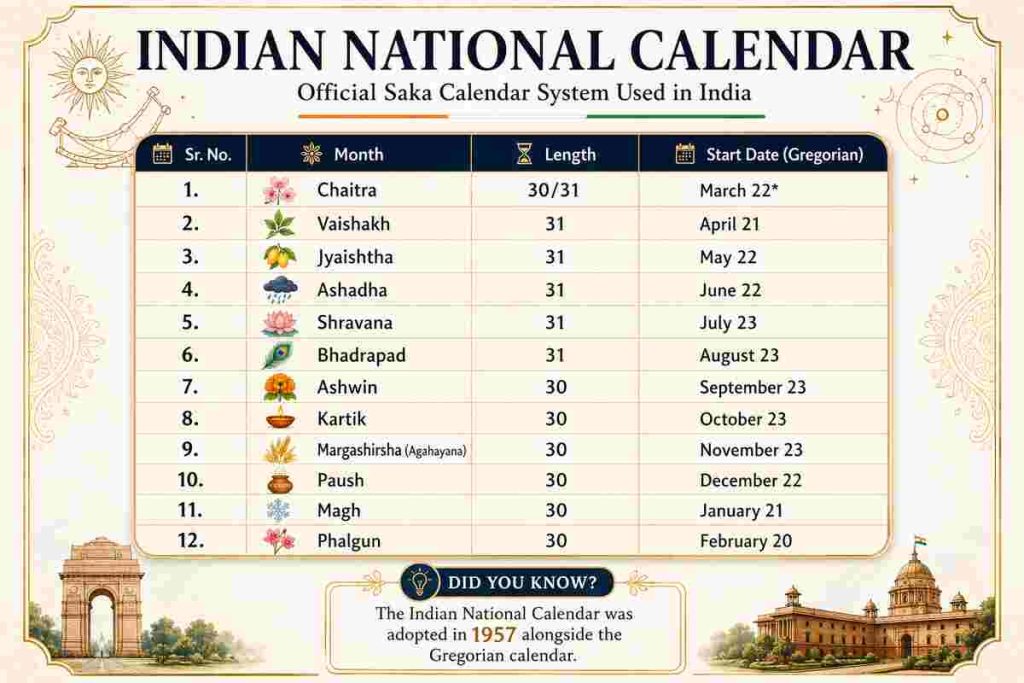
The National Calendar of India, often referred to as the Saka Calendar, is the official civil calendar used by the Government of India. If you are wondering what is the national calendar of India, it was adopted on March 22, 1957 (Chaitra 1, 1879 Saka Era). Despite the widespread use of the Gregorian calendar for daily life, India’s national calendar holds immense significance for official government communication and religious observances.
Calculation and Official Use of the Saka Calendar
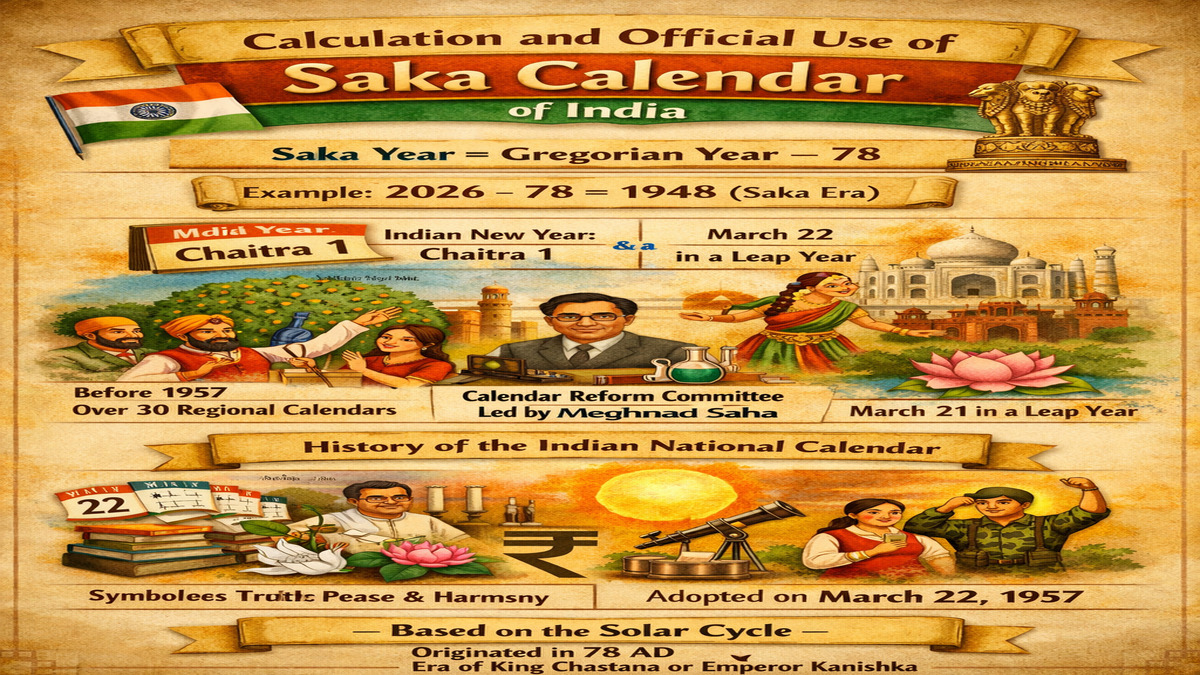
Understanding the relationship between the National Calendar of India and the Gregorian calendar is essential for its practical application. To find the current Saka year, you simply subtract 78 from the current Gregorian year. For example, the year 2026 corresponds to Saka Era 1948.
Every year, the Indian National Calendar officially begins on Chaitra 1. In a normal year, this New Year date falls on March 22, while in a leap year, it commences on March 21.
The History of the National Calendar of India
The journey toward a unified national calendar of India began shortly after independence. Before 1957, India used a chaotic mix of over 30 different regional calendars to determine religious festivals and civil dates. To fix this, the Government of India appointed the Calendar Reform Committee in 1952.
Led by the renowned scientist Meghnad Saha, the committee aimed to create a scientifically accurate system. They eventually selected the Saka Era as the foundation. Consequently, the Indian National Calendar was formally adopted on March 22, 1957, serving as a symbol of national unity and scientific progress.
The Science Behind the Saka Era
Many people ask, “The Indian National Calendar is based on what?” The answer lies in the solar cycle. Unlike many traditional calendars that rely solely on the moon, the Saka Calendar is a solar-based system.
The era was founded in 78 AD, marking the ascension of King Chastana or, as popularly believed, the Kushana Emperor Kanishka. To calculate the current year in India’s national calendar, you simply subtract 78 from the current Gregorian year. For example, if the Gregorian year is 2026, the Saka year is 1948.
Understanding the Months of the National Calendar
The National Calendar of India name is synonymous with the Saka Samvat. It consists of 12 months, each with a specific number of days that align with the sun’s movement through the zodiac.
| No. | Saka Month | Gregorian Start Date | Days |
| 1 | Chaitra | March 22 (March 21 in Leap Years) | 30/31 |
| 2 | Vaishakha | April 21 | 31 |
| 3 | Jyeshtha | May 22 | 31 |
| 4 | Ashadha | June 22 | 31 |
| 5 | Shravana | July 23 | 31 |
| 6 | Bhadrapada | August 23 | 31 |
| 7 | Ashvina | September 23 | 30 |
| 8 | Kartika | October 23 | 30 |
| 9 | Agrahayana | November 22 | 30 |
| 10 | Pausha | December 22 | 30 |
| 11 | Magha | January 21 | 30 |
| 12 | Phalguna | February 20 | 30 |
Official Purpose of India’s National Calendar
While the Gregorian calendar is used for day-to-day activities, what is our national calendar used for officially? The Government of India mandates the use of the Saka Calendar alongside the Gregorian calendar for the following four formal purposes:
-
The Gazette of India: All official state notifications and records must carry the Saka date.
-
News Broadcasts: All India Radio (Akashvani) announces the date according to the National Calendar of India during its daily news bulletins.
-
Government Publications: Official calendars and diaries issued by the Government of India prominently feature the Saka months.
- Public Communication: Formal government communications and documents addressed to the general public include the official national calendar name and date.
FAQs for National Calendar of India – History and Uses
1. What is the national calendar name of India?
2. Which is the national calendar of India?
3. The Indian National Calendar is based on what era?
4. What is the first month of our national calendar?
5. How many months are there in the Indian National Calendar?
6. What are the official uses of India’s national calendar?
– The Gazette of India.
– News broadcasts by All India Radio (Akashvani).
– Calendars and diaries issued by the Government of India.
– Government communications addressed to the public.1
7. How do you calculate the current Saka year?
8. Why was the National Calendar of India adopted?
9. Who introduced the National Calendar of India?
Ans: The Government of India officially introduced the National Calendar based on the Saka Era in 1957 following the recommendations of the Calendar Reform Committee.
10. Who headed the Calendar Reform Committee in India?
Ans: The Calendar Reform Committee was headed by renowned astrophysicist Meghnad Saha.
11. Is the Saka Calendar different from the Gregorian Calendar?
Ans: Yes, the Saka Calendar is based on the Saka Era, while the Gregorian Calendar is based on the birth year of Jesus Christ.
12. Which day marks the beginning of the Saka Calendar year?
Ans: The Saka Calendar year usually begins on March 22, or March 21 during leap years.
13. How many days are there in the first month of the Saka Calendar?
Ans: The first month, Chaitra, has 30 days in a normal year and 31 days in a leap year.
14. Is the National Calendar of India used across all states?
Ans: The National Calendar is mainly used for official government purposes, while many states also follow their regional calendars for festivals and cultural events.
15. Why the Saka Calendar Matters Today
Ans: The National Calendar of India is more than just a tool for keeping time; it is a bridge between India’s ancient astronomical wisdom and modern civil administration. By basing the system on the Saka Era, India honors a legacy that has lasted nearly two millennia. For students and citizens alike, knowing what is our national calendar helps in understanding the cultural fabric that ties the diverse regions of India together.
Also Read: The Gregorian Calendar – History and Facts
📚 Related Articles



👉 You May Also Read
📚 Related Articles
- Sangam City Prayagraj – History, Significance, and Kumbh Mela
- Bardo Chham Dance: Cultural Heritage of Arunachal Pradesh
- Food, Dance and Language of States of India: Complete Guide
- State and Union Territory Holiday Calendar 2024
- How Many Weeks In A Year
🔥 Popular Posts


📌 Explore Categories
- About India
- Artificial Intelligence & Machine Learning
- Calendar
- Career
- Counselling
- Current Affairs
- Economy
- Education
- English Grammar
- Exams
- Festival
- Health and Fitness
- Hindi Sahitya
- History
- Intelligence Agency
- International Personality
- Know India
- Knowledge
- Maths
- Maxim
- Moral Stories
- Nature
- NEWS
- Olympiad
- Others
- Personal Finance
- Personality Development
- Politics
- Scholarship
- Science and Environment
- Sports
- States of India
- Study Abroad
- Study Tips
- Technology
- The Greatest Indian
- Uncategorized