
Active and Passive Voice Rules
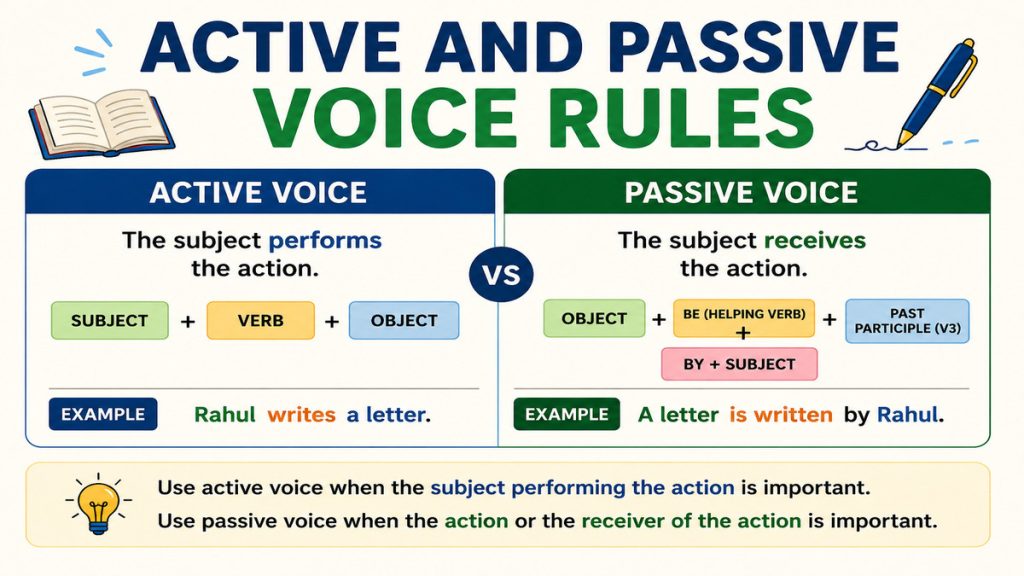
Voice is a crucial aspect of English grammar. It indicates if the subject of the sentence is performing the action or if the action is performed on the subject. To know the difference between the active and passive voice, contributing to the improvement of writing, speaking, and sentence clarity. In this article, you will learn the meaning of active and passive voice, important rules, sentence structures, examples, and tips to easily change sentences from active voice to passive voice.
What is Active Voice?
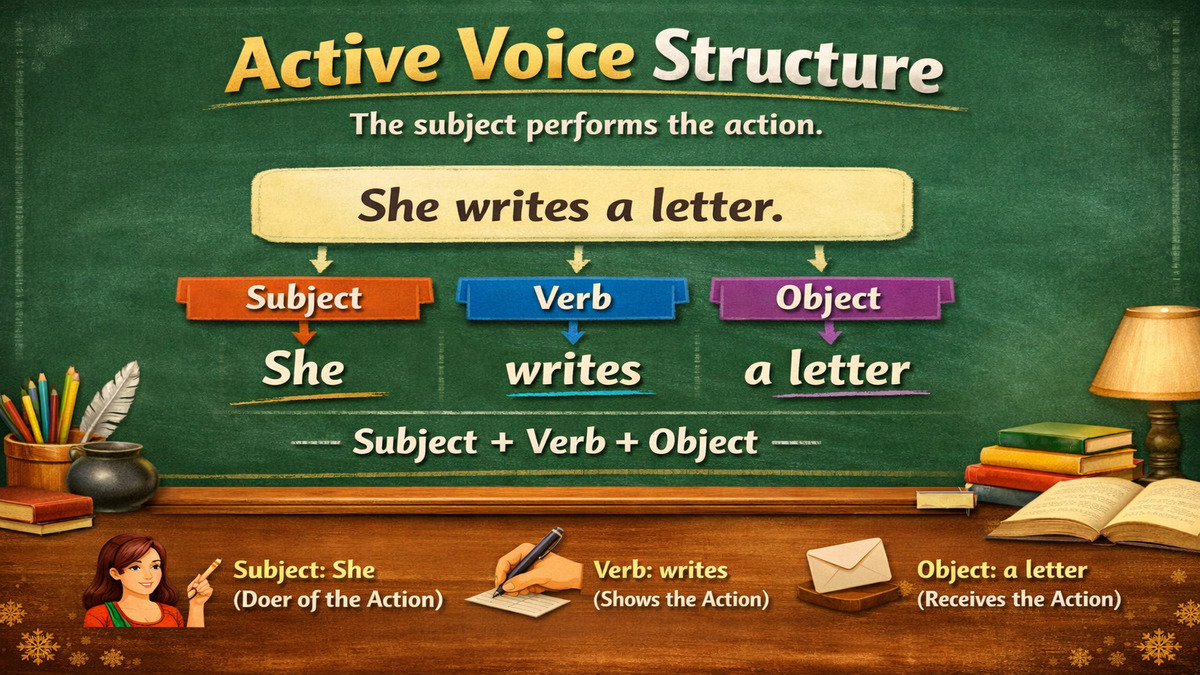
Active voice: The subject of the sentence is doing the action. It renders sentences easy to understand, simple, and clear to readers and hearers. In common usage, active voice is employed in writing or speaking to impart information in a more direct manner.
Why do we use Active Voice?
Active voice is employed to make sentences clear, direct and easy for understanding. It can be used to make it easier for readers to understand what is happening and who is doing the action, which makes communication and sentence flow easier. Active voice is seen more often in conversational, academic, blogs, and professional writing because it conveys a more natural and engaging tone.
Structure of Active Voice
She Writes a letter
Subject + Verb + Object
- Subject → She
- Verb → writes
- Object → a letter
So, the subject (She) is the does of the action, the verb (writes) shows the action, and the object (a letter) receives the action.
Examples of Active Voice
- Rahul writes a letter.
- The teacher explains the lesson.
- She completed the project yesterday.
- The dog chased the cat.
In all these examples, the subject is doing the action.
What is Passive Voice?
Passive voice is a way of arranging a sentence that shows the person or thing receiving the action rather than the person or thing doing the action. It is used primarily only when the action or the result is more important than the person or thing that is responsible for the action. Passive sentences are frequently used in formal writing, reports, academic writing, and official writing.
Why Do We Use Passive Voice?
When the action or result is more important than the person who performs it, use passive voice. It is also useful when the agent of the action is not explicitly stated or otherwise implied. Passive voice is often used in formal writing, scientific papers and reports, news articles, and official announcements.
Structure of Passive Voice
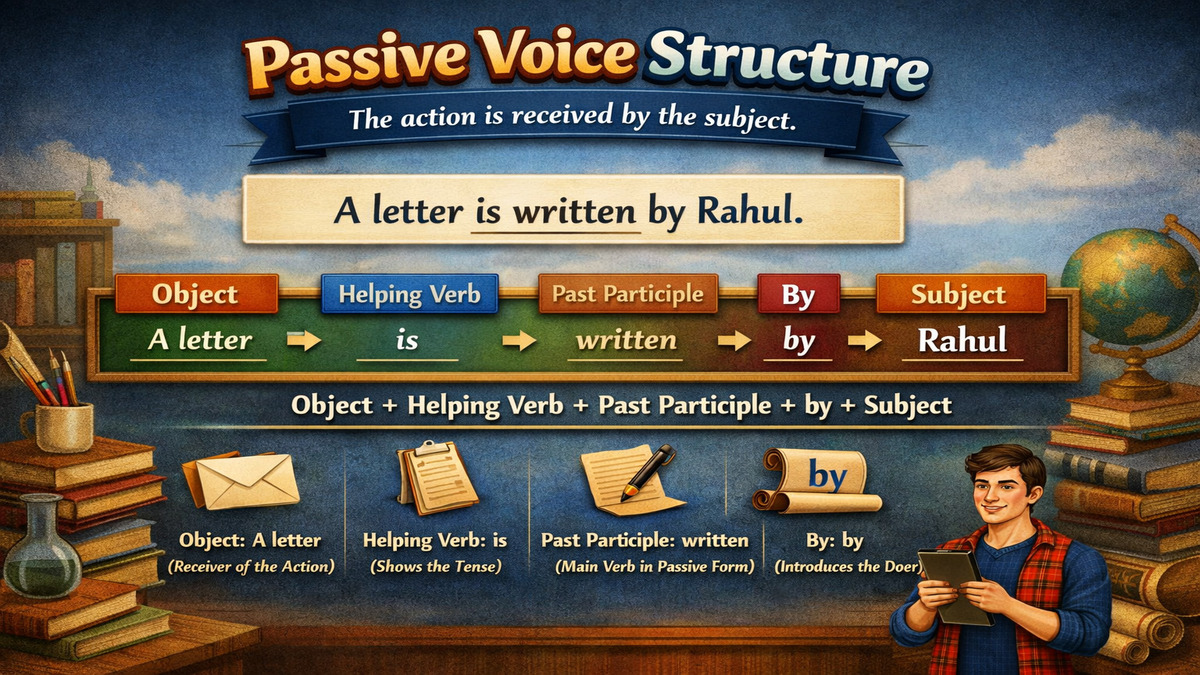
A letter is written by Rahul
Object + Helping Verb + Past Participle + by + Subject
- Object → A letter (This is the receiver of the action and comes first in passive voice.)
- Helping Verb → is (Supports the main verb and shows tense.)
- Past Participle → written (The main verb in passive form.)
- By → by (Introduces the doer of the action in passive voice.)
- Subject → Rahul (The original doer of the action, placed after “by.”)
Examples of Passive Voice
- The lesson is explained by the teacher.
- The project was completed by her yesterday.
- The cat was chased by the dog.
Here, the focus is on the action or the receiver of the action.
Difference Between Active and Passive Voice
| Active Voice | Passive Voice |
|---|---|
| Subject performs the action | Subject receives the action |
| Direct and clear | Focuses on action/result |
| Common in everyday communication | Common in formal and official writing |
| Example: The boy kicked the ball. | Example: The ball was kicked by the boy. |
Rules for Changing Active Voice into Passive Voice
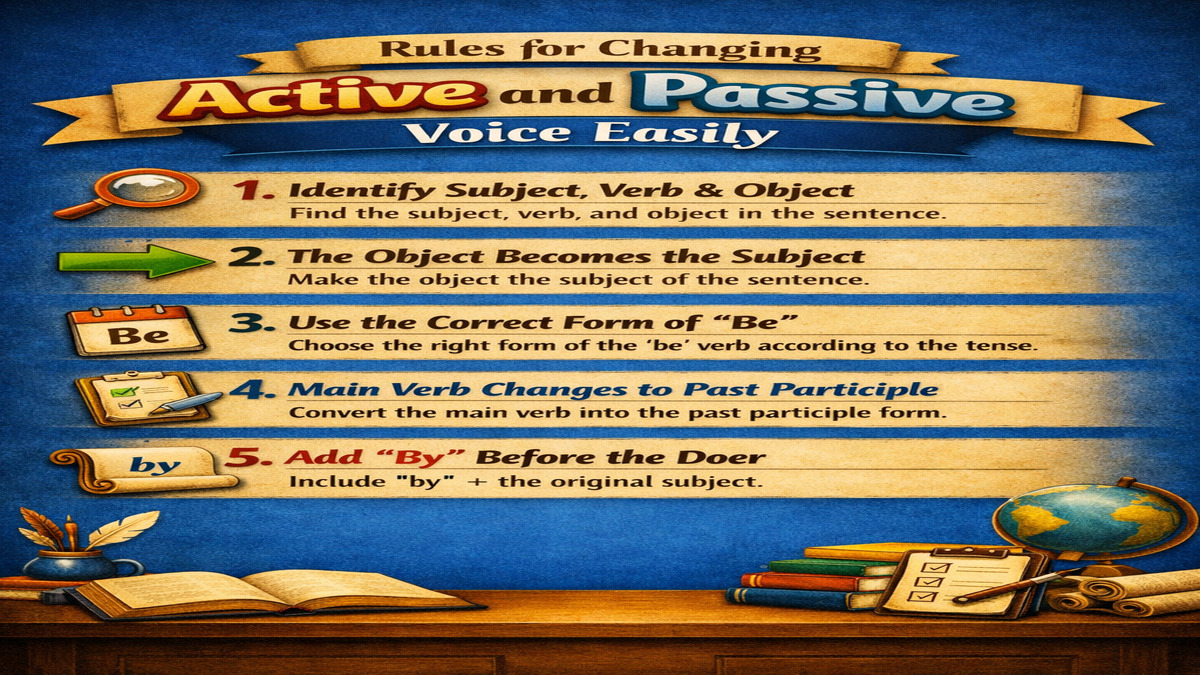
Rule 1: Identify Subject, Verb, and Object
Before changing the sentence, find:
- Subject
- Verb
- Object
Example
Active Voice:
Ravi eats an apple.
- Subject = Ravi
- Verb = eats
- Object = an apple
Passive Voice:
An apple is eaten by Ravi.
Rule 2: The Object Becomes the Subject
In passive voice, the object of the active sentence becomes the subject.
Example
Active: The chef cooked the meal.
Passive: The meal was cooked by the chef.
Rule 3: Use the Correct Form of “Be”
The helping verb changes according to the tense.
Common Forms of “Be”
| Tense | Helping Verb |
|---|---|
| Present Simple | is, am, are |
| Past Simple | was, were |
| Future Simple | will be |
| Present Continuous | is being, are being |
| Present Perfect | has been, have been |
Rule 4: Main Verb Changes into Past Participle
The main verb in passive voice is always written in the past participle form (V3).
Examples
| Base Verb | Past Participle |
|---|---|
| write | written |
| eat | eaten |
| make | made |
| complete | completed |
Rule 5: Add “By” Before the Doer
The original subject is usually added using the word by.
Example
Active: The artist painted the picture.
Passive: The picture was painted by the artist.
Sometimes, the doer is not necessary.
Example
- The road was repaired.
- The announcement was made.
Tense-wise Rules for Active and Passive Voice
Simple Present Tense
Structure
Active: Subject + V1 + Object
Passive: Object + is/am/are + V3 + by + Subject
Examples
- She writes a story.
→ A story is written by her. - They clean the room.
→ The room is cleaned by them.
Present Continuous Tense
Structure
Active: Subject + is/am/are + V1+ing + Object
Passive: Object + is/am/are + being + V3
Examples
- He is painting the wall.
→ The wall is being painted by him. - They are watching a movie.
→ A movie is being watched by them.
Present Perfect Tense
Structure
Active: Subject + has/have + V3 + Object
Passive: Object + has/have + been + V3
Examples
- She has completed the task.
→ The task has been completed by her. - They have built a bridge.
→ A bridge has been built by them.
Simple Past Tense
Structure
Active: Subject + V2 + Object
Passive: Object + was/were + V3
Examples
- The police arrested the thief.
→ The thief was arrested by the police. - He cleaned the car.
→ The car was cleaned by him.
Past Continuous Tense
Structure
Active: Subject + was/were + V1+ing + Object
Passive: Object + was/were + being + V3
Examples
- She was reading the book.
→ The book was being read by her. - They were decorating the hall.
→ The hall was being decorated by them.
Simple Future Tense
Structure
Active: Subject + will + V1 + Object
Passive: Object + will be + V3
Examples
- He will finish the work.
→ The work will be finished by him. - They will organize the event.
→ The event will be organized by them.
Imperative Sentences in Passive Voice
Imperative sentences that are passive voice are used to give a command, instruction, request or order, and where the action is what is emphasized, not the person doing it. Words such as let are typically used with a helping verb and the past participle form of the main verb to form these sentences. They are commonly used in formal teaching, notices and official communication.
Structure
Let + Object + be + V3
Examples
- Open the door.
→ Let the door be opened. - Complete the assignment.
→ Let the assignment be completed.
Interrogative Sentences in Passive Voice
Passive voice interrogative sentences: These are questions that focus on the action or the person receiving the action and not the person performing the action. The sentences are made with the past participle and helping verbs. Passive sentences are often used in formal writing, report writing, or questions and answers.
Structure
Helping Verb + Object + Past Participle (V3) + by + Subject?
Examples
- Did she write the letter?
→ Was the letter written by her? - Are they watching the match?
→ Is the match being watched by them?
Sentences That Cannot Be Changed into Passive Voice
Sentences that do not contain an object cannot usually be changed into passive voice. These sentences use intransitive verbs, where the action does not pass to any person or thing. Since passive voice requires an object to become the subject, such sentences remain only in active voice.
Examples
- He sleeps early.
- The baby cried loudly.
- They arrived late.
These are called intransitive verbs.
Tips to Learn Active and Passive Voice Easily
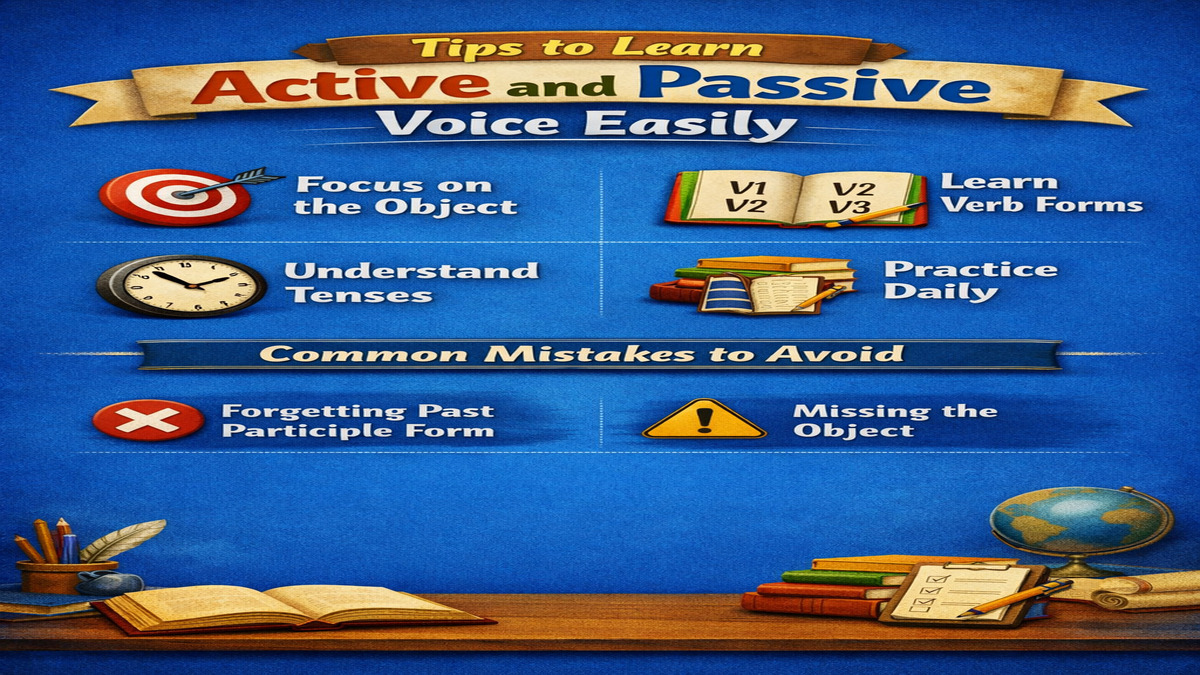
Focus on the Object
Identify who performs the action and who receives the action before changing the sentence.
Learn Verb Forms
Practice the three verb forms regularly, especially the past participle form (V3), because it is important in passive voice.
Understand Tenses
Learn the helping verbs used in different tenses to convert sentences correctly.
Practice Daily
Convert simple sentences daily to improve quickly.
Common Mistakes in Active and Passive Voice
Using Wrong Helping Verbs
❌ The work is completed yesterday.
✔ The work was completed yesterday.
Forgetting Past Participle Form
❌ The cake was eat by him.
✔ The cake was eaten by him.
Missing the Object
Only sentences with objects can usually be changed into passive voice.
Examples of Active and Passive Voice
| Active Voice | Passive Voice |
|---|---|
| The boy kicked the ball. | The ball was kicked by the boy. |
| She sings a song. | A song is sung by her. |
| They built a house. | A house was built by them. |
| The teacher praised the student. | The student was praised by the teacher. |
| He will write a letter. | A letter will be written by him. |
Advantages of Learning Active and Passive Voice
Learning active and passive voice helps students:
- Improve grammar skills
- Write professional content
- Speak clearly and confidently
- Understand sentence structures better
- Perform well in exams
Final Thoughts
Active and passive voice are essential parts of English grammar. Active voice makes sentences direct and easy to understand, while passive voice highlights the action or result. By learning the rules, sentence structures, and tense changes, students can easily convert sentences between active and passive voice. Regular practice with examples is the best way to master active and passive voice rules in English grammar.
FAQs on Active and Passive Voice Rules
1. What is active voice in English grammar?
Ans: Active voice is a sentence structure where the subject performs the action directly. It makes sentences clear, simple, and easy to understand.
2. What is passive voice in English grammar?
Ans: Passive voice is a sentence structure where the subject receives the action instead of performing it. It is commonly used in formal and professional writing.
3. What is the main difference between active and passive voice?
Ans: In active voice, the subject does the action, while in passive voice, the subject receives the action.
4. Why is active voice commonly used?
Ans: Active voice is commonly used because it makes sentences direct, natural, and easier to read.
5. Why do writers use passive voice?
Ans: Writers use passive voice when the action is more important than the person performing it or when the doer is unknown.
6. What is the structure of active voice?
Ans: The basic structure of active voice is:
Subject + Verb + Object
7. What is the structure of passive voice?
Ans: The basic structure of passive voice is:
Object + Helping Verb + Past Participle (V3) + by + Subject
8. Can every sentence be changed into passive voice?
Ans: No, only sentences that contain an object can usually be changed into passive voice.
9. Which verb form is used in passive voice?
Ans: The past participle form of the verb (V3) is always used in passive voice.
10. What are helping verbs in passive voice?
Ans: Helping verbs such as is, am, are, was, were, has been, have been, and will be are used in passive voice depending on the tense.
11. Is passive voice important in academic writing?
Ans: Yes, passive voice is widely used in academic writing, reports, scientific writing, and formal communication.
12. How can I learn active and passive voice easily?
Ans: You can learn active and passive voice easily by understanding sentence structure, practicing verb forms, and converting sentences regularly.
13. What are imperative sentences in passive voice?
Ans: Imperative sentences in passive voice are commands or instructions where the focus is on the action rather than the doer.
14. What are interrogative sentences in passive voice?
Ans: Interrogative sentences in passive voice are question forms where the emphasis is placed on the action or receiver of the action.
15. Why is learning active and passive voice important?
Ans: Learning active and passive voice improves grammar skills, writing quality, speaking ability, and overall communication in English.
Read More: How To Improve Your English Language Skills
Active and Passive Voice Tricks
👉 You May Also Read
📚 Related Articles
🔥 Popular Posts




📌 Explore Categories
- About India
- Calendar
- Career
- Counselling
- Current Affairs
- Economy
- Education
- English Grammar
- Exams
- Festival
- Health and Fitness
- Hindi Sahitya
- History
- Intelligence Agency
- International Personality
- Know India
- Knowledge
- Maths
- Maxim
- Moral Stories
- Nature
- NEWS
- Olympiad
- Others
- Personality Development
- Politics
- Scholarship
- Science and Environment
- Sports
- States of India
- Study Abroad
- Study Tips
- Technology
- The Greatest Indian
- Uncategorized