
Study Abroad or Build Your Career in India? What to Compare in 2027
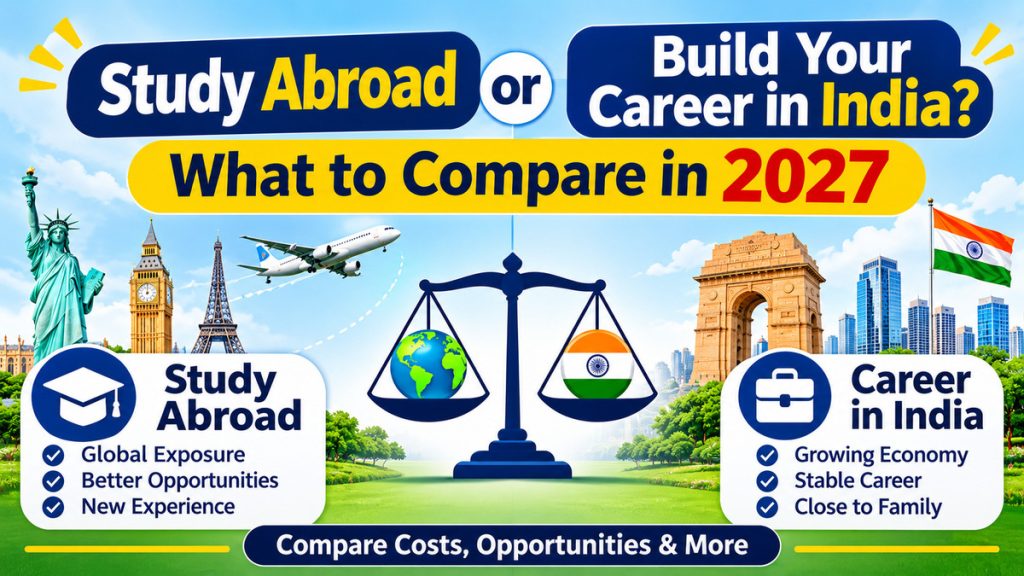
Few decisions shape a young person’s future as much as where to study and where to start a career. For years, a foreign degree was the default aim for ambitious Indian students. In 2027 the choice is less clear: several popular destinations have tightened visa rules, while India now offers foreign university campuses and strong hiring in growing fields. Neither option is better for everyone. The right one depends on your field, budget, goals and tolerance for risk.
This guide compares the two across the factors that matter most.
Quick Comparison
| Factor | Study abroad | Study and build a career in India |
| Learning style | Often practical, research-based, discussion-heavy | Varies: strong at top institutes, more exam-focused elsewhere |
| Cost | High, with a wide range | Lower, especially at public institutions |
| Work rights after study | Depend on visa rules that keep changing | No visa risk |
| Global exposure | Strong | Growing, including remote and foreign-campus options |
| Admission | Holistic: academics, statement of purpose, tests, sometimes work experience | Often entrance-exam based |
| Family and support | Distance from home | Close to family |
| Policy risk | High | Low |
1. Quality of Education and Learning Style
Studying abroad
Many overseas programmes emphasise projects, case studies, class discussion and research, and some build internships or placements into the course. This can help students develop communication and problem-solving skills that employers value. Quality still varies widely by university and course, so the country and institution matter more than the label “abroad.”
Studying in India
India has outstanding institutions, especially in engineering, medicine, management and the sciences. Outside the top tier, many colleges remain focused on exams and syllabus completion, so students often need to add practical skills through internships and projects.
A new middle option
Foreign universities now run campuses in India under UGC rules. As of July 2026, one report counted three operating campuses (Deakin and Wollongong at GIFT City, and Southampton in Gurugram), with more than 15 others approved or holding letters of intent and opening between August 2026 and 2027. These can offer a foreign-branded degree without leaving the country, though immigration benefits and recognition can differ from studying overseas.
2. Cost and Financial Planning
What studying abroad costs
Estimates differ by source: one puts the annual cost for Indian students at ₹18–69 lakh, and another at ₹12–55 lakh. The range depends on country, course and lifestyle. Tuition is only part of the bill.
| Cost item | What to budget for |
| Tuition | Often the largest expense, and varies by course and university |
| Living costs | Rent, food, transport, health cover |
| Visa and application fees | Australia raised its student visa charge to AUD 2,500 from 1 July 2026, and the UK student visa fee rose to £558 in April 2026 |
| Proof of funds | Australia, for example, asks for AUD 29,710 in living costs plus tuition |
| Travel and settling in | Flights, deposits, equipment |
| Currency movement | A weaker rupee raises the cost of every instalment |
Indian tax and loan rules
| Item | Current position (as reported) |
| Tax collected at source (TCS) on education remittances | Nil up to ₹10 lakh; 2% above that if self-funded; nil regardless of amount if funded by an eligible education loan |
| Education loan interest | Deductible under Section 80E for up to eight years (old tax regime) |
| Collateral-free loans | Under CGFSEL, up to ₹7.5 lakh without collateral or a third-party guarantor |
This is general information, not financial advice. Speak to a bank or a qualified adviser before borrowing.
Studying in India
Costs are usually much lower, particularly at public institutions, and many students finish without a large loan. Private universities and foreign campuses can still be expensive, so compare fees.
3. Visa and Policy Risk in 2027
This is the biggest change from a few years ago. Government data reported by Careers360 shows the US, UK, Australia and Canada together lost 1,73,891 Indian students, with Canada down 41%, while countries such as Germany gained.
| Country | What has changed (as reported) |
| United States | A $100,000 H-1B fee was vacated by the courts, but DHS has proposed a $103,265 petition fee and is weighing a large fee on OPT. A rule capping stays at four years is also in effect from September 2026 |
| United Kingdom | The Graduate visa is set to fall from two years to 18 months for most applications from 1 January 2027. The Autumn Budget proposes keeping two years for graduates of “high-compliance” universities, but details are still to come |
| Canada | About 155,000 new study permits in 2026 under a cap, and the Student Direct Stream ended in 2025 |
| Australia | Higher visa charge and funds, a 2027 planning level held at 295,000, and plans to stop most student and graduate visa holders bringing family |
| Ireland, New Zealand | Reported to have changed the least, with no enrolment caps and clearer post-study work rights |
Rules often depend on your application date, so check the official government site for your exact intake.
Useful official visa resources:
USCIS – Students and Employment (OPT)
UK Government – Graduate Visa
Canada Government – Work After Graduation
Australia Government – Temporary Graduate Visa
Germany – Study in Germany
4. Career Opportunities and Work Rights
Abroad
A foreign degree can open global job markets, and some countries have clear routes from study to work. Other routes are narrower or uncertain. Healthcare, IT, engineering and skilled trades are the fields most often named as in demand abroad, but you still compete with local graduates, and some professions need local licensing.
In India
India’s hiring picture is strong in several fields. The India Skills Report 2026 says employability reached 56.35%, with technology, BFSI, manufacturing, renewable energy and healthcare leading hiring, and AI, data analytics, cloud computing and cybersecurity the most in-demand skills. LinkedIn data shows entry-level hiring rose 168% between 2023 and 2025.
There is a flip side. LinkedIn also reports that applicants per job have doubled, that 74% of Indian recruiters find it harder to find qualified talent, and that 84% of professionals feel unprepared. Jobs exist, but skills decide who gets them.
Useful resources:
5. Skill Development and Employability
| Aspect | Abroad | India | |
| Practical exposure | Often built into the course | Depends on the institution; you may need to add internships | |
| Communication and teamwork | Frequently assessed through projects and presentations | Stronger at top institutes; elsewhere self-driven | |
| Industry links | Strong at many universities | Growing, especially at top colleges and foreign campuses | |
| Proof of skill | Degree plus experience | Employers increasingly value projects, internships and certifications |
In both settings, what you can show matters as much as where you studied.
6. Admission Process
Abroad, universities typically look at your academic record, test scores where required, a statement of purpose, recommendations and sometimes work experience. In India, admission to many top institutions depends on entrance exams and cut-offs, and limited seats mean many capable students miss out. Each system rewards different strengths, so compare the process, timeline and cost of applying.
7. Personal Growth, Family and Lifestyle
Living abroad builds independence and exposes you to new cultures, but it also means distance from family, homesickness and handling money and paperwork alone. Staying in India offers a support network and familiar surroundings, which many students find helps them focus. Be honest about which environment helps you do your best work.
8. Return on Investment: A Simple Way to Compare
Think of the decision as costs against realistic outcomes.
| Step | Question to ask |
| 1 | What is the total cost, including living and visa expenses? |
| 2 | What is a realistic starting salary in my field, abroad and in India? |
| 3 | How long can I legally work after graduating, and in what jobs? |
| 4 | How long would repayment take if I borrow? |
| 5 | What is my backup if I don’t get a visa or job? |
Use real alumni outcomes, not marketing claims, to answer these.
9. Middle Paths Worth Considering
| Option | How it works | Benefit |
| Work first, master’s later | Gain experience in India, then apply abroad | Stronger application and clearer goals |
| Foreign campus in India | Earn a foreign-branded degree here | Lower cost than moving overseas |
| Lower-cost destinations | Look at Germany, Ireland or New Zealand | Often lower tuition or clearer work rights |
| Remote or global roles | Work for international employers from India | Global exposure without relocating |
10. Who Should Choose Which?
| If this describes you | You may lean toward |
| You aim for a global career, your field has strong overseas demand and you can fund it | Studying abroad |
| You want a research or PhD career with funding | Studying abroad |
| You need a large loan with an uncertain job outcome | Building in India first |
| Your field is hiring strongly in India (AI, data, cloud, cyber, finance, clean energy, healthcare) | Building in India |
| You value family support and stability | Studying in India |
| You are unsure | A hybrid path, such as work first and master’s later |
Common Mistakes to Avoid
- Following friends or trends. Choose based on your goals.
- Looking only at tuition. Include living, visa, insurance and exchange-rate risk.
- Assuming rules will stay the same. Visa and work policies have changed quickly.
- Trusting only agents. Verify information on official government and university sites.
- Ignoring India. Domestic options and hiring have improved.
- Rushing. Give yourself time to compare.
Decision Checklist
- Write down your career goal and how you will measure success.
- Shortlist two or three options in each category.
- Check the latest visa and work rules on official sites.
- Calculate total cost and repayment.
- Speak to recent graduates about real job outcomes.
- Choose a backup plan.
- Decide, then review it each year.
Frequently Asked Questions
- Is studying abroad still worth it in 2027?
It can be, but it takes more planning than it used to. Government data reported by Careers360 shows the US, UK, Australia and Canada together lost about 1.74 lakh Indian students, with Canada down 41%, while countries such as Germany gained. Whether it is worth it depends on your field, your budget and how clearly you can show a path from the degree to a job. - Which is better, studying abroad or building a career in India?
Neither is better for everyone. Studying abroad offers global exposure and specialised programmes but carries higher cost and policy risk. Building a career in India offers lower cost, no visa risk and strong hiring in fields such as AI, data, cloud, cybersecurity, finance and clean energy. Match the choice to your goals and finances. - What should I compare before choosing?
Compare total cost, learning style, work rights after study, job outcomes in your field, admission requirements, family and lifestyle needs, and your backup plan if a visa or job doesn’t come through. The article’s comparison tables cover each of these. - Can I do both, working in India first and studying abroad later?
Yes. Many people gain two or three years of experience in India and then apply for a master’s abroad. It can strengthen your application, clarify your goals and sometimes lets an employer support the costs. - How much does it cost to study abroad from India?
Estimates vary. One source puts it at ₹18–69 lakh a year and another at ₹12–55 lakh, depending on country, course and lifestyle. Remember to add living costs, visa fees, insurance, travel and exchange-rate movement to tuition. - Is there tax on money sent abroad for education?
As reported for the 2026–27 rules, tax collected at source (TCS) is nil up to ₹10 lakh and 2% above that if you self-fund. If the money comes from an eligible education loan from a specified institution, no TCS applies regardless of the amount. Confirm current rules with your bank or a tax adviser. - Can I get an education loan without collateral?
Under the Credit Guarantee Fund Scheme for Education Loans, a bank can sanction up to ₹7.5 lakh without collateral or a third-party guarantor. Loan interest can also be deductible under Section 80E for up to eight years under the old tax regime. This is general information, not financial advice. - Which countries have tightened rules for Indian students?
All four traditional destinations have made changes. Canada capped new study permits at about 155,000 for 2026. Australia raised its visa charge to AUD 2,500 and requires AUD 29,710 in living funds. The UK’s Graduate visa is due to fall to 18 months for most applications from 1 January 2027, though the Autumn Budget proposes keeping two years for graduates of “high-compliance” universities. The US faces uncertainty over H-1B and OPT fees. - Which countries have changed the least?
Ireland and New Zealand are reported to have changed the least, with no enrolment caps and clear post-study work rights. Germany is also gaining popularity, with a 12-month Opportunity Card for qualified people to look for work and about 163 shortage occupations. Rules can still change, so check official sites. - What is the status of the US H-1B fee and OPT?
The $100,000 H-1B fee imposed in 2025 was vacated by the courts, and USCIS is not collecting it. DHS has since proposed a $103,265 petition fee and is considering a large fee on OPT, with one report citing $70,000 initially and $30,000 afterwards. These proposals could change, so follow the official USCIS and DHS updates. - Are there good jobs in India without a foreign degree?
Yes. The India Skills Report 2026 says technology, BFSI, manufacturing, renewable energy and healthcare lead hiring, with AI, data analytics, cloud computing and cybersecurity the most in-demand skills. LinkedIn reports entry-level hiring rose 168% between 2023 and 2025, with growth spreading beyond the big metros. - Is it hard to get a job in India?
Competition is real. LinkedIn reports that applicants per job have doubled, that 74% of Indian recruiters find it harder to find qualified candidates, and that 84% of professionals feel unprepared. Jobs exist, but skills, projects and internships decide who gets them.
and Financial Planning
What studying abroad costs
Estimates differ by source: one puts the annual cost for Indian students at ₹18–69 lakh, and another at ₹12–55 lakh. The range depends on country, course and lifestyle. Tuition is only part of the bill.
| Cost item | What to budget for |
| Tuition | Often the largest expense, and varies by course and university |
| Living costs | Rent, food, transport, health cover |
| Visa and application fees | Australia raised its student visa charge to AUD 2,500 from 1 July 2026, and the UK student visa fee rose to £558 in April 2026 |
| Proof of funds | Australia, for example, asks for AUD 29,710 in living costs plus tuition |
| Travel and settling in | Flights, deposits, equipment |
| Currency movement | A weaker rupee raises the cost of every instalment |
Indian tax and loan rules
| Item | Current position (as reported) |
| Tax collected at source (TCS) on education remittances | Nil up to ₹10 lakh; 2% above that if self-funded; nil regardless of amount if funded by an eligible education loan |
| Education loan interest | Deductible under Section 80E for up to eight years (old tax regime) |
| Collateral-free loans | Under CGFSEL, up to ₹7.5 lakh without collateral or a third-party guarantor |
This is general information, not financial advice. Speak to a bank or a qualified adviser before borrowing.
Studying in India
Costs are usually much lower, particularly at public institutions, and many students finish without a large loan. Private universities and foreign campuses can still be expensive, so compare fees.
3. Visa and Policy Risk in 2027
This is the biggest change from a few years ago. Government data reported by Careers360 shows the US, UK, Australia and Canada together lost 1,73,891 Indian students, with Canada down 41%, while countries such as Germany gained.
| Country | What has changed (as reported) |
| United States | A $100,000 H-1B fee was vacated by the courts, but DHS has proposed a $103,265 petition fee and is weighing a large fee on OPT. A rule capping stays at four years is also in effect from September 2026 |
| United Kingdom | The Graduate visa is set to fall from two years to 18 months for most applications from 1 January 2027. The Autumn Budget proposes keeping two years for graduates of “high-compliance” universities, but details are still to come |
| Canada | About 155,000 new study permits in 2026 under a cap, and the Student Direct Stream ended in 2025 |
| Australia | Higher visa charge and funds, a 2027 planning level held at 295,000, and plans to stop most student and graduate visa holders bringing family |
| Ireland, New Zealand | Reported to have changed the least, with no enrolment caps and clearer post-study work rights |
Rules often depend on your application date, so check the official government site for your exact intake.
4. Career Opportunities and Work Rights
Abroad
A foreign degree can open global job markets, and some countries have clear routes from study to work. Other routes are narrower or uncertain. Healthcare, IT, engineering and skilled trades are the fields most often named as in demand abroad, but you still compete with local graduates, and some professions need local licensing.
In India
India’s hiring picture is strong in several fields. The India Skills Report 2026 says employability reached 56.35%, with technology, BFSI, manufacturing, renewable energy and healthcare leading hiring, and AI, data analytics, cloud computing and cybersecurity the most in-demand skills. LinkedIn data shows entry-level hiring rose 168% between 2023 and 2025.
There is a flip side. LinkedIn also reports that applicants per job have doubled, that 74% of Indian recruiters find it harder to find qualified talent, and that 84% of professionals feel unprepared. Jobs exist, but skills decide who gets them.
5. Skill Development and Employability
| Aspect | Abroad | India | |
| Practical exposure | Often built into the course | Depends on the institution; you may need to add internships | |
| Communication and teamwork | Frequently assessed through projects and presentations | Stronger at top institutes; elsewhere self-driven | |
| Industry links | Strong at many universities | Growing, especially at top colleges and foreign campuses | |
| Proof of skill | Degree plus experience | Employers increasingly value projects, internships and certifications |
In both settings, what you can show matters as much as where you studied.
6. Admission Process
Abroad, universities typically look at your academic record, test scores where required, a statement of purpose, recommendations and sometimes work experience. In India, admission to many top institutions depends on entrance exams and cut-offs, and limited seats mean many capable students miss out. Each system rewards different strengths, so compare the process, timeline and cost of applying.
7. Personal Growth, Family and Lifestyle
Living abroad builds independence and exposes you to new cultures, but it also means distance from family, homesickness and handling money and paperwork alone. Staying in India offers a support network and familiar surroundings, which many students find helps them focus. Be honest about which environment helps you do your best work.
8. Return on Investment: A Simple Way to Compare
Think of the decision as costs against realistic outcomes.
| Step | Question to ask |
| 1 | What is the total cost, including living and visa expenses? |
| 2 | What is a realistic starting salary in my field, abroad and in India? |
| 3 | How long can I legally work after graduating, and in what jobs? |
| 4 | How long would repayment take if I borrow? |
| 5 | What is my backup if I don’t get a visa or job? |
Use real alumni outcomes, not marketing claims, to answer these.
9. Middle Paths Worth Considering
| Option | How it works | Benefit |
| Work first, master’s later | Gain experience in India, then apply abroad | Stronger application and clearer goals |
| Foreign campus in India | Earn a foreign-branded degree here | Lower cost than moving overseas |
| Lower-cost destinations | Look at Germany, Ireland or New Zealand | Often lower tuition or clearer work rights |
| Remote or global roles | Work for international employers from India | Global exposure without relocating |
10. Who Should Choose Which?
| If this describes you | You may lean toward |
| You aim for a global career, your field has strong overseas demand and you can fund it | Studying abroad |
| You want a research or PhD career with funding | Studying abroad |
| You need a large loan with an uncertain job outcome | Building in India first |
| Your field is hiring strongly in India (AI, data, cloud, cyber, finance, clean energy, healthcare) | Building in India |
| You value family support and stability | Studying in India |
| You are unsure | A hybrid path, such as work first and master’s later |
Common Mistakes to Avoid
- Following friends or trends. Choose based on your goals.
- Looking only at tuition. Include living, visa, insurance and exchange-rate risk.
- Assuming rules will stay the same. Visa and work policies have changed quickly.
- Trusting only agents. Verify information on official government and university sites.
- Ignoring India. Domestic options and hiring have improved.
- Rushing. Give yourself time to compare.
Decision Checklist
- Write down your career goal and how you will measure success.
- Shortlist two or three options in each category.
- Check the latest visa and work rules on official sites.
- Calculate total cost and repayment.
- Speak to recent graduates about real job outcomes.
- Choose a backup plan.
- Decide, then review it each year.
Frequently Asked Questions
- Is studying abroad still worth it in 2027?
It can be, but it takes more planning than it used to. Government data reported by Careers360 shows the US, UK, Australia and Canada together lost about 1.74 lakh Indian students, with Canada down 41%, while countries such as Germany gained. Whether it is worth it depends on your field, your budget and how clearly you can show a path from the degree to a job. - Which is better, studying abroad or building a career in India?
Neither is better for everyone. Studying abroad offers global exposure and specialised programmes but carries higher cost and policy risk. Building a career in India offers lower cost, no visa risk and strong hiring in fields such as AI, data, cloud, cybersecurity, finance and clean energy. Match the choice to your goals and finances. - What should I compare before choosing?
Compare total cost, learning style, work rights after study, job outcomes in your field, admission requirements, family and lifestyle needs, and your backup plan if a visa or job doesn’t come through. The article’s comparison tables cover each of these. - Can I do both, working in India first and studying abroad later?
Yes. Many people gain two or three years of experience in India and then apply for a master’s abroad. It can strengthen your application, clarify your goals and sometimes lets an employer support the costs. - How much does it cost to study abroad from India?
Estimates vary. One source puts it at ₹18–69 lakh a year and another at ₹12–55 lakh, depending on country, course and lifestyle. Remember to add living costs, visa fees, insurance, travel and exchange-rate movement to tuition. - Is there tax on money sent abroad for education?
As reported for the 2026–27 rules, tax collected at source (TCS) is nil up to ₹10 lakh and 2% above that if you self-fund. If the money comes from an eligible education loan from a specified institution, no TCS applies regardless of the amount. Confirm current rules with your bank or a tax adviser. - Can I get an education loan without collateral?
Under the Credit Guarantee Fund Scheme for Education Loans, a bank can sanction up to ₹7.5 lakh without collateral or a third-party guarantor. Loan interest can also be deductible under Section 80E for up to eight years under the old tax regime. This is general information, not financial advice. - Which countries have tightened rules for Indian students?
All four traditional destinations have made changes. Canada capped new study permits at about 155,000 for 2026. Australia raised its visa charge to AUD 2,500 and requires AUD 29,710 in living funds. The UK’s Graduate visa is due to fall to 18 months for most applications from 1 January 2027, though the Autumn Budget proposes keeping two years for graduates of “high-compliance” universities. The US faces uncertainty over H-1B and OPT fees. - Which countries have changed the least?
Ireland and New Zealand are reported to have changed the least, with no enrolment caps and clear post-study work rights. Germany is also gaining popularity, with a 12-month Opportunity Card for qualified people to look for work and about 163 shortage occupations. Rules can still change, so check official sites. - What is the status of the US H-1B fee and OPT?
The $100,000 H-1B fee imposed in 2025 was vacated by the courts, and USCIS is not collecting it. DHS has since proposed a $103,265 petition fee and is considering a large fee on OPT, with one report citing $70,000 initially and $30,000 afterwards. These proposals could change, so follow the official USCIS and DHS updates. - Are there good jobs in India without a foreign degree?
Yes. The India Skills Report 2026 says technology, BFSI, manufacturing, renewable energy and healthcare lead hiring, with AI, data analytics, cloud computing and cybersecurity the most in-demand skills. LinkedIn reports entry-level hiring rose 168% between 2023 and 2025, with growth spreading beyond the big metros. - Is it hard to get a job in India?
Competition is real. LinkedIn reports that applicants per job have doubled, that 74% of Indian recruiters find it harder to find qualified candidates, and that 84% of professionals feel unprepared. Jobs exist, but skills, projects and internships decide who gets them.
2. Cost and Financial Planning
What studying abroad costs
Estimates differ by source: one puts the annual cost for Indian students at ₹18–69 lakh, and another at ₹12–55 lakh. The range depends on country, course and lifestyle. Tuition is only part of the bill.
| Cost item | What to budget for |
| Tuition | Often the largest expense, and varies by course and university |
| Living costs | Rent, food, transport, health cover |
| Visa and application fees | Australia raised its student visa charge to AUD 2,500 from 1 July 2026, and the UK student visa fee rose to £558 in April 2026 |
| Proof of funds | Australia, for example, asks for AUD 29,710 in living costs plus tuition |
| Travel and settling in | Flights, deposits, equipment |
| Currency movement | A weaker rupee raises the cost of every instalment |
Indian tax and loan rules
| Item | Current position (as reported) |
| Tax collected at source (TCS) on education remittances | Nil up to ₹10 lakh; 2% above that if self-funded; nil regardless of amount if funded by an eligible education loan |
| Education loan interest | Deductible under Section 80E for up to eight years (old tax regime) |
| Collateral-free loans | Under CGFSEL, up to ₹7.5 lakh without collateral or a third-party guarantor |
This is general information, not financial advice. Speak to a bank or a qualified adviser before borrowing.
Studying in India
Costs are usually much lower, particularly at public institutions, and many students finish without a large loan. Private universities and foreign campuses can still be expensive, so compare fees.
3. Visa and Policy Risk in 2027
This is the biggest change from a few years ago. Government data reported by Careers360 shows the US, UK, Australia and Canada together lost 1,73,891 Indian students, with Canada down 41%, while countries such as Germany gained.
| Country | What has changed (as reported) |
| United States | A $100,000 H-1B fee was vacated by the courts, but DHS has proposed a $103,265 petition fee and is weighing a large fee on OPT. A rule capping stays at four years is also in effect from September 2026 |
| United Kingdom | The Graduate visa is set to fall from two years to 18 months for most applications from 1 January 2027. The Autumn Budget proposes keeping two years for graduates of “high-compliance” universities, but details are still to come |
| Canada | About 155,000 new study permits in 2026 under a cap, and the Student Direct Stream ended in 2025 |
| Australia | Higher visa charge and funds, a 2027 planning level held at 295,000, and plans to stop most student and graduate visa holders bringing family |
| Ireland, New Zealand | Reported to have changed the least, with no enrolment caps and clearer post-study work rights |
Rules often depend on your application date, so check the official government site for your exact intake.
4. Career Opportunities and Work Rights
Abroad
A foreign degree can open global job markets, and some countries have clear routes from study to work. Other routes are narrower or uncertain. Healthcare, IT, engineering and skilled trades are the fields most often named as in demand abroad, but you still compete with local graduates, and some professions need local licensing.
In India
India’s hiring picture is strong in several fields. The India Skills Report 2026 says employability reached 56.35%, with technology, BFSI, manufacturing, renewable energy and healthcare leading hiring, and AI, data analytics, cloud computing and cybersecurity the most in-demand skills. LinkedIn data shows entry-level hiring rose 168% between 2023 and 2025.
There is a flip side. LinkedIn also reports that applicants per job have doubled, that 74% of Indian recruiters find it harder to find qualified talent, and that 84% of professionals feel unprepared. Jobs exist, but skills decide who gets them.
5. Skill Development and Employability
| Aspect | Abroad | India | |
| Practical exposure | Often built into the course | Depends on the institution; you may need to add internships | |
| Communication and teamwork | Frequently assessed through projects and presentations | Stronger at top institutes; elsewhere self-driven | |
| Industry links | Strong at many universities | Growing, especially at top colleges and foreign campuses | |
| Proof of skill | Degree plus experience | Employers increasingly value projects, internships and certifications |
In both settings, what you can show matters as much as where you studied.
6. Admission Process
Abroad, universities typically look at your academic record, test scores where required, a statement of purpose, recommendations and sometimes work experience. In India, admission to many top institutions depends on entrance exams and cut-offs, and limited seats mean many capable students miss out. Each system rewards different strengths, so compare the process, timeline and cost of applying.
7. Personal Growth, Family and Lifestyle
Living abroad builds independence and exposes you to new cultures, but it also means distance from family, homesickness and handling money and paperwork alone. Staying in India offers a support network and familiar surroundings, which many students find helps them focus. Be honest about which environment helps you do your best work.
8. Return on Investment: A Simple Way to Compare
Think of the decision as costs against realistic outcomes.
| Step | Question to ask |
| 1 | What is the total cost, including living and visa expenses? |
| 2 | What is a realistic starting salary in my field, abroad and in India? |
| 3 | How long can I legally work after graduating, and in what jobs? |
| 4 | How long would repayment take if I borrow? |
| 5 | What is my backup if I don’t get a visa or job? |
Use real alumni outcomes, not marketing claims, to answer these.
9. Middle Paths Worth Considering
| Option | How it works | Benefit |
| Work first, master’s later | Gain experience in India, then apply abroad | Stronger application and clearer goals |
| Foreign campus in India | Earn a foreign-branded degree here | Lower cost than moving overseas |
| Lower-cost destinations | Look at Germany, Ireland or New Zealand | Often lower tuition or clearer work rights |
| Remote or global roles | Work for international employers from India | Global exposure without relocating |
10. Who Should Choose Which?
| If this describes you | You may lean toward |
| You aim for a global career, your field has strong overseas demand and you can fund it | Studying abroad |
| You want a research or PhD career with funding | Studying abroad |
| You need a large loan with an uncertain job outcome | Building in India first |
| Your field is hiring strongly in India (AI, data, cloud, cyber, finance, clean energy, healthcare) | Building in India |
| You value family support and stability | Studying in India |
| You are unsure | A hybrid path, such as work first and master’s later |
Common Mistakes to Avoid
- Following friends or trends. Choose based on your goals.
- Looking only at tuition. Include living, visa, insurance and exchange-rate risk.
- Assuming rules will stay the same. Visa and work policies have changed quickly.
- Trusting only agents. Verify information on official government and university sites.
- Ignoring India. Domestic options and hiring have improved.
- Rushing. Give yourself time to compare.
Decision Checklist
- Write down your career goal and how you will measure success.
- Shortlist two or three options in each category.
- Check the latest visa and work rules on official sites.
- Calculate total cost and repayment.
- Speak to recent graduates about real job outcomes.
- Choose a backup plan.
- Decide, then review it each year.
Frequently Asked Questions
- Is studying abroad still worth it in 2027?
It can be, but it takes more planning than it used to. Government data reported by Careers360 shows the US, UK, Australia and Canada together lost about 1.74 lakh Indian students, with Canada down 41%, while countries such as Germany gained. Whether it is worth it depends on your field, your budget and how clearly you can show a path from the degree to a job. - Which is better, studying abroad or building a career in India?
Neither is better for everyone. Studying abroad offers global exposure and specialised programmes but carries higher cost and policy risk. Building a career in India offers lower cost, no visa risk and strong hiring in fields such as AI, data, cloud, cybersecurity, finance and clean energy. Match the choice to your goals and finances. - What should I compare before choosing?
Compare total cost, learning style, work rights after study, job outcomes in your field, admission requirements, family and lifestyle needs, and your backup plan if a visa or job doesn’t come through. The article’s comparison tables cover each of these. - Can I do both, working in India first and studying abroad later?
Yes. Many people gain two or three years of experience in India and then apply for a master’s abroad. It can strengthen your application, clarify your goals and sometimes lets an employer support the costs. - How much does it cost to study abroad from India?
Estimates vary. One source puts it at ₹18–69 lakh a year and another at ₹12–55 lakh, depending on country, course and lifestyle. Remember to add living costs, visa fees, insurance, travel and exchange-rate movement to tuition. - Is there tax on money sent abroad for education?
As reported for the 2026–27 rules, tax collected at source (TCS) is nil up to ₹10 lakh and 2% above that if you self-fund. If the money comes from an eligible education loan from a specified institution, no TCS applies regardless of the amount. Confirm current rules with your bank or a tax adviser. - Can I get an education loan without collateral?
Under the Credit Guarantee Fund Scheme for Education Loans, a bank can sanction up to ₹7.5 lakh without collateral or a third-party guarantor. Loan interest can also be deductible under Section 80E for up to eight years under the old tax regime. This is general information, not financial advice. - Which countries have tightened rules for Indian students?
All four traditional destinations have made changes. Canada capped new study permits at about 155,000 for 2026. Australia raised its visa charge to AUD 2,500 and requires AUD 29,710 in living funds. The UK’s Graduate visa is due to fall to 18 months for most applications from 1 January 2027, though the Autumn Budget proposes keeping two years for graduates of “high-compliance” universities. The US faces uncertainty over H-1B and OPT fees. - Which countries have changed the least?
Ireland and New Zealand are reported to have changed the least, with no enrolment caps and clear post-study work rights. Germany is also gaining popularity, with a 12-month Opportunity Card for qualified people to look for work and about 163 shortage occupations. Rules can still change, so check official sites. - What is the status of the US H-1B fee and OPT?
The $100,000 H-1B fee imposed in 2025 was vacated by the courts, and USCIS is not collecting it. DHS has since proposed a $103,265 petition fee and is considering a large fee on OPT, with one report citing $70,000 initially and $30,000 afterwards. These proposals could change, so follow the official USCIS and DHS updates. - Are there good jobs in India without a foreign degree?
Yes. The India Skills Report 2026 says technology, BFSI, manufacturing, renewable energy and healthcare lead hiring, with AI, data analytics, cloud computing and cybersecurity the most in-demand skills. LinkedIn reports entry-level hiring rose 168% between 2023 and 2025, with growth spreading beyond the big metros. - Is it hard to get a job in India?
Competition is real. LinkedIn reports that applicants per job have doubled, that 74% of Indian recruiters find it harder to find qualified candidates, and that 84% of professionals feel unprepared. Jobs exist, but skills, projects and internships decide who gets them.
Final Thoughts
The question is not which option is better, but which one fits you. Studying abroad offers exposure and specialised programmes but carries cost and policy risk. Building a career in India offers lower cost, no visa risk and growing opportunity in many sectors, though competition is real. Compare costs, rules and outcomes honestly, consider a hybrid path, and make your decision on evidence, not trends.
Read More: 15 Best High-Demand Careers in India to Consider in 2027
📚 Related Articles




👉 You May Also Read
📚 Related Articles
- 15 Best High-Demand Careers in India to Consider in 2027
- Best Computer Skills to Learn for Government Jobs in India
- Government Jobs Without UPSC or SSC: Career Options, Eligibility and Opportunities in India
- How to Build a Career in Data Analytics Without a Computer Science Degree
- Business After 30 or a Stable Job: Which Path Should You Choose?
🔥 Popular Posts

📌 Explore Categories
- About India
- Artificial Intelligence & Machine Learning
- Calendar
- Career
- Counselling
- Current Affairs
- Economy
- Education
- English Grammar
- Exams
- Festival
- Health and Fitness
- Hindi Sahitya
- History
- Intelligence Agency
- International Personality
- Know India
- Knowledge
- Maths
- Maxim
- Moral Stories
- Nature
- NEWS
- Olympiad
- Others
- Personal Finance
- Personality Development
- Politics
- Scholarship
- Science and Environment
- Sports
- States of India
- Study Abroad
- Study Tips
- Technology
- The Greatest Indian
- Uncategorized