
Best Courses After Class 10 for CBSE Students Who Do Not Want to Choose Science in 2027
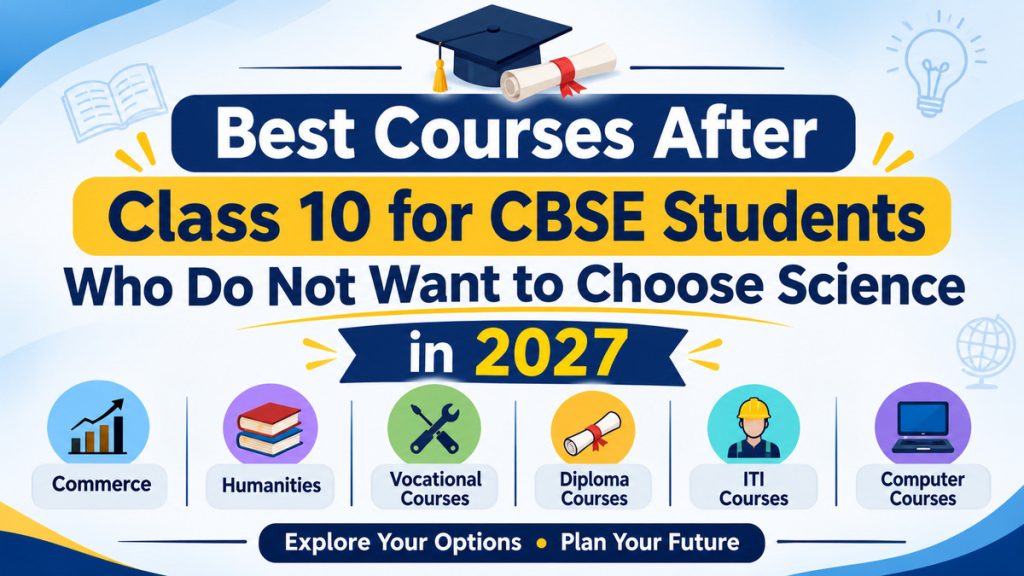
Choosing what to do after Class 10 is one of the first big academic decisions a student makes. Science is popular, but it is not the only strong path. Commerce, Humanities, skill-based courses and early career routes lead to well-paid, respected careers. This guide explains the main non-science options for CBSE students, what each one involves and how to choose.
Key Takeaways
- Under CBSE, a “stream” is really a set of Class 11 subjects, and you continue the same subjects in Class 12.
- Commerce and Humanities lead to careers in finance, law, design, business, media, psychology, public service and more.
- Skill-based courses, ITI, diplomas and some government jobs are open right after Class 10.
- Rules and exam dates change, so confirm details on the official site before you decide.
What Is New for Class 10 Students in 2027
CBSE now holds Class 10 board exams twice a year. The first exam is mandatory, and the second, held in May, is optional for improving marks in up to three subjects. The Phase 1 date sheet for 2027 runs from 16 February to 9 March 2027.
| Event | Date or expected timing |
| Practical exams (other schools) | From 1 January 2027 |
| Phase 1 board exams | 16 February to 9 March 2027 |
| Phase 1 results | April 2027 (expected) |
| Phase 2 (optional improvement) | May 2027 |
| Phase 2 results | June 2027 (expected) |
Students who do not clear Phase 1 can get provisional admission, which is confirmed after the second exam results. Always check the final schedule on the CBSE website.
How Stream Choice Works Under CBSE
Classes 11 and 12 are one course
CBSE treats Classes 11 and 12 as one composite course. Students take in Class 11 only the subjects they plan to continue in Class 12, so you generally cannot restart with a new stream in Class 12. You must offer at least five subjects, and you may add a sixth.
More flexibility than before
Under the National Education Policy, CBSE has moved away from rigid streams, and a mix such as Economics with Mathematics or History with Physics is possible in principle. In practice, what you can choose depends on your school’s timetable, teachers and admission rules, and schools often require a minimum number of students for a combination, so ask your school early.
Maths: Standard or Basic?
If you might want Mathematics in Class 11, for example in Commerce with Maths or Economics, Standard Maths in Class 10 is the safer choice, because entry to Class 11 Mathematics can depend on school discretion and the rules may change. Check the current CBSE circular for your batch.
Option 1: Commerce Stream
Core subjects
| Subject | What you learn |
| Accountancy | Recording and analysing financial transactions |
| Business Studies | How businesses are organised and managed |
| Economics | Demand, supply, national income and policy |
| Mathematics (optional) | Useful for finance, economics and statistics |
| Informatics Practices / Computer Science (optional) | Programming and data basics |
| English | Required language |
Courses and careers after Class 12 Commerce
| Course | Typical careers |
| B.Com / B.Com (Hons) | Accounting, banking, taxation |
| BBA / BMS | Management, marketing, entrepreneurship |
| Chartered Accountancy (CA) | Auditor, finance leader, tax consultant |
| CS / CMA | Company secretary, cost and management accountant |
| Economics (BA/BSc) | Economist, analyst, policy roles |
| BBA-LLB and other integrated degrees | Corporate law |
| Banking and insurance exams | Bank officer, clerk, insurance roles |
A useful early point on CA: ICAI allows students to register provisionally after Class 10, and you can sit the Foundation exam only after Class 12. It sets no age limit, and students from any stream can apply. Check ICAI’s current rules on marks.
Option 2: Humanities (Arts) Stream
Common subjects
History, Political Science, Geography, Economics, Psychology, Sociology, languages and Fine Arts, plus optional Informatics or Computer subjects where offered. Subject options vary by school.
Courses and careers after Class 12 Humanities
| Course | Typical careers |
| BA in History, Political Science, Sociology, Psychology, Economics | Civil services, research, counselling, policy |
| Journalism and mass communication | Journalist, content creator, PR |
| Law (BA-LLB through CLAT and other law entrances) | Lawyer, judge, legal advisor |
| Design (B.Des via NID DAT, NIFT, UCEED) | Designer in product, UX, fashion, graphics |
| Hotel management (NCHMCT JEE) | Hospitality and tourism management |
| Education (B.Ed. integrated programmes) | Teacher, education consultant |
| Languages, translation, creative writing | Editor, translator, writer |
Many central and other universities admit through CUET UG. The test has 13 languages, 23 domain subjects and a General Aptitude Test, and students can choose up to five. NTA had not announced the 2027 dates when I checked, and changes such as shorter papers and fewer allowed subjects are being discussed, so rely only on the official notice.
Option 3: Skill-Based and Vocational Routes After Class 10
Not every student wants to go straight into Class 11. These options start earlier.
| Route | Duration | Notes |
| ITI trades (electrician, fitter, COPA, etc.) | Typically 1–2 years | India has over 14,000 ITIs with more than 14 lakh trainees, per the Ministry of Skill Development’s 2025 review |
| Vocational and NSDC courses (IT, hospitality, beauty, retail, agriculture) | Usually 3–12 months | Check recognition by NSDC, NCVT, a state board or a university |
| Polytechnic diploma | Usually 3 years | Technical in nature; needs Class 10 marks, and lateral entry to B.Tech is possible |
| Short digital skills courses | Weeks to months | Coding, design, digital marketing, accounting software |
A note on polytechnic: it leads to engineering careers, so it suits students who like practical technical work even if they don’t want Class 11 Science. Direct entry after Class 10 generally depends on Class 10 marks, with some states asking for a minimum aggregate in Science, Maths and English, and requirements vary by state.
Option 4: Government Jobs and Defence After Class 10
Some jobs open straight after Class 10.
| Option | Basic eligibility (as reported) | Notes | |
| Agniveer GD (Army) | Class 10 pass with 45% aggregate and 33% in each subject | Four-year service; age limits are reported as 17½ to 21 or 22, so check the notification | |
| Agniveer Tradesman | Class 10 (or Class 8 for some trades) with 33% in each subject | Trade-specific | |
| Agniveer MR (Navy) | Class 10 pass, with 50% aggregate reported for some posts | Check each notice | |
| RRB Group D and technician roles | Class 10 or ITI | Competitive exams | |
| SSC MTS and GD Constable | Class 10 pass | Central government posts |
Many such jobs have age limits and physical standards, and competition is high. If you take a job route, keep studying through open schooling or Class 12 so that you have more options later.
Career Paths That Need No Science
| Career | Typical route | Key exam or step |
| Chartered Accountant | Commerce, then CA | ICAI Foundation, Intermediate, Final |
| Lawyer | Any stream, then BA-LLB | CLAT and other law entrances |
| Designer | Any stream, then B.Des | NID DAT, NIFT, UCEED |
| Hotel manager | Any stream, then BSc in Hospitality | NCHMCT JEE |
| Journalist or media professional | Humanities or any stream | University entrance or CUET |
| Business manager | Commerce or any stream, then BBA/BMS or integrated programmes | CUET, IPMAT or university tests |
| Psychologist or counsellor | Humanities, then BA/BSc in Psychology | University entrance |
| Civil servant | Any graduate degree | UPSC and state exams |
Comparing Your Options
| Route | Starts | Duration before work or next step | Best for |
| Commerce | Class 11 | 2 years, then degree or CA | Finance, business, law and economics interests |
| Humanities | Class 11 | 2 years, then degree | Writing, social sciences, law, design, public service |
| ITI or vocational | After Class 10 | Months to 2 years | Hands-on skills and early earning |
| Polytechnic | After Class 10 | 3 years | Technical careers without a long degree |
| Defence Job or government job | After Class 10 | Varies | Early government service, with physical standards |
How to Choose the Right Path
Start with interests and strengths
Look at what you enjoy and what you do well, such as numbers, writing, debating, drawing, building things or working with people. Chasing a stream because friends chose it often backfires.
Check what your school offers
Not every school offers every combination, so ask which subject groups, electives and skill subjects are available before you decide.
Keep the next step in mind
Your Class 11 subjects decide which entrance exams you can take after Class 12. For example, CUET domain subjects follow your Class 12 subjects, and some courses ask for specific subjects. Check the requirements of the courses you may want.
Don’t decide by marks alone
Strong marks in one subject don’t make a career. Use marks as one input alongside interest, aptitude and the career you can see yourself in.
Timeline for the 2026–27 Session
| When | What to do |
| November–December 2026 | Research streams, talk to teachers, alumni and professionals |
| January–February 2027 | Prepare for Phase 1 boards; shortlist two or three subject combinations |
| February–March 2027 | Take Phase 1 exams |
| April 2027 | Results; apply to schools for Class 11 and your preferred stream |
| May 2027 | Optional improvement exam in up to three subjects |
| Mid-2027 | Class 11 begins |
Common Mistakes to Avoid
- Choosing by pressure or trend. Pick a stream you can sustain for two years.
- Ignoring Maths needs. If you may want Maths in Class 11, plan for it in Class 10.
- Not checking school availability. Confirm combinations early.
- Assuming Commerce or Humanities is easier. CA, law and design exams are demanding.
- Skipping backup plans. Keep a second option in case marks or seats fall short.
Frequently Asked Questions
- Which is the best course after Class 10 for CBSE students without Science?
Commerce and Humanities are two of the best options for students who do not want to choose Science. Students can also consider ITI, polytechnic diplomas and vocational programmes based on their interests and eligibility.
- Can I get a good job without choosing Science after Class 10?
Yes. Students from Commerce, Humanities and vocational backgrounds can build successful careers in banking, accounting, management, law, teaching, government services, digital marketing, design and hospitality.
- Is Commerce better than Arts after Class 10?
Neither stream is universally better. Commerce is suitable for students interested in finance, business and accounting, whereas Humanities is suitable for students interested in law, history, psychology, politics and social sciences.
- Can CBSE students choose Commerce without Mathematics?
Yes, many schools offer Commerce subject combinations without Mathematics. However, subject availability varies by school. Students should check whether their preferred college or professional course requires Mathematics.
- Can I become a government officer without studying Science?
Yes. Students from Commerce and Humanities can pursue a bachelor’s degree and later apply for eligible government examinations, including UPSC Civil Services and state public service examinations.
- Which diploma courses are available after Class 10 without Science?
Students can explore commercial practice, fashion design, hospitality, photography, graphic design and certain vocational diplomas. However, technical diplomas such as engineering programmes may include Mathematics and Science-related subjects.
- Can I join ITI after completing Class 10?
Yes. Several ITI trades accept students who have passed Class 10. However, eligibility depends on the specific trade, minimum qualification and admission rules.
- Which computer course is best after Class 10 for non-Science students?
Basic computer applications, Tally with GST, digital marketing, graphic design, DTP and web design are useful options. Students should select a course based on their interests and future career goals.
- Can I become a lawyer after choosing Humanities?
Yes. After completing Class 12, students can apply for eligible five-year integrated law programmes such as BA LLB, subject to the institution’s admission requirements.
- Can I study MBA after choosing Arts or Commerce?
Yes. Students from Arts and Commerce backgrounds can generally pursue an MBA after completing a recognised bachelor’s degree, subject to the admission requirements of the institution.
Conclusion
Choosing a course after Class 10 is an important step, but students should not feel pressured to select Science just because it is considered a popular stream.
CBSE students who do not want to study Science have many educational and career opportunities through Commerce, Humanities, vocational education, ITI, polytechnic diplomas and professional training programmes.
Students interested in business can choose Commerce, while those interested in law, government services, psychology and social sciences can explore Humanities. Students who prefer practical learning can consider vocational courses and ITI programmes.
Before making a decision in 2027, students and parents should compare course fees, eligibility, duration, future education opportunities and employment prospects.
The best course is not necessarily the most popular course. It is the one that matches a student’s interests, abilities and long-term career goals.
Read More: Study Abroad or Build Your Career in India? What to Compare in 2027
📚 Related Articles
👉 You May Also Read
📚 Related Articles
- CBSE Date Sheet 2027 for Class 10 and 12: Complete Exam Schedule
- Coaching vs Self-Study: Which is Best in 2026 for Competitive Exams?
- NEET & JEE Preparation Guide for State Board Students
- Why Self-Discipline is More Important Than Motivation for Students
- How Visualization Strategies Can Improve Test Performance
🔥 Popular Posts
📌 Explore Categories
- About India
- Artificial Intelligence & Machine Learning
- Calendar
- Career
- Counselling
- Current Affairs
- Economy
- Education
- English Grammar
- Exams
- Festival
- Health and Fitness
- Hindi Sahitya
- History
- Intelligence Agency
- International Personality
- Know India
- Knowledge
- Maths
- Maxim
- Moral Stories
- Nature
- NEWS
- Olympiad
- Others
- Personal Finance
- Personality Development
- Politics
- Scholarship
- Science and Environment
- Sports
- States of India
- Study Abroad
- Study Tips
- Technology
- The Greatest Indian
- Uncategorized