

Percentage Calculator
Calculate percentage from obtained marks and total marks.

Academic session 2026-27, Chapter 2 in the current curriculum.
Welcome to the NCERT Solutions for Class 9 Science - Chapter The Fundamental Unit of Life. This page offers a step-by-step solution to the specific question from Exercise 5, Question 9:
Carry out the following osmosis experiment:
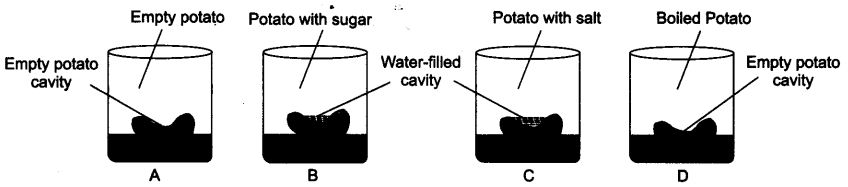
Take four peeled potato halves and scoos each one out to make potato cups. One of these potato cups should be made from a boiled potato. Put each potato cup in a trough containing water. Now,
(a) Keep cup A empty
(b) Put one teaspoon sugar in cup B
(c) Put one teaspoon salt in cup C
(d) Put one teaspoon sugar in the boiled potato cup D.
Keep these for two hours. Then observe the four potato cups and answer the following:
(i) Explain why water gathers in the hollowed portion of B and C.
(ii) Why is potato A necessary for this experiment?
(iii) Explain why water does not gather in the hollowed out portions of A and D.
Carry out the following osmosis experiment:
Take four peeled potato halves and scoos each one out to make potato cups. One of these potato cups should be made from a boiled potato. Put each potato cup in a trough containing water. Now,
(a) Keep cup A empty
(b) Put one teaspoon sugar in cup B
(c) Put one teaspoon salt in cup C
(d) Put one teaspoon sugar in the boiled potato cup D.
Keep these for two hours. Then observe the four potato cups and answer the following:
(i) Explain why water gathers in the hollowed portion of B and C.
(ii) Why is potato A necessary for this experiment?
(iii) Explain why water does not gather in the hollowed out portions of A and D.
(i) Water gathers in B and C in light of the fact that in both the circumstances there is contrast in the centralization of water in the box and water in some Potato. Therefore, osmosis happens as the potato cells go about as a semipermeable membrane.
(ii) Potato A is necessary for this experiment for comparison, it acts as a control.
(iii) Water doesn't gather in the emptied out parts of A and D. As some A doesn't have change in the concentration for water to stream. For osmosis to happen one of the concentrations ought to be higher than the other.
In cup D, the cells are dead and thus the semi-permeable membrane doesn't exist for the progression of water and no osmosis happens.
NCERT questions are designed to test your understanding of the concepts and theories discussed in the chapter. Here are some tips to help you answer NCERT questions effectively:
Stay updated with our latest educational content and study tips
It’s not about starting over if you took a break to care for children, take care of yourself, be healthy or for any other reason. This is a realistic strategy for the recovery of skills, selection of the right job, and overcoming the resume problem. One year, three years or 10 years of a career … Read more
Read MoreThere’s no need to score 95% or achieve a JEE/NEET rank. You don’t need to score 95% or rank in JEE/NEET to build a solid career. A candid and pragmatic guide to the routes that actually work for students who have an average mark and what to do when faced with the options. If … Read more
Read MoreAI tools, online platforms that are much cheaper than coaching centres and the changing idea of what “structure” even means have upended this argument more in the past two years than in the decade preceding it. Here’s what is really the case for 2026 – and what has actually stayed the same. If you look … Read more
Read MoreStarting to make a new career after 30 isn’t a start from scratch. Marketing, teaching, financial, retail, healthcare, sales and other professionals can pursue careers in technology by applying the existing knowledge and skills they have acquired to new technology skills. There are various ways to enter the technology industry, such as in IT support, … Read more
Read MoreCalculate percentage from obtained marks and total marks.
Welcome to the NCERT Solutions for Class 9 Science - Chapter . This page offers a step-by-step solution to the specific question from Excercise 5 , Question 9: Carry out the following osmosis experiment: Take four peeled potato halves and scoos each one out....
Fresh educational articles and updates.
Most-read articles from SaralStudy.
Fast access to frequently used study resources.
Recently viewed articles based on SaralStudy activity.
Add Comment