
Home Loan vs Savings: Compare the Costs Before Buying a Home

Pay upfront, or pay off less and over time? The truth depends on four factors most consumers will never compare at the same time: the interest rate on the house loan, the interest rate on the savings account, the rate of home price appreciation, and the cost of renting the home until you actually buy one.
In every home purchase there is some variation on this theme: Do you need to make a house purchase today with the down payment you have available, or should you wait and save a bit more and purchase next time with a larger down payment, or should you wait and save enough to purchase outright? The emotional argument that many people have is “debt is not good” and “rent is dead money” are both arguments that tug at you in opposite directions, but the facts are actually a math problem that has a definite shape and can be calculated. This article explains the math in detail and with the most up-to-date rates, and you can do the same math for your rates when you don’t have the gut feeling.
The Four Numbers That Actually Decide This
Every version of the “loan now vs save longer” question comes down to comparing four rates. Get clarity on these, and the rest of the decision becomes arithmetic rather than anxiety.
- Home loan interest rate: what the bank charges you to borrow. In India in 2026, this typically runs from around 7.1% to 9.5% per annum depending on the lender, your credit score, and loan amount, with most major banks clustering between 7.5% and 8.75%.
- Savings/investment return rate: what your money earns while it sits waiting for a bigger down payment. A standard savings account earns roughly 2.5%–3% annually; a fixed deposit typically earns 6.5%–7.1%; other instruments (equity, mutual funds) carry higher potential returns but with real risk and volatility attached.
- Home price growth rate: how fast property prices in your target area are rising. This varies hugely by city and even by neighborhood, but it’s the number that determines whether waiting to save more actually leaves you better off, or whether it means chasing a moving target.
- Rent (if applicable): what you’re paying to live somewhere while you wait and save. This is a real, unavoidable cost of the “wait” strategy and needs to be counted, not ignored.
The Core Trade-Off, Explained Simply
Taking a home loan now means paying interest on borrowed money, but it locks in today’s property price and lets you stop paying rent (or lets you avoid future price increases on the same property). Waiting and saving avoids that loan interest entirely, but it exposes you to two real risks: your savings might grow slower than home prices do, and you’re still paying rent (or opportunity cost) during the entire waiting period.
Is your savings/investment return rate, plus the benefit of avoiding loan interest, higher or lower than how fast home prices are rising in your target area, plus what you’re spending on rent while you wait? If prices and rent are rising faster than your money is growing, waiting usually costs you more than borrowing does and vice versa.
Worked Example: ₹50 Lakh Home, Two Paths
Assume a home currently priced at ₹50 lakh, and a buyer who currently has ₹10 lakh saved (20% down payment).
Path A: Buy Now
₹40L loan @ 8%
20-year tenure, roughly ₹33,500 EMI/month. Total interest paid over the loan term: approximately ₹40.5 lakh meaning the home effectively costs about ₹90.5 lakh over 20 years, paid gradually rather than upfront.
Path B: Wait 3 Years, Save More
+₹8–10L saved
At a 7% return, ₹10 lakh plus ongoing monthly savings could grow to roughly ₹18–20 lakh in 3 years. But if the same home’s price rises just 6% annually (common in many Indian cities), it would cost roughly ₹59.5 lakh by then the down payment grew, but so did the target.
In this illustrative scenario, waiting doesn’t necessarily save money; it depends entirely on whether the buyer’s savings growth rate outpaces local home price growth, which in many fast-appreciating markets, it doesn’t. In slower-appreciating or stagnant markets, waiting can genuinely pay off. There’s no universal answer; there’s only your specific city’s numbers.
Side-by-Side Cost Comparison
| Factor | Buy Now With a Loan | Wait and Save Longer |
| Upfront cost | Down payment + processing fees + registration costs | None yet — costs deferred |
| Ongoing cost | EMI (principal + interest) every month | Rent (if applicable) + opportunity cost of waiting |
| Exposure to price rises | Locked in at today’s price | Exposed to future price increases in target area |
| Exposure to rate changes | Floating-rate loans can rise or fall with RBI repo rate changes | Savings/FD returns can also shift with rate cycles |
| Flexibility | Lower — committed to EMI and property | Higher — can change city, budget, or plans more easily |
| Tax benefits (India) | Deductions available on home loan principal and interest under applicable sections | None directly, though other tax-saving instruments may apply |
| Risk if income disrupted | EMI obligation continues regardless of income changes | No fixed obligation — more room to adjust if income drops |
Timing your Home Purchase: Critical Factors
Deciding whether to buy a home immediately or wait and save is a complex choice that hinges on dynamic market conditions like price appreciation and interest rates, balanced against your personal financial stability and the goal of building a larger down payment for long-term benefit. This critical financial move requires mastering all factors to secure your future.
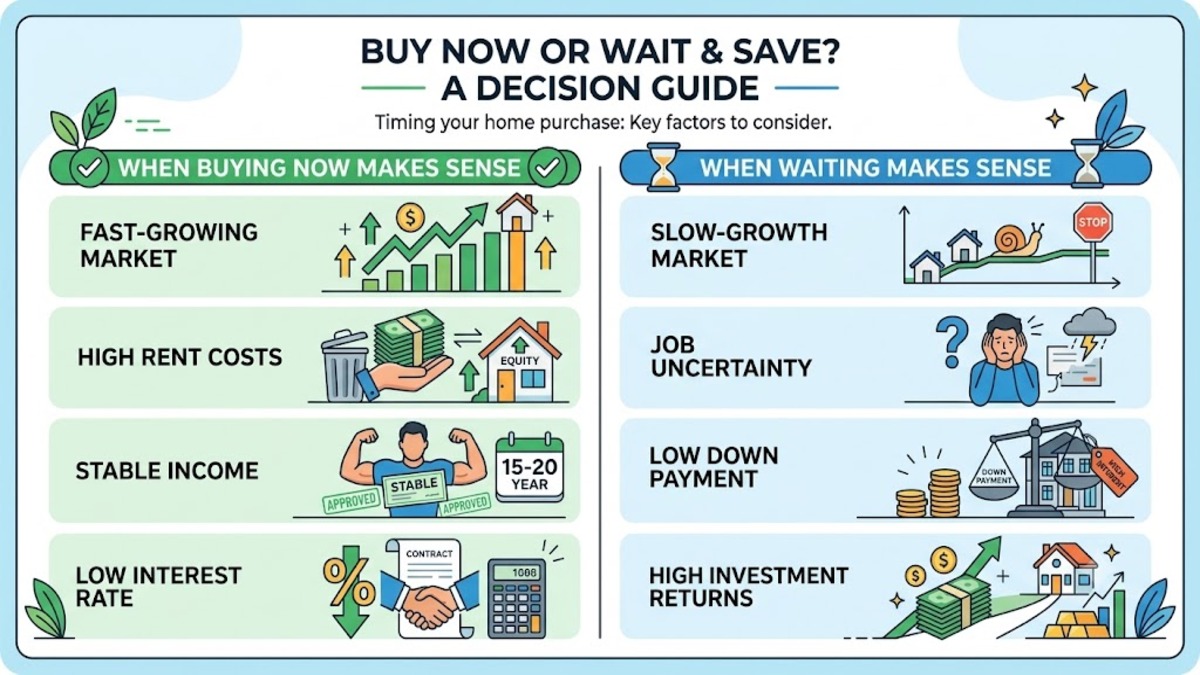
When Buying Now Tends to Make More Sense
- You’re in a fast-appreciating market. If home prices in your target area are rising faster than you can realistically grow your savings, every year you wait effectively raises the bar you’re saving toward.
- You’re currently paying significant rent. If rent is a large recurring cost with zero equity building, an EMI of similar size at least builds ownership over time; the “cost” of waiting includes this rent, not just lost investment growth.
- You have a stable, predictable income. A secure job or income stream makes committing to a 15–20 year EMI far less risky than it would be with uncertain or highly variable income.
- You qualify for a genuinely competitive interest rate. A strong credit score and stable financial profile can secure a rate meaningfully below the market average, improving the loan math considerably.
When Waiting and Saving Tends to Make More Sense
- You’re in a flat or slow-growth property market. If prices aren’t rising quickly, there’s little urgency, and a larger down payment later meaningfully reduces total interest paid.
- Your income or job situation is uncertain. Committing to a long-term EMI during an unstable period raises real financial risk if income drops or job security is in question.
- You don’t yet have the minimum reasonable down payment. A very small down payment usually means a higher loan amount, higher EMI burden, and often a higher interest rate due to increased lender risk waiting to build a more substantial down payment (ideally 20% or more) often improves loan terms meaningfully.
- You can access meaningfully higher, relatively safe returns. If you have access to investment vehicles reliably outperforming both inflation and local property price growth, the math can genuinely favor waiting.
A Practical Way to Run Your Own Numbers
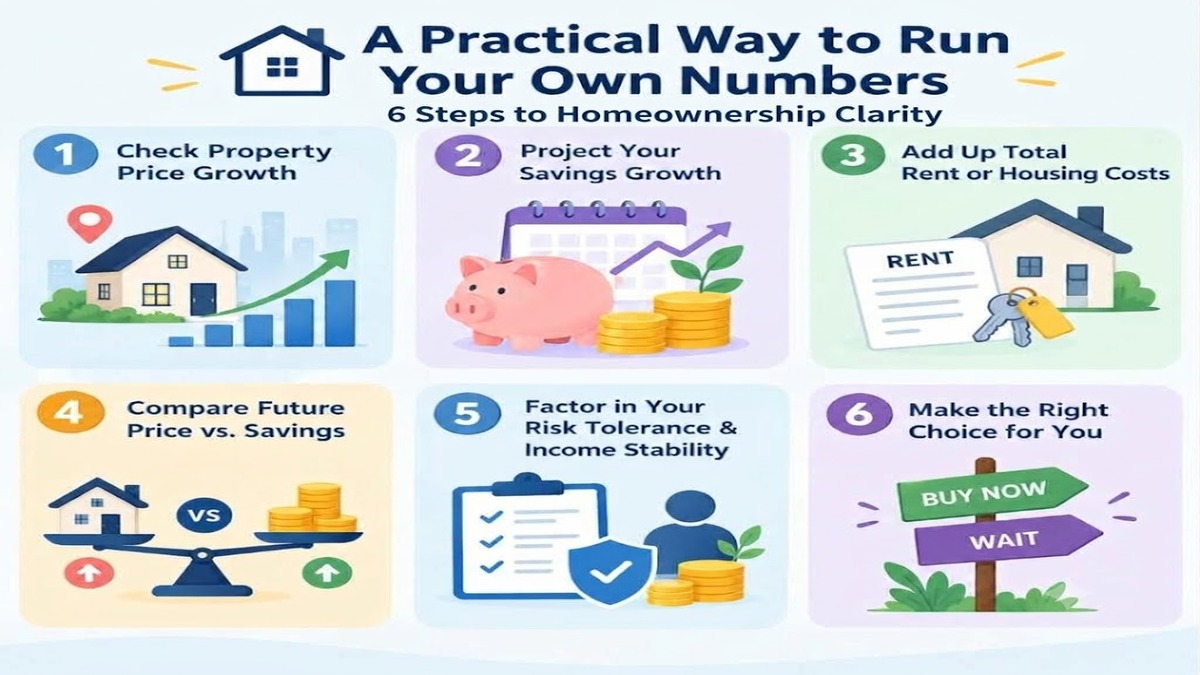
- Find your target property’s price growth over the last 3–5 years in your specific area, not a national average, which can be misleading given how much this varies by city and neighborhood.
- Calculate what your current savings would grow to over your planned waiting period, using a realistic, achievable return rate for the instrument you’d actually use (savings account, FD, or other).
- Add up total rent or housing cost you’d pay during the waiting period, since this is a real cost of the “wait” strategy that’s easy to underweight.
- Compare the projected future home price against your projected future savings plus avoided rent. If your savings plus the money you didn’t pay in loan interest would outpace the home’s price growth, waiting wins. If the home’s price growth outpaces your realistic savings growth, buying sooner usually wins.
- Factor in your personal risk tolerance and income stability. Lastly, the math gives you a starting answer, but your actual comfort with a long-term financial commitment should have real weight in the final decision.
The Bottom Line
There’s no universally correct answer to “loan now or save longer” it depends entirely on how your local property market, your realistic savings growth rate, and your current rent or housing cost compare against each other. In fast-appreciating markets with significant rent already being paid, buying sooner with a loan often works out cheaper in the long run despite the interest cost. In flatter markets with uncertain income, patience and a larger down payment can genuinely save money. The only way to know which applies to you is to run your own specific numbers rather than relying on a general rule the four-number framework above is exactly how to do that.
FAQs for Home Loan vs Savings
1. Should I buy a home now with a higher loan or wait and save for a larger down payment?
It depends on your local market speed and current savings rate:
-
Buy now if home prices in your target area are appreciating faster than your ability to save. Delaying increases the total purchase price, requiring a much larger future loan.
-
Wait and save if property prices are flat or growing slowly. A larger down payment later will significantly lower your total loan balance and save you substantial interest charges over time.
2. How does paying high rent factor into the “Buy vs. Save” equation?
Rent is an ongoing cost with zero equity return. If your current monthly rent is comparable to a potential Equated Monthly Installment (EMI), buying now allows that monthly outlay to build home equity. However, if your rent is substantially lower than a home EMI, remaining in your rental while investing the difference into higher-yielding assets may yield a stronger long-term result.
3. Is a smaller down payment always a bad idea?
Not always, but it comes with financial trade-offs. Putting down less upfront (e.g., 10% instead of 20%) lets you enter the property market sooner, but it results in a larger principal balance, higher monthly EMIs, and potentially higher interest rates due to increased risk for the lender. Aiming for at least a 20% down payment generally secures optimal loan terms.
4. How does job security and income stability affect this decision?
A home loan is a long-term commitment (typically 15–20 years). If you have a stable, predictable income stream, taking on a structured EMI risk is manageable. If your income is variable, commission-based, or subject to career transitions, building a larger cash buffer and waiting until your income stabilizes reduces the risk of defaulting during economic downturns.
5. What if my investments generate higher returns than the home loan interest rate?
If you can consistently achieve safe, reliable investment returns that outpace both property price growth and your mortgage interest rate, the mathematical advantage lies in investing your excess funds rather than locking them all into property equity. However, ensure these investments are low-risk; relying on volatile or uncertain market returns to offset loan interest adds unnecessary financial exposure.
Read More: Simple and Compound Interest Formulas with Questions
👉 You May Also Read
📚 Related Articles
🔥 Popular Posts





📌 Explore Categories
- About India
- Artificial Intelligence & Machine Learning
- Calendar
- Career
- Counselling
- Current Affairs
- Economy
- Education
- English Grammar
- Exams
- Festival
- Health and Fitness
- Hindi Sahitya
- History
- Intelligence Agency
- International Personality
- Know India
- Knowledge
- Maths
- Maxim
- Moral Stories
- Nature
- NEWS
- Olympiad
- Others
- Personal Finance
- Personality Development
- Politics
- Scholarship
- Science and Environment
- Sports
- States of India
- Study Abroad
- Study Tips
- Technology
- The Greatest Indian
- Uncategorized