
SSLC and PUC Full Form: Meaning in Indian Education
SSLC and PUC Full Form: Meaning in Indian Education
In India, SSLC and PUC are two of the most important milestones in a student’s school journey, especially in Karnataka, Kerala and Tamil Nadu. They are the gateway to professional careers and higher education. Whether you are a student planning your next step or a parent trying to understand the system, knowing how the two differ helps you make better decisions about future streams and careers.
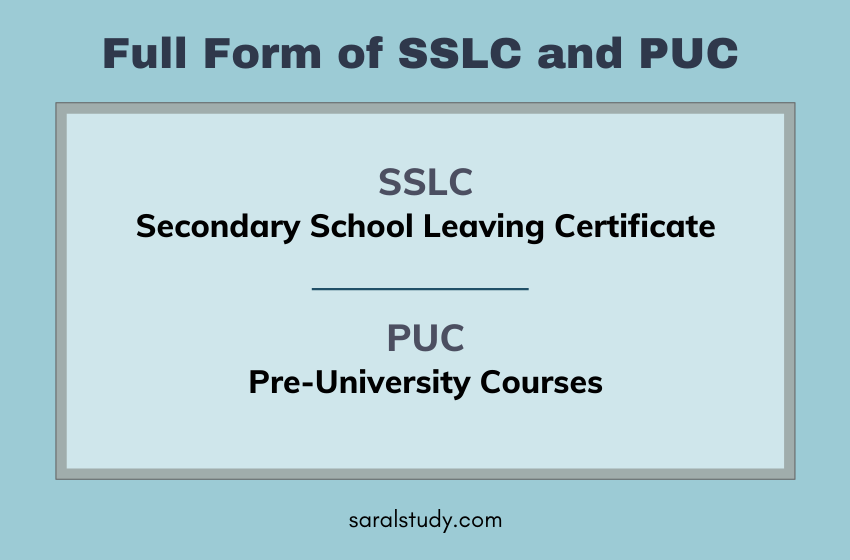
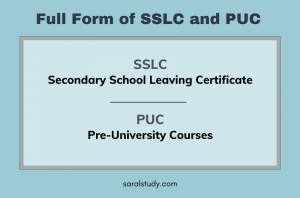
To clarify these terms, the SSLC full form is the Secondary School Leaving Certificate, which is awarded upon the successful completion of the 10th-grade board exams. Following this, students transition into the PUC full form in education, which stands for the Pre-University Course. While the sslc meaning is centered on completing foundational secondary schooling, the puc full form represents the vital two-year intermediate program (Class 11 and 12) that prepares students for university-level degrees in science, commerce, or arts.
Quick answer
- SSLC full form: Secondary School Leaving Certificate. It is awarded after passing the Class 10 board exam.
- PUC full form: Pre-University Course. It is the two-year course (Class 11 and 12) taken after SSLC, mainly in Karnataka.
- Is SSLC 10th or 12th? SSLC is 10th. PUC is 11th and 12th.
Table of Contents
- What is SSLC? Full form and meaning
- What Class 10 is called in different states
- Importance and uses of the SSLC certificate
- What to do after SSLC
- SSLC exam: schedule, marks and pass criteria
- How to download the SSLC marks card online
- How to get a duplicate SSLC certificate
- SSLC attestation for abroad
- Boards offering SSLC and Class 10 in India
- What is the full form of PUC?
- PUC equivalents in other states
- PUC streams and subject combinations
- What to do after PUC
- SSLC vs PUC: key differences
- Frequently asked questions
What is SSLC? Understanding SSLC Full Form and Meaning
The SSLC meaning refers to the first major academic milestone for students in many Indian states. The full form of SSLC is Secondary School Leaving Certificate. It is also known as the SSLC certificate, SSLC mark sheet, Matriculation certificate, Secondary School Certificate (SSC), 10th certificate or 10th standard certificate.
Is SSLC 10th or 12th?
SSLC refers specifically to Class 10. It does not refer to Class 12. In many states the Class 10 board exam is called the SSLC exam, and passing it is necessary for higher studies or vocational training.
The certificate is issued by the respective state education board after a student completes secondary schooling and passes the Class 10 public examination. School education in India is overseen by the Ministry of Education (formerly the Ministry of Human Resource Development) and the Department of School Education and Literacy, with each state board running its own exams.
Why is the SSLC certificate important?
It is required to enrol in higher secondary education (PUC / Class 11). It was also widely used as date of birth proof when birth and death registration was not mandatory, and for people born before 1989 the 10th marks card is still treated as age proof.
What Class 10 Is Called in Different States
The same qualification goes by different names across India:
|
State / Board |
Name of Class 10 certificate |
|
Karnataka, Kerala, Tamil Nadu |
SSLC (Secondary School Leaving Certificate) |
|
Andhra Pradesh, Telangana, Maharashtra, Gujarat |
SSC (Secondary School Certificate) |
|
Assam |
HSLC (High School Leaving Certificate) |
|
Bihar, Uttar Pradesh, Rajasthan, Odisha and several northern and eastern states |
Matriculation / High School Certificate |
|
West Bengal |
Madhyamik Pariksha |
|
CBSE |
AISSE (All India Secondary School Examination) |
|
CISCE |
ICSE (Indian Certificate of Secondary Education) |
Note: HSC usually means the Class 12 certificate (for example in Maharashtra), so do not confuse it with Class 10.
Importance and Uses of the SSLC Certificate
- Proof of date of birth: Before birth and death certificates became compulsory, people used the SSLC certificate as DOB proof. It is still accepted for documents such as passports and voter ID applications, especially for people born before 1989.
- Admission to higher education: You need it to enrol in PUC / Class 11, diploma, polytechnic and ITI courses.
- Driving licence: Some licence categories, such as transport vehicles, have minimum education requirements, and the SSLC certificate is accepted as proof of it.
- Jobs: Many employers and government recruitment drives ask for it as proof of minimum qualification and age.
- Passport: It is commonly used to verify date of birth and education, and missing proof can delay an application.
- Study or work abroad: Often needed in attested form (see the attestation section below).
Educational Opportunities After SSLC
After passing SSLC, students can choose from several routes:
|
Option |
Duration |
Leads to |
|
PUC / Class 11-12 (Science, Commerce, Arts) |
2 years |
Degree courses, NEET, JEE, CUET, CA and more |
|
Polytechnic diploma (engineering) |
3 years |
Jobs as a technician, or lateral entry into B.E./B.Tech |
|
ITI (trade courses) |
1 to 2 years |
Skilled trade jobs and apprenticeships |
|
Vocational programmes |
Varies |
Targeted training in trades and professions |
Students can also join technical training colleges for skills aimed directly at professional careers. Those who complete a polytechnic diploma can later move on to an engineering degree.
SSLC Exam: Schedule, Marks and Pass Criteria
- Schedule: Exams are usually held in March or April. Exact dates differ by state and year, so check your board’s timetable.
- Duration: Typically about 3 hours per paper, though it can vary by board.
- Marks: Commonly 100 per subject, divided between the written exam and internal or practical assessment.
- Pass marks: Generally 33% to 35% depending on the board. Some boards also require a minimum in each subject.
- Admit card: A single hall ticket is issued for all subjects. Keep it safe until you complete higher secondary education.
How to Download the SSLC Marks Card Online
- Open the official website of the board you wrote the exam under.
- Open the results or marks card link.
- Enter your register / roll number and date of birth.
- Check your name, date of birth and marks.
- Download and print the marks card.
Tip: Many boards also upload marks cards to DigiLocker, where the digital copy is legally valid. A downloaded copy is fine for reference, but attestation and many admissions need the original.
How to Get a Duplicate SSLC Certificate
If you lose your certificate, act quickly so the original cannot be misused.
- File an FIR at the nearest police station (or an online lost-document report where available).
- Get the application form from your board’s website, or from the board office or your school.
- Pay the prescribed fee by demand draft, NEFT or online, whichever your board accepts.
- Attach documents: FIR copy, ID proof, a copy of the hall ticket or marks card if you have one, and a photograph.
- Submit the application and collect the duplicate when it is issued.
Fees and processing time differ by board.
SSLC Certificate Attestation for Abroad
If you are moving abroad for a job or studies, the destination country usually needs proof that your certificate is genuine. This is done through attestation or an apostille, and it must be completed in India, the country that issued the document. The usual steps (they vary by country) are:
- Board or education department verification of the certificate.
- State-level attestation by the state education (HRD) and, where required, Home Department.
- MEA attestation or apostille by the Ministry of External Affairs. Apostille applies to countries in the Hague Convention, and requests can be made online through e-Sanad.
- Embassy legalization for countries that do not accept apostille.
Always confirm current requirements with the destination country’s embassy before you start.
Boards Offering SSLC and Class 10 in India
Dozens of boards in India conduct Class 10 examinations, some under the name SSLC and others under names such as SSC, HSLC or Matriculation. Major boards and their official websites are listed below. Confirm the address on the board’s own notices, as websites sometimes change.
|
S. No. |
Board |
State / Type |
Official website |
|
1 |
Karnataka School Examination and Assessment Board (KSEAB) |
Karnataka |
|
|
2 |
Directorate of Government Examinations |
Tamil Nadu |
|
|
3 |
Kerala Pareeksha Bhavan (Board of Public Examinations) |
Kerala |
|
|
4 |
Board of Secondary Education, Andhra Pradesh |
Andhra Pradesh |
|
|
5 |
Board of Secondary Education, Telangana State |
Telangana |
|
|
6 |
Maharashtra State Board of Secondary and Higher Secondary Education |
Maharashtra |
|
|
7 |
Gujarat Secondary and Higher Secondary Education Board |
Gujarat |
|
|
8 |
Goa Board of Secondary and Higher Secondary Education |
Goa |
|
|
9 |
Board of Secondary Education, Rajasthan |
Rajasthan |
|
|
10 |
Board of School Education Haryana |
Haryana |
|
|
11 |
Himachal Pradesh Board of School Education |
Himachal Pradesh |
|
|
12 |
Punjab School Education Board |
Punjab |
|
|
13 |
Board of Secondary Education, Odisha |
Odisha |
|
|
14 |
Board of Secondary Education, Madhya Pradesh |
Madhya Pradesh |
|
|
15 |
Chhattisgarh Board of Secondary Education |
Chhattisgarh |
|
|
16 |
Bihar School Examination Board |
Bihar |
|
|
17 |
Jharkhand Academic Council, Ranchi |
Jharkhand |
|
|
18 |
U.P. Board of High School & Intermediate Education |
Uttar Pradesh |
|
|
19 |
Board of School Education Uttarakhand |
Uttarakhand |
|
|
20 |
West Bengal Board of Secondary Education |
West Bengal |
|
|
21 |
West Bengal Council of Higher Secondary Education |
West Bengal (Class 11-12) |
|
|
22 |
Board of Secondary Education, Assam (SEBA) |
Assam |
|
|
23 |
Meghalaya Board of School Education |
Meghalaya |
|
|
24 |
Tripura Board of Secondary Education |
Tripura |
|
|
25 |
Jammu & Kashmir State Board of School Education |
Jammu & Kashmir |
|
|
26 |
Central Board of Secondary Education (CBSE) |
National |
|
|
27 |
Council for the Indian School Certificate Examinations (CISCE) |
National |
|
|
28 |
National Institute of Open Schooling (NIOS) |
National (open schooling) |
Other boards that issue Class 10 certificates: Board of School Education Nagaland, Board of Secondary Education Manipur, Mizoram Board of School Education, Aligarh Muslim University Board of Secondary and Senior Secondary Education, Banasthali Vidyapith, Dayalbagh Educational Institute, Gurukula Kangri Vishwavidyalaya, state open schools (Bihar, Chhattisgarh, Madhya Pradesh, Rajasthan, Telangana, West Bengal), and Sanskrit and madrasa boards in Assam, Bihar, Chhattisgarh, Uttarakhand and other states.
More board guides on SaralStudy: Karnataka Board | Andhra Pradesh Board | Himachal Pradesh Board | Meghalaya Board
What is the Full Form of PUC in Education?
The PUC full form is Pre-University Course. It is the two-year intermediate programme (Class 11 and 12, also called plus two or 10+2) taken after SSLC. In Karnataka it is the standard step between school and college. PUC is offered in PU colleges and composite junior colleges, and students need an SSLC (or equivalent Class 10 pass) to get admission.
India’s school system is traditionally described as 10+2+3/4/5: ten years of school, two years of pre-university or intermediate, and three to five years of university depending on the course. (Under the National Education Policy 2020 this is being reorganised as 5+3+3+4, but the board exams at Class 10 and 12 continue.)
PUC Full Form in Karnataka and Its Importance
In Karnataka, PUC is divided into 1st PUC and 2nd PUC, and the 2nd PUC result is used for admission to degree courses and entrance exams. The stream a student picks here shapes their later academic and career path.
PUC Equivalents in Other States
|
State |
Name of Class 11-12 stage |
|
Karnataka |
PUC (1st PUC and 2nd PUC) |
|
Andhra Pradesh, Telangana |
Intermediate (Inter 1st year, 2nd year) |
|
Kerala |
Higher Secondary (Plus One, Plus Two) |
|
Tamil Nadu |
Higher Secondary (HSC, +1 and +2) |
|
Maharashtra |
HSC / Junior College (11th and 12th) |
|
CBSE / CISCE |
Class 11 and 12 (AISSCE / ISC) |
PUC Streams and Subject Combinations
Junior colleges mainly offer three streams: Science, Commerce and Arts. Students can choose subject combinations according to their interest and what the institution offers.
Science
Best for students who enjoy concepts, formulas and experiments, and who plan careers in medicine, engineering, pharmacy, nursing, agriculture or pure sciences. Expect practicals, records, coaching and seminars. Subjects include Maths, Physics, Chemistry, Biology, Electronics, Computer Science, Statistics, Geography and Home Science.
Common combinations: PCMB, PCMC, PCME, PCMG, PCB, PCM, PCBH, PCBE
Commerce
For students interested in accounts, business, management, finance or computers. Strong skills in data, numbers and analysis help, and students can start preparing for CA, CS or CMA after this stream. Subjects include Accountancy, Business Studies, Economics, Statistics, Business Maths and Maths.
Common combinations: SEBA, ABEM, BSAM, EBAC, APBE
Arts (Humanities)
For students aiming at civil services, law, journalism, teaching, social work, economics or design. It rewards strong language, social and interpersonal skills. Subjects include History, Economics, Political Science, Sociology, Psychology, Geography, Education, Music and languages.
Common combinations: HESP, HEGP, HEPK, ELSP, ESPP, HEKM
Educational Opportunities After PUC
|
Stream |
Degree and professional options |
Common entrance exams |
|
Science |
MBBS, BDS, B.Pharm, B.Sc Nursing, B.E./B.Tech, B.Sc, agriculture and veterinary courses |
NEET, JEE Main, KCET, CUET |
|
Commerce |
B.Com, BBA, BMS, CA, CS, CMA, economics and finance programmes |
CUET, CA Foundation, CS Foundation, CMA Foundation |
|
Arts |
BA, LLB / BA LLB, BSW, B.Ed pathways, journalism, design and fashion courses |
CUET, CLAT, design entrance exams, UPSC foundation preparation |
Advantages of PUC
PUC gives students two years to explore their strengths and interests before committing to a career. It introduces higher-level study, builds exam skills and exposes students to the challenges of life beyond school.
SSLC vs PUC: Key Differences
SSLC is the Class 10 certification. PUC is the two-year preparatory course for university education, equal to Class 11 and 12. Moving from SSLC to PUC lets students specialise in chosen subjects, which guides their future academic and career choices.
|
Feature |
SSLC |
PUC |
|
Full form |
Secondary School Leaving Certificate |
Pre-University Course |
|
Education level |
Class 10 (secondary) |
Class 11 and 12 (higher secondary) |
|
Duration |
Completion of Class 10 |
2 years (1st and 2nd PUC) |
|
Streams |
Common subjects, no streams |
Science, Commerce, Arts |
|
Purpose |
Eligibility for higher secondary, diploma, ITI |
Eligibility for degree and professional courses |
|
Board exam |
Class 10 board exam |
2nd PUC board exam |
|
Commonly used in |
Karnataka, Kerala, Tamil Nadu |
Karnataka (other states use Intermediate or Higher Secondary) |
Final Thoughts
SSLC and PUC are two connected steps in the Indian education journey. SSLC (Secondary School Leaving Certificate) marks the end of school-level education at Class 10 and is also one of the most commonly used proofs of date of birth and qualification. PUC (Pre-University Course) is the two-year bridge to college, where students choose Science, Commerce or Arts and begin shaping their careers.
Keep these points in mind:
- Keep your SSLC certificate and marks card safe. You will need them for admissions, jobs, passports and visas, and a duplicate takes time and paperwork to get.
- Save a digital copy in DigiLocker so you always have a verified backup.
- Choose your PUC stream based on your interests and long-term goals, not on pressure or trends. Every stream has strong career options.
- If you plan to study or work abroad, start the attestation process early, since it involves several offices.
- Always check your board’s official website for the latest dates, fees and rules, as these change from year to year.
Whether you are a student about to write your Class 10 exams, a parent guiding a child through the next stage, or someone who needs to understand these terms for a form or application, we hope this guide has made SSLC and PUC clear. Bookmark it for reference, and share it with anyone who might find it useful.
Frequently Asked Questions
1. What is the full form of SSLC?
SSLC stands for Secondary School Leaving Certificate.
2. What is the full form of PUC?
PUC stands for Pre-University Course, the two-year course (Class 11 and 12) taken after SSLC.
3. Is SSLC 10th or 12th?
SSLC is the 10th standard certificate. Class 12 is the 2nd PUC or equivalent.
4. Is PUC equal to Class 12?
1st PUC equals Class 11 and 2nd PUC equals Class 12.
5. What comes after SSLC?
Students can join PUC (Science, Commerce or Arts), a polytechnic diploma, ITI or a vocational course.
6. What comes after PUC?
Degree and professional courses such as MBBS, engineering, B.Com, CA, BA and law, depending on the stream chosen.
7. Is SSLC valid as date of birth proof?
Yes. It is widely accepted as DOB proof, including for passport applications.
8. What is the minimum pass percentage in SSLC?
Generally 33% to 35%, depending on the board.
9. Is PUC available only in Karnataka?
The name PUC is mainly used in Karnataka. Other states use names like Intermediate, Higher Secondary or Class 11-12 for the same stage.
10. Which PUC stream is best?
It depends on your interests and career goals. Science suits medicine and engineering, Commerce suits finance and business, and Arts suits law, civil services and humanities careers. None of them is better than the others.
11. Do I need to attest my SSLC certificate to go abroad?
Usually yes. Foreign employers, universities and visa authorities often require attestation or an apostille from the issuing country.
12. How do I get a duplicate SSLC certificate?
File an FIR, apply to your board with the required documents and fee, and collect the duplicate once issued.
Also Read: Tips To Crack Business School Entrance Examination
FAQs regarding SSLC and PUC
I want to build my career in the Paramedical field, Which PUC courses should I opt for?
How to get the SSLC certificate?
Are SSLC and SSC the same?
Can a person born after 1989 also use SSLC as the Date of Birth Proof?
Can I Opt for diploma courses after PUC?
What is PUC Full Form and Meaning in Education
Is PUC Necessary After SSLC?
What does SSLC mean in education?
Is PUC the same as 12th?
What is the full form of PUC in Karnataka?
What is the difference between SSLC and PUC?
Is PUC compulsory after SSLC?
What is the sslc full form and its significance?
📚 Related Articles



👉 You May Also Read
📚 Related Articles
- Best Computer Skills to Learn for Government Jobs in India
- Government Jobs Without UPSC or SSC: Career Options, Eligibility and Opportunities in India
- How to Build a Career in Data Analytics Without a Computer Science Degree
- Business After 30 or a Stable Job: Which Path Should You Choose?
- How to Return to Work After a Career Break: Skills, Jobs and Preparation in 2026
🔥 Popular Posts
📌 Explore Categories
- About India
- Artificial Intelligence & Machine Learning
- Calendar
- Career
- Counselling
- Current Affairs
- Economy
- Education
- English Grammar
- Exams
- Festival
- Health and Fitness
- Hindi Sahitya
- History
- Intelligence Agency
- International Personality
- Know India
- Knowledge
- Maths
- Maxim
- Moral Stories
- Nature
- NEWS
- Olympiad
- Others
- Personal Finance
- Personality Development
- Politics
- Scholarship
- Science and Environment
- Sports
- States of India
- Study Abroad
- Study Tips
- Technology
- The Greatest Indian
- Uncategorized