
How to Return to Work After a Career Break: Skills, Jobs and Preparation in 2026
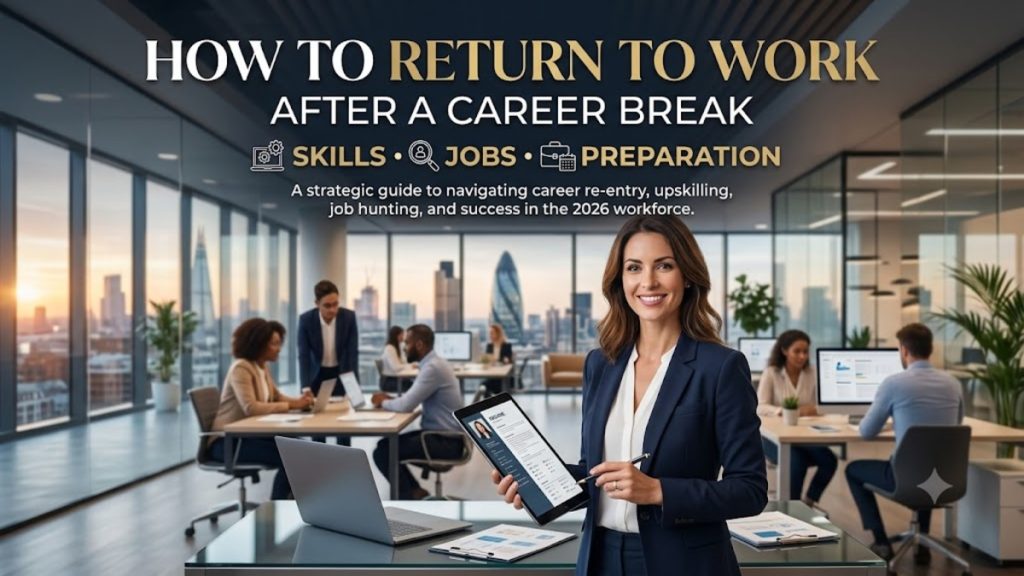
It’s not about starting over if you took a break to care for children, take care of yourself, be healthy or for any other reason. This is a realistic strategy for the recovery of skills, selection of the right job, and overcoming the resume problem.
One year, three years or 10 years of a career break seems to wipe the slate clean. It didn’t. In reality, what actually transpired over these years is that your skills in working professionally were not exercised, whereas other skills organisation, negotiation, crisis management and patience under pressure were. It’s not a challenge of building from scratch; it’s a challenge of demonstrating to an employer what you have and what’s still fresh in your mind, and what’s rusty and needs to be refreshed.
This is a practical guide to doing exactly that realistically, and without pretending the gap doesn’t exist.
First, Take Stock of What Didn’t Actually Disappear
Before touching a résumé or a course catalog, it helps to separate what genuinely needs rebuilding from what you still have and simply haven’t had to name out loud in a while.
- Transferable skills rarely expire. Project management, budgeting, negotiation, conflict resolution, and communication are used constantly in caregiving, volunteering, freelancing, and running a household; they just weren’t labeled “professional skills” while you were doing them.
- Technical and industry-specific knowledge is what actually goes stale. Software versions change, regulations get updated, and industry practices shift. This is the part worth being honest about and the part worth focused effort to refresh.
- Confidence erodes faster than competence. Many returners underestimate how much they still know, simply because they haven’t had to demonstrate it under professional conditions recently. This is worth naming, because it affects how you present yourself far more than any actual skill gap does.
The Preparation Roadmap
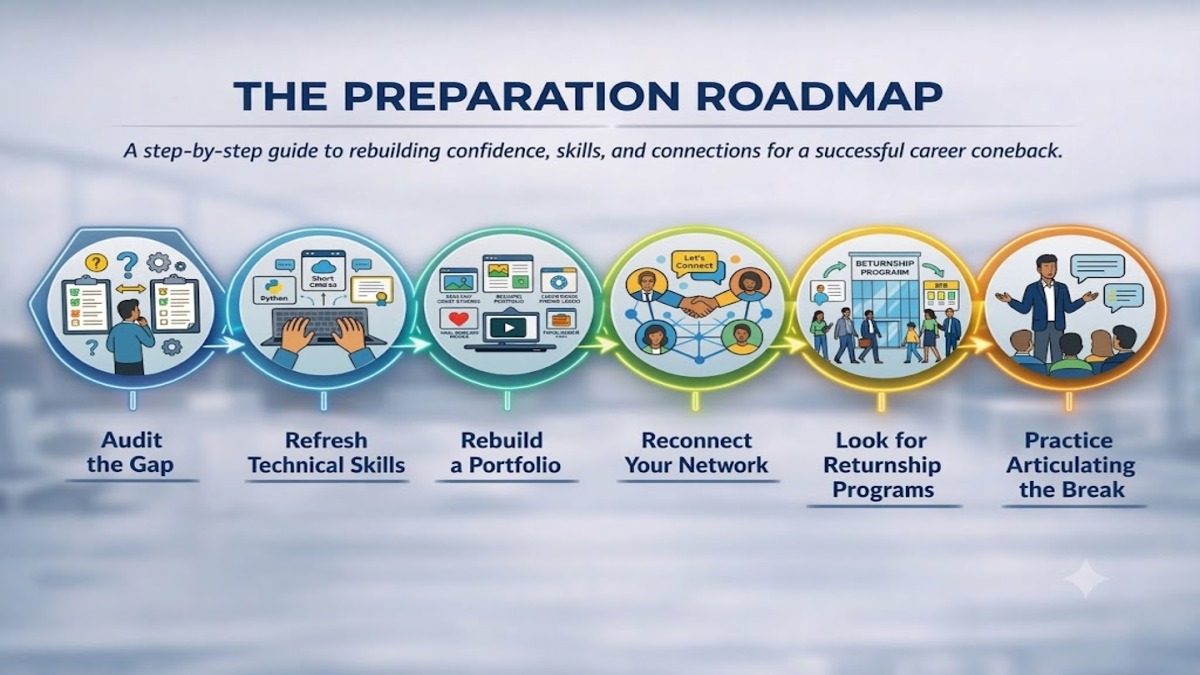
1. Audit the gap honestly, subject by subject
List out what’s changed in your field since you left new tools, new terminology, new regulations, new ways of working (remote/hybrid norms, for instance). Be specific rather than anxious in the abstract; a concrete list is easier to act on than a vague sense of being “behind.”
2. Refresh technical skills through short, targeted learning
You don’t need to relearn your entire field, you need to close specific gaps. Short courses, certifications, or even free tutorials on the two or three tools or systems that changed most in your absence are usually enough to get functional again quickly.
3. Rebuild a portfolio of recent, demonstrable work
If your last role feels too far in the past to speak to your current ability, create something newer to point to: a freelance project, volunteer work that uses relevant skills, a personal project, or a short course’s capstone assignment. Recency matters as much as relevance in a hiring manager’s eyes.
4. Reconnect your network before you need it
Reach out to former colleagues and industry contacts before you’re actively job-hunting under pressure. A simple “I’m planning to return to work in the next few months, would love to hear what’s changed in the field” is a low-pressure way back in, and referrals matter enormously for returners specifically, since they help bypass a résumé gap that automated filters or unfamiliar recruiters might otherwise flag.
5. Look specifically for returnship and re-entry programs
A growing number of companies, particularly larger employers run structured “returnship” programs explicitly designed for people coming back after a career break, often functioning like a paid internship with mentorship built in. These are worth seeking out deliberately, since they remove the burden of justifying the gap; the program itself already assumes and accounts for it.
6. Practice articulating the break, briefly and factually
You don’t need an elaborate explanation, and you don’t need to apologize. A short, neutral statement about what the break was for, and what you did to prepare for return said confidently, closes the topic faster than a long, hedging explanation does.
Jobs and Paths That Tend to Work Well for Returners
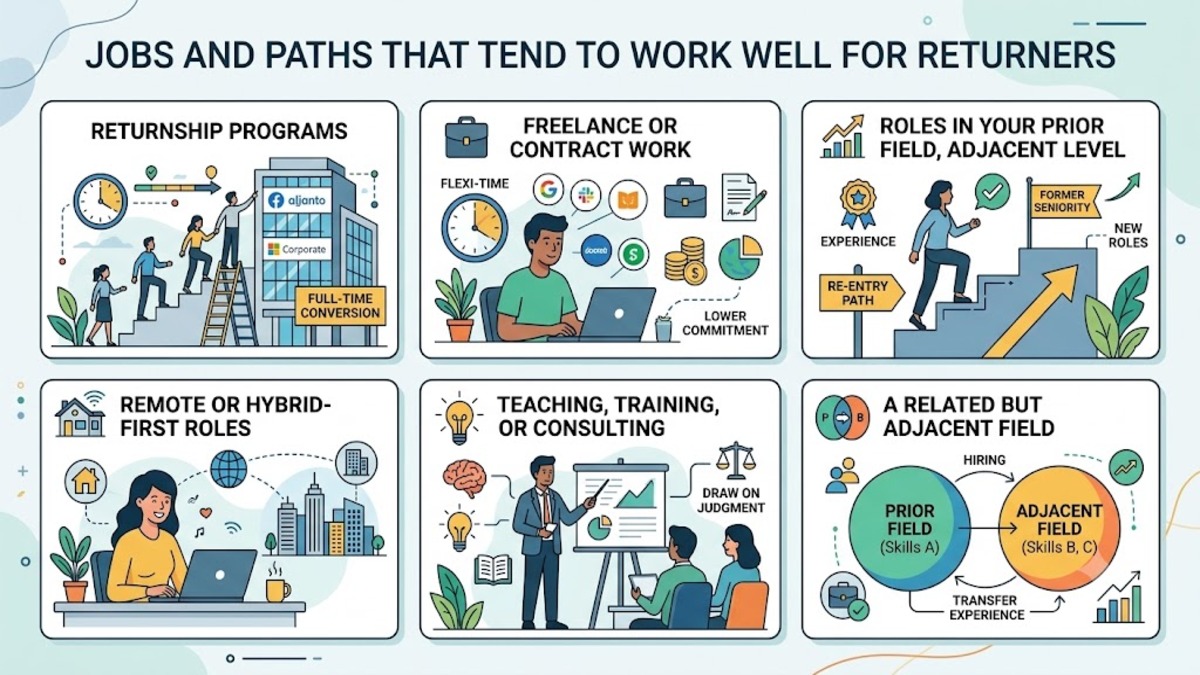
Jobs and career paths that offer flexible work options, use transferable skills, and provide opportunities to rebuild experience after a career break.
1. Returnship programs
Structured, time-boxed programs at larger companies built specifically for career-break returners, often converting to full-time roles.
2. Freelance or contract work
Lower-commitment entry points that let you rebuild a recent track record and confidence before committing to full-time employment.
3. Roles in your prior field, adjacent level
Returning at a slightly lower level than where you left, with a realistic path back up, is often faster than insisting on re-entering at your exact former seniority.
4. Remote or hybrid-first roles
Companies with flexible or remote-first cultures are often more accustomed to hiring people with varied career paths, including breaks.
5. Teaching, training, or consulting in your old field
If deep expertise remains even after a break, roles that draw on judgment and experience rather than day-to-day tool fluency can be a strong re-entry point.
6. A related but adjacent field
Sometimes the fastest path back isn’t your exact old role, but a neighboring field where your existing skills transfer well and the market is currently hiring more actively.
Handling the Resume and the Interview
A career break should not be the main focus of your résumé. Highlight your previous work experience, current skills, recent courses, certifications and projects that show you are ready to return to work.
During the interview, be prepared to explain your career break honestly and briefly. Focus on what you learned during the break, how you updated your skills and why you are now ready to take up a new role.
Prepare for Interviews
Interview preparation is especially important after a career break.
Be prepared to answer questions such as:
- Why did you take a career break?
- Why do you want to return now?
- What have you learned during the break?
- How have you updated your professional skills?
- Why are you interested in this position?
- Are you comfortable with current workplace technology?
Practice answering these questions clearly without becoming defensive about the career gap.
A Realistic Timeline
Weeks 1–4
Audit skill gaps, reconnect with 3–5 former contacts, research returnship programs in your industry.
Weeks 5–10
Complete one or two targeted courses or certifications, start a small freelance or volunteer project to build a recent work sample.
Weeks 11–16
Update resume and LinkedIn, begin applying to returnship programs specifically and practice a short, confident explanation of the break for interviews.
Months 4–6
Most returners who follow a structured plan like this see interview traction within this window, though timelines vary significantly by field, seniority, and local job market conditions.
The Bottom Line
Returning to work after a career break is less about proving you’re still capable you likely already know you are and more about giving an employer enough recent, concrete evidence to see it too. Audit what actually needs refreshing, build something recent to point to, use your network and returnship programs deliberately, and talk about the gap plainly rather than apologetically. The break is a fact about your timeline. It isn’t a verdict on your ability.
FAQs: How to Return to Work After a Career Break in 2026
1. Can I get a job after a long career break?
Yes. A career break does not prevent you from returning to work. Updating your skills, preparing your résumé and applying for suitable roles can improve your chances.
2. What skills should I learn before returning to work?
Focus on skills related to your target job. Excel, digital tools, communication, AI tools, data analysis and industry-specific software can be useful in many modern workplaces.
3. How should I explain my career break in an interview?
Be honest and keep the explanation simple. Briefly explain the reason for the break and focus on the skills, learning or experience you gained during that period.
4. Should I mention my career break on my résumé?
Yes, if it creates a noticeable gap. You can briefly explain the period while giving more importance to your previous experience, current skills, certifications and recent projects.
5. Which jobs are suitable after a career break?
Depending on your experience, you can consider administration, customer service, sales, teaching, accounting, digital marketing, IT support, data-related roles, freelancing and other flexible jobs.
6. Can I work remotely after a career break?
Yes. Remote and hybrid roles are options in areas such as customer support, content, digital marketing, administration, technology and online education, depending on the employer.
7. Do I need a new degree to restart my career?
Not always. A new degree may be useful for some career changes, but short-term courses, certifications and practical projects may be enough for many roles.
8. How can I regain confidence before applying for jobs?
Start with small projects, online courses, practice interviews and networking. Gradually taking on professional tasks can help rebuild confidence and workplace familiarity.
9. Are returnship programmes useful after a career break?
Returnship programmes can provide structured opportunities to refresh skills, gain recent work experience and understand current workplace practices.
10. How long does it take to return to work?
There is no fixed timeline. It depends on your previous experience, career goal, skills, job market and the amount of preparation you need.
11. Can I change my career after a career break?
Yes. A career break can also be an opportunity to move into a different field. Start by identifying transferable skills and learning the requirements of your new career.
12. What is the first step to returning to work in 2026?
Start by deciding what type of job you want, reviewing your existing skills and identifying the skills you need to update. Then prepare your résumé and begin applying for suitable positions.
Read More: science/" target="_blank" rel="noopener">Career Change After 30: How to Transition from Non-Tech to IT or Data Science
📚 Related Articles



👉 You May Also Read
📚 Related Articles
- Best Career Options After Class 12 for Average Students in 2026
- Career Change After 30: How to Transition from Non-Tech to IT or Data Science
- Government Jobs by Age Limit: Eligibility and Opportunities in 2026
- Why Self-Discipline is More Important Than Motivation for Students
- How Visualization Strategies Can Improve Test Performance
🔥 Popular Posts



📌 Explore Categories
- About India
- Artificial Intelligence & Machine Learning
- Calendar
- Career
- Counselling
- Current Affairs
- Economy
- Education
- English Grammar
- Exams
- Festival
- Health and Fitness
- Hindi Sahitya
- History
- Intelligence Agency
- International Personality
- Know India
- Knowledge
- Maths
- Maxim
- Moral Stories
- Nature
- NEWS
- Olympiad
- Others
- Personality Development
- Politics
- Scholarship
- Science and Environment
- Sports
- States of India
- Study Abroad
- Study Tips
- Technology
- The Greatest Indian
- Uncategorized