
Career Change After 30: How to Transition from Non-Tech to IT or Data Science
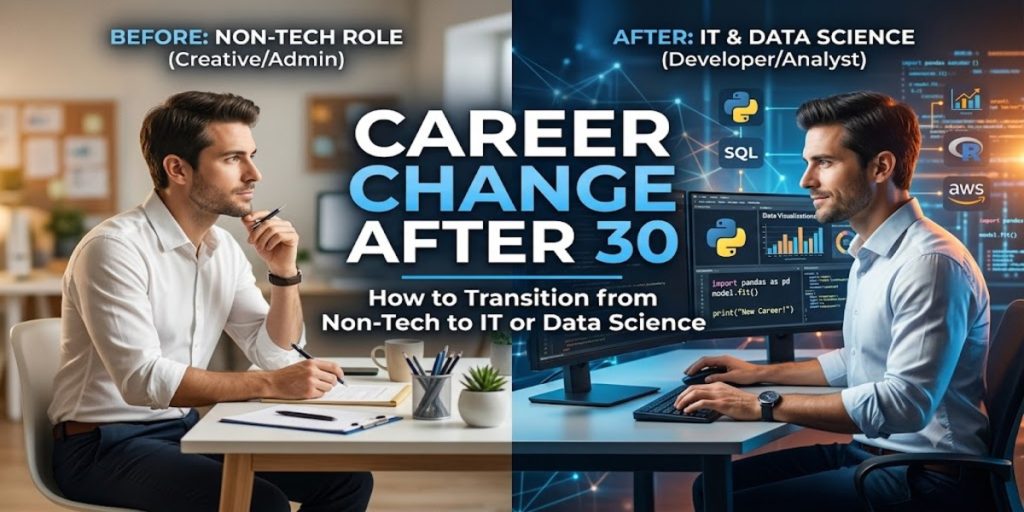
Starting to make a new career after 30 isn’t a start from scratch. Marketing, teaching, financial, retail, healthcare, sales and other professionals can pursue careers in technology by applying the existing knowledge and skills they have acquired to new technology skills.
There are various ways to enter the technology industry, such as in IT support, data analytics, QA testing, cloud management, and business analysis. Your former experience may also be beneficial. For instance, a teacher might have good communication and presentation skills, but a finance person might have previous experience with numbers, Excel and reporting.
The essence is to have a clear plan. Rather than trying to learn all about technology, select a career and learn the skills necessary for that career, create practical projects and obtain the needed experience. This guide covers how to select the right path, the skills you need to acquire, how to create a portfolio, and how to effectively showcase your experience in your job transition.
Why This Transition Works Better Than People Expect
Tech hiring has changed shape over the last several years. Fewer roles require a computer science degree, more require a portfolio and a track record of learning fast. That shift favors career changers in three specific ways.
- Domain knowledge is a shortcut, not a handicap. A former nurse who learns SQL becomes a strong candidate for healthcare analytics. A former teacher who learns product analytics understands how to explain data to non-technical stakeholders — a skill many CS graduates lack.
- “Soft skills” are actually a scarce resource. Communication, stakeholder management, and project ownership take years to build. Most 22-year-old graduates are still building them. If you’ve spent eight years managing clients, running a classroom, or coordinating logistics, you already have them.
- The entry points have multiplied. IT support, QA testing, business analysis, data analytics, and junior data engineering all offer lower-friction entry than “software engineer” or “data scientist,” and each one can be a stepping stone toward a more technical role later.
Choosing a Lane: IT or Data Science?
“Tech” isn’t one career, it’s dozens of them, and IT and data science pull on genuinely different strengths. Get this choice right before you invest months of study.
Consider IT if you enjoy:
- Fixing things and troubleshooting under time pressure
- Clear, procedural problem-solving (this broke, why, how do I fix it)
- Working directly with people who need help, not just data
- Systems, infrastructure, and how the pieces of a network or platform fit together.
Consider data science or data analytics if you enjoy:
- Finding patterns in numbers and explaining what they mean
- Working with ambiguity — questions with no single correct answer
- Statistics, experimentation, and testing hypotheses
- Storytelling: turning a spreadsheet into a decision someone else will act on
| Factor | IT (Support / Cloud / SysAdmin) | Data Science / Analytics |
| Typical entry role | Help desk, IT support, junior sysadmin | Data analyst, BI analyst |
| Time to first job-ready skill set | 3–6 months | 6–12 months |
| Core early skills | Networking basics, OS fundamentals, ticketing systems, one cloud platform | SQL, spreadsheets, one BI tool, basic statistics |
| Math intensity | Low | Moderate to high, especially past the analyst level |
| Certification value | High — CompTIA A+, Network+, AWS/Azure fundamentals are widely recognized | Moderate — certificates help but portfolios matter more |
If you’re genuinely unsure, spend two weekends on free introductory material in each CompTIA A+ overview video series for IT, a beginner SQL course for data before committing. The lane that feels engaging rather than exhausting after ten hours is usually the right one.
The Transition Roadmap
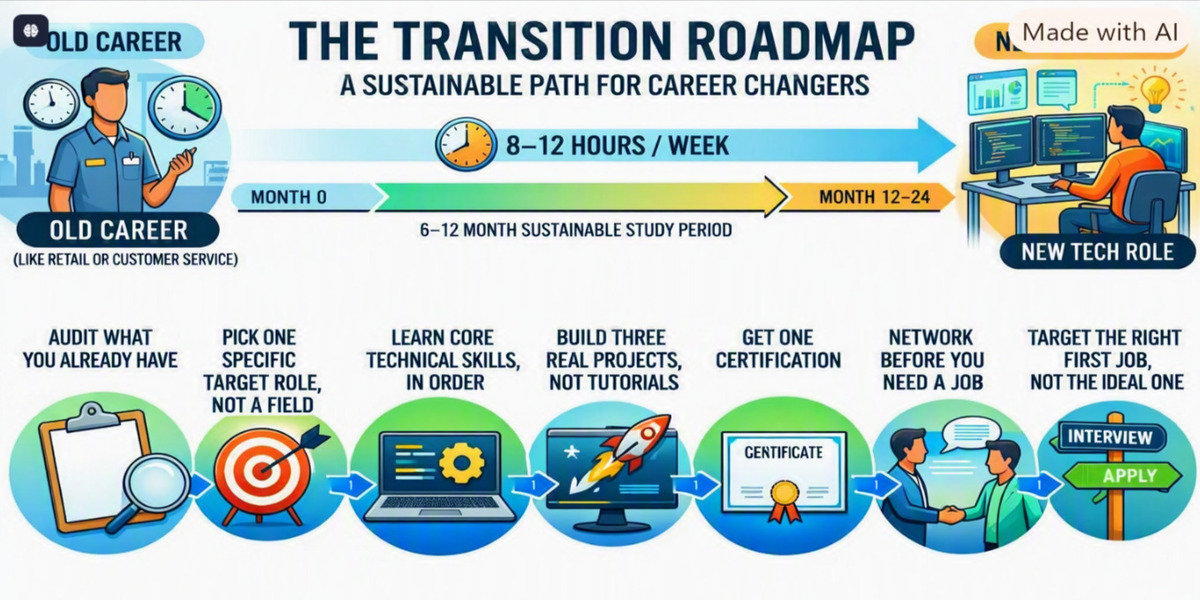
The sequence below is designed to be done alongside a full-time job. It assumes 8–12 hours a week of study, which most people find sustainable for six months to a year.
- 1. Audit what you already have
Before learning anything new, write down what your current role has already taught you that transfers: Excel modeling, client communication, project coordination, process documentation, data entry at scale, vendor management. These become talking points in interviews and, in some cases, mean you can skip early material.
- 2. Pick one specific target role, not a field
“I want to work in data” is not a plan. “I want to become a data analyst at a mid-sized company within 12 months” is. Pull five real job postings for that exact title and treat their requirements as your syllabus. This keeps you from over-studying topics that don’t matter for your first job.
- 3. Learn the core technical skills, in order
For IT: operating systems fundamentals, networking basics (TCP/IP, DNS, subnetting), then one cloud platform (AWS or Azure fundamentals), then a scripting language like Python or PowerShell for automation.
For data: SQL first it underlies almost every analytics and data science role. Then spreadsheet-level statistics, then Python or R, then a visualization tool such as Tableau or Power BI.
- 4. Build three real projects, not tutorials
A tutorial proves you can follow instructions. A project proves you can solve a problem. Use a public dataset relevant to your old industry retail sales if you worked retail, patient wait times if you worked healthcare and build something end to end: clean the data, analyze it, present a finding. Document your process on GitHub or in a short write-up. This becomes your portfolio.
- 5. Get one credible certification
Certifications won’t replace a degree or a portfolio, but they signal seriousness and pass automated résumé filters. Pick one that’s widely recognized in your lane (CompTIA A+/Network+ for IT; Google Data Analytics Certificate or a recognized SQL/Python credential for data) and stop there collecting badges is a common form of productive procrastination.
- 6. Network before you need a job
Career changers who land roles faster almost always do it through people, not job boards. Join two or three online communities in your target field, comment thoughtfully on others’ work, and reach out to people in roles you want for 15-minute conversations. Referrals bypass the automated filters that often screen out non-traditional résumés.
- 7. Target the right first job, not the ideal one
Your first tech role rarely needs to be your dream role. IT support, QA testing, data entry with analytics exposure, or a junior BI analyst position are common, legitimate entry points that lead somewhere better within 18–24 months. Optimize your first move for learning and internal mobility, not prestige or salary.
Making Your Career Change Story Work in Interviews
When explaining a career change in an interview, be clear about why you are moving into technology and how your previous experience can help in your new role. Highlight transferable skills such as communication, problem-solving, teamwork, and data handling. Also mention the courses, certifications, and projects you have completed to show that you have taken practical steps toward the transition. Focus on what you can bring to the new role rather than apologizing for your lack of direct experience.
Address the resume gap directly
If you have a period dedicated to full-time studying, name it on your resume as what it was: “Independent study Data Analytics” with the tools and projects listed underneath, not left blank or hidden.
Example:
“My marketing experience helped me develop strong analytical and communication skills. I learned SQL and Power BI and completed practical data projects. Now I want to combine my previous experience with my new technical skills in a data analyst role.”
Common Mistakes That Slow the Transition
- Tutorial hopping. Jumping between courses without finishing a project gives a feeling of progress without building proof of skill. Pick one learning path and one project format, and finish them.
- Waiting to feel “ready.” Most people apply too late, not too early. Start applying once you can talk fluently about one real project, even if your skills are still developing.
- Ignoring the job market in your target city or field. Course completions don’t equal hiring demand. Check real job postings in your area before committing months to a specific specialization like machine learning or cybersecurity.
- Underpricing yourself out of fear. Career changers sometimes accept unpaid “internships” or heavily underpaid roles. A low-paid entry role can be a reasonable trade-off for experience, but an unpaid one rarely signals the employer isn’t investing in you either.
What a Realistic Timeline Looks Like
- Months 1–2
Research roles, pick a lane, start core technical learning (SQL or networking fundamentals). - Months 3–5
Deepen technical skills, start a first project, join relevant communities, begin light networking. - Months 6–8
Finish two to three portfolio projects, earn one certification, polish resume and LinkedIn, begin applying to entry-level and adjacent roles. - Months 9–12
Active job search, informational interviews, interview practice, and — for most people who followed the steps above — an offer for a first role in the field.
The Bottom Line
Switching into IT or data science after 30 isn’t a story about starting over. It’s a story about adding a technical layer to expertise you already have. The people who do it successfully treat it like a project with a plan and a deadline, not an open-ended act of reinvention. They pick a specific role, learn the specific skills that role requires, build proof they can do the work, and put themselves in front of the people who can hire them. None of that requires being early in your career. It just requires starting.
FAQs for the Carrier Change after 30
1. Is 30 (or older) really too late to start a career in tech?
No. Tech hiring is increasingly skills-based rather than degree- or age-based. Employers care more about what you can demonstrably do — through projects, certifications, and problem-solving ability — than how old you are when you start. Many successful analysts, developers, and IT professionals begin in their 30s, 40s, or later.
2. Do I need a computer science degree to switch into IT or data science?
No. Most entry-level IT and data roles (help desk, QA testing, data analyst, junior BI analyst) prioritize practical skills, certifications, and portfolio projects over a CS degree. A degree helps for certain specialized or research-heavy roles, but it’s not a requirement for the majority of entry points.
3. How long does the transition usually take?
Most people take 6 to 12 months of part-time study and job searching while working full-time. IT roles tend to have a shorter runway (3–6 months to job-ready) than data science, which often takes 6–12 months due to the statistics and programming involved.
4. Should I choose IT or data science if I’m not sure which fits me?
Try both at a beginner level before committing. Spend a couple of weekends on introductory networking/IT support material and a beginner SQL course. IT tends to suit people who like troubleshooting and clear procedural problems; data science suits people who enjoy pattern-finding, statistics, and ambiguity.
5. What’s the single most important skill to learn first?
For IT: networking and operating system fundamentals. For data: SQL — it’s used across nearly every data analyst, BI, and data science role and is one of the fastest skills to become job-ready in.
6. Do certifications actually matter, or is a portfolio enough?
Both matter, but differently. Certifications (like CompTIA A+ for IT or the Google Data Analytics Certificate) help you pass automated resume filters and prove baseline knowledge. A portfolio proves you can actually apply that knowledge to real problems. Aim for one solid certification plus two to three real projects, not a long list of either.
7. How do I explain a career change in interviews without it sounding like a weakness?
Frame it around transferable skills and initiative, not apology. Name what your old role taught you that’s relevant (data-driven decisions, client communication, process management), then point to a concrete project or certification that shows you’ve already started doing the new work.
8. What if my resume has a gap while I was studying full-time?
Don’t leave it blank. List it as “Independent Study — [Data Analytics/IT]” with the specific tools, courses, and projects underneath, the same way you’d list a job.
9. Is it normal to take a pay cut for a first tech job?
Often, yes — especially if you’re moving from a senior non-tech role into an entry-level tech one. A temporary pay cut in exchange for real experience is usually a reasonable trade-off. Unpaid work, however, is a red flag; a legitimate employer should be paying you even at entry level.
10. Can I keep my current job while making the transition?
Yes, and most people do. The roadmap in the article above is built around 8–12 hours a week of study alongside full-time work, with active job applications starting once you have one strong portfolio project to talk about — not after you feel “fully ready.”
Read More: Government Jobs by Age Limit: Eligibility and Opportunities in 2026
📚 Related Articles



👉 You May Also Read
📚 Related Articles
- Study Abroad or Build Your Career in India? What to Compare in 2027
- 15 Best High-Demand Careers in India to Consider in 2027
- Best Computer Skills to Learn for Government Jobs in India
- Government Jobs Without UPSC or SSC: Career Options, Eligibility and Opportunities in India
- How to Build a Career in Data Analytics Without a Computer Science Degree
🔥 Popular Posts


📌 Explore Categories
- About India
- Artificial Intelligence & Machine Learning
- Calendar
- Career
- Counselling
- Current Affairs
- Economy
- Education
- English Grammar
- Exams
- Festival
- Health and Fitness
- Hindi Sahitya
- History
- Intelligence Agency
- International Personality
- Know India
- Knowledge
- Maths
- Maxim
- Moral Stories
- Nature
- NEWS
- Olympiad
- Others
- Personal Finance
- Personality Development
- Politics
- Scholarship
- Science and Environment
- Sports
- States of India
- Study Abroad
- Study Tips
- Technology
- The Greatest Indian
- Uncategorized