
Government Jobs by Age Limit: Eligibility and Opportunities in 2026
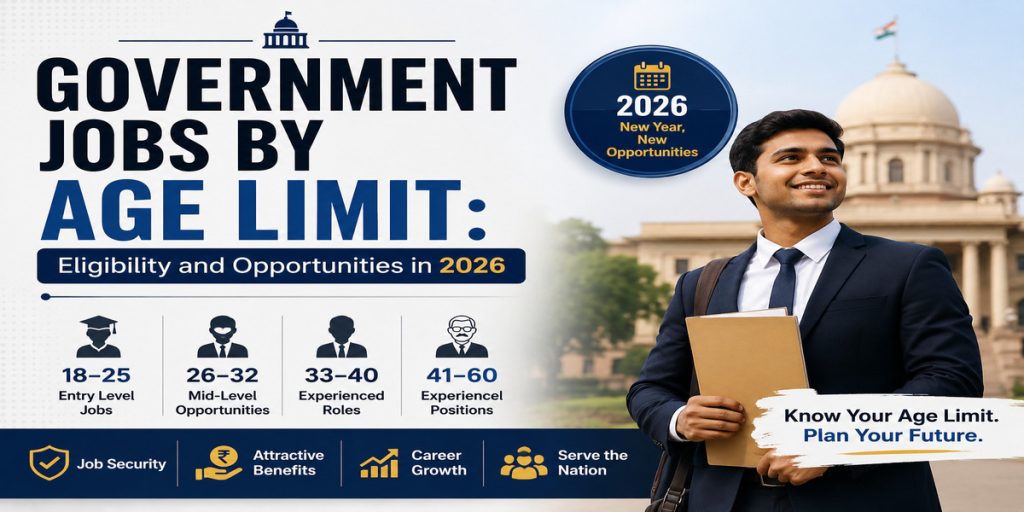
Government jobs continue to be one of the most popular employment options in India because of their job security, regular salary, pension benefits, and promotion prospects. However, one of the most frequent doubts of aspirants is age eligibility. Countless candidates are discouraged from applying for Government positions – or even from preparing for them – every year because they think that they have surpassed the age limit for government recruitment.
Actually, there are opportunities to work in government jobs in all age groups. As long as it is 18, 25, 30, 35 or more than 40 years old, depending on qualification, category and specific recruiting body, there are several routes available. It provides clarity on age eligibility for various major sectors of the government in 2026, minimum age, maximum age, relaxations by category & others that are still available at various ages.
The Role of Age Criteria in Public Sector Recruitment
In almost every government job notification age is one of the most basic eligibility criteria. A candidate may be able to satisfy all of the requirements and preparation requirements, but if he/she exceeds the upper age limit, he may be disqualified.
Age criteria are established by Government departments to achieve a balanced workforce structure, training suitability and for long-term service tenure. But age relaxation for reserved categories and exceptions, if provided on a case to case basis, can extend eligibility well beyond the grasp of most candidates who think that they are “too old” to apply for the exam.
Common Myths About Age Eligibility
- I’m more than 30 and missed my chance. There are numerous tests, positions and jobs in the PSU system that are still available even after 30 years.
- The age relaxation is applicable only to reserved categories. The category-wise relaxations are the highest but a few exams also provide relaxation to the Government employees, Ex-Servicemen and PWDs irrespective of the category.
- The age limit is the same in all government exams. Age restrictions are department, post and even exam level dependent.
Minimum Age Limit for Government Jobs in India
Most government jobs in India set the minimum eligible age at 18 years, though this varies depending on the department and nature of the role.
| Exam / Sector | Minimum Age |
| SSC Exams | 18 Years |
| Railway (RRB) Exams | 18 Years |
| Banking Exams | 20 Years |
| UPSC Civil Services | 21 Years |
| Defence – NDA | 16.5 Years |
| Teaching Jobs | 18–21 Years |
Understanding the minimum age requirement early helps students align their graduation timeline with their intended competitive exam strategy, particularly for exams like NDA that accept candidates while still in Class 12.
Maximum Age Limit for Government Jobs in 2026
Upper age limits vary widely depending on the examination and the level of government (central vs. state). Central government exams generally enforce stricter upper-age limits than state-level recruitments.
| Sector | Typical Maximum Age |
| SSC Exams | 27–32 Years |
| Banking Exams | 28–30 Years |
| UPSC Civil Services | 32 Years |
| Railway Jobs | 30–33 Years |
| State PSC Exams | 35–40 Years |
| Teaching Jobs | 35–40 Years |
| PSU & Specialist Roles | 40–45 Years |
Notably, several state-level recruitments, PSU vacancies, contractual roles, and teaching positions remain open to candidates well above 40 years of age, making age far less of a barrier than commonly assumed.
Age Relaxation Benefits for Reserved Categories
The Government of India provides upper-age relaxation for candidates belonging to reserved categories, ensuring equitable access to public sector employment.
| Category | Typical Age Relaxation |
| SC / ST | 5 Years |
| OBC (Non-Creamy Layer) | 3 Years |
| Persons with Benchmark Disabilities (PwBD) | 10 Years |
| Ex-Servicemen | As per applicable service rules |
| Existing Government Employees | Department-specific |
Example: How Relaxation Changes Eligibility
If the general upper age limit for an SSC exam is 30 years:
- SC/ST candidates may apply up to 35 years
- OBC candidates may apply up to 33 years
- PwBD candidates may apply up to 40 years, depending on specific rules
Because relaxation clauses differ between departments and exam notifications, candidates should always verify the exact relaxation applicable to their category in the official notification before assuming ineligibility.
Age Eligibility for SSC Recruitment Exams in 2026
The Staff Selection Commission (SSC) conducts several of India’s most popular central government recruitment exams, offering strong job stability and structured career growth.
Combined Graduate Level (SSC CGL)
Recruits for posts such as Income Tax Inspector, Assistant Section Officer, Auditor, and Central Excise Inspector.
- Minimum Age: 18 Years
- Maximum Age: 27–32 Years (varies by post)
Combined Higher Secondary Level (SSC CHSL)
Designed for 12th-pass candidates targeting clerical and administrative roles.
- Minimum Age: 18 Years
- Maximum Age: 27 Years
Multi-Tasking Staff (SSC MTS)
- Minimum Age: 18 Years
- Maximum Age: 25–27 Years
General Duty Constable (SSC GD)
- Minimum Age: 18 Years
- Maximum Age: 23 Years
Stenographer Grades C and D
| Grade | Age Range |
| Grade C | 18–30 Years |
| Grade D | 18–27 Years |
Age Eligibility for UPSC Examinations in 2026
UPSC examinations remain among the most prestigious and competitive government recruitment routes in India.
The Civil Services Examination (CSE)
| Category | Maximum Age | Number of Attempts |
| General | 32 Years | 6 Attempts |
| OBC | 35 Years | 9 Attempts |
| SC / ST | 37 Years | Unlimited (up to age limit) |
The Civil Services Examination recruits for premier services including:
- Indian Administrative Service (IAS)
- Indian Police Service (IPS)
- Indian Foreign Service (IFS)
- Indian Revenue Service (IRS)
- Other Group A and Group B Central Services
Additional UPSC Recruitment Exams
| Exam | Age Range |
| UPSC CDS | 19–25 Years |
| UPSC NDA | 16.5–19.5 Years |
| UPSC CAPF | 20–25 Years |
Given the vast syllabus and demanding selection process, UPSC aspirants are generally advised to begin structured preparation well in advance of reaching the upper age boundary.
Age Eligibility in the Banking Sector for 2026
The banking sector still lures large crowds of candidates because of its lucrative salary packages, high job mobility, and a defined career path.
| Exam | Minimum Age | Maximum Age |
| IBPS PO / SBI PO | 20 Years | 30 Years |
| IBPS Clerk / SBI Clerk | 20 Years | 28 Years |
| RBI Grade B | 21 Years | 30 Years (34 Years for PhD holders) |
| NABARD Grade A | 21 Years | 30 Years |
Several Specialist Officer roles in public sector banks extend the upper age limit up to 35 years, particularly for candidates with relevant professional experience — making banking a viable path even for slightly older aspirants.
Age Eligibility for Indian Railways Recruitment in 2026
Indian Railways is one of the largest employers in the country, offering strong job security and a wide range of technical and non-technical roles.
| Exam | Age Range |
| RRB NTPC | 18–33 Years |
| RRB Group D | 18–33 Years |
| RRB JE | 18–33 Years |
| RRB ALP | 18–30 Years |
Railway recruitment is particularly attractive due to strong job security, travel benefits, structured pension schemes, and consistently high vacancy volumes. For candidates above 30 years, reserved category relaxations often meaningfully extend eligibility.
Age Eligibility for Defence Sector Recruitment in 2026
Defence careers appeal to candidates seeking disciplined work environments, leadership roles, and opportunities for national service.
| Exam | Age Range |
| Indian Army Agniveer | 17.5–21 Years |
| Indian Navy SSR | 17–21 Years |
| AFCAT (Flying Branch) | 20–24 Years |
| AFCAT (Ground Duty) | 20–26 Years |
| Territorial Army | 18–42 Years |
The Territorial Army stands out as one of the few defence-related opportunities specifically suited to working professionals seeking part-time national service later in their careers.
Age Eligibility for Teaching Positions in 2026
Teaching careers offer some of the most flexible age eligibility criteria among all government job categories.
| Post / Exam | Maximum Age |
| CTET / TET | No fixed upper limit in many states |
| KVS – PRT | 30 Years |
| KVS – TGT | 35 Years |
| KVS – PGT | 40 Years |
| DSSSB Teaching Roles | 21–36 Years |
Because of this flexibility, teaching remains one of the most accessible government career paths for candidates seeking stability at a later career stage.
Matching Career Options to Your Current Age Bracket
Opportunities Available Past the Age of 30
Crossing 30 does not close the door to government employment. Candidates above 30 can still pursue:
- State PSC Examinations
- Teaching Positions
- Specialist Officer Roles in Banking
- Railway Departmental Recruitments
- PSU Vacancies
- Insurance Sector Roles
- Territorial Army
- Judiciary Services
Reserved-category candidates in particular often remain eligible for several SSC and banking exams well beyond age 30.
Opportunities Available Past the Age of 35
Several meaningful opportunities remain available past 35, especially for candidates with relevant experience:
- State PSC Recruitment
- Teaching and Lecturer Positions
- PSU Management Roles
- Research Institute Positions
- Judicial and Legal Officer Roles
- Railway Supervisory Posts
- Territorial Army
At this stage, aspirants are generally better served focusing on role-specific opportunities rather than general competitive exams with strict upper-age ceilings.
Opportunities Available Past the Age of 40
Government opportunities continue even beyond 40, particularly in specialized, senior, and experience-driven roles:
- State Administrative Positions
- Teaching and Professorial Roles
- Public Sector Undertaking (PSU) Positions
- Research Organization Roles
- Consultancy Assignments
- Legal and Judicial Services
- Medical Sector Recruitment
Many universities, PSUs, and government institutions prioritize domain experience over age for senior-level positions, making this stage viable for professionals transitioning from private-sector careers.
Roles That Impose No Fixed Upper Age Ceiling
A small but valuable set of opportunities either apply flexible upper-age criteria or have no fixed limit at all:
- CTET Qualification-Based Roles
- Research Fellowships
- University Professor Positions
- Contractual Consultant Roles
- Medical Specialist Positions
- Guest Faculty Roles
Even so, every individual recruitment notification should be checked carefully, as terms can vary by institution and state.
Understanding How Your Eligible Age Is Determined
Government departments calculate a candidate’s age based on the cut-off date specified in the official recruitment notification — not the date of application or exam.
Key rules to keep in mind:
- The date of birth recorded on the 10th-grade certificate is treated as the final, authoritative record.
- Any mismatch between documents (birth certificate, Aadhaar, school records) can lead to application rejection.
- Age is calculated as of the specific cut-off date mentioned in the notification, not the exam date.
- Category-based relaxation benefits require valid, verifiable supporting certificates submitted within the specified timeframe.
Maintaining accurate and consistent educational and identity documentation well before applying can prevent avoidable disqualification at a later stage.
Building an Effective Preparation Plan
Understanding eligibility is only the first step — success ultimately depends on consistent, well-structured preparation.
Step 1: Understand the Exam Pattern
Every exam differs in sections, difficulty level, and marking scheme. Reviewing the detailed syllabus and exam pattern before starting preparation prevents wasted effort on irrelevant topics.
Step 2: Commit to a Structured Daily Timetable
A daily study plan improves consistency, reduces last-minute syllabus backlog, and helps balance preparation across multiple subjects.
Step 3: Make Mock Tests a Regular Habit
Mock tests build:
- Accuracy under exam conditions
- Speed and time management
- Familiarity with the actual exam interface
- Confidence going into the real exam
Step 4: Work Through Previous Years’ Question Papers
Previous years’ papers reveal recurring question patterns, typical difficulty levels, and commonly tested topics — helping prioritize study time effectively.
Step 5: Never Underestimate Consistent Revision
Consistent revision, rather than last-minute cramming, is essential for long-term retention and reliable exam-day performance.
At-a-Glance Summary: Age Limits by Sector
| Sector | Minimum Age | Typical Maximum Age | Notable Flexibility |
| SSC | 18 Years | 27–32 Years | Category relaxation up to 10 years (PwBD) |
| UPSC Civil Services | 21 Years | 32 Years | Up to 37 years for SC/ST |
| Banking | 20 Years | 28–30 Years | Up to 35 years for Specialist Officers |
| Railways | 18 Years | 30–33 Years | Category relaxation extends eligibility |
| Defence | 16.5 Years | 21–26 Years | Territorial Army up to 42 years |
| Teaching | 18–21 Years | 35–40 Years | Several roles with no fixed upper limit |
| State PSC / PSU | Varies | 35–45 Years | Widest flexibility for experienced candidates |
Final Thoughts
Government job opportunities in India are not confined to a single age group. From SSC and Banking exams to UPSC, Railways, Teaching, and PSU recruitments, viable paths exist for candidates across a wide range of ages — from 18 to well beyond 40. The key lies in correctly understanding eligibility rules, applying category-based relaxations where applicable, selecting the right exams for one’s current life stage, and preparing with a consistent, structured strategy.
Many aspirants lose out on genuine opportunities simply by assuming they are no longer eligible. Rather than relying on assumptions, candidates should always verify the exact age criteria in the official notification for each exam and plan their preparation around their qualification, category, and career goals. With the right strategy and consistent effort, a stable and rewarding government career remains well within reach in 2026 and beyond.
FAQS for The Government Jobs by Age Limit: Eligibility and Opportunities in 2026
1. What is the minimum age to apply for a government job in India?
Most government jobs set the minimum eligible age at 18 years. However, this varies by sector — banking exams typically require candidates to be at least 20, UPSC Civil Services requires 21, while defence exams like NDA accept candidates from 16.5 years onward.
2. What is the maximum age limit for government jobs in 2026?
There’s no single upper limit across all government jobs — it depends on the sector. SSC exams typically cap at 27–32 years, UPSC Civil Services at 32 years, while state PSC exams, teaching roles, and PSU positions can extend up to 40–45 years depending on the post and category.
3. How much age relaxation is available for reserved categories?
Typical relaxation is 5 years for SC/ST candidates, 3 years for OBC (Non-Creamy Layer), and up to 10 years for Persons with Benchmark Disabilities (PwBD). Ex-servicemen and existing government employees may also receive relaxation as per applicable service rules.
4. Can I still apply for government jobs after turning 30?
Yes. Many opportunities remain open past 30, including State PSC exams, teaching positions, Specialist Officer roles in banking, PSU vacancies, and Railway departmental recruitments — especially with category-based relaxation applied.
5. Are there government jobs available for candidates above 40?
Yes. Several senior and experience-driven roles remain accessible past 40, such as teaching and professorial positions, PSU management roles, research organization posts, consultancy assignments, and legal or judicial services.
6. Which government exams have no fixed upper age limit?
Roles like CTET qualification-based positions, research fellowships, university professor posts, contractual consultant roles, and guest faculty positions often carry flexible or no fixed upper age criteria — though this varies by state and institution.
7. How is age calculated for government exam eligibility?
Age is calculated based on the cut-off date mentioned in the official recruitment notification — not the date of application or the exam date itself. The date of birth on your 10th-grade certificate is treated as the authoritative record.
8. What happens if there’s a mismatch in my date of birth across documents?
A mismatch between your birth certificate, Aadhaar, and school records can lead to application rejection. It’s important to ensure your documents are consistent well before applying.
9. Do all UPSC exams have the same age limit?
No. UPSC Civil Services allows up to 32 years (general category, extending to 37 for SC/ST), while other UPSC exams differ — CDS requires 19–25 years, NDA requires 16.5–19.5 years, and CAPF requires 20–25 years.
10. Which sector offers the most flexible age eligibility for older candidates?
Teaching consistently offers the widest flexibility, with several posts like CTET-based roles having no fixed upper age limit in many states. State PSC and PSU recruitment also tend to extend well beyond 35–40 years.
11. Can government employees get extra age relaxation for other government exams?
Yes, in many cases. Existing government employees are often granted department-specific age relaxation when applying for other government positions, though the exact benefit varies by recruiting body.
12. Is it better to check the official notification instead of relying on general age limit guides?
Yes, always. While general guides (like this one) provide a reliable overview, exact age criteria, relaxation clauses, and cut-off dates can differ notification to notification — the official recruitment notice remains the final authority.
Read More: SSC CGL 2024: Golden opportunity for government job with 18,000+ vacancies
📚 Related Articles




👉 You May Also Read
📚 Related Articles
- How to Build a Career in Data Analytics Without a Computer Science Degree
- Business After 30 or a Stable Job: Which Path Should You Choose?
- How to Return to Work After a Career Break: Skills, Jobs and Preparation in 2026
- Best Career Options After Class 12 for Average Students in 2026
- Career Change After 30: How to Transition from Non-Tech to IT or Data Science
🔥 Popular Posts

📌 Explore Categories
- About India
- Artificial Intelligence & Machine Learning
- Calendar
- Career
- Counselling
- Current Affairs
- Economy
- Education
- English Grammar
- Exams
- Festival
- Health and Fitness
- Hindi Sahitya
- History
- Intelligence Agency
- International Personality
- Know India
- Knowledge
- Maths
- Maxim
- Moral Stories
- Nature
- NEWS
- Olympiad
- Others
- Personal Finance
- Personality Development
- Politics
- Scholarship
- Science and Environment
- Sports
- States of India
- Study Abroad
- Study Tips
- Technology
- The Greatest Indian
- Uncategorized