Moral Story: Wickedness Brings In Ruin

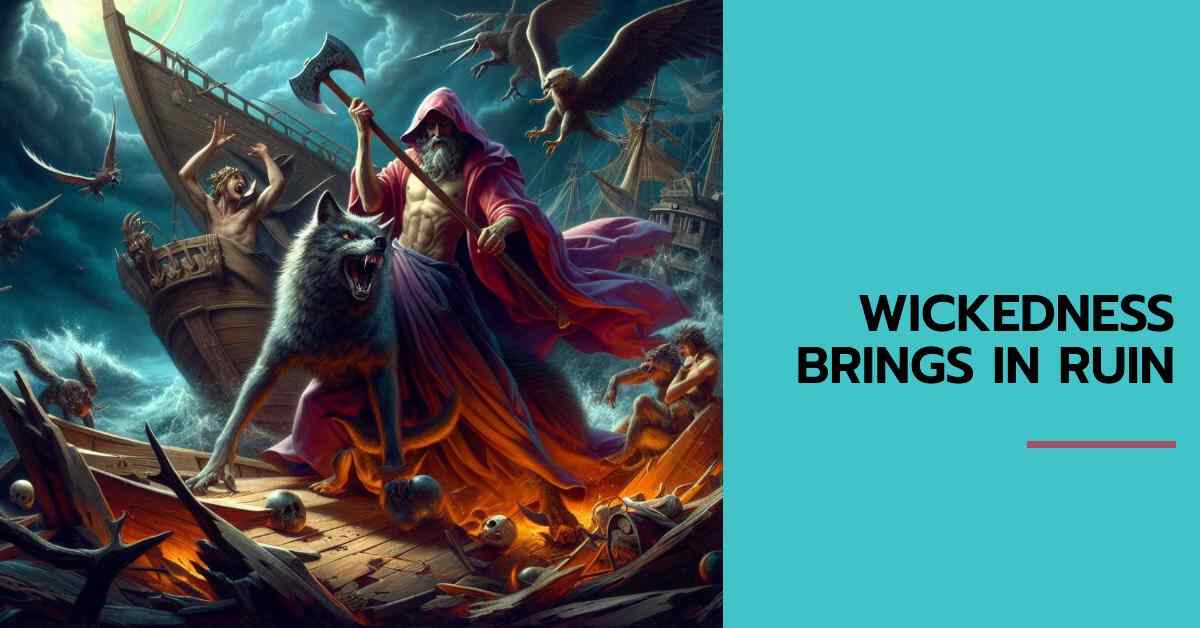
Wickedness Brings In Ruin

Once a wolf was roaming in search of prey in a forest. He came near a village that stood   at the edge of the forest. There he saw a flock of sheep grazing in a pasture.

While the wolf was planning to kill a sheep, he found a sheep -skin lying by the foot -path. It was of a sheep that must have been killed by some fierce animal some days before. Seeing the sheep -skin, a wicked idea struck the wolf. He thought of wearing it and slipping into the flock. He was sure that it would be an easy way to get a prey.

As soon as the wolf got into the flock, the shepherd drove it to the village. Reaching there he enclosed it in the pen and shut the door fast. Just then his wife came and said, “I have nothing to cook for dinner. So, kill one sheep for me.”

The shepherd went into the pen and looked for a fat sheep. Mistaking the disguised wolf for a meaty sheep, he killed him with his axe. The wickedness is its own punishment.

Also Read: Much wants more but loses all

Uttarakhand – A destination to Adventure Sports Lovers

Introduction

Uttarakhand boasts of a rich flora and fauna and is home to some of the most beautiful pilgrimage destinations in the country. Because of the location of this state in the western Himalayas, the state has a lot to offer to the adventure sport lovers.

Capital

Dehradun is the official capital of Uttarakhand and is also the largest city in the state. The city has the headquarters of many National Organizations and Institutes like Survey of India, Forest Research Institute, ONGC and Indian Institute of Petroleum.

Culture

Uttarakhand has a rich cultural history dating back to the prehistoric times. The state is a storehouse of art and paintings. Wood carving and stone carving are two well known art forms found in the state. Wood carving can still be seen in many temples located in the state.

Weather

Uttarakhand experiences very cold winters and summers rarely exist here. The weather is pleasant because of the Himalayas, which act as a natural coolant. The winters also bring snowfall in the state which makes the place even more beautiful.

Lifestyle

The folks of Uttarakhand have a colorful and cultured lifestyle. Different traditions and customs are followed by people belonging to different religions which make their lifestyle even more unique.

Major crops grown

Agriculture is not a much profitable work in the state because of the undulating topography and lack of means of irrigation. The major crops grown here are rice, wheat, sugarcane, soybean, maize, oilseeds and pulses.

Costume and ornaments

People of Uttarakhand wear dresses that are economical, simple as well as suited for the hilly region. Rangwali Pichora is a garment worn by the women on special occasions and during festivals. Men mostly wear dhoti or lungi teamed up with a Kurta.

Major festivals

Mostly all the major Indian festivals are celebrated by the people of Uttarakhand. Other festivals that hold importance include bhitauli, basant panchami, phool dei, harela, the nanda devi fair, , the purnagiri fair and the haathalika fair.

Tourist attractions

The state of Uttarakhand is blessed with a lot beautiful places, including snow-clad peaks, shrines and other holy places. The picturesque views of the Himalayas are worth watching. Other places of interest include Kedarnath, Badrinath, Corbett national park, Gangotri and Yamunotri.

Kinds of homes

The rural population resides in small linear villages. The rural houses generally have two stories in which the lower floor is used for keeping animals. They have access to basic amenities. The urban population resides in well built houses with all the modern facilities.

Famous personalities

Bachendri Pal, the first Indian woman to reach the top of the Everest was born in Uttarakhand. Abhinav Bindra, shooter and Olympic gold medalist are also from this state. Other famous personalities include Sunder Lal Bahuguna, a social activist and Mahendra Singh Dhoni.

PEOPLE HATE WHAT THEY CANNOT GET

PEOPLE HATE WHAT THEY CANNOT GET

Once upon a time a hungry fox was roaming in search of food. He was feeling weak and tired due to hunger. Luckily he came to a garden. There he saw a grape -vine laden with bunches of grapes. They looked quite ripe and juicy.

The fox looked at the grapes with longing eyes and licked his chops. He was sure that he would eat them up and appease his hunger. But he was feeling weak.

So, the fox sat down for a while to take rest. Then feeling refreshed he jumped as high as he could to get at the grapes. But alas! The bunches were too high for him.

The fox once again rested for a while and made another bold attempt. But he failed to reach the grapes this time too. Forced to give up trying anymore, he walked away. Instead of owning his failure, he remarked with an air of dignity, “I thought those grapes to be ripe and juicy. But now I see that they must be quite sour.”

Also Read: The Wise are Seldom Taken In

Moral Story: Be Ever-Ready for the Worst

Moral Story: Be Ever-Ready for the Worst

Moral Story: One day a fox was roaming about in a thick forest in search of food. Suddenly he caught sight of a wild boar. The boar was rubbing his tusks against the trunk of a tree.

The fox looked about carefully but he couldn’t see any danger for the boar anywhere. Despite his wisdom, he couldn’t follow why, after all, the boar was doing that.

Unable to control himself, the fox went to the boar and asked, “Why are you doing that, Mr Boar? The hunters are not out today and I see no other danger as well.”

“You are perfectly right my friend;” replied the boar, “but will it be wise to dig a well when a fire has broken out? We are living in a forest where enemies are there at every step. Who knows when I’ll have to face an enemy and use my tusks against him? If I don’t do it now, I may not get any time to sharpen my tusks when I need them most?”

Always be prepared for the worst that can happen.

Also Read: Moral Story: The Wise are Seldom Taken In

Tripura – A state having ethnic mix of Tribals and Bengalis

Introduction

Located in an extreme corner, Tripura is bounded by Bangladesh and Assam on its sides. Tribal culture and folk music is prevalent in the state. Tripura has places of religious and archaeological importance that were earlier possessed by Maharaja’s and emperors until the country got independence.

Capital

Agartala is the capital city of Tripura. It is the second largest city is the north eastern India right after Guwahati. The city perches on the banks of river Haora and is located just 2 km away from the border of Bangladesh.

Culture

Art and craft of Tripura is very popular. Risha, Pachra and other hand woven products are demanded all over the country. Other famous craftwork is the cane and bamboo furniture.

Weather

Tripura experiences the subtropical humid type of climate with rainfall occurring during most part of the year. The average summer temperature is 28 degrees while the average winter temperature ranges between 13-18 degrees. Some areas in the state get flooded during the rainy season.

Lifestyle

Tripura has a very unique style and aura. People there are not as modest as Mumbaikars but they happily live the way they like. Clothing is simple, the weather is pleasant and agriculture earns the economy of the state.

Major Crops Grown

Tripura is a very small state and doesn’t contribute much to the country’s economy. Basically the state is popular for animal husbandry and Jhum cultivation. Other than this the crops grown here are cotton, rubber, tea, coconut, Mesta, pineapple, jackfruit, orange, etc.

Costume & Ornaments

The men generally wear a towel like cloth called ricottaJamaica with shirts accompanied by the turban. Women wear a long skirt like cloth called rinai and a short cloth as a top known as risa.

Major Festivals

KharchiPuja which is a weeklong Puja is amongst the most popular festivals of Tripura. Other important festivals include Ker puja, Garia puja and Ashokastami festival.

Tourist Attractions

Tripura has some amazing places for travellers to look through. Places like Kamalasagar, Udaipur, Agartala, Pilak, Neermahal, Damboor Lake, Jampui hill gather tourists’ attention.

Kinds of homes

Tripura is a hilly region and thus the rains are extreme. Accordingly, people of the state make their houses in order to keep themselves safe from floods and landslides.

Famous personalities

Abbas Ali, cricketer and Swami Shanti Kali Maharaj, famous Hindu priest.

Manipur – Jewel of India

Introduction

Manipur is a beautiful state set in the lap of the Himalayas. Because of its location, it is also known as the ‘Jewel of India’. Since 1956, Manipur has been a union territory and it was declared a state in 1972. The state is surrounded by beautiful hills, swamps and innumerable small rivers.

Capital

Imphal is the official capital of the state of Manipur. The city boasts of some beautiful locations and picturesque landscapes. Imphal is an ideal place for people who cherish the calm nature far from the hustle and bustle of urban life. The well built temples and ancient relics speak much about the past of Imphal.

Culture

People from India as well as abroad are well known to Manipur mainly because of its rich culture and art. The Manipuri dance is very famous because it is different from other art forms of the country. The Manipuri handlooms are colorful and varied. The local craftwork includes bed sheets and covers, saris and gowns, tribal shawls, curtains and screens.

Weather

Manipur experiences moderate type of climate almost throughout the year. The climate changes with the change in altitude. Maximum temperature doesn’t go beyond 35 degrees while winter temperatures drop down to as low as 0 degrees.

Lifestyle

The people of Manipur live a very simple and basic lifestyle. The beautiful state of Manipur has been untouched by the development and so is the life of the people. Rice and fish are the staple food of the people.

Major crops grown

Productivity in agriculture is generally low because of poor farming practices like shifting cultivation and improper use of fertilizers. Paddy is the main crop grown in the state. Rice grown in Manipur is sweet in taste. Other crops grown here include pulses, tea, wheat, orange and coffee.

Costumes and ornaments

Manipuri costumes are simple and easy to wear. The outfit for women consists of a phanek and a cloth around the skirt known as sarong. This is accompanied by a shawl locally known as innaphi. The male attire consists of a jacket and dhoti along with a white turban.

Major festivals

For the folks of Manipur, festivals symbolize their culture and ethnic values. The celebration of festivals goes on round the year. Every month or two, a festival is celebrated here. The major festivals celebrated here include Ningol Chakouba, Yaoshang, Gang-Ngai, Chumpa, Christmas, Kang and Cheiraoba.

Tourist attractions

Manipur is surely a fascinating tourist destination for people who love to explore more. The capital of Manipur is itself so beautiful and incredible that one should not miss seeing it while on a trip to Manipur. Major tourist attractions in the state include Shri Shri Govindaji temple, Kangla, Manipur State Museum, War cemetery and Loukoi Pat.

Kinds of homes

The Manipuris construct their dwelling place on the plains and not in the mountains. They live in traditional houses known as Inchau which is made up of woods and bamboo. Tin is also used for building houses. The people of Manipur love to stay in the houses that have been built with the traditional pattern.

Famous personalities

Manipur has given a lot of sportsperson to the country. One of them is Mary Kom. She is 5 times world boxing champion. Other famous people of Manipur are Laishram Devendro Singh, Kothajit Singh and Laishram Bombayla Devi.

Kerala – Spice Garden of India

Introduction

Kerala has always been known for its rich sources and marvellous places. It is often called the ‘spice garden of India’ because of the variety of spices it delivers to the nation. Located between the Lakshadweep Sea and the Western Ghats, Kerala is considered to be one of the peaceful and cleanest states of India. 

Capital

Thiruvananthapuram is the capital of Kerala which is also known as Trivandrum. It is a beautiful city located in the utmost south of the state. The city is regarded as the ‘evergreen city of India’ and is responsible for about 80% of all exports of software.

Culture

Kerala has always been a state of rich cultural heritage, with folk dance as its prime form of art. People here were of Dravidian culture which was related to Tamil primarily.

Weather

Weather conditions remain hot, humid and sultry for the most part of the year because it is located in the southernmost part close to the equator. It receives moderate rainfall and that is the time when it is most suitable for tourism.

Lifestyle

People in Kerala have very different lifestyles. They have bright, big temples everywhere and music and folk dance are very common.

Major Crops Grown

Kerala contributes about 63.8% to the total economy in all the major sectors. The main crops grown in Kerala are rice, rubber, tea, coconut, and spices like cardamom, pepper, and cinnamon. The minerals found in the state are bauxite, quartz, silica and many more.

Costume & Ornaments

The clothes worn by the people of Kerala are usually simply because of the hot and humid climate. Generally, women are seen in saris which are loose and placed over the head. Their attire is traditionally called Mundum Neriyathum. Men wear Mundu, which reaches the ankle.

Major Festivals

The most famous festival celebrated in Kerala is Onam. Vishu, Navratri, Diwali, mahashivratri, Easter and Christmas are among the other festivals.

Tourist Attractions

Kerala is a beautiful place which has got amazing ambience, vast stretch of greenery, lowland areas, glowing lakes and huge mountains. It has many spots that attract tourists from all over the globe. The natural history museum, zoological garden, Pu the Maliga Palace Museum, Neyyar dam, Kovalam which is a tiny beach in the capital that astonishes travellers with its beauty.

Famous personalities

Kerala has been home to many famous personalities. Kings and rulers like Raja Kesavadas, Rama Varma Kulashekhara and faces like the K.R.Narayanan-10th president of India, A. K. Antony and Shashi Tharoor are known to everyone.

SLOW AND STEADY WINS THE RACE

Once a hare went to a pool to quench his thirst. There he chanced to see a slow -moving   tortoise and mocked at it. The tortoise felt pinched and challenged the hare to a race.

The hare accepted the challenge with a smile and a day was fixed for it. On the fixed day, the race began early in the morning. As expected, the hare left the tortoise far behind.

Soon the hare felt bored. So, he stopped and began eating blades of green grass. Having had his fill, he felt sleepy. Seeing a shady bush nearby, he lay down under it. As the tortoise was quite away behind, he had no worry from his side.

As for the tortoise, he plugged along at his slow place and overtook the sleeping hare. Passing by him silently, he got to the winning point. 

When the hare awoke, it was fairly late. He feared that the tortoise might have passed by him. So, he ran at break –neck speed but only to find his rival already there as a winner.

ONE IN-HAND IS WORTH TWO IN-BUSH

One day a fisherman went fishing to a river as usual. He cast his net into the river and sat waiting for the fish to get into it. He expected a very good catch. 

After some time, the fisherman drew the net up and saw one single tiny fish into it. Taking the fish out, he put it into his basket. He was going to cast his net again into the river when the tiny fish begged him, “Please, sir, put me back into the river otherwise I shall die.”

“Why after all?” asked the fisherman.

“I am only very small now. So, I am of little use for you. But after a few days, I shall grow fairly big. You can catch me again then I shall be more useful at that time,” replied the fish.

“Oh no! I won’t leave you now that I have caught you. Because if I put you back into the river, I may never catch you again.  But I am not going to be that foolish in any case. It is said that the certain must never be given up for the uncertain.”

Rajasthan – A State of Desert

Introduction

Rajasthan is a state of Kings and emperors. It has got beautiful palaces and forts that reflect the previous era. Here men are seen with long mustaches and women in formal ghagras. Shimmering temples and iconic landscape make the state stand out.

Capital

Jaipur is the capital of Rajasthan is the largest city of northern India. The city is known as the ‘ Pink City’ because of the vibrant colors of buildings and monuments. It is the most famous tourist destination of the state.

Culture

Rajasthani culture has always been dominated by folk music which also has got international recognition. Famous musical instruments like Sarangi sitar and tabla are part of almost every folk song and ballad which relates the history and Rajputani culture. Handicraft works like the Zari products, wooden furniture and embroidery are exported all over the country.

Weather

The climate of Rajasthan is semi-arid. Because of the deserts, the day temperature rises while the night temperatures fall abruptly. During summers the maximum, temp. recorded 49 degrees and for winters, it’s 7-8 degrees.

Lifestyle

Rajasthani men and women have their different attire and they believe in simple living. The villages still have Panchayats where they follow the commands of the Mukhiya.

Major Crops Grown

Rajasthan is home to many small scale industries and is the largest producer of cotton. Other than this, other major crops that are grown in the state are maize, Bajra, wheat, jowar, barley, gram and pulses. Fruits are also grown like guava, orange, mango, pomegranate and lemon.

Costume & Ornaments

People of Rajasthan like to wear colorful clothes from head to toe. The female clothing includes ghagra teamed up with a kurta and dupatta. The men on the other hand, are seen in dhoti Kurta and a white turban.

Major Festivals

The camel festival is celebrated in Rajasthan annually during the month of December or January. Other festivals are Nagaur fair, Elephant festival, Mewar festival, Mahashivratri, Holi and Guru Purnima.

Tourist Attractions

Rajasthan has some unobtrusive spots and is a perfect mix of culture and beauty. Against the magnificent dessert stand an array of camels that look picturesque at times. Forts like Chittorgarh fort, City palaces, Dilwara temples and carved havelis and temples like the Jaisalmer Havelis are all part of the beautiful state. Famous tourist destinations are Jaisalmer, Jaipur- the pink city, Bikaner, Ranthambore Tiger Reserve, Udaipur, Kanak Valley and Ajmer.

Kinds of homes

Houses in Rajasthan are made in order to reflect the scorching heat which prevails almost throughout the year.

Famous personalities

Bhairon Singh Shekhawat- VP of India, and also CM of Rajasthan, Jaswant Singh, Sachin Pilot, Gayatri Devi and many more were born in Rajasthan.