HSSC CET Haryana 2025: Admit Card, Exam Dates, Fees, and More

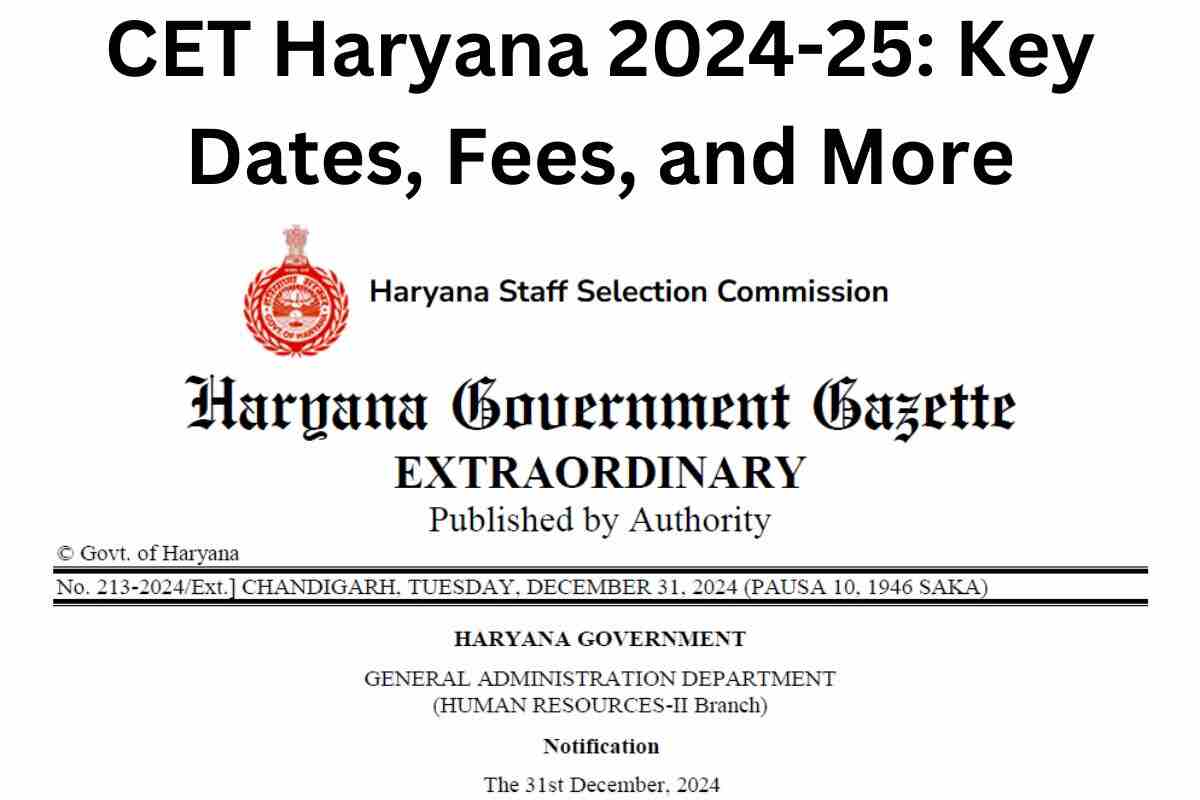
HSSC CET Haryana 2024-25: Key Dates, Fees, and More

Haryana government issued a notification on 31st December 2024 through its Gazette notification No. 42/119/2019-5HR-II for CET Haryana 2024.

The Common Eligibility Test (CET) for Haryana is a significant opportunity for candidates seeking government jobs in Group C and Group D posts. Below is a comprehensive summary of the key information you need to know as a participant.

CET 2024 Notification

📢 Latest Update (July 2025):

The Haryana Staff Selection Commission (HSSC) has released the CET Group C Admit Card 2025 on 17 July 2025 for candidates appearing in the exam scheduled on 26th and 27th July 2025.

Candidates can download their hall tickets from the official portal – www.hssc.gov.in. The exam will be conducted in offline OMR mode in four shifts across multiple exam centres in Haryana.

Earlier this year

The CET Haryana 2024 notification provides crucial details for aspiring candidates applying for Group C and D posts in Haryana. Below is a simplified guide covering all the important aspects:

Application Process

  • Start Date: 28/05/2025
  • End Date: As specified in the official notification (stay updated on the Commission’s website).
  • Registration Requirements:
    • Parivar Pehchan Number (PPN) or Aadhaar Number for online registration.
    • Upload required documents such as caste certificate, educational qualifications, and other relevant claims.
  • Registration Number: Once registered, you receive a unique ID valid for subsequent applications without re-registering.

Exam Details

Exams are scheduled on 26th and 27th July 2025.

  • Eligibility:
    • Minimum age and education qualifications must be met by the application deadline.
    • Reserved categories (SC/BC/EWS) enjoy 10% relaxation in eligibility criteria.
  • Syllabus: Detailed syllabus for Group C and D will be published in the advertisements issued by the Commission.

Preparation Book For CET Haryana Group C and Group D: Buy Now

  • Exam Structure:
    • Group C: Written exam and skill tests.
    • Group D: Merit-based on CET scores.

CET 2025 Exam Guidelines

  • Admit card contains crucial information such as exam date, venue, time, roll number, and instructions.
  • As per HSSC rules, 1 mark will be deducted for every unanswered question. So, avoid leaving any question blank on the OMR sheet.
  • Carry a printed admit card, a valid photo ID proof, and avoid personal items like bags, mobiles, or notes.
  • Candidates in religious/cultural attire must report 2 hours early for smooth frisking and verification.
  • Fees Structure

CET Haryana 2024 Fee Structure
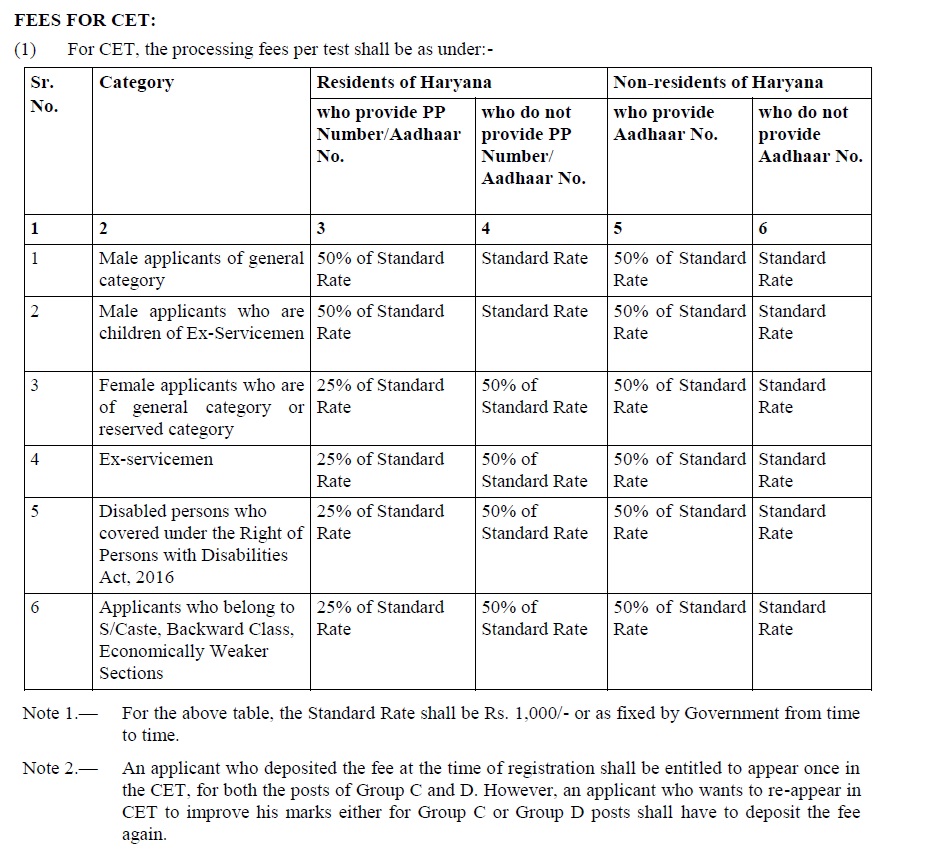
    • Processing Fees: The standard fee is ₹1,000, with reduced rates for specific categories:

Concessions:

      • General Male Applicants: 50% of the standard rate for Haryana who provides Aadhar Card or Parivar Pahchan Patra (PPP). This concession is also applicable to students for out of Haryana.
      • Female Applicants: 25% to 50% of the standard rate, depending on residency status.
      • Ex-Servicemen and Disabled Persons: 25% to 50% of the standard rate.
      • SC, Backward Class, and EWS Applicants: 25% to 50% of the standard rate.
  • Reservation Policies

    • Reservation Categories: There are specific provisions for various categories, including Scheduled Castes, Backward Classes, Economically Weaker Sections (EWS), ex-servicemen, and persons with disabilities. Candidates from reserved categories will have a concession of 10% in the minimum qualifying marks.
    • Female and minority applicants receive additional benefits.
    • Documentation Required: Applicants must upload necessary documents for claims related to reservation, educational qualifications, and other details as specified by the government.

Re-Evaluation Policy

  • Candidates can reappear in CET to improve marks with no restriction on attempts.
  • Validity of Marks:  The marks obtained in the CET will be valid for three years. If you improve your score in subsequent attempts, the validity will reset from the date of the new result.

Important Guidelines

  1. Ensure accuracy in uploading all required documents.
  2. Maintain your Registration Number for future applications.
  3. Check the Commission’s official website for advertisements and syllabus updates.

Official Notification Reference

For more details, refer to the CET Haryana 2024 official notification on the Haryana Government Gazette (Extra), dated Dec. 31, 2024.

Stay tuned for further updates on application dates and detailed guidelines. Best of luck to all CET Haryana 2024 aspirants!

Also Read: CET Haryana 2025 – Exam Overview, Syllabus, Exam Pattern & Group C, D Details

Rekha Gupta: Delhi’s new Chief Minister | Know her journey and priorities

Rekha Gupta: Delhi's new Chief Minister | Know her journey and priorities

In a significant change in Delhi politics, Rekha Gupta has been announced as the new Chief Minister of Delhi By PM Narendra Modi, bringing the Bharatiya Janata Party (BJP) back to power in the capital after 27 years. Rekha Gupta defeated Aam Aadmi Party (AAP) candidate Vandana Kumari from the Shalimar Bagh assembly constituency by a margin of 29,595 votes, ending the AAP’s ten-year dominance.

Early life and education of Rekha Gupta

Born in 1974 in Nandgarh village in Haryana’s Jind district, Rekha Gupta’s father was an officer in the State Bank of India. In 1976, when Rekha was just two years old, her family shifted to Delhi, where she completed her primary to higher education.

Political journey of Rekha Gupta

Rekha Gupta’s political journey began in 1992 with the Akhil Bharatiya Vidyarthi Parishad (ABVP) at Delhi University’s Daulat Ram College. In 1996-97, she assumed the presidency of the Delhi University Students Union (DUSU) and remained active on student issues. In 2007, she was elected councillor from North Pitampura, where she contributed significantly to the improvement of local amenities such as libraries, parks, and swimming pools. She also launched the “Sumedha Yojana” to assist economically weaker female students in higher education. As the chairperson of the Women Welfare and Child Development Committee, she took several initiatives for the empowerment of women.

Role in BJP

In the BJP Mahila Morcha, Rekha Gupta has served as the General Secretary in Delhi and a member of the National Executive Committee, where she played a key role in organisational work.

Delhi Assembly Elections 2025

In the 2025 Delhi Assembly elections, the BJP won 48 out of 70 seats, while the AAP was reduced to only 22 seats. In this election, prominent leaders of the AAP, such as former Chief Minister Arvind Kejriwal, former Deputy Chief Minister Manish Sisodia, and other prominent figures lost their seats. Kejriwal, who represented the New Delhi seat for 10 years, lost to BJP’s Parvesh Verma by 4,089 votes.

PM’s reaction on Delhi’s New Chief Minister Rekha Gupta

Prime Minister Narendra Modi congratulated Rekha Gupta on becoming the new Chief Minister of Delhi and described this historic victory as a “new beginning of development and good governance in Delhi”. He said that this victory of BJP reflects the trust of the people and the desire for change. PM Modi expressed confidence that under the leadership of Rekha Gupta, Delhi will get a corruption-free, transparent and welfare government.

Rekha Gupta’s priorities and vision

Speaking on her priorities as Chief Minister, Rekha Gupta said that the main goal of her government will be clean administration, women safety, improvement in education, and betterment of health services. She assured the people of Delhi that her government will speed up development work and solve the problems of common citizens.

Rekha Gupta said that her government will especially focus on the following issues:

  • Priority to women safety – running special campaigns for women safety and making Delhi a safe city.
  • Education reforms – Ensuring high quality education in government schools and colleges.
  • Health facilities – Making better government hospitals, free medicine and healthcare accessible.
  • Traffic and transportation – Solving Delhi’s traffic problems and making public transport accessible.
  • Pollution control – Taking stringent measures to reduce air and water pollution.

Change in Delhi politics

The appointment of Rekha Gupta has brought about a major change in Delhi politics. While the Aam Aadmi Party held power for a decade, now the return of the BJP has brought a new twist in the administrative approach. The people of Delhi have great expectations from Rekha Gupta’s working style and experience.

Conclusion

The appointment of Rekha Gupta as the Chief Minister is a historic moment in Delhi politics. With her political experience and strong leadership, she is ready to take new initiatives towards the development of Delhi. Her priorities point towards improving the living standards of the people of Delhi and giving a responsible administration. It will be interesting to see how she implements her plans in the coming years and establishes Delhi as a strong and modern capital.

Also Read: PSTET Result 2025 Released: How to Download Scorecard and Important Information

How AI and ML in Education Are Transforming Learning for the Future

How AI and ML in Education Are Transforming Learning for the Future

One thing that has always remained the same in this world; is learning. Whatever may become outdated at some point, learning and education will always remain a part of our society. The integration of AI and ML in education is reshaping the traditional learning experience, making it more adaptive, personalized, and efficient.

In earlier times, Gurukuls were where one could seek an education, and then came schools and colleges as the chief institutions providing learning. Now, we are seeing another revolution in the education sector driven by game-changing technologies – artificial intelligence (AI) and machine learning (ML). These transformative technologies are changing how students learn, interact with educators, and prepare for the future. From adaptive learning experiences to grading systems, AI and ML are transforming education to make it smarter, more effective, and accessible to everyone.

This article discovers how AI and ML are improving and enhancing education for everybody.

Rise of AI and ML in Education

If you are an educator in the education field, you may be aware that all students learn at their own pace and have different learning styles. There is no single teaching style that can be ideal for all the students. Providing lessons to individual students with varying teaching styles is not possible, but it is no longer the case. AI and ML technology have enabled teachers to provide personalized learning to their students.

Artificial intelligence-based tools can be utilized to examine huge student data and identify their learning requirements and preferences. Additionally, the tools can be used to develop customized learning content and lectures for students to enhance their learning process.

There is a great demand for applications and AI/ML-based tools in education, and learning AI skills can make you capable of creating such tools and applications. How to gain these skills? – Enroll in an AI course, like the IIIT Hyderabad AI course.

Role of AI and ML Transforming Education

AI and ML are revolutionizing education by enabling personalized learning, AI-powered tutors, and automated grading systems. These technologies enhance student engagement, streamline teaching methods, and create smarter, more adaptive learning environments.

Personalized Learning

Traditional schooling is one-size-fits-all, with all students learning at the same rate. But we all know that’s not how learning occurs in real life! AI is shifting this by providing adaptive learning platforms that adjust lessons based on a student’s strengths and weaknesses.

AI-Powered Tutors and Chatbots

Wouldn’t it be great to have a 24/7 available AI tutor? AI tutor and chatbots are rendering this a possibility. The virtual tutors can provide immediate responses to student queries, explain, and even grade homework.

Smart Content and AI-Generated Materials

Those days are over when students used to depend only on bulky books. AI is transforming content development by creating intelligent study materials, including:

  • AI-generated summaries and flashcards for rapid revision
  • Interactive simulations and videos for improved visualization of concepts
  • Real-time quizzes that adjust to a student’s learning pace

This not only makes learning more interesting but also retains information better. AI-created content guarantees that students learn updated and applicable study materials without having to wade through endless resources.

Automated Grading

This not only makes learning more interesting but also retains information better. AI-created content guarantees that students learn updated and applicable study materials without having to wade through endless resources.

AI-Powered Skill Development

AI is not only enhancing learning in classrooms – it’s also assisting students in making appropriate career choices. AI-powered career recommendation systems assess a student’s skills, interests, and grades to provide relevant career recommendations.

Moreover, AI is also becoming a key area for skill building. Students are taking up courses in AI and ML to prepare themselves for the future workforce. Online platforms provide hands-on projects in AI, coding practice, and real-world usage, thus ensuring that learners acquire practical experience.

One of India’s IT hubs, Hyderabad, is increasingly becoming popular for its investments in AI. You can consider exploring an AI course in Hyderabad, as the city is full of opportunities.

Future of AI in Education

In the future, AI and ML will keep transforming education. With the development of Virtual Reality (VR) and Augmented Reality (AR), learners will soon be exposed to immersive learning spaces. Envision learning about ancient civilizations by walking virtually in the streets of Rome or learning chemistry from interactive 3D simulations.

So, if you’re someone in the education field, be prepared for the revolution to come up because of AI.

Conclusion

AI and ML in education are revolutionizing the way students learn, educators teach, and institutions operate. From personalized learning experiences to AI-driven tutors, smart content, and automated grading, these technologies are making education more efficient, engaging, and accessible. As AI continues to evolve, the future of education will see even greater advancements, including immersive learning through VR and AR.

Embracing AI and ML in education is no longer an option but a necessity to prepare students for a rapidly changing world. The key lies in integrating these innovations responsibly, ensuring that technology enhances human potential rather than replacing it.

Also Read: Bhashini AI Tool: An Initiative To Break Language Barrier

Haryana Teacher Eligibility Test (HTET): Comprehensive Guide

Haryana Teacher Eligibility Test (HTET)

To improve the quality of teaching in the country, almost every state in India conducts its own Teachers’ eligibility test. The government of Haryana conducts the Haryana Teachers Eligibility Test, also known as the HTET, which is a compulsory examination for all B.Ed candidates aspiring to become teachers in schools run by the government or private managements in the state of Haryana.

Apart from this, the schools have also been given the liberty by CBSE to recruit teachers based on either the test conducted by states or on the ranks obtained in CTET (Central Teachers Eligibility Test), conducted by the central government. It has become mandatory for teachers to clear either of the examinations to secure the job of a teacher in any school across the country.

This guide provides detailed information about HTET, including eligibility criteria, exam structure, application procedures, and important guidelines.

What is HTET?

The Haryana Teacher Eligibility Test (HTET) is an important examination for individuals aspiring to become teachers in Haryana, India. Conducted by the Board of School Education Haryana, HTET ensures that candidates possess the necessary aptitude and skills to meet the challenges of teaching at various educational levels.

HTET stands for Haryana Teacher Eligibility Test. The HTET is a mandatory qualification for individuals seeking teaching positions in schools recognized by the Department of School Education, Haryana. The test is conducted in accordance with guidelines set by the National Council for Teacher Education (NCTE) and the Department of School Education, Haryana.

Applicability of HTET

HTET applies to:

  • Schools established by the State Government or local authorities.
  • Aided schools receiving financial support from the government.
  • Unaided schools not receiving any government aid.

Eligibility Criteria

Candidates must meet specific educational qualifications to be eligible for HTET, which is conducted for three levels:

Level I: Primary Teacher (Classes I-V)

  • Senior Secondary or its equivalent with at least 50% marks and a 2-year Diploma in Elementary Education.
  • Graduation with a 2-year Diploma in Elementary Education.

Level II: Trained Graduate Teacher (Classes VI-VIII)

  • Bachelor’s degree with at least 50% marks in the relevant subject and a B.Ed. degree.
TGT eligibility criteria at subject level:
Subject Educational Qualification Additional Requirement
TGT Social Studies – Bachelor’s degree with at least 50% marks in Social Science (elective/Honours) with BTC/JBT/D.Ed./D.El.Ed. OR

– B.Ed./B.Ed. (Special Education) with Social Science as a teaching subject OR

– Four-year B.El.Ed. with Social Science OR

– Four-year Integrated B.A. B.Ed. with Social Science

– Any two subjects: History, Political Science, Economics, Geography, Sociology, Psychology

– Hindi or Sanskrit in Matric or Hindi in Higher Education

TGT Science – Bachelor’s degree with at least 50% marks in Science (elective/Honours) with BTC/JBT/D.Ed./D.El.Ed. OR

– B.Ed./B.Ed. (Special Education) with Science as a teaching subject OR

– Four-year B.El.Ed. with Science OR

– Four-year Integrated B.Sc. B.Ed. with Science

– B.Sc. must have three subjects: Physics, Chemistry, Botany, Zoology, Mathematics

– Hindi or Sanskrit in Matric or Hindi in Higher Education

TGT Mathematics – Bachelor’s degree with at least 50% marks in Mathematics (elective/Honours) with BTC/JBT/D.Ed./D.El.Ed. OR

– B.Ed./B.Ed. (Special Education) with Mathematics as a teaching subject OR

– Four-year B.El.Ed. with Mathematics OR

– Four-year Integrated B.A./B.Sc./B.Com. B.Ed. with Mathematics

– Hindi or Sanskrit in Matric or Hindi in Higher Education
TGT English – Bachelor’s degree with at least 50% marks in English (Compulsory/Elective/Core/Honours) with BTC/JBT/D.Ed./D.El.Ed. OR

– B.Ed./B.Ed. (Special Education) with English as a teaching subject OR

– Four-year B.El.Ed. with English OR

– Four-year Integrated B.A. B.Ed. with English

– Hindi or Sanskrit in Matric or Hindi in Higher Education
TGT Hindi – Bachelor’s degree with at least 50% marks in Hindi (Compulsory/Elective/Core/Honours) with BTC/JBT/D.Ed./D.El.Ed. OR

– B.Ed./B.Ed. (Special Education) with Hindi as a teaching subject OR

– Four-year B.El.Ed. with Hindi OR

– Four-year Integrated B.A. B.Ed. with Hindi

– Hindi or Sanskrit in Matric or Hindi in Higher Education
TGT Sanskrit – Bachelor’s degree with at least 50% marks in Sanskrit (elective/Honours) with BTC/JBT/D.Ed./D.El.Ed. OR

– B.Ed./B.Ed. (Special Education) with Sanskrit as a teaching subject OR

– Four-year B.El.Ed. with Sanskrit OR

– Shastri with at least 50% marks and Shiksha Shastri/LTC/OT OR

– Four-year Integrated B.A. B.Ed. with Sanskrit

– Hindi or Sanskrit in Matric or Hindi in Higher Education
TGT Punjabi – Bachelor’s degree with at least 50% marks in Punjabi (elective/Honours) with BTC/JBT/D.Ed./D.El.Ed. OR

– B.Ed./B.Ed. (Special Education) with Punjabi as a teaching subject OR

– Four-year B.El.Ed. with Punjabi OR

– Four-year Integrated B.A. B.Ed. with Punjabi

– Hindi or Sanskrit in Matric or Hindi in Higher Education
TGT Urdu – Bachelor’s degree with at least 50% marks in Urdu (elective/Honours) with BTC/JBT/D.Ed./D.El.Ed. OR

– B.Ed./B.Ed. (Special Education) with Urdu as a teaching subject OR

– Four-year B.El.Ed. with Urdu OR

– Four-year Integrated B.A. B.Ed. with Urdu

– Hindi or Sanskrit in Matric or Hindi in Higher Education
TGT Physical Education – Graduate with B.P.Ed. or D.P.Ed. or equivalent – Hindi or Sanskrit in Matric or Hindi in Higher Education
TGT Home Science – Bachelor’s degree with at least 50% marks in Home Science (elective/Honours) with BTC/JBT/D.Ed./D.El.Ed. OR

– B.Ed./B.Ed. (Special Education) with Home Science as a teaching subject OR

– Four-year B.El.Ed. with Home Science OR

– Four-year Integrated B.A. B.Ed. with Home Science

– Hindi or Sanskrit in Matric or Hindi in Higher Education
TGT Art – B.F.A./B.A. with at least 50% marks in Art (elective/Honours) with BTC/JBT/D.Ed./D.El.Ed. OR

– B.Ed./B.Ed. (Special Education) with Art as a teaching subject OR

– Four-year B.El.Ed. with Art OR

– Four-year Integrated B.F.A./B.A. B.Ed. with Art

– Hindi or Sanskrit in Matric or Hindi in Higher Education
TGT Music – B.A. with at least 50% marks in Music (elective/Honours) with BTC/JBT/D.Ed./D.El.Ed. OR

– B.Ed./B.Ed. (Special Education) with Music as a teaching subject OR

– Four-year B.El.Ed. with Music OR

– Four-year Integrated B.A. B.Ed. with Music

– Hindi or Sanskrit in Matric or Hindi in Higher Education

Level III: Post Graduate Teacher (Classes IX-XII)

  • Post Graduate degree in the relevant subject with at least 50% marks and a B.Ed. degree.

Also Read: HTET Admit Card 2025: Download Link, Exam Date and Complete Details

Admission Criteria

A person scoring a minimum of 60% marks in the examination would be considered to have cleared the examination. However as per the Haryana Government’s extant reservation policy of Haryana Teachers Eligibility Test, the government can decide to give 5% concession to candidates belonging to the SC/ST, OBC, differently able persons etc.

Apart from this the candidate must note that having cleared the HTET examination would not confer them the right of employment or recruitment, as this examination is just one of the important factors of the eligibility criteria for appointment.

Exam Structure

HTET consists of multiple-choice questions (MCQs) across three levels, with no negative marking. Each level has a specific structure:

Level I: Primary Teacher

  • Total Questions: 150
  • Duration: 2.5 hours
  • Subjects: Child Development, Languages, General Studies, Mathematics, Environmental Studies

Level II: Trained Graduate Teacher

  • Total Questions: 150
  • Duration: 2.5 hours
  • Subjects: Child Development, Languages, General Studies, Subject-Specific Questions

Level III: Post Graduate Teacher

  • Total Questions: 150
  • Duration: 2.5 hours
  • Subjects: Child Development, Languages, General Studies, Subject-Specific Questions

Scoring and Negative Marking

There is no negative marking associated with the HTET examination. Each paper consists of 150 multiple choice questions with each carrying 1 mark. For every question answered correctly the candidate is awarded 1 mark and for every wrong answer 1 mark is deducted from the total.

Application Procedure

Candidates can apply for HTET 2024 online through the official HTET website. The application process includes:

  • Filling out the online application form.
  • Uploading required documents (photograph, signature, thumb impression).
  • Payment of the application fee.

Important Dates

  • Application Start Date: 04-11-2024
  • Application End Date: 14-11-2024

Examination Schedule of HTET

The HTET will be conducted on specified dates as per the admit card. Candidates must download their admit cards from the official website.

  • Exam Date: 8 February and 9 February 2025

Important Guidelines

  • The HTET qualifying certificate is valid for a lifetime.
  • There is no limit on the number of attempts for HTET.
  • Candidates can improve their scores by reappearing for the test.

Special Provisions for Differently Abled Candidates

Differently abled candidates may receive additional time and can opt for a scribe during the examination. Specific guidelines are provided to ensure accessibility.

Conclusion

The Haryana Teacher Eligibility Test (HTET) is a vital step for aspiring teachers in Haryana. Understanding the eligibility criteria, exam structure, and application process is essential for success. Candidates are encouraged to stay updated through the official HTET website for any changes or announcements regarding the examination.

Also Read: HSSC CET Haryana 2024-25: Key Dates, Fees, and More

CBSE Admit Card 2025 Released: Important Information for Class 10th and 12th

CBSE Admit Card 2025

CBSE Admit Card 2025 Released For Class 10 and Class 12: The Central Board of Secondary Education (CBSE) has released the admit cards for Class 10th and 12th final exams on the Priksha Sangam Portal. Students can collect their admit cards from the respective schools, as these are available only through the school login.

Schools can download the admit cards login to official website cbse.gov.in.

How To Download The CBSE Admit Card 2025:

Only schools can download the CBSE Class 10 and CBSE class 12 admit card through CBSE official protal login.

For school administration:

  • Visit the official website of CBSE at cbse.gov.in.
  • Click on the ‘Pariksha Sangam‘ portal.
  • Choose the ‘School (Ganga)’ option.
  • Click on the ‘Admit Card, Centre Material for Main Exam 2025’ link in the ‘Pre-Exam Activities’ tab.
  • Enter the required login details and download the admit card.

How Students of CBSE Board Class 12 get the admit card:

Students cannot download the admit card directly from the CBSE website. Please, contact your respective schools and get the admit card from there.

How CBSE class 10 students get the admit card:

Class 10 students of CBSE board also can’t download the admit card directly from the CBSE website. They also need to get this from their respective schools.

Exam Schedule For CBSE Board Exams Of Class 10 and Class 12:

All exams will start at 10:30 am.

Important Instructions For CBSE Board Exam 2025:

Permitted Items:

  • For Regular Students: Admit Card and School ID Card.
  • For Private Candidates: Admit Card and any photo ID card issued by the Government.
  • Essential stationery in transparent pouch, like blue/royal blue pen, pencil, eraser, scale etc.
  • Analog watch, transparent water bottle, metro card, bus pass, money.

Prohibited Items:

  • Text material, calculator, pen drive, electronic pen, scanner etc.
  • Mobile phone, Bluetooth, earphone, microphone, smartwatch, camera etc.
  • Wallet, goggles, handbag, pouch etc.
  • Any food item.

Note: Strict action will be taken against anyone found using any unfair means in the exam centre.

Tips for Students:

  • Get the admit card from your school on time and confirm all the information mentioned in it.
  • Do not forget to bring the admit card and required documents on the day of the exam.
  • Follow all the instructions related to the exam and do not bring prohibited items to the exam centre.
  • Keep getting regular updates from the official website of CBSE and your school. Best of luck to all the students for the upcoming exams.

Also Read: Physical education given priority to curb rising childhood obesity in China, know the new guidelines

Physical education given priority to curb rising childhood obesity in China, know the new guidelines

Rising Childhood Obesity in China

The Ministry of Education of China has issued new guidelines to prioritize physical education in primary and secondary schools to tackle obesity in China. According to the official Xinhua news agency, these schools will have to ensure that physical education teachers are given the same status and respect as teachers of other subjects such as Chinese, mathematics and English.

Along with this, special efforts have also been recommended to develop major sports like football, basketball and volleyball. This step has been taken to promote sports and physical activities among children.

Increasing Rates Of Childhood Obesity in China

Childhood obesity has become a serious problem globally today, and China is not untouched by it. In view of the rapidly increasing obesity problem in China, the government has decided to give priority to physical education in schools. The move is aimed at helping children adopt a healthy lifestyle and protect them from the ill effects of obesity.

Rising obesity figures in China

The problem of obesity is increasing rapidly in China. According to a study, obesity rates among children and adolescents in China have doubled in the last decade.

Childhood obesity in China post COVID-19

Post COVID-19, China is seeing a sharp rise in obesity among youth. This happened majorly due to a decrease in physical activity during COVID-19 and a growing trend of ordering junk food online.

Doctors believe that obesity in China will increase further in the coming 10-12 years. The main reason for this will be the slowing economy and the structural changes associated with it, which will promote poor eating habits and a decrease in physical activity.

The figures of childhood obesity in China:
  • Obesity in boys: The percentage of obese boys in China was only 1.3% in 1990, which increased to 15.2% in 2022.
  • Obesity in girls: This figure was 0.6% in 1990, which increased to 7.7% in 2022.
Comparison with other countries:
  • The percentage of obese boys in the US is 22%.
  • The figure is 6% in Japan, 12% in the UK and Canada, and 4% in India.

These facts show how important the new measures being taken by China to promote physical education and fitness are.

China’s move: Priority to physical education

The Chinese government plans to make physical education compulsory in schools to address the problem of child obesity.

Importance of physical education:
  • Encourage children towards sports and physical activities.
  • Control obesity and other health problems through physical exercise.
New policies:
  • Increasing physical education hours in schools.
  • Children should be made to do 1 hour of exercise every day.
Role of teachers and parents:
  • Teachers have been given the responsibility of organizing sports activities for children.
  • Parents are being encouraged to pay attention to children’s diet and screen time.

Increasing risk of childhood obesity

As per WHO (World health organization) 2.5 billion adults (18 years and above) were overweighted, out of which 850 mn were obese. Comparing to 1990; this number increased significantly by 25%. The problem has been more prevalent at the regional level, with rates in Southeast Asia and Africa at 31%, while in the Americas it reached 67%. Source: WHO

In addition, approximately 37 million children under the age of 5 were overweight in 2022, almost half of whom lived in Asia. 390 million children and adolescents aged 5–19 years were overweight or obese, rising from 8% in 1990 to 20% in 2022. The problem is now also growing rapidly in low- and middle-income countries, posing new challenges for public health.

Childhood obesity is not just a problem of physical beauty; it is the root of many serious health problems.

  • Effects on health: Obesity increases the risk of diseases such as type 2 diabetes, high blood pressure and heart disease in children.
  • Psychological effects: Obesity affects children’s self-confidence and they may face mental stress, depression and social isolation.
  • Long-term consequences: Children who are obese in childhood are at higher risk of obesity-related problems when they become adults.

Ways to prevent obesity

Here are few simple steps to prevent childhood obesity, which anyone can follow.

Healthy eating:

  • Feed children homemade nutritious food.
  • Stay away from junk food and sugary beverages.

Physical activities:

  • Encourage children to participate in sports daily.
  • Limit technology time.

Social awareness:

  • Run obesity awareness campaigns in schools and communities.

China’s goal and future path

This step of China is a commendable effort towards making children adopt a healthy lifestyle.

  • Improving health: Promoting physical education will not only improve the physical health of children but will also strengthen their mental state.
  • New standards: If this step is successful, it can become a model for other countries.

Conclusion

Childhood obesity is not just a country’s problem, but it is a global challenge. China’s decision to prioritise physical education in schools is a positive initiative that will help secure children’s health and future. This step sets an important example for raising awareness and promoting a healthy lifestyle among children.

Also Read: Yoga For Students: 5 Best Yoga Poses For Children

Waqf Amendment Bill 2024: Key Amendments Approved by Joint Parliamentary Committee (JPC)

Waqf Amendment Bill

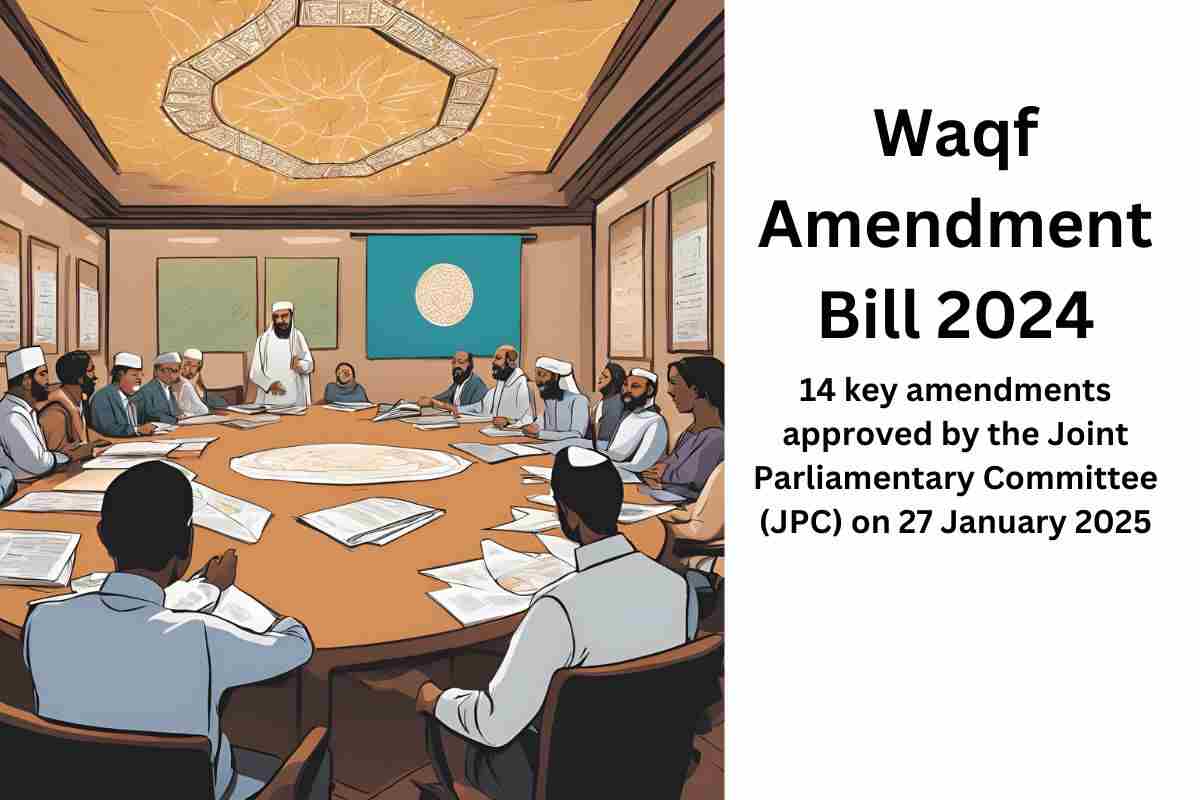
The Waqf Amendment Bill 2024, reviewed by the Joint Parliamentary Committee (JPC), introduces significant changes to reform the management of Waqf properties in India. With 14 key amendments approved, the bill aims to enhance transparency, accountability, and efficiency within Waqf boards while addressing long-standing governance challenges.

Major Waqf Amendments Approved by JPC

The 14 key amendments approved by the Joint Parliamentary Committee (JPC) for the Waqf Amendment Bill 2024 focus on reforming the governance and management of Waqf properties in India. While specific details may vary depending on official reports, here’s a summarized breakdown based on the general direction of the amendments:

  1. Digitization of Records: Mandatory digitization of all Waqf property records to prevent unauthorized encroachments and improve transparency.
  2. Independent Auditing: Annual independent audits of Waqf boards to ensure financial accountability and detect irregularities.
  3. Enhanced State Oversight: State governments granted greater authority to monitor and regulate Waqf boards’ functioning.
  4. Dispute Resolution Mechanism: Establishment of dedicated tribunals or panels to expedite disputes over Waqf properties.
  5. Transparency in Fund Utilization: Clear guidelines on the use of Waqf funds to ensure they are allocated for community welfare purposes like education and healthcare.
  6. Restrictions on Leasing and Transfer: Stricter regulations for leasing or transferring Waqf properties to prevent undervaluation or misuse.
  7. Improved Appointment Process: Transparent and merit-based procedures for appointing members to Waqf boards.
  8. Submission of Progress Reports: Mandatory submission of regular performance and progress reports by Waqf boards to the government.
  9. Accountability Measures: Penalties for Waqf boards that fail to comply with governance and financial standards.
  10. Enhanced Legal Framework: Strengthening legal provisions to address encroachments and unauthorized occupation of Waqf properties.
  11. Capacity-Building Programs: Introduction of training and capacity-building programs for Waqf board officials to enhance efficiency.
  12. Central Database Creation: Development of a centralized national database for all Waqf properties to ensure uniformity and easy access to information.
  13. Streamlined Conflict Resolution: Clear processes for resolving conflicts between stakeholders, including community members and Waqf boards.
  14. Role of Local Authorities: Empowering local authorities to collaborate with Waqf boards in managing properties effectively.

These amendments aim to make Waqf boards more transparent, accountable, and efficient while ensuring that Waqf properties are utilized for their intended charitable and community purposes. For specific and official details, referring to the final bill text or government releases is recommended.

Political and Legislative Context On Waqf Amendment Bill

The bill’s amendments were proposed by the BJP-led NDA government and approved by the JPC after detailed deliberations. However, opposition parties under the INDIA bloc raised concerns over the procedural handling of the amendments. They alleged that proper parliamentary rules were not followed and that their suggestions were largely ignored during the review process.

Concerns Raised by the Opposition

While the amendments focus on reform, the opposition has expressed concerns that some changes might centralize power and undermine the autonomy of Waqf boards. They have also questioned the transparency of the JPC’s review process.

Expected Impact of the Amendments On Waqf Board

  • Improved Governance: The amendments aim to address financial mismanagement and inefficiencies in Waqf board operations.
  • Transparency and Trust: Digitization and independent audits will build public trust and reduce corruption.
  • Empowered Local Governance: Enhanced oversight by state governments will ensure localized control and accountability.
  • Efficient Dispute Resolution: The dedicated dispute resolution mechanism will expedite legal cases and prevent prolonged conflicts over Waqf properties.

Conclusion

The Waqf Amendment Bill 2024, with its 14 approved amendments, represents a significant step toward reforming the management of Waqf properties in India. While the changes aim to enhance accountability and transparency, their successful implementation will be key to achieving the desired outcomes. Ongoing debates highlight the need for a balanced approach that respects the community’s sentiments while ensuring robust governance.

Also Read: Sky Force Movie: A Film Based On 1965 Sargodha Airstrike True Event

Sky Force Movie: A Film Based On 1965 Sargodha Airstrike True Event

Sky Force Movie: A Film Based On 1965 Sargodha Airstrike

Mission Sky Force is a mission of Sargodha airstrike by India in 1965 Indo-Pak war. Now on this true event bollywood directors Abhishek Anil Kapur and Sandeep Kewlani have directed Sky Force Movie in Hindi with the name ‘Sky Force’, which was released on 24 January 2025 in theaters.

This film Sky Force; written by Sandeep Kelwani and produced by Amar Kaushik, Jyoti Deshpande, and Dinesh Vijan. The film starring Akshay Kumar (played the role of group captain O. P. Taneja, 13-aircraft) and Veer Paharia (played the role of squadron leader Ajammada Boppaya Devayya) tells the true story of the Sargodha airstrike carried out by the Indian Air Force during the 1965 Indo-Pak war. The film shows the courage, strategy and sacrifice of the Indian Air Force, which added a new chapter to the country’s history.

Background of 1965 Sargodha Airstrike

A major war took place between India and Pakistan in 1965, in which the Indian Army and Air Force played an important role. During this 1965 Indo-Pak war, Pakistan’s Sargodha airbase was considered the main center of their air attacks. The Sargodha airbase was the main base of Pakistan’s air force and became a major threat to India.

Bold move of Indian Air Force

The Indian Air Force planned to target the Sargodha airbase. The aim of this operation was to weaken Pakistan’s air force power and keep the Indian soldiers safe. The Indian Air Force, despite its limited technology and resources, demonstrated amazing strategy and courage.

Key events of Sargodha Airstrike

  • Covert strategy: The Indian Air Force carried out airstrikes at night, when the enemy was less alert.
  • Precise targeting: Many enemy aircraft and air equipment were destroyed in this airstrike.
  • Patriotic spirit: Indian pilots made the supreme sacrifice to protect the country without caring for their lives.

Main key aspects in Sky Force Movie

The film Sky Force will not only tell the story of this operation, but will also highlight the emotions, struggles and challenges of the pilots of the Indian Air Force. This film will tell the audience how the Air Force of a nation defeated the enemy despite limited resources.

Akshay Kumar and Veer Paharia’s role

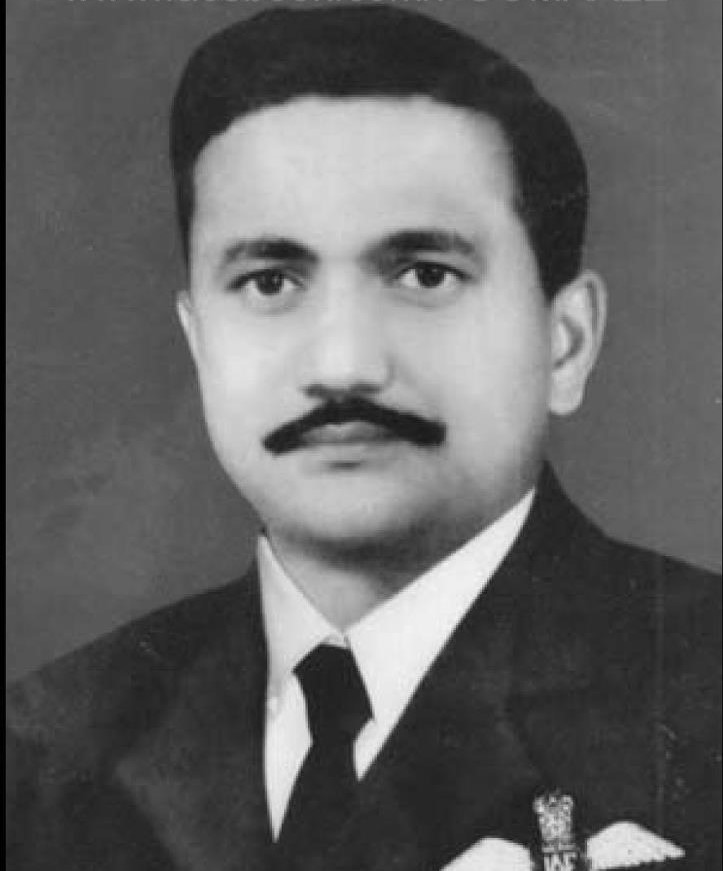
Group Captain Om Prakash Taneja
Shri O P Taneja. Img source: bharat-rakshak

The film stars Akshay Kumar in the lead role, who will be seen as a courageous pilot of the Indian Air Force. This is Veer Pahadia’s debut film, and he will be seen in the role of a young pilot as squadron leader Ajammada Boppaya Devayya. The pair will try to bring alive the indomitable courage of the pilots of the Indian Air Force on screen.

Squadran Leader A B Devayya

Squadron Leader Ajammada Boppaya Devayya
Squadron Leader Ajammada Boppaya Devayya. Img source: bharat-rakshak.com

Squadron Leader Ajjamada Boppayya Devayya, an instructor turned fighter pilot during the 1965 Indo-Pak war, showcased extraordinary bravery during a mission to Sargodha Airfield on September 7, 1965. While flying a Mystere IVa fighter-bomber, he was intercepted by a superior Pakistani F-104 Starfighter.

Despite his crippled aircraft, Sqn Ldr Devayya engaged in an aerial combat and successfully shot down the enemy jet, losing his life in the process. His unrivaled bravery, placing comrades’ safety ahead of his own, earned him the Maha Vir Chakra posthumously—the only such award for an Indian Air Force officer to date.

Objective of the film

Sky Force is not just a film; It is a tribute to the heroes who laid down their lives to protect the country. This film is an attempt to make today’s generation understand the sacrifices of the Indian Air Force and the importance of their role.

Impact of the 1965 Sargodha Airstrike

This operation proved to be a major victory for India. The Indian Air Force not only demoralized the enemy but also showed that it can go to any extent to protect the country. 1965 Sargodha airstrike is a golden chapter of India’s military history.

Conclusion:

Sky Force is the story of the gallantry, glory and strategic moves of the Indian Air Force. This film will inspire the Indian audience and make them feel proud of the Indian soldier. If you are interested in real stories related to Indian history and patriotism, then this film will be a must-watch experience for you.

Also Read: What is Global Warming? Causes, Effects & Solutions

On X.com (formerly known as twitter.com) the official post says

Republic Day of India: History, Significance and Interesting Facts


JEE Main 2025 Admit Card Errors: How to Identify and Resolve

JEE main admit card 2025 errors

Jee Main 2025 admit cards will be released three days before the exact exam dates. First slot of admit cards will be released on 20th January 2025 for the exam date 23rd January 2025. To solve your JEE main 2025 admit card errors please follow below steps to rectify it immediately.

How to download JEE Main 2025 Admit Card

  • Visit the official site of JEE exam; jeemain.nta.nic.in
  • Click on  the option ‘download JEE main admit card’
  • Enter the details the portal asks you
  • After entering the details the admit card will be shown to you
  • Take the printout of the same

What is JEE main 2025 Admit Card Errors?

Ensuring the accuracy of your JEE Main 2025 Admit Card is crucial for a smooth examination experience. Below is a comprehensive guide highlighting common discrepancies, their implications, and the steps to resolve them:

Common Discrepancies in JEE Main 2025 Admit Card

Discrepancy Type Description
Incorrect Personal Details Errors in name, date of birth, gender, or category.
Unclear Photograph Blurred or unclear photograph due to issues during application submission.
Unclear Signature Blurred or unclear signature as uploaded in the application form.
Incorrect Exam Details Errors in exam date, shift, or center allocation.
Missing Information Omission of essential details such as roll number or application number.

Steps to Resolve Discrepancies

  1. Prepare Application Details: Keep your JEE Main 2025 application number and other relevant details ready.
  2. Contact NTA Helpline: Reach out to the National Testing Agency (NTA) at 011-40759000 between 10:00 AM to 5:00 PM on working days.
  3. Report the Issue: Clearly explain the discrepancy, providing your application number and specific details of the error.
  4. Follow Instructions: NTA will verify the information and notify the respective exam center authority.
  5. Carry Necessary Documents: On exam day, bring the original admit card along with a valid ID proof and a recent passport-sized photograph.
  6. Post-Exam Corrections: NTA will address and correct the discrepancies after the examination.

Important Notes

  • No Reissued Admit Card: NTA will not issue a new admit card; candidates must use the original one despite discrepancies.
  • Exam Participation: Informing NTA in advance ensures you are not barred from taking the exam due to admit card issues.

Also Read: JEE Main Exam date, Syllabus, Pattern, Results and more

Details Mentioned in JEE Main 2025 Admit Card

Detail Type Description
Personal Information Candidate’s name, father’s name, date of birth, gender, category, and state code of eligibility.
Exam Details Roll number, application number, paper appearing for, exam date, shift, and timings.
Exam Center Information Venue address, city, and center code.
Photograph and Signature As uploaded during the application process.
Important Instructions Guidelines for exam day, including reporting time, items to carry, and conduct during the exam.

Ensuring all details are accurate on your admit card is essential. In case of any discrepancies, promptly contact NTA to rectify the issues and avoid complications on the exam day.

Also Read: Initiative to Revamp with Sports Equipment in 600 government school hostels in Tamil Nadu

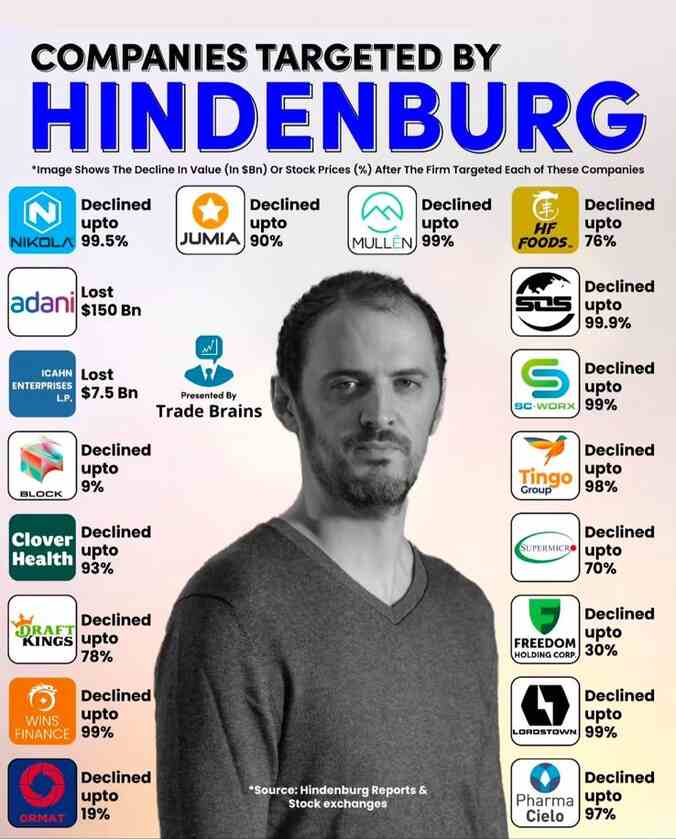
List Of Big Corporate Victims Of Hindenburg Research

Corporate Victims Of Hindenburg Research

Hindenburg Research, famous for exposing financial fraud and irregularities, has recently announced the closure of its operations. The company exposed the flaws of many big companies around the world, causing investors to lose billions of dollars.

13 Big Corporate Victims Of Hindenburg Research

Hindenburg has targeted many big companies from time to time. Some of the prominent names among these are:

corporate victims of hindenburg research
Corporate victims of Hindenburg research | Image source: trade.brains
  1. Adani Group, India
  • Allegations: Manipulation of shares and misuse of tax havens.
  • Loss: $150 billion value
  • Impact: This report damaged the image and market share of Adani Group.

2. Nikola Corporation

  • Allegations: The electric vehicle manufacturer made false claims about its products and technology.
  • Decline: 99.5% fall in share

3. Mullen Automotive

  • Allegations: The company’s financial claims and production capacity were misrepresented.
  • Decline: 99% fall in shares

4. Clover Health

  • Allegations: Financial fraud and misinformation.
  • Decline: 93% in sahres

5. Jumia

  • Allegations: Misinformation about the company’s revenue and operations.
  • Decline: 90% fall in shares

6. DraftKings

  • Allegations: Illegal betting and lack of financial transparency.
  • Decline: 78% fall in shares

7. Freedom Holding Corp.

  • Decline: 30% fall in sahres

8. Tingo Group

  • Decline: 98% fall in shares

9. Lordstown Motors

  • Decline: 99%.

10. Vince Finance

  • Decline: 99%.

11. SC-Works

  • Decline: 99%.

12. Pharma Cielo

  • Decline: 97%.

13. Ormat

  • Decline: 19%.

Reasons behind Hindenburg’s closure

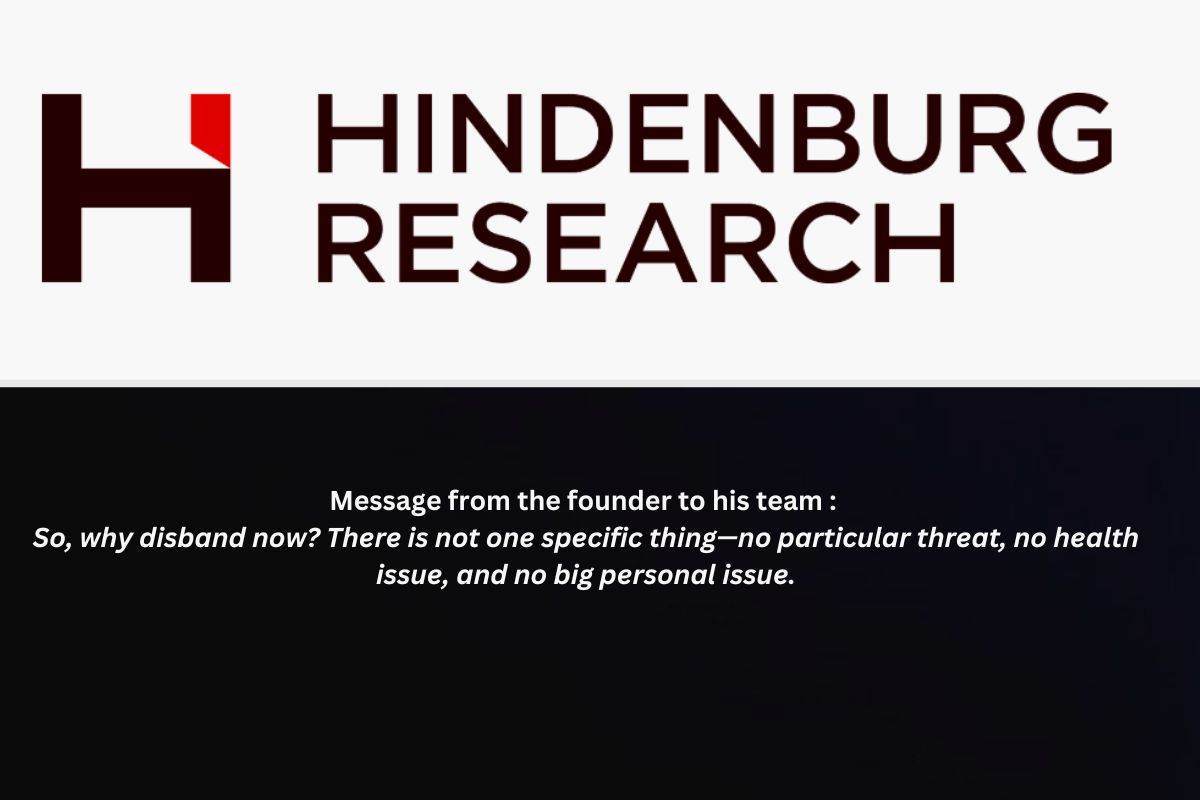
Nate Anderson, founder of Hindenburg Research, said in the closure announcement that the decision was not taken due to any external pressure or financial problems. He said, “It is time to start a new chapter in my life. I want to focus on family and personal life.”

Closure note from Nate Anderson
Closure note from Nate Anderson, Founder of Hindenburg Research

Hindenburg effect

Hindenburg Research played a key role in promoting financial transparency among companies around the world. Its revelations not only shook the stock market, but also forced many companies to bring transparency in their operations and claims.

Also Read: CBSE issues show cause notice to 29 schools over enrollment irregularities