
Difference Between AI and Machine Learning
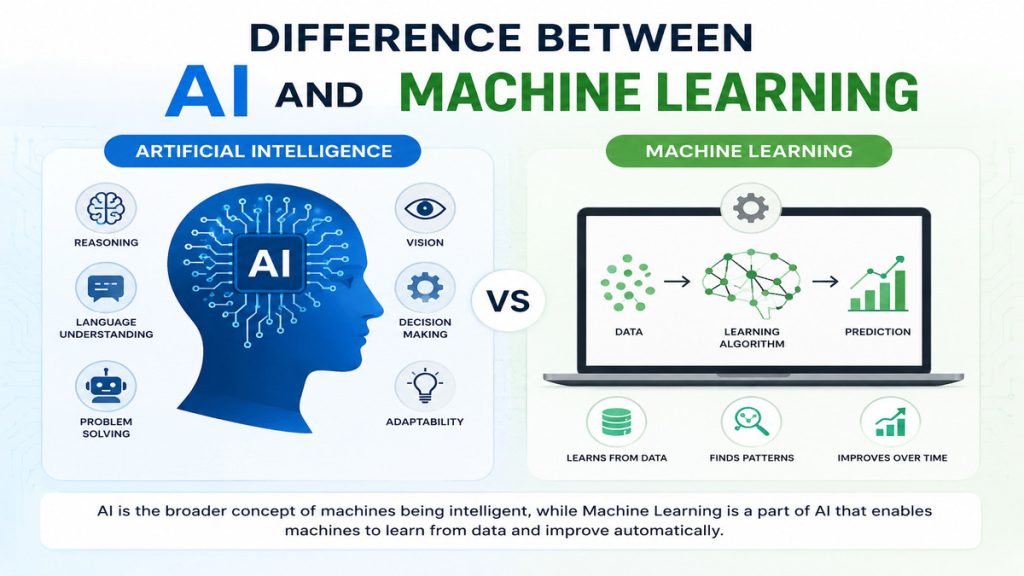
Artificial Intelligence (AI) and Machine Learning (ML) are two of the most sought-after technologies in today’s digital era. Although these terms are often used together, they are not the same. Machine Learning is, in fact, a component of Artificial Intelligence that enables systems to learn and enhance on their own, without direct programming.
AI is about designing intelligent systems that perform the same thought and decision-making processes that humans do, whereas Machine Learning is more about training machines to learn patterns from data. In this article, you will get a simple and professional explanation of the meaning, difference, features, applications, advantages and examples of AI and Machine Learning.
What is Artificial Intelligence (AI)?
Artificial Intelligence (AI) is a part of computer science that helps machines and computer systems to perform tasks that would otherwise require human intelligence, like learning, reasoning, problem-solving, decision-making, and understanding language. AI systems are built to automatically analyze data, recognize patterns, and make intelligent decisions. Artificial Intelligence has various features such as automation, speech recognition, image recognition, problem-solving, decision-making, and continuous learning, which enhance efficiency and accuracy across different sectors including health care, education, finance and transportation.
Advantages of Artificial Intelligence
- Automates repetitive tasks
- Reduces human errors
- Improves productivity
- Supports faster decision-making
- Available 24/7
Examples of AI
- Virtual assistants like Siri and Alexa
- Self-driving cars
- Chatbots
- Facial recognition systems
- Smart recommendation systems
What is Machine Learning (ML)?
Machine Learning (ML) refers to the area of Artificial Intelligence (AI) where computers and systems automatically learn from data and make improvements without explicit programming. Algorithms and data analysis are used in ML to find patterns, make predictions, and assist in decision making processes. Machine Learning enables automated learning, pattern recognition, predictive analysis, continuous improvements, data-driven decision making, and automation; these are key features that can be applied in recommendation systems, fraud detection, speech recognition, and image analysis.
Advantages of Machine Learning
- Improves accuracy over time
- Handles large amounts of data
- Detects hidden patterns
- Automates predictions
- Enhances business intelligence
Examples of Machine Learning
- Email spam filters
- Netflix and YouTube recommendations
- Fraud detection systems
- Online product suggestions
- Predictive analytics
Relationship Between AI and Machine Learning
Artificial Intelligence (AI) and Machine Learning (ML) are closely connected technologies, but they are not the same. Machine Learning is a subset of Artificial Intelligence, which means ML is one part of the broader AI field. Their relationship is based on the idea that Machine Learning helps AI systems become smarter by learning from data and improving automatically.
AI focuses on making machines behave intelligently like humans, while Machine Learning focuses on enabling machines to learn patterns, make predictions, and improve performance through experience.

| Aspect | Artificial Intelligence (AI) | Machine Learning (ML) |
| Role | Broad concept of intelligent systems | Subset of AI |
| Main Focus | Mimicking human intelligence | Learning from data |
| Working Method | Uses logic, reasoning, and learning | Uses algorithms and datasets |
| Dependency | Can work with or without ML | Always works under AI |
| Objective | Smart decision-making | Improving accuracy automatically |
Simple Understanding
- Artificial Intelligence = Making machines intelligent
- Machine Learning = Helping machines learn from data
AI is the broader concept, while ML is one technique used to achieve AI capabilities.
Difference Between AI and Machine Learning
| Basis | Artificial Intelligence (AI) | Machine Learning (ML) |
| Definition | AI enables machines to mimic human intelligence. | ML enables systems to learn from data automatically. |
| Goal | To create intelligent systems. | To learn patterns and improve accuracy. |
| Scope | Broader technology field. | Subset of AI. |
| Functionality | Works on reasoning and decision-making. | Works on data learning and predictions. |
| Human Involvement | May require predefined rules. | Learns with minimal human intervention. |
| Data Dependency | Can work with or without data learning. | Strongly depends on data. |
| Examples | Robotics, virtual assistants, chatbots | Recommendation systems, spam filters |
Types of Artificial Intelligence
- Narrow AI
Narrow AI is designed to perform a specific task, such as voice assistants or recommendation systems.
- General AI
General AI refers to systems capable of performing any intellectual task like humans. This technology is still under development.
- Super AI
Super AI is a theoretical concept where machines become more intelligent than humans.
Types of Machine Learning
- Supervised Learning
The model learns using labeled data.
- Unsupervised Learning
The model identifies patterns without labeled data.
- Reinforcement Learning
The system learns by interacting with the environment and receiving rewards or penalties.
Applications of Artificial Intelligence

AI is widely used across industries for automation and intelligent decision-making.
- Healthcare
AI helps in disease diagnosis, medical imaging, and virtual healthcare assistants.
- Finance
AI is used for fraud detection, risk analysis, and automated trading.
- Education
AI supports personalized learning and smart tutoring systems.
- Transportation
Self-driving cars and traffic management systems use AI technologies.
- Customer Support
AI-powered chatbots provide instant customer assistance.
Applications of Machine Learning
Machine Learning helps businesses analyze data and improve predictions.
- Recommendation Systems
Streaming platforms recommend movies and music based on user behavior.
- Spam Detection
ML filters unwanted emails automatically.
- Predictive Analytics
Businesses use ML to predict sales, trends, and customer behavior.
- Image Recognition
ML identifies objects, faces, and patterns in images.
- Speech Recognition
Voice assistants use ML to understand spoken language.
How AI and Machine Learning Work Together
Artificial Intelligence (AI) and Machine Learning (ML) work together to create intelligent systems that can learn, analyze, and make decisions automatically. AI acts as the broader technology that focuses on simulating human intelligence, while Machine Learning provides the learning capability that helps AI systems improve through data and experience. Machine Learning algorithms analyze large amounts of data, identify patterns, and make predictions, which helps AI systems become more accurate and efficient over time. For example, virtual assistants like Siri and Alexa use AI to understand and respond to users, while ML helps them learn user preferences and improve responses continuously.
Challenges of AI and Machine Learning
Artificial Intelligence (AI) and Machine Learning (ML) face several challenges despite their growing popularity and advantages. Both technologies require large amounts of high-quality data, powerful computing systems, and skilled professionals for proper development and implementation. They can also create privacy and security risks because they process sensitive user data. Another major challenge is data bias, where incorrect or biased data can lead to inaccurate predictions and unfair decisions. In addition, AI and ML systems can be expensive to build and maintain, and some models are difficult to understand, making decision-making less transparent. Automation through AI may also reduce certain job opportunities by replacing repetitive human tasks.
Future of AI and Machine Learning

The future of Artificial Intelligence (AI) and Machine Learning (ML) is expected to bring major advancements in technology, automation, and intelligent decision-making across various industries. AI and ML will continue to improve healthcare, education, transportation, cybersecurity, business analytics, and robotics by making systems smarter, faster, and more efficient. These technologies will help automate repetitive tasks, analyze large amounts of data, improve customer experiences, and support accurate predictions and problem-solving. As AI and ML continue to evolve, they are expected to create smarter applications, better career opportunities, and innovative solutions that will transform everyday life and business operations.
Final Thoughts
Artificial Intelligence and Machine Learning are closely related technologies that play an important role in modern innovation. AI focuses on creating intelligent systems capable of human-like thinking, while Machine Learning focuses on enabling systems to learn from data and improve automatically. Understanding the differences between AI and ML helps individuals and businesses better utilize these technologies for automation, analytics, and smart decision-making.
FAQs on Difference Between AI and Machine Learning
1. What is the main difference between AI and Machine Learning?
Artificial Intelligence (AI) is a broader technology that enables machines to mimic human intelligence, while Machine Learning (ML) is a subset of AI that helps machines learn from data automatically.
2. Is Machine Learning a part of Artificial Intelligence?
Yes, Machine Learning is a branch or subset of Artificial Intelligence that focuses on learning from data and improving performance over time.
3. Can AI work without Machine Learning?
Yes, some AI systems use predefined rules and logic without Machine Learning, but modern AI applications often use ML for better accuracy and automation.
4. What are common examples of Artificial Intelligence?
Examples of AI include virtual assistants, chatbots, self-driving cars, facial recognition systems, and smart recommendation tools.
5. What are common examples of Machine Learning?
Machine Learning is used in spam email filters, Netflix recommendations, fraud detection systems, image recognition, and predictive analytics.
6. Which technology is more advanced: AI or ML?
AI is the broader and more advanced concept because it includes multiple technologies, including Machine Learning.
7. Why is Machine Learning important in AI?
Machine Learning helps AI systems learn from data, improve automatically, recognize patterns, and make accurate decisions without constant programming.
8. What are the major applications of AI and ML?
AI and ML are widely used in healthcare, education, banking, cybersecurity, transportation, marketing, and customer support.
9. Do AI and Machine Learning require coding?
Yes, most AI and ML systems require programming languages like Python, Java, or R for development and implementation.
10. What is the future of AI and Machine Learning?
The future of AI and ML includes smarter automation, advanced robotics, intelligent healthcare systems, self-driving vehicles, and improved business analytics.
Read More: How AI and ML in Education Are Transforming Learning for the Future
👉 You May Also Read
📚 Related Articles
🔥 Popular Posts





📌 Explore Categories
- About India
- Artificial Intelligence & Machine Learning
- Calendar
- Career
- Counselling
- Current Affairs
- Economy
- Education
- English Grammar
- Exams
- Festival
- Health and Fitness
- Hindi Sahitya
- History
- Intelligence Agency
- International Personality
- Know India
- Knowledge
- Maths
- Maxim
- Moral Stories
- Nature
- NEWS
- Olympiad
- Others
- Personality Development
- Politics
- Scholarship
- Science and Environment
- Sports
- States of India
- Study Abroad
- Study Tips
- Technology
- The Greatest Indian
- Uncategorized