
Time, Speed and Distance Formulas
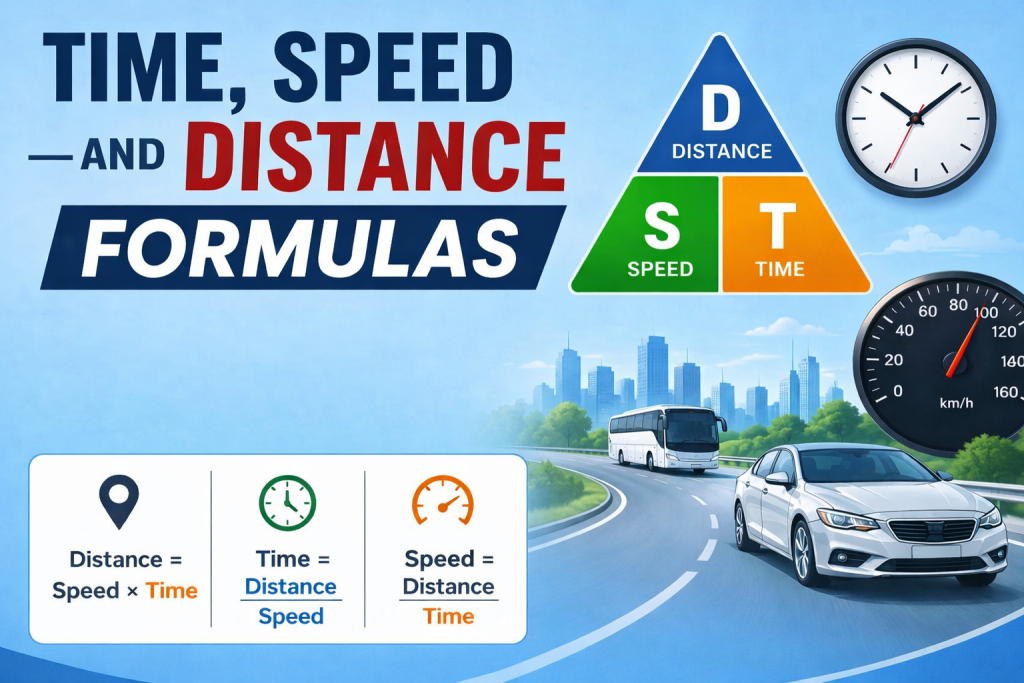
Time, Speed, and Distance are some of the most important concepts in mathematics and aptitude. These are the concepts which are used to calculate the speed of an object, time taken for an object to move and the distance traveled during the motion. Questions from this topic are frequently seen in School Tests, Competitive Tests, and in actual situations for problem solving.
Knowing the relations between time, speed and distance can help to make calculations easier and enhance logical thinking. You will get important formulas in this article that are simple and professional to learn.In this article you will get all formulas which are important and simple to learn in a professional way.
What is Time, Speed, and Distance?
Time
Time is the duration taken to complete a task or travel from one place to another. It is usually measured in seconds, minutes, or hours.
Speed
Speed refers to how fast an object moves from one point to another. It tells the distance covered in a certain amount of time.
Distance
Distance is the total length covered by an object while moving between two locations. It is commonly measured in meters or kilometers.
Basic Time, Speed and Distance Formulas
The following formulas are the foundation of this topic:
- Speed Formula
Speed=DistanceTime\text{Speed} = \frac{\text{Distance}}{\text{Time}}Speed=TimeDistance
- Distance Formula
Distance=Speed×Time\text{Distance} = \text{Speed} \times \text{Time}Distance=Speed×Time
- Time Formula
Time=DistanceSpeed\text{Time} = \frac{\text{Distance}}{\text{Speed}}Time=SpeedDistance
These formulas are widely used to solve travel, train, race, and motion-related problems.
Relationship Between Time, Speed and Distance
Time, Speed, and Distance are closely connected concepts in mathematics. If we know any two of these values, we can easily find the third one using formulas. These concepts are widely used in daily life, such as calculating travel time, vehicle speed, and distance covered during a journey.
Basic Relationship Formula
Speed=DistanceTime\text{Speed} = \frac{\text{Distance}}{\text{Time}}Speed=TimeDistance
This formula shows that speed depends on both distance and time.
Relationship Between Speed, Time and Distance
| Relationship | Condition | Explanation | Formula | Example |
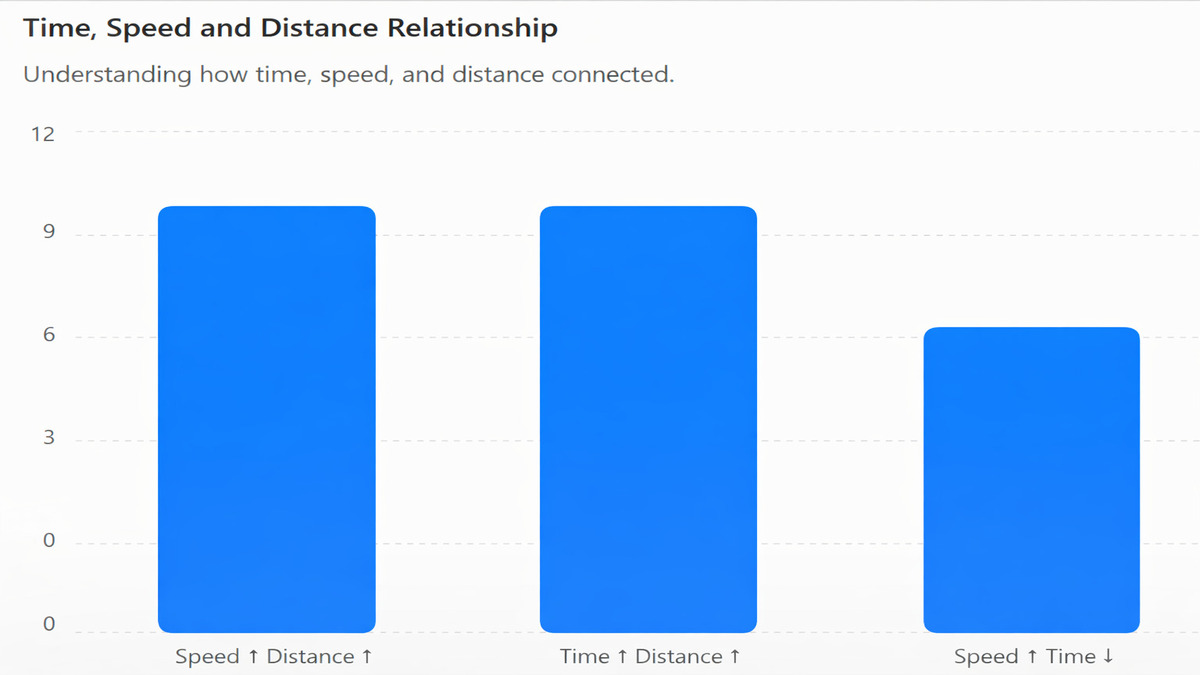
| Relationship Between Speed and Distance | Time remains constant | If speed increases, distance increases. If speed decreases, distance decreases. Speed and distance are directly proportional. | Distance=Speed×Time\text{Distance} = \text{Speed} \times \text{Time}Distance=Speed×Time | 40 km/h for 2 hours = 80 km
60 km/h for 2 hours = 120 km |
| Relationship Between Time and Distance | Speed remains constant | More time means more distance covered, while less time means shorter distance covered. Time and distance are directly proportional. | Distance=Speed×Time\text{Distance} = \text{Speed} \times \text{Time}Distance=Speed×Time | 50 km/h for 1 hour = 50 km
50 km/h for 3 hours = 150 km |
| Relationship Between Speed and Time | Distance remains constant | If speed increases, time decreases. If speed decreases, time increases. Speed and time are inversely proportional. | Time=DistanceSpeed\text{Time} = \frac{\text{Distance}}{\text{Speed}}Time=SpeedDistance | 120 km at 60 km/h = 2 hours
120 km at 40 km/h = 3 hours |
Triangle Trick for Time, Speed and Distance
The triangle trick is a simple method used to remember the formulas for time, speed, and distance easily. In this trick, Distance (D) is written at the top of the triangle, while Speed (S) and Time (T) are written at the bottom corners.
Using the formulas:
- Cover Distance to get: Speed × Time
- Cover Speed to get: Distance ÷ Time
- Cover Time to get: Distance ÷ Speed
Units of Speed, Time and Distance
Units are used to measure speed, time, and distance accurately. Understanding these units is important for solving mathematical and real-life motion problems.
1. Units of Time
Time measures how long an action or journey takes.
Common Units of Time:
- Seconds (s)
- Minutes (min)
- Hours (h)
Example
- 60 seconds = 1 minute
- 60 minutes = 1 hour
2. Units of Distance
Distance measures the total length covered between two places.
Common Units of Distance:
- Millimeter (mm)
- Centimeter (cm)
- Meter (m)
- Kilometer (km)
Example
- 100 cm = 1 m
- 1000 m = 1 km
3. Units of Speed
Speed shows how fast an object moves.
Common Units of Speed:
- Meter per second (m/s)
- Kilometer per hour (km/h)
Example
If a car travels 100 km in 2 hours:
Speed=1002=50 km/h\text{Speed} = \frac{100}{2} = 50\ \text{km/h}Speed=2100=50 km/h
Important Unit Conversions
Convert m/s to km/h
1 m/s=185 km/h1\ \text{m/s} = \frac{18}{5}\ \text{km/h}1 m/s=518 km/h
Convert km/h to m/s
1 km/h=518 m/s1\ \text{km/h} = \frac{5}{18}\ \text{m/s}1 km/h=185 m/s
Example Conversion
Convert 20 m/s into km/h:
20×185=72 km/h20 \times \frac{18}{5} = 72\ \text{km/h}20×518=72 km/h
So, 20 m/s = 72 km/h.
Average Speed Formula
Average speed is calculated when an object travels at different speeds during a journey.
Formula for Average Speed
Average Speed=Total DistanceTotal Time\text{Average Speed} = \frac{\text{Total Distance}}{\text{Total Time}}Average Speed=Total TimeTotal Distance
Formula for Equal Distances
When equal distances are covered at different speeds:
Average Speed=2xyx+y\text{Average Speed} = \frac{2xy}{x+y}Average Speed=x+y2xy
Where:
- xxx = first speed
- yyy = second speed
Relative Speed Formula
Relative speed is used when two objects move in the same or opposite directions.
Opposite Direction
Relative Speed=x+y\text{Relative Speed} = x + yRelative Speed=x+y
Same Direction
Relative Speed=x−y\text{Relative Speed} = x – yRelative Speed=x−y
Relative speed concepts are commonly used in train and race problems.
Train Formulas
Train problems are an important part of time, speed, and distance.
Train Passing a Pole
Time=Length of TrainSpeed\text{Time} = \frac{\text{Length of Train}}{\text{Speed}}Time=SpeedLength of Train
Train Passing a Platform
Time=Length of Train+Length of PlatformSpeed\text{Time} = \frac{\text{Length of Train} + \text{Length of Platform}}{\text{Speed}}Time=SpeedLength of Train+Length of Platform
Two Trains Crossing Each Other
For opposite directions:
Time=L1+L2x+y\text{Time} = \frac{L_1 + L_2}{x + y}Time=x+yL1+L2
For same directions:
Time=L1+L2x−y\text{Time} = \frac{L_1 + L_2}{x – y}Time=x−yL1+L2
Solved Examples
Example 1: Finding Speed
A car travels 120 km in 3 hours. Find the speed.
Solution:
Using the formula:
Speed=1203=40 km/h\text{Speed} = \frac{120}{3} = 40\ \text{km/h}Speed=3120=40 km/h
Answer: 40 km/h
Example 2: Finding Distance
A bike moves at 50 km/h for 4 hours. Find the distance covered.
Solution:
Distance=50×4=200 km\text{Distance} = 50 \times 4 = 200\ \text{km}Distance=50×4=200 km
Answer: 200 km
Example 3: Finding Time
A train travels 300 km at 60 km/h. Find the time taken.
Solution:
Time=30060=5 hours\text{Time} = \frac{300}{60} = 5\ \text{hours}Time=60300=5 hours
Answer: 5 hours
Shortcut Tips for Time, Speed and Distance
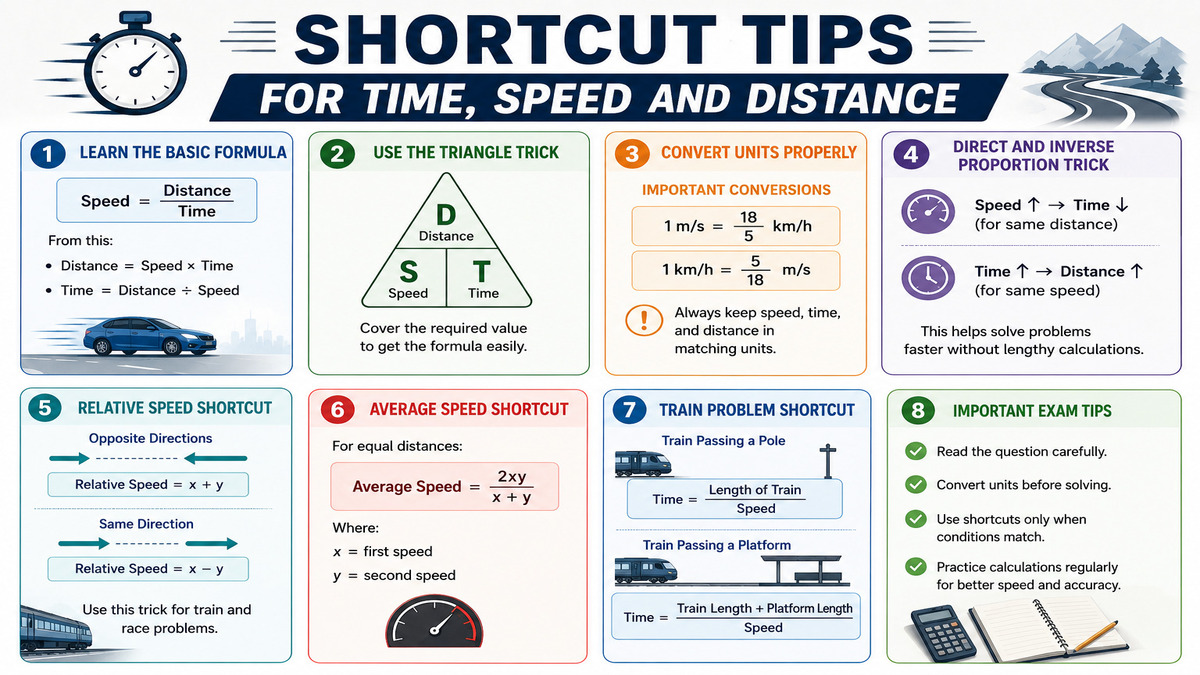
Shortcut tips help solve time, speed, and distance problems quickly and accurately in exams and daily calculations.
1. Learn the Basic Formula
Speed=DistanceTime\text{Speed} = \frac{\text{Distance}}{\text{Time}}Speed=TimeDistance
From this:
- Distance = Speed × Time
- Time = Distance ÷ Speed
2. Use the Triangle Trick
Remember the triangle:
- D at the top
- S and T at the bottom
Cover the required value to get the formula easily.
3. Convert Units Properly
Important Conversions
1 m/s=185 km/h1\ \text{m/s} = \frac{18}{5}\ \text{km/h}1 m/s=518 km/h
1 km/h=518 m/s1\ \text{km/h} = \frac{5}{18}\ \text{m/s}1 km/h=185 m/s
Always keep speed, time, and distance in matching units.
4. Direct and Inverse Proportion Trick
- Speed ↑ → Time ↓ (for same distance)
- Time ↑ → Distance ↑ (for same speed)
This helps solve problems faster without lengthy calculations.
5. Relative Speed Shortcut
Opposite Directions
Relative Speed=x+y\text{Relative Speed} = x + yRelative Speed=x+y
Same Direction
Relative Speed=x−y\text{Relative Speed} = x – yRelative Speed=x−y
Use this trick for train and race problems.
6. Average Speed Shortcut
For equal distances:
Average Speed=2xyx+y\text{Average Speed} = \frac{2xy}{x+y}Average Speed=x+y2xy
Where:
- xxx = first speed
- yyy = second speed
7. Train Problem Shortcut
Train Passing a Pole
Time=Length of TrainSpeed\text{Time} = \frac{\text{Length of Train}}{\text{Speed}}Time=SpeedLength of Train
Train Passing a Platform
Time=Train Length + Platform LengthSpeed\text{Time} = \frac{\text{Train Length + Platform Length}}{\text{Speed}}Time=SpeedTrain Length + Platform Length
8. Important Exam Tips
- Read the question carefully.
- Convert units before solving.
- Use shortcuts only when conditions match.
- Practice calculations regularly for better speed and accuracy.
Real-Life Applications of Time, Speed and Distance
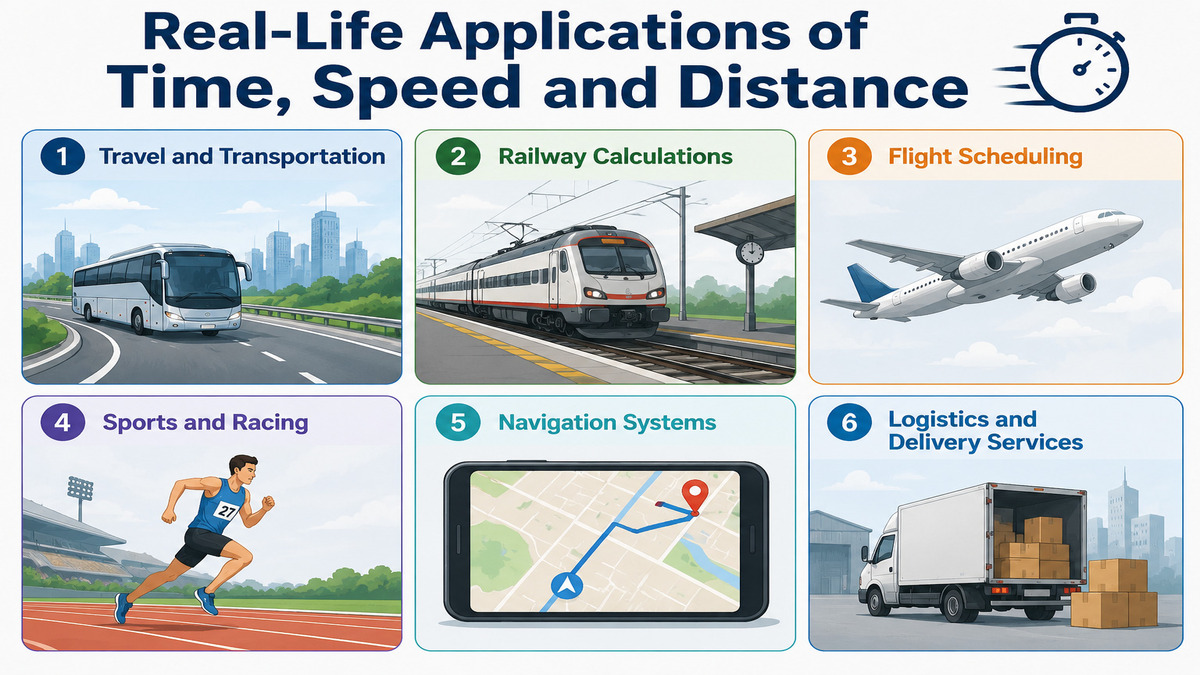
Time, speed, and distance concepts are used in many real-life situations:
1. Travel and Transportation
Time, speed, and distance formulas are widely used in transportation to calculate travel time, fuel usage, and arrival schedules. Drivers and travelers use these calculations to estimate how long a journey will take and the distance covered.
Example
Time=DistanceSpeed\text{Time} = \frac{\text{Distance}}{\text{Speed}}Time=SpeedDistance
If a bus travels 200 km at 50 km/h, the travel time will be 4 hours.
2. Railway Calculations
Railways use time, speed, and distance concepts to manage train schedules, crossing times, and platform timings. These calculations help ensure smooth and safe railway operations.
Example
Time=Train LengthSpeed\text{Time} = \frac{\text{Train Length}}{\text{Speed}}Time=SpeedTrain Length
This formula is used to calculate the time taken by a train to cross a pole or platform.
3. Flight Scheduling
Airlines use these formulas to estimate flight duration, departure time, and arrival schedules. Pilots also use speed and distance calculations during navigation and fuel planning.
Example
If an airplane travels 900 km at 450 km/h, the flight time will be 2 hours.
4. Sports and Racing
In sports, speed calculations help measure player performance and race timing. Athletes, runners, cyclists, and racers use these calculations to improve speed and performance.
Example
A runner completing 100 meters in 10 seconds can calculate running speed using the speed formula.
5. Navigation Systems
GPS and navigation systems use time, speed, and distance formulas to provide the shortest route and estimated arrival time. These systems help drivers avoid delays and choose faster routes.
Example
Google Maps estimates travel time based on vehicle speed and road distance.
6. Logistics and Delivery Services
Delivery companies use these concepts to manage parcel delivery timings, transportation routes, and fuel efficiency. Faster and accurate calculations improve delivery performance.
Example
Courier companies estimate package delivery time based on vehicle speed and travel distance.
Common Mistakes to Avoid
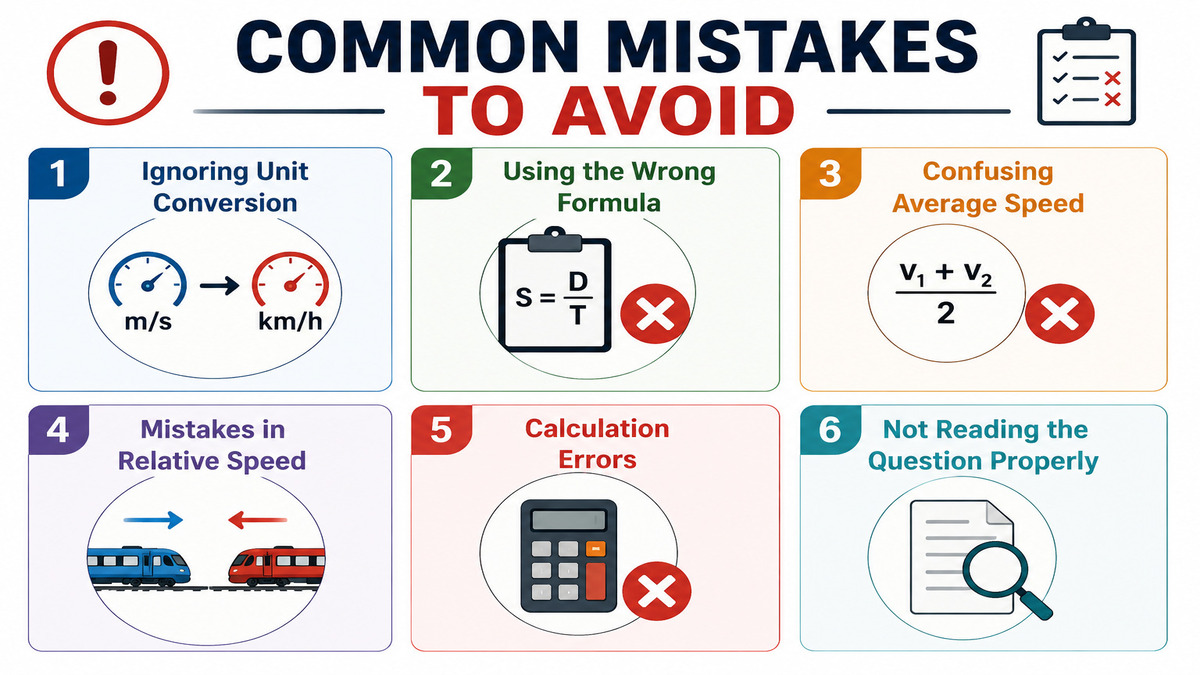
1. Ignoring Unit Conversion
Students often forget to convert units like m/s to km/h before solving problems. Incorrect unit conversion can lead to wrong answers.
2. Using the Wrong Formula
Applying the wrong formula for speed, time, or distance is a common mistake. Always identify what value needs to be calculated first.
3. Confusing Average Speed
Many students calculate average speed incorrectly by simply adding speeds and dividing by 2. Use the proper average speed formula when distances are equal.
4. Mistakes in Relative Speed
Students may forget to add speeds in opposite directions or subtract speeds in the same direction. Understanding direction is very important in train and race problems.
5. Calculation Errors
Simple multiplication or division mistakes can affect the final answer. Check calculations carefully after solving the problem.
6. Not Reading the Question Properly
Sometimes important details like unit changes or direction are missed. Reading the question carefully helps avoid unnecessary mistakes.
Final Thoughts
Time, Speed, and Distance formulas are essential concepts in mathematics and competitive exams. By understanding the formulas, unit conversions, relative speed, and average speed methods, students can solve problems quickly and accurately. Regular practice and proper understanding of concepts can improve problem-solving speed and confidence.
FAQs on Time, Speed and Distance Formulas
1. What is the formula for speed?
The formula for speed is:
Speed=DistanceTime\text{Speed} = \frac{\text{Distance}}{\text{Time}}
It helps calculate how fast an object is moving.
2. How do you calculate distance?
Distance is calculated by multiplying speed and time.
Distance=Speed×Time\text{Distance} = \text{Speed} \times \text{Time}
3. What is the formula for time?
Time is found by dividing distance by speed.
Time=DistanceSpeed\text{Time} = \frac{\text{Distance}}{\text{Speed}}
4. What are the common units of speed?
The common units of speed are:
- Kilometer per hour (km/h)
- Meter per second (m/s)
5. How do you convert m/s into km/h?
1 m/s=185 km/h1\ \text{m/s} = \frac{18}{5}\ \text{km/h}
Multiply the speed in m/s by 18/5.
6. What is average speed?
Average speed is the total distance divided by total time.
Average Speed=Total DistanceTotal Time\text{Average Speed} = \frac{\text{Total Distance}}{\text{Total Time}}
7. What is relative speed?
Relative speed is the speed of one object with respect to another moving object.
Opposite Direction
Relative Speed=x+y\text{Relative Speed} = x + y
Same Direction
Relative Speed=x−y\text{Relative Speed} = x – y
8. Why is unit conversion important in time, speed, and distance problems?
Unit conversion ensures all values are in the same measurement system, helping avoid incorrect answers.
9. What is the triangle trick in time, speed, and distance?
The triangle trick is a simple method to remember formulas by placing Distance at the top and Speed and Time at the bottom corners.
10. Where are time, speed, and distance formulas used in real life?
These formulas are used in transportation, railway calculations, sports, navigation systems, flight scheduling,
Read More: Vedic Maths Tricks
📚 Related Articles
👉 You May Also Read
📚 Related Articles
🔥 Popular Posts



📌 Explore Categories
- About India
- Artificial Intelligence & Machine Learning
- Calendar
- Career
- Counselling
- Current Affairs
- Economy
- Education
- English Grammar
- Exams
- Festival
- Health and Fitness
- Hindi Sahitya
- History
- Intelligence Agency
- International Personality
- Know India
- Knowledge
- Maths
- Maxim
- Moral Stories
- Nature
- NEWS
- Olympiad
- Others
- Personal Finance
- Personality Development
- Politics
- Scholarship
- Science and Environment
- Sports
- States of India
- Study Abroad
- Study Tips
- Technology
- The Greatest Indian
- Uncategorized