
Coaching vs Self-Study: Which is Best in 2026 for Competitive Exams?
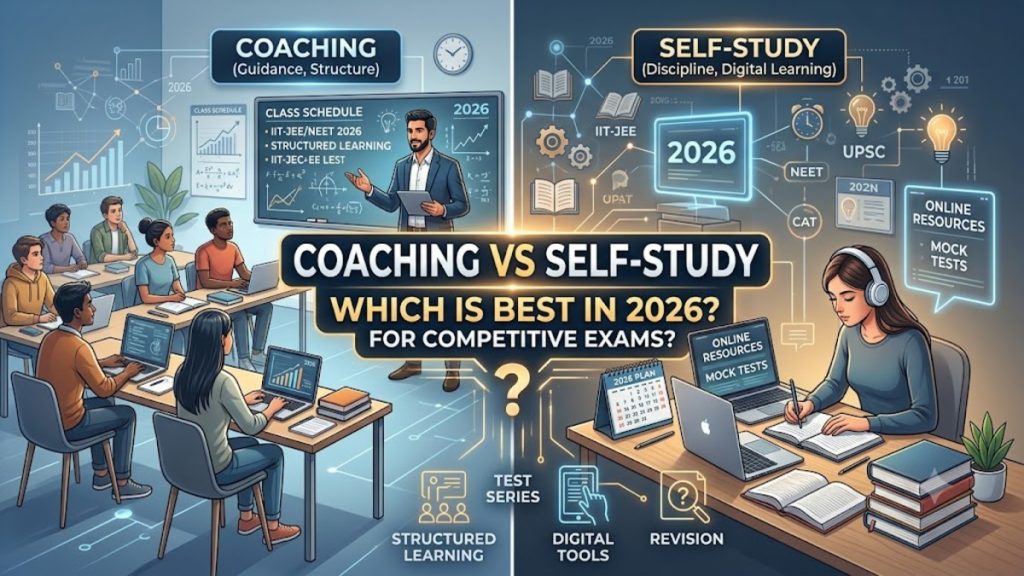
AI tools, online platforms that are much cheaper than coaching centres and the changing idea of what “structure” even means have upended this argument more in the past two years than in the decade preceding it. Here’s what is really the case for 2026 – and what has actually stayed the same. If you look at the decade before this, the debate on “coaching or self-study” was in fact more about access: access to a good teacher in your city, access to the institute-level coaching fees of coaching centres, and the ability to build discipline despite not being in a batch environment.
In 2026, that framing no longer makes sense. The real question is whether you have the ability to either build your own structure using tools that didn’t exist a few years ago, or whether you need access to something that a coaching institute still offers. The real answer to “which is best” – whether coaching or self-study – hasn’t changed that much: it still depends on the student. But the cost of self-study, the difference in quality of free and low-cost tools, and the different things coaching institutes are trying to now include in their packages makes all the difference.
What’s Actually New in 2026
Three shifts define this year’s version of the debate, and none of them were fully in place even two years ago.
- AI tools have moved from novelty to routine use. Google added full-length JEE Main and NEET practice tests directly inside Gemini in 2026, and platforms built specifically for exam prep — from AI-driven doubt-solvers to adaptive practice tools — are now standard parts of many students’ study stacks, coached or not.
- Instant, personalized feedback is no longer a coaching-only feature. A student can finish a mock test and get an AI-generated breakdown of weak chapters, time spent per question, and targeted next steps within seconds — a layer of analysis that used to require a coaching institute’s dedicated faculty and analytics team.
- Low-cost structured online platforms have matured. Options built specifically around affordability and discipline — offering full syllabus coverage, unlimited mock tests, and progress tracking at a fraction of premium offline institute fees — have narrowed the gap that used to make offline coaching feel close to mandatory.
What AI Tools Can and Can’t Do for You
It’s worth being precise here, because the hype outpaces the reality in both directions. AI tools are genuinely useful for a few specific things: explaining a concept in a different way than your textbook does, generating extra practice questions on a weak topic, summarizing daily current affairs for UPSC aspirants, and giving fast feedback after a mock test. For NEET and JEE particularly, tools now offer full practice tests with instant, chapter-wise breakdowns of where marks were lost.
What they don’t do is change what the exams actually test. NEET UG still rewards NCERT mastery, speed, and accuracy built through repetition — not the ability to have a concept explained to you quickly. Educators who work directly with droppers and repeaters have been explicit about this: consistent study and structured mock practice remain the deciding factor, and AI tools are a supplement to that process, not a substitute for it.
The trap to avoid
Using AI to generate notes or explanations you never actually revise is a common failure mode — treating a reasoning tool like a vending machine, pasting output into a document, and calling it “prep.” AI tools help most when used for active tasks — extra practice, doubt-solving, spaced revision prompts — not passive content generation.
Coaching in 2026: What’s Changed, What Hasn’t
Coaching institutes haven’t stood still either. Many now bundle their own AI-driven analytics, adaptive practice, and personalized study plans into existing programs — partly in direct response to competition from lower-cost online-first platforms. What coaching still offers that’s genuinely hard to replicate, even with AI in the mix, is live problem-solving exposure from experienced faculty (still the strongest argument for JEE Advanced specifically) and a peer environment that builds accountability through social pressure rather than app notifications.
What’s weakened is coaching’s monopoly on structure and feedback. A well-built self-study plan using a decent AI tool and a good online test series can now replicate a meaningful part of what used to require a full offline program — which is pushing more aspirants, and more institutes, toward hybrid models by default rather than as an edge case.
Who May Benefit From Coaching?
Coaching can be useful for students who:
- Need a fixed timetable
- Prefer classroom or teacher-led learning
- Require regular academic supervision
- Need frequent doubt-clearing support
- Find it difficult to create and follow their own study plan
- Want a structured test and revision system
However, joining coaching still requires independent study and regular practice outside class.
Self-Study in 2026: More Viable, Not Automatic
Self-study is more achievable in 2026 than it was five years ago, mainly because the two hardest parts of self-study — building a study plan and getting fast, useful feedback — are now partially automatable. AI-based platforms can build adaptive study paths based on real performance data, flag recurring weak areas using techniques like spaced repetition, and provide UPSC aspirants with same-day current affairs summaries mapped to the syllabus, work that used to eat hours of manual effort every week.
None of this replaces the two things self-study has always demanded: consistency and honest self-assessment. AI tools are excellent at telling you what you got wrong; they don’t make you sit down and do the next mock test. That part is still entirely on the student, exactly as it was before any of this technology existed.
Who May Prefer Self-Study?
Self-study may work well for students who:
- Have a good academic foundation
- Can follow a timetable independently
- Understand concepts through books or online lessons
- Can regularly practise questions
- Analyse their mistakes after tests
- Can stay consistent without daily supervision
Self-study requires strong time management because the student is responsible for planning, revision and progress tracking.
Coaching vs Self-Study vs Hybrid: The 2026 Comparison
| Factor | Coaching (2026) | Self-Study (2026) |
| Cost | High, though many now bundle AI tools at no extra charge | Low to moderate — books, test series, occasional paid AI tools |
| Structure | Provided by faculty and fixed schedule | Buildable via AI-assisted study plans, but self-enforced |
| Feedback speed | Fast, faculty and analytics-driven | Fast, now largely AI-driven and near-instant |
| Problem-solving exposure (esp. JEE Advanced) | Strongest advantage, largely unmatched | Improving, but still the weakest link |
| Accountability | Peer batch pressure, in-person | Self-driven, or built via study groups/online communities |
| Best suited to | Students needing external structure or heavy exam-specific pattern training | Disciplined students comfortable using tools actively, not passively |
So, Which Is Best in 2026?
For most aspirants, the honest 2026 answer is a hybrid, not a hard choice between the two extremes. Use structured online content or a shorter coaching program for core concept-building, lean on AI tools for practice, feedback, and current affairs tracking, and pay specifically for the pieces that are still hardest to replicate independently — live problem-solving exposure for JEE Advanced, expert mentorship for UPSC optional subjects, and a disciplined mock-test routine, wherever it comes from.
Full offline coaching still makes sense for students who know, from experience, that they need external structure and in-person accountability to stay consistent. Full self-study, now meaningfully assisted by AI tools, makes sense for disciplined students with a reasonable subject foundation who can be trusted to use those tools actively rather than as a shortcut. The exam and the year matter less than they used to; the student’s own habits and self-awareness matter more.
How Should Parents and Students Decide?
Before choosing a preparation method, ask these questions:
- What is the student’s current academic level?
- Does the student need regular supervision?
- Can the student study consistently without coaching?
- What is the total annual cost of each option?
- How much travel time is involved?
- Are good teachers or doubt-solving resources available?
- How will mock tests and progress be tracked?
- Can the student maintain the routine for the entire preparation period?
These questions can help families choose a preparation system based on their actual circumstances rather than simply following what other students are doing.
The Bottom Line
In 2026, the tools available to a self-studier are better than they’ve ever been, and coaching institutes have responded by folding some of those same tools into their own programs — which means the gap between the two paths has narrowed, but not closed. What coaching still buys, reliably, is structure enforced by other people and exposure to problem-solving patterns built over years of teaching. What self-study now buys, more reliably than before, is fast feedback and adaptive practice at a fraction of the cost. Neither path guarantees success on its own; the deciding factor, as it has always been, is whether the student actually does the work consistently — with or without someone standing over them to make sure of it.
FAQs for the Coaching vs Self-Study: Which is Best
- Is coaching necessary for competitive exams in 2026?
No. Coaching is not mandatory. Students can prepare through self-study, online resources, or a combination of coaching and self-study. - Can I crack NEET or JEE through self-study?
Yes, self-study is one possible preparation method. Students need a clear timetable, reliable study materials, regular practice, mock tests and consistent revision. - Is coaching better than self-study for NEET and JEE?
Both have advantages. Coaching provides structured classes, teacher guidance and regular tests, while self-study offers flexibility and greater control over the study schedule. - Is self-study cheaper than coaching?
Generally, self-study can cost less because students avoid full coaching fees. However, books, online courses, test series, internet and devices can still add to the total cost. - What is a hybrid approach to competitive-exam preparation?
A hybrid approach combines self-study with selected coaching services, such as online classes, test series or doubt-solving sessions. It can provide additional support without requiring a full-time coaching program. - How many hours should students study for NEET or JEE?
There is no fixed number of hours suitable for every student. Study time should depend on school workload, academic level, syllabus progress and individual learning speed. - Can students prepare for competitive exams while attending a state board school?
Yes. Students can prepare alongside state-board studies by following the entrance-exam syllabus separately, strengthening core concepts and using suitable practice and test resources. - Which is better for an average student: coaching or self-study?
It depends on the student’s learning needs. Students who need regular guidance may prefer structured coaching, while those who can plan and study independently may choose self-study. - Does expensive coaching guarantee success in NEET or JEE?
No. Coaching provides resources and guidance, but exam performance also depends on consistent study, practice, revision, time management and understanding of concepts. - How can parents reduce competitive-exam preparation costs?
Families can compare different coaching formats, use free educational resources, purchase only necessary books and consider online or hybrid preparation instead of automatically choosing an expensive residential program. - Should students join coaching from Class 9 or Class 10?
There is no universal requirement to start coaching at a particular class. Parents should consider the student’s academic foundation, interest, school workload and long-term preparation plan. - What should I choose in 2026: coaching, self-study or hybrid preparation?
Consider your learning style, academic needs, available time, budget and access to guidance. The best option is the one that you can follow consistently over the preparation period.
Read More: NEET & JEE Preparation Guide for State Board Students
📚 Related Articles



👉 You May Also Read
📚 Related Articles
- NEET & JEE Preparation Guide for State Board Students
- Why Self-Discipline is More Important Than Motivation for Students
- How Visualization Strategies Can Improve Test Performance
- Smart Questions to Ask in a Parent-Teacher Meeting | PTM Made Easy
- The Secret to Smarter Learning — Building Strong Critical Thinking Skills
🔥 Popular Posts


📌 Explore Categories
- About India
- Artificial Intelligence & Machine Learning
- Calendar
- Career
- Counselling
- Current Affairs
- Economy
- Education
- English Grammar
- Exams
- Festival
- Health and Fitness
- Hindi Sahitya
- History
- Intelligence Agency
- International Personality
- Know India
- Knowledge
- Maths
- Maxim
- Moral Stories
- Nature
- NEWS
- Olympiad
- Others
- Personal Finance
- Personality Development
- Politics
- Scholarship
- Science and Environment
- Sports
- States of India
- Study Abroad
- Study Tips
- Technology
- The Greatest Indian
- Uncategorized