
What is NEET? NEET Full-Form, Syllabus and Eligibility Criteria in 2026
NEET is the most crucial medical entrance examination, which is conducted in India for students who are looking forward to pursue undergraduate medical courses like MBBS, BDS, BAMS, BHMS, BSMS, BUMS, and other medical related courses. NEET is a unified and standardized exam for gaining admission into medical colleges around the country, organized by the National Testing Agency (NTA). The host of this exam is currently ITA in India. Before 2019 it was hosted by CBSE with Prometric Testing Pvt Ltd having headquarter in the US.
What Is NEET?
NEET is a National Eligibility cum Entrance Test., which is conducted to check the knowledge and aptitude level of the students who want to enter in undergraduate medical and allied healthcare courses in India. It offers a single platform where students from various educational boards and states can compete for the medical seats on the basis of the same evaluation. Exam is taken every year and accepted by all government, private, deemed and central medical institutes in the country.
History and Evolution of NEET
Before NEET was introduced, students were required to appear for multiple medical entrance examinations conducted by different states and institutions. To create a unified admission process and maintain transparency, NEET was introduced as a common entrance test. Over the years, it has become the primary gateway for medical education in India and has significantly streamlined the admission process.
Why Is NEET Important?
NEET is one of the most important entrance examinations for students who aspire to build a career in medicine and healthcare. It serves as the primary gateway to undergraduate medical and dental courses across India, ensuring a fair and standardized admission process for all candidates. By conducting a single national-level examination, NEET eliminates the need for multiple entrance tests and creates equal opportunities for students from different educational backgrounds.
Benefits of Appearing in NEET
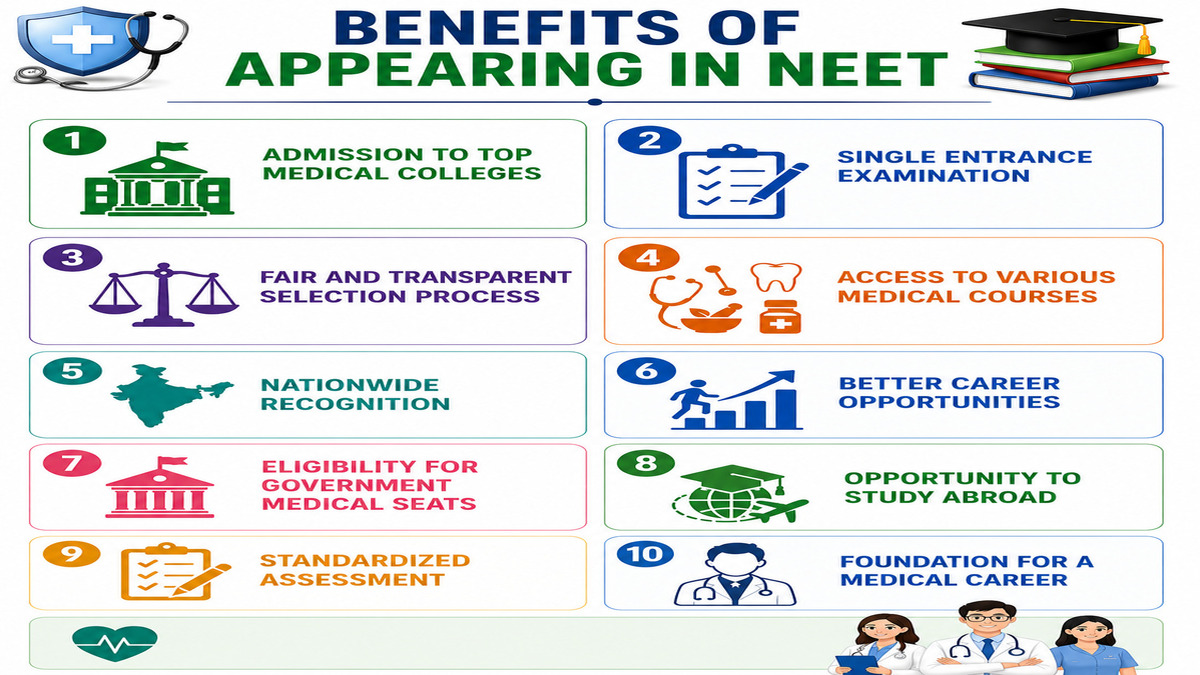
Appearing for NEET offers numerous advantages for students who aspire to pursue a career in medicine, dentistry, and other healthcare fields. As India’s primary medical entrance examination, NEET provides access to a wide range of undergraduate medical programs and serves as a standardized platform for admission to medical institutions across the country.
1. Admission to Top Medical Colleges
NEET scores are accepted by government, private, deemed, and central medical institutions, allowing students to compete for seats in some of India’s most prestigious medical colleges.
2. Single Entrance Examination
Students can apply for multiple medical courses through one examination, eliminating the need to appear for several different entrance tests.
3. Fair and Transparent Selection Process
NEET follows a merit-based admission system where candidates are selected based on their performance in a common national-level examination.
4. Access to Various Medical Courses
A qualifying NEET score can help students gain admission to:
- MBBS
- BDS
- BAMS
- BHMS
- BSMS
- BUMS
- Nursing and other allied healthcare programs
5. Nationwide Recognition
NEET is recognized across India, enabling students to apply for medical colleges in different states and institutions.
6. Better Career Opportunities
A good NEET score opens the door to professional careers in medicine, dentistry, healthcare, research, and related fields.
7. Eligibility for Government Medical Seats
Students who perform well in NEET can secure admission to government medical colleges, which often offer high-quality education at affordable fees.
8. Opportunity to Study Abroad
Many countries and foreign medical universities consider NEET qualification mandatory or beneficial for Indian students seeking medical education abroad.
9. Standardized Assessment
NEET evaluates students using a common syllabus and examination pattern, ensuring equal opportunities for all candidates.
10. Foundation for a Medical Career
Successfully qualifying NEET is the first step toward becoming a doctor, dentist, or healthcare professional and building a rewarding career in the medical field.
NEET Eligibility Criteria
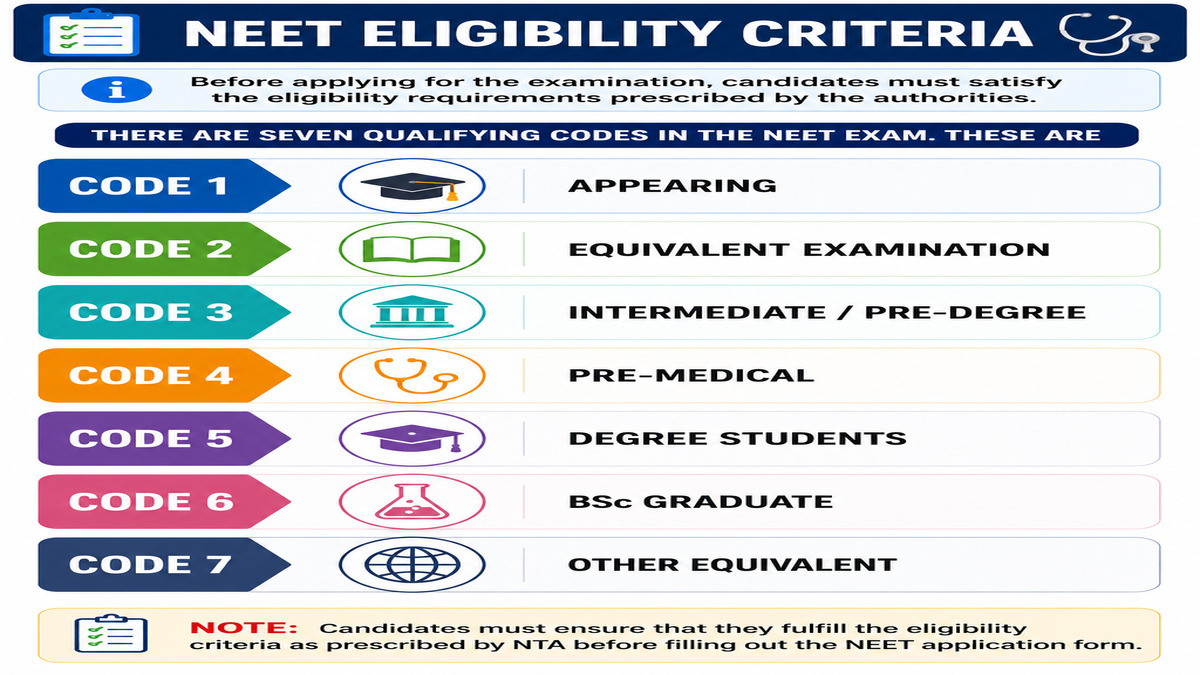
Before applying for the examination, candidates must satisfy the eligibility requirements prescribed by the authorities.
There are seven qualifying codes in the NEET exam. These are
- Code 1
- Code 2
- Code 3
- Code 4
- Code 5
- Code 6
- Code 7
Code 1- Candidates who are appearing for the class 12 board exams this year have to select this code. But at the time of the exam, a candidate must have completed the 12th class. Failing the class makes him ineligible to apply.
Code 2- Candidates who are studying from ICSE or higher/senior secondary examination, this is equivalent to class 12th examination have to choose this code. As per the NCERT, the final two years must comprise subjects (physics, chemistry, biology/biotechnology, and mathematics or any other elective subjects with English as a base subject.)
Code 3- Candidates who have done their Intermediate/Pre-degree Examination from Science of an Indian University/Board or the other recognized boards with physics, chemistry, biology/biotechnology, and mathematics or any other elective subjects with English as a base subject.
Code 4- Candidates completed Pre-professional/Pre-medical Examination after successfully passing Higher Secondary Examination or the Pre-University or other courses which are equivalent to it with subjects physics, chemistry, biology/biotechnology, and mathematics.
Code 5- Candidates having physics, chemistry, biology/biotechnology, and mathematics as compulsory subject candidates who are pursuing the three years’ degree course from a recognized University and have qualified the first year can go with this code.
Code 6- With at least two of these subjects those are Physics, Chemistry, Biology (Botany, Zoology)/Biotechnology, candidates who have passed BSc Examination from an Indian recognized University have to choose this code. But, they must have passed the earlier qualifying examination (10+2) with English, Physics, Chemistry, and Biology.
Code 7- Aspirants who have qualified for any other examination equivalent to (Last 10+2 Study comprising of Physics, Chemistry, and Biology/Biotechnology) can choose this code. Aspirants who have completed the qualifying examination from a foreign country are also required to fill in this code.
Educational Qualification
To be eligible for NEET, candidates must have passed or be appearing in Class 12 (10+2) or an equivalent examination from a recognized board. The qualifying examination must include the following subjects as core subjects:
- Physics
- Chemistry
- Biology/Biotechnology
- English
The qualifying examination must be from a recognized board.
Minimum Qualifying Marks
| Category | Minimum Marks in PCB (Physics, Chemistry & Biology) |
| General / EWS | 50% |
| OBC / SC / ST | 40% |
| PwD (General) | 45% |
Minimum Age Requirement
Candidates must be at least 17 years old at the time of admission or before the specified date in the admission year.
NEET Syllabus in 2026
The NEET syllabus is based primarily on the Class 11 and Class 12 curriculum and covers three main subjects: Physics, Chemistry, and Biology (Botany & Zoology). A thorough understanding of the syllabus helps students prepare effectively and focus on important topics for the examination.
PHYSICS
Physics evaluates a student’s understanding of scientific principles, formulas, and problem-solving abilities.
CHEMISTRY
Chemistry includes Physical Chemistry, Organic Chemistry, and Inorganic Chemistry.
BIOLOGY
Biology is the most important section of the examination and consists of Botany and Zoology.
Subject wise marks distribution
Nationality Requirements
The following candidates are generally eligible to appear for NEET:
- Indian Citizens
- Overseas Citizens of India (OCI)
- Non-Resident Indians (NRI)
- Persons of Indian Origin (PIO)
- Foreign Nationals (subject to applicable regulations)
NEET for NRI, OCI and Candidates Studying Outside India
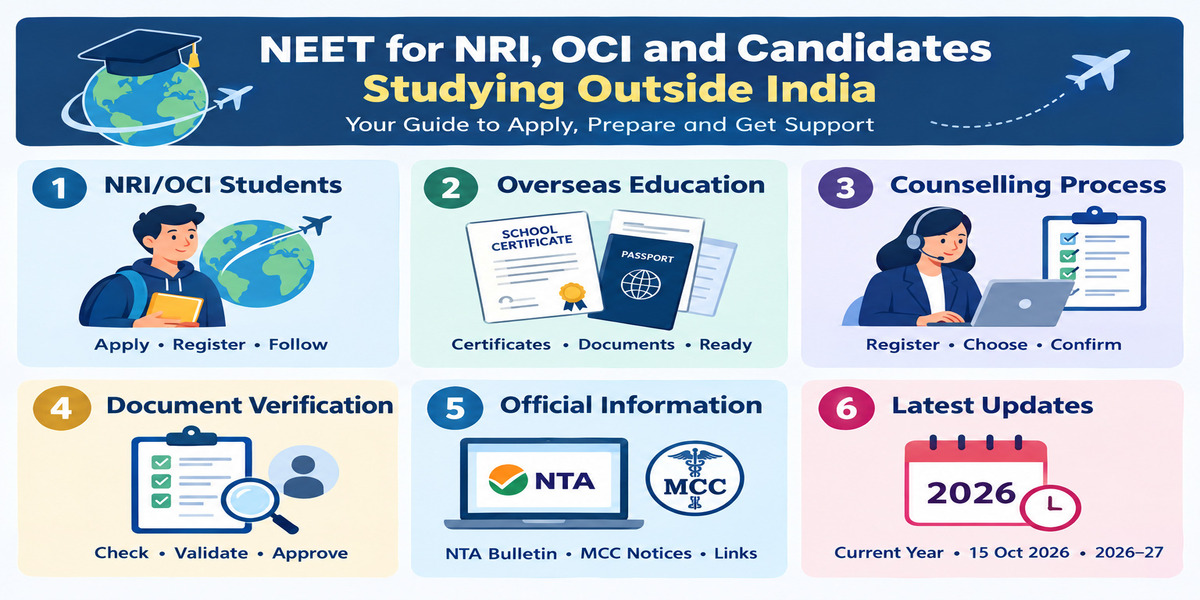
Students who live outside India may be able to appear for NEET-UG if they meet the eligibility rules published by the National Testing Agency (NTA). This may include Non-Resident Indians (NRIs), Overseas Citizens of India (OCI), and foreign nationals, subject to the current rules. Qualifying NEET does not automatically guarantee admission; candidates must also meet the requirements of the relevant counselling authority and medical college.
1. NRI/OCI Students: How to Apply for NEET
NRI and OCI students should first read the current NEET-UG Information Bulletin to confirm their eligibility, age requirements, qualifying subjects, minimum marks, application dates, and required documents. They must complete the online application through the official NTA NEET website during the application period, enter their details carefully, upload the documents requested in the application, pay the applicable fee, and download the confirmation page.
Students should use the nationality and qualifying-examination options that accurately match their circumstances. The rules for appearing in NEET and the rules for claiming an NRI category during counselling are not necessarily the same. Candidates should check both the NTA instructions and the relevant counselling notices before applying.
2. Overseas Education: School Certificates and Documents
Students who completed school outside India should keep their Class 10 and Class 12 certificates or equivalent records ready. Their qualifying education must meet the current NEET requirements, including the required subjects—Physics, Chemistry, Biology/Biotechnology, and English—and the applicable minimum marks.
Depending on the student’s education system and the counselling authority’s rules, documents may include school transcripts or mark sheets, a pass certificate, proof that the qualification is equivalent to the required Indian Class 12 standard, a passport or other identity document, and translations if records are not in an accepted language. Candidates should confirm the exact list in the current bulletin and counselling instructions rather than assume that every document is required in every case.
3. Counselling Process for NRI/OCI Candidates
After the NEET result, eligible candidates must register separately for the counselling process relevant to the seats they want. The Medical Counselling Committee (MCC) conducts counselling for specified All India Quota and other participating seats, while state counselling authorities manage the seats assigned to them. The applicable process depends on the college, seat type, and current rules.
Candidates should register on the correct official counselling portal, check the schedule and eligibility conditions, fill in their choices, and follow the instructions for seat allotment, fee payment, and reporting. NRI-category applicants must follow any additional steps announced by MCC or the relevant authority. Qualifying NEET alone does not guarantee an NRI seat or a particular college.
4. Document Verification: NRI/OCI Status
During counselling, the relevant authority may verify a candidate’s nationality or OCI status, educational qualifications, and eligibility for the category or seat claimed. For an NRI-category claim, additional evidence may be requested under the current notice. Depending on the case and the official instructions, this may include passport or visa-related records, proof of the sponsor’s NRI status, documents showing the relationship between the candidate and sponsor, affidavits, or other prescribed certificates.
This is only a general guide to the types of records that may be requested. The exact list, format, submission method, and deadline must be taken from the latest MCC or state counselling notice. Candidates should upload clear, genuine documents and keep the originals available for verification. If a document is missing or does not meet the stated requirements, the category claim or admission may be affected.
5. Official Information and Useful Links
Always rely on official notices because eligibility rules, document requirements, counselling schedules, and procedures can change. Useful official resources include:
- NEET-UG Information Bulletin 2026 (NTA): https://neet.nta.nic.in/admission-bulletin/
- NEET-UG 2026 Documents and Notices (NTA): https://neet.nta.nic.in/documents/
- MCC Undergraduate Medical Counselling: https://mcc.nic.in/ug-medical-counselling/
- MCC News and Events for UG Counselling: https://mcc.nic.in/news-events-ug-medical/
- MCC Public Notice on NRI Candidature for Academic Year 2026–27: https://mcc.nic.in/document/public-notice-for-eligibility-of-nri-candidature-for-academic-year-2026-27/
- MCC NRI Eligible Candidate List for UG Round 1 (2026–27): https://mcc.nic.in/document/nri-list-of-eligible-candidates-for-ug-round-1-2026-27/
Latest Updates
Information checked on 15 October 2026. The NTA website lists the NEET-UG 2026 Information Bulletin and related examination notices. MCC’s 2026–27 UG counselling pages also list NRI eligibility and document-verification notices, NRI eligible-candidate lists, and counselling updates. Candidates should revisit the official NTA and MCC pages before acting, because later notices may replace or amend earlier instructions.
NEET Exam Pattern
Understanding the NEET exam pattern is essential for effective preparation. The exam pattern provides information about the mode of examination, number of questions, marking scheme, subjects covered, and overall structure of the test. NEET is designed to evaluate a candidate’s knowledge of Physics, Chemistry, and Biology based on the Class 11 and Class 12 syllabus. The examination is conducted by the National Testing Agency (NTA) in a standardized format across India.
NEET Exam Pattern Overview
| Particulars | Details |
| Exam Name | National Eligibility cum Entrance Test (NEET-UG) |
| Conducting Body | National Testing Agency (NTA) |
| Mode of Exam | Offline (Pen-and-Paper) |
| Question Type | Multiple Choice Questions (MCQs) |
| Total Questions | 180 |
| Total Marks | 720 |
| Duration | 3 Hours (180 Minutes) |
| Subjects | Physics, Chemistry, Botany, Zoology |
| Marking Scheme | +4 for Correct Answer, -1 for Incorrect Answer |
| Negative Marking | Yes |
Subject-Wise Question Distribution
Physics
- Number of Questions: 45
- Total Marks: 180
Chemistry
- Number of Questions: 45
- Total Marks: 180
Botany
- Number of Questions: 45
- Total Marks: 180
Zoology
- Number of Questions: 45
- Total Marks: 180
Total
- Questions: 180
- Marks: 720
Marking Scheme
- Correct Answer
Candidates receive 4 marks for every correct answer.
- Incorrect Answer
1 mark is deducted for every incorrect answer.
- Unanswered Questions
No marks are awarded or deducted for unanswered questions.
- Maximum Score
The highest possible score in NEET is 720 marks.
Examination Mode and Duration
- National-level entrance examination
- Multiple-choice questions (MCQs)
- Conducted by NTA
The examination is conducted over a fixed duration determined by NTA. Recent updates have increased the exam duration to provide candidates with additional time.
Courses Available Through NEET
A qualifying NEET score can be used for admission to several medical and healthcare programs.
Undergraduate Medical Courses
- MBBS
- BDS
- BAMS
- BHMS
- BSMS
- BUMS
- BSc Nursing (selected institutions)
How to Prepare for NEET
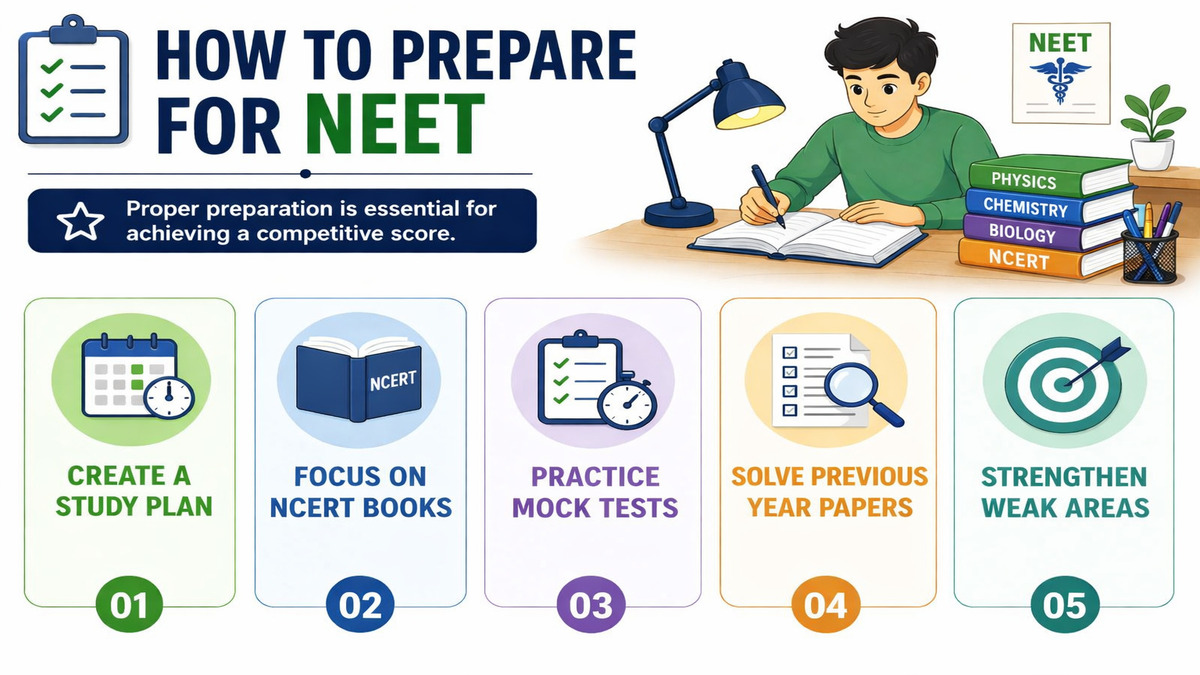
Proper preparation is essential for achieving a competitive score.
- Create a Study Plan
Develop a structured timetable covering all subjects and topics.
- Focus on NCERT Books
Most NEET questions are based on NCERT concepts and fundamentals.
- Practice Mock Tests
Regular mock tests help improve speed, accuracy, and confidence.
- Solve Previous Year Papers
Analyzing previous papers provides insight into question patterns and important topics.
- Strengthen Weak Areas
Allocate extra time to subjects and chapters that require improvement.
NEET Previous Year Question Papers
The following resources provide year-wise NEET question papers and solutions for practice and exam preparation.
| Year | Question Paper Link |
| NEET 2026 | NEET 2026 Question Paper & Solutions |
| NEET 2025 | NEET 2025 Question Paper PDF |
| NEET 2024 | NEET 2024 Question Paper PDF |
| NEET 2023 | NEET 2023 Question Paper PDF |
| NEET 2022 | NEET 2022 Question Paper PDF |
| NEET 2021 | NEET 2021 Question Paper PDF |
| NEET 2020 | NEET 2020 Question Paper PDF |
| NEET 2019 | NEET 2019 Question Paper PDF |
| NEET 2018 | NEET 2018 Question Paper PDF |
| NEET 2017 | NEET 2017 Question Paper PDF |
| NEET 2016 | NEET 2016 Question Paper PDF |
| AIPMT 2015 | AIPMT 2015 Question Paper PDF |
Final Thoughts
NEET is the gateway to medical education in India and plays a crucial role in selecting candidates for undergraduate medical and healthcare programs. Understanding the full form, eligibility criteria, syllabus, and examination structure is essential for every medical aspirant. With a clear preparation strategy, strong conceptual knowledge, and consistent practice, students can improve their chances of securing admission to their desired medical college and pursuing a successful career in healthcare.
FAQs on NEET 2026: Full Form, Syllabus and Eligibility
1. What is the full form of NEET?
Answer: NEET stands for National Eligibility cum Entrance Test. It is the national-level entrance examination conducted by the National Testing Agency (NTA) for admission to MBBS, BDS, BAMS, BHMS, BSMS, BUMS, and other undergraduate medical courses in India.
2. Who can apply for NEET 2026?
Answer: Candidates who have passed or are appearing for Class 12 with Physics, Chemistry, Biology/Biotechnology, and English from a recognized board are eligible to apply for NEET 2026.
3. What is the minimum age requirement for NEET 2026?
Answer: Candidates must be at least 17 years old on or before 31 December 2026. There is currently no upper age limit for appearing in NEET.
4. What are the minimum qualifying marks required for NEET eligibility?
Answer: Candidates must obtain the following minimum marks in Physics, Chemistry, and Biology (PCB) in Class 12:
- General/EWS: 50%
- OBC/SC/ST: 40%
- PwD (General): 45%
5. What subjects are included in the NEET 2026 syllabus?
Answer: The NEET syllabus covers three major subjects:
- Physics
- Chemistry
- Biology (Botany and Zoology)
The syllabus is primarily based on NCERT Class 11 and Class 12 topics.
6. How many questions are asked in NEET 2026?
Answer: NEET 2026 consists of 180 compulsory multiple-choice questions (MCQs) distributed across Physics, Chemistry, Botany, and Zoology.
7. What is the marking scheme for NEET 2026?
Answer:
- +4 marks for each correct answer
- -1 mark for each incorrect answer
- 0 marks for unanswered questions
The maximum score is 720 marks.
8. Is NEET mandatory for MBBS admission in India?
Answer: Yes. NEET is the mandatory entrance examination for admission to MBBS and most undergraduate medical programs in government, private, deemed, and central medical institutions across India.
9. What is the best way to prepare for NEET 2026?
Answer: Students should focus on:
- Studying NCERT textbooks thoroughly
- Creating a structured study plan
- Solving previous-year question papers
- Taking regular mock tests
- Revising important concepts frequently
Biology deserves special attention because it carries the highest weightage in the exam.
10. How many times can a student attempt NEET?
Answer: As per the current eligibility criteria, there is no restriction on the number of attempts for NEET, provided the candidate meets all eligibility requirements.
11. What is the exam mode of NEET 2026?
Answer: NEET 2026 is expected to be conducted in offline (pen-and-paper) mode, where candidates mark their answers on an OMR sheet.
12. What is the duration of the NEET 2026 exam?
Answer: The duration of the NEET exam is expected to be 3 hours (180 minutes), during which candidates must answer all questions.
13. Can students from open schools apply for NEET 2026?
Answer: Yes, students who have completed their Class 12 education through recognized open schools are eligible to apply for NEET, subject to the prescribed eligibility criteria.
14. Is Biology compulsory for NEET 2026?
Answer: Yes, Biology (Botany and Zoology) is a mandatory subject for NEET. Candidates must have studied Biology/Biotechnology along with Physics and Chemistry in Class 12.
15. Can international students appear for NEET 2026?
Answer: Yes, Overseas Citizens of India (OCI), Non-Resident Indians (NRI), Persons of Indian Origin (PIO), and foreign nationals can apply for NEET, subject to the eligibility requirements.
Read More: NEET 2025: Application correction window opens, know how to edit and what changes can be made
All About NEET
📚 Related Articles




👉 You May Also Read
📚 Related Articles
- Coaching vs Self-Study: Which is Best in 2026 for Competitive Exams?
- NEET & JEE Preparation Guide for State Board Students
- Why Self-Discipline is More Important Than Motivation for Students
- How Visualization Strategies Can Improve Test Performance
- Smart Questions to Ask in a Parent-Teacher Meeting | PTM Made Easy
🔥 Popular Posts


📌 Explore Categories
- About India
- Artificial Intelligence & Machine Learning
- Calendar
- Career
- Counselling
- Current Affairs
- Economy
- Education
- English Grammar
- Exams
- Festival
- Health and Fitness
- Hindi Sahitya
- History
- Intelligence Agency
- International Personality
- Know India
- Knowledge
- Maths
- Maxim
- Moral Stories
- Nature
- NEWS
- Olympiad
- Others
- Personal Finance
- Personality Development
- Politics
- Scholarship
- Science and Environment
- Sports
- States of India
- Study Abroad
- Study Tips
- Technology
- The Greatest Indian
- Uncategorized