
Life Insurance vs Health Insurance: Why Families May Need Both
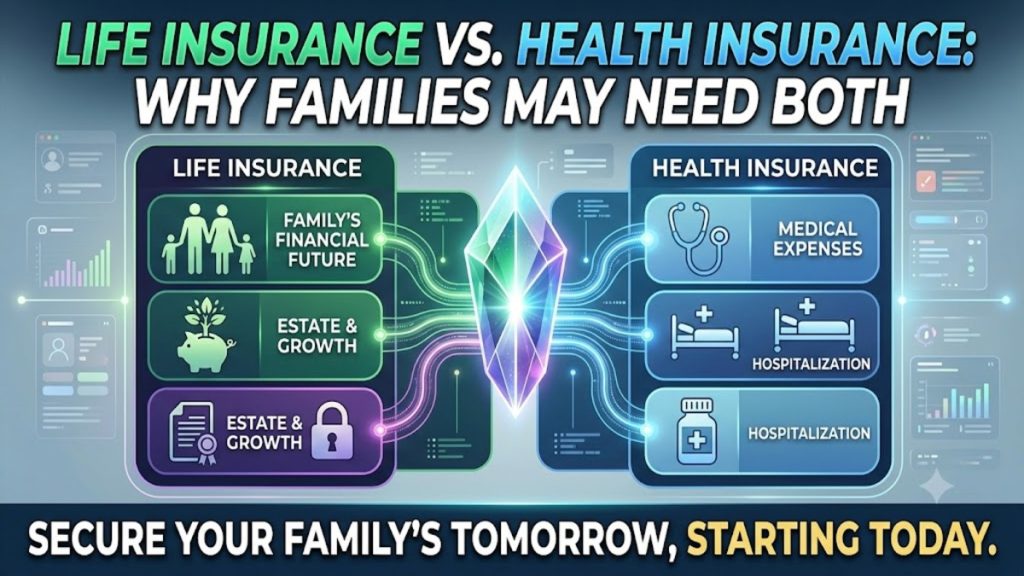
Are often purchased, talked and planned as being a replacement for another. They aren’t. One safeguards your family’s income in your absence and the other safeguards your family’s savings in the event that someone becomes ill. An examination of what they do, what they do not do, and why they are missing it when one or both are omitted.
The first time families seriously consider insurance, many will take an initial product and consider the matter to be resolved. Others purchase a life insurance policy because they feel they are required to have it in order to support their dependents. Some use a health policy, typically via an employer, as the bill to the hospital seems more imminent. These instincts are both sound. Both in isolation, leave a lot of financial liability open in the family.
What is Life Insurance?
Life insurance is a financial protection plan that provides financial support to your family if you die during the policy period, subject to the policy terms and conditions. You pay a regular amount called a premium to the insurance company, and in return, the company provides a predetermined amount to your nominee if you die while the policy is active. This payment, known as the death benefit, can help your family manage daily expenses, outstanding loans, children’s education and other financial responsibilities after the loss of an earning member.
The amount of life insurance a person needs depends on factors such as income, age, existing debts, number of dependents, savings and future financial goals. There are different types of life insurance, including term insurance and policies that may combine insurance with savings or investment features. Before choosing a policy, it is important to understand the coverage, premium, policy period, exclusions and other conditions. In simple terms, life insurance is mainly designed to protect your family’s financial future if you are no longer able to provide an income.
What is Health Insurance?
Health insurance is a financial protection plan that helps cover eligible medical and healthcare expenses when you or a covered family member becomes ill or needs medical treatment. You pay a regular amount called a premium to the insurance company, and the insurer provides coverage according to the policy terms. Depending on the plan, it may cover expenses such as hospitalisation, surgeries, diagnostic tests, medicines used during hospitalisation and other approved treatments. Some policies provide cashless treatment at a network of hospitals, while others may require you to pay the medical bill first and then claim reimbursement. The exact coverage, limits, waiting periods, exclusions and claim conditions vary between policies.
Health insurance is important because a serious illness, accident or hospitalisation can result in a large medical bill and may affect a family’s savings. A suitable health insurance plan can help reduce the financial burden of unexpected healthcare expenses and allow families to focus on treatment rather than arranging a large amount of money immediately. Individuals can choose plans based on factors such as age, family size, existing coverage, medical needs and budget. Before buying a policy, it is important to check the sum insured, premium, hospital network, waiting periods, exclusions, deductibles, co-payments and renewal conditions. In simple terms, health insurance helps protect your family’s finances from the high and unexpected cost of medical treatment.
Two Products, Two Different Risks
The most useful way to separate the two is to ask what each one pays for, who receives the money, and when.
| Factor | Life Insurance | Health Insurance |
| Core purpose | Replace lost income and settle financial obligations if the insured person dies | Pay for medical treatment and hospitalization costs |
| Who benefits | The nominee or beneficiary (typically family members) | The insured person, through payment to the hospital or reimbursement |
| Trigger event | Death of the insured (or maturity, for certain savings-linked plans) | Illness, injury, or hospitalization of an insured family member |
| Payout structure | Typically a fixed sum assured paid to the nominee | Actual medical expenses, up to the sum insured, per policy terms |
| Time horizon | Long-term; often chosen for 20–40 years, aligned with working life | Typically renewed annually, with premiums reviewed over time |
| What it protects | The family’s future income and long-term goals | The family’s existing savings and monthly cash flow |
Why One Cannot Substitute for the Other
The clearest way to see why both matter is to run two scenarios through a typical household.
Scenario 1: A serious illness, but no health cover
A family member is hospitalized for a major procedure. The bill runs into several lakhs, and there’s no policy to absorb it. A life insurance policy doesn’t help here — it pays out on death, not on a hospital stay. The family either draws down savings meant for education, a home, or retirement, or takes on debt. The household’s long-term plan is damaged even though nobody died.
Scenario 2: The primary earner dies, but there’s only health cover
Now reverse it. The household has solid health insurance, but the main income earner passes away unexpectedly. A health policy pays nothing in this situation. The family still faces rent or EMIs, school fees, daily expenses, and a sudden loss of income — with nothing designed to replace it.
The practical takeaway
Health insurance protects the family’s savings from medical costs. Life insurance protects the family’s income from the loss of the person earning it. A family that has only one of the two is protected against one kind of financial shock and fully exposed to the other.
The 2026 Cost Environment Makes Health Cover More Pressing
Several developments over the past year have shifted how families should think about both products, particularly in India.
- GST on individual premiums was removed. From September 22, 2025, individual life and health insurance premiums became exempt from the 18% GST they previously carried. Group health insurance purchased through employers or organizations still attracts 18%.
- But premiums haven’t fallen as many expected. Reported renewal data from 2026 shows premium increases of roughly 25% to 41% for many individual health policies, driven by medical inflation estimated at 13–15% and the loss of input tax credits for insurers. One widely cited example describes a family of four paying ₹40,000 for a ₹10 lakh cover before September 2025 now paying more than ₹45,000.
- Medical costs continue to rise faster than general inflation. Advanced diagnostics, specialist fees, and private hospital operating costs are all pushing treatment prices upward, which means a sum insured that looked adequate a few years ago may fall short today.
- Industry analysts have encouraged using the tax relief to increase cover. Financial advisers quoted in business press have suggested that existing policyholders use the premium savings to raise their sum insured or add top-up cover, rather than simply pocketing the difference — and, for life insurance, to treat the exemption as an opportunity to increase protection.
The net effect: health insurance is becoming a larger recurring line item in family budgets, and the cost of being underinsured is rising alongside it. That makes it more important, not less, to be deliberate about how much of each product a household buys.
How to Think About Sizing Each Policy
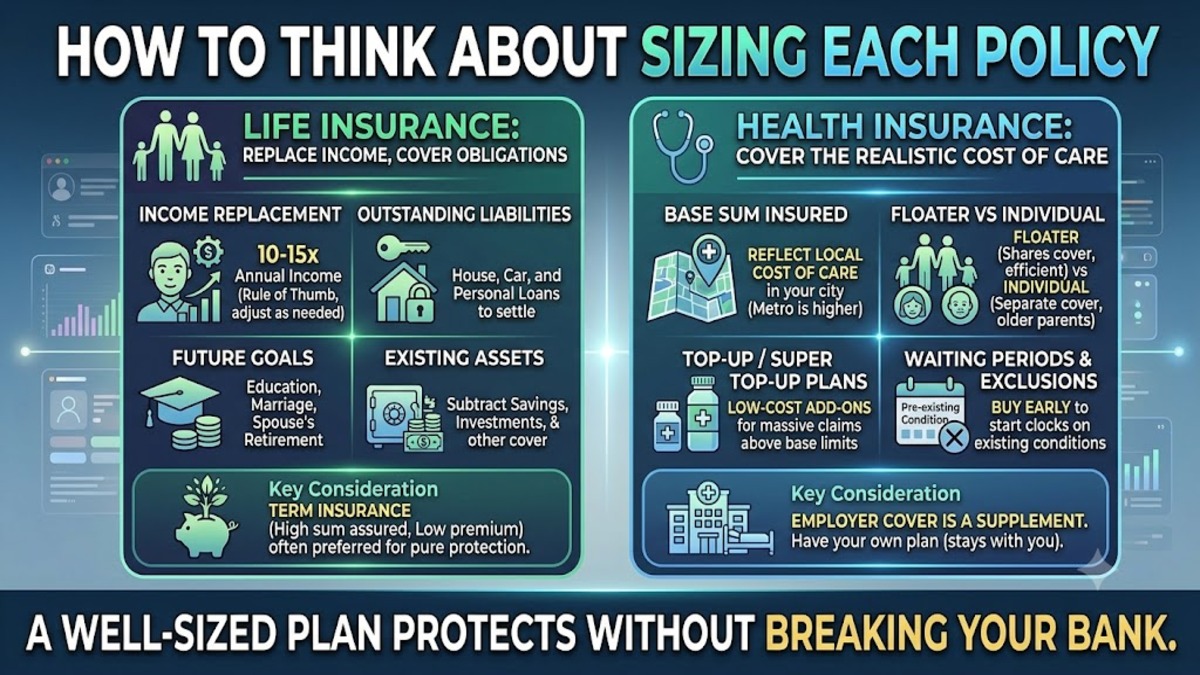
Life insurance: replace income, cover obligations
The goal of a life policy is to leave dependents in a position where they can maintain their standard of living and meet long-term commitments without the earner’s income. A commonly used starting point is to estimate the following:
- Income replacement: how many years of the earner’s income the family would need to bridge, often until children are financially independent or a spouse can return to full earning capacity. A frequently cited rule of thumb suggests a cover of roughly 10 to 15 times annual income, though the right figure varies with age, dependents, and existing savings.
- Outstanding liabilities: home loan balances, personal loans, and other debts that would otherwise fall to the family.
- Future goals: children’s education and marriage costs, and a spouse’s retirement needs.
- Existing assets: savings, investments, and any other insurance, which can be subtracted from the total need.
For pure income protection, many planners point families toward term insurance, which provides a high sum assured for a relatively low premium, rather than savings-linked or endowment policies that mix insurance and investment and typically deliver lower protection per rupee of premium. Which product is appropriate depends on the household’s goals, and it is worth comparing carefully before buying.
Health insurance: cover the realistic cost of care
For health insurance, the central question is how large a hospital bill the family could absorb without damaging its finances, and how fast that number is rising.
- Base sum insured: should reflect hospital costs in the city where the family lives, not national averages. Metro-city private hospital costs run materially higher than smaller cities.
- Family floater vs individual policies: a floater shares one sum insured across all members, which can be cost-efficient for younger families. Individual policies give each member their own cover, which can be preferable where one member has a higher expected medical need, such as older parents.
- Top-up and super top-up plans: a relatively inexpensive way to raise total cover above a base policy’s limit, useful for guarding against very large claims without paying full premiums for a much larger base cover.
- Waiting periods and exclusions: pre-existing conditions typically carry waiting periods before they are covered, which makes buying earlier — while healthy — especially valuable.
- Employer cover is a supplement, not a plan: group cover usually ends when employment ends, and the sum insured may be modest. Families that depend entirely on an employer policy are exposed if the job changes or is lost, often at precisely the moment premiums on a new individual policy would be higher because of age or health changes.
Common Mistakes Families Make
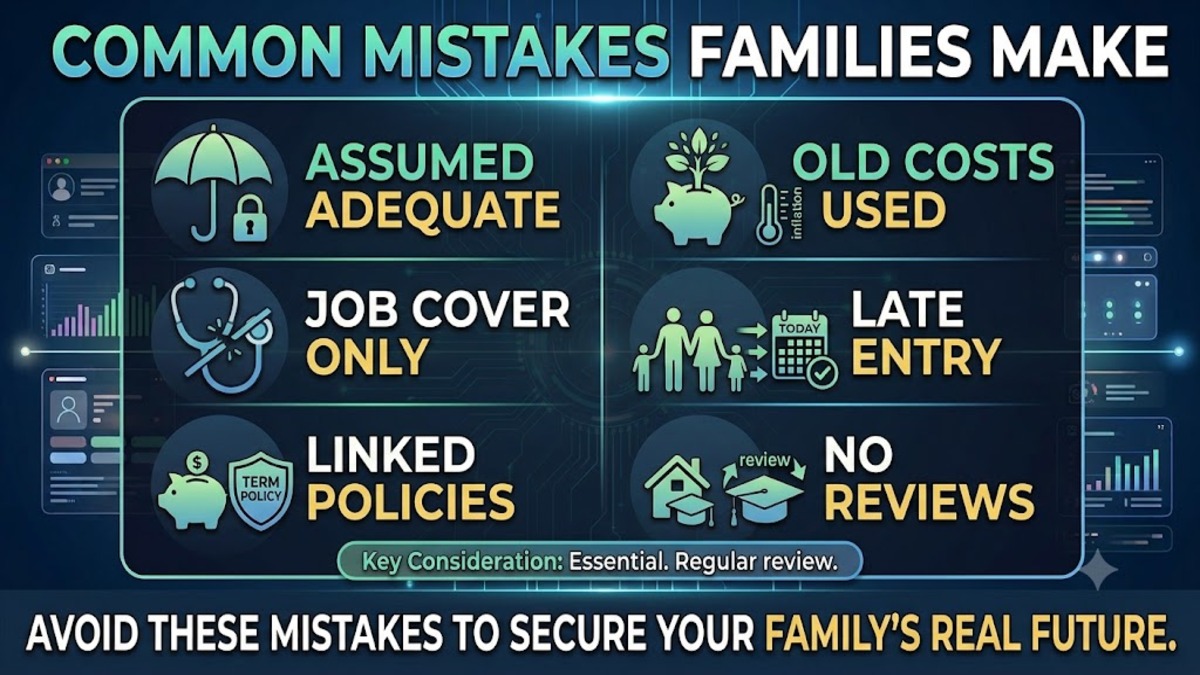
- Treating one policy as “enough insurance.” As the scenarios above show, each covers a risk the other cannot.
- Relying solely on employer-provided health cover. It tends to be limited, tied to the job, and not portable.
- Buying life cover through investment-linked products for protection purposes. These can leave a family with far less actual protection than a comparably priced term policy.
- Under-insuring based on today’s costs. With medical inflation running in the low-to-mid teens, a sum insured chosen five years ago may now fall well short.
- Delaying purchase. Life cover is generally cheapest when bought young and healthy, and health policies impose waiting periods on pre-existing conditions that start counting only once a policy is in force.
- Not reviewing coverage after major life events. Marriage, a new child, a home loan, or a parent moving in all change how much of each product a family needs.
What the Right Mix Looks Like by Life Stage
| Family Stage | Life Insurance | Health Insurance |
|---|---|---|
| Young, Single Professional | Fewer dependents mean life cover may be less urgent, but taking term insurance early can help secure lower premiums. | A good individual health policy is useful even if you have employer-provided coverage. |
| Newly Married / Starting a Family | Life cover becomes more important as financial responsibilities and dependents increase. | Consider a family floater and a top-up plan for larger medical expenses. |
| Young Children + Home Loan | Life cover should be sufficient to help clear the home loan and support children’s education. | Health cover should be adequate for hospital and treatment costs in your area. |
| Supporting Parents + Children | Life insurance should account for the financial needs of both children and dependent parents. | Elderly parents may be better covered under separate health policies, as adding them to a family floater can increase premiums. |
| Approaching Retirement | Life insurance needs may reduce as loans are paid off and children become financially independent. | Health insurance becomes increasingly important. Maintaining continuous coverage is especially valuable. |
| Single-Income Household | Life cover for the earning member is critical because the family depends mainly on one income. | Health insurance should cover all family members and should not depend only on employer-provided coverage. |
A Practical Checklist for Families
- List dependents and fixed obligations. Loans, school fees, parents’ support, and rent or housing costs define how much income needs replacing.
- Estimate the life cover gap. Total needs minus existing assets and any existing life insurance gives a working target.
- Review current health cover. Check whether it is employer-provided, how large the sum insured is, and what happens to it if employment changes.
- Check sums insured against local hospital costs. Compare typical costs in the family’s city with the cover currently in place.
- Consider a top-up or super top-up before simply raising the base sum insured, since it can be a cost-effective route to higher total cover.
- Read the fine print. Waiting periods, sub-limits, room-rent caps, and exclusions affect what a policy pays in practice, not just what its headline sum insured suggests.
- Review annually and after life events. Coverage that fits today may not fit after a marriage, birth, new loan, or change of job.
A note on taxes
Insurance premiums have historically qualified for deductions under certain provisions of Indian income tax law, but eligibility depends on which tax regime a taxpayer has chosen, and the rules have been subject to change. Families should confirm what applies to their situation with a qualified tax professional rather than assuming a deduction is available.
The Bottom Line
Life insurance and health insurance are not alternatives to each other; they are two halves of a single protection plan. Life insurance protects the family’s future income if the earner is lost. Health insurance protects its savings and stability when illness strikes while everyone is alive. In an environment where medical costs are rising faster than general inflation and renewal premiums are climbing even after the removal of GST, delaying or skimping on either one carries a real and growing cost. For most families, the practical question isn’t which one to buy, it’s how much of each, and how often to revisit the answer.
FAQ’S for the title Life Insurance vs Health Insurance
1. What is the basic difference between life insurance and health insurance?
Life insurance pays a fixed sum to your nominee if the insured person dies, replacing lost income and settling obligations. Health insurance pays for medical treatment and hospitalization costs while the insured person is alive. They protect against two entirely different financial events.
2. Can health insurance replace life insurance, or the other way around?
No. A health policy pays nothing if the main earner dies, and a life policy doesn’t pay for a hospital stay. A family with only one of the two is covered against one kind of shock and fully exposed to the other.
3. Is employer-provided health insurance enough for my family?
Usually not on its own. Group cover typically ends when employment ends, the sum insured may be modest, and it isn’t portable. Many families keep a separate individual or family policy so they aren’t left exposed if they change or lose a job.
4. How much life insurance cover does a family need?
It depends on income, dependents, debts, and savings. A commonly used rule of thumb is roughly 10 to 15 times annual income, but this is only a starting point. A more tailored estimate adds up income replacement needs, outstanding loans, and future goals like education, then subtracts existing assets and insurance.
5. What type of life insurance is best for pure family protection?
Many planners point families to term insurance, which offers a high sum assured for a relatively low premium. Savings-linked or endowment plans mix insurance with investment and typically give less protection per rupee of premium, so compare carefully before choosing.
6. Should I choose a family floater or individual health policies?
A floater shares one sum insured across all members and can be cost-efficient for younger families. Individual policies give each person their own cover and can suit households where one member, such as an older parent, has higher expected medical needs.
7. What are top-up and super top-up plans?
They are relatively inexpensive add-ons that raise your total health cover above a base policy’s limit. They help guard against very large claims without paying full premiums for a much bigger base policy.
8. Did the GST removal make insurance cheaper in 2026?
Only partly. Individual life and health premiums became exempt from the 18% GST on September 22, 2025, though group health insurance still attracts it. However, reported health insurance renewal increases of roughly 25% to 41% in 2026, driven by medical inflation of around 13% to 15% and the loss of input tax credits for insurers, have offset much of the tax saving for many policyholders.
9. When is the best time to buy each policy?
As early as possible. Life cover is generally cheapest when you’re young and healthy. Health policies apply waiting periods to pre-existing conditions, and that clock only starts once the policy is in force, so buying early means coverage for those conditions begins sooner.
10. How often should I review my coverage?
At least once a year, and after major life events such as marriage, the birth of a child, a new home loan, or a parent moving in. With medical costs rising faster than general inflation, a sum insured chosen a few years ago may no longer be enough.
Read More: Insurance Regulatory Development Authority of India (IRDA)
📚 Related Articles

👉 You May Also Read
📚 Related Articles
🔥 Popular Posts



📌 Explore Categories
- About India
- Artificial Intelligence & Machine Learning
- Calendar
- Career
- Counselling
- Current Affairs
- Economy
- Education
- English Grammar
- Exams
- Festival
- Health and Fitness
- Hindi Sahitya
- History
- Intelligence Agency
- International Personality
- Know India
- Knowledge
- Maths
- Maxim
- Moral Stories
- Nature
- NEWS
- Olympiad
- Others
- Personal Finance
- Personality Development
- Politics
- Scholarship
- Science and Environment
- Sports
- States of India
- Study Abroad
- Study Tips
- Technology
- The Greatest Indian
- Uncategorized