
Best Career Options After Class 12 for Average Students in 2026
First, Let Go of Two Myths
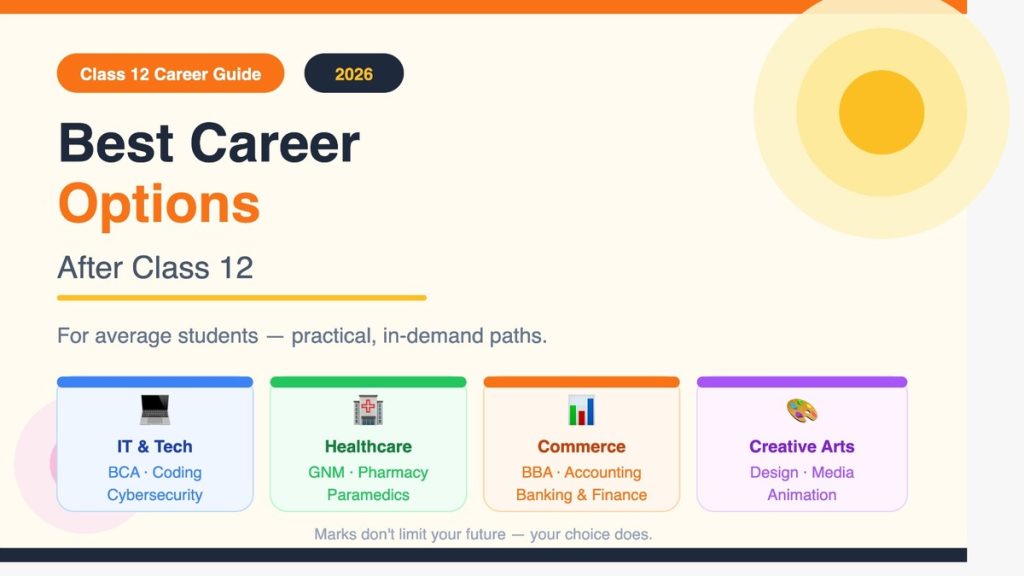
- Myth 1: Your Class 12 percentage decides your career ceiling. It decides which specific college seats you can get through a merit-list cutoff. Plenty of successful professionals, business owners, and skilled tradespeople had average or below-average school marks. What matters going forward is what you do between 18 and 25, not what happened at 17.
- Myth 2: The only “real” careers are engineering, medicine, or a government job. These are well-known paths, not the only good ones. Skill-based careers, vocational trades, creative fields, and business-oriented paths often have lower entry barriers, faster time-to-income, and less brutal competition than the traditional “prestige” routes.
Career Paths Worth Seriously Considering
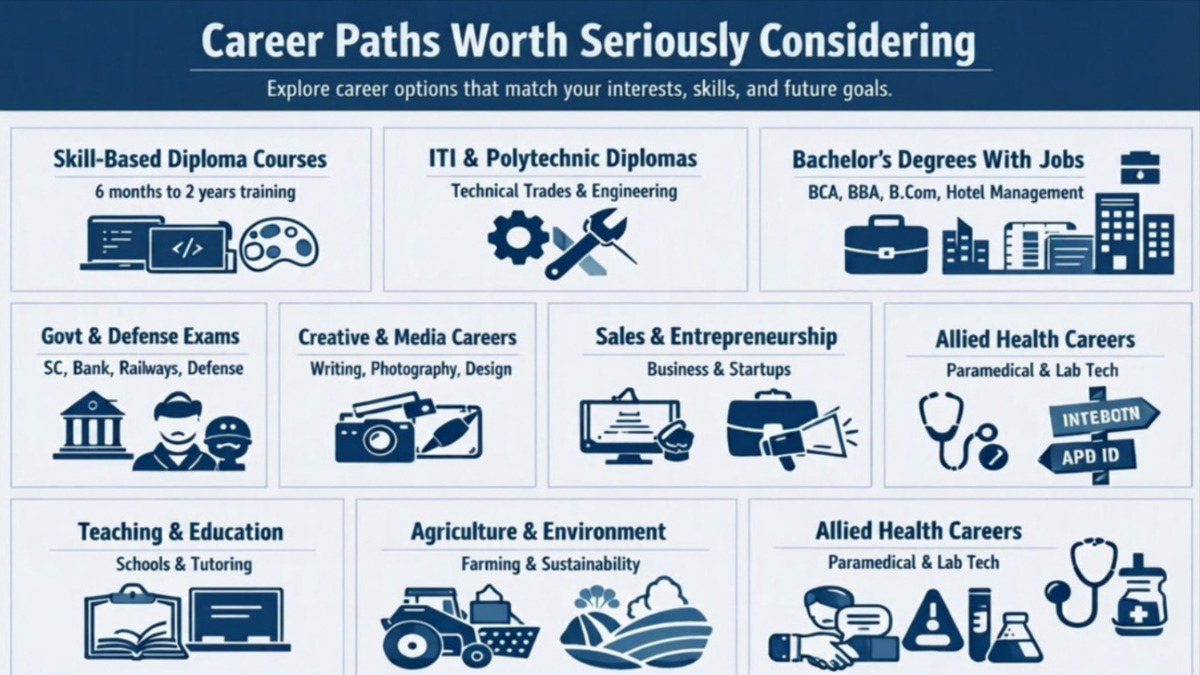
Career Paths Worth Seriously Considering means exploring career options that match a student’s interests, skills, academic strengths and future goals.
1. Skill-Based Diploma Courses
Focused, practical training in a specific trade, usually 6 months to 2 years.
- Web/app development bootcamps
- Digital marketing & social media management
- Graphic design, UI/UX design
- Animation & video editing
2. ITI & Polytechnic Diplomas
Government-recognized technical training, often more affordable than a full engineering degree.
- Electrician, fitter, mechanic trades
- Diploma in mechanical/civil/electrical engineering
- Lateral entry into a B.Tech later, if desired
3. Bachelor’s Degrees With Strong Job Markets
Not every degree needs to be engineering or medicine to lead to solid employment.
- BCA / BSc IT (software, testing, support roles)
- BBA (business, sales, operations, management trainee roles)
- B.Com (accounting, finance, banking)
- Hotel management & hospitality
4. Government & Defense Exams
Stable income and job security, with entry points that don’t require a top board score.
- SSC CGL/CHSL, bank PO/clerk exams
- Railways (RRB) technical and non-technical posts
- Defense forces (Army, Navy, Air Force entries)
- State-level police and administrative posts
5. Creative & Media Careers
Portfolio matters more than marksheets in these fields.
- Photography & videography
- Content writing & copywriting
- Fashion design & styling
- Culinary arts
6. Design and Creative Careers
Students who are creative and enjoy drawing, photography, design or digital content can explore creative careers.
Possible areas include:
- Graphic design
- UI/UX design
- Fashion design
- Animation
- Interior design
- Video editing
- Photography
7. Sales, Business & Entrepreneurship
Performance-driven fields where results speak louder than academic scores.
- Sales and business development roles
- Real estate
- Insurance and financial advisory
- Starting a small business or reselling venture
8. Teaching and Education
Students who enjoy explaining concepts and working with children can consider education-related careers.
Depending on the chosen subject and qualification, students can later work in:
- Schools
- Coaching centres
- Educational companies
- Online learning platforms
- Tutoring
9. Agriculture and Environmental Careers
Students interested in nature, agriculture, food production or the environment can explore related degree programs.
Possible areas include:
- Agriculture
- Horticulture
- Food technology
- Environmental science
- Forestry
- Agricultural business
10. Allied Health and Paramedical Courses
Students interested in healthcare do not necessarily have to choose MBBS. Several allied-health fields offer different career paths.
Depending on eligibility and college, options may include:
- Medical Laboratory Technology
- Radiology and Imaging Technology
- Physiotherapy
- Operation Theatre Technology
- Optometry
- Nutrition and Dietetics
How to Actually Choose Between These
Rather than picking based on which option sounds most impressive, ask three practical questions.
1. What do you actually enjoy doing, even outside school?
A student who spends free time editing videos, tinkering with gadgets, talking their way into deals, or drawing has a real signal about what they’ll stick with long enough to get good at. Skill-based careers reward consistency far more than raw intelligence and consistency is easiest when you’re not fighting your own interest the entire time.
2. How much time and money can you realistically commit?
A 6-month skill course gets you earning sooner than a 3-year degree, but may cap your long-term ceiling in some fields without further upskilling. A government exam path can take a year or more of preparation with no income during that time. Be honest about what your family situation can sustain.
3. Does this field reward experience over credentials?
Fields like design, digital marketing, sales, and skilled trades tend to care far more about what you can demonstrably do: a portfolio, a client result, a completed project than which college you attended or what your board exam score was. If your marksheet feels like a liability, gravitate toward fields where it simply isn’t part of the conversation after your first job.
A Realistic Roadmap for the Next 2 Years
Months 1–3
Explore two or three options seriously: take a free trial class, talk to someone already working in that field, or shadow them for a day if possible. Avoid choosing based on what sounds prestigious to relatives.
Months 4–12
Commit to one path and start formal training, a diploma, a degree, or exam preparation. Build a portfolio or practical project alongside formal study wherever the field allows it (a few client projects, a small business trial run, a design portfolio).
Year 2
Start seeking internships, apprenticeships, or entry-level roles even before formal training finishes, if the field allows it. Real-world experience compounds faster than classroom time in most skill-based and business-oriented careers.
What to Tell Family Members Who Push Back
Many average-scoring students face real pressure to “just try again” for engineering or medical entrance exams, or to pursue a traditional degree regardless of fit. If this is your situation, it helps to reframe the conversation around outcomes rather than prestige: ask what the actual goal is stable income, respect, security, growth and show how the path you’re considering can realistically deliver that, even if it looks unconventional on paper. Concrete examples of people who’ve built solid careers through vocational training, business, or skill-based work (and there are many) tend to land better than abstract arguments about passion.
The Bottom Line
An average Class 12 score closes exactly one door: admission by merit-list cutoff into a small number of specific, oversubscribed programs. It closes nothing else. The paths above — skill-based courses, diplomas, business-oriented degrees, government exams, and creative fields have produced financially stable, genuinely satisfying careers for enormous numbers of people who didn’t top their board exams. What actually determines the outcome from here isn’t the number on last year’s marksheet; it’s the consistency, curiosity, and follow-through you bring to whichever path you choose next.
FAQs for the Best Career Options After Class 12 for Average Students
- Does a low percentage in Class 12 (2026) really limit career options?
No — it limits eligibility for merit-based cutoffs into a small number of oversubscribed programs, not your overall career potential. Skill-based courses, diplomas, business degrees, and government exams don’t weigh your board score once you’re past initial admission. - What are the fastest career options to start earning after Class 12?
Skill-based diploma courses — digital marketing, web development, graphic design, UI/UX, video editing — typically run 6 months to 1 year and can lead to paid internships or entry-level roles faster than a 3-year degree. - Are skill-based courses considered as credible as a degree in 2026?
Increasingly, yes, especially in tech, design, and digital fields where employers now prioritize portfolios and practical skill tests over formal degrees. Traditional degrees still matter more in regulated fields like finance, law, or government jobs. - Is BCA or BBA a good option for an average student?
Yes. Both are job-market-friendly degrees with lower cutoffs than engineering or medicine, and they open doors into IT support, software testing, business operations, sales, and management trainee roles — fields with real hiring demand. - Can an average student still prepare for government jobs?
Absolutely. Exams like SSC CGL/CHSL, bank PO/clerk, and railway recruitment (RRB) don’t require a high Class 12 percentage — they test separately through their own exam pattern, so consistent preparation matters more than school marks. - What if a student doesn’t know what they’re interested in yet?
That’s normal at 17–18. The practical fix is exploration, not paralysis — try short trial classes, talk to people already working in 2–3 shortlisted fields, or take on a small project (a mock client site, a design piece, a content sample) before committing a year of study to any one path. - Are AI and tech-related skill courses worth pursuing in 2026 for an average student?
Yes, particularly beginner-to-intermediate roles like AI-assisted content creation, basic data analysis, digital marketing with AI tools, and no-code app building — these have lower entry barriers than core software engineering and are in growing demand. - Do creative careers like photography or content writing pay well for beginners?
Entry-level income in creative fields is often modest and inconsistent at first, since it depends heavily on building a portfolio and client base. It typically takes 1–2 years of consistent work before income becomes stable, but ceiling potential can be high for those who build a strong reputation. - How should a student handle family pressure to retry engineering/medical entrance exams?
Reframe the conversation around the actual goal — stability, respect, income — rather than the specific path, and show concrete examples of people who’ve built solid careers through vocational training or business routes. Concrete outcomes tend to land better with skeptical family members than abstract arguments about passion. - What’s the biggest mistake average students make when choosing a path after Class 12?
Choosing based on perceived prestige rather than personal fit or realistic timelines — leading to years spent in a field they don’t enjoy or can’t sustain financially. Matching the path to genuine interest, family budget, and how much the field rewards practical skill over credentials tends to produce far better long-term outcomes.
Read More: Career Change After 30: How to Transition from Non-Tech to IT or Data Science
📚 Related Articles


👉 You May Also Read
📚 Related Articles
- How to Return to Work After a Career Break: Skills, Jobs and Preparation in 2026
- Career Change After 30: How to Transition from Non-Tech to IT or Data Science
- Government Jobs by Age Limit: Eligibility and Opportunities in 2026
- Why Self-Discipline is More Important Than Motivation for Students
- How Visualization Strategies Can Improve Test Performance
🔥 Popular Posts

📌 Explore Categories
- About India
- Artificial Intelligence & Machine Learning
- Calendar
- Career
- Counselling
- Current Affairs
- Economy
- Education
- English Grammar
- Exams
- Festival
- Health and Fitness
- Hindi Sahitya
- History
- Intelligence Agency
- International Personality
- Know India
- Knowledge
- Maths
- Maxim
- Moral Stories
- Nature
- NEWS
- Olympiad
- Others
- Personality Development
- Politics
- Scholarship
- Science and Environment
- Sports
- States of India
- Study Abroad
- Study Tips
- Technology
- The Greatest Indian
- Uncategorized