
Intelligence Bureau (IB): Meaning, Role, Importance & Key Facts
The Intelligence Bureau (IB) is an authoritative and long-standing intelligence agency governed by the Ministry of Home Affairs. As India’s primary internal security organization, the IB agency is responsible for identifying and mitigating domestic threats to maintain national stability.
While the Intelligence Bureau technically falls under the Ministry of Home Affairs, its influence is vast. The IB director is a crucial member of the Strategic Policy Group and the National Security Council’s Joint Intelligence Committee (JIC), often reporting directly to the Prime Minister. Although the specific functions of the agency remain unidentified, it is known that the agency is responsible for counterterrorism, counterintelligence, intelligence collection in border areas, infrastructure protection and anti-secession activities.
Intelligence Bureau (IB) works with other Indian intelligence and law enforcement organizations, especially RAW (Research and Analysis Wing, India’s external intelligence agency) and the newly created Defense Intelligence Agency. The agency also manages partnerships with foreign agencies, including security agencies in the U.K., U.S., and Israel.
Importance of Intelligence Bureau (IB)
Below are some importance of the intelligence bureau:
The Intelligence Bureau plays an indispensable role in maintaining the structural integrity of India’s internal safety. Below are the key functional areas that highlight the importance of the IB agency:
-
Security Management: Executing critical security-related tasks assigned by senior leadership.
-
Leadership & Oversight: Training and supervising subordinates to maintain high operational standards.
-
Crisis Response: Managing emergencies in a disciplined and orderly manner to prevent escalation.
-
Protocol & Documentation: Handling sensitive paperwork regarding security breaches and maintaining meticulous records.
-
Strategic Communication: Coordinating between different office locations to deliver time-sensitive information.
-
Support Operations: Providing essential assistance to the Assistant Central Intelligence Officer (ACIO) as required.
-
Field Intelligence: Engaging directly with local communities to gather ground-level data for the Intelligence Bureau.
Responsibilities of the Intelligence Bureau (IB)
Check below the main responsibilities of the intelligence bureau:
The Intelligence Bureau operates as a highly authoritative body focused on gathering domestic intelligence. Below are the primary responsibilities and the operational structure of the IB agency:
-
Counter-Intelligence & Terrorism: Shrouded in secrecy, the Intelligence Bureau is primarily used to garner intelligence within India and execute complex counter-terrorism tasks.
-
Organizational Structure: The Bureau recruits experts from various law enforcement agencies, including the Indian Revenue Service (IRS) and the military. However, the Director of the Intelligence Bureau is traditionally a senior IPS officer.
-
Border Intelligence: Following the 1951 Himmat Singh Ji Committee recommendations, the IB department was specifically tasked with intelligence collection in border areas—a responsibility held by military intelligence prior to 1947.
-
Strategic Scope: The charter of duties for the Intelligence Bureau covers almost all spheres of human activity within India and its neighboring regions.
-
Evolution of Roles: Historically, the IB handled both internal and external intelligence until 1968, when the Research and Analysis Wing (R&AW) was formed to take over external responsibilities.
Workings of the Intelligence Bureau (IB)
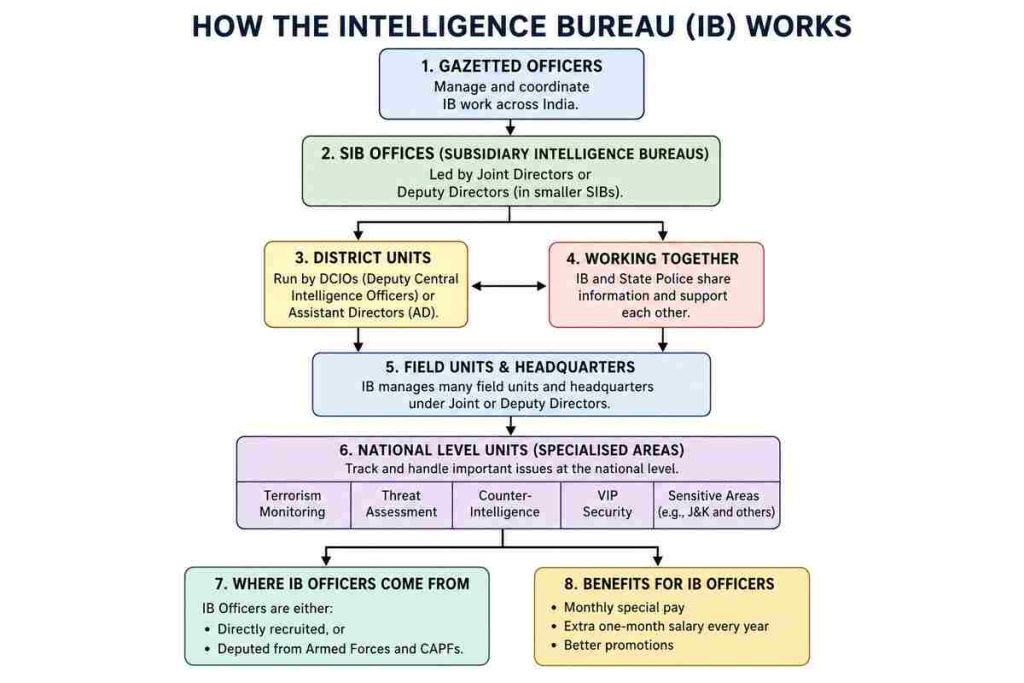
The internal structure of the Intelligence Bureau is designed for seamless coordination and high-level management. Here is how the IB agency operates across different levels:
-
Management & Coordination: Gazetted officers are responsible for the higher-level management and strategic coordination within the Intelligence Bureau.
-
Regional Operations (SIBs): Subsidiary Intelligence Bureaus (SIBs) serve as regional hubs. These are typically headed by officers with the rank of Joint Director or above, though Deputy Directors may lead smaller units.
-
District Presence: At the district level, the IB department maintains units headed by Deputy Central Intelligence Officers (DCIO) or Assistant Directors (AD).
-
State & Federal Synergy: By managing numerous field units and utilizing an intricate deputation process, the Intelligence Bureau maintains an organic and vital link with various state police agencies.
-
Specialized National Units: At the national level, the IB agency operates specialized units to monitor critical issues such as counter-intelligence, threat assessment, VIP security, and sensitive regions like Jammu and Kashmir.
-
Recruitment & Benefits: IB Officers are either directly recruited or brought in on deputation from the Armed Forces and CAPFs. Due to the high-stakes nature of their work, they receive monthly special pay, an annual extra month’s salary, and specialized promotion tracks.
Interesting Facts About Intelligence Bureau (IB)
The Intelligence Bureau holds a unique place in global history and modern security. Here are some compelling facts about this authoritative organization:
-
World’s Oldest Agency: The Indian Intelligence Bureau is recognized as the oldest intelligence organization in the world, with roots dating back to 1887.
-
The Great Split: Originally, the IB managed both internal and external intelligence. In 1968, it was divided, leading to the creation of the Research and Analysis Wing (R&AW) for foreign intelligence.
-
KGB Training: Historically, IB officers received specialized training from the Russian KGB, known as one of the world’s most effective intelligence agencies.
-
Extreme Secrecy: The IB agency operates in total shadows. The work is so secretive that even an officer’s family is often unaware of their specific assignments or whereabouts.
-
Daily Vigilance: On a daily basis, the Intelligence Bureau gathers secret data regarding terror threats, riots and internal strife. They monitor any group or individual that poses a danger to national safety.
-
Specialized Skillsets: Becoming a spy for the IB department is an immense challenge. Agents are trained in surveillance, disguise, source building and the critical art of defusing tensions before they escalate.
-
Resource Evolution: While historical reports suggested that funding levels were once a concern compared to foreign agencies like the ISI, the situation is changing rapidly.
-
Modernization: Today, the Intelligence Bureau is benefiting from better facilities, upgraded technology, and significantly improved payout structures for its officers.
Frequently Asked Questions
Does the Intelligence Bureau (IB) recruit every year?
Why is the IB selection process considered so difficult?
Can IB officers join R&AW?
Do Intelligence Bureau officers carry guns?
Is the IB ACIO exam tough to crack?
What is the motto of IB?
IB comes under which ministry?
What is the IB officer full form in the hierarchy?
📚 Related Articles



👉 You May Also Read
1 thought on “Intelligence Bureau (IB): Meaning, Role, Importance & Key Facts”
Leave a Comment
📚 Related Articles
- 10 Online Safety Rules Every Parent Should Teach Their Kids
- Top 8 internet Safety terms Parents Must Know to Keep Children Safe
- CID – Purpose, Power, And Functions
- RAW: India’s External Intelligence Agency
🔥 Popular Posts




📌 Explore Categories
- About India
- Artificial Intelligence & Machine Learning
- Calendar
- Career
- Counselling
- Current Affairs
- Economy
- Education
- English Grammar
- Exams
- Festival
- Health and Fitness
- Hindi Sahitya
- History
- Intelligence Agency
- International Personality
- Know India
- Knowledge
- Maths
- Maxim
- Moral Stories
- Nature
- NEWS
- Olympiad
- Others
- Personality Development
- Politics
- Scholarship
- Science and Environment
- Sports
- States of India
- Study Abroad
- Study Tips
- Technology
- The Greatest Indian
- Uncategorized
No