Mother’s Day – History, Celebration And Importance

Mother's Day

The origin of Mother’s Day goes back to the era of ancient Greek and Romans. But the roots of Mother’s Day history can also be traced to the UK where a Mothering Sunday was celebrated much before the festival saw the light of the day in the US. However, the celebration of the festival as it is seen today is a recent phenomenon and not even a hundred years old.

Thanks to the hard work of the pioneering women of their times, Julia Ward Howe and Anna Jarvis that day came into existence. Today the festival of Mothers day is celebrated across 46 countries (though on different dates) and is a hugely popular affair. Millions of people across the globe take the day as an opportunity to honor their mothers, thank them for their efforts in giving them life, raising them, and being their constant support and well-wisher.

Earliest History of Mothers Day

The earliest history of Mothers Day dates back to the ancient annual spring festival the Greeks dedicated to maternal goddesses. The Greeks used the occasion to honor Rhea, wife of Cronus and the mother of many deities of Greek mythology.

Ancient Romans, too, celebrated a spring festival, called Hilaria dedicated to Cybele, a mother goddess. It may be noted that ceremonies in honor of Cybele began some 250 years before Christ was born. The celebration made on the Ides of March by making offerings in the temple of Cybele lasted for three days and included parades, games, and masquerades. The celebrations were notorious enough that followers of Cybele were banished from Rome.

Early Christians celebrated a Mother’s Day of sorts during the festival on the fourth Sunday of Lent in honor of the Virgin Mary, the Mother of Christ. In England, the holiday was expanded to include all mothers. It was then called Mothering Sunday.

History of Mother’s Day: Mothering Sunday

The more recent history of Mothers Day dates back to the 1600s in England. Here Mothering Sunday was celebrated annually on the fourth Sunday of Lent (the 40-day period leading up to Easter) to honor mothers. After a prayer service in church to honor Virgin Mary, children brought gifts and flowers to pay tribute to their own mothers.

On the occasion, servants, apprentices, and other employees staying away from their homes were encouraged by their employers to visit their mothers and honor them. Traditionally children brought with them gifts and a special fruit cake or fruit-filled pastry called a simnel. Yugoslavs and people in other nations have observed similar days.

The custom of celebrating Mothering Sunday died out almost completely by the 19th century. However, the day came to be celebrated again after World War II, when American servicemen brought the custom and commercial enterprises used it as an occasion for sales.

History of Mother’s Day: Julia Ward Howe

The idea of an official celebration of Mother’s day in the US was first suggested by Julia Ward Howe in 1872. An activist, writer, and poet Julia shot to fame with her famous Civil War song, “Battle Hymn of the Republic”. Julia Ward Howe suggested that June 2 be annually celebrated as Mothers Day and should be dedicated to peace. She wrote a passionate appeal to women and urged them to rise against war in her famous Mothers Day Proclamation, written in Boston in 1870. She also initiated a Mothers’ Peace Day observance on the second Sunday in June in Boston and held the meeting for a number of years. Julia tirelessly championed the cause of the official celebration of Mothers Day and the declaration of an official holiday on the day. Her idea spread but was later replaced by the Mothers’ Day holiday now celebrated in May.

History of Mother’s Day: Anna Jarvis

Anna Jarvis is recognized as the Founder of Mothers Day in the US. Though Anna Jarvis never married and never had kids, she is also known as the Mother of Mothers Day, an apt title for the lady who worked hard to bestow honor on all mothers.

Anna Jarvis got the inspiration of celebrating Mothers Day from her own mother Mrs. Anna Marie Reeves Jarvis in her childhood. An activist and social worker, Mrs. Jarvis used to express her desire that someday someone must honor all mothers, living and dead, and pay tribute to the contributions made by them.

A loving daughter, Anna never forgot her mother’s word and when her mother died in 1905, she resolved to fulfill her mother’s desire of having a mothers day. The growing negligent attitude of adult Americans toward their mothers and a desire to honor her mothers soared her ambitions.

To begin with, Anna sends Carnations to the church service in Grafton, West Virginia to honor her mother. Carnations were her mother’s favorite flower and Anna felt that they symbolized mother, pure love. Later Anna along with her supporters wrote letters to people in positions of power lobbying for the official declaration of the Mothers Day holiday. The hard work paid off. By 1911, Mother’s Day was celebrated in almost every state in the Union, and on May 8, 1914, President Woodrow Wilson signed a Joint Resolution designating the second Sunday in May as Mother’s Day.

History of Mother’s Day: Present Day Celebrations

Today Mothers Day is celebrated in several countries including the US, UK, India, Denmark, Finland, Italy, Turkey, Australia, Mexico, Canada, China, Japan, and Belgium. People take the day as an opportunity to pay tribute to their mothers and thank them for all their love and support. The day has become hugely popular and in several countries, phone lines witness maximum traffic. There is also a tradition of gifting flowers, cards, and others gift to mothers on Mothers Day. The festival has become commercialized to a great extent. Florists, card manufacturers, and gift sellers see huge business potential in the day and make good money through a rigorous advertising campaign.

It is unfortunate to note that Ms. Anna Jarvis, who devoted her life to the declaration of the Mothers Day holiday was deeply hurt to note the huge commercialization of the day.

First Mother’s Day

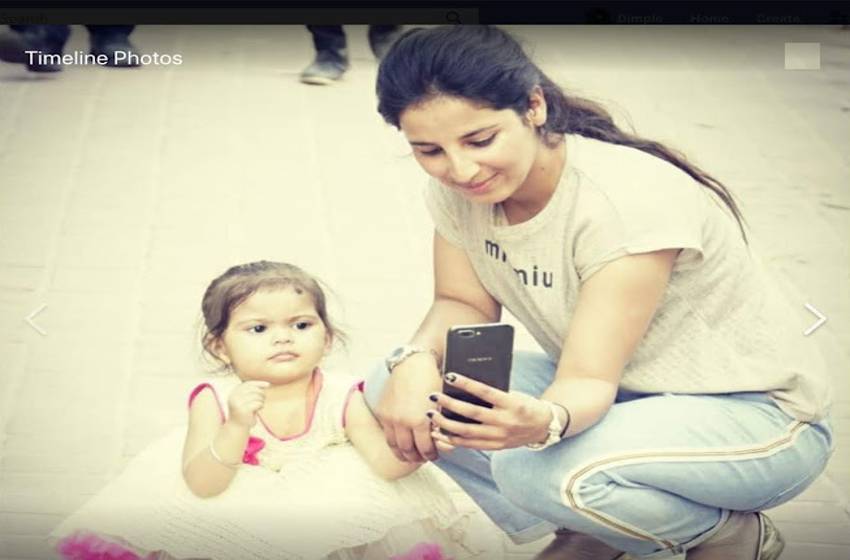
A woman’s First Mothers Day evokes mixed feelings of joy and pride. It is the time for the new mother to celebrate her first mothers day. She must relish the joys of holding her baby, feeling her own heartbeat inside it, and should take pride in the fact that she is the ‘mother’ of that adorable little child. On the special day of the new mother, the child’s father and other close relatives and friends must come forward to hold celebrations and make the mother feel important and happy.

Fathers to Celebrate Wife’s First Mother’s Day

As the baby is too young to say thanks to its mothers, the wife’s first Mother’s Day Celebrations should be celebrated by the child’s father. Fathers must take initiative to give a special day to the new mother. They must realize that it is tiresome for the mother to handle the infant all the time. She should be given a day’s rest and fathers must take responsibility for looking after the child, changing nappies, and feeding the baby, at least for a day. It would be a nice idea to pamper the mother with flowers, cards, and a gift. She would forget the drudgery of child rearing and feel proud of being a mother.

Time to say Thank You to your own Mother

First Mothers Day is also the time when a woman realizes the value of her own mother. The mother’s words, “You will not understand the importance of all I do for you till you yourself become a mother!”, keep reoccurring in her mind and would sound so very true. The new mother feels all the more grateful to her own mother for bringing her up so well and being so caring a mother. On her first Mother’s Day, the new mother must say a big thank you to her own mother with a big hug.

‘Mother’ Name in Different Languages

  • English – Mom, Mummy, Mother
  • Hindi – Maatta ( माता ), Maa
  • Marathi – Aai ( आई )
  • Urdu – Ammi
  • French – Mere ( mère )
  • German – Mutter ( Mutter )
  • Italian – Madre ( madre )
  • Portuguese – Mãe
  • Albanian – Mëmë; Nënë; Burim; Kryemurgeshë
  • Belarusan – Matka
  • Cebuano – Monahan; Nanay
  • Serbian – Majka
  • Czech – Abatyse
  • Dutch – Moeder; More
  • Estonian – Ema
  • Frisian – Emo, Emä, Kantaäiti, Äiti
  • Greek – Màna
  • Hawaiian – Machine
  • Hungarian – Anya, Fu
  • Ilongo – Iloy; Nanay; Nay
  • Indonesian – Induk, Ibu, Biang, Nyokap
  • Afrikaans – moeder
  • Arabic- والدة
  • Chinese (Traditional) – 母親
  • Thai – แม่

When is Mother’s Day

Mother’s Day is celebrated in several countries across the globe though the month and date on which Mother’s Day is celebrated in different countries vary. Most countries celebrate Mothers Day on the second Sunday in the Month of May. This Mother’s Day date was declared by US President Woodrow Wilson on May 8, 1914, when he signed a Joint Resolution designating the second Sunday in May as Mother’s Day. This US tradition of celebrating Mothers Day and paying tribute to mothers spread across several countries over the years and these countries too adopted the second Sunday of May as Mother’s Day.

However, in many countries, the way Mothers Day is celebrated varies and is quite different from the manner in which Mothers Day is celebrated in the US. But what is more important than the date and fashion of the celebration is the feeling behind the festival. The idea of celebrating Mother’s Day the world over is to pay tribute to mothers for all their love and support and to make them feel special.

Mother’s Day Date in Different Countries

  • United States: Second Sunday in the month of May.
  • Australia: Second Sunday in the month of May.
  • Belgium: Second Sunday in the month of May.
  • Brazil: Second Sunday in the month of May.
  • Canada: Second Sunday in the month of May.
  • Denmark: Second Sunday in the month of May.
  • Finland: Second Sunday in the month of May.
  • Germany: Second Sunday in the month of May.
  • Greece: Second Sunday in the month of May.
  • India: Second Sunday in the month of May.
  • Italy: Second Sunday in the month of May.
  • Japan: Second Sunday in the month of May.
  • New Zealand: Second Sunday in the month of May.
  • Singapore: Second Sunday in the month of May.
  • Turkey: Second Sunday in the month of May.
  • The United Kingdom/England: Mother’s Day is called Mothering Sunday and falls on the fourth Sunday in Lent.
  • France: First Sunday in June or last Sunday in May
  • Much of South America (as well as Mexico), Bahrain, Malaysia, Oman, Pakistan, Qatar, Saudi Arabia, United Arab Emirates: May 10
  • Mexico: – May 8
  • Albania: – March 8
  • Russia: – November 28
  • Poland: – May 26
  • Indonesia: – December 22
  • Egypt: – March 21
  • Norway: – February 13
  • Thailand: Birthday of Queen Sirikit Kitiyakara – August 12
  • Sweden: Last Sunday in May
  • Lebanon: First day of Spring
  • Norway: The second Sunday in February
  • Austria, Hong Kong, Netherlands, Taiwan, Hungary, Portugal, South Africa, Spain: First Sunday in May
  • Antwerp (Belgium), Costa Rica: Assumption day – August 15
  • Argentina: The Día de la Madre – The second or third Sunday in October

Also Read: International Mother’s Day
Vinayaka Chaturthi (Ganesha Chaturthi) – History, Significance, and Importance

Vinayaka Chaturthi (Ganesha Chaturthi) - History, Significance, and Importance

Vinayak Chaturthi, also known as Ganesha Chaturthi; is set apart for the sole worship of Lord Ganesha, the common deity of all Hindus. As he is supposed to be very fond of rice puddings, these dishes are cooked on a very large scale in every Hindu house and offered to God, to be consumed by the members of the family, after the worship is over.

How is Ganesh Chaturthi celebrated?

The festival celebrates the birthday of Lord Ganesh, the Lord of wisdom, peace and fortune. The festivals are sometimes called Vinayak Chaturthi or Vinayak chavithi. The day celebrated by Hindus is widely celebrated in particular in Maharashtra.

A fresh image of Ganesh in clay is made and worshipped on this day. One hundred and eight different names of this God are repeated after the preliminary ceremonies and 108 different flowers are thrown in worship over them.

The origin of this worship is prehistoric. Yudhisthira, the hero of the Mahabharata, Damayanti, the queen of the Nishada King Nala, Indra, the Lord of Heavens, and even Krishna, the expounder of the Bhagavadgita are said to have devoutly worshipped Ganesh and to have obtained their desired ends. 

History of Ganesh Chaturthi

Histories The Ganesh Chaturthi Festival has its roots back in the Maratha reign when Chatrapati Shivaji started it. The belief is based on Ganesha’s birth. Though this god is invoked on several occasions during the years, there is a special day in every year which is set apart, particularly for his worship, and this day is called the Vinayaka Chaturthi day, which falls on the fourth lunar day of the bright half of the month of Simha. The Tamils term this day Pillaiyar Chavutti  day.

The story of Lord Ganesha’s birth

Vinayaka or Ganesh is the eldest son of Shiva and Parvati, or of Parvati only, according to the following legend, as he sprang from the dirt of her body. Shiva had gone from home and Parvati was left alone on the Kailasa; she wished to have a bath and not liking the idea of any person entering the house then, she rubbed her body with her hands and the dirt that rolled off produced a figure to which she gave life and named Ganesh. She then asked Ganesh to sit at the door and allow no one, however, he might be, to come in till she had finished her bath. Ganesh sat at his duty and while Parvati was bathing inside, Shiva returned home. He wanted to enter his house, but Ganesh would not allow him. After trying in vain to persuade him with gentle words, the great god used threats which, however, had no effect. He was at last compelled to cut off Ganesh’s head and force his way in. When the goddess who was within perceived her lord entering and when she came to know that Ganesh had been murdered, she would not speak to Shiva until her attendant was restored to life. In order to do this, Shiva gave orders to his army of the Bhutaganas to find the first living creature that slept with its head turned towards the north, to cut off its head and fit it into Ganesh’s body. The Bhutas searched and searched for a very long time and at last found an elephant asleep with its head to the north, and cutting off its head, they brought it and fixed it to the Ganesh’s body, and lo! he rose up Ma man in body and elephant in the face. This story also accounts for the belief of Hindus to avoid the northern aspect of sleep.

Who is Lord Ganesh?

Vinayaka (Lord Ganesh) is the eldest son of Shiva and Parvati and one of the most popular deities in India. He is the male Minerva and the Janus of public ways. His shrine is in every Hindu village. He is worshipped in every Hindu house. Every schoolboy begins his lessons after offering his usual prayers to Vinayaka. Every merchant commences his operation after first propitiating this deity. In marriages and every other kind of religious ceremony, Vinayaka is the first God whose help is invoked. Almost all the standard works in Sanskrit and the Vernacular languages begin with an invocation of the help of Ganesh.

Symbolism

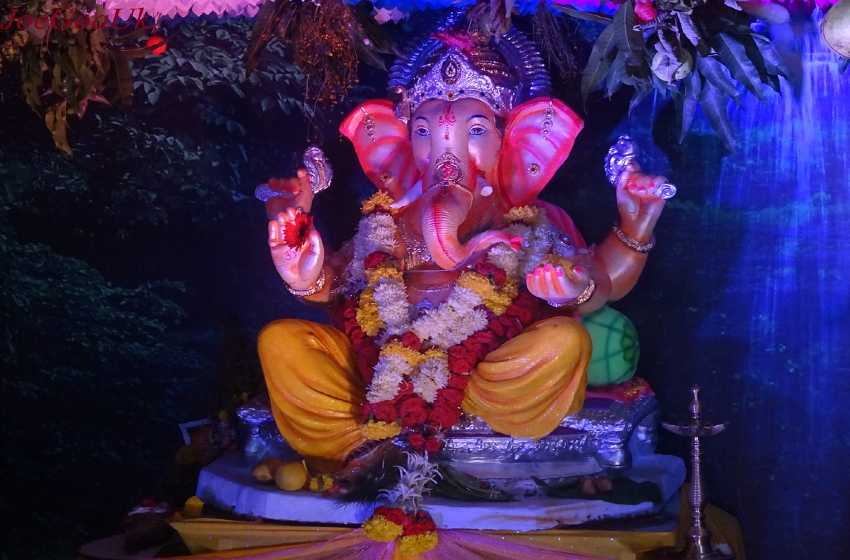
Vinayaka’s figure is represented as the elephant in the face and a man in the body. The elephant’s head is regarded as the emblem of sagacity. In his image, he is always seated at his ease, with his legs folded under him on a lotus throne. He has four arms and they hold an elephant’s trunk, a noose, a mace, and a Modaka (rice pudding). He wears a crown. His ears are adorned with jewels and his forehead vibhuti – the sacred ashes. He wears a garland of pearls and precious stones around his neck. He is worshipped under the different names of Vinayaka, Ganesh, Ganapati, Pillaiyar, etc. As this most popular deity is worshipped in almost every village, there is a belief among certain people that he is the god of the Sudras and lower orders, who are generally uneducated. As an authority for this belief, the following couplet is sometimes quoted: –

Viparanam daivatam Sambhuh | Kshatriyanam tu Madhavah

Vaisyanam tu bhaved Brahma | Sudranam Gananayakah!!

The above verse means that Shiva is the god of the Brahmans, Vishnu of the Kshatrivas, Brahma of the Vaisyas, and Ganesh of the Sudras. This is a most fanciful verse, which is not at all corroborated by any other authority. If any regard is to be paid to this couplet, then no Brahman can worship Vishnu and no Vaisya can worship Shiva, facts which are absurd on their very face, as testified by both the ancient and modern ways of Hindu faith.

Worship and festivals

Ganesh worship is a prehistoric one and it goes without saying that the couplet sometimes quoted as an authority that Ganesh is the god of the Sudras is unfounded. On the other hand, he is worshipped by the highest class of Brahmans. There are also special sects who are called Ganapatiyas, whose sole devotion is to this deity. Vinayaka is the deity that rules over good and bad alike-controlling the evil in every case and preventing hindrances to success. He controlled all those qualities which overcame hindrances in every undertaking with their usual accompaniments-good living, plenty, prosperity, and peace. This is the one great and real reason for the popularity of the worship of this deity.

There is always a small shrine of Vigneswara, attached to all Shiva temples. In the Vishnu temples too he is worshipped as Tumbikkaialvar – the sage of the elephant’s trunk – and as Vishvaksena. Sometimes he has his own temples too. As he is the favourite son of Shiva, he receives honours equal to Shiva. His image is with sincere devotion adored by men and women alike. He is supposed to represent several personifications of sagacity, shrewdness, patience, and learning.

Why is Lord Ganesha worshipped first?

As a test of his wisdom, it is related that when he was a child and playing in company with his brother Subrahmanya (also known as Kartikeya, Murugan or Shanmukha), Shiva promised to present a mango to him who made a circuit around the world and returned first. Subrahmanya summoned his peacock, mounted it, and was ready for the journey. But Ganesh calmly went round Shiva, his father, and demanded the fruit. “But you never went round the world,” said Shiva. “What is the world, but your own holy self? I went round you. Ergo, I went round the world,” was Ganesh’s wise reply. Shiva was of course convinced, praised Ganesh for his shrewdness, and gave him the promised fruit, which however he shared with Subrahmanya. The peculiarity of this deity is that his worship is combined as it were with that of every other God. All sects unite in claiming him as their own. It is for this reason that his shrines are found generally associated with those of other deities – Shiva and Vishnu. The largest temple built solely in honour of Ganesh in India is the Uchchippillaiyar temple on the top of the famous and beautiful rock at Tiruchirapalli.

Of all the figures in Hindu Mythology, that of Ganesh or Pilaiyar must be most familiar to every European. In the bathing ghat of every river and underneath the pipal tree will be seen a figure in a sitting posture, short and stout, with a protuberant stomach and four hands, riding a mouse and with the body of a man and the head of an elephant. This is the image of Ganesh or Pillaiyar, and there is not a single village in the whole of India which does not possess at least half a dozen of these familiar images. The elephant head has only one full tusk and the other appears cut off in the middle, the result of a scuffle between Ganesh and Parasurama. The “belly god” is on this account called Ekadanta, or the single-tusked. Ganesh is said to have written the Mahabharata at the dictation of Vyasa – for it is said that the letter was so quick in repeating the epic that no mortal could have managed to follow him.

Raksha Bandhan – Meaning, Significance, and Etymology

raksha bandhan

Raksha Bandhan (transl. Bonds of Protection) falls on the full-moon day (Purnima) of the month of Sravana (July – August). Therefore it is also called Rakhi Purnima. The main celebrations of Raksha Bandhan take different forms in different regions.

History of Raksha Bandhan

Raksha Bandhan has a historical background. About 3000 B.C. Aryans entered India through the North-Western passes and settled in North-Western India. They brought with them their traditional custom, Raksha Bandhan. It was a tradition among the Aryans to have a ‘Yajna’ before a war to invoke God’s blessing for protection and security. Apart from the regular army, the clan leader called the able-bodied men of the villages to join the war. Before the men departed for the battlefield the women-folk tied an anointed sacred thread or amulet: i) to protect the man ii) to remind him to uphold the honour of his clan.

This is how the custom of Raksha Bandhan originated. The word ‘Raksha’ means protection. Later, different ethnic tribes entered India, each with its own traditional customs. This led to a fusion of Aryan and Non – Aryan customs. Consequently, new and modified forms of the various customs came to be. The same happened with Raksha Bandhan.

The predominance of Hindu texts

A story is also found in Vamana Purana, Bhavishya Purana and Vishnu Purana about Raksha Bandhan’s mythological mantra ‘Yen Badho Bali Raja, Danavendro Mahabalah Ten Tvam Pratibadhanami Rakshey Machal Machalah‘ read on the auspicious occasion of Rakshabandhan.

According to this, King Bali was a very charitable king and was also an exclusive devotee of Lord Vishnu. Once he organized a Yagya. During this time, Lord Vishnu brought Vamanavatar to test him and asked King Bali to give three steps of land in charity. But he measured the whole earth and sky in two steps. On this King Bali understood that God was testing him.

For the third step, he got God’s foot placed on his head. Then he pleaded with God that now my everything is gone, Lord, accept my request and stay with me in the underworld. The Lord accepted the request of the devotee and left the world of Baikunth and went to Hades.

On the other hand, Goddess Lakshmi got upset. Then she composed Leela and appeared in front of King Bali as a poor woman. Seeing the woman’s poverty, King Bali kept her in his palace and started taking care of her like a sister. On the day of Shravan Purnima, Goddess Lakshmi, who was in the form of a poor woman, tied a raw thread around the wrist of King Bali. King Bali said you have tied this thread on my wrist as a sister, so I want to give something to you, ask for whatever you want.

On this, Goddess Lakshmi came in her real form and said you have a real God, I want the same, I have come to take him only. I am alone in Baikuntha without my husband Bhagavav Vishnu. Even after knowing the truth about the woman, King Bali remained on the path of religion and according to the promise, King Bali let Lord Vishnu go with Mother Lakshmi. However, while leaving, Lord Vishnu granted a boon to King Bali that he would reside in Hades for four months every year. These four months are known as Chaturmas, extending from Devshayani Ekadashi to Devuthani Ekadashi.

Gradually a deeper religious aspect entered this festival. Of the three Hindu Gods -Brahma, Vishnu and Maheswar, the Vishnu cult is said to have been derived from the Aryans. This cult was the most popular of the three, especially because Vishnu represented peace and stability. A variety of regional literature and practices developed around the Vishnu cult. Raksha Bandhan stood for security, stability and fraternity. It was associated with the cult of universal love and brotherhood. In the North and West of India, Raksha Bandhan became a regular feature of society. It celebrated love and brotherhood along with the customary celebration of the divine activities of Radha and Krishna.

Traditional celebration of Raksha Bandhan

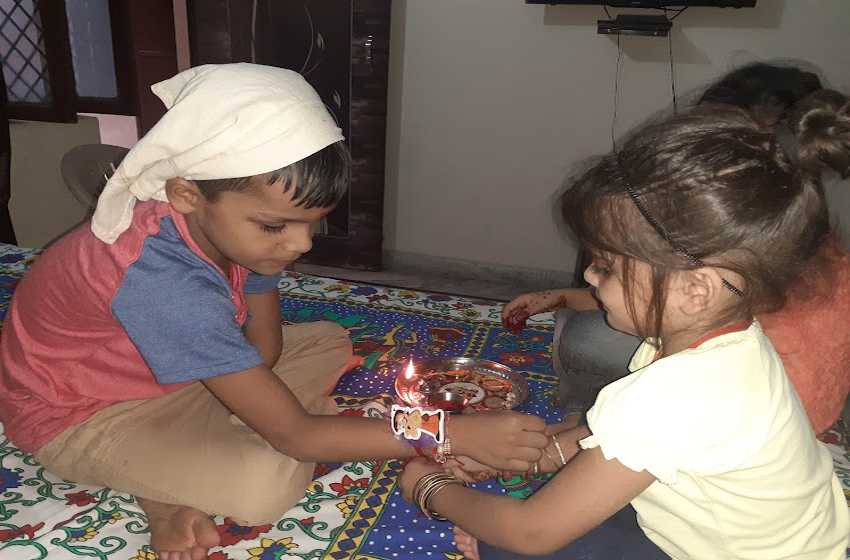
The festival is also called Saluno, a deviation from the Persian word ‘Sal – i – nu’ which means the New Year. This ritual strengthens the bond of love between brothers and sisters. Rakhi is also tied on the wrists of close friends and neighbours. Women tie a Rakhi (rosette) around the right wrist of their brothers. If the brother is in a distant place the Rakhi may be sent by post. Women receive gifts and cash from their brothers.

Significance of Raksha Bandhan in Different Parts of India

Raksha Bandhan was not prevalent in Eastern India. In 1905, Curzon partitioned Bengal on communal lines. A great movement was initiated to oppose the partition. Rabindranath Tagore was one of the prominent figures who vehemently opposed this atrocious partition. In 1905, he introduced the custom of Raksha Bandhan among the Hindus and Muslims of Bengal to nurture an atmosphere of universal brotherhood.

This custom became so popular that it spread to every corner of Bengal. It took a very different connotation in Bengal and became a symbol for forging unity between Hindus and Muslims. It also helped to arouse national consciousness against the divide-and-rule policy of the British. Such was the force of the protest that in 1911, the partition of Bengal was annulled. The capital was shifted from Calcutta to Delhi.

In the West, the festival is called Nardi Purnima or Coconut Full Moon. To the Hindus, the coconut is of great religious significance. The three eyes of the coconut represent the three eyes of Lord Shiva. The coconut plays a significant role in Hindu Festivals. Coconuts are offered to the God of Water in the presence of a huge congregation on the beach at Bombay.

The Myth and Reality of Rakshabandhan: Rani Karnawati and Humayun

The Myth

A widely told story associated with Rakshabandhan involves Rani Karnawati of Mewar and Mughal Emperor Humayun. According to this tale, Rani Karnawati, facing a military threat from Sultan Bahadur Shah of Gujarat, sent a rakhi to Humayun, invoking the brotherly bond between them. Moved by the gesture, Humayun is said to have rushed to her aid, thereby saving her kingdom. This narrative has been popularized as a symbol of Hindu-Muslim unity and the protective nature of the Rakshabandhan festival.

The Reality

However, historical records suggest a different sequence of events. In their book, “The History of India for Children (Vol. 2): FROM THE MUGHALS TO THE PRESENT,” authors Archana Garodia Gupta and Shruti Garodia offer a more nuanced account. They write that Humayun reached Chittor several months after Sultan Bahadur Shah had already captured the fort. Instead of immediately coming to the rescue, Humayun waited for the Mewar empire to collapse before taking action. This delay indicates that the story of the rakhi and Humayun’s immediate response may be more myth than fact.

During Bahadur Shah’s occupation of Chittor, he conducted widespread massacres and looting. His ministers believed that because Humayun was a Muslim, he would not harm Bahadur Shah, who was also a Muslim. However, Humayun eventually attacked, but only after the situation had deteriorated significantly for Chittor. In the ensuing conflict, Humayun initially struggled but ultimately managed to capture Gujarat and Malwa, leading to the downfall of Bahadur Shah’s sultanate.

Historical records also reveal correspondence between Humayun and Bahadur Shah during the Chittor attack. As noted by S.K. Banerjee in his book “Humayun Badshah,” Bahadur Shah wrote to Humayun, emphasizing that he was fighting “infidels.” In his response, Humayun expressed regret over the division between them despite their shared faith.

Conclusion

The romanticized story of Rani Karnawati sending a rakhi to Humayun and his subsequent heroic rescue is a compelling narrative, but historical evidence suggests a more complex reality. Humayun’s delayed intervention and the political and religious dynamics of the time paint a different picture, one that does not align with the simplistic tale of Rakshabandhan often recounted.

Frequently Asked Questions on Raksha Bandhan

Q1. When is Raksha Bandhan celebrated?

Ans: Raksha Bandhan is celebrated according to the Hindu Calendar. It is celebrated on the full-moon day (Purnima) of Sravana (July – August) every year.

Q2. What is Raksha Bandhan Mantra?

Ans: On the occasion of Rakshabandhan, priests and sisters can recite this mythological mantra ‘Yen Badho Bali Raja, Danavendro Mahabalah Ten Tvam Pratibadhanami Rakshey Machal Machalah’ (येन बद्धो बलि राजा,दानवेन्द्रो महाबल: तेन त्वाम् प्रतिबद्धनामि रक्षे माचल माचल:). The meaning of this mantra is – I bind you with the same Rakshabandhan, which will protect you, with the same Rakshabandhan from which the great mighty demon king Bali was tied. O Protector, be steady, be steady

Also Read: Popular Festivals of India – A Comprehensive Guide