
Business After 30 or a Stable Job: Which Path Should You Choose?
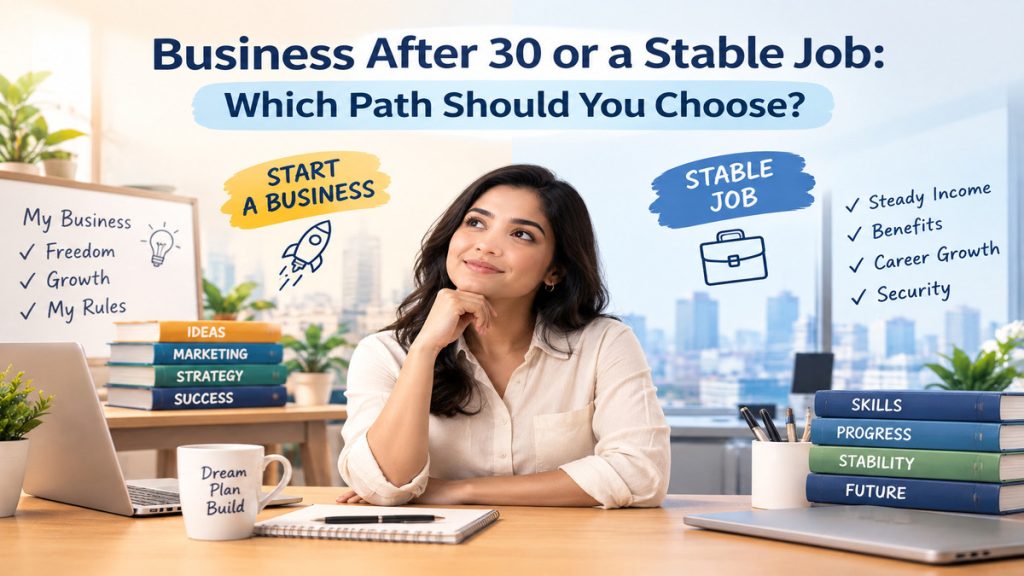
Thirty is when the question starts to get raised and you’re able to do something because you know you have the experience—you know you have the responsibility. Here are some ways to consider the choice based on a realistic assessment without idealizing either aspect.
Restlessness is one of those things that appears in your early 30’s. After nearly a decade in the workforce, you’ve got a pretty good handle on the industry and at least once in your career, you’ve thought “I can do that better myself.” Meanwhile, 30 is the age when financial responsibilities begin to add up, when a mortgage, a family, aging parents or just the aches and pains of walking away from a paycheck that you’ve come to expect begin to feel like a burden.
But both ways aren’t necessarily better, as “just take the leap” content or “stability above all” content will have you believe. The real question is: which path fits your situation, temperament and money? Which is more useful: which path sounds more admirable?
Starting a Business After 30
Starting a business after 30 can be a good option for people who have work experience, industry knowledge or a clear business idea. By this stage, many professionals have developed useful skills, built contacts and gained a better understanding of customers and the market.
However, running a business also involves financial risk. Income may be uncertain during the early stages, and you may need to invest your savings or take a business loan. Managing employees, customers, marketing and daily operations can also be demanding.
Before starting, it is useful to test the business idea on a small scale while continuing your current job, if possible.
Staying in a Stable Job
A stable job can provide regular income, employee benefits, career growth and greater financial predictability. This can be particularly important if you have family responsibilities, loans or other major expenses.
You can also use your job to build savings and develop skills before considering a business later. A stable career does not mean you cannot become an entrepreneur in the future.
What Each Path Actually Demands
Strip away the motivational language, and starting a business and holding a stable job ask fundamentally different things about you.
| Factor | Starting a Business | Stable Job |
| Income in year one | Uncertain, often lower or negative | Predictable, typically steady growth |
| Time investment | Frequently 60+ hours/week early on | Defined hours, generally more boundaried |
| Decision-making | Entirely yours — and entirely your responsibility | Shared, with structure and oversight |
| Ceiling on income/growth | Uncapped, but not guaranteed | Capped by role, though often more certain |
| Risk of failure | Real and material — most new businesses don’t survive long-term | Lower, though not zero (layoffs, restructuring) |
| Skill demands | Broad — sales, finance, operations, hiring, resilience | Deep — specialization within a defined role |
Why 30 Specifically Changes the Calculus
The math of this decision genuinely shifts with age, not because of some cutoff on ambition, but because the surrounding context usually has changed.
- You likely have real capital, or a route to it. A decade of saving, credit history, and possibly a network of people willing to invest or lend puts real options on the table that weren’t available at 22.
- You have domain expertise now, not just enthusiasm. Most businesses started by people in their 30s and 40s succeed because of specific industry knowledge and a real network not because of raw hustle. That’s an advantage the “start young” narrative undersells.
- Your obligations have usually grown too. A dependent family, a mortgage, or aging parents needing support changes how much risk is responsible to take on not whether risk is possible, but how it should be structured and buffered.
- Your runway for recovery is different, not gone. A failed business at 32 still leaves plenty of career ahead. The instinct to treat 30 as a last chance is usually more anxiety than arithmetic.
Questions Worth Answering Honestly Before Deciding
1. Can you financially survive 12–18 months without stable income?
Most viable businesses take longer than founders expect to become reliably profitable. If starting one would mean immediate financial strain on dependents, that’s not necessarily a reason to abandon the idea but it is a reason to either build more of a cushion first, or start it alongside your current job rather than leaving it outright.
2. Is this idea validated, or is it a feeling?
Genuine enthusiasm and a validated business idea are different things. Have you talked to potential customers, tested a small version of the offering, or seen any real signal of demand or is the plan still theoretical? Businesses started on validated demand fail less often than those started on conviction alone.
3. Do you have or can you build the specific skills this requires?
Running a business requires competence across sales, basic finance, operations, and people management, regardless of what the core product or service is. If several of these are genuinely unfamiliar to you, that’s addressable, but it should factor into your timeline and how much you plan to outsource early on.
4. What does your risk tolerance actually look like under pressure, not in theory?
It’s easy to feel bold about risk when things are going well. The more useful test is how you’ve handled financial uncertainty or setbacks in the past, panic, problem-solving, or somewhere in between. That pattern is a better predictor of how you’ll handle a rough first year than how motivated you feel right now.
5. What would “stable” actually cost you if you stayed?
Sometimes the honest answer is that a stable job isn’t actually stable in the way it feels like a stagnant industry, a ceiling you’ve already hit, or years of being visibly unfulfilled have real costs too, even if they’re less immediately visible than a business’s financial risk.
The Middle Ground Most People Skip
The framing of “business or stable job” is often a false binary. A large number of successful founders in their 30s and 40s built their venture alongside a job for a period of nights, weekends, or a reduced schedule before making the full jump, once there was validated demand, some savings runway, and early customers or revenue in place.
A practical middle path
Keep the stable income while testing the idea in a low-stakes way: a small pilot, a handful of paying customers, a side project run on weekends. Set a specific, honest milestone, a revenue number, a customer count, a validated signal that would justify leaving the job, rather than leaving on optimism alone.
How to Prepare for a Business While Working
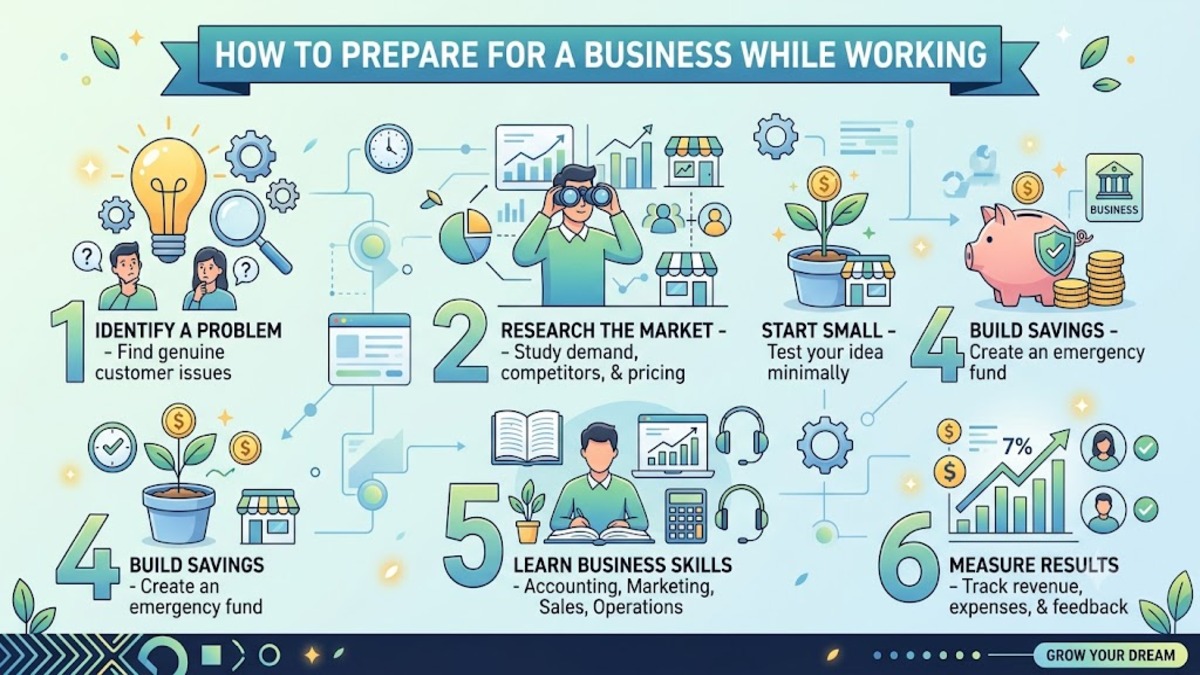
If you are considering entrepreneurship, you can use your current job period to prepare.
Step 1: Identify a Problem
Look for a genuine problem that customers are willing to pay to solve.
Step 2: Research the Market
Study your potential customers, competitors, pricing and demand.
Step 3: Start Small
Instead of immediately investing a large amount, test the idea with a small product or service.
Step 4: Build Savings
Create an emergency fund and keep your personal financial needs separate from business capital.
Step 5: Learn Business Skills
Learn basic accounting, marketing, sales, customer service and business operations.
Step 6: Measure Results
Track revenue, expenses, customers and repeat business. This will give you a clearer picture of whether the idea can become a sustainable business.
Signs You’re Genuinely Ready to Choose Business
- You have 6–12 months of expenses saved, separate from the business’s own funding needs
- You’ve validated real demand — actual conversations, pilot customers, or pre-orders, not just positive reactions to the idea
- You have a support system (financial or otherwise) that can absorb a rough first year without collapsing
- You’ve identified the specific skills you lack and have a realistic plan to learn them or bring in help
Signs a Stable Job Is the Right Call, For Now
- You have dependents whose stability would be seriously compromised by an income gap
- The business idea is still a feeling rather than something you’ve tested
- You’re motivated primarily by dissatisfaction with your current job rather than genuine pull toward the business itself
- You haven’t yet built the savings or support system that would let a rough first year be survivable rather than catastrophic
The Bottom Line
Thirty isn’t a deadline, and it isn’t a green light either — it’s simply the age at which most people have enough experience to make this decision seriously instead of impulsively, and enough responsibilities to make the stakes real. The right choice isn’t the braver-sounding one or the safer-sounding one; it’s the one that matches your actual financial cushion, the strength of your validated idea, and how honestly you’ve assessed your own risk tolerance under real pressure, not hypothetical confidence. Either path can go well. What determines which one will be is preparation, not age.
Read More: How to Return to Work After a Career Break: Skills, Jobs and Preparation in 2026
📚 Related Articles



👉 You May Also Read
📚 Related Articles
- How to Return to Work After a Career Break: Skills, Jobs and Preparation in 2026
- Best Career Options After Class 12 for Average Students in 2026
- Career Change After 30: How to Transition from Non-Tech to IT or Data Science
- Government Jobs by Age Limit: Eligibility and Opportunities in 2026
- Why Self-Discipline is More Important Than Motivation for Students
🔥 Popular Posts



📌 Explore Categories
- About India
- Artificial Intelligence & Machine Learning
- Calendar
- Career
- Counselling
- Current Affairs
- Economy
- Education
- English Grammar
- Exams
- Festival
- Health and Fitness
- Hindi Sahitya
- History
- Intelligence Agency
- International Personality
- Know India
- Knowledge
- Maths
- Maxim
- Moral Stories
- Nature
- NEWS
- Olympiad
- Others
- Personality Development
- Politics
- Scholarship
- Science and Environment
- Sports
- States of India
- Study Abroad
- Study Tips
- Technology
- The Greatest Indian
- Uncategorized