
Government Jobs Without UPSC or SSC: Career Options, Eligibility and Opportunities in India
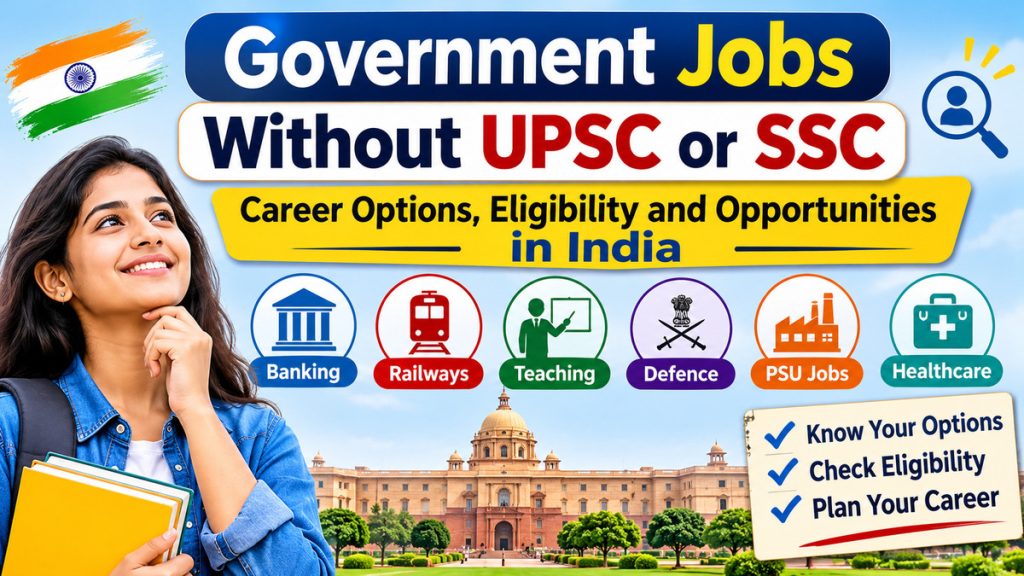
UPSC and SSC are the most talked about exam bodies, but there are numerous exam bodies that conduct interviews for government jobs in India. Banks, railways, the armed forces, state commissions, school boards, public sector companies (PSUs), the postal service, hospitals and research labs conduct their own recruitment and collectively take care of lakhs of posts every year.
Selection of the candidates may be made based on written Examination, Interview, skill Test, Physical Test or direct recruitment based on the post. Information about these career options can enable job seekers to select which government roles are appropriate for their age, skills and educational background.
This guide lists each major route including eligibility, recent figures, stages and links.
Why Look Beyond UPSC and SSC?
Looking beyond UPSC and SSC opens up a much wider range of government careers. Roles are not limited to administrative posts: you can become a bank officer, a loco pilot, a teacher, a scientist or a police officer, depending on your interests and skills. The eligibility rules are also more flexible, since many exams accept candidates with a Class 10 or Class 12 certificate, an ITI or diploma, or any graduate degree, so you don’t need a specific degree to get started. State-level exams add another advantage by letting you work close to home, and many of them test in your own regional language. Finally, because banks, railways, defence services, state commissions and other bodies hold recruitment drives throughout the year, missing one exam does not end your chances, as another opportunity is usually just around the corner.
Key Takeaways
- You can build a government career through banking, railways, defence, state services, teaching, PSUs, postal and health services without writing UPSC or SSC.
- Qualifications range from Class 8 and Class 10 to ITI, diplomas, graduation, engineering degrees and nursing degrees.
- Many exams share the same core subjects (reasoning, quantitative aptitude, English, general awareness), so one preparation plan can cover several exams.
- Age limits and attempts vary a lot by exam, and some, like Agniveer, close early.
- Always apply through official portals. Fake job alerts are common.
Overview: Major Routes at a Glance
| Sector | Main recruiting bodies | Typical qualification | Selection |
| Banking | IBPS, SBI, RBI, NABARD | Graduation | Prelims, mains, interview (post-dependent) |
| Railways | Railway Recruitment Boards (RRBs) | Class 10, 12, ITI, diploma, graduation | Computer-based tests, skill test, document check |
| Defence | Army, Navy, Air Force | Class 8 to 12 | Online exam, physical test, medical |
| State services | State PSCs, state staff boards, police boards | Varies by post | Written exam, interview, physical test |
| Teaching | CBSE (CTET), KVS, NVS, state TETs, UGC NET | D.El.Ed., B.Ed., postgraduate | Eligibility test plus recruitment exam |
| PSUs | NTPC, ONGC, IOCL, BHEL, GAIL, SAIL and others | Engineering degree, diploma | GATE score or own exam, then GD/interview |
| Postal | India Post | Class 10 | Merit based on Class 10 marks |
| Health | AIIMS and state health departments | Nursing, paramedical degrees | Online eligibility test |
| Research | ISRO, DRDO, BARC | Engineering, science degrees | Own recruitment process |
1. Banking Sector Jobs
Banking is one of the most popular routes for graduates. Most public sector banks recruit through IBPS, while SBI runs its own exams.
IBPS PO and Clerk
IBPS released its 2026 Probationary Officer notification on 30 June, covering 6,715 vacancies across public sector banks. For clerks, the 2026 notification covered 11,403 vacancies, with applications open from 1 to 21 August and prelims in October. ibps po 2026 notification 6715 vacancies apply july 21 +2
| Post | Qualification | Reported age limit (General) |
| IBPS PO | Any graduate | 20 to 30 years, as expected for 2026 |
| IBPS Clerk | Any graduate | 20 to 28 years mahendrasrojgardekho |
IBPS PO sets no fixed attempt limit, so you can keep applying while you meet the age criteria.
SBI PO and Clerk
SBI released its PO notification on 18 June 2026 for 1,500 Probationary Officer vacancies. Of those, 1,446 were regular and 54 were backlog vacancies. Applications ran until 8 July 2026, and prelims were scheduled for 1–2 August 2026. sbi po 2026 notification out 1500 vacancies open check eligibility criteria exam date how to apply and more 538035 2026 06 19 +3
For eligibility, the age limit was 21 to 30 years as on 1 April 2026, and relaxations apply to reserved categories. Graduates in any discipline can apply. careers360pw
IBPS RRB (Regional Rural Banks)
IBPS RRB recruits Officer Scale I, II and III and Office Assistants. The published schedule lists these dates:
| Post | Qualification | Usual age | Exam dates listed |
| Officer Scale I | Graduation | 18–30 | Prelims 21 and 22 Nov 2026; Mains 20 Dec 2026 |
| Office Assistant | Graduation | 18–28 | Prelims 6, 12 and 13 Dec 2026; Mains 30 Jan 2027 |
| Officer Scale II | Graduation plus specialist qualification or experience | 21–32 | Single exam on 20 Dec 2026 |
| Officer Scale III | Graduation plus experience | 21–40 | Single exam on 20 Dec 2026 Company Logo +3 |
RBI and NABARD
The Reserve Bank of India and NABARD recruit officers separately. For RBI Grade B 2026, the notification announced 60 vacancies, split into 40 General, 10 DEPR and 10 DSIM. These are higher-level, specialised roles, and they suit candidates with strong economics, finance, statistics or management backgrounds. edutap
Official links: IBPS · IBPS RRB page · SBI Careers · RBI Opportunities · NABARD
2. Railway Jobs (RRB)
The Railway Recruitment Boards run some of the biggest recruitment drives in the country. All applications go through the RRB application portal.
| Category | Example posts | Typical qualification |
| NTPC (graduate) | Goods Train Manager, Station Master | Graduation |
| NTPC (undergraduate) | Junior Clerk, Accounts Clerk, Traffic Assistant | Class 12 |
| Group D | Track maintainer, helper | Class 10 or ITI |
| ALP and Technician | Assistant Loco Pilot, technicians | ITI or diploma |
| JE | Junior Engineer | Engineering diploma or degree |
For NTPC, reported age limits are 18 to 33 years for graduate posts and 18 to 30 years for 12th-level posts. RRB does not conduct interviews for Group D posts. practicemockcareers360
Vacancy figures for 2026 differ between sources. Some reports say 8,868, while others cite 5,165 approved posts, so rely only on the official CEN notice.
3. Defence Services
Agniveer (Army, Navy, Air Force)
The Agnipath scheme recruits for a four-year term. Key facts:
| Item | Detail |
| Age | 17.5 to 21 years for all posts |
| Relaxation | None for SC, ST or OBC under the scheme |
| Term | Four years of service |
| Pay | ₹30,000 to ₹40,000 a month plus a Seva Nidhi package |
| After four years | The remaining 75% receive a financial package for civilian life Army Agniveer GD 2026 Eligibility: Your Comprehensive Guide to Joining the Ranks +4 |
Educational requirements depend on the trade, from Class 8 and 10 up to Class 12. Air Force entry also looks at subject marks, asking for a minimum of 50% in Physics, Chemistry, Maths and English. pw
Other Defence and Paramilitary Entries
Constable posts in the CRPF, BSF, ITBP and CISF, Coast Guard entries and military nursing run through their own recruitment drives. NDA, CDS and AFCAT are officer-level entries, and NDA and CDS are conducted by UPSC, so they are outside this guide.
Official links: Join Indian Army · Join Indian Navy · Indian Air Force Agniveer
4. State Government Jobs
Each state runs its own recruitment bodies, which often give local candidates an advantage through domicile rules and regional-language papers.
| Body type | Typical posts |
| State Public Service Commissions (TNPSC, UPPSC, BPSC, KPSC, MPSC and others) | State civil services, Group I to IV |
| State Staff Selection Boards | Clerks, assistants, technical staff |
| State Police Recruitment Boards | Constables, sub-inspectors |
| State judicial services | Civil judges |
| State education and health departments | Teachers, nurses, paramedical staff |
Sample official sites: TNPSC · UPPSC · BPSC · KPSC · MPSC
Tip: Search for your own state’s commission and staff selection board, and bookmark their notification pages.
5. Teaching Jobs
Teaching is another career option for graduates and candidates with professional teaching qualifications. Government school organisations such as Kendriya Vidyalaya Sangathan (KVS), Navodaya Vidyalaya Samiti (NVS) and state education departments recruit teachers for different subjects and grade levels.
Common teaching positions include:
- Primary Teacher (PRT)
- Trained Graduate Teacher (TGT)
- Post Graduate Teacher (PGT)
- Special Educator
- Other academic and non-teaching positions
Eligibility: Candidates generally need the relevant educational degree and teaching qualifications, such as D.El.Ed or B.Ed, depending on the post. Teacher eligibility test requirements may also apply.
Selection Process: Recruitment may involve written examinations, interviews, teaching demonstrations and document verification, depending on the organisation.
Candidates interested in education can explore these opportunities without preparing for UPSC or SSC examinations.
| Step | Examples |
| Eligibility test | CTET (central), state TETs |
| Central school recruitment | KVS and NVS |
| State recruitment | State education departments |
| College level | UGC NET for assistant professor |
CBSE has announced that the 22nd edition of CTET will be held on 12 and 13 December 2026. A CTET certificate is an eligibility requirement for many central school posts, not a job in itself. adda247
Official links: CTET · KVS · NVS · UGC NET (NTA)
6. PSU and Engineering Jobs
Public Sector Undertakings are government-owned or government-controlled organisations operating in industries such as energy, power, oil, engineering and infrastructure. Many PSUs recruit graduates, engineers, diploma holders and experienced professionals for technical and administrative positions. pwpw
Some well-known organisations include:
- Oil and Natural Gas Corporation (ONGC)
- Bharat Heavy Electricals Limited (BHEL)
- National Thermal Power Corporation (NTPC)
- Power Grid Corporation of India
- Indian Oil Corporation (IOCL)
Eligibility: Requirements depend on the job. Engineering positions generally require relevant engineering qualifications, while finance, human resources and administrative roles may require other degrees.
Selection Process: Some PSUs recruit candidates through GATE scores, while others conduct their own examinations, interviews or direct recruitment processes. truejobs
Official links: GATE results portal (IIT Guwahati) · check the careers page of each PSU you target.
7. Postal, Health, Insurance and Research Jobs
India Post Gramin Dak Sevak (GDS)
GDS suits Class 10 pass candidates. Selection is based solely on merit using Class 10 marks, with no interview. The age limit is 18 to 40 years. Reported pay is ₹12,000 to ₹29,380 for Branch Postmasters and ₹10,000 to ₹24,470 for ABPMs and Dak Sevaks. India Post GDS Recruitment 2026: Registration Process Starts At indiapostgdsonline.gov.in; Here’s How To Apply +2
Vacancy reports differ by cycle. One round reported 28,740 posts, while a later round reported 23,757, so check the latest notice. Also note that candidates should confirm the local-language and subject requirements in the notification. careerindia
Apply only through India Post and indiapost.gov.in.
AIIMS Nursing Officer (NORCET)
AIIMS runs a common test for nursing officers. NORCET-11 covered 2,218 Nursing Officer posts at Level 7 (₹44,900 basic) across 27 AIIMS. Apply through AIIMS exams. indianpaycalculator
Insurance and Research Bodies
- LIC and general insurers recruit assistants and administrative officers. See LIC India.
- ISRO and DRDO recruit scientists, engineers and technicians through their own processes. See ISRO and DRDO.
8. Judiciary and Court Jobs
Government courts and judicial institutions also offer career opportunities for law graduates and other qualified candidates.
Some common positions include:
- Civil Judge
- Judicial Magistrate
- Court Assistant
- Stenographer
- Court Clerk
- Legal Assistant
Eligibility: Civil Judge positions generally require an LLB degree and other conditions prescribed by the relevant state judicial service notification. Clerical and support positions may require different educational qualifications and computer or typing skills.
Selection Process: Judicial officer recruitment generally involves preliminary and main examinations followed by an interview. Other court positions may have written tests, skill tests or interviews.
These opportunities can be suitable for candidates interested in law, administration and the judicial system.
9. Government Research and Scientific Organisations
Candidates with science, engineering and research backgrounds can explore employment opportunities in government research institutions.
Organisations such as ISRO, DRDO, CSIR and ICAR recruit professionals for scientific, technical, administrative and support positions.
Some job opportunities include:
- Scientist
- Technical Assistant
- Research Associate
- Laboratory Assistant
- Project Assistant
- Scientific Officer
Eligibility: Requirements depend on the position and may include bachelor’s, master’s or doctoral qualifications in relevant subjects.
Selection Process: Organisations may use written examinations, GATE scores, interviews, practical assessments or direct recruitment, depending on the vacancy.
These careers can be suitable for candidates interested in scientific research, innovation and technical development.
Government Job Opportunities Based on Educational Qualification
| Educational Qualification | Government Job Opportunities |
|---|---|
| Class 10 Pass | India Post GDS, RRB Group D, Agniveer (selected trades), State Police Constable |
| Class 12 Pass | RRB NTPC (Undergraduate), Agniveer, State Clerical Posts |
| ITI / Diploma | RRB ALP, RRB Technician, RRB JE (where eligible), PSU Technician Posts |
| Any Bachelor’s Degree | IBPS, SBI, RRB NTPC (Graduate), Bank Clerk, State PSC |
| B.Tech / B.E. | PSU Jobs through GATE, RRB JE, ISRO, DRDO |
| B.Ed. / D.El.Ed. | CTET, KVS, NVS, State Government Teacher Recruitment |
| Nursing / Paramedical | AIIMS NORCET, State Health Department Jobs, Government Hospital Jobs |
| Pharmacy | Government Pharmacist, State Health Department Jobs |
| LLB | Civil Judge, Judicial Services, Court Assistant, Legal Officer |
| Master’s Degree | Research Positions, Government College Teaching, Scientific and Specialist Posts |
Age Relaxation Rules
Most exams follow central norms for the upper age limit. The SBI PO notification, for example, shows 3 years for OBC non-creamy layer, 5 years for SC and ST, and 10 years for PwBD in the general and EWS categories. Agniveer is a notable exception with no relaxation. pw
| Category | Common relaxation (verify per exam) |
| SC / ST | 5 years |
| OBC (non-creamy layer) | 3 years |
| PwBD (General/EWS) | 10 years |
| Ex-servicemen | As per rules of the exam |
Typical Selection Stages
Most government recruitment follows a similar step-by-step process. It begins with an online application, where you fill in your details and upload the required documents. Candidates who meet the eligibility rules then take a preliminary or screening exam, which is usually computer-based. For posts that need further filtering, a main exam follows. Depending on the job, you may then face a skill or physical test, such as a language test or typing test, or physical and medical tests for defence and police roles. Officer-level posts often add an interview or group discussion to judge communication skills and personality. The final stage is document verification and a medical examination, where the recruiting body checks your certificates and confirms you are fit for the job before issuing an appointment.
- Online application and document upload.
- Preliminary or screening exam (computer-based).
- Main exam, where applicable.
- Skill or physical test: language test, typing, or physical and medical tests for defence and police.
- Interview or group discussion, for officer-level posts.
- Document verification and medical examination.
Pay and Benefits
Pay varies widely by post. Reported entry figures include a basic pay of ₹48,480 for SBI PO plus allowances, ₹44,900 basic for AIIMS Nursing Officers and ₹30,000 to ₹40,000 a month for Agniveers. Government jobs usually add allowances, leave, medical benefits and job security, but terms differ by employer, so read the notification. SBI PO 2026 Notification, Exam Dates, Vacancies, Eligibility, and Selection process +2
Opportunities Open Around Now
As of 12 November 2026, these dates are near:
| Opportunity | Date |
| IBPS RRB Officer Scale I prelims | 21 and 22 November 2026 |
| CTET | 12 and 13 December 2026 |
| IBPS RRB Office Assistant prelims | 6, 12 and 13 December 2026 |
| IBPS RRB Scale II and III | 20 December 2026 Company Logo +3 |
Many other applications are already closed for this cycle. Keep watching official sites for the next round.
How to Choose the Right Exam
The first step in choosing an exam is to check whether you actually qualify for it. Every recruitment has its own rules on educational qualification and age, so confirm these in the official notification before you spend months studying. Next, think about the kind of life each job leads to. Defence, railways and postal roles often involve transfers, postings in distant places and shift work, while teaching and many state government jobs tend to be more settled and let you stay in one area. It also helps to compare pay and career growth, because officer-level posts in banking and PSUs usually offer faster promotions and better long-term earning potential than entry-level clerical posts.
Your language and location matter too. State government jobs and India Post GDS usually require knowledge of the local language, so they suit candidates who plan to stay in their home region. Finally, it is smart to choose exams with overlapping syllabi. Reasoning, quantitative aptitude and English appear in many banking, railway and state exams, which means one preparation plan can prepare you for several exams at once. Picking two or three well-matched exams, instead of chasing every opening, lets you use your time better and improves your chances of a selection.
Preparation Strategy
| Step | What to do | Why it matters |
| Study the official material | Start with the official syllabus, exam pattern and previous years’ papers. | Shows exactly what is asked and how the paper is structured. |
| Build a daily routine | Cover quantitative aptitude, reasoning, English and current affairs every day. | These core subjects appear in most banking, railway and state exams. |
| Take mock tests | Attempt timed mock tests weekly and track your weak topics. | Builds speed and shows which areas need more work. |
| Prepare physically (defence and police) | Start physical training early and clear the medical requirements. | Fitness and medical tests are part of selection. |
| Focus on GATE (PSUs) | Give most of your preparation time to GATE. | Your GATE score drives shortlisting. |
| Keep documents ready | Arrange certificates, caste or EWS certificate, domicile proof, photographs and signature. | Avoids last-minute problems with applications. |
Common Mistakes to Avoid
- Missing the age cut-off date: Each notification sets its own date for calculating your age, and it is often earlier than the exam or application date. Check this date carefully, because even a few days over the limit can make you ineligible.
- Trusting unofficial sites for dates and vacancy numbers: Coaching and news sites often disagree with each other and can be out of date. Always confirm exam dates, vacancy counts and eligibility on the official website of the recruiting body.
- Skipping the local-language requirement: Many state jobs and posts like India Post GDS require knowledge of the local language or a pass in it. If you ignore this rule, your application can be rejected even if you clear the exam.
- Applying with incomplete or wrong documents: Wrong photographs, unclear signatures, or missing certificates can lead to rejection at the application or verification stage. Keep every document ready and match the size and format rules in the notification.
- Paying money to agents who promise a job: Genuine government recruitment never needs a payment to an individual, and the only fee is the official application fee paid on the recruiting body’s portal. Anyone who asks for money in return for a job is running a scam, so avoid them and report them.
Frequently Asked Questions
1. Are there government jobs without any exam?
Some roles, such as India Post GDS, select on marks without a written exam, but most other posts need an exam or test. Check the notification for the exact stages.
2. Which government job is easiest to get?
No job is easy. Competition is high for every exam, with lakhs applying for thousands of posts. Choose the route that matches your skills and prepare consistently.
3. Can I apply to several exams at once?
Yes, as long as the dates don’t clash and you meet each exam’s eligibility rules.
4. Do I need coaching?
No, but a structured plan, mock tests and previous papers are very helpful. Free official syllabi and previous papers are available on the recruiting bodies’ websites.
5. Which jobs suit Class 10 or 12 pass candidates?
Agniveer, India Post GDS, RRB Group D, RRB NTPC (undergraduate) and state police posts are common options.
6. Do these jobs have age relaxation?
Most do for reserved categories, but the rules differ, and Agniveer offers none.
Final Thoughts
UPSC and SSC are not the only doors to a government career. Banking, railways, defence, state services, teaching, PSUs, the postal service, hospitals and research bodies all offer secure careers across a range of qualifications. Pick two or three exams that match your profile, prepare steadily, and track the official notifications.
Read More: Government Jobs by Age Limit: Eligibility and Opportunities in 2026
📚 Related Articles




👉 You May Also Read
📚 Related Articles
- How to Build a Career in Data Analytics Without a Computer Science Degree
- Business After 30 or a Stable Job: Which Path Should You Choose?
- How to Return to Work After a Career Break: Skills, Jobs and Preparation in 2026
- Best Career Options After Class 12 for Average Students in 2026
- Career Change After 30: How to Transition from Non-Tech to IT or Data Science
🔥 Popular Posts

📌 Explore Categories
- About India
- Artificial Intelligence & Machine Learning
- Calendar
- Career
- Counselling
- Current Affairs
- Economy
- Education
- English Grammar
- Exams
- Festival
- Health and Fitness
- Hindi Sahitya
- History
- Intelligence Agency
- International Personality
- Know India
- Knowledge
- Maths
- Maxim
- Moral Stories
- Nature
- NEWS
- Olympiad
- Others
- Personal Finance
- Personality Development
- Politics
- Scholarship
- Science and Environment
- Sports
- States of India
- Study Abroad
- Study Tips
- Technology
- The Greatest Indian
- Uncategorized