Essence of a Positive Attitude

A bright, cheerful person has more friends than someone who is gloomy and brooding all the time. Optimism is a rare talent these days. With work pressures and stress levels growing each day, most people only have the time to sit and crib. Negativity wrings out the happiness and ability to think positively about the present or future in a person and sends out a negative vibe about the individual. So, smile and make others smile and send out positive vibes to people you meet and interact with.

Here are a few things that a positive attitude towards life can get you:

  • Improves Your Social Status: By being positive and cheerful, you will attract more people towards you and build more relationships and friendships with important people. People will know you as a person who is happy and cheerful and fun to be with. These people may also bring important opportunities in your life.
  • Helps your body heal faster from injuries and illnesses: It has been observed that people who have a positive attitude towards life heal faster from injuries and illnesses. There are so many cases of people suffering from terminal diseases such as cancer of coming back to perfect health through their grit and determination. A person who feels depressed and unhappy about life feels sick and uneasy all the time. Such persons may even develop diseases due to their attitude. On the other hand, people who are full of life and are optimistic about the situations in their life, tend to face them with ease and conquer all their problems to emerge victorious.
  • Makes you a go-getter in your professional life: Be it interviews, deadlines or client deals, people with a positive attitude are more successful as compared to those who see negativity in everything. A positive attitude gives you the drive to achieve everything and anything. Optimists do not take failure as a setback instead learn their faults from their mistakes and forge on ahead with double the energy and win. Pessimists on the other hand are affected by criticism and become hesitant in approaching any situation henceforth. People with a positive attitude take up challenges and deliver to the best of their ability. A positive attitude allows your mind to think clearly and helps you achieve your goals easily. Even in job interviews, a positive attitude will leave a more lasting impression than your skills and capabilities.
  • Ensure a successful life: Consider Thomas Alva Edison or any other inventor who is hailed by the whole world today for their inventions. All great people have suffered setbacks in their lives but it was their positive attitude which kept goading them to achieve their goals. With a positive attitude, you learn to take failures in your stride and move on ahead to achieve your goals. People with negative attitudes give up when met with failure and hence never can be successful in their lives.

Hence, a positive attitude can ensure you a bigger social circle, social recognition and success in personal and professional life.
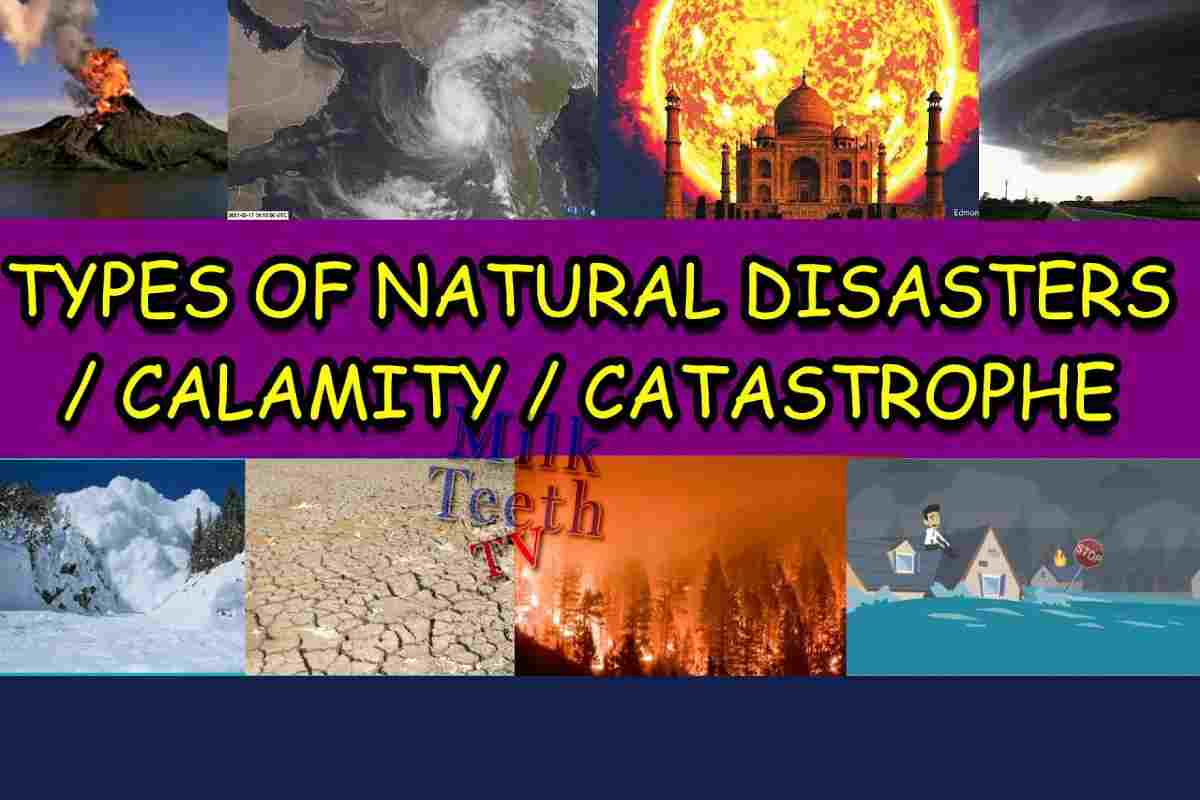
Types of Natural Calamities

Types of Natural Calamities

There are different forms of disasters or calamities. The duration of these natural calamities can be indefinite. It can range from a couple of hours to many days and even months. The following is a list of natural calamities.

Agricultural diseases 

Agricultural diseases not only affect livestock. They affect human beings as well. The issue of foreign pests and diseases is common in many agriculture oriented countries. There is periodic outburst of agricultural diseases such as avian influenza, emerald ash borer, Asian long horned beetle, and many such pest infections in agricultural lands.

Heavy and damaging winds

These types of winds are called straight line winds. They cause destruction due to their high velocity and volume. These winds can be caused from a thunderstorm draft. They have an average speed of 50-60 mph which can increase in due course of time. There have been cases when damaging winds have crossed 150 mph.

Earthquakes

A severe earthquake is a frightening natural calamity. It causes damage en masse. To recover from an earthquake is as difficult as to recover from any other natural calamity. The severity of an earthquake depends on the level of urbanization in an area. Earthquakes can also damage plain land by offsetting them. Earthquakes have been happening for millions of years. The movement of tectonic plates will continue to happen and there is no way to stop it.

Extreme heat

Excessive heat causes fatalities. It causes sunstroke and dehydration. It creates an abnormal temperature in the body. The body is pressurized to maintain a normal temperature. A mass heat wave can kill a lot of people. Overexposure to the sun is one of the main causes. It is not necessary that extremely hot places cause fatalities. Poor air quality and atmospheric conditions also cause heat related calamities.

Floods

Areas with dense populations are the most affected by floods. Lesser the ground surface to absorb flood water more is the destructive potential of flash floods. The construction of structures such as buildings, highways, roads, and flyovers increase the destruction. Floods can also be caused in cities due to overwhelmed storm drains. Heavy rainfall fills these storm drains over their normal capacity. The water from these storm drains percolates into the streets and roads.

Hurricanes

Hurricanes generally affect coastlines. They cause high velocity winds in the range of 200 mph. The winds are spiral in nature and have great gravitational force. Hurricanes can induce heavy rainfall, thunderstorms, floods, and storms. There have been instances where hurricanes have caused landslides where many hundreds and thousands of people were buried under land. There is no generally accepted knowledge as to when a hurricane can appear. It is also not clear as to where they can appear. A hurricane can appear anywhere along the coastline.

Wildfire

Remote mountains and rural settings are becoming places of inhabitation. Human settlement is causing the creation of wildfires. These fires begin unnoticed. Soon they spread quickly and uncontrollably. Wildfires are a very real threat in forests and places of intense vegetation.

Lothal Once a Port for World Trade

Lothal is a pre-historic port found in India. This was actually a port city situated in the present Ahmedabad District of Gujarat. Lothal was excavated in 1954. Studies on the ruins of this ancient port city revealed that it was part of the Indus Valley Civilization that existed around 2400 BC.

The meaning of Lothal is ‘City of Dead’. It functioned as an outpost to important places in the Indus Valley Civilization, namely Harappa and Mohenjo Daro. Being a port town, this city generated wealth and prosperity. It facilitated trade and commerce with major ports of West Asia. Lothal was a well-known center to manufacture and export beads. During its time, it was here that the Sabarmati River passed through before meeting with the Gulf of Khambat.

Lothal – A thriving port town

Although the Indus Valley Civilization flourished for more than 5000 years, none of its ruins are as well-preserved as the ruins of Lothal. Remnants of this ancient port city reveal that it was a thriving centre-place of trade. It was also a bustling shipyard. A visit to the site reveals so many aspects of this ancient civilization. For one, they were an organized group of people. They had better roads, strong brick houses, and closed drainage lines.

Lothal – An organized place

Lothal was once a pottery town. Its strategic location was noticed and it was made into a port city. Historians conclude that Lothal reached its peak in prominence around 2350 BC. The city had an excellent underground drainage system. Even during that time weights and measures were used to erect structures with great precision. 

  • The infrastructure of this city was strong.
  • It survived the onslaught of three raging floods.
  • But it could not withstand a flood that happened in 1900 BC. This flood destroyed the city permanently.

Lothal’s dynamics

The walls of the structures found in Lothal have no intricate carvings. Interestingly, Lothal was not ruled by kings. Rather, it was ruled by a democratically elected group of councils. The ruins found in this ancient port city are flat and desolate. They are not exciting and may not generate interest. This aspect reveals that this city meant only business and was not perceived to be a city of art and crafts.

  • It is at Lothal where India’s first ship-building yard operated from.
  • The ship building and breaking yard manufactured, modified, and destroyed ships and boats. It had a capacity to hold more than 30 ships at a single point of time.
  • It had a total capacity of holding 30 tonnes of ship-able goods. 
  • This metric indicates that Lothal was as prominent and large a port city as the present day Visakhapatnam.

Conclusion

It is interesting to note that within a span of a few hundred years Lothal disappeared into oblivion. It left behind no substantial evidence of the language people spoke in the region. There is not much information on how the port city was operated. Nevertheless, the city of Lothal gives us a peek into a glorious past we can be proud of.

Diwali India’s Most Celebrated Festival

Diwali or Deepavali is a popular Indian festival. Also called the Festival of Lights, this festival is celebrated in the Hindu calendar month of Ashwin. When referencing this with the Gregorian calendar, you will be celebrating diwali in between October and November. Diwali is celebrated with much aplomb. It is celebrated for a period of 1 – 5 days. In many states of India, the state government issues a holiday for this festival. For Hindus, there cannot be a more important festival than this. At this time, Hindu families unite to celebrate together. Jains regard this festival as an auspicious occasion during which Mahavira attained nirvana. Arya Samaj Ists have a different interpretation of this festival. They celebrate it to commemorate the demise of Swami Dayanand Saraswati. 

Origins of Diwali 

  • The festival of Diwali was celebrated in ancient India as a harvest festival. There are different theories supporting the origins of this festival.
  • It is said to be the time of the year when Lakshmi, the Goddess of Prosperity married Lord Vishnu.
  • In Bengal, Deepavali is celebrated in the honour of Mother Kali.
  • In many Hindu homes, this festival is also an occasion to worship Lord Ganesha.
  • Jains believe that this was the time of the Hindu year when during 527 BC Mahavira attained moksha.
  • For a majority of people, this festival is the celebration of Rama’s victory over Ravana. It commemorates Lord Rama’s and his queen Sita’s return from exile after fourteen years.

The four days of Diwali

  • First day – This is the day that commemorates the killing of Tarka. This demon is killed by Lord Krishna.
  • Second Day – This day is called Amavasya. On this day, Hindus worship Lakshmi. Worshipping her on this day is said to benefit devotees. On this day Lakshmi is said to be in a very generous mood. She willfully fulfills all the wishes of her devotees.
  • Third day – Lord Krishna grants a wish to the tyrant Bali. Krishna allows Bali to visit Earth once a year. This is the day that Bali visits Earth. This day is also called Kartika Shudda Padyami.
  • Fourth Day – The fourth day is the Bhai Dooj day. This day is special for sisters and their brothers. Sisters prepare special meals for their brothers and invite them home.

Diwali – an orchestra of lights and firecrackers

Diwali is the time when homes are illuminated with lights which are called deepams. People burst firecrackers and send them into the skies. It is a celebration of life. It is to ask the heavens to lift the spirits of devotees and provide the earthlings with good health, wealth, and overall happiness. 

On this auspicious day, many families indulge in another strange activity – gambling. It is said that Shiva and Parvati – the two husband and wife gods, played dice on this day. Parvati opined that whoever gambled on this day and won will win more riches in his or her future life.

Conclusion

The festival of diwali is open to interpretation. People celebrate this festival for different reasons. Nevertheless, it is still the festival of lights, laughter, and joy.

Getting To Know Internal Combustion Engine

Introduction

In general sense, the term Internal Combustion Engine refers to an engine in which the process of combustion is sporadic. In such an engine combustion of fuel especially fossil fuels (mainly petroleum) takes place in the combustion chamber, which is an integral part of the engine. In this process of internal combustion, expansion of high temperature and pressure takes place, which in turn applies force to certain parts of the engines (such as pistons, turbine blades etc.) that allows movement. In simple terms Internal Combustion Engine is used for converting chemical energy into mechanical energy.

History 

Evidence says that there were several Internal Combustion Engines present before the advent of the 19th century but their development was hindered until the production of petroleum began in the mid 1850s. It was towards the mid of the 19th century that various engineering advances and developments led to their pervasive usage and adoption. However, Étienne Lenoir was the first to have developed a commercially efficacious Internal Combustion Engine.

Applications 

In current times, the Internal Combustion Engines are used in all forms of machinery that requires mobile propulsion, as it provides high power-to-weight ratios along with outstanding fuel energy density. Its general usage includes automobiles, boats, aircrafts, rockets etc. 

Types

Depending on the layouts and the type of engines, Internal Combustion Engines can be classified as follows;

  • Reciprocating:
  • Two-stroke engine
  • Four-stroke engine (Otto cycle)
  • Six-stroke engine
  • Diesel engine
  • Atkinson cycle
  • Miller cycle

 Gyratory

  • Wankel engine

Incessant combustion

  • Gas turbine
  • Jet engine

Functioning

The common usage of Internal Combustion Engines could be easily explained through its workings in a 4-stroke engine, which are as follows:

  • Intake / Suction Stroke – This stroke is the first step that an Internal Combustion engine takes. As the name specifies, in this stroke the piston of the engines moves downward thereby creating a vacuum in the upper part of the cylinder leading the inlet valve to open up. As a result of this the vaporized fuel mixture is sucked into the combustion chamber.
  • Compression Stroke – In this step, both the valves are closed and the piston moves upward creating compression on the mixture.
  • Power Stroke – Just before the piston reaches top dead center, the spark plugs ignite the fuel mixture, which leads to its combustion in the presence of air (oxidizer) thereby generating a great amount of heat, steam and carbon dioxide along with other chemicals at very high temperature. This whole process basically generates power that is transmitted to the crankshaft mechanism.
  • Exhaust Stroke – In this step the piston again starts moving downwards, which opens the exhaust valve so that exhaust gases can easily escape. At the end of this stroke the exhaust valve is closed and the inlet valve gets opened. Hence the whole process keeps on repeating itself starting from Step-1.

However it should be noted that here, Oxygen has been mentioned as an ideal oxidizer for the combustion of vaporized fuel mixture due to the fact that it could be found in plenty and doesn’t require being stored in the vehicle. But there are other oxidizers too, which do the same work but they are either more power generating and less energy efficient or vice-versa.

Diego Armando Maradona Redefining Football

Introduction Diego Armando Maradona is a former Argentinean football player, coach and team manager who is also considered to be one of the greatest football players of all times. Moreover he is the only football player to have set a world record for contract fees and that too twice, the first one being £5m when he shifted to Barcelona and the next one £6.9m while shifting to Napoli. In his international career he has played in 4 FIFA World Cup tournaments and his club career includes association with 6 clubs. Although Maradona had an excellent football career, he is also known for a controversial side too, which has caused him a lot on his reputation. 

Early Years and Personal Life

Diego Armando Maradona was born on 30 October 1960 in Lanús, Buenos Aires Province but was later raised and brought up in Villa Fiorito, a purlieu on the southern suburbs of Buenos Aires. He belonged to a poor family and had 5 siblings. He was the fifth child and the first son, after three daughters, of his parents. Maradona always had the charm of playing football in him and it got spotted by a talent scout who found the 10 year old playing the game in the neighborhood. Later he joined the junior team of Buenos Aires’s Argentinos Juniors and charmed the crowd by his wizardry with the ball.

Maradona married his long time love and fiancée Claudia Villafañe on 7 November 1984 in Buenos Aires and has two daughters from this relationship. However due to his infidelity and other personal matters the couple got separated in 2004. However from his illegitimate relationships and affairs Maradona has two sons from different mothers.

Careers

1. International – Maradona made his international debut at the age of 16 in the match against Hungary. In his international career, playing for the Argentina national football team, he has scored 34 goals in his altogether 91 appearances. As mentioned earlier MAradona has played 4 FIFA world cup tournaments, which are:

  • 1982 World Cup
  • 1986 World Cup (Captain)
  • 1990 World Cup
  • 1994 World Cup

In the 1986 World Cup Maradona captained his team and led to their glorious victory over West Germany, which also earned him the Golden Ball award for being the tournament’s best player. As you may know, he is the only football player to have won the Golden Ball award in the 1979 FIFA Under-20 World Cup and 1986 FIFA World Cup.

2. Club – Maradon’s club career includes his association with altogether 6 teams that are as follows:

  • 2.1 Argentinos Juniors and Boca Juniors
  • 2.2 Barcelona
  • 2.3 Napoli
  • 2.4 Sevilla, Newell’s Old Boys and Boca Juniors

His average of goals scored/match is 0.526, while playing for the domestic clubs.

Playing Style

Maradona’s strong legs, compact physique and short height gave him a lot of advantages in short sprints and was able to hold the ball for long enough. His trademark moves are Rabona, a reverse cross pass that is shot behind the leg (the one holding all the weight) and dribbling full-speed on the right wing along with accurate passes on reaching the opponents goal line. He truly redefined football with his excellent capabilities and sportsmanship!

Food Best Non Vegetarian Delicacies

Delectable delicacies not just delight an epicurean, but it also brings joy in anybody’s life. Give a sad person a delicacy and he will feel better almost immediately. Yes! That’s the power of food. Here is a list of best non vegetarian delicacies that are not just mouth watering, but equally delightful and full of flavor.

Tandoori Chicken

An Indian delicacy, Tandoori Chicken is prepared in a Tandoori or tall, cylindrical equipment that has firing charcoal inside. Prepared with less oil, it is a healthy, refreshingly tasty snack. Plus, you can always take it off the sticks and use it with curry for dinner.

Steaks

Whether it is lamb or beef, steaks are one of the quickest cooked foods. Served as a main, with options like fresh vegetables such as beans and potatoes on the side, this delightfully tasty dish is made by using a cut of meat and then searing it in the pan in rare, medium rare or fully cooked look. 

Rogan Josh

Another Indian delectable delight, this Mughalai dish is preferred all over the world because of its thick and rich curry and carefully cooked lamb that is so soft that it just melts in your mouth. Rogan Josh is widely available and the curry also serves well for chicken.

Prawns and Scallops

Boiled, seared and then seasoned with regular herbs, this entrée is widely popular in fine dining restaurants. Coastal countries like Thailand, Malaysia, Australia and Indonesia have their own versions of this sea food starter.

Seared Tuna with Pistachios

The filet of Tuna is first wrapped in a layer of finely crushed pistachios that stick to it because of the smearing of olive oil. Then it is kept in a cling wrap and later seared on a non stick pan to give you the crunchy taste of pistachios and the soft, fresh taste of the yummy tuna.

Fried Chicken 

Whether it is from KFC (Kentucky Fried Chicken) or from any Dhaba or Diner in any country of the world, fried chicken is a savory that will be loved by all. Chicken, which is wrapped in special batter, is an amalgamation of crispy outside and soft-juicy on the inside.

Stuffed Turkey 

Around the globe, Thanksgiving Day is celebrated by preparing a large, stuffed turkey. Stuffing is usually a family secret that has been used for generations. Served along with roasted potatoes or onion rings, this dish has several variants.

Butter Chicken

With fresh cream on the top and butter that gives you profound pleasure, this Indian dish is the Punjabi way of enjoying gluttony at its best. Serve it with butter Naan or Indian bread prepared in Tandoor and you wouldn’t be able to take your mind off its taste for days!

Shepherd’s Pie 

Thinly rolled pastry has juices of several meats flowing inside. This English delicacy is known for being a comfort food all over Europe where families have been using their old Grandma’s to prepare this food. Use beef, ham, chicken or turkey, you will get a dish that oozes with creaminess.

Tiger Reserves Building the breed

In India, the Project Tiger program is one of the well-managed tiger conservation efforts. Launched in 1973, the project has constituted tiger reserves in many parts of India. Every tiger reserve maintains a naturalistic disposition. The main aim of these tiger reserves is to conserve the natural habitat in which tigers thrive. It helps build tiger populations naturally.

Tiger population – a receding graph

During the early part of 1900, India had a substantial tiger population. The tiger census placed the tiger population at 40,000. This was an informal census. The first formal census was conducted in the year 1972. Horrifyingly, only 1800 tigers were left in the country. This statistic triggered a panic wave across the country. The government was pressurized to retain natural tiger habitats that were being encroached in the name of urbanization.

  • In 1969, the IUCN General Meeting was held in New Delhi to address the receding population of tigers.
  • In 1970, there was a nationwide ban on the hunting of tigers. • In 1972, the government formulated the Wildlife Protection Act.
  • The first Task Force is set up to maintain tiger reserves.
  • From 1973, the government started setting up tiger reserves.
  • The government segregates land into urban development land and tiger conservation land.
  • By 1974, 9 tiger reserves were provisioned.

Tiger reserves are managed technologically in India

Tiger reserves are managed by professional staff. All activities are conducted through wireless communication. Wireless transmitters are fitted onto certain tigers that are suspected to be carrying, diseased, or for research purposes. Outstation patrol camps man the length and breadth of these reserves. The Voluntary Village Relocation scheme is the government’s assistance to villagers living in these areas to find better places for inhabitation.

  • The Village Relocation scheme has been effective in tiger reserves at Kanha, Bandipur, and Ranthambore.
  • Villages in and around these areas have been relocated to safer regions.
  • Villagers have been provided lands for cultivating agriculture.
  • Livestock has been managed well and kept away from tiger inhabitation areas.
  • Compensatory developmental works have improved the economic situation of these areas.
  • Tiger habitats have been kept intact and undisturbed.
  • There has been an improvement in the level of ground water in these areas. The quality of vegetation has improved as well. These aspects have improved the naturalistic disposition of these tiger reserves.

Tiger reserves – the future

The government is undertaking various activities to control the menace of tiger poachers. It is impossible to man the entire perimeter of tiger reserves. So this problem creates many porous areas through which the poachers infiltrate. Government agencies are using information and communication technologies to coordinate their activities. Some of the salient points about this exercise are:

  • Mapping the areas that have animal inhabitation and subsequently tracking them.
  • Identifying and categorizing sensitivities by which animal habitat can be influenced.
  • Punitive measures for encroachers and unlawful gamers.

Conclusion

The Project Tiger is a sigh of relief to millions of Tiger lovers.

Romans Responsible for Politics and Democracy

Democracy is one of most popular forms of public administration followed in some of the leading countries of the world today. India is the largest democracy and it uses elected representatives to voice and address the needs and concerns of its billions of citizens.

Origin of democracy 

  • The system of democracy is believed to have originated in Athens in Greece.
  • Athens first had a king. Then the state was ruled by nobles. It was in the 6th century BC that statesman Solon created four new kinds of citizenship.
  • All adult free males were considered citizens and all citizens had the right to vote in the assembly or government body. • Citizens of the three higher classes could also hold public office.
  • However, democracy was limited at that time as women, slaves and foreign nationals did not come under the category of citizens.
  • A hundred years after Solon, Cleisthenes, a leader, allowed all citizens to add laws on passage and debate and created a council of randomly chosen members.
  • It was during the Golden Age of Greece, that democracy got a more refined face. Pericles gave more power to democracy by increasing the number of paid government employees, enabling poor citizens to secure employment with the government.
  • He also introduced the idea of direct democracy, wherein citizens could directly deal with the state. This bypassed citizen representatives.

As the Golden Age of Greece faded and the Roman Empire rose to its peak of glory, the republican element of Rome was integrated into the public administration system

Influence of Romans

  • Rome was a republic where citizens had the right to vote and choose their leaders.
  • However, in Rome too only free adult males were considered citizens.
  • The republican government of Rome consisted of a Senate that had two assemblies.
  • The Senate was the most powerful form of government and had Senators who only came from the group of land-owning aristocrats called Patricians.
  • The Senators elected two consuls who would take care of the daily management of the government and the Army. • These consuls were similar to the President, but had a service term of only one year.
  • Some of the most important Roman laws that have influenced modern day democracies include:
    • All citizens were considered equal and had the right to equal treatment
    • A citizen would be considered innocent until proven guilty-This influenced the judicial system of the USA.
    • The onus of producing proof rests on the shoulders of the accuser than the accused.
    • Any law that seemed unfair could be set aside.

Problems arose in Rome due to the difference in power in the two assemblies. The lower assembly consisting of the Plebeians did not have much power and had to depend on the Patricians to make any changes.

Attempts to reform Roman laws later ended in the Civil Wars. The Republican form of government that had developed over the years gave into the victory of Monarchy. However, the end of the Pax Romana marked the end of democracy in Rome.

Job Security or Job Description – Which is more Important?

Job is ultimately the biggest goal in one’s life. No matter what your passions are, no matter what you have studied or what your ambition is, you need a job to make sure that you have ample security in life, that you can obtain basic necessities including food, clothing and shelter along with an opportunity to fulfil your desires.

Although, job security and job description don’t seem to be related to each other, yet they both are interconnected. You need to know about a job’s description as well about the security that job offers to ensure that you have sufficient stability in life.

1. What’s job security?

As the term suggests, Job security refers to the probability at which you will retain the job. It is a subtle indicator about the fact that whether you will be employed or unemployed in the long run. For instance, a job offering more security ensures that you have fewer chances of losing it and rendering you unemployed. Similarly, a job that offers lesser security, owing to factors like economic recession, expansion, laws etc, you may have more chances of becoming unemployed. Factors such as experience, education, functional area, work industry play a pivotal role in deciding about job security. Ideally, government jobs and jobs in law, education or health are more secure than ones in the private sector.

2. What’s a Job Description?

Job description includes a set of skills that a person needs to possess for a particular job. It is a set of functions or responsibilities that the individual performing the job is expected to take over. It is considered that job description is very important in companies that respect competency architecture and are involved in strategic human resource development. Job description and job security may or may not be interrelated, but if you are focusing on getting or creating jobs, then you need to know their importance.

3. What is more important – Job security or Job description?

Let’s check out what is more important.

It is widely believed that a job description is exceptionally important, especially for companies that support a proper competency structure in the organization. Job description is necessary to help you know what the organization expects from you, what your jobs, skills and responsibilities will be and the kind of relationship you will have with clients. It is utterly important for individuals who have received education in a particular vocational skill. For instance, for a student of psychology, job description is important to know whether she is expected to be a counsellor, a psychiatrist or a clinical psychologist.

Job security on the other hand is an important factor for individuals who seek growth in a particular organization. For instance, surgeons in health care would seek a job with more security, as it will help them gather the experience required to become a head or senior official in their organization. This is particularly important for individuals who work in a system where age hierarchy works and seniority is based more on the work experience in a single organization.

Therefore, both of them are equally important. If you are looking forward to changing jobs or have a specific private sector vocational degree, then job description is important for you. But if you are working in an age-related seniority organization, then job security is more important.