India in Tokyo Olympic, 2020

tokyo olympics

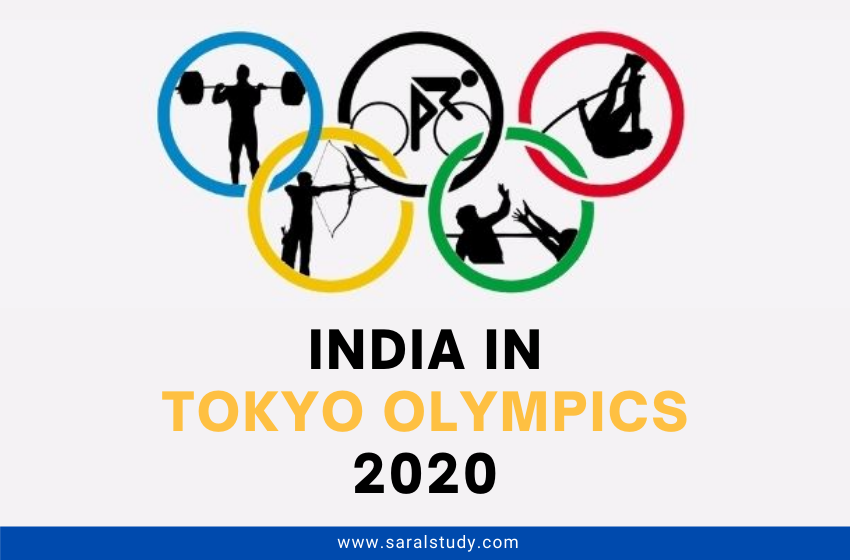
Tokyo Olympic 2020 was originally scheduled for 24th July 2020 to 9th August 2020 but due to COVID 19 pandemic, the games were postponed and rescheduled for 23rd July to 8th August 2020. India participated in Tokyo Olympics, 2021 in Japan.  Since 1920, India has appeared in all the summer Olympics and made its official debut in the 1900 Summer Olympic, Paris. 

India appeared with 124 competitors in the 2020 games, the biggest ever contingent and it proved to be the most successful Olympics till date with India winning 7 medals – 1 Gold, 2 Silver, and 4 Bronze. Indian contingent participated in 69 events and earned medals in 18 athletic fields. 

India in Tokyo Olympic, 2020 – Medals List

Many of the Indian Athletes showed great efforts and performed very well. India has already won Gold, Silver, and Bronze medals. In total India won 7 medals which include 2 silver, three bronze, and 1 gold. Let’s have a look at who won which medal in which discipline-

Tokyo Olympic, 2020 Indian Medals List

Athlete Name Game Event Medal
Neeraj Chopra Athletics Men’s Javelin Throw Gold
Ravi Kumar Dahiya Wrestling Men’s Freestyle 57 kg Silver
Mirabai Chanu Weightlifting Women’s 49 kg Silver
PV Sindhu Badminton Women’s Single Bronze
Indian team Hockey Men’s Tournament Bronze
Lovlina Borgohain Boxing Women’s Welterweight Bronze
Bajrang Punia Wrestling Men’s Freestyle 65 kg Bronze
  1. First Gold Won by India in Tokyo Olympic 2020India’s First medal (Silver) came in weightlifting, won by Mirabai Chanu. 
  2. On the 7th day of the event, Lovlina Borgohain won the second medal (Bronze) for India in Boxing.
  3. PV Sindhu also secured Bronze by defeating Bing Jiao in Women Badminton Singles. 
  4. The fourth medal (Bronze) was secured by the Indian Men’s Hockey team and India’s medal-list counts Hockey reached 12 in Olympic till date. 
  5. The fifth medal (Silver) was won by Ravi Kumar Dahiya in Wrestling 57 kg category. 
  6. Bajrang Punia won the Bronze as the Sixth medal for India in the men’s wrestling 65 kg category. 
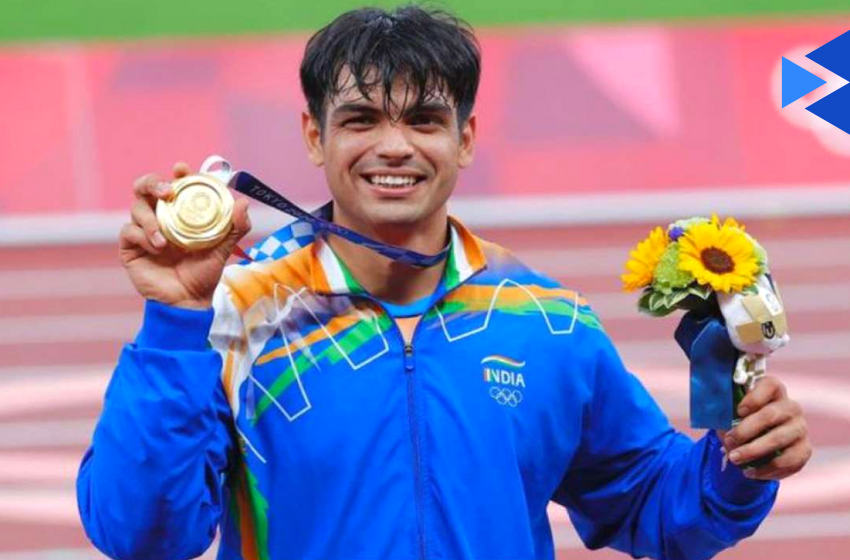
  7. The Seventh and the historic medal was won by Neeraj Chopra (Gold) in the men’s Javelin throw. 

Neeraj Chopra won the first Gold for India in Tokyo Olympic 2020 with a confound throw of 87.58 meters. His Gold medal has increased India’s medal tally to 7 which was 6 in the 2012 London games. 

India in Tokyo Olympic 2020 – Noticeable firsts in terms of participation

This time in Tokyo Olympic 2020, India created several noticeable firsts in terms of participation. Let’s have a look-

  • This happened for the first time in History that Fencer (Bhavani Devi) from India got qualified for the Olympic games. 
  • Bhavani won the first match 15/3 against Nadia Aziz and became the first women fencer to win the match in Olympics. But she lost the game in the second match. 
  • The first-ever female sailor from India (Nethra Kumanan) got qualified for the Olympic games. 
  • Sajan Prakash and Srihari Nataraj were the first Indian swimmers to qualify in Olympic games by accomplishing the “A” qualification standard in swimming.

Backward Classes

Backward Classes

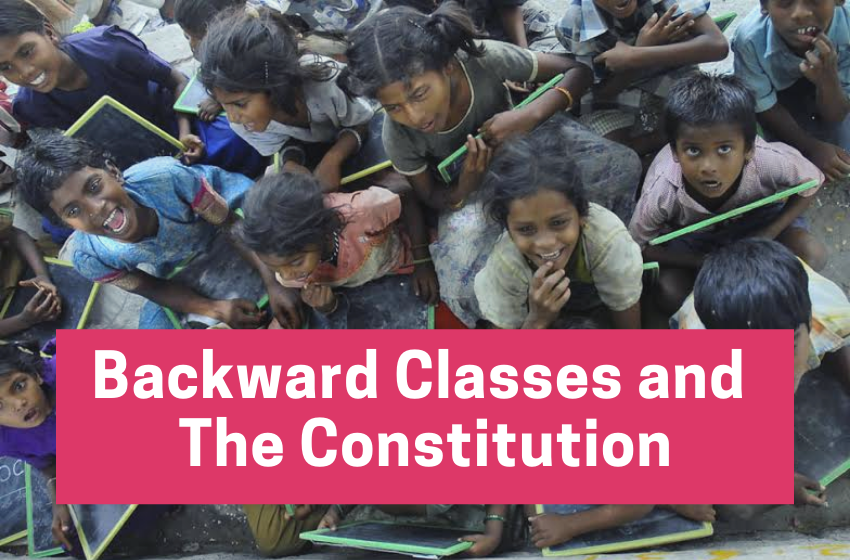
The backward classes do not define by the Constitution of India but the backward classes refer to the stratum of people who are educationally and economically less privileged compared to other classes in the society. However, later on, the President established a commission for the welfare regarding the conditions of the backward classes educationally as well as socially under Article 340 which was authorized to investigate the conditions of backward classes by appointing a commission. Structural standards are maintained to the different relationships between the prevailing group and the subordinate in each society and by providing various forms of disparity to the backward classes, these norms act as structural obstacles.

Backward Class and the Constitution

On 29th January 1953 after the order passed by the president, the first backward class commission was held and established under the chairmanship of Kaka Kalelkar, and later on 30th March 1955, the report of the entire country’s 2,399 backward classes and communities were submitted and prepared a list through which 837 groups had been categorized as the “most backward”.

The final reports of these commissions to determine backwardness are recommended as “caste as the criteria” however, the report was declined by the government due to the fear that the caste and communities excluded from the backward classes may not be considered by the commission. Below are the some most notable recommendation which were made by the Kalelkar commission. Let’s have a look at these commissions:

  1. In the census board of 1961, the commission undertakes caste-wise enumeration of the population.
  2. Treating all women as “backward” as a class.
  3. Relating the social backwardness of a class of the Indian society in the traditional caste hierarchy to its low position.
  4. Provides 70% seats of reservation of the backward class students qualified in all professional and technical institutions.
  5.  Reservation of vacancies of other backward classes in all local bodies as well as government sectors.

Definitional Issues of Backward Classes

There is a list of some definitional issues in terms of backward classes which were raised by the people and the society mentioned below in points.

  • The term ‘backward classes’ originally defined since the colonial times due to the lack of any clear definition parameters with including and excluding the group regarding the collection as backward.
  • The term ‘backward classes’ remains imprecise even at the time of constitutional drafting and debate took place in the matter of its definition.
  • The debates of the Constitutional Assembly in which the ‘backward classes’ term was used in two broad ways: the first usage is the inclusion group needed preferential treatment of all the section of the society and second usage term used was as the “Other Backward Classes”.
  • The category of the ‘backward classes’ was not given such preferences as compared to the categories of the Scheduled Caste (SC) and Scheduled Tribes (ST).
  • The category of the ‘backward classes’ denoted as the unprivileged and marginalized group of people in the society.

Characteristics of the Backward Classes

The backward classes suffer from many disabilities, dishonors, and disadvantages in the society such as social and economic problems, poverty, illiteracy, low status, etc., which they have to inherited as only being born in low tribes or caste. The other group of the society does not accept them due to their lower status whereas the Constitution of India is still silent to define the backward classes in the society.

Structural discrimination faced by the Backward Class People

The structural discrimination faced by the backward classes is explained below in some points:

  • In India, the structural discrimination experienced by the backward people is generally based on ethnic identities, caste, color, gender, and class that has adversely affected the life and health of these people living in society.
  • Being the member of the backward classes, women also face dual discrimination of specific class, culture, or caste group while experiencing gender issues. The women of this class have given less importance and rights and less control over the resources. They can’t even speak up on the important decisions that are related to their life personally. Moreover, the women of this class have got married at an early age and the women’s health gets unfavorably affected by childbearing.
  • The major problem that arises in the backward classes is that the girl child gets married before the age of 18 years which is an officially illegal act done by the backward people as according to the survey conducted in 2002-04 and 2006 as well by the District level Household Survey Department. They highlighted the effects of women’s health by reporting the maternal mortality which is rising higher and trending in India.
  • According to the National Family Survey conducted in the year 2000 reports in the ratio of 540 deaths per 10,000 live births which varies between rural to urban sectors of the society, and the death mostly occurs from avoidable causes happens in the backward region of the society.
  • Dalits are the caste that does not refer to the suggested group of people who are helpless or poor, or in a state of social disability. In India, which is a caste-dominating country. Dalits are referring to those communities whose Human Rights have been dishonored and disrespected sternly. At earlier times, they were used to be called “Untouchables” as they had lower jobs such as sweeper, scavengers, cobblers, etc.

Other Backward Classes (OBC)

OBC is a specific group of community that qualifies as backward on the common basis of a complex set of educational, economical, and social criteria which is specified by the government of India under the National Commission on Backward Classes (NCBC) to ensure its development towards the society, economic and educational welfare such as in India, the government has provided the 27% reservation in the higher education and public sector employment to the OBCs.

Backward Classes – FAQs

Q1. Are the OBC and BC are same?
Ans. The term OBC stands for Other Backward Classes whereas BC stands for the Backward Classes.  But most of the time the OBC is written as simply BC regarding as the short term generally avoiding ‘O’ due to the purpose of short or fast typing of the fact that Backward Classes itself contains all types of classes which are usually backward in society. Therefore, OBC and BC being different in criteria but both are the same thing.

Q2. How many castes are included in the list obtained by the government of India for the BC? Explain.
Ans. According to the member-secretary of the commission, A Krishnamohan there are 74 castes included in the list obtained by the government of India for BC which includes Telaga, Balija, Kapu, and Ontario communities which takes place under the active consideration of the Andhra Pradesh Commission of Backward Classes (APCBC). This commission has also prepared an integrated detailed study manual survey to depicts the economic, social, and educational backwardness of communities state-wise and submitted the list to the government asking the government to conduct the Smart Pulse Survey (SPS) to determining the economic and social communities backwardness in each state of the country as a precursor to declare the backward classes as a part of any caste.

Q3. Who looks after the backward classes and what comes under these classes?
Ans. The Backward Classes Cell (BCC) looks after the affairs of the backward classes in the Ministry of Home Affairs since 1985 and in the year 1985, the separate Ministry of Welfare was created in which the matters were then transferred to the new Ministry of the Scheduled Castes, Scheduled Tribes, Minorities (Backward Classes), and Other Backward Classes. These Ministries look after the planning, implementation, and policy of all the programmes relating to the economic and social welfare of the backward classes people and society.

Q4. What do you mean by NCBC?
Ans. National Commission of Backward Classes (NCBC) is a Constitutional body of India which comes under the Ministry of Social and Justice Empowerment in Article 338B. It consists of 19 members as Chairperson, Vice-Chairperson, 3 Members, Secretary, Administration Wings, Deputy Secretary, Under Secretary, Section Officer, Account Officer, Research Wing, Joint Director, 2 Research Officers, 4 Research Investigators. And the Constitutional provision of the NCBC is the prohibition of discrimination in the matter of caste, color, religion, place of birth, gender, or race and providing inequality in the matters of public employment. The other various work has been performed by the NCBC such as preparing annual reports, commission reports, and tour reports of all the surveys done, organizing commission meetings, etc.

Q5. Name some of the castes which are categorized as the Backward classes by the government of India.
Ans. The list consisting the name of some of the castes categorized as the backward classes by the government of India are shown in the table given below.

S.No. Name of Castes
1. Raigar.
2. Bagria.
3. Ghasi, Ghaiyara or Ghosi.
4. Kahar, Jinwar, or Dinwar.
5. Ghirath including Chang & Bhati.
6. Rachar, Rechara, or Re.
7. Nar.
8.  Kumi.
9. Kanjar or Kanchan.
10. Gwaria, Gauria or Gawar.
11. Daiya.
12. Chirimar.
13. Changar.
14. Beta, Hensi, or Hesi.
15. Barra.
16. Aheria, Aheri, Heri, Naik, Thori or Turi.

Neeraj Chopra – The Gold Man of India

Neeraj Chopra

Neeraj Chopra, The Gold Man of India, The Star of India, etc. Everyone is giving a new name in honour of this Indian Gem who won the first-ever gold for India in the Tokyo Olympics 2020. He made the country proud with his astonishing performance in the javelin throw and secured Gold.  With his astounding javelin throw of 87.58 meters in the finals of the Tokyo Olympics 2020, India’s 100-year wait for Gold has come to an end. 

Now, let’s have a look at the earlier life and the achievements of the Gold man of India. 

Neeraj Chopra Biography

Name Neeraj Chopra
Father’s Name Satish Kumar
Mother’s Name Saroj Devi
Date of Birth 24th December 1997
Birth Place Panipat, Haryana
Village Khandra
Height 178 cm / 6 ft
Weight 86 Kg
Game Javelin Throw

The living legend of India, the Gold Man was born in Panipat, Haryana on 24th December 1997. He is 23 and an Olympic Gold Winner of India. He went to DAV College for his education. He belongs to a Haryanvi agricultural family.

The Gold Man has another identity as Subedar Neerja Chopra in the Indian Army. Neeraj Chopra joined the Army through sports quota at the post of Naib Subedar in 2016. The parent unit he joined was the Rajputana Rifles. He was promoted to Subedar rank and received recognition for his contribution to sports. Neeraj Chopra is a perfect example of Where there is a Will, there is a Way. He made his country and Armed forces proud by creating history in the Tokyo Olympics 2020.

Neeraj Chopra – Career

Below are the career details of Neeraj Chopra.

Early Career

Local children used to tease Neeraj for his obesity. His father enrolled him to the Gym and he used to visit Panipat Sports Authority of India where Jaiveer Chaudhary, a javelin thrower recognised his talent. Neeraj was capable enough to throw 40 meters without any training or practice. Jaiveer became his first coach from there. 

After 1 year, he went to Tau Devi Lal Sports Complex in Panchkula where his coach Naseem Ahmed trained him for long-distance running and javelin throw. Under the training of Naseem Ahmed, he became capable of throwing 68.40-meter javelin and won the 2012 junior nationals in Lucknow. 

In year 2013, he competed at international level in the world youth championship, Ukraine. His first international medal was silver that he won at the youth Olympic qualification, Bangkok. 

In 2014, he achieved his first throw of 70 meters in senior nationals and in year 2015, he made world record in javelin throw in junior category of 81.04 meters in All India Inter-University Athletic Meet 2015. 

Later he received a call from a national level training camp and he left Panchkula to train in NIS Patiala in 2016. In the same year he won he secured Gold in the 2016 South Asian Games where he achieved an astonishing throw of 84.23 meters and equalled the Indian national record. 

Impressed with his performance, he was appointed as NaibSubedar in Rajputana rifles. This post, typically, was not for athletes, who were posted as NCO.  

2017 – 2020 Career

In 2017, Neeraj won Gold in the Asian Athlete Championship 2017 with amazing throw of 85.23 meters. 

In 2018 at commonwealth games in Men’s javelin throw, he registered as season-best effort of 86.47 meters and became one of the few Indian athletes to win Gold in Commonwealth Games. In 2018, he broke the national record of Doha Diamond League with throw of 87.43 meters.  Neeraj made his appearance at the Asian Games representing India and was also the flag-bearer for the Indian contingent during the Asian Games Parade of Nations 2018. Neeraj won gold in the Asian Games 2018 with a throw of 88.06 m and sets a new Indian national record, bettering his own previous record. At the Asian Games, this was India’s first gold medal in javelin’s throw. Neeraj was awarded by Arjuna Award in September 2018. In the same year, he was rewarded by the army with an out-of-turn promotion to Subedar. 

In 2019, Neeraj was suffering from an elbow injury so he underwent surgery on 2 May 2019 in Mumbai. And it is the day after the qualifying competitions for the Olympics Tokyo 2020 had begun. After a period of recuperation, involving rehabilitative and meditation training at IIS Vijayanagar and the Patiala, Neeraj traveled to South Africa in November 2019 for training under German biomechanics expert Klaus Bartoneitz. 

In 2020, Neeraj Chopra won the Athletics Central North West League Meeting in Potchefstroom, South Africa, a throw of 87.86 meters. This distance is over 85 meters which qualified him for the Tokyo Olympiad. After South Africa, Neeraj travelled to Turkey for training but was forced to return to India due to the COVID-19 pandemic. Then Neeraj gave next year’s training at the NIS Patiala. Later, the Athletics Federation of India and the Odisha state government aid the national javelin team by providing a training camp at Kalinga Stadium in Bhubaneswar, which Neeraj attended from December 2020 through February 2021. In 2021, Neeraj again broke his national record with a new amazing throw of 88.07m, ranking him third-best internationally.

Neeraj Chopra in the Olympics 

Neeraj chopra continues his excellence in Olympics games too and became the first Indian to win two Olympics medal in track & field games.

Paris Olympics 2024

Neeraj Chopra won the silver medal in men’s Javelin throw; a track & field game in Paris Olympics 2024. His best throw in Olympics 2024 was of 89.45 meters, which push him on second position to secure a silver medal. He is also the first Indian to win two Olympic medals in track and field games.

Pakistan’s Arshad Naeedm won the gold medal with an Olympic record breaking performance of 92.97 meter throw.

Tokyo Olympics 2020

Neeraj appeared at the Olympics representing India at the 2020 Summer Olympics. He was placed in Group A on 4 August 2021. Neeraj won the gold medal in the final on 7 August with a throw of 87.58 m, becoming the first Indian Olympian to win a gold medal in athletics. It was also the first post-independence Indian Olympic medalist in athletics. Neeraj and his historic victory at the Tokyo Olympics have won everyone’s hearts in the country.

23-year-old Neeraj has become the first Indian in over 120 years, to win an Olympic medal in track-and-field games. The first Olympic track and field medal was won by Norman Pritchard in the 1900 Paris Olympics in 200 meters and 200 meters hurdles event. Thus Neeraj became only the second Olympic track and field medalist for India. He is the youngest Olympic gold medalist in the country. He is the first Javelin thrower Olympic Gold medalist of India. Neeraj dedicated his win to sprinters P. T. Usha and Milkha Singh both former Olympians from India.

Awards and Recognition

National awards and decorations

  • In 2018 – Arjuna Award 
  • In 2020 Republic Day honors – Vishisht Seva Medal (VSM) 

Rewards announced by various organizations for winning the gold medal at the Olympics Tokyo 2020

  • From the Government of India – ₹75 lakh
  • From the Government of Haryana, a Class-I state government appointment, and a plot of land for an athletics center – ₹6 crores
  • From BYJU’S – ₹2 crores
  • From the Government of Punjab – ₹2 crores
  • From the Government of Manipur – ₹1 crore
  • From Chennai Super Kings and a personalized jersey – ₹1 crore
  • From the Board of Control for Cricket in India – ₹1 crore
  • From the Elan realty group Gurugram – ₹25 lakh
  • From the Indian Olympic Association – ₹75 lakh

Neeraj Chopra’s Tweets

“The javelin, runway, track is where most of my life has been spent,” he said. “To us it’s like a god. I wanted to give my thanks.”

“I was thinking that I will break the record again here,” Chopra said, the Olympic gold around his neck. “Throw my personal best, but that did not happen. But there will be time for that, right now the Olympic gold is better. I almost cried on the podium, but then no tears came. But it was like a current was going through me.”

Here’s what others are saying. Have a look.

Klaus Bartonietz, the coach of Neeraj Chopra, said he felt “overwhelming joy” after Neeraj became the “best javelin thrower in the world”.

Prime Minister Narendra Modi tweeted, “History has been scripted at Tokyo! What Neeraj Chopra has achieved today will be remembered forever. The young Neeraj has done exceptionally well. He played with remarkable passion and showed unparalleled grit. Congratulations to him for winning the Gold.”

Also Read: The Olympic Games: History, Significance, Achievements, and Disputes

Vedic Maths Tricks

Vedic Maths Tricks

Vedic Maths has gained a lot of popularity in some of the last years because of its fast and accurate calculations. Calculation is a crucial part of every profession nowadays, and people with fast calculation abilities seems to have special skill, as not everybody has this ability to calculate fast and accurate. Everybody wants to have this skill as it makes people look smarter.

Vedic maths as the name suggests is based on the knowledge gained from our Vedas but not everybody was able to gain the knowledge that has been given our prestigious Vedas as the ancient language is not everybody’s cup of tea. So to make it more simple for common people Swami Bharti Krishna Tirtha Ji Maharaj, who is the Shankaracharya of  Govardhan Peeth, Puri, has given six sutras over which Vedic maths has been set up and it becomes simple for common people to understand it without putting endless efforts.

Now when we say that the information has been taken from Vedas, the question here is which Veda? The answer is “the Atharvaveda”.

Atharvaveda is said to have extreme knowledge of science and mathematics which people are discovering today, but it has been in our Vedas since ancient time. So the Swami Bharti Ji has decoded the information for all of us, compressed it into 16 sutras and presented it for us.

16 Principles (Sutras) of Vedic Mathematic and Sub-Sutra

The main sutras and sub-sutra of Vedic maths are:

Name / Sutra Corollary / Sub-Sutra Meaning
Ekadhikena Purvena (एकाधिकेन पूर्वेण) Anurupyena By one more than the previous one.
Nikhilam Navatashcaraman Dashatah (निखिलं नवतश्मचरमं दशतः) Sisyata Sesasamjnah All from 9The last from 10
Urdhava – Tiryagbyham (ऊर्ध्वतिर्यग्भ्याम्) Adyamadyenantyamantyena Vertically and crosswise.
Paravartaya Yojayet (परावर्त्य योजयेत्) Kevailash Saptakam Gunyat Transpose and adjust.
Shunyam Saamyasamuccaye (शून्यं साम्यसमुच्चये) Vestanam When the sum is the same that sum is zero.
Anurupye Shunyamanyat (आनुरुप्ये शून्यमन्यत्) Shunuya Anayat If one is the ratio, the other is zero.
Sankalana- Vyavakalanabhyam (संकलन व्यवकलनाभ्यां) Yavadunam Tavadunikritiya Varga Yojayet By addition and subtraction.
Purana Puranabyham (पूरणापूरणाभ्यां) Antyayordashakepi By the completion.
Chalana – Kalanabyham (चलनकलनाभ्याम्) Antyayoreva Similarities and differences.
Yavadunam (यावदूनम्) Samuccayagunitah The extent of its deficiency.
Vyashtisamasthi (व्यष्टिसमष्टिः) Lopanasthapanabhyam Part and whole.
Shesanyankena Charamena (शेषाण्यङ्केन चरमेण) Vilokanam Remainder by the last digit.
Sopaantyadyamantyam (सोपान्त्यद्वयमन्त्यम्) Gunitasamuccayah The ultimate and penultimate.
Ekanyunena Purvena (एकन्यूनेन पूर्वेण) Dhyajanka By one less than the previous one.
Gunitasamuchyah (गुणितसमुच्चयः) Dwandwa Yoga The product of some is equal to the sum of the product.
Gunakasamuchyah (गुणकसमुच्चयः) Adyam Antyam Madhyam The factors of the sum is equal to the sum of the factors.

Example of Vedic Maths Sutras

Below are the 16 Vedic Maths Sutras example:

Sutra 1: Ekadhikina Purvena

(One is more than the previous one)

This Sutra is very useful and helps in finding the products of the numbers, if the unit digit’s sum of the two numbers totals to 10.

For example; 

 24 x 26 =?
= (first digit x one more than first digit) (product of unit digits of both the number)
= ( 2 x 3 ) ( 4 x 6)
= 624

So, 24 x 26 = 624. 

You see the answer above has come without doing any elaborate calculation.

Sutra 2: Nikhilam Navatashcaramam Dashatah

(All from 9 last from 10)

This Sutra is commonly used to subtract the numbers from the power of 10.

For example;
 10000 – 7688 = 2312

Now if we analyse this situation, the last number is 8 and it is subtracted from 10 and the next 8 is subtracted from 9, whereas all other numbers are subtracted by 9 and the result comes out almost orally.

Sutra 3: Urdhva-Tiryagbyham

(Vertically and crosswise)

This sutra is used For multiplication.

Formula used for this sutra is ab × cd =(ac) (ad + bc) (bd) 

The example is given below:

24 x 12
= (2 x 1) (2 x 2 + 4 x 1) (4 x 2 )
= 288

And the answer is 288.

You can see how simple multiplication can become using this sutra.

Sutra 4: Parvaartya Yojayet

(Transpose and adjust)

This sutra is used for division, when the divisor is greater than the power nearest to 10.

Let us see an example using 434\12

The very first thing that we need to see is that the number 12 which is divisor is greater than 10, in that case this sutra can be applied easily. Next we need to check is that how many digits are there in a divisor, this one has two digits so the dividend needs to split into two, 43 and 4, other process is given below;

As shown above, the divisor is written and leaving 1 apart, 2 is taken down as 2 bar, i.e. vinculum 2. The dividend is divided into two parts 43 and 4. 4 of 43 is taken down and to this four, the vinculum 2 is multiplied to get vinculum 8 which is written under 3 of 43. 3 vinculum 8 would be vinculum 5 which is taken down. Vinculum 2 of the divisor is multiplied with this vinculum 5 and the result 10 is written under 4 and totalled to 14.

14 is taken down as it is. Now 45 is a vinculum number because 5 is vinculum. According to Vedic maths rules vinculum, 5 is complemented with 10 to get normal 5 which is taken down. The number next to the vinculum number should be reduced by 1. So, 4 becomes 3 and comes down

And the answer is quotient =35 and remainder = 14 when 434/12.

Sutra 5: Shunyam Saamyasamuuaye

(When the sum is the same the sum is zero)

This sutra is used to solve equations in the forms given below:

ax + b = cx + d
So, x = d – b/a – c
(x+a)(x+b) =(x+c)(x+d)

So, x = cd-ab/a+b-c-d

Some applications

A term which occurs as a common factor in all the terms is equated to zero e.g. : 14x + 9x = 4x + 12x. Here x occurs as a common factor with all terms and hence the value of x according to this sutra is zero.

If the product of the independent term on either side of the equation is equal the value of the variable will be zero, which is the second interpretation of this sutra.

E.g.
(x +8) (x+3) = (x + 12 ) (x + 2 )
8 x 3 = 24 = 12 x 2 and hence value of x in this equation would be 0 

Sutra 6 : Anurupyena-Sunyamanyat

(If one is in ratio, the other is zero) 

This sutra is also used to solve equations. 

Suppose:

2x + 4y = 8
And
4x + 6y = 16, 

The ratio of terms with x = 2x/4x = ½
The ratio of the R.H.S term is also 8/16 = ½
Therefore, the other variable, in this case y = 0

Substituting this value of y in any other of the two equations, we can get value of x

2x + 4(0)=8
2x = 8

Therefore x= 8/4 = 2.

Sutra 7: Sankalana-Vayavakalanabyham

(By addition and by subtraction) 

This sutra is used to solve equations but with a condition and the condition is that if the coefficient of 1 variable is same in both the equations,  irrespective of the signs being used.

Wait, no need to get confused, what it means is that the coefficient of 1 variable in 1st equation should be equal to the 2 variable in 2nd equation and in the same way the coefficient of 2nd variable in first equation should be equal to the 1st variable in second equation. If the condition matches, the equations can be easily added and subtracted.

For example;

4x + 2y = 6………… equation 1 and
2x + 4y = 7 ………….equation 2. 

Now add equation 1 and 2 we get

6x + 6y = 13 or
6 (x + y) = 13 or

X + y = 13/7…………we get equation 3.

Subtract equation 2 for equation 1

2x -2y = -1
2 (x -y ) = -1 or 

X – y = – 1 / 2 …… we get equation 4…….therefore
Y = x + 1 / 2…………equation 5 substitute this in equation 3. 

So we get

X + (x + ½) = 13/7… solving for x, we get
X = 19/7 = 2.71…….

And y = x + 0.5….. from equation 5

So, y = 2.71 +0.5= 3.21

Sutra 8: Purana Purana Byham

(By the completion or non-completion) 

This sutra can be used to solve problems of addition but with a condition, which is; when the unit digits of the numbers add up to 10.

For example;

Numbers 22 and 18 the unit digits add up to 10.

Let try to add 295 + 46 + 28 + 15 + 44 + 22 =?

Now we need to check and number and pair them in such a way that their unit places add up to 10. So….

295 + 46 + 28 + 15 + 44 + 22 =?

Rearrange to put the paired number together.

(295 + 15) + (46 + 44) + (28 + 22)
300 + 90 + 50 = 440.

This happened in easy steps instead of long calculations.

Sutra 9: Chalana kalanabyham

(difference and similarities)

The application of this sutra can be found in calculus to find roots of a quadratic equation and the another application is in differential calculus for factorizing 3rd, 4th, and 5th degrees expression. This sutra finds very specialized applications in the area of higher mathematics.

Sutra 10: Yavadunam

(Whatever the extent of its deficiency) 

This sutra is used to find squares of numbers that are close to the powers of base 10. 

You need to compare the number with the closed base to the number and find the deficiency or excess. After which you need to square the difference of numbers and this is one part of the answer after which you reduce the given number or increase the same by the difference the number has to the power of base 10.

Let us understand this with an example;

Let us try to find the square of 12

12 is near to 10 and it is 2 excess than 10.

  1. Square the difference (excess in this case). So 2 x2 = 4….this is the unit place
  2. Now add the excess to the number. The number is 12 so 12 + 2 = 14…this is the left part of the answer
  3. Combining both of them we get = 144
  4. Solving it in equation form
  5. 122 = (12 + 2) ( 2)2 = 144

Sutra 11: Vyashtisamanstih

(Part and whole)

This sutra helps in the factorization of quadratic equations.

Sutra 12: Shesanyankena charamena

(The remainders by the last digit) 

This sutra gives you the process of converting fractions to decimals.

For example; 1/29 

  1. The last digit of the divisor should be 9. It is in this case, now increase the value by 1 of the number next to 9. So, the number is 2 and increasing it by 1 makes it 3
  2. The dividend is 1 now it has to be divided by 3 so,
  3. 1 / 3
  4. Doing it mentally it will be 0.0 and remainder 1 and it is written as
  5. 0.10 and 10 is divided by 3 and it will be written as 3 and remainder 1 written to left
  6. 0.1 01 3 now 13 is to be divided by 3 and it will be written as 4 and remainder 1 written to left
  7. 0.101314 and keep on dividing it by 3 to as many decimal places as needed. For three decimal places the answer is 0.034

Sutra 13: Sopaantyadvayamantyam

(The ultimate and twice the penultimate.)

This sutra is used to find solution of equations in the following form

1/ ab + 1/ac = 1/ad + 1/bc

Where a, b, c and d are in arithmetic progression

B= a + z
C = a + 2z
D = a + 3z

Solution for such equations is 2c + d = 0

1. g.

1/ (x+1)(x+2) + 1/ (x +1)(x+3) = 1/ (x+1)(x + 4) + 1/ (x+2)(x +3)

Now according to the above sutra the solution would be

2(x +3) + (x+4) = 0
2x + 6 + x + 4 = 0
3x + 10 = 0
X = -10/3

Sutra 14: Ekanyunena Purvena

(By one less than the previous.)

Multiplication problems can be solved using this sutra.

The product of two number can be calculated using this sutra when the multiplier consists of only 9

For example;

12 x 99 = ?

The process to do it is

  1. Reduce 1 from multiplicand i.e. 12-1=11
  2. The other part of the answer would be 99-11 = 88 (complement of 99)

Hence the answer is 1188

Sutra 15: Gunita Samuchaya

(The product of the sum is equal to the sum of the product) 

This sutra is useful to find the correctness and accuracy of the answers in factorization problems and it states that the sum of the coefficients in the product is equal to the sum of coefficients of the factors and if this condition is satisfied then the equation can be considered to be balanced.

For example; 

let us consider a quadratic equation

8×2 + 11x + 3 = (x+1)(8x+3)

In this case, the sum of coefficients is 8+11+3=22

Product of the sum of coefficients of the factors =2 (8+3)= 2 x 11 = 22

Since both, the totals tally the equation is balanced and correct.

Sutra 16: Gunakasamuchya

(The factor of the sum is equal to the sum of the factors.)

This sutra holds good for a perfect number.

Let us find the factors of number 28,

1 x 28= 28
2 x 14 = 28
4 x 7 = 28

So, in this case, the sum of factors is 1+2+4+7+14 = 28

The sum of factors equals the factor of the sums, so 28 is said to be a perfect number.

Frequently Asked Questions

Q1. How is Vedic Mathematics useful?
Ans. Vedic mathematics helps in making one’s calculation more accurate and also helps in speeding up one’s calculation abilities. Having this skill in oneself can automatically boost up the confidence and one do not have to run from the situations where there is any kind of calculation required. 

Q2. Is Vedic Mathematics a part of our education curriculum?
Ans. Vedic Mathematics is not officially included in our education curriculum, but students opt Vedic m mathematics to prepare for certain competitive exams like SSC, RRB, UPSC, IBPS, etc. Because during these examinations students need to have fast calculation skills as there is a limited time for competitive exams and questions are more.

CBSE Board Exams Update: Major Changes for Class 10, 12 Board Exams 2021-22

CBSE Special Assessment Scheme

All heads who are affiliated with the CBSE: Special Scheme of Assessment for Board Examinations Classes 10 and 12 for the Session of 2021-22. Because of COVID 19, most of the schools had to operate virtually in the session of 2020-21. There was a great risk on the well-being of students had CBSE decided to conduct a Board examination while the second wave was at its peak in April 2021, so it decided to cancel the board examinations of both Class 10 and Class 12. The results that are to be declared will be based on the true, dependable, and trustworthy assessment of a different policy. This unyielding situation has also called for a way in which it can be decided how to conduct Board examinations of the next batch i.e. 2021-22 if the situation remains the same.

Consultations were held by CBSE with the other private schools across the country, especially those which are situated in rural areas. During the consultations, most of the schools have demanded that a similar syllabus be prepared like the one that was released last year to complement the reduced amount of time that is permitted for conducting online classes. The Board is also concerned about the accessibility of electronic gadgets and the requirements that need to be fulfilled by the students, especially the ones belonging to the weaker sections of society. The Board also has concerns about the availability of connections and the productivity of online teaching.

There was a survey conducted by CBSE in which it was reported that the syllabus that was prepared for the session 2020-21 turned out to be fruitful for schools to ensure that the curriculum was duly covered and the students had little to no stress in understanding and retaining it. The Board has continued to focus on the assessment of the survey given above and decided to create examinations based on the current scenario that will not disregard the students’ problems and will be honest and valuable.

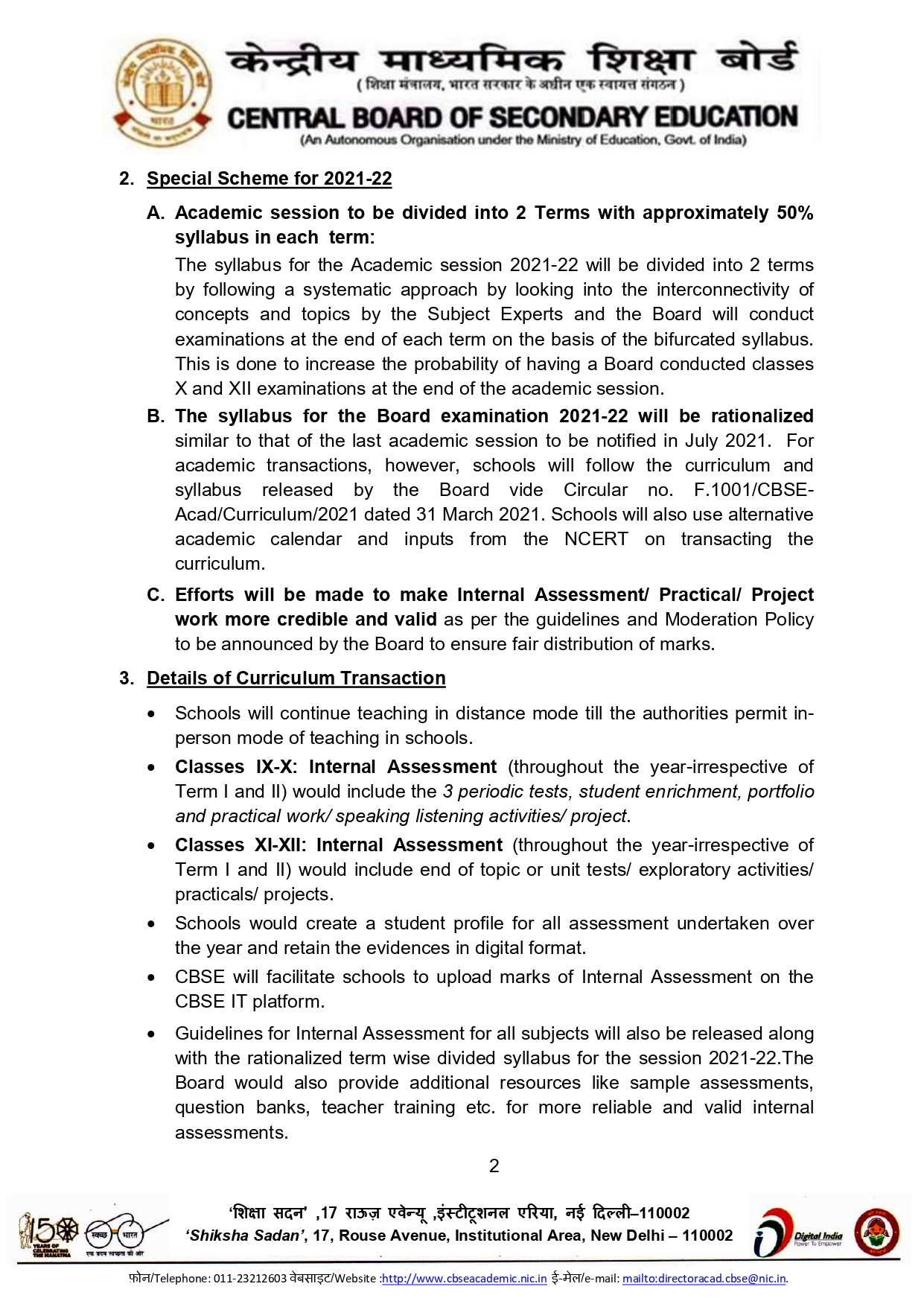
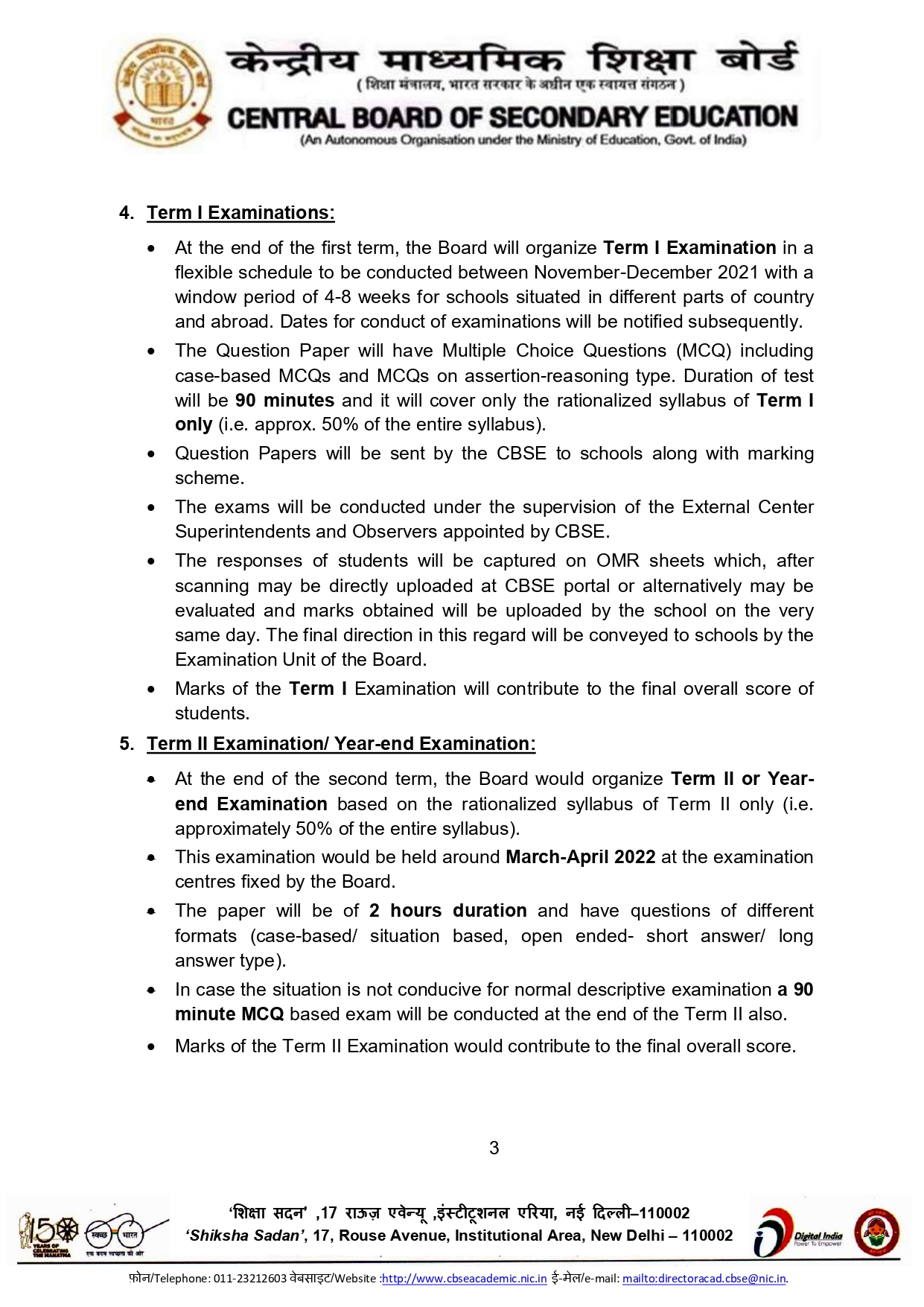
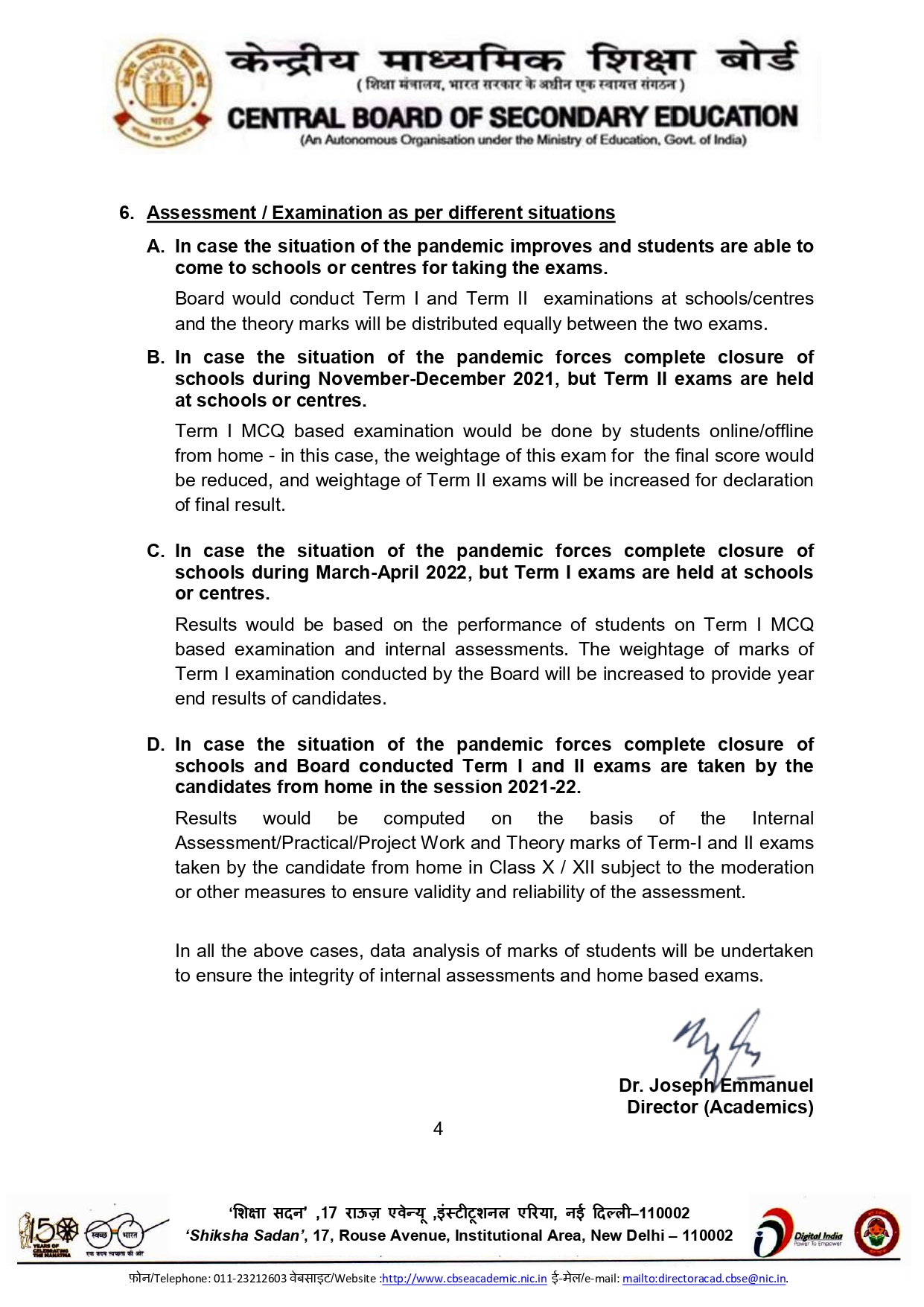
CBSE Special Scheme for the Academic Session 2021-22

The academic session 2021-22 will be divided into 2 Terms with some 50% syllabus in every term. This will be done following a scientific approach by wanting into the interconnectivity of ideas and topics by the subject specialists and the Board will conduct examinations at the end of every term on the idea of the divided syllabus, CBSE sophisticated. This is being done to increase the chance of getting a Board conducted class 10 and 12 examinations at the end of the educational session.

CBSE Special Scheme_page-0001

CBSE Special Scheme_page-0002

CBSE Special Scheme_page-0003

Check out our study material for Class 10 & 12 Board Exams:

CBSE Board Class 10 Study Materials
NCERT Solutions for Class 10 NCERT Books for Class 10
NCERT Exemplar for Class 10 CBSE Sample Paper for Class 10


CBSE Board Class 12 Study Materials
NCERT Solutions for Class 12 NCERT Books for Class 12
NCERT Exemplar for Class 12 CBSE Sample Paper for Class 12

Backward Classes Welfare Department

backward classes welfare department

The Backward Classes Welfare Department, a department under the government is serving towards sustainable development of the people who belong to the SC, ST, and Other Backward Classes of different states of India. The Department’s main aim is to improve the quality of life of these socially and economically backward classes and enhance the capability of the people belonging to these communities so that they can be very much part & parcel of the mainstream of society.

Backward Classes Welfare Department – Functions

The main function of backward classes are:

  1. Reinforce infrastructure and creation of community assets for integrated development of the backward classes.
  2. Progression and implementation of educational schemes including training for improvement of skills in them.
  3. Granting caste certificates and implementation of reservation rules in services, posts, and educational institutions.
  4. Execution of schemes including income generation schemes for financial upliftment.
  5. Cultural and social development of the backward classes.

Constitutional Provisions

  • Provisions associating to Socially & Educationally Backward Classes (OBCs).
  • Provisions associating to Persons with Disability and the Old.
  • Provisions associating to Prevention of Substance Abuse.
  • Some General Provisions.
  • Twelfth Schedule.
  • Eleventh Schedule.
  • Seventh Schedule.
  • Provisions associated with Social Justice and Empowerment.
  • Provisions relating to SCs.

Let’s discuss these provisions below.

[irp posts=”589″ name=”Board Exams All More Tactical Preparations”]

1. Provisions associating to socially & Educationally Backward Classes (OBCs)

The Constitution (One Hundred and Second Amendment) Act, 2018, introduced Article 338B which gives for a Commission for the socially and educationally backward classes to be recognized as the National Commission for Backward Classes. 

2. Provisions associating to Persons with Disability and the Old 

The Persons with Disabilities (Protection of Rights, Equal Opportunities,  and Full Participation) Act, 1995 had come into implementation on February 7, 1996. It is a vital step that assures equal opportunities for the people with disabilities and their full participation in nation-building. The Act provisions for both the preventive and promotional features of rehabilitation like vocational training, research, education, reservation, and employment, and manpower development,  rehabilitation of persons with disability, unemployment allowance for the disabled, special insurance scheme for the disabled employees, creation of a barrier-free environment,  and establishment of homes for persons with severe disability, etc.

3. Provisions associating to Prevention of Substance Abuse 

The Scheme of Assistance for the Prevention of Substance Abuse is being implemented for identification, counseling, treatment, and rehabilitation of addicts through voluntary and other eligible organizations.

4. Some General Provisions

The State shall not favor against any citizen only of sex, religion, place of birth, race, caste, or any of them.

No citizen shall, on spots only of sex, religion, place of birth,  race, caste, or any of them, be subject to any disability, liability, restriction, or condition about the access to shops, hotels, public restaurants, and places of public entertainment or the use of wells, roads, bathing ghats,  tanks, and places of public resort controlled wholly or partly out of State funds or applied to the use of the general public. 

5. Twelfth Schedule

The twelfth Schedule includes the following:

  • Safeguarding the benefits of weaker sections of society, including the mentally retarded and handicapped.
  • Slum improvement and up-gradation.
  • Solid waste management, public health, sanitation, and conservancy.
  • Urban poverty alleviation.

6. Eleventh Schedule

  • Education, including primary and secondary schools.
  • Technical training and vocational education.
  • Adult and non-formal education.
  • Health and sanitation, including primary health centers, hospitals, and dispensaries.
  • Family welfare.
  • Women and child development.
  • Welfare of the weaker sections, and in specific Scheduled
  • Social welfare including the well-being of the mentally retarded and handicapped 
  • Castes and the Scheduled Tribes.
  • Public distribution system.

7. Seventh Schedule

The list I – Union List

  • Manufacture, cultivation, and sale for export, of opium.
  • Any other matter not defined in List II or List III including any tax not defined in either of those Lists.

List II – State List

  • Intoxicating liquors, the production, purchase, production, possession, transport, and sale of intoxicating liquors.
  • Relief of the disabled and unemployable.

List III – Concurrent List

  • Vagrancy, nomadic and migratory tribes.
  • Lunacy and mental deficiency, including places for the treatment of lunatics and mentally deficient.
  • Drugs and poisons, directed to the provisions of entry 59 of List I concerning drugs.
  • Economic and social planning.
  • Social insurance and social security unemployment, and employment.

8. Provisions associated with Social Justice and Empowerment, as a whole

Prohibition of violated labor and traffic in human beings

  • Traffic in human beings and other alike forms of forced labor are banned and any violation of this provision shall be an offense punishable by the law.
  • The state shall not make any prejudice on grounds only of religion, race, caste or class, or any of them.

Prohibition of employment of children

  • Under the age of 14 years, no child shall be employed to work in any factory 

9. Provisions relating to SCs

Special Provisions relating to certain classes

The President may involve any State or Union Territory, and where it is a State, after discussion with the Governor thereof, by public notification, specify the castes, races or tribes or parts of or groups in castes, races or tribes which shall for this Constitution be deemed to be Scheduled Castes about that State or Union Territory, as the case may be.

Parliament may by law exclude from the list of Scheduled

Castes specified in a notification declared under clause (1) any caste, tribe or part of or group within any caste, race or tribe, but save as previous a notification announced under the said clause shall not be altered by any following notification

Summing It Up!

The Backward Classes Welfare Department serves for the cultural, financial, and social welfare of the person who belongs to Scheduled Castes (SC) and Other Backward Class (OBC) in the State. It is important to look after the welfare of the most underprivileged sections of the society specifically the Schedule Tribes, Scheduled Castes, Backward Classes and Minorities, and the responsibility of leading all-round development of these sections. It intends the effort of the state to continue the plans and programs with greater emphasis so that the Scheduled Tribes, the Scheduled Castes, the Backward Castes, and Minorities could reap the benefit of the programs.

[irp posts=”906″ name=”CBSE Exams Result 2020: CBSE 12th result will come before 10th”]

Frequently Asked Questions

Q1. What is meant by backward classes?
Ans. Backward classes who are economically and socially deprived and face or may have faced discrimination on account of the birth. They typically include the flats the scheduled castes. 

Q2. Who comes under the backward class?
Ans. Backward Classes are those classes of citizens other than the Scheduled Castes and Scheduled Tribes as may be defined by the Central Government in the lists prepared by the Government of India from time to time for plans of making provision for the reservation.

Q3. What is the most backward class?
Ans. Communities that were found to be as disadvantaged as the SCs but could not be declared as Scheduled Castes (SCs), because of the non-existence of untouchability factor were classified as Most Backward Classes (MBCs).

Q4. What is backward class A and B?
Ans. The OBC quota is classified into two categories. Backward Classes (A) category, including a majority of groups under the state OBC list, is granted 80% reservation, while Backward Classes (B) category, with dominant groups like Lingayats, Vokkaligas, and Bunts, is granted the balance 20% reservation.

Q5. What are the problems of backward classes in education?
Ans. Depend on some elements of backwardness such as illiteracy and lack of education poverty, exploitation of labor, non-representation in services, and untouchability, Scheduled Castes and Scheduled Tribes are listed in the Constitution while the third group i.e. Other Backward Class is unlisted.

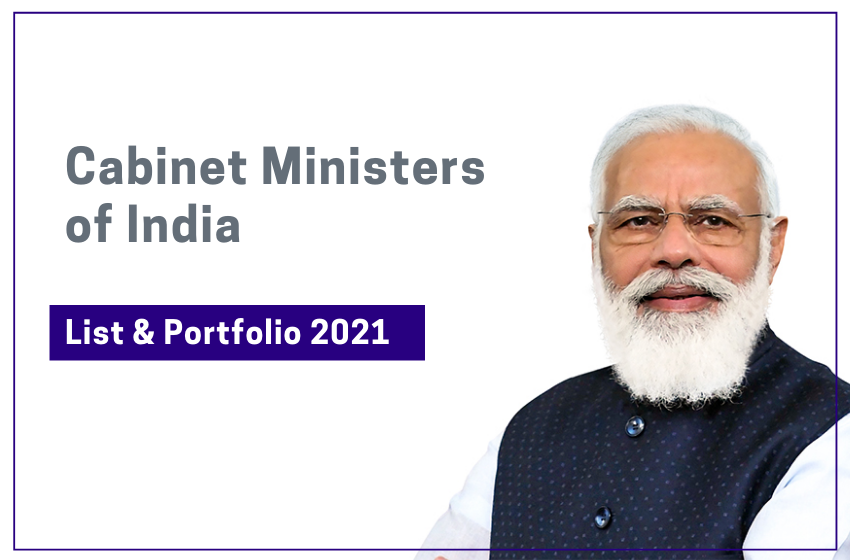
Cabinet Ministers of India – List and Portfolio

List of Cabinet Ministers of India

The head of the Republic of India is the Prime Minister who has the responsibility of governance in the country. Managing such a big country is not an easy task for a single person, so, many ministries are managing the sectors of public administration. The Prime Minister appoints the ministers for every ministry. The ministers responsible for key portfolios are the cabinet ministers or in other words, the cabinet is the team of high-ranking government officials mainly consisting of top leaders of the executive branch. The members of the cabinet are called as cabinet members. The cabinet ministers of a government are mainly responsible for the day-to-day government tasks and management. It is the supreme decision-making body in India.

Roles of Cabinet Ministers

The main roles of cabinet ministers of India are:

  1. The main role of the cabinet is to keep the confidence of the parliament house.
  2. The cabinet ministers are responsible for the schemes and policies of both houses (Rajya Sabha and Lok Sabha).
  3. Directing government policy and making decisions based on national issues.
  4. Utilizing their majority work hours in discussing the problems of the country and ways to resolve it.
  5. Presenting bills and proposing laws from their government departments.

Selection of Cabinet Ministers

Cabinet ministers are officially appointed by the president of India but selected by the Prime Minister. The portfolios are distributed among the ministers based on competence and interest. Apart from competence and interest, the Selection of a minister also depends on the loyalty of the minister with the ruling party and the implicit need for representing the major part of the country’s population. For example, based on caste, religion, language, etc.

The selected minister must be a member of any of the houses of the parliament of India.

List of Cabinet Ministers of India and their Portfolios

Below are the list of cabinet ministers of India and their portfolios:

Prime Minister Portfolio
Shri Narendra Modi
  • Ministry of Personnel, Public Grievances and Pensions,
  • Department of Atomic Energy,
  • Department of Space,
  • All important policy issues, and other portfolios not allocated to any Minister

Cabinet Ministers of India

S.No. Cabinet Ministers Portfolios
1 Shri Rajnath Singh
  • Minister of Defence
2 Shri Amit Shah
  • Minister of Home Affairs
  • Minister of Cooperation
3 Shri Nitin Jairam Gadkari
  • Minister of Road Transport and Highways
4 Shri Nirmala Sitaraman
  • Minister of Finance
  • Minister of Corporate Affairs
5 Shri Narendra Singh Tomar
  • Minister of Agriculture and Farmer Welfare
6 Shri S Jaishankar
  • Minister of External Affairs
7 Shri Arjun Munda
  • Minister of Tribal Affairs
8 Smt. Smriti Zubin Irani
  • Minister of Women and Child Development
9 Shri Piyush Goyal
  • Minister of Commerce and Industry
  • Minister of Consumer Affairs, Food and Public Distribution
  • Minister of Textiles
10 Shri Dharmendra Pradhan
  • Minister of Education
  • Minister of Skill Development Entrepreneurship
11 Shri Pralhad Joshi
  • Minister of Parliamentary Affairs
  • Minister of Coal
  • Minister of Mines
12 Shri Narayan Tatu Rane
  • Minister of Micro, Small and Medium Enterprises
13 Shri Sarbananda Sonowal
  • Minister of Ports, Shipping and Waterways
  • Minister of AYUSH
14 Shri Mukhtar Abbas Naqvi
  • Minister of Minority Affairs
15 Dr. Virendra Kumar
  • Minister of Social Justice and Empowerment
16 Shri Giriraj Singh
  • Minister of Rural Development of Panchayati
17 Shri Jyotiraditya M Scindia
  • Minister of Civil Aviation
18 Shri Ramchandra Prasad Singh
  • Minister of Steel
19 Shri Ashwini Vaishnaw
  • Minister of Railways
  • Minister of Communication
  • Minister of Electronics and Information Technology
20 Shri Pashu Pati Kumar Paras
  • Minister of Food Processing Industries
21 Shri Gajendra Singh Shekhawat
  • Minister of Jal Shakti
22 Shri Kiren Rijiju
  • Minister of Law and Justice
23 Shri Raj Kumar Singh
  • Minister of New and Renewable Energy
24 Shri Hardeep Sing Puri
  • Minister of Petroleum and Natural Gas
  • Minister of Housing and Urban Affairs
25 Shri Mansukh Mandaviya
  • Minister of Health and Family Welfare
  • Minister of Chemical and Fertilizers
26 Shri Bhupender Yadav
  • Minister of Environment, Forest and Climate Change
  • Minister of Labour and Employment
27 Dr. Mahendra Nath Pandey
  • Minister of Heavy Industries
28 Shri Parshottam Rupala
  • Minister of Fisheries, Animal Husbandry and Dairying
29 Shri G Kishan Reddy
  • Minister of Culture
  • Minister of Tourism
  • Minister of Development of North Eastern Region
30 Shri Anurag Singh Thakur
  • Minister of Information and Broadcasting
  • Minister of Youth Affairs and Sports

Ministers of State (Independent Charge)

S.No. Ministers of State
(Independent Charge)
Portfolios
1 Shri Rao Inderjit Singh
  • Ministry of Statics and Programme Implementation
  • Ministry of Planning
  • Ministry of Corporate Affairs
2 Dr. Jitendra Singh
  • Ministry of Science and Technology
  • Ministry of Earth Sciences
  • Prime Ministers Office
  • Ministry of Personnel, Public Grievances and Pensions
  • Department of Atomic Energy
  • Department of Space

Ministers of State

S.No. Ministers of State Portfolios
1 Shri Shripad Yesso Naik
  • MoS Ministry of Ports, Shipping and Waterways
  • MoS Ministry of Tourism
2 Shri Faggansingh Kulaste
  • MoS Ministry of Steel
  • MoS Ministry of Rural Development
3 Shri Prahlad Singh Patel
  • MoS Ministry of Jal Shakti
  • MoS Ministry of Food Processing Industries
4 Shri Ashwini Kumar Choubey
  • MoS Ministry of Consumer Affairs, Food and Public Distribution
  • MoS Ministry of Environment, Forest and Climate Change
5 Shri Arjun Ram Meghwal
  • MoS Ministry of Parliamentary Affairs
  • MoS Ministry of Culture
6 Gen (Retd.) VK Singh
  • MoS Road Transport and Highways
  • MoS Ministry of Civil Aviation
7 Shri Krishan Pal
  • MoS Ministry of Power
  • MoS Ministry of Heavy Industries
8 Shri Danve Raosaheb Dadarao
  • MoS Ministry of Railways
  • MoS Ministry of Coal
  • MoS Ministry of Mines
9 Shri Ramdas Athawale
  • MoS Ministry of Social Justice and Empowerment
10 Sadhvi Niranjan Jyoti
  • MoS Consumer Affairs, Food and Public Distribution
  • MoS Ministry of Rural Development
11 Shri Sanjeev Kumar Balyan
  • MoS Ministry of Fisheries, Animal Husbandry and Dairying
12 Shri Nityanand Rai
  • MoS for Home Affairs
13 Shri Pankaj Chaowdhary
  • MoS for Finance
14 Smt. Anupriya Singh Patel
  • MoS Ministry of Commerce and Industry
15 Prof SP Singh Baghel
  • MoS Ministry of Law and Justice
16 Shri Rajeev Chandrasekhar
  • MoS Ministry of Skill Development and Entrepreneurship
  • MoS Ministry of Electronics and Information Technology
17 Smt. Shobha Karandlaje
  • MoS Ministry of Agriculture and Farmers Welfare
18 Sadhvi Niranjan JyotiBhanu Pratap Singh Verma
  • MoS Ministry of Micro, Small and Medium Enterprises
19 Smt. Darshana Vikram Jardosh
  • MoS Ministry of Textiles
  • MoS Ministry of Railways
20 Shri V. Muraleedharan
  • MoS External Affairs
  • Ministry of Parliamentary Affairs
21 Smt. Meenakashi Lekhi
  • MoS Ministry of External Affairs
  • MoS Ministry of Culture
22 Shri Som Parkash
  • MoS Ministry of Commerce and Industry
23 Smt. Renuka Singh Saruta
  • MoS Ministry of Tribal Affairs
24 Shri Rameswar Teli
  • MoS Ministry of Petroleum and Natural Gas
  • MoS Ministry of Labour and Employment
25 Shri Kailash Choudhary
  • MoS Ministry of Agriculture and Farmers Welfare
26 Smt. Annapurna Devi
  • MoS Ministry of Education
27 Shri A. Narayanaswamy
  • MoS Ministry of Social Justice and Empowerment
28 Shri Kaushal Kishore
  • MoS Ministry of Housing and Urban Affairs
29 Shri Ajay Bhatt
  • MoS Ministry of Defence
  • MoS Ministry of Tourism
30 Shri BL Verma
  • MoS Ministry of Development of North Eastern Region
  • MoS Ministry of Cooperation
31 Shri Ajay Kumar Mishra
  • MoS Ministry of Home Affairs
32 Shri Devusinh Chauhan
  • MoS Ministry of Communications
33 Shri Bhagwanth Khuba
  • MoS Ministry of New and Renewable Energy
  • MoS Ministry of Chemicals and Fertilizers
34 Shri Kapil Moreshwar Patil
  • MoS Ministry of Panchayati Raj
35 Smt. Pratima Bhoumik
  • MoS Ministry of Social Justice and Empowerment
36 Shri Subhas Sarkar
  • MoS Ministry of Education
37 Shri Bhagwat Kishanrao Karad
  • MoS Ministry of Finance
38 Shri Rajkumar Ranjan Singh
  • MoS Ministry of External Affairs
  • MoS Ministry of Education
39 Smt. Bharati Pravin Pawar
  • MoS Ministry of Health and Family Welfare
40 Shri Bishweswar Tudu
  • MoS Ministry of Tribal Affairs
  • MoS Ministry of Jal Shakti
41 Shri Shantanu Thakur
  • MoS Ministry of Ports, Shipping and Waterways
42 Shri Munjapara Mahendrabhai
  • MoS Ministry of Women and Child Development
  • MoS Ministry of AYUSH
43 Shri John Barla
  • MoS Ministry of Minority Affairs
44 Shri L Murugan
  • MoS Ministry of Fisheries, Animal Husbandry and Dairying
  • MoS Ministry of Information and Broadcasting
45 Shri Nisith Pramanik
  • MoS Ministry of Home Affairs
  • MoS Ministry of Youth Affairs and Sports

CBSE Class 10 Syllabus 2021-22 Maths, Science, English, Hindi

CBSE Class 10 Syllabus

CBSE Class 10 Syllabus 2021-2022: CBSE class 10 is the most crucial year of a student’s life as it lays the foundation of their career. The syllabus for CBSE class 10 2021-22 is very different from 2020-21. In the year 2020-21, many topics were reduced due to the disturbance in the study due to the pandemic.

The CBSE Class 10 Syllabus 2021-22 contains complete information about the latest academic curriculum, structure of course, exam pattern, project and assessment guidelines, etc. Understanding the syllabus is the basis of examination preparation. All the students need to know the details of the CBSE class 10 syllabus to start preparation in the right direction and well-planned manner.

Here we are providing the link of all subjects of CBSE class 10 syllabus 2021-22 as mentioned within the official CBSE website. So, students are advised to prepare for the exam as per the curriculum mentioned here to gain the maximum number in upcoming board exams.

CBSE Class 10 Syllabus 2021-22 – Subject Wise

CBSE Class 10 Subjects 2021-22 Download Syllabus in PDF
CBSE Class 10 Maths Syllabus 2021-22 Download Here
CBSE Class 10 Science Syllabus 2021-22 Download Here
CBSE Class 10 English Syllabus 2021-22 Download Here
CBSE Class 10 Hindi Course A Syllabus 2021-22 Download Here
CBSE Class 10 Hindi Course b Syllabus 2021-22 Download Here
CBSE Class 10 Social Science Syllabus 2021-22 Download Here

Also, go through the complete details of the changes created to the CBSE class 10 Assessment scheme and perceive the examination pattern of class 10 academic year 2021-2022. All details and updates are often checked from the following link:

CBSE Board Exams Update: Major Changes for Class 10, 12 Board Exams 2021-22

Students should analyse the entire syllabus to set up their studies properly for the year so that they will do well in their periodic tests and annual examinations.

NCERT books are the best books for the preparations of board examination of CBSE Class 10. These books are the ultimate power to your basics as they help to make a strong foundation of a subject and make it very easy and simple to understand the concepts. In this way, all the CBSE Students of class 10 are advised to follow the most revised CBSE syllabus and read from NCERT books for extensive learning. Check CBSE Class 10 NCERT books and CBSE Class 10 NCERT Solutions from the below links:

NCERT Solutions, Books for Class 10

NCERT Solutions for Class 10 NCERT Books for Class 10
NCERT Solutions for Class 10 Science NCERT Books for Class 10 Science
NCERT Solutions for Class 10 Maths NCERT Books for Class 10 Maths
NCERT Solutions for Class 10 English NCERT Books for Class 10 English
NCERT Solutions for Class 10 Hindi NCERT Books for Class 10 Hindi
NCERT Solutions for Class 10 Social Science NCERT Books for Class 10 Social Science

In Case, Student has any trouble regarding the details or instructions referenced in the syllabus, they should check it and clear it with their teachers.

CBSE Class 10 Syllabus 2021-22 – FAQs

Q1. What is the syllabus of CBSE Class 10 2021-22?
Ans. CBSE Syllabus for class 10 contains complete information about the latest academic curriculum, structure of course, exam-pattern, project and assessment guidelines etc. One can see the revised syllabus CBSE official website of cbse.nic.in or you can download the revised syllabus from our website.

Q2. Is CBSE going to reduce syllabus 2021-22?
Ans. Yes, CBSE will reduce the syllabus for Class 10 for the academic year 2021-22.

Q3. Is there any change in CBSE class 10 syllabus 2021-22?
Ans. CBSE has announced the new assessment scheme, and there is a considerable reduction in the syllabus of class 10 board exams for this academic year.

Q4. Will consumer rights questions come on CBSE Class 10 Board Exam 2021-22?
Ans. No, Consumer rights chapter questions will not be asked in the board exam. The consumer rights chapter is meant for project works only.

What is SSLC Certificate? Download SSLC Certificate Online

What is SSLC?

A Secondary Schools Leaving Certificate or SSLC is a pivotal educational document that necessitates legalization. The verification of the School Leaving Certificate is necessary for proving your and your document’s legitimacy. The process of attestation is performed by the home govt. granting permission to enter the country abroad. The concerned government office needs proof that you are an opportunity individual when you are getting a visa or rendering attested documents. Also, the method of legalization in India is long and dreary. There is an extent of initiative that maintains the document attestation until the final one. Along these lines, executing the attestation the benefit of capable associations can end up being useful.

SSLC is a certificate that the students receive after completing their studies at the secondary school level. It is generally a qualification exam that is most common in India for enrollment to higher secondary school. Students may get the SSLC after clearing the class 10 public examination normally referred to as grade 10 board exams.

The SSLC certificate was utilized as the primary form of evidence for the date of birth during the period when registration of death and births was not needed in India. For the people who were born before 1989, the 10th marks card is recognized as evidence for DOB. SSLC is common in international marketplaces, which is a general examination of qualification and also in many states in India, especially Karnataka, Tamil Nadu, and Kerala.

Meaning of SSLC 

SSLC meaning SSLC certificate is a Senior Secondary School Leaving Certificate (SSLC), there are many names called by peoples like SSLC Certificate, Matriculation; SSLC Mark sheet, SSC, Secondary School Certificate, etc.

Importance of SSLC

  • In India, when birth and death documentation was not compulsory, the SSLC certificate was applied as the primary identification framework for the date of birth.
  • People who were born before 1989, according to the MEA website are yet a reliable way for the Indian civil authorities to verify the date of birth to issue public papers such as passports.

Why is it required?

SSLC Certificate attestation is necessary for legalization in which an attestation stamp from the designated authority is concerned. It requires to be done from the certificate-issued country i.e. India. In India, the Secondary School Leaving Certificate is a certification received from a student who completes an exam at the end of secondary school education. The SSLC is passed after passing the Class 10 public examination, usually referred to as the ‘Class 10 Exam’ in India. The verification of an SSLC is a task as there is no information about the procedure to be served in India. But grasping the method is not enough, one must have expertise in the attestation of the School Leaving in India.

What are the uses of having an SSLC Certificate?

The SSLC certificates are divided into three categories which are:

For Studying Higher Education

SSLC of 10th standard certificate is required for studying 11th standard / Intermediate or any diploma courses or polytechnic courses.

For Passport

SSLC Certificate must for applying for ECNR Passport

For Driving License

If you want to get a Driving License or Batch. For the license, you just need to pass Secondary School / 10th Standard

Download SSLC Certificate Online

Students can also download their SSLC certificates online by following the simple steps mentioned below:

Step 1: Visit the official website of the board from which you have appeared for the class 10 exam.
Step 2: Click on the link for the SSLC certificate on the website.
Step 3: Enter your registration no. /roll no and Date of birth.
Step 4: You can see your SSLC certificate on your screen, check for the necessary details.
Step 5: Click on the Download option and print it. 

Getting your lost SSLC Certificate

In case, due to any reason you lost your SSLC certificate, the very first thing to do is filing the FIR complaint. If you fail to do so, it can be misused by anyone.  For downloading the duplicate SSLC certificate, follow the following steps:

Step 1: Visit the official website of your respective boards and download the application form.
Step 2: Enter Roll no. and Date of Birth.
Step 3: Download and take a printout. 

Students can also visit their respective board office or the school authority. Submit the application and you will get your duplicate SSLC certificate. Some boards may also ask for some fees for this. 

Boards Offering SSLC Certificate 

There is a total of 53 Boards in India which are offering SSLC to their students. The list is as follows:

  1. Assam Sanskrit Board
  2. Aligarh Muslim University Board Of Secondary & Sr. Secondary Education, Aligarh
  3. Board of Secondary Education (Andhra Pradesh)
  4. Board of School Education Nagaland
  5. Board of School Education
  6. Board of School Education Uttarakhand
  7. Board of Secondary Education Rajasthan
  8. Board of Secondary Education, Assam
  9. Board of School Education Haryana
  10. Board of Secondary Education, Telangana State
  11. Board of Secondary Education
  12. Board of Secondary Education, Manipur
  13. Board of Vocational Higher Secondary Education, Kerala
  14. Board of Secondary Education, Madhya Pradesh
  15. Bihar School Examination Board
  16. Bihar Board of Open Schooling & Examination
  17. Bihar State Madrasa Education Board
  18. Bihar Sanskrit Shiksha Board
  19. Banasthali Vidyapith
  20. Central Board of Secondary Education
  21. Chhattisgarh Board of Secondary Education
  22. Chhattisgarh State Open School
  23. Chhattisgarh Sanskrit Board, Raipur
  24. Chhattisgarh Madrasa Board
  25. Council For The Indian School Certificate Examinations
  26. Dayalbagh Educational Institute (Deemed University)
  27. Goa Board of Secondary and Higher Secondary Education
  28. Gujarat Secondary and Higher Secondary Education Board
  29. Gurukula Kangri Vishwavidyalaya
  30. H. P. Board of School Education
  31. Jharkhand Academic Council, Ranchi
  32. Karnataka Secondary Education, Examination Board
  33. Kerala Board of Public Examination
  34. Maharashtra State Board of Secondary and Higher Secondary Education
  35. M. P. State Open School Education Board
  36. Maharishi Patanjali Sanskrit Sansthan
  37. Meghalaya Board of School Education Mizoram
  38. National Institute of Open Schooling
  39. Odisha Punjab School Education Board
  40. Rajasthan State Open School, Jaipur
  41. Rashtriya Sanskrit Sansthan
  42. State Board of School Examinations (Sec.) & Board of Higher Secondary Examinations, Tamil Nadu
  43. State Madrassa Education Board, Assam
  44. Telangana Open School Society
  45. Tripura Board of Secondary Education
  46. The J & K State Board of School Education
  47. The West Bengal Council of Rabindra Open Schooling
  48. U.P. Board of High School & Intermediate Education
  49. Uttarakhand Sanskrit Shiksha Parishad
  50. West Bengal Board of Secondary Education
  51. Uttrakhand Madrasa Education Board
  52. West Bengal Council of Higher Secondary Education
  53. West Bengal Board of Madrasah Education

Frequently Asked Questions

Q1. What is the schedule for SSLC exams?
Ans. Secondary School Leaving Certificate exams are directed around the month of March. The SSLC exam dates for all the state boards alter.

Q2. What is the span of the SSLC exam?
Ans. The exam span for all the SSLC exams irrespective of the state board is 3 hours. 

Q3. What is the minimum percentage required to qualify for the SSLC exam?
Ans. Typically applicants must get at least 33% in SSLC exams to qualify the same. But, some state boards have set the minimum score as 35% 

Q4. What are the total marks of the SSLC exam?
Ans. Each subject at SSLC will have 100 total marks which are divided into practical/ internal assessments and final examination.

Q5. Will there be a common admit card for tests for all the subjects under SSLC?
Ans. Yes, applicants will be issued a single SSLC admit card for all the subjects. Applicants must preserve the admit card until the promotion to the higher secondary school.

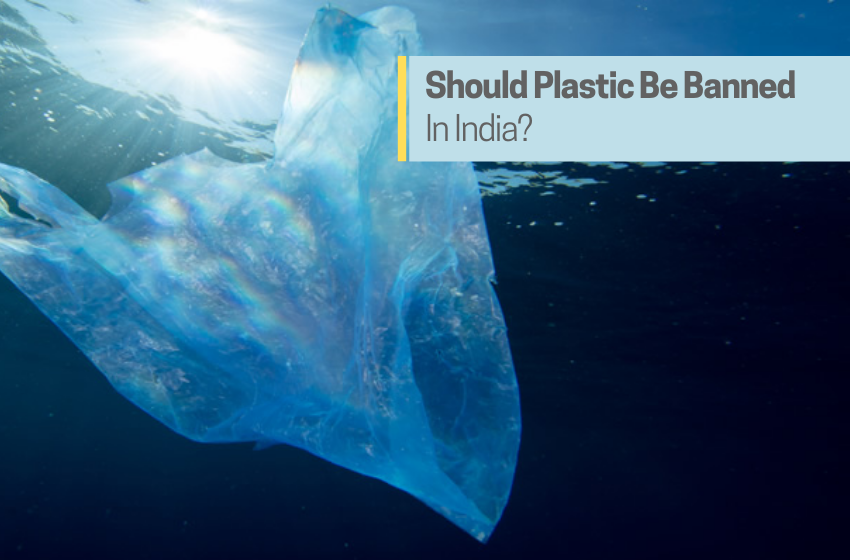
Should Plastic Be Banned In India?

Should Plastic Be Banned In India?

Plastic is a polymer, which are long chains of molecules that are made from repetitive links known as monomers. Plastic is often produced from chemicals such as petroleum. Plastic can be turned and twisted to form any kind of shape or flexibility. Plastic is popular because of its easy-to-use characteristic, durability, water resistance, and because the fact that they are inexpensive. Plastic is manufactured from fossil fuels but with time it is also being manufactured from renewable materials like corn and cotton.

In many sectors, plastic is an essential commodity. Plastic is common used in the manufacture of goods, for packaging purposes. It is waterproof, can be bought at a very low rate, easy to carry and manage, and is resistant to corrosion. In the medical sector, plastic is used heavily in the form of syringes and gloves. After all, they control contamination and infection because they can be used for a single-use purpose.

In the food sector, plastic is heavily used as a form of packaging because it keeps food fresh and ensures hygiene. In small eateries in India, single-use plastic materials like, crockery is used to control expenses and again, to ensure hygiene. Many bathroom products are made travel-sized which people think are a waste of plastic prove to be useful for a majority of the Indian population because of their affordable prices. With this, it is important to note that low-income families, which vastly contribute to the Indian population, are the greatest consumers of plastic because of its affordable value. Plastic products are a lifesaver to the Indian population because of the affordability it offers.

Plastic is here for the Long Run

While plastic has been an environmental hazard since the beginning of time, it is essential to take into consideration the ever-rising inflation of the Indian market. Time and again, measures have been taken to ensure that certain types of plastic are banned in India so that the amount of plastic waste flowing through the Indian sewages and seas alike is curbed to the best of the government’s ability. The Ban on plastic mostly hurts the low-income sector as the majority of the products present in the market are made of plastic, contain plastic, or are carried in plastic.

Apart from consumers, new start-ups or businesses should also be taken into consideration. Because plastic is inexpensive and easily accumulated, small businesses use plastic products or packaging to curb their expenses. With the ban on plastic, these small business owners will have to resort to pricier items available in the market. That will hurt their budget to a great degree to an extent that it will hurt their business too. 

Common thinking is that plastic is easily replaceable. But that is not the case. While there are some biodegradable options like paper, card-boards et cetera, which are better options to choose from because of the amount of water and natural resources that are consumed while producing them, it should be duly noted that it is not an easy task to find an alternative which will constitute all the properties of plastic which make it a consumer favorite. In a study, it was found that plastic is more eco-friendly than paper and cotton but only in areas where there is a proper waste management system preventing any leakages. Unfortunately for India, we have a long way to go where there is a well-structured waste management system with no leakages at all, until then it is a great initiative to make plastic lesser in circulation.

[irp]

History of Plastic Ban in India

Plastic was initially banned for the first time in India, in 1998, in the state of Sikkim. Carry bags with a thickness of 20 microns or less were banned in the effort to reduce plastic that was the most harmful to the environment along with the effort to restrict packaging of food in recycled plastic bags. Since then it has been the constant effort of the government to lessen the use of plastic in the country. Ensuring the use of lesser plastic or ensuring a ban on plastic has also been one of the many recurring political strategies of the government which hurts the industry, much to its displeasure. 

The first firm step was taken towards the drive was when the Plastic Waste (Management and Handling Rules) banned the use of plastic that was used to pack and store materials like Gutkha, Tobacco, and Pan Masala in 2011.

In the year 2016, the Union Environment Ministry released a new set of Plastic Waste Management Rules, which we claimed to wipe out all multi-layered plastics used to pack products. The ban didn’t go quite as planned and the bill had to be scraped off. 

Bans in the States never work out. History has been the witness of bans being implemented with vigor but not turning out well because of a lot of factors, one of them being the notorious consumer of plastic and the lack of government’s initiative to carry out the steps needed to ban anything strictly. Plastic continued to be burned in most States and the use of plastic bags was very much in use. The railway tracks and bus terminals looked free of plastic as ever but the reality was not quite the same.

Despite the continuous setbacks faced by the government of India when it came to enforcing the plastic ban in India, the government of India proposed yet again another proposal. The Union Ministry proposed a ban on several plastic materials which are of single-use. Along with that the thickness of plastic now should be maintained over 120 microns; earlier it was 20 microns and at present, the ban is on the plastic of fewer than 50 microns. The government’s initiative in an attempt to deal with a huge amount of plastic waste that is already present in the country.

This comes after the knowledge that almost 40% of the country’s plastic waste goes uncollected every day. The constant accumulation causes chocking of the drainage systems and the river systems in the country. Not only do the aquatic animals ingest the contaminated water, but the littered plastic is also consumed by innocent stray animals. The burning of plastic results in the emission of harmful gases which are inhaled by humans and animals alike. Not only plastic harms the environment but also the health of humans and animals alike. The government thinks that if virgin or recycled plastic comes into circulation, it will significantly improve the collection and recycling of plastic waste.

Responsible Step Towards Change

It is time to take into consideration that in a country with a huge population like India, it might not be solely the problem of waste management to clean up all the plastic waste. After all the people responsible for the huge accumulation of plastic waste is not only the government but all the millions of Indian citizens. While we should leave it to the government to set up the perfect waste management system to take care of the plastic waste problem, we as responsible citizens should play a vital role in the plastic removal strategies and initiatives.

We have to wake up from our comfortable slumber and realize that if not taken care of, plastic waste will remain trapped in our environment for centuries to come. While plastic breaks down into fragments easily, its integral polymer chains take up very high temperatures to break down further. This can be only done through the recycling process and only 15% of the plastic waste is recycled all over the world.  It should be considered that Indian manufacturers are hurt by the bans imposed by the government to curb plastic waste, it is the manufacturers themselves who use raw materials made from plastic and discard them after a single-use. This results in further production of such single-use products and further accumulation of plastic. The waste, however, does not get recycled and is thrown away into the water bodies or burned.

[irp]

Plastic should be banned but that is not a very strong point to take further. Just like Rome wasn’t built in a single day, reducing plastic consumption in a notorious country like India can be nothing short of rocket science. We should take some steps ourselves to curbs the waste, like following the three Rs we were taught in school.

  1. Reduce- It is high time we should start putting effort into contemplating our overall consumption of plastic. While it can be difficult to adopt a minimalist lifestyle we should make an effort to reduce our consumption of plastic by only using what is needed and not desired. The desired products should be of other plastic alternatives, if possible. When we are finally living in a world where we are even fighting for oxygen, we should remember that our natural resources are being depleted and start respecting the planet for the resources it provides it and not try to mold everything to serve our purposes.
  2. Reuse- We should make it a point to buy things that we can keep on reusing. This will not only result in the depletion of the use of plastic but also provide a good enough window to clean the accumulated waste. It is said that we are now living in a time where we throw away items that break, instead of repairing them. We should repair and renew the lives of whatever items still look good enough for further use.
  3. Recycle- Recycling the waste we generate, seals the deal in proper management of waste. If we recycle plastic waste, the manufactures will use that waste to manufacture products like furniture, packaging materials, and clothing. This gives and take will create a cycle where only the existing plastic will be in circulation and there will not be any need to manufacture more.

Plastic Ban: Is it Worth the Effort?

Nothing has ever come out of banning plastic in India. If we look at the statistics, the bans have never worked out in the country. Then why doesn’t the government go on to introduce other ways to curb plastic accumulation? 

  1. One of the reasons would be the political agenda it gives to the government. Just like promising good roads, (in which recycled plastic could be used), the government also promises a healthier, plastic-free environment for us to live in. As gullible citizens, we all fall for that. Another reason could be the tired policy-making of the government after it comes to power. 
  2. Long gone are the promises and only lazy initiatives are present to fulfill the far-fetched promises of the government. While the government is to the blame, the notorious citizens of the country of India have no lesser hand at increasing the plastic usage and waste in the country. If the bans were taken seriously by the citizens and their responsibilities realized and fulfilled, half the problem would have had ended by now. 
  3. Coming back to the laziness of the government it is important to note that the bans imposed by the government must be carried out with the same seriousness and effort with which it was imposed to gain votes or confidence of the citizens. Instead of fighting losing battles to regulate pollution and waste, agencies should strongly enforce the ban on the country.
  4. With a vast population like India, it is understandable that the agencies have more urgent matters that need to be looked into and accomplished every day and plastic waste management is the last thing on their list. Again, this strengthens our point that bans are useless in a country like India. A lot of states have tried to carry out bans on plastic but have failed to do so.
  5. If the government wants the imposition of banning to work, it should also work on the betterment of the work conditions of the people responsible for waste management. Government officials have a poor understanding of the threat that pollution pose to the environment and living organisms, have huge workloads, and have a lack of motivation to take steps in the eradication of plastic waste.

Conclusive Viewpoints

Because the majority of the Indian population comprises of youth, India as a country is finally realizing how knee-deep it is in plastic waste and is taking substantial steps like cleanliness drives and adopting a minimalist lifestyle to helo curb as much plastic waste as possible. The situation cannot change just by the youth changing their lifestyles and taking an active part in cleanliness drives but it will if every part responsible for the waste management works together to bring out the change for a better environment to live in. 

The government, industry, as well as citizens, should work together and reduce, reuse and recycle plastic waste with vigor. We should remember that our efforts will not only provide a healthier living environment for us but also for our generations to come.

[irp]

Frequently Asked Questions

Q1. Why should plastic be banned in India?
Ans. The constant accumulation causes chocking of the drainage systems and the river systems in the country. Not only do the aquatic animals ingest the contaminated water, but the littered plastic is also consumed by innocent stray animals. The burning of plastic results in the emission of harmful gases which are inhaled by humans and animals alike. Not only plastic harms the environment but also the health of humans and animals alike. 

Q2. What steps should be taken by us to curb the accumulation of plastic?
Ans. Reduce- While it can be difficult to adopt a minimalistic lifestyle we should make an effort to reduce our consumption of plastic by only using what is needed and not desired. The desired products should be of other plastic alternatives, if possible.

Reuse- We should make it a point to buy things that we can keep on reusing. This will not only result in the depletion of the use of plastic but also provide a good enough window to clean the accumulated waste.

Recycle- Recycling the waste we generate, seals the deal in proper management of waste.

Q3. Why plastic ban does not work in India?
Ans. With a vast population like India, it is understandable that the agencies have more urgent matters that need to be looked into and accomplished every day and plastic waste management is the last thing on their list.

Government officials have a poor understanding of the threat that pollution pose to the environment and living organisms, have huge workloads, and have a lack of motivation to take steps in the eradication of plastic waste.

Q4. What latest ban has been proposed by the government on plastic?
Ans. The Union Ministry proposed a ban on several plastic materials which are of single-use. Along with that the thickness of plastic now should be maintained over 120 microns; earlier it was 20 microns and at present, the ban is on the plastic of fewer than 50 microns.