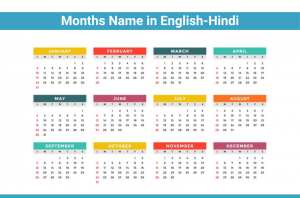
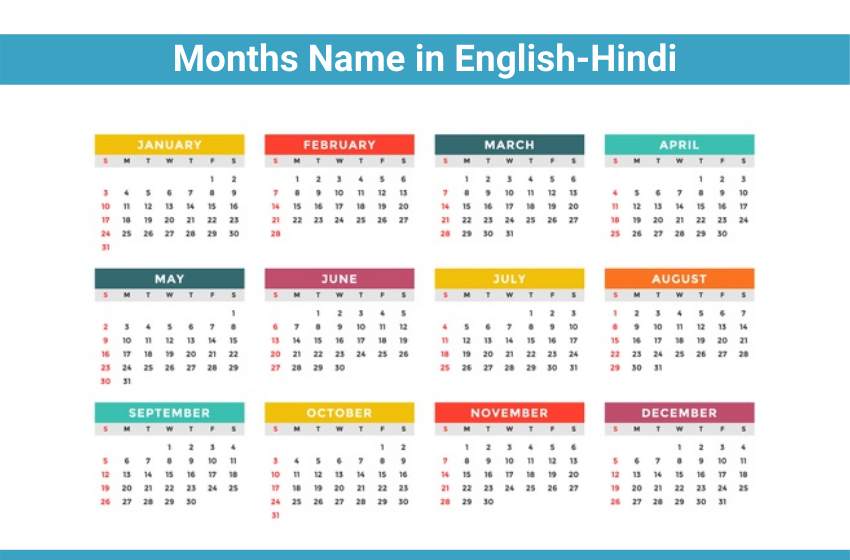
12 Months of the Year: All Month Name in Hindi & English (Hindu Calendar)

12 Months of the Year: Months Name in Hindi and English

All of us know the months of the year in English because they are taught to us in school, and we use the English calendar daily. However, whether you are a student, teacher, or just looking to expand your knowledge, knowing all month name in our native language is essential. Sadly, many people don’t know the proper Hindi months name. In this article, we will provide a complete list of every Hindu month name, their English equivalents, and dive into the rich history of the Hindu calendar.

12 Months Of The Year – Months Name in Hindi & English

Here you will learn about English months name in Hindi or in a layman language we can say learn about January February in hindi.

Name of the 12 months in Hindi and English (12 महीनों के नाम हिंदी और अंग्रेजी में)

Here is the months of the year in Hindi and English with their pronunciation. The most popular calendar is Gregorian calendar (English Calendar), hence the English months name are most known months name too. This calendar consist of 12 months and months name can be learned as:

“January, February, March, April, May, June, July, August, September, October, November, December”.

Each month are further divided in weeks and each month has approximately 4 weeks. Each week consist of 7 days, which can be learned as:

“Monday, Tuesday, Wednesday, Thursday, Friday, Saturday, Sunday”.

Months Of Year in English  Months Names in Hindi

(Hindu Calendar)

Hindi Months Name (Devanagari) Pronunciation
January पौष – माघ जनवरी Janvari
February माघ – फाल्गुन फरवरी Pharvari
March फाल्गुन – चैत्र मार्च Maarch
April चैत्र- वैशाख अप्रैल Aprail
May वैशाख- ज्येष्ठ मई Mai
June ज्येष्ठ – आषाढ़ जून Joon
July आषाढ़- श्रावण जुलाई Julaayi
August श्रावण – भाद्रपद अगस्त Agast
September भाद्रपद – आश्विन सितम्बर Sitambar
October आश्विन (क्वार) – कार्तिक अक्टूबर Aktubar
November कार्तिक – मार्गशीर्ष (अगहन) नवम्बर Navambar
December मार्गशीर्ष – पौष दिसम्बर Disambar

Hindi (Hindu) Calendar

A calendar is generally used to organize days, this is done by giving the name to the period like days, 52 weeks, months, and years. There are so many different types of calendars used around the globe in different communities and one of them is our Hindi Calendar which we also call it Hindu Calendar or Panchang or Panjika. This Panchang is a set of various lunisolar calendars which is used traditionally in Indian sub-continents and Southeast Asia. There is a major difference between the English calendar (the Gregorian calendar) and the Hindi calendar.

Features of the Hindu Calendar

The main features of the Hindu calendar are:

  1. This is a multi-dimensional calendar which means it offers a multi-dimensional way of structuring time, combining information about lunar days, solar days, lunar months, and solar months as well as the movement of the Sun and the Moon in relation to the settler constellation.
  2.  It consists of 12 lunar months as well as 12 solar months.
Desi Month Name (चैत्र, वैशाख महीनों के नाम in english)
Lunar Months Of The Year Solar (civil) Months
Chaitra (चैत्र) Mīna
Vaisakha (वैशाख) Meṣa
Jyeshtha (ज्येष्ठ) Vṛṣabha
Ashadha (आषाढ़) Mithuna
Shraavana (Sawan) (श्रावण) Karkaṭa
Bhadrapad (Bhado) (भाद्रपद) Siṃha
Ashvin (आश्विन) Kanyā
Kartik (कार्तिक) Tulā
Agahana (Margashirsha) (मार्गशीर्ष, अगहन) Vṛścika
Pausha (पौष) Dhanu
Magha (माघ) Makara
Phalguna (फाल्गुन) Kumbha
  1. Seasons within the Hindu (Hindi) calendar year start with a New Moon before the Sun enters the Zodiac sign of Aries (Meṣa).
  2. The Hindu calendar also tracks some more astronomical time spans like Nakshatra, Yoga, and Karana.
  3. The dates of many Hindu holidays are determined according to the lunisolar calendar which means that the festivals coincide with the Full Moon or a New Moon.

Months name as per Gregorian calendar and Hindu calendar

Seasons(Ritu) Months as per the Hindu Calendar Months (Gregorian calendar/English)
Vasanta (Spring) Chaitra – Vaisakha ((चैत्र- वैशाख) March-April
Grishma (Summer) Jyeshtha – Ashadha (ज्येष्ठ – आषाढ़) May – June
Varsha (Monsoon/Rainy) Shravana – Bhadra (श्रावण – भाद्रपद) July – August
Sharada (Late Monsoon/Autumn) Ashvin – Kartik (आश्विन – कार्तिक) September – October
Hemanta (Early Winter) Margashirsha (Agrahayana or Agahan) – Pausha (मार्गशीर्ष – पौष) November – December
Shishira (Winter) Magha – Phalguna (माघ – फाल्गुन) January – February

Cultural and Religious Significance of Each Months Of The Year

Each month in the Hindu calendar has specific festivals, rituals, and cultural practices associated with it:

Hindu Months Name and their Cultural Significance

  • Chaitra (March-April): Marks the beginning of the Hindu New Year. Celebrated with festivals like Gudi Padwa and Ugadi.
  • Vaishakha (April-May): Known for Buddha Purnima, celebrating the birth of Lord Buddha.
  • Jyaistha (May-June): Includes Vat Savitri Vrat and Ganga Dussehra.
  • Asadha (June-July): Known for Rath Yatra and Guru Purnima.
  • Shravana (July-August): Features Shravan Maas, significant for Lord Shiva devotees.
  • Bhadrapada or Bhado (August-September): Celebrates Ganesh Chaturthi and Krishna Janmashtami.
  • Ashvina (September-October): Includes Navaratri and Dussehra.
  • Kartika (October-November): Known for Diwali, Chhath Puja and Kartik Purnima.
  • Margashirsha or Agahan(November-December): Associated with Gita Jayanti and Vivah Panchami.
  • Pausha (December-January): Marks Makar Sankranti.
  • Magha (January-February): Known for Vasant Panchami and Maha Shivaratri.
  • Phalguna (February-March): Features Holi and Maha Shivaratri.

Historical Evolution of Months Of The Year Names

The names of the months in the Hindu calendar have evolved over centuries. They are derived from ancient Sanskrit and have been influenced by various dynasties and cultural shifts. Understanding these names offers insights into India’s historical and linguistic development.

January to December in Hindi and English
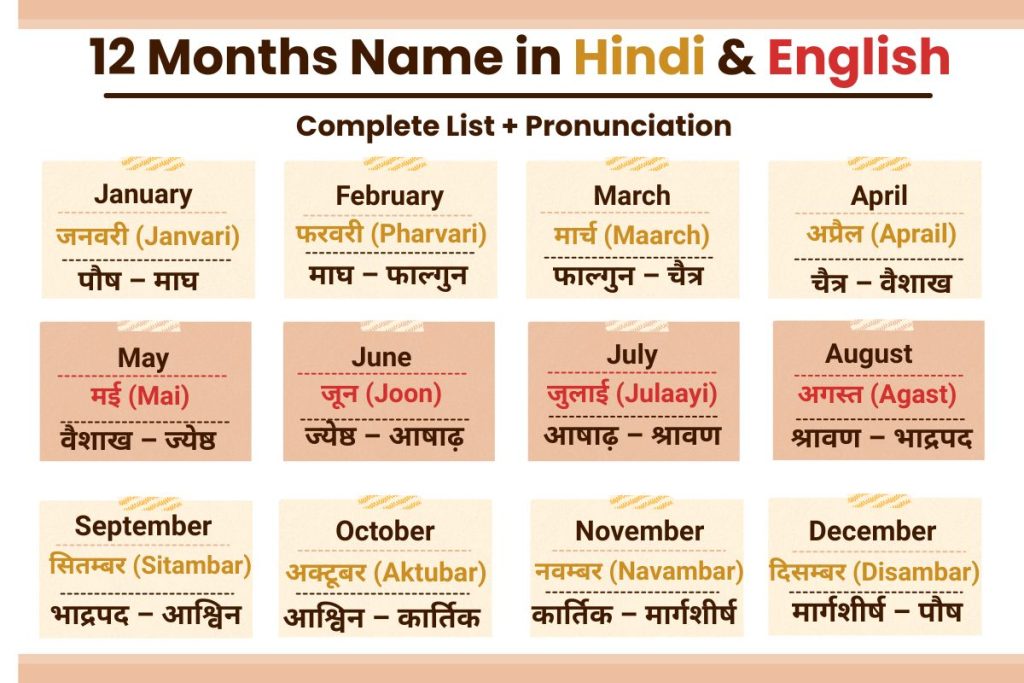
months name in hindi and english
Name of Months In English and Hindi

Astrological Insights for Each Months Of The Year

Each month has astrological significance, often aligned with specific zodiac signs:

  • Chaitra: Linked with Aries.
  • Vaishakha: Taurus.
  • Jyaistha: Gemini.
  • Asadha: Cancer.
  • Shravana (Sawan): Leo.
  • Bhadrapada (Bhado): Virgo.
  • Ashvina: Libra.
  • Kartika: Scorpio.
  • Margashirsha (Agahan): Sagittarius.
  • Pausha: Capricorn.
  • Magha: Aquarius.
  • Phalguna: Pisces.

These alignments influence various cultural practices and beliefs in Hindu tradition.

Practical Uses of the Hindu Calendar

The Hindu calendar is integral to daily life, particularly in rural India. It helps in planning agricultural activities, weddings, and other significant events. Farmers rely on the calendar to determine planting and harvesting times, while families use it to choose auspicious dates for weddings and religious ceremonies.

Common Terms and Phrases Related to the Months

  • Panchang: The Hindu calendar.
  • Amavasya: New moon day.
  • Purnima: Full moon day.
  • Sankranti: Transition of the sun from one zodiac sign to another.
  • Ekadashi: The eleventh day of the lunar fortnight, observed as a day of fasting.

Differences between Hindu and English Calendar

Below are the main differences between the Hindu and English calendars:

English Calendar Hindu Calendar
The Gregorian calendar (English Calendar) is based on the earth’s revolution around the sun.  The Hindu calendar is based on the Moon’s revolution around the earth. 
In this calendar, each month out of 12 months has 30 or 31 days except the month of February. February has 28 days normally. Every leap year Feb has 29 days. Whereas here there are only 30 days in every month. They add an extra full month after every 32-33 months by complex rules to cover the gap of previous days which is known as “Adhik Maas” or “Purushottam Maas”
According to this calendar, the year starts on 1 January The Hindu calendar begins in Chaitra (March-April). 
The name of the months according to this calendar are January, February, March, April, May, June, July, August, September, October, November, and December.  Here the names are Chaitra, Vaisakha, Jyaistha, Asadha, Shravana, Bhadra, Ashwin, Kartika, Mārgasirsa (Agrahayana), Pausha, Magha, and Phalguna. 
As per this calendar, there are four seasons; summer, spring, winter, and autumn. Whereas here there are six seasons; Vasant Ritu (spring), Greeshma (summer), Varsha (monsoon), Sharad (autumn or late monsoon), Hemant (early winter), and Shishira (winter season) 
In this Calendar, the whole day is divided into 24 hours with 60 minutes in each hour.  Whereas according to this calendar, the day is divided into 15 muhurtas, each of which has 48 minutes and the night is similarly divided. 
In the Gregorian calendar, the days of the week are named after Roman gods, as well as the sun and moon.  In the Hindu calendar, each week has seven days and those are named for Hindu deities. Each day also corresponds with a separate planet. 


Understanding the months in Hindi and English, along with their cultural, religious, and astrological significance, enriches our appreciation of the Hindu calendar. This knowledge highlights the calendar’s integral role in Indian tradition, guiding daily life and cultural practices.


Read Also: National Calendar of India & History and Uses

Related Articles

State and Union Territory Holiday Calendar 2024

The Sixth Month June – History and Significance

The Gregorian Calendar – History and Facts


Frequently Asked Questions

From which month does the Hindi Calendar start?

Hindi Calendar starts from Chaitra month (March-April).

What do we call Ashwin month in English?

Ashvin (आश्विन or क्वार) or Ashwin month called September in English. Usually, Ashwvin month of Hindi stays between September to October.

What do we call Baisakh month in English?

If you are wondering about Baisakh month in English (often misspelled by users as Vaisakha (वैशाख) or beshak month in english), it corresponds to the overlapping period of April and May in the Gregorian calendar. In the Hindu calendar, Vaisakha (or Baisakh) is the second month of the year and is highly auspicious, marking the harvest festival of Vaisakhi.

What do we call Paush month in English?

Pausha (पौष) or Paush month of the Hindi calendar called December in English. Usually, the Paush month in Hindi falls between December and January.

What do we call Kartik month in English?

Kartik month (कार्तिक) of the Hindi calendar is called October in English. Usually, the Kartik mhina (month) in Hindi falls between October and November.

What is Chaitra month in English?

Chaitra is the first month of the Hindu calendar and typically falls between March and April. It marks the beginning of the Hindu New Year.

What is Jyeshtha month in English?

Jyeshtha is the third month and falls between May and June. It is usually the peak of the summer season in India.

What is Ashadha month in English?

Ashadha corresponds to June and July. It traditionally marks the beginning of the monsoon season and the famous Rath Yatra.

What is Shravana (Sawan) month in English?

Shravana, often called Sawan, falls between July and August. It is a holy month dedicated to Lord Shiva.

What is Bhadrapada (Bhado) month in English?

Bhadrapada falls between August and September. Major festivals like Ganesh Chaturthi occur during this month.

What is Margashirsha (Agrahayana) month in English?

Margashirsha falls between November and December. It is considered a very auspicious month for religious activities and weddings.

What is Magha month in English?

Magha falls between January and February. It is famous for the Magh Mela and the Vasant Panchami festival.

What is Phalguna month in English?

Phalguna is the final month of the Hindu calendar, falling between February and March. It is best known for the celebration of Holi.
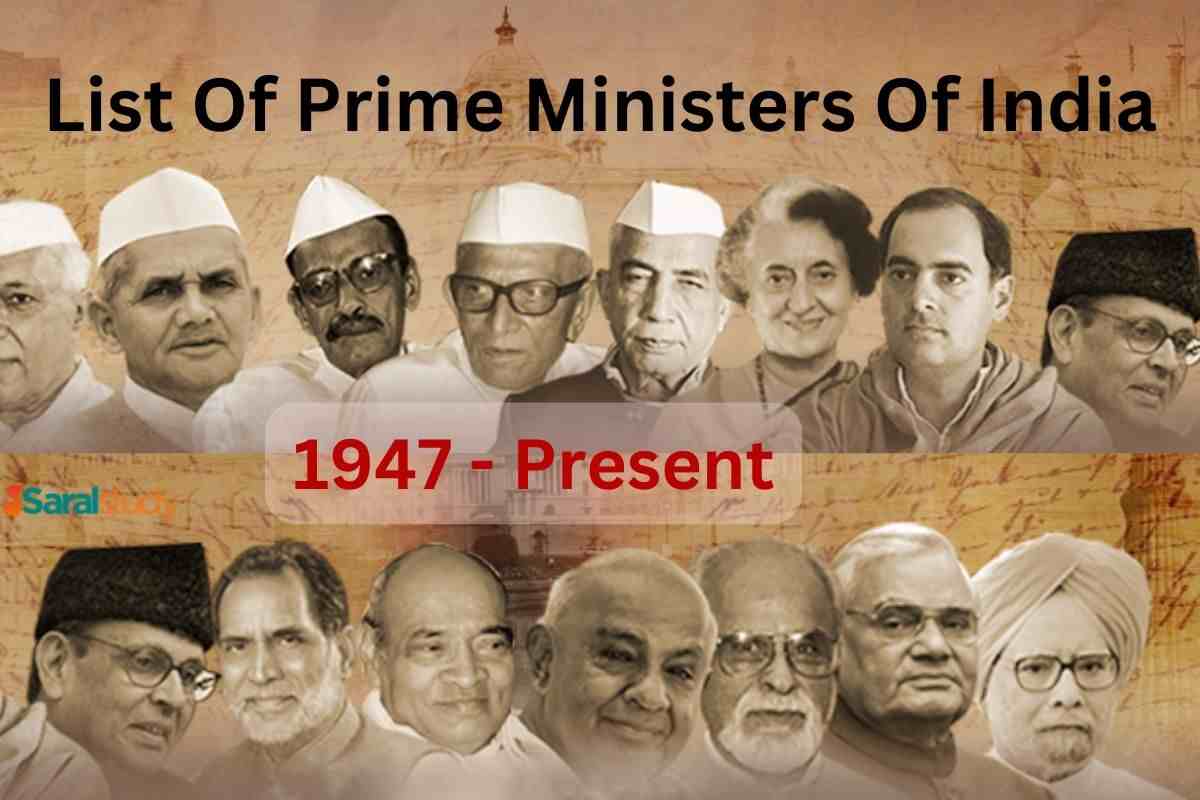
 

Comprehensive List of Prime Ministers of India (1947 – Present)

List of Prime Ministers of India (1947 - Present)

India, which is the most popular and the biggest democracy in the World has a wide parliamentary system with the Prime Minister of India, who is the chief executive of the Government of India. Under the parliamentary or semi-presidential system, the Prime Minister is the leader of the Ministers and head of the Cabinet in the executive branch of government.

The Prime Minister also has the authority to dismiss or select the other cabinet members. Nowadays, the Prime Minister sometimes often may be a member of the lower house of the legislature, and being the head of the government, the prime minister also holds some other posts and roles.

Introduction

The prime minister is appointed by the President of India and usually, in the Indian Parliament, the prime minister is the chairperson of the majority party of the government. The role of the prime minister is to appoint a committee of the cabinet, Ministry of Planning, Ministry of Personnel Pensions, and Public Grievances Department of Atomic Energy and Space. 

The prime minister also performs the duties of various international meetings, organizations, and conferences. And to vote in the elections for the prime minister a person should be a citizen of India, and should be a member of the Rajya Sabha or Lok Sabha, and should be age above 25-30 years.

List of Prime Ministers of India

The first prime minister of India was Pt. Jawaharlal Nehru from the “Indian National Congress” and the current prime minister is Narendra Modi from the “Bharatiya Janata Party”. Despite that India has had fifteen prime ministers since the day of Independence in 1947. There is the list of the Prime Ministers of India from the years 1947 to 2024 under the table given below:

Name of Prime Ministers Photo of PMs Working Period Party
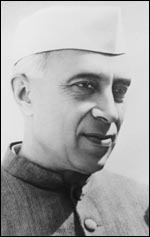
Shri Jawaharlal Nehru Comprehensive List of Prime Ministers of India (1947 - Present) 1947 – 1964 16 years, 286 days Indian National Congress
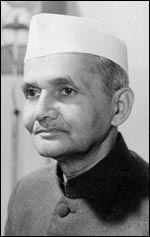
Shri Lal Bahadur Shastri Comprehensive List of Prime Ministers of India (1947 - Present) 1964 – 1966 1 year, 216 days Indian National Congress
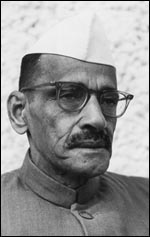
Shri Gulzarilal Nanda Comprehensive List of Prime Ministers of India (1947 - Present) 1966 – 1966 13 days Indian National Congress
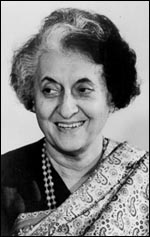
Mrs. Indira Gandhi Comprehensive List of Prime Ministers of India (1947 - Present) 1966 – 1977 11 years, 59 days Indian National Congress
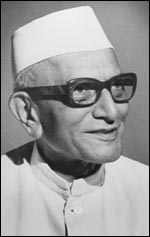
Shri Morarji Desai Comprehensive List of Prime Ministers of India (1947 - Present) 1977 – 1979 2 years, 126 days Janata Party.
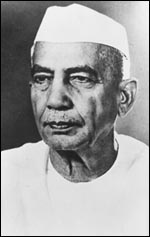
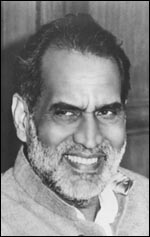
Shri Chaudhary Charan Singh Comprehensive List of Prime Ministers of India (1947 - Present) 1979 – 1980 170 days Janata Party (Secular)
Mrs. Indira Gandhi Comprehensive List of Prime Ministers of India (1947 - Present) 1980 – 1984 4 years, 291 days Indian National Congress
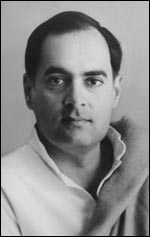
Shri Rajiv Gandhi Comprehensive List of Prime Ministers of India (1947 - Present) 1984 – 1989 5 years, 32 days Indian National Congress
Shri Vishwanath Pratap Singh (V. P. Singh) Comprehensive List of Prime Ministers of India (1947 - Present) 1989 – 1990 343 days Janata Dal (National Front)
Shri Chandra Shekhar Comprehensive List of Prime Ministers of India (1947 - Present) 1990 – 1991 223 days Samajwadi Janata Party
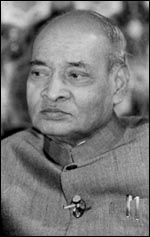
Shri P.V Narasimha Rao Comprehensive List of Prime Ministers of India (1947 - Present) 1991 – 1996 4 years, 330 days Indian National Congress
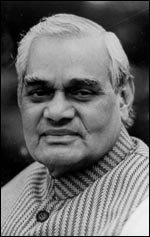
Shri Atal Bihari Vajpayee Comprehensive List of Prime Ministers of India (1947 - Present) 1996 – 1996 16 days Bharatiya Janata Party
Shri H.D Deva Gowda Comprehensive List of Prime Ministers of India (1947 - Present) 1996 – 1997 324 days Janta Dal (United Front)
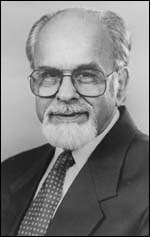
Shri Inder Kumar Gujral Comprehensive List of Prime Ministers of India (1947 - Present) 1997 – 1998 332 days Janta Dal (United Front)
Shri Atal Bihari Vajpayee Comprehensive List of Prime Ministers of India (1947 - Present) 1998 – 2004 6 years, 64 days Bharatiya Janata Party
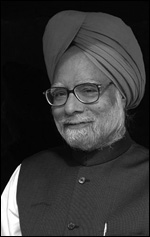
Dr. Manmohan Singh Comprehensive List of Prime Ministers of India (1947 - Present) 2004 – 2014 10 years, 4 days Indian National Congress
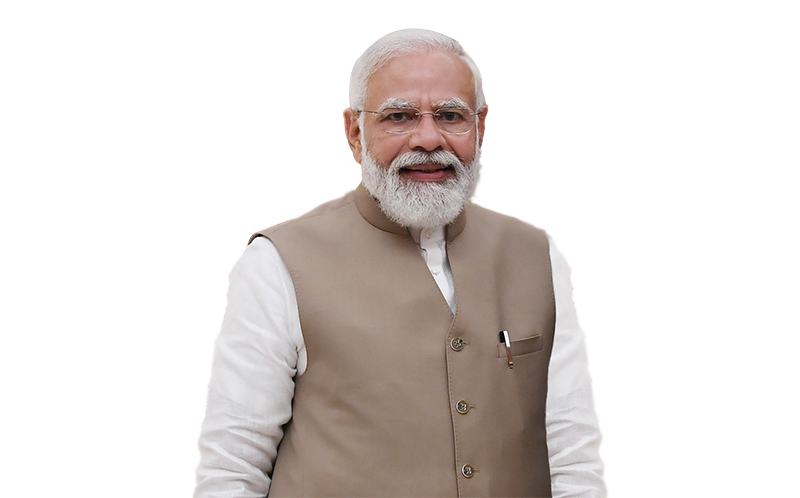
Shri Narendra Modi Narendra modi 2014 – incumbent 10+ years Bharatiya Janata Party

Let’s discuss all the details briefly one by one below.

Detailed All PM List Of India

The Prime Minister of India is the head of the government and plays a crucial role in the administration and policy-making of the country. Since India’s independence in 1947, the nation has seen several leaders who have shaped its destiny. We will see the detailed list of all PM of India here.

1st Prime Minister of India: Pt Jawaharlal Nehru (1947-1964)

jawaharlal nehru
Shri Jawaharlal Nehru

Shri Jawaharlal Nehru was born on 14th November 1988 and was also an Indian independence activist. He was the first and the longest-serving prime minister of India since the date of independence and served in the country until his death in 1964 he was also called Pandit Nehru due to his birthplace in the Kashmiri Pandit community and also named Chacha Nehru due to the love for the children. Today, Children’s Day is celebrated on the day of his birth anniversary (14th November) in remembrance of his memory.

Political career and key contributions of the first prime minister of India:
  • Early Life: Born on November 14, 1889, in Allahabad. Educated in the UK at Harrow and Trinity College, Cambridge.
  • Political Career: Joined the Indian National Congress, played a pivotal role in the freedom movement.
  • Political Party: Indian National Congress
  • Key Contributions: Architect of modern India, established the Planning Commission and spearheaded India’s non-alignment policy.

2nd Prime Minister of India: Shri Lal Bahadur Shastri (1964-1966)

Shri Lal Bahadur Shashtri

Lal Bahadur Shastri was born on 2nd October 1904. He joined the Indian independence movement in 1920 later after the independence he joined the “National Congress party” and became the key cabinet colleague of Jawaharlal Nehru and served India in numerous positions such as the Railway Minister and Home Minister. During the Indo-Pakistan War in the year 1965, his slogan “JAI JAWAN JAI KISAN” became very famous. His political career runs under the years 1947 to 1964 & in the year 1964, he became the second Prime Minister of India after the death of Jawaharlal Nehru.

He had continued the socialist, economic policies as per the guidelines of Nehru with central planning and died in 1966 at Tashkent, Uzbekistan (one day after signing the peace treaty to end Indo-Pakistan War).

Political career and key contributions of Shri Lal Bahadur Shashtri
  • Political Party: Indian National Congress
  • Key Contributions: Promoted the White Revolution, led India during the Indo-Pak war of 1965, and coined the slogan “Jai Jawan Jai Kisan.”

3rd Prime Minister of India: Shri Gulzarilal Nanda (1964, 1966)

Shri Gulzarilal Nanda

Gulzarilal Nanda was born on 4th July 1898. He was a specialized economist and politician in the “labour issue”. He had the chance to become the Prime Minister of India for a short period twice after the death of Jawaharlal Nehru in 1964 and Lal Bahadur Shastri in 1965 as he was in the position of the Home Minister in both times and his term ended until the Indian National Congress’s parliamentary party elected or assigns the new prime minister. He was also awarded Bharat Ratna.

4th & 7th Prime Minister of India: Indira Gandhi (1966-1977 & 1980-1984)

Mrs. Indira Gandhi
Smt. Indira Gandhi

Indira Priyadarshini Gandhi was born on 19th November 1917 and was the daughter of the Jawaharlal Nehru. She was the first women prime minister of India and also the central figure of the “Indian National Congress”. She was the second longest-serving prime minister of India. The slogan of “Garibi Hatao” became very famous which was in support of the rural and urban poor. In the Indo-Pakistan War, her biggest achievement was the decisive victory over Pakistan.

She had also served India in many positions such as the Ministry of External Affairs, Ministry of Home Affairs, Minister of Defence, minister of Information, and Broadcasting, and she was assassinated in 1984 by two of his Sikhs bodyguards by their service weapons in New Delhi to take the revenge for Operation Blue Star.

Political career and key contributions of the First Lady Prime Minister of India:
  • Early Life: Born on November 19, 1917, in Allahabad. Studied at Visva-Bharati University, Shantiniketan, and the University of Oxford.
  • Political Career: Served as the Minister of Information and Broadcasting before becoming Prime Minister.
  • Tenure Achievements: Led India to victory in the 1971 war, abolished the Privy Purse, and implemented the 20-point program during the Emergency.
  • Political Party: Indian National Congress
  • Key Contributions: Green Revolution, nationalization of banks, led India during the Bangladesh Liberation War.

5th Prime Minister of India: Morarji Desai (1977-1979)

Shri Morarji Desai
Shri Morarji Desai

Morarji Ranchhodji Desai was born on 29th February 1896. He was the Indian independence activist and also the fifth prime minister of India. He was appointed as prime minister of India in the year 1977. Since the war in 1962, he restored normal relations with China for the first time after the war. He also established a friendly relationship with Pakistan. He also played a crucial role in the Indian Nuclear Program in 1974 he also worked for the decimation of R&AW.

He was also honoured as the freedom fighter in his generation and also a socialist and moralist. After the retirement, he lived in Mumbai and died at the age of 99 years in 1995.

Political career and key contributions of Shri Morarji Desai
  • Political Party: Janata Party
  • Key Contributions: Emphasized administrative reforms, initiated the anti-corruption drive, and improved relations with Pakistan through the Simla Agreement.

6th Prime Minister of India: Shri Charan Singh (1979-1980)

Shri Charan Singh
Shri Charan Singh

Chaudhary Charan Singh was born on 23rd December 1902 and serves India as the sixth prime minister. He was also referred to as “Champion of India’s Peasants”. He won the Lok Sabha election from the “Janata Party” in 1977 and was asked to resign in 1978 for the following disagreement with Morarji who was the Home Minister at that time but came back again to the cabinet as the prime minister in 1979 however, after 23 days of becoming the prime minister he again resigned on 20 August 1979.

Despite that his birthday is celebrated as “Kissan Diwas” on 23rd December every year in India and the Amausi Airport in Lucknow, Uttar Pradesh was also renamed after him as the “Chaudhary Charan Singh Airport” and in his honor the University of Meerut, Uttar Pradesh was also named after him as “Chaudhary Charan Singh University”.

Political career and key contributions of Shri Charan Singh
  • Political Party: Janata Party (Secular)
  • Key Contributions: Focused on agrarian reforms, introduced policies for farmers’ welfare.

8th Prime Minister of India: Rajiv Gandhi (1984-1989)

Shri Rajiv Gandhi
Shri Rajiv Gandhi

Rajiv Ratna Gandhi was born on 20th August 1944 and was served as the prime minister of India. He took office after the assassination of his mother, Prime Minister Indira Gandhi, and became the youngest prime minister of India at the age of 40 years. His first action after being the prime minister was to pass the Anti-Defection Law in 1985. He also increased government support in technology, science, and associated industries reduced taxes and tariffs on technology-based industries, import quotas.

He also announced the National Policy of Education in 1986 and founded the Jawahar Navodaya Vidyalaya system. He also served as the Pilot in Indian Airlines and also works for different foreign policy and at the age of 46 years, he was also assassinated by the LTTE suicide Bombay in 1991.

Political career and key contributions of Shri Rajiv Gandhi
  • Early Life: Born on August 20, 1944, in Bombay. Educated at the Doon School and Trinity College, Cambridge.
  • Political Career: Entered politics after the tragic death of his brother Sanjay Gandhi, and became Prime Minister after Indira Gandhi’s assassination.
  • Tenure Achievements: Pioneered India’s information technology and telecommunications revolution, and initiated efforts to reduce bureaucracy.
  • Political Party: Indian National Congress
  • Key Contributions: Introduced the IT and telecom revolution in India, promoted modernization and liberalization, and led anti-defamation and anti-terrorism laws.

9th Prime Minister of India: Shri Vishwanath Pratap Singh (1989-1990)

Shri Vishwanath Pratap Singh

Vishwanath Pratap Singh was born on 25th June 1931. He was an Indian politician and became the prime minister in 1989. After a few days of taking the office, he faces a crisis as the Kashmiri military kidnapped the daughter of his Home Minister Mufti Mohammed Sayeed who was the former Chief Minister of Jammu & Kashmir therefore, his government agreed to release the militants in exchange for sort-out the crisis. He also enacted the “SC-ST Act of 1989” to prevent the atrocities against the members of the Scheduled Tribes & Scheduled Castes.

He also moved forward on the social-justice-related issues and decided to implement the Mandal Commission and after his huge efforts to India, he died in Delhi on 27th November 2008.

Political career and key contributions of Shri V P Singh
  • Political Party: Janata Dal
  • Key Contributions: Implemented the Mandal Commission report, provided reservations for OBCs, and initiated measures for transparency in governance.

10th Prime Minister of India: Chandra Shekhar (1990-1991)

Shri Chandra Shekhar

Chandra Shekhar Singh was born on 1st July 1927 and was the prime minister of the second shortest period of seven months after Charan Singh. During his period, he handled the portfolios of home & defence affairs.

However, as the congress withdrew support during its formulation on 6th March 1991 that’s why his government was unable to introduce the full budget and consequently, he had to resign from the office on the same day.

Political career and key contributions of Shri Chandra Shekhar
  • Political Party: Samajwadi Janata Party
  • Key Contributions: Addressed economic challenges, and negotiated with the IMF for economic aid.

11th Prime Minister of India: Shri P V Narasimha Rao (1991-1996)

Shri P V Narasimha Rao

Pamulaparthi Venkata Narasimha Rao was born in 28th June 1921. He was an Indian lawyer and politician and became the prime minister in 1991. He adopted to avert the impending economic crisis in 1991, his government also reduced the fiscal deficit and progressed in the areas of opening up foreign investments and energising the National Nuclear Security & Ballistic Missile Programme. He appointed Dr. Manmohan Singh an economist as his Finance Minister to accomplish his goals.

He was also referred to as the “Father of Indian Economic Reforms”. However, soon the Sonia Gandhi supporters forced him to step down as the Party President and therefore replaced by Sitaram Kesri after making many huge efforts as the prime minister he also faced many financial difficulties and died from a heart attack on 9th December 2004.

Political career and key contributions of Shri P V Narasimha Rao
  • Early Life: Born on June 28, 1921, in Karimnagar. Studied at Osmania University, University of Mumbai, and Nagpur University.
  • Political Career: Served in various capacities including Chief Minister of Andhra Pradesh, Defense Minister, and Foreign Minister.
  • Tenure Achievements: Liberalized the Indian economy, dismantled the License Raj, and initiated reforms that attracted foreign investments.
  • Political Party: Indian National Congress
  • Key Contributions: Launched major economic reforms, liberalized the Indian economy, and introduced policies that encouraged foreign investments.

13th Prime Minister of India: Shri H D Deve Gowda (1996-1997)

Shri H D Deve Gowda
Shri H D Deve Gowda

Haradanahalli Doddegowda Deve Gowda was born on 18th May 1933. He was an Indian politician and became the prime minister in 1996 when the United Front with the support of the Congress decided to form the government at the centre then Deve Gowda was chosen unexpectedly as the prime minister of India and continued until 1977.

He was also appointed as the Chairman of the Steering Committee of the United Front and was also credited for providing financial closure in the development of the Delhi Metro Project.

Political career and key contributions of Shri H D Deve Gowda
  • Political Party: Janata Dal
  • Key Contributions: Focused on rural development, initiated policies for farmers’ welfare.

The 14th Prime Minister of India: Shri Inder Kumar Gujral (1997-1998)

Shri Inder Kumar Gujral

Inder Kumar Gujral was born on 4th December 1919. He was a freedom and politician activist, and an Indian diplomat also. He became the prime minister of India in 1997. He is also remembered for his Gujral Doctrine which is a set of five principles to guide the conduct of foreign relations with India’s immediate neighbours such as Pakistan he also served the country as the minister of external affairs.

He died on 19th November 2012 with the illness of Lung infection.

Political career and key contributions of Shri Inder Kumar Gujral
  • Political Party: Janata Dal
  • Key Contributions: Advocated the Gujral Doctrine for India’s foreign policy, focused on improving relations with neighboring countries.

12th, 15th & 16th Prime Minister of India: Shri Atal Bihari Vajpayee (1996, 1998-1999, 1999-2004)

Shri Atal Bihari Vajpayee
श्री अटल बिहारी वाजपेयी (Shri Atal Bihari Vajpayee)

Atal Bihari Vajpayee was born on 25th December 1924. He served three terms as the Prime Minister of India. The first term was in 1996 which is of 13 days, the second term was in 1998-99 which was 13 months, and then followed the third full term in 1999-04. He was the co-founder and senior leader of the BJP despite that he was also a famous poet and writer and over the five decades, he was also a member of the Indian Parliament.

The Pokhran-II Nuclear test in 1998 was conducted during his tenure as the prime minister. He also serves the country as the Ministry of External Affairs. And died on 16th August 2018 due to his illness. His birth anniversary is celebrated as the “Good Governance Day” on the remark of his duties as a politician as well as prime minister.

Political career and key contributions of Shri Atal Bihari Vajpayee
  • Early Life: Born on December 25, 1924, in Gwalior. Studied at Victoria College (now Laxmibai College) and DAV College, Kanpur.
  • Political Career: One of the founding members of the Bharatiya Janata Party, served as a Member of Parliament for decades.
  • Tenure Achievements: Led India to conduct nuclear tests, introduced major infrastructure projects like the Golden Quadrilateral, improved Indo-US relations.
  • Political Party: Bharatiya Janata Party
  • Key Contributions: Initiated economic reforms, nuclear tests in 1998, introduced the Golden Quadrilateral project.

17th Prime Minister of India: Manmohan Singh (2004-2014)

Dr. Manmohan Singh
डॉ. मनमोहन सिंह (Dr. Manmohan Singh)

Manmohan Singh was born on 26th September 1932. He was an Indian Economist, academic, and politician as well and became the prime minister of India in 2004. He was the first Sikh to be the PM of India and was also re-elected after completing the terms of five years from the Indian National Congress. He worked on a better Health & Education system and new laws were also passed in his tenure period such as the Right to Information Act, National Rural Employment Guarantee Act (NREGA), Land Acquisition Act & Right of Children to Free & Compulsory Education Act.

He also continued the pragmatic foreign policies which were started by P.V Narashima Rao. He was also honoured by many awards at the National & International level.

Political career and key contributions of Dr Manmohan Singh
  • Political Party: Indian National Congress
  • Key Contributions: Implemented economic reforms, introduced policies for social and rural development, and spearheaded the Indo-US nuclear deal.
  • Early Life: Born on September 26, 1932, in Gah, Punjab (now in Pakistan). Educated at Panjab University, University of Cambridge, and University of Oxford.
  • Political Career: Known as the architect of India’s economic reforms, served as Finance Minister before becoming Prime Minister.
  • Tenure Achievements: Implemented landmark economic policies, and advanced social welfare programs, strengthened India’s position on the global stage.

18th Prime Minister of India: Narendra Modi (2014- Incumbent)

Shri Narendra Modi
Shri Narendra Modi

Shri Narendra Modi has been the current Prime Minister of India since 2014 as he was re-elected thrice as the head of the government now serving his third consecutive tenure; which equals Jawaharlal Nehru’s record. He is the head of the Councils of Ministers and the leader of the Lok Sabha. He has regulated many policies and schemes for the civilians such as Pradhan Mantri Awas Yojna, generating Ayushman Cards for the treatment of the people up to 5 lacs as the government schemes and so on. 

Political career and key contributions of Shri Narendra Modi
  • Early Life: Born on September 17, 1950, in Vadnagar, Gujarat.
  • Political Career: Served as Chief Minister of Gujarat before becoming Prime Minister.
  • Tenure Achievements: Launched significant campaigns like Make in India, Digital India, and Swachh Bharat, implemented the Goods and Services Tax (GST), managed the COVID-19 pandemic response.
  • Political Party: Bharatiya Janata Party
  • Key Contributions: Launched initiatives like Make in India, Digital India, and Swachh Bharat, implemented GST, successfully drove the Namami Gange project to clean the sacred river Ganga, revoked Article 370, Muslim Women (Protection of Rights on Marriage) Act, 2019; which render Triple Talaq illegal in India starting from August 1, 2019, and led the fight against COVID-19.

Frequently Asked Questions – List of Prime Ministers of India

Q1. Who was the first prime minister of India?

Ans. Pandit Jawaharlal Nehru was the first prime minister of India since the day of independence.

Q2. Who was the first woman to be appointed as the prime minister in India?

Ans. Indira Gandhi was the first woman to be appointed as the prime minister of India.

Q3. Who was the youngest prime minister of India?

Ans. Rajiv Gandhi was the youngest prime minister of India as he held the office of the parliament after the assassination of her mother, Indira Gandhi.
Q4. Why and when is Good Governance Day celebrated in India?
Ans. The Good Governance Day is celebrated on 25th December every year in the remembrance and remark of the former prime minister Atal Bihari Vajpayee.

Q5. Who was the prime minister of India before Narendra Modi?

Ans. Dr. Manmohan Singh was the prime minister of India just before Shri Narendra Modi took oath of PM in 2014.

List of First Women in India

First Women in India

Women empowerment or female empowerment is the way through which we try to empower women in every field. It has several definitions to give such as listening to women, educating women, letting them raise their voice towards certain topics, understanding and accepting their viewpoint, providing equal opportunities in every field, letting a woman be financially independent, and the list can go on. Women’s empowerment allows and provides paths to women and letting them make their own decisions which determine their life through all the obstacles society throws at them. Women empowerment nowadays has become an important and burning topic in economics and development as economic independence or economic empowerment can lead women to utilize the resources, assets, and income that can lead to a better society. 

People often think that why to provide so many opportunities to women as they are weak, less capable, have less determination towards work, etc., but they forget that women are the counterpart of the society and by all means, they have the right to go for anything they are willing of. If here we talk about women being physically weak in contrast a woman or a female has the capability of bringing a new life in this world, and if we talk about facts than physiology men and women are different and they will always be but God has provided the same brain to all the humans, so why not judge someone based on their capabilities rather on their gender, let’s talk about the intelligence, caliber, potential, pressures handle capacity, leadership quality, and other personality traits. 

Women have always been shattering those glass ceilings and telling the world that what they are capable of, women have done so many things despite all the restrictions and boundaries that people have created for them, and we have uncountable such women in our history, present, and will be in future too. 

List of First Women in India 

So many women our India have raised to set an example for the world that what capabilities does a woman can have, some of the honorable mentions are given here:

Name of Women Achievement Details
Smt. Pratibha Patil First woman president of India Served as the 12th president of India from 2007 till 2012.
Smt. Indra Gandhi India’s first woman Prime Minister, and first Bharat Ratna winner. Became motivation for the millions of girls. She served as prime minister from January 1966 to March 1977 and again from January 1980 until her assassination in October 1984.
Sarojini Naidu India’s First Women Governor and also first woman president of INC(Indian National Congress) An activist, a poet and also called “The Nightingale of India”.
Razia Sultan India’s First Woman ruler on Delhi throne She was the first Muslim woman to rule and also the last. 
Kiran Bedi India’s First Woman IPS officer This lady has inspired a lot of hearts
Sucheta Kripalani India’s First Woman Chief Minister of a state ( Uttar Pradesh)
Rajkumari Amrita Kaur India’s First Woman Union minister
Annie Besant India’s First Woman President of INC(Indian National Congress)
Meera Sahib Fatima Bibi India’s First Woman Supreme Court
Nirja Bhanot India’s First Woman, who got Ashok Chakra A brave flight attendant saved many lives during the plane hijack.
Vijayalakshmi Pandit India’s First Woman Ambassador at United Nations
Arati Saha First Woman to swim across the English Channel
Mother Teresa India’s First Woman to received Noble Prize She served Indian people selflessly and became popular for spreading peace.
Bachendri Pal India’s first woman to climb the Mt.Everest
Miss Reita Faria India’s first woman to become Miss World
Santosh Yadav India’s First Woman to climb Mt.Everest Twice
Sushmita Sen India’s First Woman to become Miss Universe A well-known Bollywood actress too.
Ashapurna Devi First Indian woman to received Jnanpith Award She was a famous poet and novelist.
Sania Mirza first Indian Woman to won WTA(WOMEN’S TENNIS ASSOCIATION) title She is a reputed Indian tennis player.
Durga Banerjee First Indian Woman airline pilot
Kamaljeet Sandhu First  Indian Woman to win a Gold in Asian Games
Arundhati Roy First Indian woman to win Booker Prize
M.S. Subbulakshmi First Indian woman musician to get Bharat Ratna
Kalpana Chawla First Indian woman to go into space.

All of the above-mentioned women have faced their different challenges but accepted all of them and fought with all of their hearts and eventually won and made names written in golden words with their works.

Whats is NCC (National Cadet Corps)? How to join NCC?

What is NCC (National Cadet Corps)?

The full form of NCC is the “National Cadet Corps”. It is a youth development organization. The flag of NCC contains tricolor of Red, Dark blue, and Light Green. The Head Office of NCC is in New Delhi. It is one of the most respected organizations anyone can be a part of. It is based on three service training organizations which contain the Indian Armed Force, Navy & Air force training programs, or a platform by which an individual can reach the height of these services easily and can stand out from the crowd of ordinary people. NCC is the head-to-toe development organization that contains physical, mental, and personality development strategies. It is an overall life-changing experience where one should be! The NCC is a voluntary organization that searches and recruits cadets all over India from schools, colleges, and universities. The eligible cadet is given a few basic training in the military which helps a volunteer to proceed further with a bright future.

What is NCC?

History of NCC (National Cadet Corps)

NCC was first introduced in Germany in the year 1666 but, In India, the NCC was formed in the year 1948, in the form of the Cadet Corp Act. During the First World War, when the British government falls short of the army. Then they introduced its first origin of NCC which were started as the “University Corps”. It was created in 1917 under the Act of Indian Defense. The main objective of this organization was to meet the shortage of the armed forces. In the year 1920, the University Corps was replaced by the University Training Corps (UTC) under the Indian Territorial Act. The main objective of UTC was to raise the status and become more attractive amongst the youth of the nation. The dress-up and attitude of the Officers and Cadets were just like an army under the UTC. To make the UTC at a national level so that more youth can acquire knowledge and military training, a committee was headed by Pandit H.N Hunzru in which he recommended creating a cadet organization that should be established in all the schools and colleges. On 15 July 1948, The Governor-General accepted the proposal, and then the National Cadet Corps was introduced and enacted under the law.

In 1949, an equal opportunity was provided to girls in schools and colleges to remove the inequality so that the girls could also perform equally in the field of NCC. This encourages them to participate in the nation.

In the years 1965 and 1971, During the Indo-Pakistan War. The NCC Cadets were on the second number to organized and assist the nation as well as the community. They play a better role in supplying the arms and ammunition to the front officers as well as to the patrol parties. The NCC Cadets join all the activities with the Civil Defense authorities during the war. Hence, this was a great achievement of NCC Cadets which proved that they have leadership quality and are contributed towards the nation in all respect.

NCC Certificates

NCC provides you with 3 types of certificates according to the level of the training. There are 3 certificates- A, B and C. Let’s have a look at them 

  1. Certificate ‘A’ – NCC ‘A’ certificate is given on the completion of the first level of training. The time duration of this training is 1-2 years and done at the school level. 
  2. Certificate ‘B’ – NCC ‘C’ certificate is given to the credits of senior wings and has a minimum of 75% attendance in NCC training.
  3. Certificate ‘C’ – NCC ‘C’ certificate is the highest certificate which id provided to the credit who is in the third year of training and should have attended a minimum of 2 national trainings.

Benefits of NCC

The main benefits of Joining the NCC are discussed below:

1. Non-Defense Benefits: The non-defense benefits include Incentives, Scholarships, Reservations and Education, and Preferences in Security Agency which are explained below:

  • Incentives: It includes many kinds of incentives which are provided to NCC Cadets by both the Central and State Government such as Daily Allowance, Incidentals, Missing Allowances, Washing and Polishing, Refreshments and many more.
  • Scholarships: It also contains many kinds of scholarships. To emphasize and motivate the Cadets, the government provide them different scholarship programs and the “Best Cadet Award” to raise their spirit.  If in case, there is a cause of death during the NCC activity. Their family will also be provided with financial assistance.
  • Reservation and Education: In many colleges state entrance exams, the reservation for the NCC Cadets are already present.
  • Preferences in Security Agency: There are many governments and private sector agencies including The RELIANCE GROUP provide preference to NCC Cadets for the post of security.

2. Defense Benefits: The NCC Cadets holding the C-Certificate have the golden opportunity to join the Defense Forces as a Commission Officer. Both males and females can take special advantage of this service without qualifying for the entrance exam. One can directly appear for the SSB Interview.

On the other hand, If we talk about other ranked recruitment in NCC, A cadet with A Certificate can get 5 marks A Cadet with B-Certificate get 10 marks additionally. While, If A Cadet is having C-Certificate then one does not need to give Common Entrance Exam(CEE). Moreover, If comes to specific benefits of C-Certificate A cadet will get 5-10 bonus marks in sailors or airmen while 2- 10 bonus marks in paramilitary forces. Despite this, A cadet will also get some extra marks in the recruitment of Department Of Telecommunication. They will be given preferences in some specific states as the State Police, Home Guard, or another different department. A cadet with C-Certificate has a chance to become an Officer as well as Civilian Gliding Instructor, Girl Cadet and whole time Lady Officer as well.

3. Non- Tangible Benefit: In NCC, as a cadet despite learning military exposure you will also learn a lot of different things. NCC provides you to develop leadership quality, personality development, and a different way to live your life for the sake of the nation & for the motive of having the best feeling in the world.

Motto of NCC (National Cadet Corps)

The main motto of NCC is “Unity and Discipline” The motto of NCC took place in the 11th Central Advisory Committee meeting which was held on 11th August 1978, after discussing lots of mottos of NCC in the meetings, At last, the committee finally decided the motto of NCC as Unity & Discipline in the 12th Central Advisory meeting which was held on 12th October 1980.

In NCC, The meaning of Unity refers to the youth who came and participated in NCC from different states, religions,  backgrounds, languages,  prospects but united together. While the discipline in NCC refers to the training of the youth for properly performing any task or action.

Importance of NCC

NCC brings the feeling of contribution toward the nation in the youth moreover, it helps in providing a better platform for youth to uplift their career chances through providing them guidance, training and channelizes their energy in a constructive purpose and after completing the training program of NCC, the cadets with their achieving certificates can use their preferences and got selection based on their achievements. The NCC provides better career opportunities and preferences which can change one individual life. The main aim of NCC is to groom an individual into a good discipline and contributing him/her toward the nation as well as society.

Activities of NCC

The activities of the National Cadet Corps are of many types, some of them are as follows:

  1. Institutional Training: Institutional training is conducted at schools and colleges which is associated with NCC Armed Forces Personnel and NCC Officers. This training is mainly based on the military training process to the cadets which enable them to prepare to join the armed forces. The specific purpose of this training is to provide a new way of life amongst the youth which inculcates the values of self-defense, discipline, punctuality, unity and to empower them to contribute themselves towards the nation and to build a good personality. Moreover, the Institutional training also generates the interest in the youth of adventures, thrills, excitement which attracts young cadets towards NCC.
  2. Camp Training: The practice of Camp training is the basic aim of NCC through which the cadets regime a way of their life, explore the adventures and help them to develop a personality of leadership, self-confidence, and teamwork. This helps the cadets to join the camps training which also includes Annual Training Camps (ATC) and Centrally Organized Camps (COC) across India.
  3. Prime Minister’s Rally: The Prime Minister’s Rally is the most prestigious moment held in NCC where the PM’s rally was introduced in every Republic Day on 26th January. In which the Honorable Prime Minister is presented with the Guards of Honor. The number of cadets who participated in PM’s Rally is 3,000 approximately.
  4. Social Service And Community Development: In this activity, a volunteer gets inspired towards its social environment. This built the courage to perform multiple tasks. It teaches them the dignity of hard work and labor, motivates them to take interest in constructive work. The Social Service And Community Development Activities include Traffic Control activity, Swacch Bharat Abhiyaan, Tree Planting, Awareness of Diseases, Blood Donation, Reliefs during Disasters and many more other social services which come across.
  5. Adventure-Based Learning: The Adventure is in the blood of youth. In NCC, the main aim of providing adventure activities is to bring knowledge of topography and provide them a new experience of different atmosphere which develop a discipline, the level of tolerance, built stamina, courage in the NCC Cadets. The adventure-based learning programs include Mountain Expeditions like trekking, Camel Safari, Paragliding and Parasailing, Para Basic Course, cycle and motor rallies, sea sorties, etc.
  6. Sports: The NCC has a high potential facility like Hockey, Football, Shooting at a state and national level. NCC games were organized in the year 2013 which brings opportunities amongst the youth of NCC including the competition and selection at the national level.

How to Join NCC (National Cadet Corps)?

To join the NCC, one should have to face the two situations described as:

  • In the first situation, by chance If NCC is in your school or college then you just need to visit your Associate NCC Officer (ANO) and discuss your interest in NCC and asked them to the process to join NCC. And it’s all done.
  • In the second situation, If unfortunately, the NCC is not in your school then you need to take a step ahead and visit any other school or college having NCC. This doesn’t imply that you have to take admission to another school or college. You just have to take NCC from Open Admission in available schools and colleges. Or you might visit the Group Headquarter Unit and meet the Permanent Instructor (PI) Staff and discuss your situation to join NCC. Hence, they will directly help you to choose the school or college to join NCC by taking Open Admission for NCC or else sometimes, they directly provide you admission from their unit but, in this situation, you have to get a signed (NOC) Non-Objection Certificate from the principal of your school or college.
  • To search a school, college, or Unit for NCC nearby you! You need to search for it on your phone with the help of the Google application. This can make your job easy.

Online Registration for NCC

To apply online for NCC, you must follow the steps which are discussed below:

  1.  You can visit the Official Website of India  Army as joinindianarmy.nic.in 
  2.  Then you have to click on Register.
  3.  You just need to fill-up the form carefully and submit the following information.
  4.  From there you will get your OTP number.

Hence, you will soon get your confirmation that you have successfully registered for the NCC online.

Frequently Asked Questions

Q1. What steps should be followed to become the NCC Officer?
Ans. To become the NCC Officer one need to have a 2-year experience in NCC as ANO or GCI or have the equal rank in Police, he/she is the holder of NCC C-Certificate and have to qualify the written exam, medical exam, personality test and in the face to face interview as well.

Q2. What kind of learning aspects of NCC?
Ans. The training of NCC includes physical activities, discipline, sports, visits, and tours in remote areas, arms training, ethics, team spirit, follow rules and orders, and many more.

Q3. What are the fees criteria in NCC?
Ans. As the NCC is a government organization of youth, you don’t need to pay anything. It is free of cost from the government.

Q4. What is the total duration of the NCC complete course?
Ans. The total duration of the NCC complete course is 3-5 years approximately.

Q5. How much salary do I get from NCC from starting to afterward?
Ans. The salary which is offered to you in the starting is 10,000 to 20,000 INR and you can get increment up to lakhs according to your post, eligibility and working period.

The Bharat Scouts And Guides

The Bharat Scouts and Guides (BSG) is the national scouts and guides association of India. Its headquarters is based in New Delhi and it is recognized by The Government of India. It was founded on 7th November 1950. If we talk about Scouting, It was founded in the year 1909 as a branch in India to overseas and then in 1937, The Scouts association became the member of the World Organization of the Scouts Movement. On the other hand, In India Guiding was started in the year 1911 and became a member of the World Association of Girl Guides and Girls Scouts in the year 1928. Meanwhile, at present, it is covering Bangladesh and Pakistan and many more areas in different countries.

The Bharat Scouts And Guides

The main mission of this association is to contribute the youth to the education by the value-based system on the Scouts Promise and Law to make a person self-dependent and also can serve their society with their best efforts and to build a better life for the individual. The unit of scouts and guides is separate from other units due to some different co-educational activities like Rallies, Conferences, and Jamborees. The best thing about Bharat Scouts and Guides (BSG) is that the handicapped person whether boy or girl can also participate in it.

The BSG is further divided into 4 sections according to the age group which is as below:

  • Bunnies section- It includes both boys and girls of the age group of 3-5 years.
  • CUBS section- It includes only boys of the age group of 5-10 years.
  • Scouts section- It includes only boys of 10-17 years of age.
  • Rovers section- This also includes only boys in the age group of 17-25 years.

While the Bharat Guides contains:

  • Bulbul section- This is the section only for girls of the age group of 5- 10 years.
  • Guides section- This also includes only girls of the age of 10-17 years.
  • Ranger section- It is also for girls of the age group of 17-25years.

Bharat Scouts and Guides Activities

The Bharat Scouts and Guides (BSG) have four special branches which conduct different activities which are detailed below: 

  1.  Extension Scouting: The main feature of extension scouting is to meet the special needs of the youth. The founder of Extension Scouting was “Robert Baden Powell” who made BSG “open to all”.
  2. Sea Scouting: It is founded in the year 1909. Sea Scouting is based on water-based activities which can be performed on sea, rivers, or lakes. These activities provide chances to learn about navigation, sail cruise or boats and also give knowledge about how to work on engines. They also have their “uniform code”. 
  3. Air Scouts: The Air scouts was founded in 1911. Air Scouts are based on flying activities like aviation but most of the Air Scouts’ activities are mainly based on the ground as well. Such as visiting airports, on airfields, etc. The Air Scouts depend mainly on age groups, scouts group, and country to participate in the different kinds of activities like parachuting or fly in different aircrafts such as hot air balloons, gliders, helicopters, etc. 
  4. Venture Club Scheme: The Venture Club program is mainly focused on young people of the age group of 15-18 years. This program comprises the knowledge and learning-based concepts for youth for developing their learning and professional skills. The Venture Scheme includes many activities like Wind Surfing, Mountain Biking, Sailing, etc.

History of Bharat Scouts and Guides (BSG)

The Bharat Scouts And Guides (BSG) was established in the year 1914 and the founder of the “Scout Movement” was Robert Baden Powell. The boy scouts movement was first, introduced by him in the United Kingdom after that he had organized a “Scout Camp” in the year 1907 which took place at Brown Sea Island. This movement was spread all over the United Kingdom as well as in other parts of the world.

In India, The first Scout Troops comprised three British boys which were later increased to nine more boys. This Boys Scouts Organization was formed in 1911 in nine states of India which consists of Shimla, Madras, Jabalpur, Saidpur, Bangalore, Calcutta, Allahabad, Poona, and Khadki.

In the year 1911, “The Girl Guide Movement” was started at Jabalpur and get expanded enormously. And in 1916 The “All India Girl Association” came into existence. The huge efforts were made after independence by many leaders such as our first Prime Minister Pt. Jawaharlal Nehru, Dr. H.N Kunzru, Our Education Minister, Maulana Abdul Kalam Azad, etc., and probably, the final movement was held on 7th November 1950, which was named as “Bharat Scouts and Guides”. Nowadays, its headquarters are based in New Delhi. And have many branches all across India.

Importance of Bharat Scouts and Guides (BSG)

The importance of BSG is to build self-confidence in youngsters. There is a lack of confidence amongst youth while participating in various programs and activities organized by BSG. A student becomes confident in every way. Even this organization also dominates the purpose of fun where young people develop their physical, social, spiritual, and intellectual skills while building a sense of communication skills, interaction skills, learning skills, leadership skills, and team spirit which helps them to grow in a better way. The BSG is “Open To All”. There is no differentiation of caste, creed, religion, or gender. Everyone is treated and respected equally in BSG Camps. Also, there is some basic “Scouts and Guides law”. The BSG mainly focused on these laws properly.

Motto of Bharat Scouts and Guides (BSG)

The main motto of BSG is to Be Prepared. This means that a person should always be ready and prepare with his body and mind to perform his duty anywhere and anytime. To be active, wise, disciplined, obedient, gentle, kind, strong, and smart to handle any situation that may occur anytime. To keep your mind and body prepared to perform the right action at a time.

How to join Scouts and Guides

The Bharat Scouts and Guides (BSG) require very simple steps to join in. If by chance, the BSG is in your school or college that can make your job easy as all you need to visit the BSG Officer and ask them to help you join in, and hence you will be done. But if the BSG is not conducted in your school or college then you need to search for the unit of BSG nearby you. You can make it easy by searching the BSG unit nearby you on your phone through the Google application. Then you have to visit the unit and discuss your situation with the Unit Officer. They will surely help you out to join the Bharat Scouts and Guides (BSG).

Benefits of Bharat Scouts and Guides (BSG)

The main benefit to joining Bharat Scouts and Guides are discussed briefly:

  1. First of all, the main benefit of BSG is that you will be physically fit as there are many activities and parades, sports, pets through which you can maintain fitness.
  2.  Secondly, BSG provides you the certificates, which can help you to join government sectors because these certificates provide some bonus points which may be very essential for you to participate in any government exam, interview, or jobs as these certificates can make your percentage better by their bonus points or from its preferences as well.
  3. If anyone performs very well in the BSG activities, then one can get the chance to get an honor from the Central and State government which is such a prestigious moment for the candidate.
  4. Moreover, you can enjoy the benefit to visit new places and can explore, have adventurous activities in which you can perform and have fun also.

How to register online for Bharat Scouts and Guides (BSG)

To apply online for Bharat Scouts And Guides (BSG), you must follow the simple steps which are explained below:

  1. First, all you need to visit the Official Website of Bharat Scouts and Guides. You can easily find out the form online by the name of the Rashtrapati Award Application Form.
  2. After that, you have to fill-up the form carefully by providing each and every information required in the form.
  3. Then click the submit option to submit your application form.
  4. And hence, you will get your OTP number. Once you enter your OTP in your application within minutes you will get your confirmation message that you have successfully registered for the BSG online.

Frequently Asked Questions

Q1. State the points of the Scouts Law.
Ans. The Scouts Law comprises of 12 principles in general:

  1. A scout should be helpful.
  2. A scout should be loyal.
  3. A scout should be trustworthy.
  4. A scout should be friendly.
  5. A scout should be courteous.
  6. A scout should be kind.
  7. A scout should be obedient.
  8. A scout should be cheerful.
  9. A scout should be thrifty.
  10. A scout should be brave.
  11. A scout should be clean.
  12. A scout should be reverent. 

Q2. What is the maximum age at which anyone can apply for the BSG?
Ans. The age limit is 25 to 45 years to apply for the BSG.

Q3. What kind of activities are performed in BSG?
Ans. There are many kinds of adventurous as well as fun-loving activities in BSG such as parachuting, flying different aircraft, mountain biking, sailing, camping, exploring different cities and remote areas, and many more.

Q4. Why scouts and guides are important to students?
Ans. The activities based on BSG are for fun purposes, help the students to stay happy, healthy and bring self-confidence, enables them to explore the world and provide better skills and knowledge, That is why the scouts and guide plays an important role in the life of students.

Q5. Why BSG, scouts shake their left hand instead of the right one?
Ans. This is the formal way of greeting the other scouts to shake their left hand. This practice is followed all around the world by the members of scouts. The left hand is close to the heart so, as a token of friendship, the scouts shake their left hand only.

Sitaram Jindal Scholarship 2021: Application Form, Eligibility, Rewards, Last Date

Sitaram Jindal Scholarship

Sitaram Jindal Scholarship Scheme: It is provided by the Sitaram Jindal Foundation, a charitable organization in Bangalore. The Sitaram Jindal Scholarship Scheme aims to provide monetary assistance to worthy candidates who belong to the weaker section. It is a merit-cum- means based scholarship. The applicants must be studying in class 11 to post-graduation to apply for this scholarship. The scholarship amount is Rs. 2500 per month based on this course. The scholarship program is designed in such a way that it will help the student in every sphere of their academic life. Details are provided under. Read the article for more information.

Sitaram Jindal Scholarship 2021 (SJS) – Highlights

This scholarship is divided into many categories as per the course studied by the students.

Conducted By Sitaram Jindal Foundation
Eligibility Students pursuing class XI to postgraduate degree including ITI, diploma and professional courses
Region India
Rewards Up to ₹3,200 per month
Last Date of Application December 31, 2021

Sitaram Jindal Scholarship 2021 – Important Dates

Events Dates
Commencement of application Open throughout the year
Last date for filling Open throughout the year

Sitaram Jindal Scholarship 2021 – Eligibility Criteria

In the table given below all the details of eligibility criteria are given.

Category Eligibility
Category A (for class 11 and 12)
  • Candidates must study in class 11 or 12.
  • Male candidates must secure a minimum of 65% of marks.
  • Female candidates must secure a minimum of 60% of marks.
  • Candidates of Karnataka should secure 75% marks for boys and 70% marks for girls.
  • Candidates of West Bengal should secure 70% of marks for boys and 65% marks for girls.
  • Candidates who are employed must have an annual income of less than Rs. 4 lacs p.a.
  • Other candidates who are not employed should have an annual family income of less than Rs. 2.5 lacs.
  • The candidate ought to be less than 30 years old.
Category B (For ITI students)
  • Candidates should study at ITI colleges or institutions.
  • Male candidates must secure a minimum of 50% of marks in the last qualifying exam.
  • Female candidates must secure a minimum of 40% of marks in the last qualifying exam.
  • Candidates who are employed must have an annual income of less than Rs. 4 lacs p.a.
  • Other candidates who are not employed should have an annual family income of less than Rs. 2.5 lacs.
  • The candidate ought to be less than 30 years old.
Category C (for Graduate & post graduate course)
  • Candidates must be studying in graduate or postgraduate courses.
  • Male candidates must secure a minimum of 60% of marks for graduation and 65% of marks for post-graduation.
  • Female candidates must secure a minimum of 55% of marks for graduation and 60% of marks for post-graduation.
  • Candidates of Karnataka should secure 70% marks for boys and 65% marks for girls.
  • Candidates of West Bengal should secure 65% of marks for boys and 60% marks for girls.
  • Candidates who are employed must have an annual income of less than Rs. 4 lacs p.a.
  • Other candidates who are not employed should have an annual family income of less than Rs. 2.5 lacs.
  • The candidate ought to be less than 30 years old.
Category D (Diploma courses)
  • Candidates must be studying in Diploma courses like computer science, Nursing, civil engineering, pharmacy, etc.
  • Male candidates must secure a minimum of 60% of marks.
  • Female candidates must secure a minimum of 55% of marks.
  • Candidates who are employed must have an annual income of less than Rs. 4 lacs p.a.
  • Other candidates who are not employed should have an annual family income of less than Rs. 2.5 lacs.
  • The candidate ought to be less than 30 years old.
Category E (Engineering & Medical courses)
  • Candidates must be studying in Medical or Engineering, or architecture courses.
  • Male candidates must secure a minimum of 70% of marks.
  • Female candidates must secure a minimum of 65% of marks.
  • Candidates of Karnataka should secure 75% marks for boys and 70% marks for girls.
  • Candidates who are employed must have an annual income of less than Rs. 4 lacs p.a.
  • Other candidates who are not employed should have an annual family income of less than Rs. 2.5 lacs.
  • The candidate ought to be less than 30 years.

Besides this, there are some more eligibility criteria for applicants:

  • For differently-abled candidates, the eligibility percentage marks are pass marks only.
  • The minimum percentage marks required for Sitaram Jindal scholarship continuation is relaxed by 5%.

Sitaram Jindal Scholarship 2021 – Documents Required

The required documents for Sitaram Jindal Scholarship are:

  1. Aadhaar card
  2. Income certificate
  3. Mark sheets of last qualifying exam
  4. Merit certificate for Medical, diploma, Engineering, Architecture
  5. Fee receipt number for Medical, diploma, Engineering, Architecture
  6. Certificate of hostel warden for Hostellers
  7. Physical disability certificate
  8. PPO, Relationship dependency certificate, and ex-servicemen widow ID card.

Sitaram Jindal Scholarship 2021 – Benefits

The main benefits of Sitaram Jindal Scholarship  are:

  • Sitaram Jindal Scholarship helps deserving candidates to pursue their education without any financial issues.
  • There are various categories so there is a large number of seats i.e. 12000 students can get the benefit.

Further in this article, there is a complete detail of the rewards and benefits provided to the candidates.

The stepwise application process to apply for the Sitaram Jindal Scholarship Online Application

These scholarships cannot be applied online. Check how to apply for the Sitaram Jindal Scholarship application form by following these simple steps given below:

  1. Visit the official site of Sitaram Jindal Scholarship @ www.sitaramjindalfoundation.org
  2. Download Sitaram Jindal Application form from pdf click on this link click here.
  3. Print out and fill the application form.
  4. Attach the necessary documents.
  5. Send the application in the undermentioned address.

Students living in Andhra Pradesh, Andaman & Nicobar Island, Dadra & Nagar Haveli, Daman & Diu, Gujarat, Goa, Kerala, Karnataka, Maharashtra, Lakshadweep, Puducherry, Tamil Nadu, 

Telangana are required to send the application in the undermentioned address:

The Trustee,
Sitaram Jindal Foundation,
Jindal Nagar, Tumkur Road,
Bangalore 560073

Students living in Arunachal Pradesh, Bihar, Chhattisgarh, Delhi, Haryana, Assam, Chandigarh, Jammu and Kashmir, Himachal Pradesh, Madhya Pradesh, Mizoram, Meghalaya, Manipur, Nagaland, Rajasthan, Tripura, Sikkim, Uttar Pradesh, West Bengal, Uttarakhand, Punjab are required to send the application in the undermentioned address:

The Trustee,
Sitaram Jindal Foundation,
11, Green Avenue,
Vasant Kunj, Sector D-3,
New Delhi 110070

Sitaram Jindal Scholarship 2021 – Terms and Conditions

  1. Registered candidates must submit the application form in the concerned department, in person and must take the receipt.
  2. The student must apply for the scholarship only once in the duration of the course.
  3. The student must not be getting any other stipend or scholarship from any other source.
  4. For three years or more duration courses, the application will not be entertained from final year students.
  5. The scholarship will not be given for courses of less than one-year duration.
  6. The scholarship will be discontinued after the student crosses 30 years of age.
  7. Application forms separately printed (in the printing press) will not be entertained.
  8. All the details and documents produced by the candidate must be authentic and true. If the information given is found wrong, then the application form and data collected will be rejected.

Sitaram Jindal Scholarship 2021 – Rewards

Category Scholarship Amount
Category A (for class 11 and 12) Rs.500 per month
Category B (For ITI students) Rs.500 per month for government ITI
Rs.700 per month for private ITI
Category C (for Graduate & postgraduate course) Graduate Courses:
Rs.1000 per month(general category girls)
Rs.800 per month(general category boys)
Rs.1000 per month(physically challenged students)
Rs.1200 per month(widows & unmarried children of Ex-Servicemen)Post-Graduates Courses:
Rs.1200 per month (general category girls)
Rs.1000 per month (general category boys)
Rs.1200 per month (physically challenged students)
Rs.1500 per month (widows & unmarried children of Ex-servicemen)
Category D (Diploma courses) Rs.1200 per month (for girls)
Rs.1000 per month (for boys)
Category E (Engineering & Medical courses) Engineering courses:
Rs.1700 per month (for girls)
Rs.1500 per month (for boys)Medical courses:Rs.2000 per month (for girls)
Rs.1800 per month (for boys)

Postgraduate courses in Engineering & Medical:
Rs.2500 per month (for girls)
Rs.2300 per month (for boys)

For students living in a hostel Rs. 800 per month (Additional amount for hostellers studying ITI, Diploma, Postgraduate, Graduate) courses.

Rs. 1200 per month (Additional amount for hostellers studying Engineering, Medical, courses including Post Graduate courses.

Sitaram Jindal Scholarship 2021 – Fee Charges

No fee is charged for the application process. It’s free to register.

Sitaram Jindal Scholarship – FAQs

Q1. Who can apply for this Sitaram Jindal Scholarship ?
Ans. A candidate must be studying in class 10+2, ITI, Diploma, Post – Graduation, Graduation.

Q2. Who is giving the Sitaram Jindal Scholarship?
Ans. This Scholarship is given by Sitaram Jindal Foundation.

Q3. Who is Sitaram Jindal?
Ans. Sitaram Jindal is the Chairman, Founder, and Managing Director of Jindal Aluminium Limited which is the biggest extruder of aluminium extrusions in India.

Q4. What is the eligibility for the graduation and post-graduation candidates?
Ans. The eligibility for the graduation and post-graduation candidates are the following:

  • Candidates must be studying in graduate or postgraduate courses.
  • Male candidates must secure a minimum of 60% of marks for graduation and 65% of marks for post-graduation.
  • Female candidates must secure a minimum of 55% of marks for graduation and 60% of marks for post-graduation.
  • Candidates of Karnataka should secure 70% marks for boys and 65% marks for girls.
  • Candidates of West Bengal should secure 65% of marks for boys and 60% marks for girls.
  • Candidates who are employed must have an annual income of less than Rs.4 lacs p.a.
  • Other candidates who are not employed should have an annual family income of less than Rs.2.5 lacs.
  • The candidate ought to be less than 30 years old.

Q5. How much is given to the diploma students?
Ans. Rs.1200 per month for girls and Rs.1000 per month for boys is given to the diploma students.

Different Types of Education Models in the World

Types of Education Models

Over many decades the processes of learning and teaching have changed significantly to adapt to human needs and fulfill the requirements of evolving societies. Two common elements associated with any learning and teaching methods are students and teachers. The two of them are reflections of one another success in their professions. As a teacher, successful students indicate a good teaching process, while successful teachers indicate well-established learning styles. It covers mastery, outcome-based, competency-based, and school-based learning educations. It shows the pros and cons of each education model and highlights major points related to that type of education.

There are numerous research findings on the education systems around the world that force us to think about how we impart education to our students. The few countries that dominate conversations of good education systems are Finland, the USA, Australia, Singapore, Japan, China, France, South Korea, and Canada.

Types of Education Models

Check below the types of education models in world.

1. Finland

The Education system in Finland which is considered as the world number one is different from that in many other countries. Compulsory education begins at 7 years old, with a maximum of one year of pre-school education. There is a national core curriculum, but time-table and delivery are left up to schools and teachers. There is no selection in terms of formal testing or national examinations at any stage before higher education until matriculation (end of secondary education) which is required for entry to post 19 education.

2. USA

The Education System in the USA is also based on free and compulsory primary and secondary education, but, the ages by which children are enforced to start and allowed to finish education varies from state to state. Typically, education is mandatory from first grade (usually age 6) to tenth grade (age 16). At the end of secondary school, most scholars sit for SAT examinations to continue tertiary education.

3. Australia

The Education system in Australia is based on mandatory primary and secondary education from age 6-19. Before primary education, there is pre-primary education which is non-compulsory. After secondary education in Australia, there is tertiary education at universities or technical schools.

4. Singapore

The Education system in Singapore which is acknowledged among the best in the world consists of preschool (3-6), mandatory primary education (6-12), secondary education (12-17), and tertiary education. The noting point is that at the end of primary schooling, children have to take the Primary School Leaving Examination which is highly competitive and decides the secondary school allocated to a child.

5. Japan

Japan, forms communities of learners who look to help each other instead of working alone as individuals. Learning from and teaching other disciples not only helps the learner but also the teacher. Teaching other students encourages students to clarify what they do and don’t know, as well as logically structuring their thoughts. This action of retrieval also supports embed knowledge in long-term memory.

A collectivist culture of Japan also forms families who are supportive of the school system and educational achievement. Receiving emotional support from family is highly beneficial and can promote academic success whilst also helping improve student well-being.

6. China

China is notable for developing exceptional maths abilities in its scholars such that, by age 15, scholars are up to three years ahead of their English peers. Some have recommended that this may be, in part, due to their mindset towards maths. Emphasis is placed on an expectation that scholars can all do maths, with lots of practice and support on how to get better. Strategies to help develop a growth mindset are commonplace in English schools, though there is a worry that this is sometimes not done most effectively.

7. France

France has recently passed a law which is enforced in September is that banning students from using their mobile phones at school. Recent research conducted in England found that this may be a very good policy, as scholars who attended schools that had enforced a ban saw an average boost of 6.4% to their grades, with this effect being even more asserted for struggling students at 14%. Hence, schools in England should consider the following suit, or at least look at teaching students better strategies to manage their phones.

8. South Korea

In South Korea, the main focus of their education system is primary education. They make a good start with students, which leads them through the rest of their educational life. The scholars are known to go to school seven days a week. South Korea consumes 8% of its GDP on education as compared to a 6% average of other OECD participating countries. Culturally there is a high importance placed on education. Parents are very concerned and are willing to spend a lot of money to get their children the education they need. Teachers have to be highly qualified and are also getting good salaries. It is one of the yearned for career choices in South Korea.

9. Canada

From the last few years, Canada has been a surprise entry in the top 10 education systems. Their system is very simple. They concentrate on three main parts that are literacy, math, and high school graduation. With a clear perception, they have created a transparent system in collaboration with administrators, teachers, and the union to create a curriculum and methodology that is successful. The system promotes teamwork, quality education, continued teacher training, transparent results, and a culture of sharing best practices. The teacher confidence is also high because their pay is acceptable, working conditions are favorable, facilities are good and there are all kinds of opportunities for teachers to improve their practice. Most importantly, maybe, there is discretion for teachers to make their own judgments.

10. India

In India, the education system is based on 10 years of primary education, from the age of 6-14, consisting of 5 years of lower primary education and 3 years of upper primary, which is followed by 2 years of high school. This is followed by 2 years of higher secondary education and lastly 3 years of college education for a bachelor’s degree.

Wrapping up 

We can learn a lot from other country’s education systems. No country has all the answers, and what works somewhere will not significantly work elsewhere. Places that are definitely worth considering include banning mobile phones, developing a growth mindset, starting school later, not streaming by ability, and adopting a more collective culture.

This work has shown the possible association between major educational models currently in use and the so-called teacher effectiveness. Several models of education have been explained in thorough detail along with corresponding literature to highlight the link between the two variables mentioned earlier. The study pinpoints the road map to further studies to explore this relationship.

Frequently Asked Question

Q1. What is the education model?
Ans. An educational model consists of a compilation or synthesis of different pedagogical theories and approaches, which guide teachers in the preparation of study programs and the systematization of the teaching and learning process.

Q2. What are educational systems?
Ans. An education system is an arrangement that consists of at least one teacher and one student in a context. Education systems encompass all institutions that are concerned with educating scholars who are in K-12 and higher education.

Q3. What are the types of the education system?
Ans. The school system in India has four levels: lower primary (age 6 to 10), upper primary (11 and 12), high (13 to 15), and higher secondary (17 and 18). The lower primary school is distributed into five standards, upper primary school into two, high school into three, and higher secondary into two.

Q4. Why are models so important?
Ans. Models are useful tools in learning science that can be used to improve explanations, generate discussion, make predictions, provide visual representations of abstract concepts and generate mental models 

Q5. Why Finland’s education system is best?
Ans. Finland has been paid outsized attention in the education world as its scholars scored the highest among dozens of countries around the globe. Teachers in Finland spend some hours at school each day and spend less time in classrooms. Teachers utilize the extra time to build curriculums and assess their students.

Intelligence Bureau (IB): Meaning, Role, Work, Importance & Facts

Intelligence Bureau (IB)

India’s Intelligence Bureau (IB) of Investigation is a reputed and established intelligence agency, which is governed by the Ministry of Home Affairs. It serves as India’s internal security agency responsible for mitigating domestic threats. IB technically falls under the authority of the Ministry of Home Affairs. Though, the IB director is part of the Strategic Policy Group as well as the Joint Intelligence Committee (JIC) of the National Security Council and can report directly to the prime minister. Although the specific functions of the agency remain unidentified, it is known that the agency is responsible for counterterrorism, counterintelligence, intelligence collection in border areas, infrastructure protection, and anti-secession activities.

Intelligence Bureau (IB) works with other Indian intelligence and law enforcement organizations, especially RAW (Research and Analysis Wing, India’s external intelligence agency) and the newly created Defense Intelligence Agency. The agency also manages partnerships with foreign agencies, including security agencies in the U.K., U.S., and Israel.

Importance of Intelligence Bureau (IB)

Below are some importance of the intelligence bureau:

  • Undertaking security-related tasks assigned by the supervisor
  • Training and supervising subordinates
  • Dealing with an emergency in an orderly manner
  • Deal with paperwork related to breach of security
  • Maintaining records
  • Visiting other office locations to deliver information
  • Assisting the ACIO when and as needed
  • Interacting with the locals to gather as much information

Responsibilities of the Intelligence Bureau (IB)

Check below the main responsibilities of the intelligence bureau:

  • The IB is used to garner intelligence from within India and also execute counter-intelligence and counter-terrorism tasks, Shrouded in secrecy.
  • The Bureau includes employees from law enforcement agencies, mostly from the Indian Police Service (IPS) or the Indian Revenue Service (IRS) and the military. Though, the Director of the Intelligence Bureau has always been an IPS officer. 
  • Domestic intelligence responsibilities, the IB is especially tasked with intelligence collection in border areas, following the 1951 recommendations of the Himmat Singh Ji Committee (also known as the North and North-East Border Committee), a task trusted to the military intelligence organizations before independence in 1947. 
  • All spheres of human activity in India and in the neighbourhood are allocated to the charter of duties of the Intelligence Bureau. The IB also worked with other external intelligence responsibilities from 1951 until 1968 when the Research and Analysis Wing was formed.

Workings of the Intelligence Bureau (IB)

  • The Gazetted officers carry out coordination and higher-level management of the IB. 
  • Subsidiary Intelligence Bureaus (SIBs) are headed by officers of the rank of Joint Director or above, although smaller SIBs are also sometimes headed by Deputy Directors.
  • The SIBs have their units at district headquarters headed by Deputy Central Intelligence Officers (DCIO) or Assistant Directors (AD). 
  • The IB manages a large number of field units and headquarters (which are under the control of Joint or Deputy Directors). It is by these offices and the intricate process of the deputation that a very organic linkage between the state police agencies and the IB is maintained. 
  • In addition to these, at the national level, the IB has various units (in some cases SIBs) to keep track of issues like terrorism, threat assessment, counter-intelligence, VIP security, and sensitive areas (i.e. Jammu and Kashmir and such). 
  • IB officers (like their counterparts in RAW) get monthly special pay and an extra one-month salary every year, as well as better promotions. 
  • IB Officers are either directly recruited or are deputed from Armed Forces and CAPFs.

Interesting Facts About Intelligence Bureau (IB)

  • The Indian IB is the oldest intelligence agency in the world.
  • IB was formerly in charge of internal and external intelligence, but later on, was divided into Research and Analysis Wing (RAW) and Intelligence Bureau (IB).
  • IB officers were trained by the world’s most effective intelligence agency, the Russian KGB.
  • We don’t exactly know what an IB officer does, and the agency is so secretive that even the family members of an agent are unaware of their whereabouts or their job.
  • But we do know that IB spies gather daily secret information on possible terror threats, riots, and internal strife in a community, or that posed by a union or a group, or an individual that can be dangerous for the safety of the country.
  • Becoming a spy is an extremely difficult and challenging task. IB agents are taught to penetrate a community, raise sources and contacts, use secret methods of surveillance, maintain a disguise, use foot surveillance, track a suspect without being caught, and most importantly, how to do counterintelligence and even defuse tensions before they escalate in a particular area.
  • Unfortunately, the quality of the Intel being gathered has been falling, and the funding is so deplorable that reports suggest that Pakistani ISI agents have better resources.
  • Things are changing fast, however. Better facilities are being provided with much better payouts than before.

Frequently Asked Questions

Q1. Does IB recruit every year?
Ans. It is a national-level examination held once a year. The application process is conducted online mode. 

Q2. Why is IB so hard?
Ans. The intensity of IB is one of the factors which makes it appear ‘difficult’. Students, to a large extent, have to do as all-rounders. With the aid of CAS, IB ensures that students’ education is not only limited to their classrooms. This can be both a good and a bad thing.

Q3. Can IB officers join raw?
Ans. Generally, RAW (Research and Analysis Wing) does not recruit candidates directly; They recruit candidates from other government departments in India (Armed forces, Intelligence Agencies, Police Services, Administrative Services, etc.). Most of the personnel are from IB (Intelligence Bureau).

Q4. Do IB officers carry guns?
Ans. An IB officer can have unlimited opportunities for jobs in other organizations as the deputation, you can be deputed to CRPF, RAW, Airport protection, or SPG. Some of them are basic like officers of the Intelligence Bureau who do not carry guns all time, they have guns while on deputation in CRPF or SPG.

Q5. Is the IB exam tough?
Ans. Difficulty levels for the exams are similar. One can expect some direct questions. Also, the questions in the IB ACIO exam direct to be more tricky than lengthy. Hence, it is a good idea to understand the basics first and then move on to keeping short tricks handy.

CBSE Board Exams New: Class 10th Board Exams Cancelled and 12th Postponed

CBSE Class 10 Exams Updates

CBSE Board Exams Live updates: Board Exams for Class 10th cancelled & 12th postponed. Results of Class 10th will be prepared on the basis of an “objective criterion” to be developed by the Board. Class 12th exams will be held later, the situation will be reviewed on 1st June by the Board: Ministry of Education

Education System in India

Education System in India, Education Level

Education is the process of teaching, learning, and training human capital in schools and colleges. This promotes and increases knowledge and results in skill development hence enhancing the quality of the human capital. The government has always valued the importance of education in India.

There are broadly three stages of school education in India, namely primary, secondary and higher secondary, and Higher Education. Overall, schooling lasts 12 years. Although, there are considerable differences between the various states in terms of the organizational patterns within these first 10 years of schooling. The government of India is committed to ensuring universal elementary education for all children aged 6-14 years of age. The primary school involves children of ages six to eleven, organized into classes one through five. Secondary school students aged eleven through fifteen are organized into classes six through ten, and higher secondary school students ages sixteen through seventeen are enrolled in classes eleven through twelve. 

In such cases classes, nine to twelve are classified under the high school category. Higher Education in India gives an opportunity to specialize in a field and includes technical schools (such as the Indian Institutes of Technology), colleges, and universities.

Types of Education

  1. Primary Education
  2. Secondary and Higher Secondary Education
  3. Higher Education

Let’s discus these education types are below one by one.

1. Primary Education

Primary Education consists of three stages – Primary and Middle. Lower primary (standards I to V) and upper primary or middle (Standards VI to VIII) education is compulsory and free in India. Primary education starts at age 6 with Middle/Upper Primary school education ending at age 14. Schooling is proposed at state-run and private schools, though, private schools often have good facilities and infrastructure than government schools. The regional language is the medium of guidance for most primary schools and English as a second language usually starts by grade 3.

2. Secondary and Higher Secondary Education

Secondary education in India is classified into two stages – Lower (Standard IX to X) and Higher Secondary (XI to XII). After both stages pupils take examinations controlled by the state and central examination boards. In addition to conducting the Standard X and Standard X+II (10+2) examinations, the boards are responsible for setting curriculums and allotting school-leaving certificates at affiliated schools. The boards gain academic and research support from the government-sponsored National Council of Educational Research and Training (NCERT), while overall administration of school education in India is given by the State Ministries of Education and the Central Department of Education.

Secondary education holds a very important position in the educational pattern of the country. Secondary education is the link between primary education and higher education. Primary education is intended to provide minimum requirements for survival whereas secondary education enables an individual to become a full member of the complicated society.

At present, Thirty-four (34) secondary boards exist. Mainly four boards operate at the national level, while the remaining Thirty-one (31) boards have jurisdiction within a state or part of a state.

There are a total of Thirty-one (31) state examination boards and three national boards. Secondary schools are approved by either the state board relevant to their location or one of the national boards:

  • Central Board of Secondary Education Board (CBSE)
  • Council for the Indian School Certificate Examinations (CISCE)
  • National Institute of Open Schooling Board (NIOS)
  • State Government Boards

3. Higher Education

The Higher Education sector of India is the third-largest in the world in terms of the number of students. Higher education relates to the study in colleges, universities, and research centers. After the completion of class 12th, a student generally goes for higher study. India has nearly 380 universities and deemed universities, over 17,500 colleges, and hundreds of national and regional research institutes. The institutes for higher education in India follow specific rules as made by the state or the central government. There are also some sanctioned and autonomous bodies running in the country to regulate the higher education system in the country.

Higher education has several types of education given in postsecondary institutions of learning. And generally affording, at the end of a course of study, such as degree, diploma, or certificate of higher studies. Higher-educational institutions involve not only universities and colleges but also numerous professional schools that provide preparation in such fields as law, medicine, business, music, and art. Higher education also covers teacher-training schools, junior colleges, and institutes of technology. The basic entrance requirement for higher-educational institutions is the completion of secondary education, and the general entrance age is about 18 years.

Education Types in Other Countries

Below are the points of education types in other countries:

1. Types of Education in UK

The UK (England, Scotland, Wales, and Northern Ireland) follows the National Curriculum, with some differences from India. In the UK, children generally start some formalized schooling at age 4, and with a greater early focus on academics. With key-stage examinations and, eventually, the two-year GCSE program, starting at age 14, followed by the two-year A-Level program, starting at age 16, the system leads students towards increased specialization and can be interpreted as a ‘winnowing’ system.

2. Types of Education in US

The US system places less importance on examinations, and students remain generalists all the way through to the end of secondary school when they graduate with a high school diploma at the end of class 12, the equivalent of Year 13 in the UK. In the US, most kids attend some kind of part-time preschool, but state-provided education does not start until Kindergarten (Year 1 in the UK), and, in many school districts, Kindergarten is still a part-time offering.

In the early years, children are eased into academic studies, and there is a heavy emphasis on socialization as well as developing basic English and maths skills. Certainly, it is generally agreed that, from Kindergarten to Class 3, children are given an academic foundation that will be implemented and developed more rigorously during Class 4.

The US system is typically divided into three levels of schools: elementary (Classes K–5), middle (Classes 6–8), and high (Classes 9–12). Some districts vary this, occasionally including Class 6 in the elementary level and offering a junior high school for Class 7 and Class 8, for example. Some districts may divide Kindergarten from the rest of the elementary school. However, there are three divisions that are acknowledged in the different configurations offered by districts.

3. Types of Education in Germany

In Germany, the education system is different in many ways from the ones in other countries, but it produces high-performing students. The strong majority of German students attend public schools. Children aged three to six may attend kindergarten. After that in Germany, school is compulsory for nine or ten years. From grades 1 through 4 children attend elementary/primary school, where the subjects taught are the same for all. 

After the 4th grade there are two years of an orientation or testing phase in which pupils are separated according to their academic ability and the choices of their families, and then go on to attend one of three different kinds of secondary schools such as Hauptschule, Realschule, or Gymnasium. Elementary/Primary teachers recommend their students to a particular school based on such things as academic achievement, self-confidence, and ability to work independently. Yet, in most states, parents have the final say as to which school their child attends following the fourth (or sixth) grade.

Conclusion

 Education types are an ordered set of divisions, intended to group educational programs concerning gradations of learning experiences and the knowledge, skills, and competencies which each program is designed to impart. Quality assurance in education is at the top priority of most of the educational policies and programs in India and abroad. Countries throughout the world are striving hard to achieve quality in education. Quality in Education is a relative concept and not something absolute. Education types are therefore a construct based on the assumption that education programs can be grouped into an ordered series of categories. These divisions represent broad steps of educational progression in terms of the complexity of educational content. The more advanced the program, the higher the level of education.

Education System in India – FAQs

Q1. What are the different types of education?
Ans. Basically there are mainly three types of education mention below-

  • Primary Education
  • Secondary and Higher Secondary Education
  • Higher Education

Q2. Why is Indian education so hard?
Ans. Education in India is actually much tougher than in America. In India, students are focused to study the syllabus, only the syllabus, and commit to memory so many dates and facts. No much scope for curiosity and innovation.

Q3. Why is Indian education better than foreign education?
Ans. Foreign Universities have a mixed group of students coming from various countries. Therefore a student gets better exposure. In India, universities and colleges give limited courses to choose from to the students. International universities provide multiple courses and specializations to students.

Q4. Which country has the toughest education?
Ans. In certain countries, the issue of education is just ignored, which results in extremely low rates of literacy. The following ten countries have the worst education systems that are Angola, Gambia, Pakistan, Guinea, Eritrea, Ethiopia, Central African Republic, Mali, Burkina Faso, and Niger.

Q5. Is US education easier than India?
Ans. Education system in the US is considerably more flexible than that in India. – The Indian education standard is considerably higher than that of US Standards, as students are made to prepare for challenges in life, unlike the US where education is made as said flexible so that every student passes out of High school.