Yoga For Students: 5 Best Yoga Poses For Children

Yoga For Students: 5 Best Yoga Poses For Childrens

In today’s electronic world, where children are even used to mobile and TV, yoga for students be the most important things to grow your child healthy. In this article we will learn 5 easy but very important yoga, to keep the students healthy and fit.

The biggest problem is when the children are sick because many times they are unable to express themselves by saying or cannot bear the pain. And their parents are unable to see their problems. But if children are made to do yoga or exercise regularly, then their immunity power will be correct and they will fall sick less. So in today’s article, we are telling you some yoga asanas, which not only help children develop completely but also cause them to fall ill less. Just get the children to do this Yogasana daily for only 5 minutes and ensure their complete development.

5 Essential Yoga For Students

There must be at least 30 minutes of yoga practice and exercise for the children. Usually, children spend 14-16 hours studying, tuition, going to school, eating, drinking and sleeping. In the midst of this run-of-the-mill life and broken family, children have started living a mechanical life.

Benefits of Yoga For Students

Along with bringing health and awareness in children, yoga and asanas make them vigorous and bright and at the same time, they are helpful in bringing awareness towards the country and the society.

  • It is helpful in increasing the height.
  • Increases concentration.
  • Reduces mental stress.
  • Increases physical flexibility.
  • It is helpful in increasing memory.
  • Regular practice of Pranayama increases the health of the lungs and provides relief from respiratory diseases.
  • Regular practice of yoga brings mental strength and students can contribute to the society and country

Every child must do Pranayam daily for 5-10 minutes so that their memory and concentration can increase. Along with this, due to the supply of plenty of oxygen in the lungs, health also prevails. But only pranayama does not work, the practice of yoga asanas is also essential for physical and mental health.

So let us discuss the five best easy yoga poses for children which will make them fit and fit.

1. Shirsasana (Head stand pose or sirsasana)

Shirshasana is made up of two words, head and asana. Shirshasana is called the king of asanas. Children should do this asana for 1 to 2 minutes.

Sirsasana-Headstand
Sirsasana-Headstand | source: pixahive

Benefits: Shirshasana sharpens the mind of children and increases concentration. Those whose mind is not engaged in studies, start paying attention to studies. Since the flow of pure blood from this asana is towards the brain, then the eye, Ears, nose etc get healthy. This asana heals the pituitary and pineal gland, which activates the brain and improves memory, intelligence and concentration.

Read sirsasana in detail: Sirsasana steps, benefits, and precautions

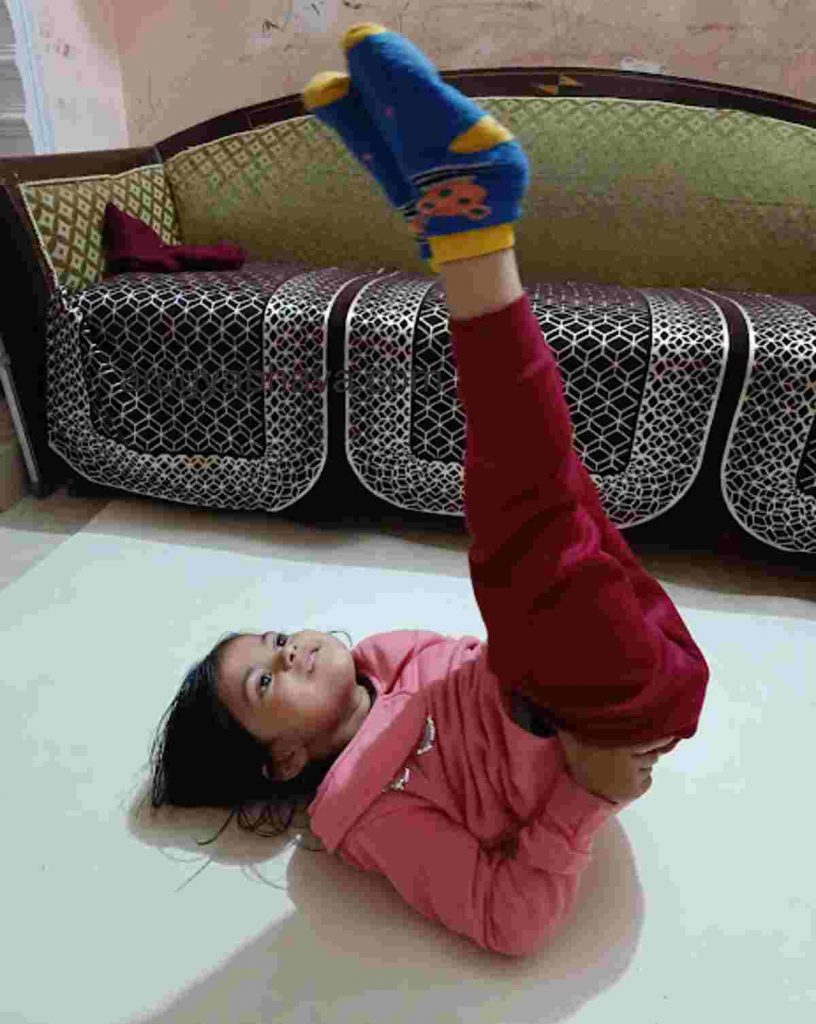
2. Sarvangasana for students

It comes second in the list of most beneficial asanas. Those who cannot do Shirshasana or those who are prohibited from doing Shirshasana can also do Sarvangasana. This asana can be done for 1-2 minutes.

sarvangasana
sarvangasana |source: arogyabhava

Sarvangasana Benefits: Due to the activation of the thyroid and pituitary glands by this asana, it helps in increasing the height of the children. The rest of the benefits like an increase in brain power, and help in concentration, are similar to Shirshasan. This asana gives relief from tiredness and tension.

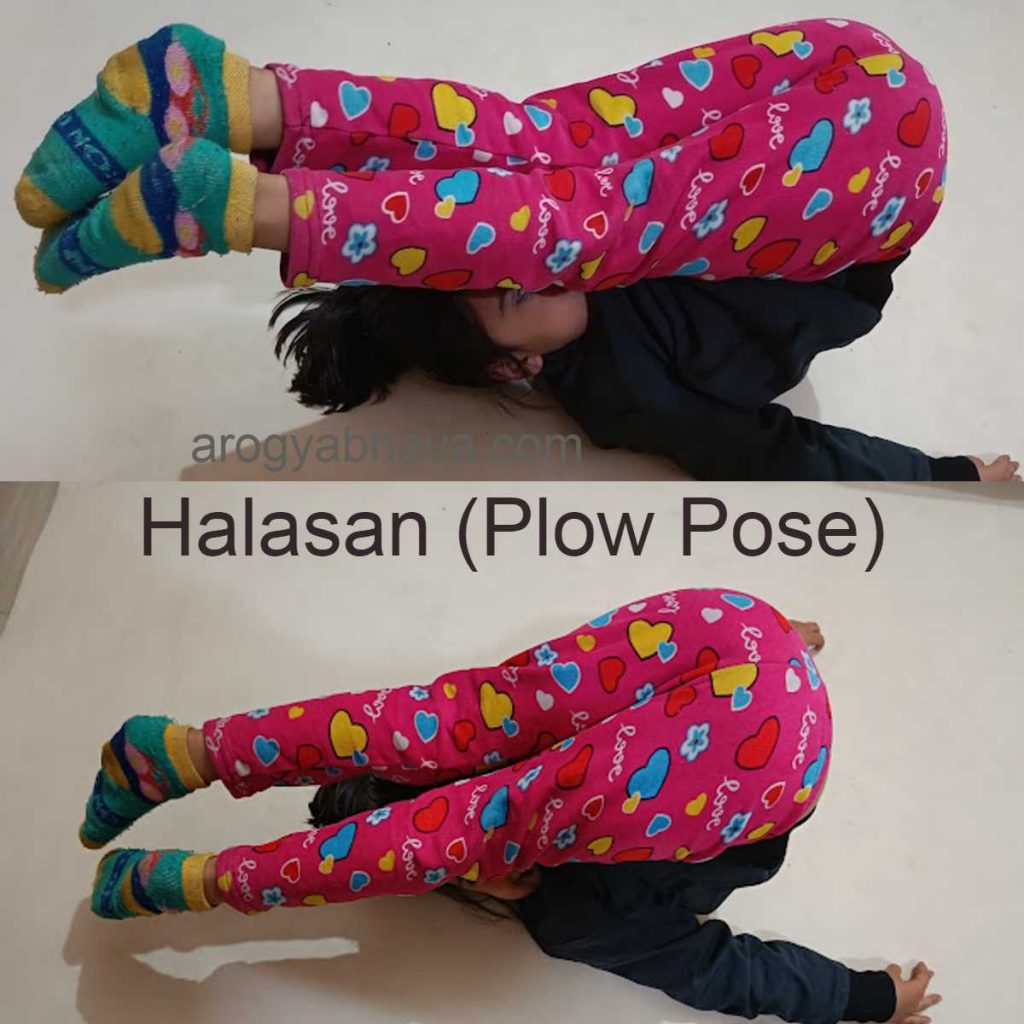
3. Halasana (Plow Pose) for students

Your children definitely learn this asana. The spine can be made healthy and flexible by this asana. Due to this children can be effective in sports, exercise, and athletics. This asana also removes the problem of obesity in children.
Children who cannot do Halasana should practice Mandukasana or Shasakasana.

halasana- plow pose
halasana- plow pose| source: ArogyaBhava

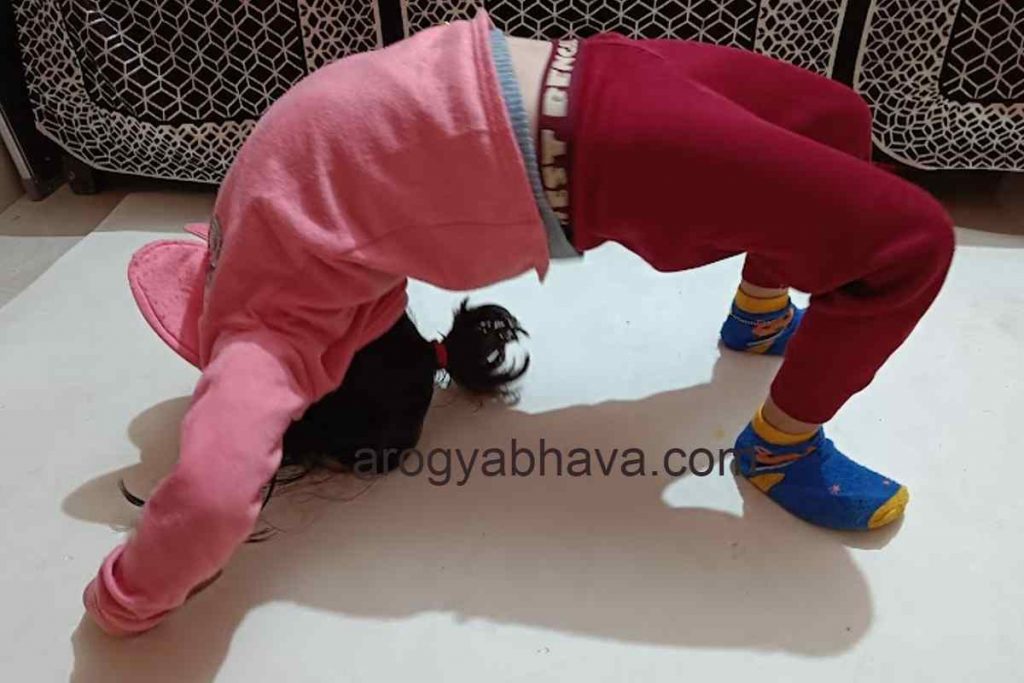
4. Chakrasana (Wheel pose or upward-facing bow)

Chakrasana is a beneficial asana for children. The spine becomes flexible through the practice of this asana. Appetite also feels good and intestines become active. As a result of the practice of this asana, the energy in the body, strength, and brightness of the face increases. It works like a panacea for children who have breathing problems, headaches, or eye disorders.

Chakrasana - Wheel Pose
Chakrasana | Wheel Pose | Image source: arogyabhava

Chakrasana steps:

Lie on your back with your knees bent. The heels should be as near to the buttocks as possible. Maintain equilibrium by keeping both hands upside down behind the shoulders at a small distance. Inhale and raise your waist and chest. Slowly pull the hands and feet closer together, so that the body forms a circle.

Read chakrasana (wheel pose) in detail: Chakrasana steps, benefits, and precautions

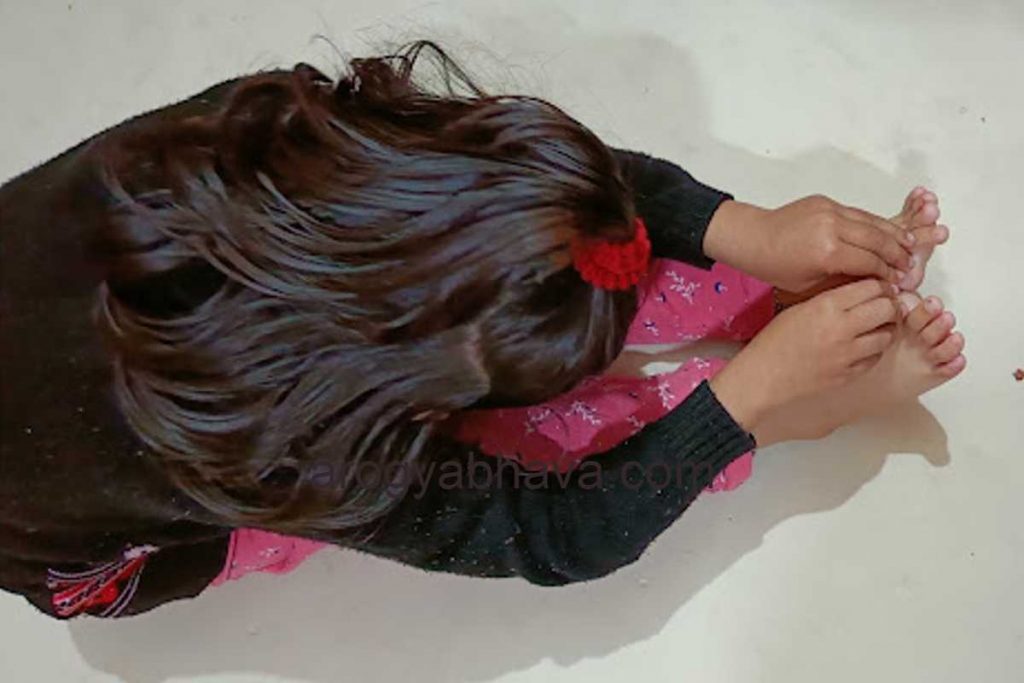
5. Paschimottanasana (Seated Forward Bend Yoga Pose)

Paschimottasana (Two legged forward bend)
Paschimottasana|Two legged forward bend|source:arogyabhava

Paschimottanasana is a very beneficial asana for school-going students. By practising this asana, the back muscles of children expand and become healthy. Due to the contraction of the muscles of the stomach, the health of the stomach improves. According to Yoga Shastras, this asana directs the Prana towards the Sushumna, which helps in the awakening of the Kundalini. Children’s concentration increases and their mind is also engaged in studies.

Also Read: Healthy Eating Slogans For Kids

Related Articles:

Healthy Diet for Students in Summer

Study: Junk Food Can Fuel Your Anxiety


CBSE Class 10 Syllabus 2021-22 Maths, Science, English, Hindi

CBSE Class 10 Syllabus

CBSE Class 10 Syllabus 2021-2022: CBSE class 10 is the most crucial year of a student’s life as it lays the foundation of their career. The syllabus for CBSE class 10 2021-22 is very different from 2020-21. In the year 2020-21, many topics were reduced due to the disturbance in the study due to the pandemic.

The CBSE Class 10 Syllabus 2021-22 contains complete information about the latest academic curriculum, structure of course, exam pattern, project and assessment guidelines, etc. Understanding the syllabus is the basis of examination preparation. All the students need to know the details of the CBSE class 10 syllabus to start preparation in the right direction and well-planned manner.

Here we are providing the link of all subjects of CBSE class 10 syllabus 2021-22 as mentioned within the official CBSE website. So, students are advised to prepare for the exam as per the curriculum mentioned here to gain the maximum number in upcoming board exams.

CBSE Class 10 Syllabus 2021-22 – Subject Wise

CBSE Class 10 Subjects 2021-22 Download Syllabus in PDF
CBSE Class 10 Maths Syllabus 2021-22 Download Here
CBSE Class 10 Science Syllabus 2021-22 Download Here
CBSE Class 10 English Syllabus 2021-22 Download Here
CBSE Class 10 Hindi Course A Syllabus 2021-22 Download Here
CBSE Class 10 Hindi Course b Syllabus 2021-22 Download Here
CBSE Class 10 Social Science Syllabus 2021-22 Download Here

Also, go through the complete details of the changes created to the CBSE class 10 Assessment scheme and perceive the examination pattern of class 10 academic year 2021-2022. All details and updates are often checked from the following link:

CBSE Board Exams Update: Major Changes for Class 10, 12 Board Exams 2021-22

Students should analyse the entire syllabus to set up their studies properly for the year so that they will do well in their periodic tests and annual examinations.

NCERT books are the best books for the preparations of board examination of CBSE Class 10. These books are the ultimate power to your basics as they help to make a strong foundation of a subject and make it very easy and simple to understand the concepts. In this way, all the CBSE Students of class 10 are advised to follow the most revised CBSE syllabus and read from NCERT books for extensive learning. Check CBSE Class 10 NCERT books and CBSE Class 10 NCERT Solutions from the below links:

NCERT Solutions, Books for Class 10

NCERT Solutions for Class 10 NCERT Books for Class 10
NCERT Solutions for Class 10 Science NCERT Books for Class 10 Science
NCERT Solutions for Class 10 Maths NCERT Books for Class 10 Maths
NCERT Solutions for Class 10 English NCERT Books for Class 10 English
NCERT Solutions for Class 10 Hindi NCERT Books for Class 10 Hindi
NCERT Solutions for Class 10 Social Science NCERT Books for Class 10 Social Science

In Case, Student has any trouble regarding the details or instructions referenced in the syllabus, they should check it and clear it with their teachers.

CBSE Class 10 Syllabus 2021-22 – FAQs

Q1. What is the syllabus of CBSE Class 10 2021-22?
Ans. CBSE Syllabus for class 10 contains complete information about the latest academic curriculum, structure of course, exam-pattern, project and assessment guidelines etc. One can see the revised syllabus CBSE official website of cbse.nic.in or you can download the revised syllabus from our website.

Q2. Is CBSE going to reduce syllabus 2021-22?
Ans. Yes, CBSE will reduce the syllabus for Class 10 for the academic year 2021-22.

Q3. Is there any change in CBSE class 10 syllabus 2021-22?
Ans. CBSE has announced the new assessment scheme, and there is a considerable reduction in the syllabus of class 10 board exams for this academic year.

Q4. Will consumer rights questions come on CBSE Class 10 Board Exam 2021-22?
Ans. No, Consumer rights chapter questions will not be asked in the board exam. The consumer rights chapter is meant for project works only.

Important Study Tips for Cracking the Board Exams

Study Tips for Board Exams

CBSE class 10th and 12th board exams for the year 2020-21 will be starting soon with the reduced syllabus. We know that all the students have extreme pressure on their mind about how to score well in these exams which can result in lots of negative effects like depression, fear of paper, etc. and this academic year went awful due to pandemic. Students are attending their classes online which cannot compete with the offline school classrooms. Students cannot get the doubt clearing sessions which they can get in the classroom, Although, there are lots of ways on the internet to solve your doubts they cost too much which is not friendly with the pockets of the middle-class student. At this time students are busy with the preparation of their board exams and they all wanted to give their 100% on this. At this time of Pandemic, all the students are in stress and struggling with the exam preparation. Now in this article, we will discuss some of the most important points which you should remember when you are preparing for the board exams and want the best result. If you follow these tips you will get high scores in your board exams without stressing your mind and body. These Tips are highly beneficial especially for the students who have to attempt their board examinations this year. So let’s start-

Some Tips to Crack your Board Exam

  1. Start your preparations early: We know that all the students have their own capabilities for the learning and understanding of topics, but you should start from the beginning of the session to avoid the tension and to reduce the burden on your mind. But, if you have not yet started the preparation, you can start from today, it is not late yet.
  2. Proper time table: Researches have proved the importance of a proper time table to reach your goal. So, every student should prepare a proper time table and have to stick to it to get better results. Make your time table in such a way that you can spare some time for your hobbies and fun activities without disturbing your studies. Divide your study time properly in order to avoid over-stress on your mind.
  3. Sufficient time for self-study: No matter that you are going to coaching, tuitions, or other educational institutions but you have to give an ample amount of time for self-study. You can use this time to revise the topics which you have learned in school or coaching. When you learn a topic in school then again you go through it in tuitions or coaching classes and then again during your self-study time, the topic gets printed in your mind in such a way that you can solve any problem or answer any questions related to that topic. You can also go through the topics which you will be studying in school or coaching next day for better clarification but do this only if you have time left after revising today’s topic. Self- study is a boon for examination preparation. Especially during this pandemic year, Self-study is great support for the students. This is one of the important pillars that can help you to get your result.
  4. Best study habits adaptations: To stand in the queue of toppers, you must adopt proper study habits by creating well-planned study strategies and sticking to it. This will also help you to be disciplined and will be helpful in your future also. Giving proper time to academics as well as your personal life can lead to a good quality living and better preparations for your exams. These adaptations will become a habit if you do it in a disciplined manner which is important for a student in his/her life.
  5. Strategy to learn long answers: It is natural that every student whether he/she is a topper or an average student has a phobia of learning long answers and these long answers contain the maximum marks in the examination that is why they cannot be left un-attempted at any cost. So, the student should make a strategy for learning these answers like you can break it into paragraphs, pen it down again and again on the paper or relating it with the real-life can help you a lot in learning these long answers.
  6. Solving previous year question papers: If you are in a race and you have an idea of it, your chance of winning it doubles. So, in the same way, you can solve the previous year question papers so that you can understand the pattern of the exam, the frequently asked questions, marking scheme and important topics. As a result your chances to perform in the board exams will increase. Solving the previous year question paper introduces you with your weakness and strong points.
  7. Solving sample papers: Solving the cbse sample papers will do the same work as done by question papers but it has an additional advantage that it contains the marking scheme of the paper which will come in that particular year. It will also give you the idea of the number of questions that will come and their types like no. of MCQs, Short answers, etc.
  8. Take regular breaks: Do not get too engaged in studies all the time. Remember to take breaks in between to freshen up your mind. Research has proved that everyone’s mind has its own power to work without getting rest. So, when your mind and brain have reached that particular limit, you will start to lose focus on your studies. This is the signal that you need to rest. Understand your mind and body and take rest after every 2:00 – 2:30 hours of studying.
  9. Throw the fear of exams away and just relax: If you will fear your board exam then you will definitely not be able to do well as proved by the research. So in place of taking useless tensions, start the preparations with a relaxed mind. You just need to give your best and definitely the result will be good. As the syllabus is huge and time is less. Don’t waste it in taking tension and stressing out yourself. Focus on studies and utilize every single minute.
  10. Write your board exam answers appropriately: After preparing for the exams and doing so much hard work, now it is the time to reflect it on your answer sheet. You should write the answers according to the questions asked and its weightage in terms of marks. Always write answers up to the mark rather than writing answers which are full of riddles. Make sure to utilize your first 15 minutes which are given to you as a reading time.
  11. Don’t keep too much food on your plate: This means do not try to study everything in a single day, if a chapter is too long and is also hard to understand, try to break it into parts and do not mug up all the parts in a one single day. Take 3-4 days to study that chapter thoroughly.
  12. Have proper food and rest: Remember to have a healthy diet. Many students start ignoring their lunch and dinners which leave them exhausted and they end up tired and sick. Make sure to have some snacks at least 2 times a day (between breakfast and lunch, between lunch and dinner). Also, take proper rest and at least 7 hours of sleep is necessary for a student to study well. Eat a balanced diet that is full of vitamins, minerals, and other nutrients. It will also safeguard you from the illness which you can face at the time of the exam or near it.
  13. Do meditation: Do meditation when you wake up. It will help you to understand the topics better. Meditation helps you to calm your mind and increases your mental capacity. Students doing meditation daily can focus on their studies very well.
  14. Don’t force yourself to be a morning or evening person: Always remember that everyone is not a morning person who can wake up early in the morning and do study. Some people have that kind of mind which works well in the evening or night. So, study at that time in which your mind is ready. Don’t force yourself to wake up too early in the morning or to study too late at night if you are not comfortable with it.
  15. Take Mock Test: Mock tests are available everywhere. Attempting them is the best way to get familiar with the real examination, environment, and exam day stress.
  16. Work on your weak and strong points: Once you find out your weak subjects or topics, Try to work hard on them and find different ways to understand them. You can also ask for assistance from your teachers or friends. Give extra time to these topics and try to crack them. Polish your strong topics and subjects. These can be very scoring for you and can make a great impact on your result. Prepare them in such a way that you can attempt any question from these topics.

Conclusion

Every student has unique abilities and studying strategies. It is important to keep in mind that these board exams are the most important part of your study. You have to score good in these exams to shape your future in a better way. Give your 100% efforts in exam preparation and don’t be afraid. No need to overstress yourself and study with a calm mind. Follow the above – listed tips, you will surely get the best result. All the best for your Board Examinations. 

Frequently Asked Questions

Q1. I am a student of class 10th and very afraid of examinations. What should I do to get rid of this fear?
Ans. Firstly, remember Examinations are not ghosts. Calm yourself, Do meditation, and study hard. Once you start understanding the topics, you will feel confident. Attempt mock tests, previous year question papers, and sample papers to increase your confidence. Try talking to your friends and do group studies. Remember, nothing is impossible and you are capable enough to score well in these examinations.

Q2. Board Examination Pattern remains the same or does it change?
Ans. The Board examination pattern can change but the board will definitely inform you about the new pattern with the means of sample papers released by it or through official notifications. Make sure to go through the sample papers properly and check for any changes. 

Q3. How much syllabus is reduced for board examination this year?
Ans. The CBSE has reduced its syllabus due to the disturbance in the study because of the pandemic. You can get the proper information of the reduced syllabus subject -wise on its official website. 

Q4. Only classes 10th and 12th have board examinations?
Ans. Yes, Majorly only class 10th and 12th have board examinations but many state boards also have class 8th board examinations.

Q5. Why are Board examinations important?
Ans. Board examinations are very important in a student’s life as they are the evaluation of the knowledge of the students and their preparation level. They help students to understand their strengths and choose their careers accordingly. They strengthen the student’s insight and prepare them for their future. Board exams teach students punctuality, time management, Toleration power, and perseverance. Students get a chance to compete with the students outside their school and learn to face stress and get success. 

Q6. What are the Passing marks in the CBSE Board examination?
Ans. The passing marks for the CBSE Board examination are 33%. The student must score at least 33% in every subject to pass the examination. If he/she fails to score 33% in all the subjects, needs to apply for re-examination or the compartment examination. 

Q7. Do we need to study the whole syllabus for the Board examinations or there are any selected topics?
Ans. Usually, students are required to study the whole syllabus for board examinations but this year the syllabus is reduced in CBSE. The reduction of the syllabus is done due to the huge disturbance in studies because of the pandemic. 

Q8. What are MCQs?
Ans. MCQs are multiple-choice questions. As the name suggests, these types of questions comprise four options and you need to select the right answer. You are likely to get these questions in all your board examinations. Please go through the sample papers released by the board for further information.

The Career Options After Class 10th – Is Class 12th must to Build a Career?

Career Option After Class 10

Most of the pupils completing their 10th standard are concerned about choosing the right career path. Choosing the right course after class 10 is not an easy task. For a successful career, solid planning and following it up with a useful plan is needed.  Career research, knowledge about one’s own self, decision-making ability, future goals are some of the basic elements required for successful career planning. For determining a potential career, one can also serve educational fairs and career guidance seminars that enable us to get in touch with several institutes and courses. They should have a persistent focus on his or her goal and can seek the help of their teachers, parents, and elders.

Picking the right career option after the 10th is probably the most important decision of our life and should not be taken in a hurry.

Let us see how we can choose the right career path after class 10th: 

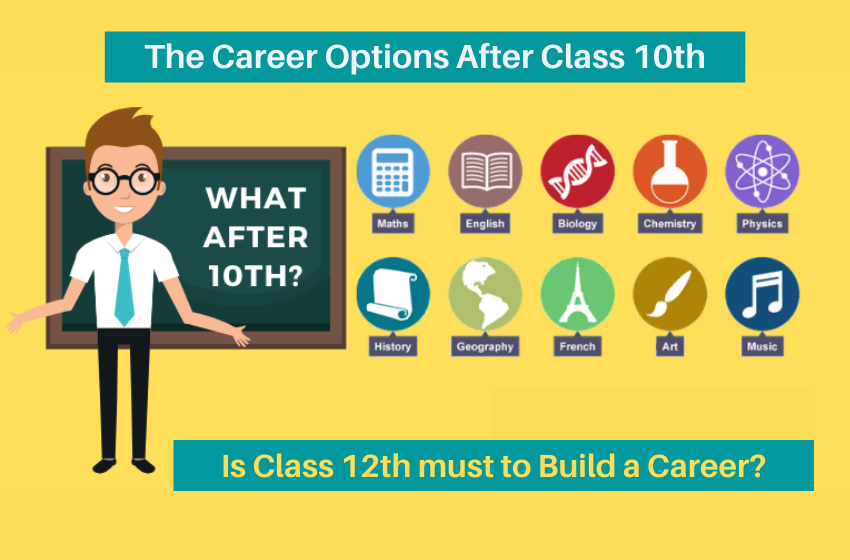
  • Intermediate – After the 10th class, the pupil can choose subject combinations like PCM, PCB, PCMB, Commerce with Maths, Commerce without Maths. Post completion of the 12th class, one can do graduation in multiple disciplines based on the subject selection.
  • Polytechnic – After the 10th class, students can do polytechnic courses like Mechanical, Civil, Chemicals, Computer, Automobile. Polytechnic colleges provide diploma courses for 3 years, 2 years, and also 1 year.
  • ITI (Industrial Training Institutes) – After the 10th class, students can do ITI courses for employment like Mechanical, electrician, electrical.
  • Paramedical – After the 10th class, pupils can do paramedic courses like DOA (Diploma in Ophthalmic Assistant), DOT (Diploma in Ophthalmic Assistant), DMLT (Diploma in Medical Laboratory Technology). 
  • Short term courses – After the 10th class, pupils can do short term courses like Tally, DTP, etc.

Right career advice and guidance at the right time can do wonders for us. A career counselor can help us decide what to choose after the 10th. An expert will assess and analyze our strengths, passion, and interest.Based on that the expert will determine our most suitable career path.

How to pick the education board? Should we go to CBSE or ISCE or IB?

We have finished our 10th. Now we are planning to pick an education board that is most suitable for us. Deciding between CBSE, ISCE, and IB is not an easy decision. Each education board has its own advantages. If it comes to having the best education, choosing the right board and school is very important. Let’s take a glance at the perks of choosing any education board. It will be easier for us to decide which board to opt for.

Benefits of CBSE (Central Board of Secondary Education)

  • Probably it is the most common education board and the national board of our country. CBSE has a combined curricular approach that assists develop holistic individuals.
  • CBSE emphasizes skill development. 
  • CBSE assists pupils to prepare for competitive exams as most of the questions in competitive exams are asked from NCERT.
  • Most of the competitive exams like JEE mains and advanced are conducted by CBSE. 
  • It gives quality knowledge to the pupils as well as assures the overall development of an individual.
  • One of the best advantages of the CBSE board is that it gives the flexibility to choose the subjects based on the student’s interests. The overall structure of CBSE is very compact and it doesn’t allow us to feel any pressure.
  • We don’t need to mug up the answer. Well-written answers are praised by the CBSE board giving pupils a chance to examine their thinking horizon. 

Benefits of ICSE (Indian Certificate of Secondary Education)

  • ICSE is estimated to be the hardest board. The curriculum of ICSE is very comprehensive and it includes all fields with equal importance. 
  • ICSE pupils become usually very good at English because of their in-depth curriculum.
  • There is no surprise that students who do well in ICSE are required to clear the Civil service exam as the art of writing compactly in English is very much needed in Civil services.
  • The syllabus and structure of ICSE are in such a form that it allows pupils to study beyond textbooks and have practical insights into the concepts.
  • The standard and curriculum of ICSE provide the students with a strong foundation and make them ready for their future.
  • Amount and content of the syllabus might be high. However, it also develops high knowledge among the students. We might have heard that what CBSE teaches us in 11th or 12th, the ICSE board has already taught the concepts in 9th. Such result and resourcefulness is ICSE’s curriculum. 

Benefits of IB (International Baccalaureate)

  • It helps us to get admission in respective foreign countries if we are planning to study abroad. 
  • IB board helps us to become more culturally aware.
  • It encourages us to get into the Global Association.
  • It helps in the all-round development of a student through their extra curriculum. 
  • IB board gives us the flexibility to select our subjects.

These are some advantages of the top education board. As no board is the best, every board has its advantages. It depends on the student’s aptitude i.e. tendency to learn new things. It is also essential for a student to understand a career assessment for the 10th class. To understand the personality, interest, and aptitude of the student Career assessment is necessary. As it helps to find out the suitable subject group and career path.

Negative impact of getting a job/doing job oriented course instead of higher education

  • Economic: According to the statistics provided by the Bureau of Labour, people with some form of higher education tend to earn more money and have a low probability of unemployment. 
  • Better communication: Some form of written or verbal communication is involved in most jobs. As such, we usually improve in both areas during our college and professional career.
  • Recognition of passions: As it is said that the more we learn than more we are inclined to find our true passion in life and it is implicated in most people.  Therefore, through the education process only we can explore the various aspects of a prospective field and find our strength with it. 
  • A higher sense of discipline: The discipline required in the professional world can be taught by the different troops of education. Thus, by learning to comprehend complex directions and by meeting strict deadlines, we will be better able to adjust to the rigidity of the marketplace. 
  • Health: Productive employment and a certain cashflow take away the stress factors connected with any financial insecurity. As such, we are more inclined to live a better and healthier life with some form of college below our belt.
  • Civic involvement: When we earn well and our network grows then we are more liable to involve in volunteer work.As it is all possible due to the productive employment and financial resources.
  • Personal growth: As the people with their respective careers tend to live more structured lives with a stronger sense of responsibility traits that serve as a strength-builder in other areas.
  • Sense of accomplishment: Each time we complete a school assignment or job task, it’s the product of our talent and hard work which cannot be felt if we only study for a limited class.

Positive impact of getting a job/doing job oriented course instead of higher education

  • There are a few popular jobs available after class 10th in the government sector.  Aside from the government sector, public sector companies such as HAL, ONGC, and others also provide low ranked positions after class 10th.
  • The cut-throat competition faced for taking a Sarkari Naukri with minimum educational eligibility of class 10th can be an apparent example of this aspect. Students who want to financially support their families or need some experience before pursuing their further studies can opt for Government jobs after Class 10th.
  • The several government departments advertise regular vacancies with a minimum qualification of class-10th every year for the government job seekers who have done class 10th. And these advertisements are done in public through newspapers and the official website of the departmental websites. However, this job offers see very tough competition due to the minimum educational qualification due to which deserving candidates miss out on application deadlines.

Conclusion

Yet there are limited career opportunities after class 10th but still, you can be hired in an array of jobs after your class 10th. Hence, there is no reason to feel bad if you couldn’t continue your higher studies. As there are several opportunities you could climb to grab the career ladder. Therefore, get ready to work hard and not to be disheartened as you have to achieve great heights, with minimum educational qualification and maximum determination.  


FAQs regarding Career After Class 10th

Q1. Which is the best course to opt for after class 10th?

Ans. There are many best courses available after class 10th but it highly depends on your interest and the scope of that particular course shortly. Thus, you can choose from any stream from Arts, Science, Commerce or you can also opt for Polytechnic diploma courses.

Q2. What are the different courses available after the 10th?

Ans. There are mainly three-stream Arts, Commerce and Science for the best way to go further study and some other courses available after 10th class such as Diploma courses, ITI courses, short term computer, and other courses.

Q3. What are the subjects in science?

Ans. There mainly five subjects in Science Stream in the form of two groups and i.e. 

  • Group A – Mathematics, Physics, Chemistry, English. 
  • Group B – Biology, Physics, Chemistry, English. And One subject is selected as per school as it is optional.

Q4. Is math a science subject?

Ans. Yes, Mathematics is one of the Science stream subjects in Group A and other science subjects like Physics, Chemistry, Biology, English.


Related Links:

Career Options in Defence Services After the 12th Class?
Best Career Options after 12th in Creative Field
Best Career Option After 12th in Scientific Field
Career Prospects for Biology 12th Pass Students

SSLC and PUC Full Form: Meaning in Indian Education

sslc and puc

In India, education plays a critical role in shaping the future of students, and two of the most important milestones in this journey are SSLC and PUC. These two certifications act as the gateway to professional careers and higher learning, especially in states like Karnataka, Kerala, and Tamil Nadu. Whether you are a student planning your next academic move or a parent trying to understand the school system, knowing how these two stages differ is essential for making informed decisions about future career streams.

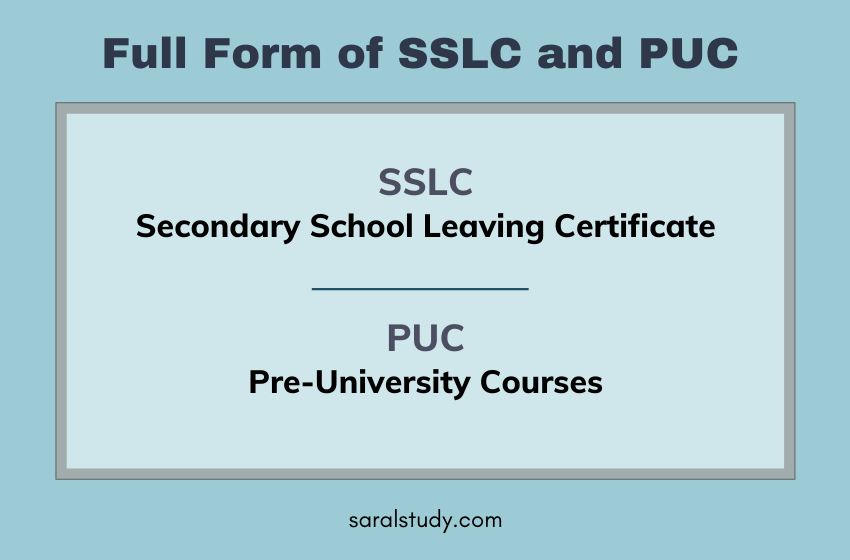
To clarify these terms, the SSLC full form is the Secondary School Leaving Certificate, which is awarded upon the successful completion of the 10th-grade board exams. Following this, students transition into the PUC full form in education, which stands for the Pre-University Course. While the sslc meaning is centered on completing foundational secondary schooling, the puc full form represents the vital two-year intermediate program (Class 11 and 12) that prepares students for university-level degrees in science, commerce, or arts.

What is SSLC? Understanding SSLC Full Form and Meaning

The SSLC meaning refers to the first significant milestone in a student’s life in many Indian states.
The full form of SSLC is the Secondary School Leaving Certificate and there are many other names also such as SSLC certificate, Matriculation, SSLC mark sheet, Secondary school certificate, SSC etc. It is the Class 10
th certificate or 10th standard certificate.

SSLC Meaning: Is SSLC 10th or 12th?

The term SSLC refers specifically to the 10th grade. It does not indicate 12th grade. In many Indian states, the 10th board exam is referred to as the SSLC exam, and passing this exam is necessary to pursue higher studies or vocational training.

It is given to the student by the respective educational boards after successfully completing class 1st to 10th along with the senior secondary certificate examination i.e. class 10th examination. All the states are approved by the Ministry of human resource development, the Department of school education, and the government of India. 

Why SSLC certificate is important?

The SSLC certificate is important to enroll in higher secondary education in India. It was used as the Date of Birth proof in India when death and birth certificate were not mandatory. In India, the SSLC certificate is the age proof of the people born before 1989.

Different names of SSLC in India

  • In Kerala, Karnataka, and Maharashtra and the other South Indian States, it is called SSLC certificate for class 10th.
  • In the north and eastern states of India, it is called HSC – Higher Secondary/matriculation certificate.
  • In Andhra Pradesh and Telangana, it is called SSC certificate – Secondary school certificate.

Importance of SSLC

  • Proof of Date of Birth: As discussed earlier, It is a proof of Date of birth for the people born before 1989 in India. Before 1989 the Birth and death certificates were not compulsory in India, so people started using SSLC as their Date of Birth Prove. They can use it as a legal document for different purposes like making passports or voter cards etc. 
  • Enroll for higher education: A student must obtain an SSLC certificate to enroll for class 11th or any diploma/polytechnic courses. 
  • For Driving Licence: To get a driving license in India, one must possess the SSLC certificate to prove that he/she has passed class 10th..

Relevance of SSLC Certificate for Job Objectives and Passport Acquisition in India

In India, the SSLC (Secondary School Leaving Certificate) is crucial for several pivotal reasons.

Job Requirements

Many employers in India mandate the SSLC certificate as proof of educational qualification. This certification demonstrates that the individual has successfully completed secondary education, providing a foundational level of literacy and essential skills required for various job roles.

Passport Application

For passport applicants, the SSLC certificate serves as an important document. It is often required to verify the applicant’s date of birth and academic qualifications. Without this certificate or an equivalent, the passport application process can be significantly delayed.

In summary, possessing an SSLC certificate is essential for meeting job qualifications and successfully acquiring a passport under Indian regulations.

Educational opportunities after SSLC

A student becomes eligible for higher education or pre-university education after the qualifying SSLC examination. An SSLC certificate holder can apply anywhere for any technical course. The students will be trained professionally for their careers.

Options for Technical Training After SSLC:

  1. Technical Training College:
    • Students can choose to enroll in a technical training college. Here, they will gain skills tailored for professional careers.
  2. Polytechnic for Engineering Diploma:
    • Students possessing SSLC can apply for a 3-year diploma course in polytechnic for engineering.
    • After completing the diploma, they can further pursue an engineering degree.
  3. Vocational Educational Programs:
    • There is also an option to enter vocational educational programs after completing SSLC.

After SSLC, students can also apply for vocational educational programs. If any Indian wants to migrate to another country for job purposes, he/she needs an SSLC certificate for the passport.

Breaking it down further, the specific paths include joining a polytechnic for an engineering diploma, which can lead to an engineering degree, or opting for vocational educational programs that provide targeted training in various trades and professions. These alternatives ensure a robust pathway for students aiming for technical careers.

How to get duplicate SSLC

There have been many unfortunate incidents where people lost their important documents. To obtain the duplicate SSLC, you need to follow some of the steps mentioned below:

Step 1: File an FIR in the nearest police station where you have misplaced your SSLC. 

Step 2: Download the form for Duplicate SSLC from your board website and if it is not available online, you can also visit the Board’s office to fill-up the form.

Step 3: Make the Demand Draft or NEFT, whichever is accepted by your board, for the amount prescribed by the Board. 

Step 4: Attach all the Documents needed for the duplicate SSLC. 

Boards Offering SSLC in India

There are a total of 53 Boards in India which are offering SSLC to their students. The list is as follows:

S. No. Board Name Link
1 Assam Sanskrit Board Link
2 Aligarh Muslim University Board of Secondary & Sr. Secondary Education, Aligarh Link
3 Board of Secondary Education (Andhra Pradesh) Link
4 Department of School Education Nagaland Link
5 Board of School Education, Haryana Link
6 Board of School Education Uttarakhand Link
7 Board of Secondary Education Rajasthan Link
8 Board of Secondary Education, Assam Link
9 Board of School Education Haryana Link
10 Board of Secondary Education, Telangana State Link
11 Board of Secondary Education Link
12 Board of Secondary Education, Manipur Link
13 Board of Vocational Higher Secondary Education, Kerala Link
14 Board of Secondary Education, Madhya Pradesh Link
15 Bihar School Examination Board Link
16 Bihar Board of Open Schooling & Examination Link
17 Bihar State Madrasa Education Board Link
18 Bihar Sanskrit Shiksha Board Link
19 Banasthali Vidyapith Link
20 Central Board of Secondary Education Link
21 Chhattisgarh Board of Secondary Education Link
22 Chhattisgarh State Open School Link
23 Chhattisgarh Sanskrit Board, Raipur Link
24 Chhattisgarh Madrasa Board Link
25 Council For The Indian School Certificate Examinations Link
26 Dayalbagh Educational Institute (Deemed University) Link
27 Goa Board of Secondary And Higher Secondary Education Link
28 Gujarat Secondary And Higher Secondary Education Board Link
29 Gurukula Kangri Vishwavidyalaya Link
30 H. P. Board of School Education Link
31 Jharkhand Academic Council, Ranchi Link
32 Karnataka Secondary Education Examination Board Link
33 Kerala Board of Public Examination Link
34 Maharashtra State Board of Secondary And Higher Secondary Education Link
35 M. P. State Open School Education Board Link
36 Maharishi Patanjali Sanskrit Sansthan Link
37 Meghalaya Board of School Education Link
38 National Institute of Open Schooling Link
39 Odisha Punjab School Education Board Link
40 Rajasthan State Open School, Jaipur Link
41 Rashtriya Sanskrit Sansthan Link
42 State Board of School Examinations(Sec.) & Board Of Higher Secondary Examinations, Tamil Nadu Link
43 State Madrassa Education Board, Assam Link
44 Telangana Open School Society Link
45 Tripura Board of Secondary Education Link
46 The J & K State Board of School Education Link
47 The West Bengal Council of Rabindra Open Schooling Link
48 U.P. Board of High School & Intermediate Education Link
49 Uttarakhand Sanskrit Shiksha Parishad Link
50 West Bengal Board of Secondary Education Link
51 Uttarakhand Madrasa Education Board Link
52 West Bengal Council of Higher Secondary Education Link
53 West Bengal Board of Madrasah Education Link

What is the Full Form of PUC in Education?

PUC stands for or PUC full form is pre-university courses mainly known as intermediate or plus 2 (10 + 2) in India. These courses are conducted by the educational boards of India or the state boards and the duration of the courses is 2 years. 

In Karnataka and several other Indian states, PUC refers to the two-year intermediate course taken after completing the SSLC or 10th standard. It is equivalent to 11th and 12th grades and prepares students for higher education in streams like science, commerce, and arts.

Students who wish to take admission for Pre-university courses need to get the SSLC (Secondary school leaving certificate). The education system in India follows the 10+2+3/4/5 pattern. 10 years of schooling which includes 5 years of primary education and 5 years of secondary education. 2 years of schooling is the pre-university courses or the intermediate. The duration of university courses in India is 3-5 years depending upon the field chosen by the student. PUC is offered in the PU colleges or the junior colleges in India. 

PUC Full Form in Karnataka and Its Importance

In Karnataka, PUC (Pre-University Course) is the standard progression after completing SSLC. Students can choose between different streams like science, commerce, and arts, which determine their further career or higher education paths.

Educational opportunities after PUC

The Junior colleges mainly offer 3 streams for PUC i.e. Science, Commerce, and Arts. 

The students who qualify PUC with science stream can opt for Professional courses in Nursing, Pharmacy, Medicine, agriculture, and engineering in any Indian University. These students can also opt for B.sc (Bachelor in Sciences). 

The students who qualify PUC with commerce stream can opt for Bachelor of Commerce or the Bachelor of Business management in any Indian university.

The students who qualify PUC with Arts stream can opt for BA (Bachelor of Arts), D.ed (Diploma in education), BSW (Bachelor of Social work), or any designing courses like fashion designing.

Advantages of PUC

PUC offers 2 years to the students to explore their strengths and develop an interest in the field they wish to opt for as their career. PUC introduces the students to further study for their careers. The students can understand the world outside the school and get to know the real challenges they are going to face. 

Know the various fields of PUC in detail

As discussed earlier about the courses offered in PUC, let’s have a detailed look at them:

Science: The students who score high in their secondary examinations can opt for this field in PUC as the students of this stream are expected to have a clear understanding of concepts, theories, formulas, and experiments. The Students of their stream usually get occupied with practicals, records, coachings, seminars, etc. 

The subjects available in the science stream are Maths, Physics, Chemistry, Biology, Electronics, computers, statistics, geography, and home science. Students can choose the subjects according to their choices and the combinations offered by the Institutions. 

Common combinations: PCB, PCM, PCMB, PCMC, PCME, PCMG, PCBH and PCBE

Commerce: This stream is for the students who wish to make their career in accounts, business, computer, management, etc. Although this stream is easy for the students, one must have a stronghold over Data, Theory, Numerical and Analytical. The students can also prepare for CA after qualifying PUC with commerce. 

The subjects available in this stream are Maths, Business Studies, Accountancy, Statistics, Economics, Business Maths, Economics, etc. students can choose according to their choices and the combinations offered by the educational institutions.

Common combinations: SEBA, ABEM, BSAM, EBAC, and APBE.

Arts: Students who wish to make their career in IAS, Economists, etc can opt for this stream in PUC. People usually consider this field for the students who are below average but the truth is if you wish to opt for this field you must have strong linguistics, Social, Arts, and interpersonal intelligence. 

The subjects available in this field are very interesting like Psychology, sociology, Education, Languages, History, Music, Economics, Geography, Political science, etc.  Students can choose according to their interests. 

Common Combinations are HESP, HEGP, HEPK, ELSP, ESPP, HEKM, etc. 

SSLC and PUC: Key Differences

While SSLC is the 10th-grade certification, PUC is a preparatory course for university-level education, equivalent to 11th and 12th grades. The transition from SSLC to PUC is important as it allows students to specialize in chosen subjects, guiding their future academic or professional choices.

Feature SSLC PUC
Full Form Secondary School Leaving Certificate Pre-University Course
Education Level Class 10 (Secondary) Class 11 & 12 (Higher Secondary)
Purpose Eligibility for higher secondary Eligibility for Degree/University
Common States Karnataka, Kerala, Tamil Nadu Karnataka, Andhra Pradesh


Also Read: Tips To Crack Business School Entrance Examination

FAQs regarding SSLC and PUC

I want to build my career in the Paramedical field, Which PUC courses should I opt for?

For Para – Medical you must opt for the science stream in your PUC with a combination including Physics, Chemistry, and Biology. 

How to get the SSLC certificate?

To obtain an SSLC certificate, you must qualify for the secondary school examination conducted by your educational board.

Are SSLC and SSC the same?

Yes, SSLC, and SSC are the same thing. In Andhra Pradesh, it is called SSC whereas in south India it is called SSLC. 

Can a person born after 1989 also use SSLC as the Date of Birth Proof?

Yes but it is better to use the birth certificate as DOB proof as it is ordered by the government of India. 

Can I Opt for diploma courses after PUC?

Yes you can opt for diploma courses after PUC and you can also opt for the same after obtaining SSLC also.

What is PUC Full Form and Meaning in Education

PUC stands for Pre-University Course and is a two-year program that bridges secondary education and university-level studies. After completing the PUC, students can appear for various entrance exams for professional courses or seek admission to undergraduate programs.

Is PUC Necessary After SSLC?

Yes, after SSLC, students typically enroll in PUC or similar intermediate courses (11th and 12th grade). These courses are essential to qualifying for entrance exams and undergraduate programs in universities.

What does SSLC mean in education?

SSLC, or Secondary School Leaving Certificate, is a qualification awarded to students after completing the 10th grade. It signifies the end of secondary education and allows students to pursue higher education, typically through PUC or similar intermediate programs.

Is PUC the same as 12th?

Yes, PUC (Pre-University Course) is equivalent to 11th and 12th grades in India. It is a two-year program that prepares students for higher education by specializing in a chosen stream like science, commerce, or arts.

What is the full form of PUC in Karnataka?

The full form of PUC in Karnataka is Pre-University Course. After completing SSLC (10th grade), students enroll in PUC for two years to pursue specialized subjects that guide their higher education or career paths.

What is the difference between SSLC and PUC?

The SSLC (Secondary School Leaving Certificate) marks the completion of 10th grade, while the PUC (Pre-University Course) is a two-year intermediate program (11th and 12th grades). SSLC acts as the foundation for PUC, which then prepares students for university or professional courses.

Is PUC compulsory after SSLC?

While not strictly compulsory, most students opt for PUC after SSLC to complete their intermediate education. It is necessary for those aiming for university degrees or competitive entrance exams, but students can also explore vocational training or diploma courses.

What is the sslc full form and its significance?

The sslc full form is the Secondary School Leaving Certificate. Obtaining this certificate is mandatory for students completing their 10th-grade board examinations, as it acts as primary proof of age and educational qualification.

National Talent Search Exam (NTSE): Exam Dates & Pattern, Application Process, Eligibility

The National Talent Search Exam Known as NTSE is conducted every year by NCERT to search the deserving candidates who wish to pursue their further studies in social studies and science. The exam is conducted in 2 levels: State Level and National Level. The state-level examination is held for class 10th students by 29 states and 7 UTs. The students who qualify at the state level will be eligible to appear in the National Level examination. The scholars will be awarded cash prizes to continue their studies.

NTSE Scholarship Details

Scholarship Name

Provider's Name

Application Period

National Talent Search Exam (NTSE)

National Council of Educational Research and Training (NCERT)

August- November

NTSE Eligibility- Who can apply?

NTSE Eligibility for Stage 1 (State degree exam)

  • The candidate needs to be a Class X student from any Government/ Private colleges in India.
  • There isn’t any restriction. The candidate may be from any State/Union Territory of India.
  • The applicants studying through open or distance are also eligible to appear in NTSE.

NTSE Eligibility for Stage 2 (National degree exam)

Only the scholars who are certified in degree 1 (state-degree exam) are eligible to appear for the Stage 2 exam. The roll number, venue, date of exam information may be conveyed to the applicants by the NCERT.

NTSE Eligibility for Students Studying Abroad

  • Indian college students studying overseas in Class X or equal are eligible to appear in degree 2 directly and are exempted from the degree 1 exam.
  • The candidate needs to have scored 60% in the preceding year’s annual exam.
  • The applicants need to request via the Head of the Institution in which he/she is studying, along with an attested copy of the Class IX mark sheet.

Qualifying Factors- What Documents are Required?

The documents that candidates are required to submit along with the application form are:

  • Cast Certificate
  • Recent colored passport size photograph.

Benefits of this Scholarship

NTSE scholarship is a financial aid to financially weaker students who wish to continue their studies but are facing financial issues. The NCERT picks out the most deserving candidates and provides them financial assistance to fulfill their dreams. The detailed prize money and other rewards will be explained further in this article.

Rewards of this scholarship

Scholarships are presented for every degree of education. These levels are:

  • For Class XI to Class XII, a scholarship of Rs.1250/- per month is supplied.
  • For Undergraduates and Postgraduates, a scholarship of Rs.2000/- per month is supplied.
  • For Ph.D., the scholarship quantity is constant according to the UGC norms.

The stepwise application process to apply for NTSE

Step 1- Visit the NCERT official website of your state/UTs.

Step 2- The NTSE section will appear on the homepage, click on it, and select the “NTSE application form”.

Step 3- Fill up all the questions in the form.

Step 4- Upload the scanned copy of the photograph, signature file, and other documents as per the instruction given.

Step 5- Pay the fee online.

Step 6- Download the form and submit it to your school. The Principal of the School will forward it to the State Liaison Officer after reviewing it properly.

Important Dates

Events

Dates

Application Starts (Stage 1)

October

Application Starts (Stage 2)

not required

Admit Card Release Date (Stage 1)

November

Admit Card Release Date (Stage 2)

3rd week of May

NTSE Exam Dates (Stage 1)

12th - 13th December

NTSE Exam Dates (Stage 2)

13th June

Result (Stage 1)

January - March

Result (Stage 2)

October

NTSE Exam Pattern

  • NTSE examination papers for Stage 1 & Stage 2 are divided into SAT & MAT.
  • There may be a hundred questions in each MAT and SAT (Science-40, Maths-20, Social science-40).

Part 1 – Mental Ability Test (MAT)

  • This phase will have questions about analytical and logical reasoning.
  • This phase checks the scholars on their capacity to resolve reasoning questions, the capacity to think, examine, and visualize.
  • The phase includes a hundred questions. 
  • The most important subjects from this phase include series, sample perception, analogies, coding-decoding, classifications, hidden figures, and problem-fixing, etc.

Part 2 – Scholastic Aptitude Test (SAT)

  • This phase can have a hundred questions that are divided into Science (40), Social Science (40), and Mathematics (20).
  • The time allocated for the SAT phase is 120 minutes.
  • The level of questions may be equal to the class tenth or equal examination.

Overview of NTSE Exam Pattern

Exam Papers

Maximum Marks of the Examination

Total Number of Questions

Time Duration

MAT

100

100

120 minutes

SAT

100

100

120 minutes

NTSE Exam Marking Scheme

Stage 1: For every correct answer, 1 mark will be allotted with no negative marking.

Stage 2: For every correct answer, 1 mark will be allotted, negative marking of 1/3rd of the mark for every wrong answer. No negative marking will be there for the un-attempted questions.

NTSE Exam Qualifying Marks

  1. 40% Marks in each paper for General category students.
  2. 32% Marks in each paper for SC, ST & PH category students.

NTSE Reservation

Category

Reservation

Schedule Cast

15%

Scheduled Tribe

7.5%

Person with Disability

3%

Terms and Conditions for NTSE

  • The candidate should pursue only the approved courses in Science, Social Sciences, Engineering, and Medical streams only. They should be willing to pursue higher education in India only.
  • Candidates have good conduct at the school and should continue with their higher education.
  • They should not have any record of absence from school without any application leave.
  • The candidates should be a full-time student and should not be working anywhere or getting a salary/stipend.
  • If a candidate is getting scholarships under any other scheme as well, then he/she will have to decide which scholarship scheme he/she wants to continue with.
  • In case if the candidate is already receiving any other scholarship, the NTSE scholarship will be stopped and can be resumed once the other scholarship has ended.
  • If any candidate drops studies or discontinues his/her education within one year of admission, the scholarship will not be awarded to him/her.
  • It is important to qualify all the subjects on the first attempt only. In case they fail to do so in any of the core subjects, their scholarship will be canceled.

Frequently Asked Questions (FAQs) about NTSE

Q1. I am in class 8th, can I also appear for this exam?

Ans. No, you can not appear for this exam because this exam is only for class 10th students.

Q2. I failed in class 10th, now reappearing. Can I apply for NTSE?

Ans. No, you cannot apply for NTSE. It can be applied only during the first attempt in class 10th .

Q3. Is there any separate registration for stage 2 of NTSE?

Ans. No, there is no separate registration for stage 2 of NTSE. Once you qualify for stage 1, you will be eligible for stage 2.

Q4. The result of NTSE stage 2 2020 is not yet announced. When is it expected?

Ans. The result of NTSE 2020 stage 2 is not announced due to COVID Pandemic, It is expected to be announced by December 2020.

CBSE 10th Board Exam 2021: Changes in the pattern of CBSE 10th exam 2021 for Social Science, Science and Maths

CBSE 10th Board Exam 2021

CBSE has made several changes in the question paper pattern of the 10th annual exam 2021. Option questions (MCQs) have been removed from the mathematics topic for 2020-21 10th board exam. Examiners will have to answer the question of one mark in very few words. Two marks questions in science subject have been removed. Now only one, three and five marks questions will be asked. There will be only small questions (very short questions) instead of alternative questions in the social sciences paper too. These changes were made due to the lack of preparation of students in lockdown.

Earlier, the board has changed the question paper pattern of class 12th. This change has been made due to the lack of proper preparation of the students during the lockdown. The number of short questions (very short questions) has also been reduced from 20 to 16. Six questions have been increased in science and four less questions will be asked in mathematics.

Similar pattern of Mathematics in 10th and 12th: For the first time, the board has made 10th board question paper on the question paper pattern of CBSE 12th board. This will help students studying mathematics in plus two. This would be the first time that the pattern of the Class 10th question paper would be similar to Class 12th. The basic and standard math patterns will remain the same. The board has made it clear that the questions will be easy.

Subject wise changes in the 10th board 2020-21 question paper:

Board 2021 Question Paper Pattern

Board 2021 Question Paper Pattern

Subject

Total Questions

Fixed Marks

Total Questions

Fixed Marks

Maths

40

One, Two, Three and Four marks questions

36

Two, Three and Five marks questions

Science

30

One, Three, and Five marks questions

36

One, Two, Three, and  Five marks questions

Social Science

35

One, Three, Five and Six marks questions

32

One, Three, Four and  Five marks questions

CBSE Board Exam 2020: Supreme Court Gives Deadline To Decide On Pending Board Examination For Class 10 & 12 By June 23

The Supreme Court solicited the CBSE to consider the predominant COVID-19 pandemic circumstance today; June 16 and have asked to take a decision on the schedule of Class 10 and 12 pending board examination by June 23, 2020. A bench comprising Justices A.M. Khanwilkar, Dinesh Maheshwari and Sanjeev Khanna directed the CBSE to think about the circumstance and revert by one week (by 23rd June 2020) from now. 

In the first week of June a group of 4 parents, whose children have to appear in Class 12 Board examination, approached the Supreme Court against the CBSE decision to conduct the remaining board examination from July 1 to July 15. Referring to the AIIMS data where it is said that COVID-19 pandemic would be at pick in July, in a petition filed by Advocate Rishi Malhotra, parents argued to cancel the board exams in the wake of the coronavirus disease.

Guardians have additionally contended that the CBSE has cancelled the examinations of Class 10 and 12 for its around 250 abroad schools and has embraced the standards of granting marks based on either practical exams conducted or the inner assessment marks, at that point why comparative methodology can’t be followed for students in India.

Parents Approach Supreme Court for Cancellation of CBSE Examinations, Petition Filed

CBSE has announced that the pending CBSE exams for Classes 10 and 12 will be held between July 1 to July 15. These exams were postponed due to the nationwide lockdown caused by the coronavirus. But, now the group of 4 parents of the students have approached the Supreme Court against this decision of CBSE. In their petition filed against this, they have appealed not to hold the board examinations in July.

In the petition filed by Advocate Rishi Malhotra, parents are demanding cancellation of examinations citing coronavirus. They say that the corona virus infection will be at its peak in July. They are referring to the AIIMS data, where it is said COVID-19 pandemic would be at its peak in the month of July. In view of the increasing transition of Corona, there is a high chance that their children will get exposed to the pandemic. Therefore, the board should cancel the examination and declare the result of children on the basis of internal assessment.

CBSE Releases Guidelines for Art-Education & Art-Integrated Learning for Classes 1 to 10

CBSE Releases Guidelines for Art-Education & Art-Integrated Learning

According to the new CBSE circular, CBSE art-integrated activities are compulsory from 2020-21 in each subject for class 9 and 10 which would be considered for interior appraisal. CBSE students of classes 1 to 8 need to make one project each year not restricted to any one subject.

CBSE students of Classes 1 to 8 need to make in any event one art-integrated project in every academic year which can be considered for Internal Assessment in the subjects concerned the task doesn’t need to focus on just one subject.

But, CBSE students of classes 9 and 10 need to take up an art-integrated task for each subject which will be considered for internal assessment.

CBSE explained in the circular that art-integrated learning was being presented as an instructing apparatus and not to help art skills in general. It was an approach to utilize art to both educate and comprehend different subjects better.

Given below are all guidelines that CBSE schools and CBSE students need to follow for art-integrated projects.

Guidelines for CBSE schools to present art integrated learning:

  1. Classes I–VIII, Art Integrated Project should be of trans-disciplinary nature. The project work can include more than one subject and this can be considered for Internal Assessment in the subjects concerned.
  2. Classes IX and X, the students will take up the art integrated project work as subject enrichment activity in all the subjects for internal assessment.
  3. One of the objectives of art integrated education is to make the students aware of the vast and diverse cultural heritage of our country. Therefore, Students will take up integration with any form of Indian Art – visual or performing, as it will be helpful to students to easily understand the project that is culturally connected to them. Teachers need to facilitate learning of the chosen Indian art form and ensure that the students are able to creatively integrate the art form(s) being used in the project.
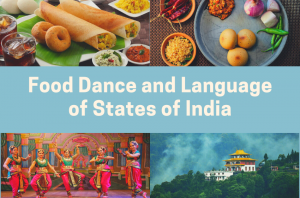
  4. In minimum one project work of students from classes I –X, it is mandatory to integrate any art form of the paired State/UT, as defined under Ek Bharat Shreshtha Bharat Programme. For example, CBSE students of Delhi will need to integrate the art form of Sikkim. Click here to confirm the latest pairings
  5. Subject teachers along with Arts teachers must plan and discuss the projects in advance at the beginning of the academic session so that students can be given proper guidance to undertake various projects.
  6. The focus should be given on research of new topics that are not yet taken up in the classroom. Teachers must facilitate exploration of research on the topics to give students hands-on experience.
  7. The project should be taken up in an eco-friendly manner, using readily available local resources without any financial burden on parents or guardians.
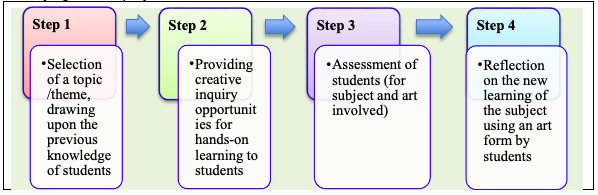
  8. The teachers may follow the following process of embedding arts with other subjects for carrying out the project work:
    CBSE Art Integrated Project
  9. The Project should be done by students in groups with 4-5 students in each group.
  10.  While creating projects, it may also be seen that it should not be too much pro art that it becomes difficult for the subject teacher to take it forward and guide the students. The projects should be simple and doable for the subject teachers and students without the assistance of art teachers/artists or others.
  11. Assessment techniques should be relevant and age appropriate. Criteria along with rubrics for assessment can be devised collectively by teachers and students while planning the projects. Students must be informed about the criteria decided for assessment along with maximum marks before commencement of work on the project.
  12. Schools and teachers may prepare their calendar by assigning dates and months for the execution of project work by the students and the records of assessment of these project works should be maintained at the schools.
  13. The Art integrated project work shall also be an integral part of assessing the student’s participation in art related activities and attainment of learning outcomes for the subject/s.
  14. The marks awarded for these projects, as part of subject-enrichment activities of class X, will be collected by the Board at the time of uploading marks of internal assessment.

Art-Integrated Learning (AIL) as a Pedagogical Tool from classes I to XII

AIL will continue as a pedagogical tool for classes I to XII, in addition to the Art Education under co-scholastic area as provided in the Secondary School Curriculum of the Board.

The objective of AIL is not to promote arts and skills of arts but to use art as a tool to teach other subjects. The focus here should be to accept arts as a medium of the learning process.

So the subject teachers may make use of simple art forms in the classrooms; and give opportunities to students to enjoy planned art activities and while they are experiencing beauty of arts, they also learn and articulate the core concept of different subjects and apply it in daily life.

Art activities which can be integrated with different subjects to aid learning are given in annexure. The activities given in the annexure are only suggestive. Correlation of AIL activities is to be seen broadly and should not restrict to one or the other kind of subjects. For example, what helps us in Agriculture as a subject can also connect to Mathematics and Science subjects. Therefore, the teachers and learners should not limit themselves in the rigid boundaries as suggested in the said annexure.

In AIL activities, teachers and students may go for integration of visual and performing arts too. Since skill of making art is not the criteria of evaluation, children can explore and might come out with very creative expressions that enable achievement of the learning outcomes.

Reporting of Implementation of Art-Education (AE) and Art-Integrated Learning (AIL)

The Board has prepared the Art Education (AE) and Art Integrated Learning (AIL) – AE & AIL portal for reporting of the implementation of Art-Education (AE) and Art-Integrated Learning (AIL). The schools are required to upload data of the Art-Education and ArtIntegrated Learning projects of students in the AE & AIL portal for enabling students of class X and XII to appear in Board exams.

Pairing of States and Union Territories for CBSE AE&AIL Project Work

The following engagement matrix has been adapted from EBSB programme:

  • Jammu & Kashmir: Tamil Nadu
  • West Bengal : Ladakh
  • Punjab : Andhra Pradesh
  • Himachal Pradesh : Kerala
  • Uttarakhand : Karnataka
  • Haryana : Telangana
  • Rajasthan : Assam
  • Gujarat : Chhattisgarh
  • Maharashtra : Odisha
  • Goa : Jharkhand
  • Delhi : Sikkim
  • Madhya Pradesh : Manipur & Nagaland
  • Uttar Pradesh : Arunachal Pradesh & Meghalaya
  • Bihar : Tripura & Mizoram
  • Chandigarh : Dadra & Nagar Haveli
  • Puducherry : Daman & Diu
  • Lakshadweep : Andaman & Nicobar

Check out the full CBSE circular

The CBSE circular was addressed to the heads of all CBSE schools. Look at the full CBSE circular here alongside all the annexures to get the details of what kind of CBSE art-integrated projects are normal for students of classes 1 to 10. 

The Art-Integration guidelines of CBSE enrolls different suggestive exercises, projects, tasks and lesson designs and are accessible here.