Dr. Ambedkar Scholarship 2021: Application Process, Status, Benefits, Eligibility, Renewal

Dr. Ambedkar Scholarship 2021

Dr. Ambedkar Scholarship Scheme: The Department of Welfare of Scheduled Castes (SC) and Backward Classes (BC), Government of Punjab provides Dr. Ambedkar scholarship to the SC and OBC students belonging to the State of Punjab. The scholarship aims to provide financial aid in the form of post-matric scholarships to students from economically weaker sections to aid in their higher education.

Dr. Ambedkar Scholarship 2021 – Highlights

Conducted By

Department of Welfare of Scheduled Castes (SC) and Backward Classes (BC), Government of Punjab

Eligibility

Class 11- Post-doctoral-level candidates

Region

Punjab, India

Rewards

Up to INR 1200 per month plus other benefits

Last Date of Application

15th February

Dr. Ambedkar Scholarship 2021 – Details

Scholarship Name

Provider Name

Application Period

Post-matric scholarship for SC Students

Department of Welfare of Scheduled Castes (SC) and Backward Classes (BC), Government of Punjab

October - November

Post-matric scholarship for

OBC Students

Department of Welfare of Scheduled Castes (SC) and Backward Classes (BC), Government of Punjab

October - November

Dr. Ambedkar Scholarship 2021 – Important Dates

The important dates for Dr. Ambedkar scholarship are given below:

Events

Important Dates

Application Start Date

November 2020

Application End Date

February 2021

*Dates are tentative and can be changed according to the preferences of the provider.

Dr. Ambedkar Scholarship 2021 – Eligibility Criteria

The Dr. Ambedkar scholarship is provided to economically backward sections of SC / OBC students belonging to the state of Punjab. The other eligibility criteria for SC and OBC students for the post-matric schemes are given below:

Post-matric scholarship for SC Students

The main post-matric scholarship for SC students are:

  1. The SC student’s family income should not exceed INR 2,50,000 annually.
  2. Applicants should be an Indian National belonging to SC.
  3. Students are not eligible to apply if they shift their course of study after completion of one or more levels of education. To avail of the scholarship, the students should be studying the same course until completion.
  4. Applicants pursuing postgraduate Medical courses are eligible to apply on the condition that they do not practice during the period of the course.
  5. Candidates pursuing distance learning/correspondences are also eligible to apply.
  6. The student should have passed Class10 and must be enrolled in a post-matric course or post-secondary course from a recognized institution.
  7. The students applying for this scheme would not be getting any scholarship/stipend from any other sources.
  8. Applicants who are receiving pre-examination coaching with financial assistance from the State / Central Government are not eligible for the stipend during the coaching program.

Post-matric scholarship for OBC Students

The main post-matric scholarship for OBC students are:

  1. Applicants should be an Indian National and belong to OBCs.
  2. The OBC student’s annual family income should not exceed INR 1,00,000.
  3. At most 2 boys of the same set of parents/guardians are eligible to apply for the scholarship. This rule is not applicable for girl candidates.
  4. The candidates should have passed Class10 and must be enrolled in a post-matric course or post-secondary course from a recognized institution.
  5. Applicants pursuing postgraduate Medical courses are eligible to apply on condition they do not practice during the period of the course.
  6. Candidates pursuing distance learning/correspondences are also eligible to apply.
  7. Students receiving any pre-examination coaching with financial assistance from the State / Central Government are not eligible for the stipend during the coaching program.
  8. The students who are applying for this scheme should not be getting a scholarship/stipend from any other sources.

Dr. Ambedkar Scholarship 2021 – Benefits

The Dr. Ambedkar Scholarship provides a monetary benefit to the economically weaker section students to pursue their higher studies. The scholarship amount is only transferable via Direct Benefit Transfer (DBT) to the applicants’ bank account. The complete scholarship  benefits are explained below:

Scholarship Rewards for SC Students

Below are the scholarship rewards for SC students:

  • The thesis typing/printing charges of up to INR 1600 to research scholars.
  • Study trip charges of up to INR 1600 per year for the scholars who are studying professional and technical courses.
  • Persons with disabilities would get a Transport allowance of INR 160 per month, an Escort fee of INR 160 per month, Special pay of INR 160 per month, and an extra fee of INR 240 per month.

Scholarship Groups

Rewards and Benefits

Group 1- UG/ PG level courses for e.g. M.Phil / Ph.D./ Post-doctoral Medicine research/ Engineering and allied courses/Veterinary and allies classes / Fashion technology/ Agriculture/Management/ Commercial Pilot Licence/ PG diploma courses in the leadership/Pharmacy/CA/ICWA/CS/ CFA/LLM

Book allowance of INR 1200.

Reader allowance of INR 240.

Hostellers would receive an amount of INR
1200 per month for 10 months.

Day scholars would receive an amount of INR 550 per month for 10 months.

Group 2- UG/ PG courses which lead to degree/ diploma/certificate in Pharmacy/ Nursing/ LLB / BFS / Mass Communication/ Hotel Management/ Financial Services for
which minimum level of study is Class 12 and other PG courses

Book allowance of INR 1200.

Reader allowance of INR 240.

Hostellers would receive an amount of INR 820 per month for 10 months.

Day scholars would receive an amount of INR 530 per month for 10 months.

Group 3- All courses which are not included in Group 1 and 2 leading to BA/ BSc/ B.Com degree.

Book allowance of INR 1200.

Reader allowance of INR 200.

Hostellers would receive an amount of INR 570 per month for 10 months.

Day scholars would receive an amount of INR 300 per month for 10 months.

Group 4- All post-matric non-degree classes with the minimum level of education being Class 10 such as Class 11/ 12/ both general and professional/ ITI / 3-year Diploma/ Polytechnic etc.

Book allowance of INR 1200.


Reader allowance of INR 160.


Hostellers would receive an amount of INR 380 per month for 10 months.


Day scholars would receive an amount of INR 230 per month for 10 months.

Scholarship Rewards for OBC Students

Below are the scholarship rewards for OBC students:

  • The thesis typing/ printing charges of up to INR 1000 to research scholars.
  • Study trip charges of up to INR 900 per annum for students studying professional and technical courses.

Scholarship Groups

Rewards and Benefits

Group 1- UG/ PG level courses for e.g. M.Phil / Ph.D./ Post-doctoral Medicine research/ Engineering and allied courses/Veterinary and allies classes / Fashion technology/ Agriculture/Management/ Commercial Pilot Licence/ PG diploma courses in the leadership/Pharmacy/CA/ICWA/CS/ CFA/LLM

Book allowance of INR 900.

Reader allowance of INR 175.

Hostellers would receive an amount of INR
750 per month for 10 months.

Day scholars would receive an amount of INR 350 per month for 10 months.

Group 2- UG/ PG courses which lead to degree/ diploma/certificate in Pharmacy/ Nursing/ LLB / BFS / Mass Communication/ Hotel Management/ Financial Services for
which minimum level of study is Class 12 and other PG courses

Book allowance of INR 900.

Reader allowance of INR 175.

Hostellers would receive an amount of INR 510 per month for 10 months.

Day scholars would receive an amount of INR 335 per month for 10 months.

Group 3- All courses which are not included in Group 1 and 2 leading to BA/ BSc/ B.Com degree.

Book allowance of INR 900.

Reader allowance of INR 130.

Hostellers would receive an amount of INR 400 per month for 10 months.

Day scholars would receive an amount of INR 210 per month for 10 months.

Group 4- All post-matric non-degree classes with the minimum level of education being Class 10 such as Class 11/ 12/ both general and professional/ ITI / 3-year Diploma/ Polytechnic etc.

Book allowance of INR 900.


Reader allowance of INR 90.


Hostellers would receive an amount of INR 260 per month for 10 months.


Day scholars would receive an amount of INR 160 per month for 10 months.

Dr. Ambedkar Scholarship 2021 – Application Process

The application process of the Dr. Ambedkar scholarship is online. The Dr. Ambedkar Scholarship form is available in the respective official scholarship portal.  Thus interested applicants can apply within the given time. The complete application procedure is given below:

  1. Applicants should visit the Dr. Ambedkar Scholarship Portal.
  2. As a new user, click on the ‘Student Registration’ tab for the registration on the scholarship portal. A User ID and password will be generated on successful registration.
  3. After registering successfully click on the ‘Registered Students’ Login’ to log in to the portal by using the registered User ID and password.
  4. Then click on the ‘Apply for Scholarship’ to access the application form.
  5. Fill the form with the required details.
  6. Check for all the particulars entered after filling the form and to submit the application form click on the “Register Scholarship Application form”.
  7. After submitting the form click on the left side tab of the application form to upload all the documents needed to verify the candidates’ credentials.
  8. After uploading all the documents the applicant should take a printout of the submitted application and then submit it to the respective institute along with all the attested supporting documents.

Dr. Ambedkar Scholarship Documents Required

The documents that should be uploaded along with the Dr. Ambedkar Scholarship Application form are:

  • Self-attested photocopy of the Caste certificate
  • Domicile certificate
  • Parents’ income certificate
  • Copy of high school certificate
  • Copy of the first page of bank passbook
  • Handicap certificate (if applicable).

Dr. Ambedkar Scholarship 2021 – Renewal Process

All applicants (both new and renewal applicants) interested in benefiting the scholarship have to register themselves on the Dr. Ambedkar Scholarship Portal. The renewal process is explained below:

  1. The renewal candidate has to visit the Dr. Ambedkar Scholarship Portal and then click on the ‘New Registration.
  2. Applicants must enter the user ID and password being used previously.
  3. After that click on the ‘Renewal Application’ tab for the current year.
  4. All the personal details of the applicants have to be entered and a new User ID and password are generated.
  5. Using the new credentials the candidate should log in to the portal.
  6. The application form will be displayed where the applicant would enter details like last years’ merit score, attendance details, etc.
  7. The applicants can update any other details if needed.
  8. The last step is to upload all the required documents and ‘Submit’ the renewal application form.

Dr. Ambedkar scholarship 2021 – Application Status

You can check the status of your application by logging in, click on “Edit Application”. Then select the “Track Status” option. This will give you the latest status of your Scholarship Application.

What if I forget my Applicant ID/ Password?

You can recover your Applicant ID/ Password by clicking on “Registered students: Recover your password” from the Registered Student Login box. You have to fill in the details like First Name, Date of Birth, Mobile Number and email Id, as you have entered in the application. Registered candidate will get the Password and SMS will be sent to your contact Mobile Number.

Dr. Ambedkar Scholarship 2021 – FAQs

Q1. Who is eligible to apply for the Dr. Ambedkar scholarship?
Ans. Students who meet different scheme rules of ministries are qualified to apply for the scholarship.

Q2. How can a student apply for the scholarship online?
Ans. Please check the portal via URL www.scholarships.gov.in to apply online.
BPL Full Form: Eligibility, Certificate, Benefits & Limit Explained

Full Form of BPL

In this article, we will learn about the BPL full form, eligibility criteria, how to apply for a BPL certificate, income limits, and the benefits you can avail. Discover detailed insights and answers to frequently asked questions.

According to the World Bank, Poverty is said to deprive one of well-being and includes many dimensions. It combines low incomes and the failure to acquire the basic goods and services needed for survival with dignity. Thus, the conventional approach to measuring poverty is to define a minimum expenditure required to purchase a basket of goods and services necessary to satisfy basic human requirements and this minimum expenditure is called the poverty line.

Understanding the Basics of BPL

Hence, Below Poverty Line (BPL) is a benchmark used by the government of India to show economic loss and to recognize individuals and households in need of government help and support. It is planned using several parameters which differ from state to state and within states. The present guidelines are based on a survey conducted in 2002. Going into a survey due for a decade, India’s central government is undecided on measures to identify families below the poverty line.

According to 2019 reports, more than a quarter of the population living in rural regions of India is below the poverty line. Out of the total population living in the rural parts of India, 25.7 per cent is living below the poverty line whereas, in the urban areas, the state is a little better with 13.7 per cent of the population living below the poverty line.

BPL Data Table

Category Details
BPL Full Form Below Poverty Line
Eligibility Criteria Varies by state; generally based on income, land ownership, and other factors
How to Apply Submit application form with necessary documents at local municipal office or Panchayat
Benefits Subsidized food grains, healthcare, education, housing, and various welfare schemes
Income Limit Determined by state-specific guidelines and household conditions
Important Documents Income certificate, address proof, identity proof
Issuing Authority Local municipal office or Panchayat
Validity Period Typically 5 years, subject to renewal

State-Wise Percentage of Population Below Poverty Line by Social Groups, 2004-05

State Rural (SC) Rural (OBC) Rural (Others) Rural (All) Urban (SC) Urban (OBC) Urban (Others) Urban (All) Combined
Andhra Pradesh 15.4 9.5 4.1 11.2 39.9 28.9 20.6 28.0 15.8
Assam 27.7 18.8 25.4 22.3 8.6 8.6 4.2 3.3 19.7
Bihar 64.0 37.8 26.6 42.1 67.2 41.4 18.3 34.6 41.4
Chhattisgarh 32.7 33.9 29.2 40.8 52.0 52.7 21.4 41.2 40.9
Delhi 0.0 0.0 10.6 6.9 35.8 18.3 6.4 15.2 14.7
Gujarat 21.8 19.1 4.8 19.1 16.0 22.9 7.0 13.0 16.8
Haryana 26.8 13.9 4.2 13.6 33.4 22.5 5.9 15.1 14.0
Himachal Pradesh 19.6 9.1 6.4 10.7 5.6 10.1 2.0 3.4 10.0
Jammu & Kashmir 5.2 10.0 3.3 4.6 13.7 4.8 7.8 7.9 5.4
Jharkhand 57.9 40.2 37.1 46.3 47.2 19.1 9.2 20.2 40.3
Karnataka 31.8 20.9 13.6 20.8 50.6 39.1 20.3 32.6 25.0
Kerala 21.6 13.7 6.6 13.2 32.5 24.3 7.8 20.2 15.0
Madhya Pradesh 42.8 29.6 13.4 36.9 67.3 55.5 20.8 42.1 38.3
Maharashtra 44.8 23.9 18.9 29.6 43.2 35.6 26.8 32.2 30.7
Orissa 50.2 36.9 23.4 46.8 72.6 50.2 28.9 44.3 46.4
Punjab 14.6 10.6 2.2 9.1 16.1 8.4 2.9 7.1 8.4
Rajasthan 28.7 13.1 8.2 18.7 52.1 35.6 20.7 32.9 22.1
Tamil Nadu 31.2 19.8 19.1 22.8 40.2 20.9 6.5 22.2 22.5
Uttar Pradesh 44.8 32.9 19.7 33.4 44.9 36.6 19.2 30.6 32.8
Uttarakhand 54.2 44.8 33.5 40.8 65.7 46.5 25.5 36.5 39.6
West Bengal 29.5 18.3 27.5 28.6 28.5 10.4 13.0 14.8 24.7
All India 36.8 26.7 16.1 28.3 39.9 31.4 16.0 25.7 27.5

Data Source: Perspective Planning Commission, New Delhi.

Source:Perspective Planning Commission, New Delhi.The poverty line at the all-India level is calculated based on the expenditure class-wise distribution of persons using URP consumption data (30-day recall period). The poverty ratio at the all-India level is obtained as the weighted average of the state-wise poverty ratios.

Eligibility Criteria and Income Slab for BPL (2023)

  • The government sets criteria to identify people below the poverty line (BPL).
  • In 2011-12, 21.9% of India’s population (27 crore people) were below the poverty line.
  • The poverty line defined by Monthly Per Capita Consumption Expenditure (MPCE): Rs. 816 for rural areas and Rs. 1000 for urban areas.

Updated Poverty Data and Reduction Efforts Made By the Govt. Of India

  • NITI Aayog’s 2023 report shows significant poverty reduction, with the rate dropping from 24.85% in 2015-16 to 14.96% in 2019-21.
  • 13.5 crore people escaped multidimensional poverty between 2015-16 and 2019-21.
  • The government has launched various schemes to combat poverty, such as:
    • Mahatma Gandhi National Rural Employment Guarantee Scheme (MGNREGS)
    • Pradhan Mantri Awaas Yojana – Gramin (PMAY-G)
    • Pradhan Mantri Gram Sadak Yojana (PMGSY)
    • Deendayal Antyodaya Yojana – National Rural Livelihoods Mission (DAY-NRLM)
    • Pradhan Mantri Garib Kalyan Anna Yojna (PMGKAY)
    • Pradhan Mantri Ujjwala Yojana (PMUY)
    • Saansad Adarsh Gram Yojana (SAGY)
  • These schemes provide direct benefits and improve infrastructure to uplift the poor.

How to Apply for a BPL Certificate

Apply In-Person

  • BPL certificate will be issued in the name of the head of the family. This certificate consists of the names of other family members so that the other members may use the certificate for the advantages meant for BPL families.
  • To apply, the eligible person has to apply with the required documents to the treated village Panchayat/ Block Panchayat / municipal authority.
  • Please go to the respective office.
  • Get the form for this certificate or write on plain paper as advised.
  • Submit the completed application with the required documents to the acquiring authority.
  • Authorities after checking the application and documents will make entries at the respective register and provide the applicant a record number for reference.
  • Keep it safe for future reference.
  • This application will be processed further.
  • There will be a ground-level verification and analysis of the documents and details by the department authorities.
  • After checking the documents and conducting a local inquiry into the facts and benefits of the case. Then the respective panchayat/Sarpanch or the respective authority issues the Certificate.
Required Documents
  • Application form
  • Identity proof
  • Self-declaration from the applicant
  • Ration Card
  • Complete information about income sources
  • Residential Proof: Residential Certificate issued by Aadhar card / Ration Card / PAN Card /  Passport / Driving License / Government Id card / Defense ID Card /Local administration office.
  • Age proof (birth certificate/school certificate)
  • Applicant passport size photograph.
  • Aadhaar card
  • Affix stamp as advised by authorities if required.

Note:

All originals and copies of originals with self-attestation as directed by respective authorities are to be submitted as per specification.

Apart from the above documents’ authorities may demand to submit additional information or documents. Please provide them for processing.

Benefits of Having a BPL Certificate

Some groups, especially those under Scheduled Tribes (ST) and Scheduled Castes (SC), suffer from exclusion in the poverty debates. While the National Sample Survey (NSS) data revealed a deterioration in overall poverty from 36% in 1993-94 to 28% in 2004-05, the numbers showed a different story for areas with tribal populations. 

The 2004-05 NSS also showed that the average consumption of Adivasis ST was 70% of the average, and that of Dalits (SC) less than 80% of the average. This census also showed that ST and SC make up a large proportion of India’s poor. The government’s programs for these groups tend to be executed not as strong and also tend to progress very slowly. 

ST and SC also suffer from displacement, differences in education and employment, and caste-based violence. States operate the power to make specific arrangements for these groups through reserved seats in educational institutions and special grants and scholarships. Also, certain income generation programs along with financial organizations that provide coaching in entrepreneurial skills do exist for these groups. 

A definite number of government jobs are set aside for these minority groups as well. A study found that in an area where members of SC/ST groups are specified roles of leadership, more funds are designated towards welfare programs. In other words, the political representation of the poor makes a huge impact on the allocation of resources.

Other programs available for the beneficiaries of BPL include Sarva Shiksha Abhiyan (SSA), the National Rural Health Mission, National Rural Employment Guarantee. Sarva Shiksha Abhiyan works to bring education to children from poor families and incorporates community work and organization. The NRHM concentrates on accessibility to health care in some of the poorest areas of India and promotes education and uplifting of Adivasi and Dalit women. The NREG implies a legal entitlement for every poor rural family to 100 days of work at the minimum wage and proposes to end food insecurity, empower village communities, and create assets.

The families who have a BPL card can receive 10 to 20 kg food grains per family per month at 50% of economic cost.  For specified quantities of wheat, rice, sugar, and other items the subsidized end retail price varies from state to state. Each state government fixes varying rates per quantity.

Various schemes for the benefit of BPL are as follows:

1. Pradhan Mantri Jan Dhan Yojana (PMJDY)

With a National Mission for financial incorporation, PMJDY is a government scheme for needy and poor people who belong to the below poverty line and was announced in 2014 on the eve of independence day. Through this scheme, they get access to financial services such as savings and deposit accounts, credit, insurance, pension, payment, etc at affordable rates. Under this scheme, almost 29.43 crore bank accounts have been opened so far.

Benefits:

  • For those who opened bank accounts before January 26th, the government plans to offer accident insurance cover for over 1 lakh and insurance cover for over Rs. 30,000.
  • 4 percent per annum will be provided on the money deposit.
  • There will be no rules for minimum balance.
  • Money can be transferred to any bank account in India as well as money from a government scheme can be directly transferred to an individual bank account.
  • Upto Rs. 5000 overdraft facility is available after operating a bank account for 6 months.

2. Pradhan Mantri Jeevan Jyoti Bima Yojana

This scheme was announced in 2015 by the then-finance minister. It is a one-year renewable life insurance plan that offers a life coverage of Rs. 2 lakh with an annual premium of Rs. 330 which is payable at the time of renewal of the plan. The given premium will be deducted from the account holder’s savings account through the auto-debit facility. It can be availed by any savings bank account holder whose age is between 18 and 50 years. Further, once the account holder attains the age of 55 years his/her insurance will be terminated.

Benefits:

  • The nominee can receive the death benefit.
  • It is a one-year cover i.e.from June 1 to May 31.

3. Sukanya Samriddhi Yojana (SSY)

Under the ‘Beti Bachao, Beti Padhao’ campaign, the Prime Minister launched the Sukanya Samriddhi Yojana on 22nd January 2015. Its main aim is to meet the education and marriage expenses of a girl child. Under this a minimum of 1,000 and a maximum of 1.5 lakh can be deposited in a girl’s bank account during a financial year. Further, the account can be closed only when the girl turns 21 if the account is not closed then the holder can still earn interest on the amount.

Benefits

  • A parent or a guardian can open or operate the account as soon as a girl child turns 10.
  • An interest rate of 8.6% is offered with income tax benefits.
  • To meet the educational requirements of a girl up to 50% of the balance can be withdrawn after she turns 18. Further, money can also be transferred from one authorized bank to another and vice versa.

4. Rashtriya Swasthya Bima Yojana (RSBY)

RSBY was introduced in the year 2008 to provide health insurance coverage to those people who belong to the below poverty line (BPL) category. As it provides insurance coverage on health to an unorganized sector that is registered under street vendors, licensed porters, welfare boards, etc.

Benefits:

  • For a family consisting of 5 members, it covers up to Rs.30,000 on a floater basis.
  • With a maximum limit of Rs. 1,000 it provides transportation charges cover of Rs. 100 per visit to the hospital.
  • RSBY smart card is provided to BPL families which allows holders to claim medical care expenses of up to Rs. 30,00 p.a with a premium of just Rs.30.

5. Ayushman Bharat Pradhan Mantri Jan Arogya Yojana (ABPMJAY)

ABPMJAY is promoted as the world’s largest insurance scheme which was launched to cover ten crores of poor families including families with no adult members between 16 and 59, beggars, domestic help, construction workers, sanitation workers, public transport drivers, etc. in both urban and rural regions. It offers up to Rs 5 lakh insurance cover per family.

Benefits:

  • Under this scheme, free treatment will be available in both private and public hospitals which are listed by the government in times of need.
  • There will be no limit on the age and size of the families.
  • It covers both pre and post-hospitalization expenses.

Conclusion

Education, gender-related problems, issues surrounding employment as well as religious factors can be considered as the main factors of poverty. Thus, the poverty line was fixed according to income/food requirements in 2000. But over the years several schemes have been launched by the government which not only helped its citizens but also focuses on the improvement of their financial situations.


FAQs regarding Below Poverty Line (BPL)

Q1. Who is considered above the poverty line?

Ans. A person who lives above its nationally assigned poverty outset is considered to be living above the poverty line. Thus, the people living in urban areas must meet their higher monthly income minimums to be regarded above the poverty line.

Q2. Who sets the poverty line in India?

Ans. Planning Commission Expert Group (1962), the working group commissioned by the Planning Commission formed separate poverty lines for rural and urban areas.

Q3. How is the poverty line calculated?

Ans. By applying an official poverty measure (OPM) the Census Bureau prepares poverty status that checks pre-tax cash income against a threshold that is set at three times the cost of a minimum food diet in 1963 and set for family size.

Q4. What does it mean to be above the poverty line?

Ans. The certain level of income that is required to reach a basic living standard with enough money for things such as food, clothing, and a place to live is said to be above the poverty line.

Q5. What is the current poverty line in India?

Ans. As per the last update in 2023, the poverty line defined by monthly per capita consumption expenditure (MPCE): Rs. 816 for rural areas and Rs. 1000 for urban areas.

Also Read: Pingali Venkayya – The Designer of The Indian Flag

The Importance of Trees: A Comprehensive Guide

Importance of Trees

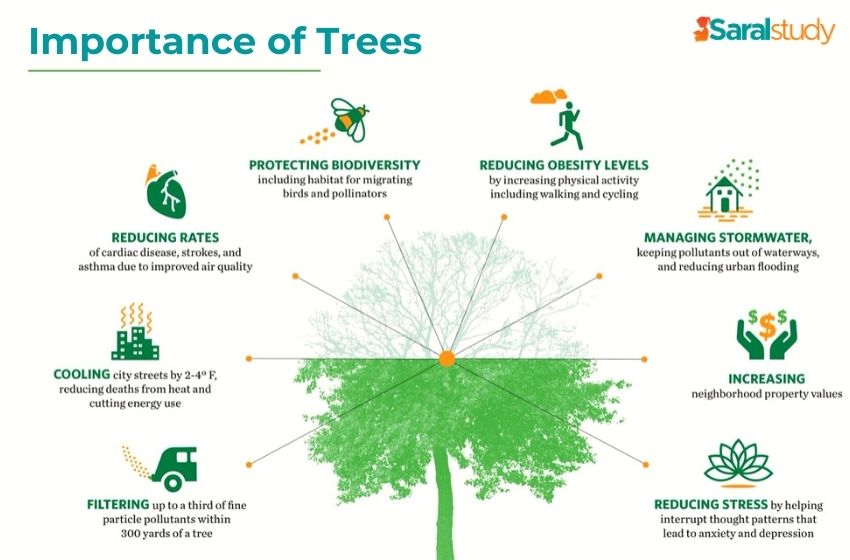
Importance of Trees: Trees play a significant importance in our environment and human well-being. Trees provide us with fresh water to drink, air to breathe, shade, and food for humans, animals, and plants. Trees give habitats for various species of fauna and flora, materials for construction, and places of spiritual, cultural, firewood for cooking, and heat and recreational importance. Trees are so essential for the global environment and the health of the species that live there. And they want our unconditional care and protection.

Why Trees Are Important?

Trees also play an important part in every community. Streets, parks, playgrounds, and backyards are filled with trees that form a peaceful, aesthetically pleasing atmosphere. Trees enhance our quality of life by bringing natural elements and wildlife habitats into urban environments. We collect under the cool shade they provide during outdoor activities with family and friends. Several areas are also the home of quite old trees which serve as historic landmarks and a great reference of town pride.

Importance of Trees in Our Lives

The main importance of trees in our lives are:

Trees and Biodiversity

Many birds, animals, and insects call trees home. The different levels and canopies of trees give habitat to a different array of wildlife from the lower levels up to the very high canopies. Forest Garden farmers usually also use trees as a place to build hives to bring bees to their land to help in pollination and to get honey. We are currently losing species at a dangerous measure so the space for biodiversity is critical as it helps keep our planet thriving.

1. Trees Provide Shelter and Shade

When it is hot, human beings and animals look for an old tree that can give shade. There are several trees that people grow to give a good canopy for them to hold meetings and also have wonderful places to relax.

Besides, people from various cultures choose to hold meetings under trees. And, trees also provide building materials for human shelter as well as their animals. Trees also decrease the rate of evaporation and make the ground a better place to stay.

2. Ecosystem Services

Trees offer essential ecosystem services such as water filtration, flood control, and pollination. They support the delicate balance of our natural ecosystems, which in turn supports human life.

Trees protect the earth from soil erosion, fires, flooding, etc. Forest Garden farmers use trees as fences, windbreaks, and restrictions. Farmers use a living fence technique that has proven especially helpful in providing by forming a green wall to enhance their soil, provide a boundary, keep livestock out, and absorb and redirect heavy rains.

3. Trees boost wildlife 🐦

Trees host complex microhabitats. When young, they give habitation and food to wondrous communities of birds, insects, lichen, and fungi. When ancient, their trunks also provide the hollow cover required by species such as bats, wood boring beetles, and woodpeckers, etc.

One mature oak can be home to as many as 500 various species. Richmond Park is full of such trees, which is one of the purposes it has been named a National Nature Reserve and Site of Special Scientific Interest.

Social and Economic Benefits of Trees

4. Trees strengthen communities

Trees sustain the distinctive character of a place and promote local pride. Woodlands can serve as an educational source and drive groups together for activities like walking and bird-watching. Trees are also valuable for children to play in and explore their sense of adventure.

5. Trees are a natural playground

The tree gives a great place to climb and explore. This is especially exciting in a world where technology can consume people’s interest. Children can learn to take risks while climbing trees. Adults can climb for robustness and strength building. Felled trees can become scale beams and a tall tree can give a good shelter or lookout during playtime.

6. Mental and Physical Health

The canopies of trees serve as a physical filter, confining dust, and absorbing pollutants from the air. They also provide shade from solar radiation and lessen noise.

Above 20 species of British trees and shrubs are recognized to have medicinal properties. Research proves that within minutes of being enclosed by trees and green space, your blood pressure drops, your heart rate slows and your stress levels come down.

7. Trees Control Noise Pollution

Trees decrease urban noise almost as efficiently as stone walls. Trees, planted at strategic positions in a neighbourhood or around your house, can reduce major noises from freeways and airports.

8. Trees are an Essential Source of Medicine🌱

For many years people used trees to use various ailments both in humans as well as their animals. Some of them are used for preparing solutions to drink. Others are rubbed on parts that are hurt. With time people applied to modern medicine, most of which is formed from different trees.

Now even with technology, most people still depend on holistic trees for medication. Trees treat most ailments.

9. Trees grow the economy

People are want to live, work, and invest in green surroundings. Research reveals that average house prices are 5-20 % higher when properties are near to mature trees. Companies get profit from a healthier, happier workforce if there are parks and trees nearby.

10. Trees provide sustainable wood

While alternative energy is ideal, the truth is that much of the world depend on wood to cook meals and boil water for purification. Where we work in Africa, approximately 80% of households rely on fuel wood and charcoal. While it can be demonstrated that planting trees for fuel or wood compete with food production, in the Forest Garden model, the two can coincide and complement one another. This means farmers are not increasing deforestation by cutting in the ancient forests. 

Environmental Benefits

11. Trees benefit the environment🌍

Trees absorb carbon dioxide while they grow and the carbon that they store in their wood aids reduces the rate of global warming.

Trees decrease wind speeds and cool the air as they lose moisture. And it reflects heat upwards from their leaves. It’s considered that trees can lessen the temperature in a city by up to 7°C. Trees also assist prevent flooding and soil erosion, etc.

12. Controls Climate 🌡️

As trees inhale Carbon dioxide in the atmosphere, tree plantation is the best organic way that could be efficiently practised to reverse global warming and prevent climate change. In recent days, the importance of tree plantation has gained significant ground in many countries.

And there is so much more!

Trees become a source of medicines, foods, and materials, improving our planet and lives in limitless ways.  We are continually discovering new ways that trees can benefit us. Research is uncovering hidden and beneficial ways in which trees enrich our planet and our lives. Without trees, we should not have a future.

Benefits of Trees

Trees offer numerous benefits, including:

  • Providing oxygen
  • Increasing property values and business traffic
  • Preventing soil erosion and slowing water runoff
  • Reducing noise pollution and combating climate change
  • Offering habitats for wildlife and cooling urban areas
  • Protecting from UV rays and providing medicines
  • Offering food and creating economic opportunities
  • Giving us invaluable resources like vegetables, fruits, wood, and paper
  • Supporting good rainfall and controlling air pollution
  • Playing a crucial role in maintaining the ecosystem balance by inhaling carbon dioxide and exhaling oxygen.

Steps to Protect and Preserve Trees

1. Switch to Digital Books

Digital Books create less of a demand for paper. Digital books are also more suitable as you have an infinite supply of books on a single device. You can also read from a digital device in the dark, unlike with a book published on paper.

2. Read Your Magazines Online

Most magazines offer the same content online if you sign up for a subscription with them. You will also get the content shortly after it is released instead of waiting.

3. Use Reusable Containers

Use containers that can be used several times for your food, gadgets, and just anything.

4. Protect Existing Forests

In addition to the threat that humans act for forests, they are also endangered by parasitic fungi, viruses, rusts, mistletoe, and nematodes. These all destroy the trees. An effort should be made to administer a chemical spray or some other treatment to destroy the parasites.

5. Reforestation

The sustainable yield system also needs that every tree that gets cut down must be replanted. So, any tree that gets burned down due to forest fires or mining activities must also get replanted. This can be done by natural or artificial methods. In the rough ground, aerial seeding is the method of choice.

6. Afforestation

Fresh afforestation programs should also be started. New plantations will enhance the forest cover and will also aid in making up the eco-balance. For afforestation, the range of trees should be made according to local geographical conditions. And then care must be taken during the initial growth of the trees.

7. Urban Forestry

Urban forestry involves the management and care of trees in urban settings. This includes planting trees in parks, streets, and residential areas, as well as maintaining existing trees to ensure their health and longevity.

8. Education and Advocacy

Raising awareness about the importance of trees and advocating for policies that protect forests are essential steps in conservation efforts. Engage with local communities, schools, and policymakers to promote tree planting and conservation initiatives.

Government Initiatives

Both central government and state governments can take some steps in this direction, such as:

  • Pass acts for the conservation of forests,
  • Survey of the forest resources,
  • Discover the areas where reforestation can be done,
  • Regulate the commercial use of forest products,
  • Preserve forest from fire, mining, and other natural disasters,
  • Develop national parks,
  • Boost forest developmental activities like social forestry, agroforestry, etc., and
  • Prepare master plans, both for long-term and short-term periods, etc.

Conclusion

Trees have a lot of importance in our lives, and it gives seamless service to the environment. We somehow have not protected them and that is why as of today we are being affected by global warming, severe pollution, and other ill effects of deforestation. Trees can be used and nurtured nicely so that human beings can survive on this planet. We should help others to plant more and more trees. It is for our own progress and the earlier we understand this the better it is for us.

We should realize that one of the severe issues in the present condition is the devaluation of trees. Henceforth the attention to planting trees must be broadly spread to make our world’s condition greener and better. One should start contributing at an individual level. We should stop cutting down trees and remember that if there will be no tree, there will be no life.

The tree plays a major role in our life. Everyone must be aware of the importance of tree plantation and also motivate and inspire others to plant more trees. It is not just for the present generation who can enjoy the benefits of having trees but also the future generation should also get the advantages of having trees around.

Frequently Asked Questions

Q1. Which is the largest tree in the world?

Ans. General Sherman, a giant sequoia, is the largest tree by volume in the world, standing 275 feet (83.8m) tall with 52,000 cubic feet (1,486.6m) of wood.

Q2. How much water can a large tree intake in a single day?

Ans. In one day, one large tree can lift 100 gallons of water out of the ground and release it into the air as oxygen and water vapour.

Q3. How are trees useful for us?

Ans. Trees are an integral part of the ecosystem. It assists to maintain balance and also acts as a valuable source of various resources

Q4. What is the importance of the tree?

Ans. Trees are one of the most valuable natural resources on earth. It is also an essential part of the ecosystem, as many organisms depend on trees for their food and shelter.

Q5: What are the main uses of trees?

Ans. Trees give many invaluable resources such as medicine, shelter, raw materials, and more.

Q6. How do forests help us?

Ans. Forests act as a shelter to various species of animals and plants. They also give humans several resources such as medicine and raw materials.

Q7. How do we save trees?

Ans. We can save trees by not cutting them down. We must plant more trees if trees are cut in other areas.

Also Read: Types of Pollution and Its Effects

Related Articles:

What is Global Warming? Causes, Effects & Solutions

Urban Pollution – Causes & Impacts on Environment

Types of Pollution and Its Effects

The Importance of Trees: A Comprehensive Guide

Issues and Challenges in Indian Education System

Issues and Challenges in Indian Education

Indian education is divided into two parts private and government education, the ratio is 5:7 respectively. Government education has failed to give a good quality of education. The education received from government schools is hugely insufficient. This is also because of the lack of teachers and the lack of proper checks on them, particularly in rural areas. Therefore, urban areas have a much higher literacy rate than rural areas.

Infrastructure and cost of educational institution in India

Public schools have weak infrastructure and poor academic attention which is very terrible for the overall development of an individual. Better facilities must be given to students in ­­ academic, sports, cultural, technical, media, arts, music, religious, social, and political areas which would aid them in discovering their areas of interest. Government schools lack a lot in this kind of aspect.

[lasso rel=”amazon” id=”5498″]

However, private schools that provide all such facilities are too expensive for lower-class families. Above 37% of the Indian population is living below the poverty line. And they cannot afford education even at a primary level. India is a country of morals and beliefs, people are still traditionalistic and apprehended modern education. 

The performance of the workers depends on several important factors like health and nutrition, education and training, etc. These are regarded as significant determinants of quality of life. Sufficient investment in these fields will increase the productivity and efficiency of the manpower. The body of knowledge is achieved by the population and the capacity of the population to use the knowledge effectively.

11 Issues and Challenges of Indian Education

Here are 11 issues and challenges of Indian education.

1. Lack of money

The absence of sufficient assets is a fundamental issue in the improvement of education. Because of poor economics, most instructive institutions need the framework, science gear and libraries, and so on. Because of this, the desired outcomes can’t be achieved.

Every year there is a separate budget for the Education sector but it needs to be well directed through the appropriate pipeline so that it reaches every sector, where it’s needed the most.

2. Costly higher education

College and specialized institutions have turned out to be expensive in India. The expense structure of specific and able institutions. Privatization of advanced education has helped the development of benefit greedy business people. Now advanced education is a much expensive undertaking.

3. Neglect of Indian languages

The medium of teaching especially is English because of the focus on education in English, students are not developing foundational literacy and numerical skills. And then they are piled on with more material in English and as a result, kids mainly from government schools and poorer backgrounds were suffering a lot because of this. Standard distributions are not accessible in native Indian languages.

4. No practical knowledge

In educational institutions, lots of attention is provided to theory and books, and practical knowledge is completely neglected. When these students pass the exam, they forget all the things they have studied due to a lack of practical experience.  In India, parents and teachers expect their students to score high in the exam rather than getting quality knowledge. And education becomes a rat race.  Practical knowledge and skill-based education are still very far away from scholars who are studying in schools, colleges, and universities.

5. The problem of brain drain

Whenever smart, capable, and meriting candidates don’t get reasonable positions in the nation. They need to travel to another country to look for employment. So our nation is denied good ability. This wonder is called ‘Brain Drain’. Because of that, we lost so many talents that could be utilized in our nation for the betterment of education as well as the overall development of the country.

6. Cast reservation and paid seat

In the Indian education system, seats are reserved for reserved cast and rich students. The education system should give equal chance to all students irrespective of their caste and creed.  In India, the child of a good rich family gets a good education just because of ample money whereas the child of a poor family hardly gets a primary education.  The government data disclose the better reality that only 1 child out of 7 that takes birth in India goes to school. That problem should be conveyed into notice as soon as possible and do some severe work to change the circumstances as soon as possible.

[lasso rel=”amazon” id=”5494″]

7. Mass illiteracy

Still, we are not capable of getting 100 percent education. Even now most of the individuals stay uneducated. In India, the quantity of illiterate individuals is approximately 33 percent of the aggregate uneducated people. Propelled nations are almost 100 percent educated, and the situation in India is very unfavorable.

8. Wastage of resources

Our education system depends on General Education. The dropout percentage is high in the essential and auxiliary dimensions. The huge majority of the understudies in the 7-14 age group leave the school before completing their studies. It implies the wastage of financial and Human Resources.

9. General education structure:

Our education structure is of General Education in nature. The advancement of specialized and professional education is very unacceptable. So our way of instruction is ineffective. Hence the number of educated jobless people is growing by each day. This has changed into a prominent concern for the Government.

10. Problems of primary education

Our primary education is performed with an extreme number of issues. A huge number of primary schools have no structures, basic facilities like drinking water, furniture and study materials, urinals and power, and many more. Large quantities of grade schools are single educator schools and many schools are even without teachers. So the drop rate is high and a basis for concern. We can say that there is a quantitative extension of training but in subjective improvement, we are still falling behind.

11. Outdated syllabus

There is an urgent requirement to modify the present system of higher education in the country. We are required to ensure quality in education as well as quantity. Students are acquiring knowledge from outdated syllabi. Lots of technological and scientific advancements are taking place in India. And hence the courses are Graduate and postgraduate and need to be updated as per modern and technological development.

[lasso rel=”amazon” id=”5490″]

6 major challenges faced by the Indian Education System

According to the 2018 Annual States of Education Report (ASER), India is creating another generation that can hardly read and write due to the lack of basic reading and arithmetic skills among the students in Indian Schools. But the mere difference now is that these children have spent some years of their lives in schools.

1. High- dropout rates

The other major challenge in the education system is the high dropout rate in public schools or government schools. It is all due to several factors such as poverty, lack of toilets, long distance to school, child marriages, patriarchal mindset, and cultural factors.

2. Poor governance and lack of responsibility

Another problem of our education is the absence of teachers in government schools. Further, poor management in these schools is also another major problem as these school management committees are barely functional. Also, the parents are oblivious of their rights and do not know whom to address in such conditions.

3. Lack of infrastructure

One of the major challenges faced by public schools is the lack of drinking water facilities, electricity, toilets, and poor hygiene, etc.

4. Quality of teachers

 Lack of trained and skilled teachers is another problem mostly faced by our education system. Besides the lack of skilled teachers, they are also burdened with a non-academic workload which diverges their focus from teaching. Thus, according to a study by the National Institute of Education Planning and Administration (NIEPA) the teachers only spend around 19per percent of their time in teaching while their rest of the time is filled mostly on non-teaching administrative work. 

5. Closure of Schools

 Due to the low strength of students and lack of teachers many government schools are closed. This is due to the competitions raised by private schools. 

6. Corruption and leakages of funds

Most of the funds which are granted for the advancement of schools are mostly consumed by corrupt mediators. As these funds transferred from central government to state government to schools involve many intermediaries. Due to which a right beneficiary only gets a certain part of the fund.

Right to Education (RTE)

To develop the skills and potential of children, education is granted as a right to help them. So, that they can benefit their community and the nation in the long run. As education helps in the growth of an economy of a country, reduces inequality, or be it breaking patriarchal norms. Some of the highlights of the right to education are as follows:

  • Without any type of discrimination, the right to education is legally granted to all.
  • The states must preserve, honor, and fulfil the right to education act.
  • Between the age of 6 to 14 years every child has the right to free and compulsory education. This act is affirmed as per the 86th Constitution Amendment Act via Article 21A.
  • According to the Right to Education Act every government school shall provide free education to all children and these schools must be conducted by the School Management Committee (SMC). While private schools shall accept at least 25% of the children in their schools from the economically backward section without any fees.
  • To monitor all phases of elementary education including quality of education National Commissions for Elementary Education shall be established.  

Conclusion

The overarching problems concerning each level of education in India are quality and pertinence. India bears extensive difficulties in facing the requirements of a growing and modern workforce.  Some of the needs that India’s education sector faces are appropriate curriculum, quality teachers, financial support for students, and adequate facilities. Additional challenges involve the inability to meet the different linguistic, social, regional, and local education needs of such a large country.

Recent advancements in Indian management have made this an especially suitable time for corporations to commit to the development of India’s education system. So, to overcome these challenges major steps should be taken by the government for the advancement of the education system in our country. As there have been no changes in the education system since the British rule. But now we can just hope for the improvement in our education system with the new education policy introduced in the recent year.

[lasso rel=”amazon” id=”5498″]

FAQs Regarding Issues and Challenges in Indian Education

Q1. What is the meaning of ‘Free and Compulsory Elementary Education’?

Ans. All children between the ages of 6 and 14 shall have the right to free and compulsory elementary education at a community school. To get elementary education there is no direct (school fees) or indirect cost (uniforms, textbooks, mid-day meals, transportation) to be borne by the child or the parents. Until a child’s elementary education is completed the government will provide schooling free-of-cost.

Q2. What is the most significant obstacle in education?

Ans. The most significant obstacle facing education today is the lack of innovation and fluidity in higher education. Because of numerous private and public determinants, colleges and universities have transformed into extensive private businesses with multi-million dollar athletic fields and multi-billion-dollar donations.

Q3. Why is change essential in education?

Ans. Change is essential for any education system as it helps to develop better strategies for achieving their moral goals. As those skillful in change recognize its subtle appearance, and they explicitly explore ideas for coping with and inspiring change toward some aspired outcomes.

Q4. What are the challenges of the Indian education system?

Ans. Some of the challenges faced in the progress of education in India are lack of capital, mass illiteracy, brain drain, wastage of resources, outdated syllabus, etc.

Read Also: Free Education: Education Should Be Free in India

Biodegradable and Non-biodegradable Waste

Biodegradable & Non-biodegradable Waste

Biodegradable items are those that degrade or break down naturally. Non-biodegradable items are those that do not degrade easily. These terms define the ability of the substances which are degradable or not. Substances like plants, animals, fruits, flowers, vegetables come under biodegradable substances. And Rubber, plastic, chemicals, paint plastic falls under the classification of non-biodegradable items.

The environment in which we live is surrounded by these two things only even the substances we use in daily life can be biodegradable or non-biodegradable. It is usually seen that non-biodegradable substances are manufactured and do not occur naturally, therefore their degradation is also not possible. However, biodegradable items easily decompose in nature by agents like water, soil, sunlight, microorganisms, etc. And it directly or indirectly is profitable to the environment.

Biodegradable Waste – Definition

Biodegradable substances are those, which degrade or break down naturally. In other words, their decomposition happens with the help of natural agents like sunlight, microorganisms, water, ozone, and more which turns them into organic manure.

Thus, Biodegradable substances are non-toxic to the environment including only natural materials. They change into simpler units and then we use them as fertilizers, manure, compost, biogas, and many more. Therefore, this makes them eco-friendly.

Nowadays, importance is given to using biodegradable and eco-friendly items as much as possible to reduce the level of pollution and substance responsible for it. This will also reduce the pollution up to some level, which is becoming one of the major dilemmas worldwide and is dangerous to every living being.

Biodegradable Waste – Identifying

It is usually of plant, animal, or mineral origin. It can be easily disposed of by the act of microorganisms or animals. It can be broken down into base elements and is easily absorbed by the environment without damaging it.

Below are the 10 examples of biodegradable materials:

  • Food waste
  • Paper
  • Human feces
  • Animal Manure
  • Human Cadaver
  • Deceased animals
  • Dead plants
  • Cotton
  • Toilet paper
  • Pencil

Non-biodegradable Waste – Definition

Non-biodegradable substances are items that do not degrade easily. As they are manufactured and do not occur naturally, degradation is impossible with certain products. Hence, when they stay in the ecosystem for a long period and do not decompose, they harm our environment.

The disadvantage of Non-biodegradable substances is that in place of returning to the environment, they convert into solid waste which acts as a great threat to the environment and health. This is eco-friendly and we must avoid using it at all costs.

Many steps are taken these days, concerning the use of non-biodegradable substances. The three ‘R’ concepts which say Reduce-Recycle -Reuse is in trend, which explains the use of the non-biodegradable materials. As we already discussed, these substances do not decompose or dissolve easily so can be recycled and reused. And one can aid in reducing this waste by throwing the plastics and poly bags in the garbage. This can be placed in the recycling bags to use again. 

Non-biodegradable Waste – Identifying

It is not of plant or animal source or is of plant and animal origin but is prepared and modified to change its basic natural composition. And hence cannot be broken down into smaller products by the action of living things such as animals or microorganisms.

Below are the 12 examples of non-biodegradable materials:

  • Rubber
  • Batteries
  • Glass
  • appliances
  • Plastic bottles
  • Metal
  • Nuclear waste
  • Synthetic fibers
  • Ceramics
  • Cans
  • Artificial rubber
  • Styrofoam

Differences between Biodegradable and Non-biodegradable Waste

Basis For Comparison

Biodegradable Substances

Non-Biodegradable Substances

Definition

The wastes that decompose naturally in the environment and are regarded as safe for the environment are called biodegradable substances.

Such wastes which do not decompose naturally in the environment and cause pollution and are also harmful to the living being are called the non-biodegradable substances.

Examples

Dead plants and animals, dug, fruits, vegetables, flowers, paper, etc.

Chemicals, paints, plastic, rubber, toxic, plastic, metals, etc.

Rate of decomposition

The rate of decomposition of biodegradable substances is High.

The rate of decomposition of non-biodegradable substances is Slow.

Decomposed by

Fungi, bacteria, and other living organisms have the ability to decompose the material into the soil.

These items do not degrade easily or by the action of natural agents.

Use

After degradation, they can be used to produce biogas, manure, fertilizers, and compost.

Their degradation rate is slow and the separation and recycling are not easy and costly too.

Effect

Biodegradable substances are not harmful to the environment.

They are harmful to the environment.

Effects of Wastes Material on Environment

The main harmful effects of wastes material on environment are:

Harmful Effects of Biodegradable Wastes

Biodegradable wastes pollute the environment only when they are in abundance in the environment. Through the following ways they can affect the environment: 

  • They produce a huge quantity of microbial flora around the wastes. These microbes can generate several communicable diseases in humans, animals, and plants.
  • Due to the release of certain gases these wastes generate bad odor on burning as it releases certain gases which contribute to greenhouse gas.
  • Amounts of such biodegradable wastes are the breeding terrains for carriers and vectors like mosquitoes and rats which grow several communicable diseases.
  • Abundant biodegradable waste in the water supply can consume its oxygen. 

Harmful Effects of Non-Biodegradable Wastes

Some of the harmful effects of non-biodegradable waste in the environment are as follows:

  • Unnecessary use of non-biodegradable wastes like chemical pesticides (D.D.T) and fertilizers make the soil acidic or alkaline thereby affecting the soil fertility.
  • It can also affect the aquatic life by these substances being washed away from the fields into the nearby water bodies and further promoting algal blooms. This aspect is termed Eutrophication.
  • Toxic substances like D.D.T when entering any food chain, being non-biodegradable, keep on expanding progressively at every trophic level. Since humans hold the leading trophic level in any food chain, the maximum intensity of these chemicals can be determined in human bodies. This phenomenon is termed biological magnification.
  • Also known as foamed polystyrene, Styrofoam is a non-biodegradable substance that can create environmental problems when it is littered and unnecessary in the environment. For example, styrene, a neurotoxin at high dosages, can drain out of polystyrene materials if temperatures increase.

Conclusion

When discussing the environment biodegradable and non-biodegradable terms are often used as both are linked with it. Therefore, the use of non-biodegradable substances should be reduced to a remarkable level as they are majorly contributing to the rising of pollution. As with the reduction in the use of non-biodegradable waste, there can be a decline in the hazardous substances from the environment making it pollution free for all living beings. 

While the use of biodegradable substances should be raised, regarding environmental issues. Thus a lot of measures are being taken up by the government and different organizations to encourage the use of biodegradable substances and avoid non-biodegradable materials. Further, the best way to save the environment is to adopt a recycle and reuse method from getting more damaged. As non-biodegradable wastes do not decompose or easily dissolve, so it is better to recycle and reuse them for reducing this kind of waste. Other than that, one can try to go green by only using biodegradable materials.

Frequently Asked Questions

Q1. What do you understand by Non – Biodegradable?
Ans. Non – Biodegradable substances are those which does not easily decompose by any natural factors or by any biological processes. Further, most of the inorganic, plastic, and artificial waste is examples of non-biodegradable.

Q2. Name some biodegradable products?
Ans. One uses more biodegradable products than they are consciously aware of.  Thus some of these items are coffee grounds and food scraps, paper towels, toilet paper, newspapers, junk mail, paper plates and cups, clothing, towels, etc.

Q3. Why are plastic bags considered non-biodegradable?
Ans. Plastic bags are not considered environmentally friendly because they do not decompose easily as decomposer organisms are not able to decompose plastic and make it into a simpler substance which makes it a non-biodegradable product. 

Q4. How do you dispose of non-biodegradable waste?
Ans. The best and most effective way to dispose of non-biodegradable waste is recycling. As it not only helps in the re-use of the material but also reduces the need to produce more non-biodegradable products. 

Q5. Why is Biodegradable ideal for the environment?
Ans. Biodegradable substances are great for the environment because they break down into natural chemicals, natural gases, and organic materials. Biodegradation is a method wherein microorganisms existing in the water, soil, and air act upon an organic or inorganic material and decompose it.

Q6. What is an Eco-Friendly environment?
Ans. An eco-friendly environment is one that doesn’t feign any immediate or long-term danger to natural resources such as air, water, and soil. It also signifies a living condition that doesn’t result in any sort of pollution or wastage of exhaustible energy resources.

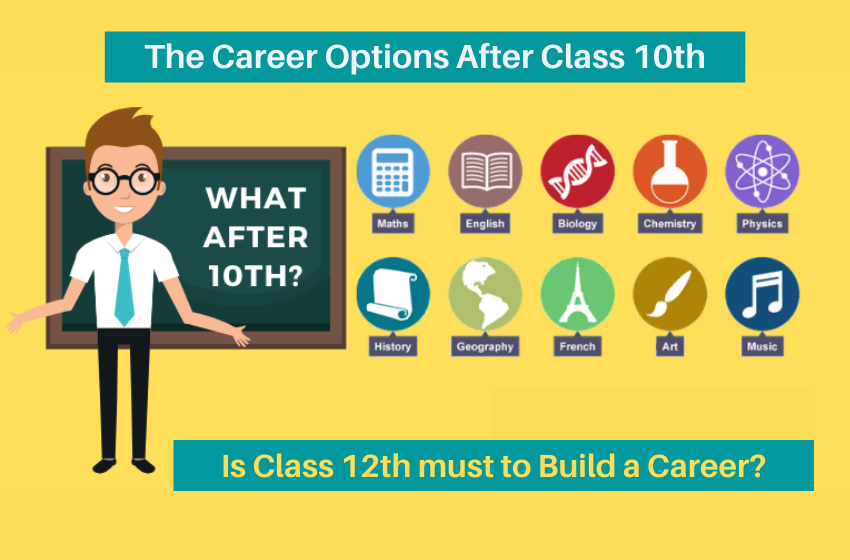
The Career Options After Class 10th – Is Class 12th must to Build a Career?

Career Option After Class 10

Most of the pupils completing their 10th standard are concerned about choosing the right career path. Choosing the right course after class 10 is not an easy task. For a successful career, solid planning and following it up with a useful plan is needed.  Career research, knowledge about one’s own self, decision-making ability, future goals are some of the basic elements required for successful career planning. For determining a potential career, one can also serve educational fairs and career guidance seminars that enable us to get in touch with several institutes and courses. They should have a persistent focus on his or her goal and can seek the help of their teachers, parents, and elders.

Picking the right career option after the 10th is probably the most important decision of our life and should not be taken in a hurry.

Let us see how we can choose the right career path after class 10th: 

  • Intermediate – After the 10th class, the pupil can choose subject combinations like PCM, PCB, PCMB, Commerce with Maths, Commerce without Maths. Post completion of the 12th class, one can do graduation in multiple disciplines based on the subject selection.
  • Polytechnic – After the 10th class, students can do polytechnic courses like Mechanical, Civil, Chemicals, Computer, Automobile. Polytechnic colleges provide diploma courses for 3 years, 2 years, and also 1 year.
  • ITI (Industrial Training Institutes) – After the 10th class, students can do ITI courses for employment like Mechanical, electrician, electrical.
  • Paramedical – After the 10th class, pupils can do paramedic courses like DOA (Diploma in Ophthalmic Assistant), DOT (Diploma in Ophthalmic Assistant), DMLT (Diploma in Medical Laboratory Technology). 
  • Short term courses – After the 10th class, pupils can do short term courses like Tally, DTP, etc.

Right career advice and guidance at the right time can do wonders for us. A career counselor can help us decide what to choose after the 10th. An expert will assess and analyze our strengths, passion, and interest.Based on that the expert will determine our most suitable career path.

How to pick the education board? Should we go to CBSE or ISCE or IB?

We have finished our 10th. Now we are planning to pick an education board that is most suitable for us. Deciding between CBSE, ISCE, and IB is not an easy decision. Each education board has its own advantages. If it comes to having the best education, choosing the right board and school is very important. Let’s take a glance at the perks of choosing any education board. It will be easier for us to decide which board to opt for.

Benefits of CBSE (Central Board of Secondary Education)

  • Probably it is the most common education board and the national board of our country. CBSE has a combined curricular approach that assists develop holistic individuals.
  • CBSE emphasizes skill development. 
  • CBSE assists pupils to prepare for competitive exams as most of the questions in competitive exams are asked from NCERT.
  • Most of the competitive exams like JEE mains and advanced are conducted by CBSE. 
  • It gives quality knowledge to the pupils as well as assures the overall development of an individual.
  • One of the best advantages of the CBSE board is that it gives the flexibility to choose the subjects based on the student’s interests. The overall structure of CBSE is very compact and it doesn’t allow us to feel any pressure.
  • We don’t need to mug up the answer. Well-written answers are praised by the CBSE board giving pupils a chance to examine their thinking horizon. 

Benefits of ICSE (Indian Certificate of Secondary Education)

  • ICSE is estimated to be the hardest board. The curriculum of ICSE is very comprehensive and it includes all fields with equal importance. 
  • ICSE pupils become usually very good at English because of their in-depth curriculum.
  • There is no surprise that students who do well in ICSE are required to clear the Civil service exam as the art of writing compactly in English is very much needed in Civil services.
  • The syllabus and structure of ICSE are in such a form that it allows pupils to study beyond textbooks and have practical insights into the concepts.
  • The standard and curriculum of ICSE provide the students with a strong foundation and make them ready for their future.
  • Amount and content of the syllabus might be high. However, it also develops high knowledge among the students. We might have heard that what CBSE teaches us in 11th or 12th, the ICSE board has already taught the concepts in 9th. Such result and resourcefulness is ICSE’s curriculum. 

Benefits of IB (International Baccalaureate)

  • It helps us to get admission in respective foreign countries if we are planning to study abroad. 
  • IB board helps us to become more culturally aware.
  • It encourages us to get into the Global Association.
  • It helps in the all-round development of a student through their extra curriculum. 
  • IB board gives us the flexibility to select our subjects.

These are some advantages of the top education board. As no board is the best, every board has its advantages. It depends on the student’s aptitude i.e. tendency to learn new things. It is also essential for a student to understand a career assessment for the 10th class. To understand the personality, interest, and aptitude of the student Career assessment is necessary. As it helps to find out the suitable subject group and career path.

Negative impact of getting a job/doing job oriented course instead of higher education

  • Economic: According to the statistics provided by the Bureau of Labour, people with some form of higher education tend to earn more money and have a low probability of unemployment. 
  • Better communication: Some form of written or verbal communication is involved in most jobs. As such, we usually improve in both areas during our college and professional career.
  • Recognition of passions: As it is said that the more we learn than more we are inclined to find our true passion in life and it is implicated in most people.  Therefore, through the education process only we can explore the various aspects of a prospective field and find our strength with it. 
  • A higher sense of discipline: The discipline required in the professional world can be taught by the different troops of education. Thus, by learning to comprehend complex directions and by meeting strict deadlines, we will be better able to adjust to the rigidity of the marketplace. 
  • Health: Productive employment and a certain cashflow take away the stress factors connected with any financial insecurity. As such, we are more inclined to live a better and healthier life with some form of college below our belt.
  • Civic involvement: When we earn well and our network grows then we are more liable to involve in volunteer work.As it is all possible due to the productive employment and financial resources.
  • Personal growth: As the people with their respective careers tend to live more structured lives with a stronger sense of responsibility traits that serve as a strength-builder in other areas.
  • Sense of accomplishment: Each time we complete a school assignment or job task, it’s the product of our talent and hard work which cannot be felt if we only study for a limited class.

Positive impact of getting a job/doing job oriented course instead of higher education

  • There are a few popular jobs available after class 10th in the government sector.  Aside from the government sector, public sector companies such as HAL, ONGC, and others also provide low ranked positions after class 10th.
  • The cut-throat competition faced for taking a Sarkari Naukri with minimum educational eligibility of class 10th can be an apparent example of this aspect. Students who want to financially support their families or need some experience before pursuing their further studies can opt for Government jobs after Class 10th.
  • The several government departments advertise regular vacancies with a minimum qualification of class-10th every year for the government job seekers who have done class 10th. And these advertisements are done in public through newspapers and the official website of the departmental websites. However, this job offers see very tough competition due to the minimum educational qualification due to which deserving candidates miss out on application deadlines.

Conclusion

Yet there are limited career opportunities after class 10th but still, you can be hired in an array of jobs after your class 10th. Hence, there is no reason to feel bad if you couldn’t continue your higher studies. As there are several opportunities you could climb to grab the career ladder. Therefore, get ready to work hard and not to be disheartened as you have to achieve great heights, with minimum educational qualification and maximum determination.  


FAQs regarding Career After Class 10th

Q1. Which is the best course to opt for after class 10th?

Ans. There are many best courses available after class 10th but it highly depends on your interest and the scope of that particular course shortly. Thus, you can choose from any stream from Arts, Science, Commerce or you can also opt for Polytechnic diploma courses.

Q2. What are the different courses available after the 10th?

Ans. There are mainly three-stream Arts, Commerce and Science for the best way to go further study and some other courses available after 10th class such as Diploma courses, ITI courses, short term computer, and other courses.

Q3. What are the subjects in science?

Ans. There mainly five subjects in Science Stream in the form of two groups and i.e. 

  • Group A – Mathematics, Physics, Chemistry, English. 
  • Group B – Biology, Physics, Chemistry, English. And One subject is selected as per school as it is optional.

Q4. Is math a science subject?

Ans. Yes, Mathematics is one of the Science stream subjects in Group A and other science subjects like Physics, Chemistry, Biology, English.


Related Links:

Career Options in Defence Services After the 12th Class?
Best Career Options after 12th in Creative Field
Best Career Option After 12th in Scientific Field
Career Prospects for Biology 12th Pass Students

SSLC and PUC Full Form: Meaning in Indian Education

sslc and puc

In India, education plays a critical role in shaping the future of students, and two of the most important milestones in this journey are SSLC and PUC. These two certifications act as the gateway to professional careers and higher learning, especially in states like Karnataka, Kerala, and Tamil Nadu. Whether you are a student planning your next academic move or a parent trying to understand the school system, knowing how these two stages differ is essential for making informed decisions about future career streams.

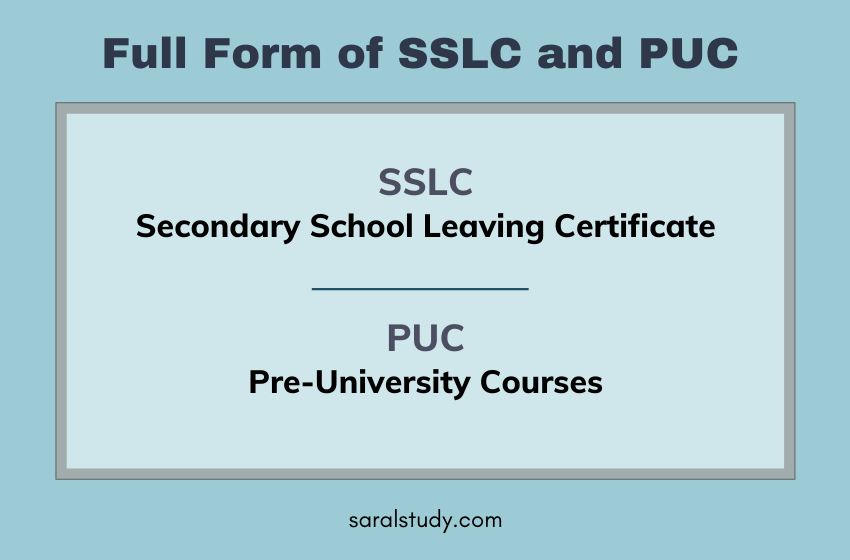
To clarify these terms, the SSLC full form is the Secondary School Leaving Certificate, which is awarded upon the successful completion of the 10th-grade board exams. Following this, students transition into the PUC full form in education, which stands for the Pre-University Course. While the sslc meaning is centered on completing foundational secondary schooling, the puc full form represents the vital two-year intermediate program (Class 11 and 12) that prepares students for university-level degrees in science, commerce, or arts.

What is SSLC? Understanding SSLC Full Form and Meaning

The SSLC meaning refers to the first significant milestone in a student’s life in many Indian states.
The full form of SSLC is the Secondary School Leaving Certificate and there are many other names also such as SSLC certificate, Matriculation, SSLC mark sheet, Secondary school certificate, SSC etc. It is the Class 10
th certificate or 10th standard certificate.

SSLC Meaning: Is SSLC 10th or 12th?

The term SSLC refers specifically to the 10th grade. It does not indicate 12th grade. In many Indian states, the 10th board exam is referred to as the SSLC exam, and passing this exam is necessary to pursue higher studies or vocational training.

It is given to the student by the respective educational boards after successfully completing class 1st to 10th along with the senior secondary certificate examination i.e. class 10th examination. All the states are approved by the Ministry of human resource development, the Department of school education, and the government of India. 

Why SSLC certificate is important?

The SSLC certificate is important to enroll in higher secondary education in India. It was used as the Date of Birth proof in India when death and birth certificate were not mandatory. In India, the SSLC certificate is the age proof of the people born before 1989.

Different names of SSLC in India

  • In Kerala, Karnataka, and Maharashtra and the other South Indian States, it is called SSLC certificate for class 10th.
  • In the north and eastern states of India, it is called HSC – Higher Secondary/matriculation certificate.
  • In Andhra Pradesh and Telangana, it is called SSC certificate – Secondary school certificate.

Importance of SSLC

  • Proof of Date of Birth: As discussed earlier, It is a proof of Date of birth for the people born before 1989 in India. Before 1989 the Birth and death certificates were not compulsory in India, so people started using SSLC as their Date of Birth Prove. They can use it as a legal document for different purposes like making passports or voter cards etc. 
  • Enroll for higher education: A student must obtain an SSLC certificate to enroll for class 11th or any diploma/polytechnic courses. 
  • For Driving Licence: To get a driving license in India, one must possess the SSLC certificate to prove that he/she has passed class 10th..

Relevance of SSLC Certificate for Job Objectives and Passport Acquisition in India

In India, the SSLC (Secondary School Leaving Certificate) is crucial for several pivotal reasons.

Job Requirements

Many employers in India mandate the SSLC certificate as proof of educational qualification. This certification demonstrates that the individual has successfully completed secondary education, providing a foundational level of literacy and essential skills required for various job roles.

Passport Application

For passport applicants, the SSLC certificate serves as an important document. It is often required to verify the applicant’s date of birth and academic qualifications. Without this certificate or an equivalent, the passport application process can be significantly delayed.

In summary, possessing an SSLC certificate is essential for meeting job qualifications and successfully acquiring a passport under Indian regulations.

Educational opportunities after SSLC

A student becomes eligible for higher education or pre-university education after the qualifying SSLC examination. An SSLC certificate holder can apply anywhere for any technical course. The students will be trained professionally for their careers.

Options for Technical Training After SSLC:

  1. Technical Training College:
    • Students can choose to enroll in a technical training college. Here, they will gain skills tailored for professional careers.
  2. Polytechnic for Engineering Diploma:
    • Students possessing SSLC can apply for a 3-year diploma course in polytechnic for engineering.
    • After completing the diploma, they can further pursue an engineering degree.
  3. Vocational Educational Programs:
    • There is also an option to enter vocational educational programs after completing SSLC.

After SSLC, students can also apply for vocational educational programs. If any Indian wants to migrate to another country for job purposes, he/she needs an SSLC certificate for the passport.

Breaking it down further, the specific paths include joining a polytechnic for an engineering diploma, which can lead to an engineering degree, or opting for vocational educational programs that provide targeted training in various trades and professions. These alternatives ensure a robust pathway for students aiming for technical careers.

How to get duplicate SSLC

There have been many unfortunate incidents where people lost their important documents. To obtain the duplicate SSLC, you need to follow some of the steps mentioned below:

Step 1: File an FIR in the nearest police station where you have misplaced your SSLC. 

Step 2: Download the form for Duplicate SSLC from your board website and if it is not available online, you can also visit the Board’s office to fill-up the form.

Step 3: Make the Demand Draft or NEFT, whichever is accepted by your board, for the amount prescribed by the Board. 

Step 4: Attach all the Documents needed for the duplicate SSLC. 

Boards Offering SSLC in India

There are a total of 53 Boards in India which are offering SSLC to their students. The list is as follows:

S. No. Board Name Link
1 Assam Sanskrit Board Link
2 Aligarh Muslim University Board of Secondary & Sr. Secondary Education, Aligarh Link
3 Board of Secondary Education (Andhra Pradesh) Link
4 Department of School Education Nagaland Link
5 Board of School Education, Haryana Link
6 Board of School Education Uttarakhand Link
7 Board of Secondary Education Rajasthan Link
8 Board of Secondary Education, Assam Link
9 Board of School Education Haryana Link
10 Board of Secondary Education, Telangana State Link
11 Board of Secondary Education Link
12 Board of Secondary Education, Manipur Link
13 Board of Vocational Higher Secondary Education, Kerala Link
14 Board of Secondary Education, Madhya Pradesh Link
15 Bihar School Examination Board Link
16 Bihar Board of Open Schooling & Examination Link
17 Bihar State Madrasa Education Board Link
18 Bihar Sanskrit Shiksha Board Link
19 Banasthali Vidyapith Link
20 Central Board of Secondary Education Link
21 Chhattisgarh Board of Secondary Education Link
22 Chhattisgarh State Open School Link
23 Chhattisgarh Sanskrit Board, Raipur Link
24 Chhattisgarh Madrasa Board Link
25 Council For The Indian School Certificate Examinations Link
26 Dayalbagh Educational Institute (Deemed University) Link
27 Goa Board of Secondary And Higher Secondary Education Link
28 Gujarat Secondary And Higher Secondary Education Board Link
29 Gurukula Kangri Vishwavidyalaya Link
30 H. P. Board of School Education Link
31 Jharkhand Academic Council, Ranchi Link
32 Karnataka Secondary Education Examination Board Link
33 Kerala Board of Public Examination Link
34 Maharashtra State Board of Secondary And Higher Secondary Education Link
35 M. P. State Open School Education Board Link
36 Maharishi Patanjali Sanskrit Sansthan Link
37 Meghalaya Board of School Education Link
38 National Institute of Open Schooling Link
39 Odisha Punjab School Education Board Link
40 Rajasthan State Open School, Jaipur Link
41 Rashtriya Sanskrit Sansthan Link
42 State Board of School Examinations(Sec.) & Board Of Higher Secondary Examinations, Tamil Nadu Link
43 State Madrassa Education Board, Assam Link
44 Telangana Open School Society Link
45 Tripura Board of Secondary Education Link
46 The J & K State Board of School Education Link
47 The West Bengal Council of Rabindra Open Schooling Link
48 U.P. Board of High School & Intermediate Education Link
49 Uttarakhand Sanskrit Shiksha Parishad Link
50 West Bengal Board of Secondary Education Link
51 Uttarakhand Madrasa Education Board Link
52 West Bengal Council of Higher Secondary Education Link
53 West Bengal Board of Madrasah Education Link

What is the Full Form of PUC in Education?

PUC stands for or PUC full form is pre-university courses mainly known as intermediate or plus 2 (10 + 2) in India. These courses are conducted by the educational boards of India or the state boards and the duration of the courses is 2 years. 

In Karnataka and several other Indian states, PUC refers to the two-year intermediate course taken after completing the SSLC or 10th standard. It is equivalent to 11th and 12th grades and prepares students for higher education in streams like science, commerce, and arts.

Students who wish to take admission for Pre-university courses need to get the SSLC (Secondary school leaving certificate). The education system in India follows the 10+2+3/4/5 pattern. 10 years of schooling which includes 5 years of primary education and 5 years of secondary education. 2 years of schooling is the pre-university courses or the intermediate. The duration of university courses in India is 3-5 years depending upon the field chosen by the student. PUC is offered in the PU colleges or the junior colleges in India. 

PUC Full Form in Karnataka and Its Importance

In Karnataka, PUC (Pre-University Course) is the standard progression after completing SSLC. Students can choose between different streams like science, commerce, and arts, which determine their further career or higher education paths.

Educational opportunities after PUC

The Junior colleges mainly offer 3 streams for PUC i.e. Science, Commerce, and Arts. 

The students who qualify PUC with science stream can opt for Professional courses in Nursing, Pharmacy, Medicine, agriculture, and engineering in any Indian University. These students can also opt for B.sc (Bachelor in Sciences). 

The students who qualify PUC with commerce stream can opt for Bachelor of Commerce or the Bachelor of Business management in any Indian university.

The students who qualify PUC with Arts stream can opt for BA (Bachelor of Arts), D.ed (Diploma in education), BSW (Bachelor of Social work), or any designing courses like fashion designing.

Advantages of PUC

PUC offers 2 years to the students to explore their strengths and develop an interest in the field they wish to opt for as their career. PUC introduces the students to further study for their careers. The students can understand the world outside the school and get to know the real challenges they are going to face. 

Know the various fields of PUC in detail

As discussed earlier about the courses offered in PUC, let’s have a detailed look at them:

Science: The students who score high in their secondary examinations can opt for this field in PUC as the students of this stream are expected to have a clear understanding of concepts, theories, formulas, and experiments. The Students of their stream usually get occupied with practicals, records, coachings, seminars, etc. 

The subjects available in the science stream are Maths, Physics, Chemistry, Biology, Electronics, computers, statistics, geography, and home science. Students can choose the subjects according to their choices and the combinations offered by the Institutions. 

Common combinations: PCB, PCM, PCMB, PCMC, PCME, PCMG, PCBH and PCBE

Commerce: This stream is for the students who wish to make their career in accounts, business, computer, management, etc. Although this stream is easy for the students, one must have a stronghold over Data, Theory, Numerical and Analytical. The students can also prepare for CA after qualifying PUC with commerce. 

The subjects available in this stream are Maths, Business Studies, Accountancy, Statistics, Economics, Business Maths, Economics, etc. students can choose according to their choices and the combinations offered by the educational institutions.

Common combinations: SEBA, ABEM, BSAM, EBAC, and APBE.

Arts: Students who wish to make their career in IAS, Economists, etc can opt for this stream in PUC. People usually consider this field for the students who are below average but the truth is if you wish to opt for this field you must have strong linguistics, Social, Arts, and interpersonal intelligence. 

The subjects available in this field are very interesting like Psychology, sociology, Education, Languages, History, Music, Economics, Geography, Political science, etc.  Students can choose according to their interests. 

Common Combinations are HESP, HEGP, HEPK, ELSP, ESPP, HEKM, etc. 

SSLC and PUC: Key Differences

While SSLC is the 10th-grade certification, PUC is a preparatory course for university-level education, equivalent to 11th and 12th grades. The transition from SSLC to PUC is important as it allows students to specialize in chosen subjects, guiding their future academic or professional choices.

Feature SSLC PUC
Full Form Secondary School Leaving Certificate Pre-University Course
Education Level Class 10 (Secondary) Class 11 & 12 (Higher Secondary)
Purpose Eligibility for higher secondary Eligibility for Degree/University
Common States Karnataka, Kerala, Tamil Nadu Karnataka, Andhra Pradesh


Also Read: Tips To Crack Business School Entrance Examination

FAQs regarding SSLC and PUC

I want to build my career in the Paramedical field, Which PUC courses should I opt for?

For Para – Medical you must opt for the science stream in your PUC with a combination including Physics, Chemistry, and Biology. 

How to get the SSLC certificate?

To obtain an SSLC certificate, you must qualify for the secondary school examination conducted by your educational board.

Are SSLC and SSC the same?

Yes, SSLC, and SSC are the same thing. In Andhra Pradesh, it is called SSC whereas in south India it is called SSLC. 

Can a person born after 1989 also use SSLC as the Date of Birth Proof?

Yes but it is better to use the birth certificate as DOB proof as it is ordered by the government of India. 

Can I Opt for diploma courses after PUC?

Yes you can opt for diploma courses after PUC and you can also opt for the same after obtaining SSLC also.

What is PUC Full Form and Meaning in Education

PUC stands for Pre-University Course and is a two-year program that bridges secondary education and university-level studies. After completing the PUC, students can appear for various entrance exams for professional courses or seek admission to undergraduate programs.

Is PUC Necessary After SSLC?

Yes, after SSLC, students typically enroll in PUC or similar intermediate courses (11th and 12th grade). These courses are essential to qualifying for entrance exams and undergraduate programs in universities.

What does SSLC mean in education?

SSLC, or Secondary School Leaving Certificate, is a qualification awarded to students after completing the 10th grade. It signifies the end of secondary education and allows students to pursue higher education, typically through PUC or similar intermediate programs.

Is PUC the same as 12th?

Yes, PUC (Pre-University Course) is equivalent to 11th and 12th grades in India. It is a two-year program that prepares students for higher education by specializing in a chosen stream like science, commerce, or arts.

What is the full form of PUC in Karnataka?

The full form of PUC in Karnataka is Pre-University Course. After completing SSLC (10th grade), students enroll in PUC for two years to pursue specialized subjects that guide their higher education or career paths.

What is the difference between SSLC and PUC?

The SSLC (Secondary School Leaving Certificate) marks the completion of 10th grade, while the PUC (Pre-University Course) is a two-year intermediate program (11th and 12th grades). SSLC acts as the foundation for PUC, which then prepares students for university or professional courses.

Is PUC compulsory after SSLC?

While not strictly compulsory, most students opt for PUC after SSLC to complete their intermediate education. It is necessary for those aiming for university degrees or competitive entrance exams, but students can also explore vocational training or diploma courses.

What is the sslc full form and its significance?

The sslc full form is the Secondary School Leaving Certificate. Obtaining this certificate is mandatory for students completing their 10th-grade board examinations, as it acts as primary proof of age and educational qualification.

How to prepare IIT or Medical Entrance Exam along with Class 12th

IIT & Medical Entrance Exam

Can a student prepare for IIT or Medical entrance exams while studying in the 12th class?

Yes, a student can prepare for IIT or NEET at the same time while studying in class 12th. IIT JEE looks like a tough exam, however, in reality, it is not as hard as everyone says it is. The only challenge that many scholars face is that they have to concurrently prepare for CBSE class 12 Board exams along with IIT JEE. However, with proper preparation and dedication, it is easy to crack IIT JEE. NEET or National Eligibility cum Entrance Test is the single national level exam conducted every year by NTA (National Testing Agency). The test has emerged as the only medical entrance exam required for qualification to seek admissions across medical institutes in the country for different medical programs. Thus, scraping multiple entrance tests that were taken out earlier, through maintaining uniformity, transparency at all levels, providing equal opportunities for applicants belonging to different categories.

NEET anticipates the participation of approximately 16 lakh passionate medical aspirants. The competition is fiercer than ever. Preparing for NEET is a game of confidence. Not only are applicants studying at home worried about covering the entire syllabus, but they are also continually required to be self-motivated and achieve set goals.

Preparation Strategy for IIT Entrance Exam

1. Build a Routine

Students who are preparing for JEE must evolve a daily routine that provides to all their needs in terms of preparation for the JEE Exam, preparation for the board exam, maintaining a healthy body as well as defined time to relax. Considering that for self-study, students will have the flexibility of dedicated preparation time for JEE, they should be able to manage it quite easily. But, preparing a daily schedule on paper and implementing it is very different. So, by preparing a great daily routine that accounts for all your study requirements, you should also assure that it has practical and achievable goals.

2. Study Materials

Coaching classes are known to provide regular study materials that are curated by experienced teachers and mentors, who have years of experience concerning the JEE test. In addition to this, the regular tests, and quick tips, make coaching classes seem to be the best way to crack JEE. But, having too much study stuff and too little time is also a problem.

Hence, scholars, who are studying for the engineering entrances on their own, are at an advantage in this respect. And, getting study materials, even from the best coaching classes is not really difficult nowadays.

3. Manage your Time

Time management is more than only preparing a timetable and following it. It refers to the planning of time in a manner that helps you achieve all your short-term tasks while making a regular process towards the long-term goal of cracking JEE Main / JEE Advanced. Time management meets three key concepts as described below:

4. Time management

Prioritizing: Along with the right time to study, time management also refers to the selection of the right topic to study. If you have a concept or a topic that will take 2 hours to complete, there is no point in picking it up when you only have an hour of study time left. To avoid this, prioritizing and selecting which concepts need how much time is also part of the right time management.

Goal-based timelines: Have you ever observed that you have been studying for hours, but still have no clue about the concept that you are trying to learn. It is because you lack a goal-based approach to your study techniques. Time management also helps you to define a goal-based timeline to complete topics and master concepts that fall within its purview.

Don’t spend long hours on the Internet, TV, playing games and go to bed early at night and rise early. It is so true that early to bed early to rise makes a man healthy, wealthy, and wise. Peer Study Groups: Coaching classes serve IIT-JEE students by giving a competitive environment of like-minded and talented people. Having to compete with a talented pool of engineering candidates usually assists students to raise the bar when it comes to JEE preparation.

However, it is not necessary to join a coaching class to build healthy competition; it can be easily achieved by building peer study groups of JEE aspirants.

Selection of Time: JEE aspirants need to pick the right time to study, where they are mentally and physically free and able to study complex concepts with relative ease. The right time to study for each candidate is different. Self-studying scholars will have the benefit of flexibility in this respect.

Preparation Strategy for Medical entrance exam

Willpower and devotion are two major factors to crack NEET, especially when one is into self- studies.

1. Follow a time table strictly

Forming a timetable is a first and chief move when it comes to either exam. It is a useful paper affirming your plan of progress for the forthcoming days before exams.

2. Plan a target

After forming your timetable you should devise a plan which aims to achieve set targets daily. As it will ensure that you study 12-14 hours at least

3. Get familiarized with NEET

As NEET being an objective question-based test so, it is advised to the students who have taken charge of clearing exam on their own to be completely aware of the syllabus, the format of the paper, marking scheme, weight age of all chapters, important concepts, and other such significant factors. It is also advised to take a printout of the same for studying reference.

4. Identify your books

One must know which book to consider as mere studying for hours together would not be as productive. Therefore, NCERT must be the first book you master completely. As there are no two ways about it. So, once if you mastered the latter book then you can also refer to other coaching material books.

5. Strive at attaining conceptual clarity

While studying topics, the student must target to understand the topic thoroughly. So these students can seek any assistance from experts/teachers/seniors or can even look online to get deep knowledge about the topic.

6. Take up mock tests

To self-analyze, your performance students can take mock tests to identify their weak areas. So they could work on them and could strengthen that topic.

7. Make notes

Ensure your notes are brief and compact. It is always better to construct your notes, showing highlights, important labeling, mapping theories, use of mnemonics, and more such hacks to make learning simpler and enjoyable.

8. Practice

To crack the given entrance exam students must practice more and more questions and master the art of solving the MCQs within a minute. So you can solve sample papers, mock tests, previous year papers, etc.

9. Staying self-motivated

The other important key factor to crack NEET is being self-motivated. So, just remember that you are your mentor so don’t waste time as having an undying spirit is a key factor to crack the medical entrance exam.

10. Never be self-righteous

Do not be driven by the fact that you understand questions as you have been consistently receiving good scores in mock tests. Overconfidence can ruin it all for you. So, always have a quest to learn more, so that you can improve yourself. As there is always an opportunity of learning something new every day. So you can work on weaker areas and attempt to solve the paper in less time. As time management is the most essential and determining factor in NEET.

Conclusion

As stated above students can prepare for the IIT or Medical entrance exam while studying in class 12th. With self-study, they can crack both the entrance exam, but they just have to follow a timetable that they have prepared for self-study. As the main point to crack any entrance exam is the clarity of one’s basic concepts. So, the students appearing for the respective exam’s main focus should be on the concepts. Thus the questions asked in both the entrance exams are not direct so it’s better to start the preparation while studying in class 12th due to which you can be updated about the respective topics. Hence, practice as many questions from each topic as practice improves one’s speed and accuracy to solve the questions. Lastly, make your separate copy for writing notes about the respective topics.


FAQs regarding Prepare of IIT or Medical Entrance Exam

Q1. Can a student appear for both NEET and JEE?

Ana. Yes, a student can give both NEET and JEE entrance exam if he fulfills the eligibility criteria for the respective exams. As many students appear for both the exams.

Q2. How many hours do IIT students’ have to study?

Ana. It is advised for students to study for at least 6 hours a day and i.e. self-study to prepare well for the JEE. But this advice is only useful when you make a timetable that suits your specific necessities.

Q3. Can a PCM student give NEET?

Ana. No, a PCM student who is appearing in the board exam is not eligible to appear for the NEET examination. As biology is a necessary subject for NEET so if you are a PCB or PCMB student then only you can apply for the given exam.

Q4. Is it possible to crack NEET by self-study?

Ans. Yes, it is possible to crack NEET with self-studies by proper time management to study for the entrance exam and the other main factor is the undying spirit of the exam.


Related Links:

NDA Entrance Exams: All about disciplined Determination
All India Youth Scholarship Entrance Examination (AIYSEE) 2020-21
Top 10 Engineering Entrance Examinations in India: Check out the dates here
12 Simple Tips And Tricks To Help You Prepare For Entrance Exams

Career Options in Defence Services After the 12th Class?

Career in Defence Services

Career opportunity in Defence

Class 12th exams are about to get over yet you are shuffling with the career decision, you are in a critical mess. It usually appears as a sense of relaxation to some children who begin early thinking but as a burden for those students who resume into the last-minute discussion, planning, and choices. There are various interesting and profitable career options in India apart from prevailing career myths coming from generations where we run behind like career options of engineering, medical, or civil servants only. Now, a- days trend has changed. We have many career options in India from diverse fields like science, engineering, medical, computers and IT, mass communication, law, armed forces, performing arts and design, and various other fields.

Surprisingly these days more and more children are opting for white-collar jobs where power and money matter a lot but yet we have a great young number of students that are choosing defence as a career, a positive and welcome sign in today’s time where one desires to serve the nation and safeguard boundaries of the country.

Hence, by being defense personnel one can find true respect and honor in the most dignified manner. Knowingly and unknowingly class 12th students sit in various Entrance Exams after class 12th. Various defense entrance exams are also present and to be a part of these elite forces and to get a chance to serve the country, lakhs of candidates appear for different defense exams every year. Joining the defence forces brings a lot of responsibilities not only to you but also to the entire nation for whom we are fighting day and night. People most of the time says “Big” things come in “Small” packages, an absolutely true statement and we can use this saying in our defence as well where we observe the same thing. Your pay checks may be little, your wages and benefits are reasonable, and you may spend a small amount of time with your families but believe me, it becomes a brave person with a “Big” heart to willingly put his/her life on the betterment of the Indian people daily. Many of them have had to sacrifice their lives just so the rest of us can live in a free and prosperous society Boys and girls finishing plus two examinations can opt for a career in Air Force, Navy, and Army in technical and non- technical categories. Students can now opt for an engineering career in the Army or Navy through Technical Entry Scheme, which allows becoming an engineer at Army expenses before getting commissioned as an officer. Various options are available in defence for class 12th students ranging from 16 to 19 years age groups.

The Indian Armed Force has four main divisions:

  • Indian Army
  • Indian Air Force
  • Indian Navy
  • Indian Coast Guard

Indian Armed Forces

The Government of India is liable for ensuring the defence of India. The capacity for national defence rests with the Cabinet. This is administered by the Ministry of Defence, which gives the policy structure and means to the Armed Forces to discharge their duties in the context of the defence of the country. The Indian Armed Forces contain three categories –Indian Air Force, Indian Navy, and the Indian Army.

Indian Army

The Indian subcontinent had recognized the cohesive concentration of several Empires in the quest for the handle of military power and governance of the State. As time rolled by, societal norms obtained an ethos in the workplace, the system of rights and privileges, and service under the flag.

The Indian Army became operational after the Country got independence from British colonialism. The Indian Army’s HQ is established in New Delhi and functions under the Chief of Army Staff (COAS), who is responsible for the command, control, and administration as a whole. The Army is categorized into six operational commands (field armies) and one training command, each following the command of a Lieutenant General, which has an equal status to the Vice-Chief of Army Staff (VCOAS), serving under the control of Army HQ in New Delhi.

Indian Navy

The foundation of the modern Indian Navy was set in the seventeenth century when the East India Company had founded a maritime force, through graduating in time to the establishment of the Royal Indian Navy in 1934. The Headquarters of the Indian Navy is established in New Delhi and is following the command of the Chief of the naval staff – an Admiral. The Indian navy is deployed under three area commands, each commanded by a flag officer. The Western Naval Command is headquartered located in Bombay on the Arabian Sea, the Eastern Naval Command located in Vishakhapatnam, Andhra Pradesh, on the Bay of Bengal, also on the Southern Naval Command located in Kochi (Cochin), in Kerala.

Indian Air Force

The Indian Air Force was formally founded on 8th October 1932. With time, the Indian Air Force began extensive upgrading of its aircraft and equipment, and as part of the process, it added more than twenty new types of aircraft. The last decade of the twentieth century saw a remarkable change in the structure of the Indian Air Force with the introduction of women into the Air Force for short service commissions. It was also a time when the Air Force began some of the most dangerous operations ever undertaken.

Indian Coast Guard

On 18 August 1978, the Indian Coast Guard was established as a sovereign armed force of the country. It protects the country’s maritime interests and maritime law enforcement with jurisdiction over both territorial and international glasses of water. This includes both the contiguous zone and the exclusive economic zone. It serves in close collaboration with the Indian Navy, Department of Revenue.

Defence Exam Eligibility

Various job opportunities for the candidates from different standards are offered through defence exams to the students who have completed the following 10th, 12th, ITI, diploma, engineering, and other graduation qualifications. The basic eligibility criteria for the defence exam are as follows:

Parameters

Details

Nationality

* A citizen of India or Nepal
* A person who has moved from Burma, Pakistan, Sri Lanka, and East African countries of Kenya Zambia, Malawi, The United Republic Of Tanzania, Uganda, Ethiopia, Zaire, and Vietnam to permanently settle in India and are of Indian origin.

Age Limit

A candidate should not be below 16½ years and above 19½ years for the NDA exam.

Education Qualification

Candidates who have passed the 10+2 Examination

Minimum Marks Required

* Candidates who have scored a minimum of 70 percent marks in Physics, Mathematics, and Chemistry in total can apply for the post.
* Various State/central board eligibility requirements for calculating PCM percentage will be based on marks obtained by the student in class 12th only.

Age Limit and Educational Qualification

Courses

Age Limit

Marital Status

Air Force Academy (AFA)

20 to 24 years

Unmarried

Indian Naval Academy (NA)

19 to 24 years

Unmarried

Indian Military Academy (IMA)

19 to 24 years

Unmarried

Officers' Training Academy (for OTA - Men)

19 to 25 years

Married and Unmarried

Officers Training Academy (for OTA - Women, Non-Technical)

19 to 25 years

Unmarried, Widow and Divorcee

Pros & Cons

Pros

  • The best candidate gets selected for the training through the defence exam and only the bravest one becomes the soldier and the biggest perk of being a soldier is the utmost respect from the civilians.
  • It opens up a whole new world of adventure and thrill and the possibility to serve a cause and advance in ranks.
  • The government pays special attention to its soldiers and their families and provides them with all kinds of facilities and perks like free schooling of children’s health cover, subsidized food, and transportation.
  • A lot of Retirement Benefits are provided to soldiers. And lead a life full of discipline and obedience.

Cons

  • The challenges that come with being in defence are not just physical but also mentally draining as well.
  • The other drawback of it is that once a person gets qualified and got selected to train and enter the permanent service then there is no going back until a particular time.
  • Due to being posted in the farfetched area or at dangerous fronts, they have to remain away from their families for a long period.

Conclusion

If you are planning for a career option in defence then you should go for it as it is one of the most prestigious and respected positions in the country. Thus those youngsters who want to choose a career of excitement, adventure, and challenges cannot find any better place to work than defence to meet all your expectations. The four professional uniformed services that consist in the Indian Armed Forces are The Indian Army, Indian Air Force, the Indian Navy, and the Indian Coast Guard. And there are other paramilitary forces also that help Indian Armed Forces. Hence for all the management of The Indian Army, the Ministry of Defence is responsible for it.


FAQs regarding Government Exams After 12th

Q1. How can one join the Indian Army?

Ans. NDA, CDS, AFCAT are the exams conducted yearly for youths to join the Indian Army.

Q2. What are the Government exams for which candidates can appear after completing 12th?

Ans. Various government exams like RRB, ALP, SSC-CHSL, SSC-MTS, Stenographer, Indian Coastal Guard, etc. can be appeared by the candidates after completing their class 12th.

Q3. What is the minimum qualification required to appear for any government job?

Ans. The minimum qualification required for different government exams varies according to the post. However, the minimum qualification that a candidate must possess to appear for a government exam is that he/she should be class 12th passed.

Q4. What subjects are covered in the syllabus of government exams for the 12th pass?

Ans. The Subjects that are covered in the syllabus of government exams after class 12th are General Awareness, Reasoning Ability, Quantitative Aptitude, and English.

Q5. How do the candidates get notified about various government exams?

Ans. The candidates can get notified about various government exams by visiting their official website of the examination conducting body or by any job portal or through newspapers.


Related Links:

The Career Options After Class 10th – Is Class 12th must to Build a Career?
Best Career Options after 12th in Creative Field
Best Career Option After 12th in Scientific Field
Career Prospects for Biology 12th Pass Students

Green Revolution in India | 11 Schemes Under Green Revolution

Green Revolution in India

William Gaud and Norman Borlaug are the fathers of the Green revolution as the term was given by them whereas the father of the Green Revolution in India is the famous Geneticist, MS. Swaminathan. Green revolution in India refers to a certain interval of time when people started using HYV (high yield variety) seeds, pesticides, tractors, and other types of equipment in agriculture.

Under the leadership of Former Prime Minister Indra Gandhi, the green revolution within India commenced in 1666 which resulted in the increase in production of food grains especially in areas like Punjab, Haryana, and Uttar Pradesh. However, this is a great step towards producing a sufficient amount of food grains in India for feeding Indians and not to rely on any other foreign nation for food import.

The Main Aspects of Green Revolution in India are:

  • High Yielding Varieties
  • Mechanization of Agriculture
  • Chemical fertilizers and pesticide use
  • Irrigation

The Green Revolution is mainly the process of using modern technology tools and machines for agricultural activities to enhance production. This period converted the agriculture of India into the Industrial system with the adoption of modern techniques like HYV (High Yielding Varieties, use of machines, fertilizers and pesticides, and irrigation. Till the year 1967, the government was trying to overcome the production shortage by increasing the land areas of farmers. The rapid increase in population and demand failed all the steps taken by the government and demanded immediate action, this is the time when the government decided to start the green revolution.

The Green Revolution in India focused on the following areas:

  1. Using the HYV (High Yielding Variety) seed.
  2. Double amount of cropping in the existing land areas.
  3. Expansion of farming areas.

Features of Green Revolution in India

  1. To introduce HYV seeds to the Indian farmers. These seeds are highly effective in the regions having good irrigation facilities. So, the green revolution was more in areas like Punjab. It was more successful on wheat.
  2. Prior wheat was the only introduced in HYV seeds and after sometimes other HYV seeds are also introduced.
  3. As we all know HYV seeds need proper irrigation, so farmers cannot fully rely on monsoon so the green revolution also improved the inland irrigation system.
  4. The introduction of the Green revolution was mainly for crops like wheat, rice, and other food grains. It does not focus on Crops like Jute, cotton, etc.
  5. It also introduced the use of pesticides, weedicides, and other chemicals for the betterment of the crop. All these chemicals were made easily available for the farmers which also saved the crops from getting damaged.
  6. It also introduced the use of tractors, drills, threshers to promote commercial farming in India.

Schemes under the Green Revolution in India

In the year 2017, Prime Minister Narendra Modi approved the Umbrella Green Revolution Scheme named ‘Krishonnati Yojana’ for 3 years i.e. 2017 to 2020 and the central shared Rs. 33,269.976 crores for this scheme. Krishonnati Yojana is a group of 11 schemes which overlooks the agriculture development and allied sector. Its aim is to increase the income of the farmers by increasing the productivity, production, and returns on the produce, improving the infrastructure for farmers, cutting down the production expenses, and the strong marketing of the produce.

Top 11 Schemes under Krishonnati Yojana

  1. MIDH – Mission for Integrated Development of Horticulture : It aims to make the horticulture sector better by enhancing the nutritional security, production, and increasing the income of household farms.
  2. NFSM – National Food Security Mission : It aims at increasing the productivity of grains like wheat, pulses, rice, etc. it also aims at restoring the soil fertility and productivity of these crops. It also includes NMOOP – National Mission on Oilseeds and Oil Palm under it. It also overlooks the area expansion, expansion of the farm-level economy, to reduce import and increase the availability of the produce in the country.
  3. NMSA – National Mission for Sustainable Agriculture : This scheme aims at promoting sustainable agriculture practices suitable for the particular agro-ecology while focusing on integrated farming, appropriate soil health management, and synergizing resource conservation technology.
  4. SMAE – Submission on Agriculture Extension : It aims to make the ongoing extensions of government or local bodies more powerful to promote socio-economic empowerment to farmers, support HRD inventions, ICT tools, etc. It also focuses on forge linkage among stake-holders, the institutionalization of program planning, and mechanism implementation. It promotes the innovative use of electronic and print media.
  5. SMSP – Sub-Mission on Seeds and Planting Material : This scheme aims to increase the production of quality seeds and farms-saved seeds and enhance SRR. To make the seed multiplication chain more powerful, to promote new methods and technologies of seed production, testing, etc., and to increase the modern infrastructure for seed production, quality, storage, and certification, etc.
  6. SMAM – Sub-Mission on Agricultural Mechanization : It aims to give the farming machines to the areas where the availability of farm power is low or the farmers do farming at a very small scale. To develop Custom Hiring centers, to create a hub for high technology farm equipment, to carry out demonstrations and capacity building activities for creating awareness among stakeholders, and to test the performance and quality of the designated testing centers all over the country.
  7. SMPPQ – Sub Mission on Plant Protection and Plan Quarantine : It aims at preventing crop damage due to insects, weeds, or other foreign material. To safeguard the agriculture bio-security from the invasion of alien species, to support the export of Indian produce to the global market, to promote better agriculture practices and plant protection strategies.
  8. ISACES – Integrated Scheme on Agriculture Census, Economics, and Statistics : It mainly aims to undertake agriculture census and studies on agro-economic problems of India, and to study the cultivation expanses of main crops, conference funding, workshops seminars, etc. with agricultural scientists and experts in order to release papers of short term studies.
  9. ISAC – Integrated Scheme on Agricultural Cooperation : This scheme aims to give financial help to make the condition of cooperatives better, removing regional imbalances, to increase agricultural processing, storage, marketing, and computerization. To ensure the supply of quality yarn at reasonable rates to the decentralized weavers, and help cotton growers fetch a remunerative price for their produce through value addition.
  10. ISAM – Integrated Scheme on Agricultural Marketing : To develop agricultural marketing infrastructure, to promote innovative technologies for upgraded marketing infrastructure for agriculture, To provide infrastructure for grading, quality certification of agricultural production. To create a common online platform to facilitate pan-India trade.
  11. NeGP-A – National e-Governance Plan : It aims to improve the farmer’s condition with respect to accessing the information of their use, enhance and integrate the existing ICT initiatives of the Centre and States, to provide relevant and time to time information to farmers to have good production. This scheme is farmer-centric and service-oriented.

Total Central Share in Green Revolution

Check below the total central share in the Green Revolution Krishonnati Yojana Schemes:

Name of the Scheme

Total Central Share

MIDH – Mission for Integrated Development of Horticulture

Rs. 7,533.04 crore

NFSM – National Food Security Mission

Rs. 6,893.38 crore

NMSA – National Mission for Sustainable Agriculture

Rs. 3,980.82 crore

SMAE – Submission on Agriculture Extension

Rs. 2,961.26 crore

SMSP – Sub-Mission on Seeds and Planting Material

Rs. 920.6 crore

SMAM – Sub-Mission on Agricultural Mechanization

Rs. 32.50 crore

SMPPQ – Sub Mission on Plant Protection and Plan Quarantine

Rs. 1,022.67 crore

ISACES – Integrated Scheme on Agriculture Census, Economics, and Statistics

Rs. 730.58 crore

ISAC – Integrated Scheme on Agricultural Cooperation

Rs. 1,902.636 crore

ISAM – Integrated Scheme on Agricultural Marketing

Rs. 3,863.93 crore

NeGP-A – National e-Governance Plan

Rs. 211.06 crore

Impacts of Green Revolution in India

  1. It increased agricultural production and the food grains has increased remarkably. Wheat grains production has risen the most. It increased to 55 million tonnes during the starting of the revolution in India.
  2. It also increased the per hectare yield along with the increase in agricultural output from 850kg/hectare to 2281 kg/hectare in the case of wheat during the initial stages.
  3. India no more depends on the import of agricultural produce and became self-sufficient. After the introduction of the green revolution, India started meeting the increasing demand of the population and even started maintaining stock for emergencies. India also started exporting its produce.
  4. It removed the fear from the people that commercial farming can lead to unemployment and farmers are no longer jobless. It created jobs for many other sectors like transportation, communication, irrigation, etc.
  5. It majorly benefited the farmers of India. It increased their income remarkably and risen their living standard. They shifted from sustenance farming to commercial farming.
  6. We can see a rapid increase in the production of food grains because of this revolution.

There is always a negative side to everything, the same as in the case of the Green Revolution.

Let’s look at the negative impacts of the Green Revolution:

  1. The agriculture Growth retarded due to insufficient irrigation, farm size shrinkage, technology failure, improper plan layout, and slow credit transfer system.
  2. There was no regional equality as the revolution worked better in the areas tech-savvy areas, the revolution worked better for wheat grains, so, the farmers growing wheat got the most benefit.
  3. The large farmers made more profit by growing more and they started purchasing the lands of small farmers which eventually lead to the loss of small farmers.

Frequently Asked Questions about the Green Revolution in India

Q1. When was the green revolution started?
Ans. The Green revolution was started in the 1970s.

Q2. Who used the term ‘Green revolution’ to increase agriculture production in India?
Ans. M.S. Swaminathan

Q3. Who was known as the father of the green revolution in the world?
Ans. Norman Borlaug

Q4. Which state was the first chosen for the green revolution?
Ans. Punjab

Q5. What are the main aspects of the Green Revolution in India?
Ans. High Yielding Varieties, Mechanization of Agriculture, Chemical fertilizers and pesticide use and Irrigation.

Q6. Was the Green Revolution really beneficial for the country?
Ans. Yes, the Green revolution has benefited the country a lot. Although there were some negative impacts of this revolution, if we look at the positive impacts, we can understand it has more positive impacts than negative impacts.

Also Read: White Revolution in India

What Are 5 Major Rice Farming Challenges in India?