Children’s Day – History, Significance, Celebration and Key Facts

Happy Children's Day

Every year on the 14th of November, India celebrates Children’s day on the birth anniversary of the first Prime Minister Pt. Jawaharlal Nehru. He always had a special place for children in his heart and life. The main aim of the celebration is to spread awareness about the rights and education of the children in India. The day is celebrated grandly with motivational and educational programs organized by the different organizations for children.

Mr. Jawaharlal Nehru was the first prime minister of independent India. Mr. Jawaharlal Nehru is very famous among Indian youth due to the amazing work he has done for the country especially for the children. The children use to call him Chacha Nehru. He believed that the children are tomorrow's youth and future Citizens of India. He was a brilliant student of Cambridge University and returned to India in 1912. Despite being a student he was interested in the freedom struggle of India. In 1916 he got his first meeting scheduled with Mahatma Gandhi and after talking to him he got the inspiration to work for the country. Later, he managed to organize Kisan March in Pratapgarh Uttar Pradesh. He went to jail twice because of his connection with the non-cooperation movement. From his teenage to his death he was a part of the freedom struggle of India. Apart from Freedom struggles, he also established various educational institutions for the children such as the Indian Institutes of Technology, All India Institute of Medical Sciences, and Indian Institutes of Management. He introduced free meals and Primary education in Indian schools. On 27th May 1964, he died in New Delhi India.

History behind the Children’s Day Celebration

Before 1964, India uses to celebrate children’s day on November 20th but after the demise of the first Prime Minister, it was decided that from now onwards children’s day will be celebrated on 14th November i.e Date of Birth of Pt. Jawahar Lal Nehru.

Jawahar Lal Nehru said, “The children of today will make the India of tomorrow. The way we bring them will determine the future of the country”. He has established the children film society in India in 1955 for uniformed children.

Significance of Children’s day in India

The real significance of this day is to understand the importance of children in our lives. How we Up bring a child decides his/her future. This day reminds adults that they should let children celebrate their childhood with full joy and they should have the proper basic educational facilities.

Here are some right listed for children in India

  1. Right to Health- It has been noticed that nearly one million children die under the age of 15. Nearly 39 children are found dead in 1000 births. Throwing light on this topic Indian government has initiated many steps towards a balanced diet, proper hygiene, etc.
  2. Right to Education- every child has the right to get basic education between the age group of 6 – 14.
  3. Right to Life- In India people are still practicing gender discrimination. In India, Nearly 117 million girls are missing as compared to the total population of boys because of selective sex-abortions. Every minute 9 abortions of female fetuses took place. Due to this Right to life is a fundamental right in our constitution and violation of this right is a criminal offense.
  4. Right against Exploitation- In India Child labor is strictly banned. A child working in Dhabas or other areas before the age of 14 years is strictly prohibited. Abusing or torturing the child is also prohibited and a punishable offense. Any physical abusing, mental abusing or sexual abusing, etc. is considered as torturing.

Schools, societies, Government, and many institutions organize special events, picnics, dancing events, camping, and a lot more activities for children where they enjoy from the depth of their hearts. Teachers make this day special for students by presenting dance and theatre for them. They tell students about their rights and how they can protect their rights given by the law.

Many people celebrate children Day in the following ways:

  1. Visiting Orphanages to meet the Children and organize some fun activities there.
  2. Distribute sweets or other items to children who live in orphanages.
  3. Organize events like swimming, dancing in school with awards listed.
  4. Donate your old clothes, books and other things to the poor children.

Facts about Children Day

  1. Children’s day is also known as “Bal Diwas” in India.
  2. This day is celebrated to increase awareness about the child’s educational rights
  3. Britain does not celebrate children’s day
  4. In some countries, children have a holiday on this day but schools organize special fun activities for the students in the school.
  5. Before 1964 children’s day was celebrated on November 20th but after the death of Mr. Jawaharlal Nehru, India started celebrating Children’s day on 14th November.
  6. In the year 1959 India celebrated its first children’s day.
  7. Apart from countries that celebrate children’s day on November 14th there are around about 50 countries in this world that celebrate children’s day on June 1st.
  8. On November 20th Universal children’s Day is celebrated.

Some facts about Pt. Jawahar Lal Nehru

  1. He was born in Prayagraj and was the eldest one among his siblings.
  2. After returning to India in 1912 he got an advocate Job.
  3. In 1929 he went to jail for the first time.

Some books based on Mr. Jawaharlal Nehru

  1. The Discovery of India
  2. Glimpses of World History
  3. Toward Freedom (his autobiography)
  4. Letters from a Father to His Daughter (collection of letters he wrote to his daughter)
  5. Nehru: The Invention Of India by Shashi Tharoor
  6. Independence and After (A Collection of Speeches, 1946-1949).

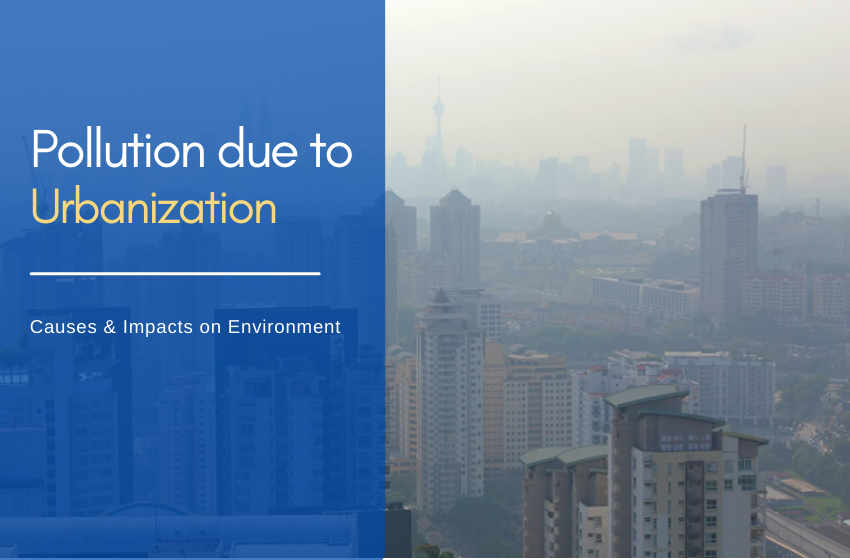
Urban Pollution – Causes & Impacts on Environment

Urban Pollution - Causes & Impacts on Environment

Urbanization is rapidly increasing worldwide, leading to significant environmental challenges, especially urban pollution. As cities grow, the demand for infrastructure, energy, and resources rises, resulting in increased waste, emissions, and contamination of natural ecosystems. This article delves into the causes of pollution due to urbanization, its adverse impacts on the environment, and the urgent need for sustainable urban development to mitigate these effects.

What is Urbanization?

A region converted from a rural or inhabited area into an urban area is known as Urbanization. It signifies the movement of people from rural to urban areas. With the introduction of urbanization, there can be an increase in the number of cities, population, and industrialization, directly or indirectly infecting our ecosystems.

Causes of Urban Pollution

Due to uncontrolled urbanization only, environmental degradation has been rising very rapidly and is caused by many problems such as land insecurity, worsening of water quality, excessive air pollution, noise pollution, and problems of waste disposal. According to a study, effective and preventive measures should be taken on the existing cause of environmental damage due to urbanization. As it is impossible to restrict urbanization so it should be ensured that urbanization should proceed on the right path.

Air Pollution

With the increase in population and industries the air in urban areas is always polluted with toxic substances. Which is becoming dangerous day by day to breathe as the air present inside cities is suffocating. The different cause of air pollution in the cities is smoke from automobiles, factories, and power generators which makes the air unhealthy. The other factors that contaminate the air are chemical spills and other toxic gases.

Water Pollution

Water, one of the most important natural resources of our environment, is being polluted day by day. There can be a different source of water pollution from industries to households to individuals. As the waste is disposed of directly to water from various sources that have arisen many water diseases.

Soil Pollution

The other cause of urban pollution is soil pollution. It occurs due to the mixing of toxins in the soil by industries or other sources. Which affects agricultural products.

Noise Pollution

One of the noisiest regions in the world is urban areas. With the population, it gives rise to various sources of noise pollution like traffic noises, loudspeakers, and other unwanted noises. It may cause many health issues like depression, mild deafness, etc.

Radioactive Pollution

It is caused due to the fortuitous leakage by nuclear power plants which poses a threat to our environment.

Visual Pollution

One of the most common pollution in urban areas is visual pollution. Signs, Billboards, Screens, high-intensity lights, etc are pretty disturbing and distracting due to the overexposure of visuals in cities.

Thermal Pollution

Other than these there is also ‘Thermal Pollution’ which is caused by an extreme amount of heat trapped in the earth’s atmosphere.

Most Polluted Cities in the World

Here are the top 10 most polluted cities according to the 2023 mid-year report:

Rank City Country AQI
1 Osorno Chile 371
2 Et Tira Israel 359
3 Ashton New Zealand 310
4 Bhagalpur India 286
5 Cuernavaca Mexico 233
6 Nuneaton UK 227
7 Abu Qir Egypt 175
8 Diadema Brazil 150
9 Concepcion Chile 142
10 Madinat Zayid UAE 142

Impacts of Urbanization on Different Components of Environment

Most of the important environmental problems will emerge in the future if the existing problems do not receive enough political attention. As the problems are not significantly noticed in many countries or the situation is being detected but nothing has been done for it. The most emerging issues that we are facing today are climate changes, freshwater scarcity, deforestation, and freshwater pollution, and population growth. These problems are very intricate and hard to define. It is very essential to examine problems through the social-economic-cultural system. Different impacts of pollution on our environment are as follows:

1. Impacts on Atmosphere and Climate

Change in Temperature

Cities remain warm at night when the countryside has already been cooled. It is due to the making of heat-absorbing materials like concrete, asphalt, bricks, etc which are used in building, household, industries, etc. The reflection of heat works differently than that of vegetation and soil.

Changes in Air Quality

A wide range of harmful gases is discharged due to human activities. Various gases that are released in the environment are carbon dioxide, carbon monoxide, sulfur oxides, nitrogen oxides, lead, and many other pollutants. This gives rise to respiratory diseases like Asthma, Tuberculosis, acute respiratory infections, etc are most affected by the people living in urban areas.

Changes in Patterns of Precipitation

As cities are warmer than the surrounding countryside, it often receives more rainfall. Since dust can stimulate the precipitation of water vapour into rain droplets.

2. Impacts on Lithosphere and Land Resources

Erosion and other changes in the quality of land

High levels of erosion and sedimentation in river channels are the result of rapid developments. The construction of buildings, roads, etc gives rise to deforestation which results in erosion and changes in the quality of the land.

Pollution

Burying a huge amount of waste in the ground results in land pollution. Pollutants are usually scattered over cities or concentrated in industrial areas or waste sites. Lead-based paint that is used on roads, highways, and buildings is one such example of a widely dispersed pollutant that found its way into the soil.

3. Impacts on Hydrosphere and Water Resources

Flow of Water into Streams

Unlike rural areas, urban areas are not surrounded by natural vegetation and undisturbed soil which are substituted with concrete, asphalt, brick, and other water-resistant surfaces. It means that when it rains in cities water is less likely to be absorbed into the ground. Which results in the direct flow of rainwater into river channels or streams.

Degraded Water Quality

With time the water quality has degraded due to urbanization. As all the city’s waste is deposited in rivers. That eventually leads to increased sedimentation thereupon increasing the pollutant in the run-off.

4. Impacts on Biosphere

Alteration of Habitats

The fertilizers that are spread across yards to promote the growth of plants find its way into water channels at the expense of fishes. The waste which is dumped into streams lowers the level of oxygen during its decay and results in the perishing of plants and animals.

Disruption of Habitats

As an outcome of urbanization complete eradication of habitats can be seen in cities. As a result, native species of the particular place are driven out of cities.

5. Other Impacts of Urbanization on the Environment

The other important effect of urbanization on the environment is a major increase in greenhouse gasses which creates an excessive risk to the environment. These are those gaseous components of the atmosphere that absorb and release radiation at a specific wavelength. The absorption of greenhouse gasses (GHG’s) in the atmosphere has rapidly increased due to the man-made activities connected to the urbanization growth which results in an irrelevant increase in the temperature of the earth. These gases absorb the energy radiated from the sun making the lower part of the atmosphere warmer. This foremost aspect is known as a natural greenhouse gas effect. These effects expanded with the emission of gasses from various man-made activities ensuing to industrialization and urbanization.

Industrial Sector

A major source of greenhouse gas emissions is industries. One-third of global carbon dioxide emission is due to the industrial sector only. In India, and other countries as well industries are the main source of emission of harmful gases. Industries like the steel industry, thermal power, cement plants, chemical production, and other industries mostly emit carbon dioxide and other harmful gases.

Waste Generation

The waste sector mainly contributes to the emission of carbon dioxide due to the waste burning of the inorganic matter when there is no energy renewal. Annual anthropogenic methane is produced approximately 10-23 percent and is discharged into the atmosphere. Both domestic and industrial water source wastewater treatment may be responsible for ten percent of anthropogenic methane emissions.

GHGs emissions due to the transportation sector

Most of the greenhouse gas emissions are due to the transport sector in urban areas. Due to an increase in the number of vehicles on the roads, there is an increase in the emission of harmful gases into the atmosphere. The traffic structure of the megacities of India (Delhi, Mumbai, Kolkata, Chennai, Bangalore, and Hyderabad) represents that there is a tangible shift from the share of slow-moving vehicles to fast-moving vehicles and public transport to private transport. For example, Delhi’s transport sector generates six times as much greenhouse gas discharges (GHG) as that of Kolkata’s, five times as much as Ahmedabad’s and three times as much as Greater Mumbai and Chennai Followed by Banglore and Hyderabad, Delhi’s transport sector emits 12.39 million ton of carbon dioxide. As compared to other Indian cities Hyderabad emits the greatest portion of GreenHouse gases according to 2015 reports.

Impact of Urbanization in Indian Cities

The main impact of urbanization on the environmental quality in Indian cities are:

  • The total slum population according to size or class of towns in India during 1991 shows that 41% of the total slum population was living in million-plus cities, where 27% of the total population of India lives.
  • According to the status of Municipal solid waste generation and collection in Metropolitan Cities of India Maharashtra generates the largest amount of municipal solid waste which is 11,000 tonnes/day followed by Delhi (8700 tonnes/day) in 2019 which are most likely to be increasing in near future.
  • Growth in motor vehicles in India and other Metropolitan Cities.
  • There has been an increase in the number of vehicles used in India and other metropolitan cities. An average of 10% or more increase has been found in the use of vehicles which is a major concern for air pollution.
  • Due to the increase in population, wasteful consumption, and negligence of conservation, water resources are diminishing day by day. With an increase in urbanization and industrialization, huge quantities of wastewater enter rivers which affect the river streams that are used for drinking and purposes.

Conclusion

Urbanization lies in the enactment and the regulating agencies of the country. Due to some bad decisions of governance, today’s cities resulted in the growth of informal settlements and slums that constitute unhealthy living and working environments. Serious attention should be given to the need for improving urban strategies, which promote productivity in resource use.

In metropolitan cities, top priority should be given to the control of Vehicular pollution. Primary attention should be addressed to reduce the generation of solid waste. In case adequate steps are not taken to prevent pollution and to improve the quality of life by providing more social amenities, the life of the urban inhabitants of metropolitan cities may become more discontented this may be the cause of health hazards and worst devastation. We can follow these major steps also:

  • By promoting economic development and creating jobs we can combat poverty which is also an important aspect of urbanization.
  • We can involve local communities who are working for the environment.
  • By upgrading energy use and alternative transport systems we can reduce air pollution.
  • Waste disposal and housing facilities can be provided through a private-public partnership.
  • A key element in urban planning is to plant trees and incorporate the care of city green spaces.

Also Read: Types of Pollution and Its Effects

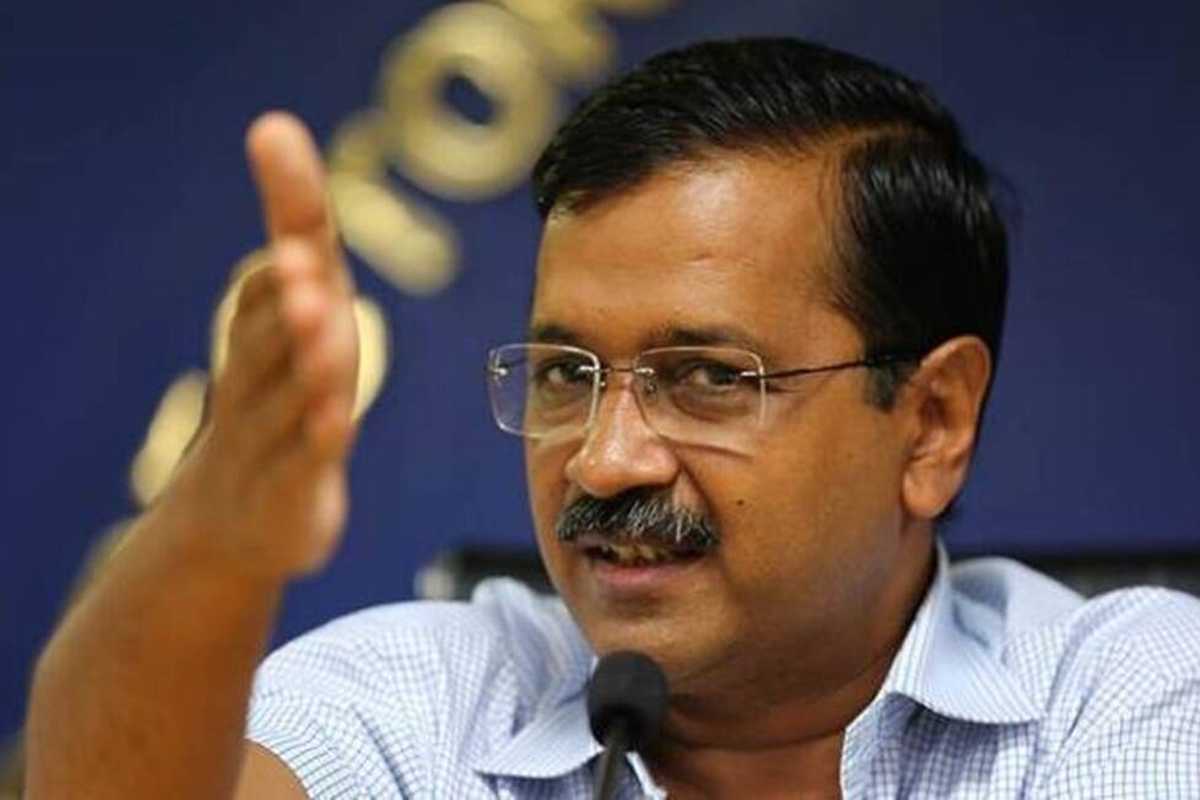
Arvind Kejriwal – A Social Activist Turned to Prominent Leader

Arvind Kejriwal – A Social Activist Turned to Prominent Leader

The year was 1995. On the first day of his job in the Indian Revenue Service (IRS), Arvind Kejriwal got some unsolicited advice from a senior official that maybe shaped the course of his life from a civil servant to a social activist and a politician who is now the scourge of the political founding. From raising his fist in the air, declaring him ‘an anarchist’ and sitting on a dharna at Lieutenant-Governor’s office to emerging as a doer whose constant focus is on giving the requirements to his electorate. The metamorphosis of Delhi chief minister Arvind Kejriwal in his five years in office is one of the most mature and fastest political course-corrections in recent times amidst a dramatic turn of events.

Activist-turned-politician Kejriwal started his tenure as an energetic and confrontational chief minister, who left no chance to beat Prime Minister Narendra Modi for all apparent ills that came his way. He was a man at war with everyone — political candidates, the media, and members of his own party. However, his Aam Aadmi Party (AAP) had got a historical mandate of 67 out of 70 seats in 2015.

Fast forward to 2020, Delhi is observing the issue of a new Kejriwal — a mellowed, matured, and focused politician whose electoral plank is his work and governance. And he is pointing away from making any controversial statement during his election campaign.

Kejriwal was once known as a fierce member of the anti-Modi mass which included Mamata Banerjee, N Chandrababu Naidu, Congress party, and others. But with the going of time, he has made a tactical shift by avoiding the group that tried to appear as a strong anti-BJP alliance. In a recent media interview when asked whether he was afraid of Modi or not. The chief minister of Delhi said ‘Is he scaring me? No. As he is doing his job as the country’s prime minister and I am doing my work as a Delhi chief minister.’

This fierce ‘anarchist’ today is not hesitant to call himself a firm ‘Hanuman Bhakt’. In public, he has even cantillated few lines from Hanuman Chalisa. The Delhi chief minister certainly has driven a long distance in the several years— from being a Social Activist to a Prominent politician and now to an Everyone Chief Minister who’s now connecting with Delhi households as their “bada beta (eldest son)”.

Arvind Kejriwal – Personal Details

Name

Arvind Kejriwal

Date of Birth

16th August 1968

Birth Place

Siwani, Bhiwani District, Haryana

Father's Name
Govbind Ram Kejriwal
Mother's Name
Gita Devi
Spouse Name
Sunita Kejriwal
Children
Harshita Kejriwal and Pulkit Kejriwal
Residence
New Delhi, India
Education
Mechanical Engineer from IIT Kharagpur
Religion
Hindu
Profession
Politician, Activist
Profession before joining politics
He worked as a Joint Commissioner for the Indian Revenie Service (IRS) in the Income Tax Department
Political Party
Aam Aadmi Party
Awards
Ramon Magsaysay Award
Known for
He is known for the Indian Against Corruption Jan Lokpal Bill.

Arvind Kejriwal – Professional Background

The professional background of Arvind Kejriwal before entering politics:

Years

Particulars

2012

Published a book called “Swaraj” which discusses his point of view on corruption. And later Formed his own political party named AAP (Aam Aadmi Party).

2006

Resigned from the post of Joint Commissioner in the Income Tax Department and founded the “Public Cause Research Foundation” with the award money he received from Ramon Magsaysay.

1999

Founded an NGO ‘Parivartan’ which main aim is to support the citizens in electricity, Income tax, and Food related matters.

1995

Joined the Indian Revenue Services (IRS) as an Assistant Commissioner of Income Tax.

1992

Resigned from his job in Tata Steel and cleared his Civil Service Examination.

1989

Graduated in Mechanical engineering and joined Tata Steel.

1985

Appeared in the IIT-JEE exam and scored 563 ranks in AIR (All India Rank).

Arvind Kejriwal – Political Timeline

Year

Events

In 2020

In NCT OF DELHI Assembly Election 2020, Arvind Kejriwal of AAP won the New Delhi seat by defeating Sunil Yadav, Romesh Sabharwal of BJP, CONGRESS respectively

In 2015

He led the AAP party to a Great Victory in the 2015 Delhi Assembly elections and took pledge as Delhi's chief minister on 14th February 2015.

In 2014

He directed the AAP party to a Great Victory in the 2015 Delhi Assembly elections and took oath as Delhi's chief minister on 14th February 2015.

In 2013

The Kejriwal’s AAP party entered politics the year 2013 from Delhi Legislative Assembly election, and became the second-largest party and won 28 of the 70 seats. With no party getting an overall majority, with limited support from the Indian National Congress, the AAP established a minority government. Arvind Kejriwal swore as Chief Minister of Delhi on 28 Dec 2013. It had been in power for 49 days than from the post-Kejriwal resigned in Feb 2014.

In 2012

Arvind Kejriwal started the Aam Aadmi Party. It is an Indian political party, formally began on 26th November 2012.

From the Bottom Up

Arvind Kejriwal started working in the income tax department as a revenue officer in 1995, he already worked at Tata Steel since graduating from IIT Kharagpur in 1989. He resigned, voluntarily, in 2006, after he reportedly became disillusioned with the rampant corruption in the government. Kejriwal had said to the Financial Times in an interview “Once you are inside the system, you realize you are a very small peg, and it is very little you can do,” in 2014.

He devoted himself full time to Parivartan, an unregistered organization intended to improve accountability and transparency in governance, which he had launched and been working on since 2001.

His efforts earned him a Ramon Magsaysay Award the same year he dropped the government, for working incessantly with villagers and slum residents on the Right to Information (RTI) Act. With his prize money, he started the Public Cause Research Foundation to resume RTI-related work.

In 2007, Kejriwal felt that RTI, a great tool for accountability, didn’t change corrupt systems. He then started drafting the Jan Lokpal Bill with the aid of lawyer Prashant Bhushan and the latter’s father, Shanti Bhushan.

Venkatesh Nayak, a senior member of the National Campaign for People’s Right to Information (NCPRI), of which Kejriwal was also part said “We told him, let’s not mix up everything in one bill, and said ‘I will take it into consideration.’ But he never did, that implies he had his own plans, and he knew specifically what he was doing,”.

When he thought the bill was not being taken seriously, Kejriwal parted with the NCPRI and joined hands with Anna Hazare in 2011. Arvind Kejriwal rallied the streets as Hazare sat on a hunger strike to demand an end to corruption. The movement galvanized the nation and gave Kejriwal the springboard to enter politics.

Arvind Kejriwal – Awards

Years

Awards

In 2004

Ashoka Fellow

In 2005

The IIT Kanpur presented Arvind Kejriwal with the Satyendra L. Dubey Memorial Award.

In 2006

Ramon Magsaysay Award

In 2006

Indian of the Year award by CNN-IBN.

In 2009

The IIT Kharagpur presented Arvind Kejriwal with the Distinguished Alumnus Award.

In 2009

Association for India's development awarded him a reward and fellowship.

In 2010

The Economic Times Awards for Corporate Excellence bestowed Aruna Roy, with Arvind Kejriwal, the Policy Change Agent of the Year.

In 2011

The Indian of the Year award by NDTV to Anna Hazare and Arvind Kejriwal.

How AAP came into existence

On the birth anniversary of Mahatma Gandhi on 2nd October, Arvind Kejriwal announced the formation of his political party. Then on 26th November the day when the Constitution of India was adopted in 1949, he formally launched his party named AAP (AAM AADMI PARTY).  AAP was begun with respect to the anti-corruption movement.  In the 2013 assembly elections, the party won a majestic 28 seats being a new party with new ideas and new thinking. It was guessed that the accomplishment was only possible because Kejriwal was a socialist leader. He won and replaced the then chief minister of Delhi Sheila Dikshit by forming a minority government.

A little over a month however Kejriwal surprised the electorate by resigning into his first term when the Jan Lokpal Bill didn’t pass the assembly test. After that when fresh elections were held in 2015, AAP once again won with a huge majority, winning 67 of the 70 seats.

The recent 2020 elections have brought back the party with the same intensity, saving only eight seats for the BJP, which had drawn in major resources to polarise the electorate.

AAP’s focus began with corruption when Kejriwal upheld the image of an activist and since 2012 it was firmly on the issues of governance, particularly those affecting the middle class.

Now, it is on issues of water, electricity, and education thriving in the middle classes. He is considered to be “an approachable and a polite politician” and as someone who is “a communicator instead of a leader who speaks only in speeches without any listening”.

In being an approachable neta this change served the party well. With the governance of Kejriwal, there can be seen major changes in the education system, hospitality, Electricity, Water Supply, etc.

In his recent interview for the 2020 election, Kejriwal said that his work and performance over the past 5 years will determine the voter’s decision.

With the more formal approach in politics, Kejriwal’s choice to adopt the middle path did not go unnoticed in the recent election. He refused to engage in the anti-Citizenship Amendment Act protest at Shaheen Bagh.

Dr. A.P.J. Abdul Kalam – The Missile Man of India

Dr. A.P.J. Abdul Kalam was acknowledged with many prestigious awards including India’s highest civilian honor “Bharat Ratna” in the year 1997. Dr. A.P.J. Abdul Kalam was the 11th President of India, who was elected against Lakshmi Sehgal in the year 2002. Before taking administration as the President of India. He worked with a space organization, the Indian Space Research Organisation commonly known as (ISRO) and also at Defence Research and Development Organisation, also known as (DRDO) and designated as an aerospace engineer.

He was known as the Missile Man of India for his vital role in the nation’s civilian space program and military missile development. Also, He made some significant contributions to India’s Pokhran-II nuclear tests, in the year 1998.

A.P.J Abdul Kalam started his career as a scientist at the Aeronautical Development Establishment of the Defence Research and Development Organization (DRDO). He had also worked as the project director of India’s first Satellite Launch Vehicle (SLV-III) at ISRO.

In the 1990s he had worked as the (CSA) Chief Scientific Adviser to the Prime Minister before taking charge as the President of India in the year 2002.

Family History and Early Life

On 15 October in the year 1931, Dr. A.P.J Abdul Kalam was born to a Tamil Muslim family in Rameswaram. Later in Madras Presidency in British India, which is now known as Tamil Nadu. His father’s name was Jainulabdeen, he owns a boat and imam of a local mosque. His mother’s name was Ashiamma, she was a housewife.

Kalam was the youngest and he had five siblings. The eldest was a sister, named Asim Zohra, and three elder brothers, i.e Mustafa Kalam, Kasim Mohammed, and Mohammed Muthu Meera Lebbai Maraikayar. He was very close to his family and always supported them, though he lived a whole bachelor’s life.

His parents had been wealthy traders and landowners, with many properties and large plots of land. They trade groceries between the mainland and the island to and from Srilanka and also carry the pilgrims from the shore to Pamban Island. Their family had the title “Mara Kalam Iyakkivar” (wooden boat steerers). They were known as “Marker.”

But by the 1920s, the family business of Dr Kalam failed to result in the loss of his family wealth. So, to assist his family, Kalam started selling newspapers at an early age.

Kalam was always an average student during school days but was very hard working and obedient. Mathematics was his favorite subject.

Finished his matriculation from Schwartz Higher Secondary School, which is located in Ramanathapuram, and later he graduated in Physics from Saint Joseph’s College. Later, He moved to Madras to continue aerospace engineering at Madras Institute of Technology, in the year 1955.

Through his graduation, he has designated a project to design a low-level attack aircraft with other students. Their teacher had addressed them a tight deadline to complete this project. It was challenging. Abdul Kalam worked hard under pressure and finished his project within the specified period. The teacher was overwhelmed by the allegiance of Kalam.

Kalam always wanted to become a fighter pilot, but he got 9th position in the qualifiers list, and only eight vacancies were available in the IAF.

Education and Career

Kalam had finished his graduation in 1957 from the Madras Institute of Technology. In 1958, he joined the Aeronautical Development Establishment of the Defence Research and Development Organisation (DRDO) as a scientist.

In the beginning 1960s, he worked with the Indian National Committee for Space Research also known as INCOSPAR under the renowned space scientist Vikram Sarabhai.

After visiting Goddard Space Flight Centre in Greenbelt, Maryland, NASA’s Langely Research Centre in Hampton, Virginia, and Wallops Flight Facility in 1963-64, he had begun working on an expandable rocket project independently in 1965 at DRDO (Defence Research and Development Organisation).

He was not very happy with his work at DRDO. And when he got transfer orders to the ISRO in 1969, he became happy. He worked as the project director of the SLV-III that successfully deployed the Rohini satellite in near-earth orbit, in July 1980. It is India’s first indigenously created and produced satellite launch vehicle.

After receiving the government’s approval in 1969 he expanded the program to include more engineers. In the 1970s. He had made an endeavor to develop the Polar Satellite Launch Vehicle (PSLV) to enable India to launch its Indian Remote Sensing (IRS) satellite into Sun-Synchronous orbit, PSLV project was successful and on 20 September 1993, that was his first launch.

In the 1970s, Abdul Kalam guided two projects, i.e Project Devil and Project Valiant. Devil Project was a new liquid-fuelled missile project intended at producing a short-range surface-to- air missile. And this project was not successful and stopped in the 1980s, and later it started the development of the Prithvi missile. And the valiant project which was aimed at the development of the intercontinental ballistic missile was also not successful.

An Indian Ministry of Defence program, which was managed by DRDO in association with other government organizations, launched the Integrated Guided Missile Development Programme (IGMDP) in the early 1980s. Dr. Kalam was called to commence the project, and in 1983 he reverted to DRDO as the Chief Executive of IGMDP, in the year 1983.

The program is directed to the development of four projects i.e Short-range surface-to-surface missile (Prithvi), Short range low-level surface-to-air missile (Trishul), Medium range surface-to-air missile (Akash), and Third-generation anti-tank missile (Nag).

Following the leadership of Abdul Kalam, the project of IGMDP demonstrated to be successful by producing missiles like the first Prithvi missile in 1988 and after that the Agni missile in 1989. Due to his participation, he was known as the “Missile Man of India.”

In 1992, he was designated as the Scientific Adviser to the Defence Minister. Among the rank of a cabinet minister, in 1999, he was selected as the Principal Scientific Adviser to the Government of India.

Abdul Kalam performed a significant role in leading the Pokhran-II, a series of five nuclear bomb test explosions, in May 1998. With the completion of these tests. He received the status of a national hero, and then Prime Minister Shri Atal Bihari Vajpayee announced India a full-fledged nuclear state.

Not only this much, but A.P.J. Abdul Kalam in 1998 also recommended a countrywide plan called Technology Vision 2020 to make India a developed nation by the year 2020 and proposed nuclear empowerment, numerous technological innovations, improvement of agricultural productivity, etc.

The National Democratic Alliance (NDA) was in power and chose Dr. A.P.J. Abdul Kalam for the post of the President of India, in the year 2002. As a popular national figure, he won the presidential election very easily.

His years at the DRDO

As a scientist, his time at DRDO was utilized in focusing on research in the defense and space arena. In the beginning, he invented a small hovercraft and started working on an expandable rocket project autonomously. In 1969 he was moved to the Indian Space Research Organisation (ISRO) where he was the project head of India’s first Satellite Launch Vehicle (SLV-III). During this time he received the government’s approval to expand the program.

The Missile Developer

In 20 years, Dr. Kalam was successful to develop the Satellite Launch Vehicle (PSLV) & SLV-III projects. He also directed two projects which developed ballistic missiles from the technology of the SLV program, in the 1970s. Abdul Kalam was appointed as the Chief Executive by then Defence Minister R. Venkataraman of a project that served on the development of a quiver of missiles. A fund of 388 crores was designated for this mission named Integrated Guided Missile Development Programme (IGMDP). He developed many missiles beneath this mission including Agni and Prithvi.

Role in Pokhran-II

ABJ Kalam worked as the Chief Scientific Adviser to the Prime Minister and he worked as the Chief Project Coordinator of the Pokhran-II nuclear tests. The extensive media coverage of this the project made Kalam a well – known nuclear scientist.

During the Vajpayee government, APJ Abdul Kalam has got Bharat Ratna and performed a significant role in the testing of nuclear weapons in 1998.

Abdul Kalam as a President of India: From 2002 to 2007

  • The NDA government introduced Kalam’s name for the presidential post to the Leader of Opposition, Congress President Sonia Gandhi, on 10 June 2002.
  • Dr. Abdul Kalam worked as the President of India from 25 July 2002 to 25 July 2007. He was the first scientist and the first bachelor to maintain the Rashtrapati Bhawan.
  • In the presidential election, he received approx. 922,884 votes and defeated Lakshmi Sehgal.
  • He became the 11th President of India by displacing K.R Narayanan.
  • Dr. Abdul Kalam got the prestigious Bharat Ratna and then became the third President to receive the highest civilian honor after Dr. Sarvapali Radhakrishnan in 1954 Dr. Zakir Hussain in 1963.
  • Dr. Kalam was recognized as the People’s President.
  • According to Dr. Kalam, the most difficult decision taken by him as the President was signing the bill of office of Profit.
  • Over his five-year term, he endured devoted to his vision of transforming India into a developed nation.
  • He was still criticized for his inaction to determine the fate of 20 aid requests out of 21, including that of the Kashmiri Terrorist Afzal Guru, who was convicted for the parliament attacks in December 2001.
  • He chose not to contest the Presidential election again in 2007 and moved down as the President on 25 July 2007.

Post Presidency

  • Information Technology at the International Institute of Information Technology, Hyderabad, and at Banaras Hindu University and Anna University was developed by Dr. Abdul Kalam.
  • Dr. Abdul Kalam was examined by civil groups over his stand on Koodankulam Nuclear Power Plant as he had encouraged the establishment of the nuclear power plant and was accused of not speaking with the local people, in 2011.
  • With a central idea for defeating corruption, a program named ‘What Can I Give Movement’ was started for the Indian Youth.

A.P.J. Abdul Kalam: Death

  • Dr. Abdul Kalam was giving a lecture at IIM Shillong where he grieved a heart attack, and his condition became critical, so he was shifted to Bethany Hospital where after that, he died of cardiac arrest, on 27 July 2015. A.P.J. Abdul Kalam’s last words, to Srijan Pal Singh, were “Funny guy! Are you doing well?”
  • The late president was laid to rest at Rameshwaram’s Pei Karumbu Ground with State honors, on 30 July 2015. About 350,000 people had attended the last ceremony, including the Prime Minister of India, the Governor of Tamil Nadu, and the Chief Minister of Karnataka, Kerala, and Andhra Pradesh.
  • The most honored death in the country and worldwide is of Dr. A.P.J Abdul Kalam. World student day is celebrated on his birthday. Abdul Kalam has the best example for a living.

A.P.J. Abdul Kalam National Memorial

In the remembrance of late President Dr. A.P.J Abdul Kalam, a statue was built on his name at Pei Karumbu, in the island town of Rameswaram, Tamil Nadu, India. It was inaugurated by the Prime Minister of India, Narendra Modi, on 27 July 2017.

In the memorial, numerous models of rockets and missiles are stored which shows the work of Dr. Abdul Kalam. Also, some acrylic paintings about his life are presented along with hundreds of portraits that describe the life of Dr. Kalam.

At the entrance of the monument, a statue of Dr. Kalam was set showing him playing Veena a musical instrument. Including these two more statues are there in sitting and standing posture.

A.P.J. Abdul Kalam: Awards and Achievements

  • In 1981, Dr. A.P.J. Abdul Kalam received Padma Bhushan from the Govt. of India.
  • In 1990, Dr. Kalam received Padma Vibhushan from the Govt. of India.
  • In 1994 and 1995, Distinguished Fellow and Honorary Fellow through Institute of Directors India and National Academy of Medical Sciences.
  • In 1997, he got Bharat Ratna from the Government of India and the Indira Gandhi Award for National Integration from the Indian National Congress.
  • In 1998, The Government of India awarded him with the Veer Savarkar Award.
  • In 2000, Alwars Research Centre awarded him with the Ramanujan Award, Chennai.
  • In 2007, he was acknowledged with the King Charles II Medal by the Royal Society, U.K., and Doctorate of Science from the University of Wolverhampton, UK.
  • In 2008, he got the Hoover Medal bestowed by ASME Foundation, USA, and obtained a Doctor of Engineering from Nanyang Technological University, Singapore.
  • In 2009, The California Institute of Technology, U.S.A, bestowed Kalam with the International von Karman Wings Award, Hoover Medal by ASME Foundation, USA, and Honorary Doctorate by Oakland University.
  • In 2010, Doctor of Engineering via the University of Waterloo.
  • In 2011, The IEEE acknowledged Kalam with IEEE Honorary Membership.
  • In 2012, Doctor of Laws by Simon Fraser University.
  • In 2013, The National Space Society awarded him with the Von Braun Award.
  • In 2014, Doctor of Science via Edinburgh University, UK.
  • Dr. Kalam was the receiver of privileged doctorates from 40 universities.
  • Dr. Kalam’s 79th birthday was known as World Student’s Day by the United Nations. He was further chosen for the MTV Youth Icon of the Year in 2003 and 2006.
  • Following his death, he took several donations like the Tamil Nadu State Government on 15 October that is on his birthday declared to be recognized across the state as “Youth Renaissance Day”. Moreover, the State Government instituted the Dr. A.P.J Abdul Kalam Award organizing an 8 gm gold medal, a certificate, and Rs 500,000.
  • On Independence Day, from 2015, the award will be bestowed annually to the citizens of the state with the achievements in strengthening scientific growth, the humanities, or the well-being of students.
  • Not only this, on 15 October 2015 the 84th anniversary of Kalam’s birth, Narendra Modi, the Prime Minister of India also delivered postage stamps honoring Kalam at DRDO Bhawan in New Delhi.
  • A new bacterium as the filters of the International Space Station (ISS) called it Solibacillus Kalami to acknowledge the late President Dr. Abdul Kalam was determined by the Researchers at the NASA Jet Propulsion Laboratory.

A.P.J. Abdul Kalam: Educational and Scientific Institutions

Numerous educational, scientific institutions and some places are named in honor of Dr. Abdul Kalam. They are as listed below:

  • At A.P.J. Abdul Kalam’s funeral, By the Bihar State Govt., an agricultural college at Kishanganj, in Bihar, was renamed as the “Dr. Kalam Agricultural College, Kishanganj”.
  • UPTU (i.e. Uttar Pradesh Technical University) was renamed “A.P.J. Abdul Kalam Technical University” via the Uttar Pradesh state govt.
  • In Kollam city, Kerala, Abdul Kalam Memorial Travancore Institute of Digestive Diseases, a new research institute, is associated with the Travancore Medical College Hospital.
  • In September 2014, India and the US started the Fulbright-Kalam Climate Fellowship. The fellowship will be managed by the binational US-India Educational Foundation (USIEF) following the Fulbright program.
  • Headquartered at Thiruvananthapuram, Kerala Technological University, where Kalam lived for years, that was renamed to A.P.J. Abdul Kalam Technological University later his death.

A.P.J. Abdul Kalam Books

Year

Name of the Books

2015

Advantage India: From Challenge to Opportunity by A.P.J. Abdul Kalam and Srijan Pal Singh, Transcendence: My Spiritual Experiences with Pramukh Swamiji (co-authored with Arun Tiwari,) and Reignited: Scientific Pathways to a Brighter Future by A.P.J. Abdul Kalam and Srijan Pal Singh

2014

Governance for growth in India and - A Manifesto for Change: A Sequel to India 2020 (co-authored with V. Ponraj, 2014)

2013

My Journey: Transforming Dreams into Actions

2012

Turning Points: A Journey Through Challenges

2011

You Are Born To Blossom: Take My Journey Beyond (co-authored with Arun Tiwari, Envisioning an Empowered Nation and Target 3 Billion by A.P.J. Kalam and Srijan Pal Singh.

2007

Inspiring Thoughts

2005

Mission India

2004

The Luminous Sparks

2002

Ignited Minds: Unleashing the power within India tells about the dream of Dr. Kalam for Developed India.

1998

India 2020:A Vision for the New Millennium (co-authored Yagnaswami Sundara Raja)

1999

Wings of Fire: An Autobiography

Biographies on A.P.J. Abdul Kalam

Year

Biographies

2009

‘My Days With Mahatma Abdul Kalam’ ( by Fr A K George).

2008

A Little Dream (Documentary film) by P. Dhanapal and The Kalam Effect: My Years with the President by PM Nair.

2002

A.P.J.Abdul Kalam: The Visionary of India by K Bhushan and G Katyal, President A.P.J. Abdul Kalam by R K Pruthi and Eternal Quest: Life and Times of Dr. Kalam by S Chandra.

A.P.J. Abdul Kalam: Legacy

Dr. Abdul Kalam was the youngest child in his family and was confined to his parents and his brothers and sisters. He never married and assisted his relatives whole life. He had a few properties including veena and a collection of books. Dr. Abdul Kalam was a kind-hearted man, a vegetarian.

He would do namaaz every day but also read Bhagwat Gita. For him, religion was a private matter, and used to insist that one should not make it a matter of ceremony and show. He used to say in your dealings with the society you have to be a humanist. Dr. Kalam often used to cite the story of how his mentor Vikram Sarabhai required church land for scientific research and got it because the bishop believed that both science and spirituality ask the Almighty’s blessings for human success, mind, and body.

While giving a lecture at the Indian Institute of Management Shillong on 27 July 2015, he failed and was rushed to the Bethany Hospital, where he was confirmed dead of cardiac arrest and on 30 July 2015 last rituals were performed at Pei Karumbu Island, Rameswaram.

Vedic Mathematics: History, Tricks, Techniques and Example

Vedic Maths

Vedic Mathematics is an assortment of Techniques/Sutras to tackle numerical mathematics in simple and quicker way. It comprises of 16 Sutras (Formulae) and 13 sub-sutras (Sub Formulae) which can be utilized for issues associated with number, algebra, geometry, calculation, conics.

What is Vedic Mathematics?

Vedic Mathematics is a book written by Bharti Krishna Tirtha and this book was published in 1965. This book contains a list of mathematics techniques and all mathematical knowledge that enable students to solve mathematical arithmetic easily.

Vedic mathematics covers 16 Sutras (Formulas) and 13 Sub-Sutras (Sub-Formulas) that are very useful in dealing with Arithmetic, algebra, geometry, calculus, and conics. The tricks of addition, subtraction, multiplication, and division are based on ancient Indian techniques which are very fast and easy to learn. Vedic mathematics is called so because of its origin from Vedas. It is originated from the Atharva Vedas. It deals with the branches of engineering, mathematics, sculpture, medicines, and all other sciences. The word Veda is a Sanskrit origin which means ‘knowledge’.

Regular mathematics is tough and complex to understand while Vedic Mathematics is very simple and easy to learn.

History of Vedic Mathematics

Shri Bharathi Krishna Tirthaji Maharaj was born in March 1884 in the Puri town of Orissa state. He was awesome in subjects like maths, science, humanities and was phenomenal in Sanskrit language. His inclinations were likewise in mysticism and intercession. Indeed when he was rehearsing meditation in the forest close to Sringeri, he rediscovered the Vedic sutras. He guarantees that these sutras/methods he gained from the Vedas particularly ‘Rig Veda’ straightforwardly or in a roundabout way and he instinctively rediscovered them when he was rehearsing meditation for a very long time.

Later he wrote the sutras on the compositions but were lost. At long last in year 1957, he wrote starting volume of 16 sutras which is called as Vedic Mathematics and wanted to write different sutras later. In any case, soon he created cataract in both of his eyes and pass away in year 1960.

Benefits of Vedic Mathematics

The main benefits of Vedic Maths are:

Less to remember

Vedic Mathematics requires only limited learning work as it has tables only up to 9. Students have to memorize only 9 tables which are sufficient for all the mathematical techniques.

Saves Time

Vedic Mathematics is the simplest way of solving mathematical problems. It involves easy methods that require very little time. Students can answer more questions is very less time. This mathematical technique is free from finger counting and no need for scratch work.

More Confidence and Concentration

Vedic mathematics enables students to concentrate more and easy understanding leads to a boost in confidence. Vedic Mathematics includes very simple and straight forward techniques. Students learn mental calculations with Vedic mathematics. The student’s mind remains alert because of elements of choice and flexibility.

Personality Development

Vedic maths techniques help in arising the spiritual side of the personality. It increases the creativity of the students and enables slow learners to grasp the concepts easily.

Brain Development

Vedic Mathematics allows students to think multi-dimensionally. It also enables students to understand and links between different branches of mathematics. It also provides the checking procedures to the students to cross-check their solutions.

Vedic Mathematics Inclusion Inboard/Courses

  • Haryana has become the first Indian state in which they work towards formalizing the instruction of Vedic mathematics at the school level. The state plan that from the next academic session they introduce the ancient system at the school level and they also trained 1500 teachers across the district to lead the effort. Haryana state council of education research and training also arranges the training workshops with 70 trainers leading the exercise.
  • Madhya Pradesh Government recommended the inclusion of Vedic Maths in CBSE Schools. The state has decided to introduce Vedic maths in NCERT books in the state-run schools.
  • In 2018, UP Board also introduced Vedic maths as an optional subject for class 9th to 12th. The Vedic maths book was named “Bharat ka Paramparagat Ganit Gyan”.

It is a great initiative to introduce students to Vedic mathematics because it can be very helpful for board students. It helps them to reduce the calculation time during the board exam as the students need to solve a large number of questions in a limited time.

Students can solve any difficult and time-consuming maths problems easily with minimal chances of errors. Usually, students face difficulty in solving problems related to polynomial functions and quadratic sums in CBSE and ICSE Boards. The Vedic Maths enables students to solve them proficiently. The Vedic Maths tricks and techniques can help the Board students to score well.

Few Examples of Vedic Mathematics

Below are the few examples of Vedic Maths are:

Example 1: 220 + 384 + 77 + 18 =?
Solution: Firstly break the numbers as per their place value
200 + 300 = 500
20 + 80 + 70 + 10 = 180
4 + 7 + 8 = 19
Repeat the process
500 + 100 = 600
80 + 10 = 90
And the unit place we have 9
Now, 600 + 90 + 9 = 699
699 is the answer

Example 2: 2354 x 9999 = ?
Solution: By one less than the previous one.

By using the above formula, we can do the same multiplication operation whose number in one part is only 9, 99, 999, 9999 so on

2354 x 9999

= (2354-1) / {(999 (9+1) – 2354)}
= 2353 / (999 10 – 2354)
= 2353 / 7646
= 23537646 (Answer)

Example 3: 38 x 12 = ?
Trick:
Step 1- Multiply the left side – 3 x 1 = 3
Step 2- Multiply the right side – 8 x 2 = 16
Step 3 – Middle Part (Cross multiplying both side) – (3 x 2) + (8 x 1) = 6 + 8 = 14

First Part | Middle Part | Last Part
3 | 14 | 16
(3+1) | (4+1) | 6
456 (Answer)

Example 4: Square of 98 (982) =?
Solution: Do the reductions from the nearest base number and keep the square of the same reduction. This is the correct result naturally emanating from the Nikhilam Sutra.

982 = (98 – 2) / 22 Base = 100
= 96 / 04 Reduction = 100-98 =2
= 9604 (Answer)

16 Principles (Sutras) of Vedic Mathematic and Sub-Sutra

Name / Sutra Corollary / Sub-Sutra Meaning
Ekadhikena Purvena (एकाधिकेन पूर्वेण) Anurupyena By one more than the previous one.
Nikhilam Navatashcaraman Dashatah (निखिलं नवतश्मचरमं दशतः) Sisyata Sesasamjnah All from 9The last from 10
Urdhava – Tiryagbyham (ऊर्ध्वतिर्यग्भ्याम्) Adyamadyenantyamantyena Vertically and crosswise.
Paravartaya Yojayet (परावर्त्य योजयेत्) Kevailash Saptakam Gunyat Transpose and adjust.
Shunyam Saamyasamuccaye (शून्यं साम्यसमुच्चये) Vestanam When the sum is the same that sum is zero.
Anurupye Shunyamanyat (आनुरुप्ये शून्यमन्यत्) Shunuya Anayat If one is the ratio, the other is zero.
Sankalana- Vyavakalanabhyam (संकलन व्यवकलनाभ्यां) Yavadunam Tavadunikritiya Varga Yojayet By addition and subtraction.
Purana Puranabyham (पूरणापूरणाभ्यां) Antyayordashakepi By the completion.
Chalana – Kalanabyham (चलनकलनाभ्याम्) Antyayoreva Similarities and differences.
Yavadunam (यावदूनम्) Samuccayagunitah The extent of its deficiency.
Vyashtisamasthi (व्यष्टिसमष्टिः) Lopanasthapanabhyam Part and whole.
Shesanyankena Charamena (शेषाण्यङ्केन चरमेण) Vilokanam Remainder by the last digit.
Sopaantyadyamantyam (सोपान्त्यद्वयमन्त्यम्) Gunitasamuccayah The ultimate and penultimate.
Ekanyunena Purvena (एकन्यूनेन पूर्वेण) Dhyajanka By one less than the previous one.
Gunitasamuchyah (गुणितसमुच्चयः) Dwandwa Yoga The product of some is equal to the sum of the product.
Gunakasamuchyah (गुणकसमुच्चयः) Adyam Antyam Madhyam The factors of the sum is equal to the sum of the factors.

Criticism

Over the years the authenticity of the solutions of the book has been challenged over and over again. Although Tirthaji claimed to have deduced these sutras from the Vedas, none of these sutras were found to any extent of Vedic literature. However some professors and researchers believe that although none of these sutras were in the standard editions of the Parishishta, they might have occurred in Tirthaji Down Parishishta.

The first of the editors of the book Prof. Vasudeva Saran Agrawala too has indicated the fact that these techniques in no way date back to the Vedic period. A similar conclusion has also been given S. G. Dani believes that all these techniques are not at all unique and that similar systems can be found in Lester Meyers’s book High-speed Mathematics that was published 10 years before Tirthaji had started writing his i.e. in 1947.

Conclusion

Vedic mathematics is the source of the modern mathematics, that we are studying now in schools and universities. We can discover numerous helpful methods to solve the mathematics problem through Vedic Mathematics. Vedic Maths is an excellent practice that helps to sharpen our brain and improves the calculation power.

Should Students get Limited Access to the Internet?

Should Students get Limited Access to the Internet?

Welcome to Saralstudy! In this article we will discuss a very important topic ‘Should Students Get Limited Access to the Internet? The Internet is one of the prime needs of today’s world. The Internet is where we can find information about everything under the sky. It is the most needed thing around the globe. Businessmen, teachers, traders, students, everyone is dependent on the internet for their work. No matter if you are a middle-class person or a millionaire, all you need is the internet, sometimes for your work and sometimes for entertainment.

If we talk about students, there are many uses of the internet in a student’s life. e-tutorials, college projects, exam preparations any many more activities can be done on the internet which can help students in their studies. But the fact that excess of anything can be harmful is applicable here also. 

Why Students Should Get Limited Access To The Internet

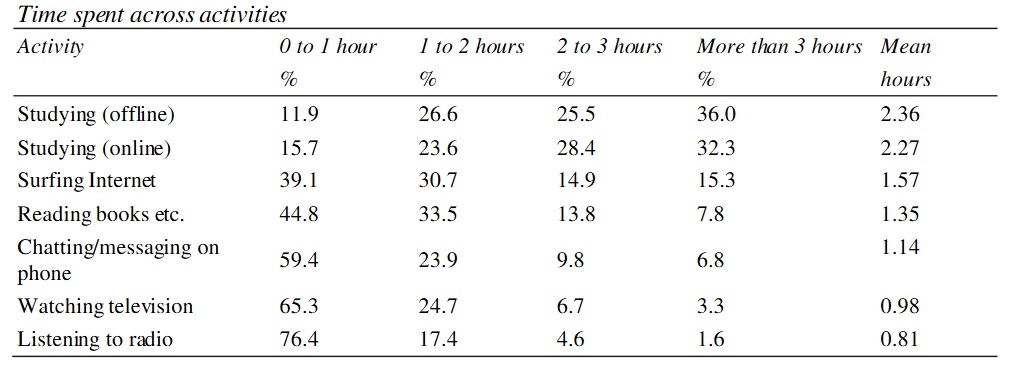
A study by Researchgate in 2021 shows that more than 60 per cent of the kids spend more than three hours on studies both offline (36 per cent) as well as online (32.3 per cent).

Internet Usage By Young Kids in India
Data source: Researchgate

Here we will discuss the harms associated with the overuse of the internet by students.

Effects on their Mentality and Family Life

This is the most serious problem among students today. They spend the maximum part of their day on the internet and hardly have any interactions with their family members. This leads to weak family bonds. The students who spend most of the time surfing the internet end up with an unhealthy bodies due to lack of physical exercise, low grades in academics because they just keep on surfing useless things, and a distance from family members because they don’t have time to sit with family and talk.

Students ignore their health, wealth, social, and personal life. The only thing they bother about is being online. We can see examples of students getting mentally and physically disturbed due to internet addiction, for example, in 2018, a girl from Vietnam was addicted to Facebook and ended up in a mental hospital. Now she is under treatment. Another case happened in Taiwan where a student died because he played an online game continuously for 2 days without eating anything. There are endless cases like this happening with students due to the excess of the internet which reminds us how important it is to limit internet access for students.

[lasso rel=”amazon” id=”5490″]

Limit Internet Access Means Limited Access To Adult Websites

Students need to focus on their studies and not pay attention to useless and bad things. But on the internet, they can easily get introduced to porn websites. These kinds of websites are available in large numbers. There can be a chance that students can reach these sites accidentally and get addicted later. As students are not mature enough to understand everything, they can be a threat to the girls around them.

Students who are introduced to pornography at an early age can commit crimes and rapes. There are many cases where we can see evidence of these kinds of crimes by school or college students just because they get addicted to these bad websites. Sexual predators are chasing young school boys and girls and pretending to have the same hobbies and finally lure them into the world of pornography. There are many cases of lost and exploited young students due to these predators. These crimes are another reason to limit Internet access for students.

Physical Harms

The overuse of the internet is physical harm for students. Students are the future of this world and they must stay healthy to focus on their studies and become responsible citizens on this earth. With the excess of the internet, we can see many students spending hours in front of their computer screens. They keep on playing online games and chatting on social sites. this leads to their back pain, muscle weakness, eye problems, and many other posture-related issues. All these physical issues directly affect their studies and make them lazy. The Internet is a web where students easily get addicted and make their life hell.

[lasso rel=”amazon” id=”5494″]

The Social Life is Affected

A student needs to have a social life, make friends, and have face-to-face interactions but due to the overuse of the internet, these interactions have been lost somewhere. The Internet is famous for meeting new people and making new friends but they have nothing to do with the people around us. Students get addicted to messaging and virtual communications rather than going out and meeting friends. This affects their social life and they no longer find it comfortable to have face to face interactions. The students are lacking communication skills and going away from their relationships and all the blame is on the excess of the internet. If we observe, we can find endless such cases near us where students are risking their future. It is important to limit internet access for the students to save their social life also.

Limited internet access prevent the cheating problem

The students getting excess of the internet can lead to cheating. The fact that the internet has all the information can be used negatively by the students. They use search engines for finding the answers to their question during tests which lead to false results. Many schools have banned the use of mobile phones and the internet inside the school so that students can focus on their classes rather than surfing. This also disables students to achieve better grades with their hard work. The reduction in internet use can lead to awareness among students and prevent the cheating problem.

Cheating is not only about cheating in examinations but there are many cases where students are hacking the school websites and changing the grades and altering the student’s information. They hack their school websites to know the assignments and find their answers. In 2017, there was a case where a former student hacked his alma mater and changed his grades. The student was arrested but this is the time to think about what leads to all this?

Fraud

Dangerous games like Blue Whale, Momo, etc are also part of the internet. They target students and young children to lure them to do useless tasks and kill themselves in the end. They do friendship with the students and after getting all the information and understanding their weaknesses, attack them emotionally, and blackmail them.

In the year 2017-18, there were countless cases where students committed suicide due to Blue Whale and Momo. These kinds of websites are a threat to today’s youth. the students are more prone to exploitation and luring which makes the internet a very unsafe place for them.

Conclusion

There is nothing more important than saving students from getting lured by frauds, cheating, and getting addicted to pornography. They need to have a normal physical and social life. Most importantly, students should focus on their studies rather than anything else. All this can be achieved only by reducing the internet access for the students. Although the internet is a very useful thing there are many harms also. It is better to allow students to use the internet for a limited time only so they do not get time for any useless online activity.

The school is the best place for the students to learn, there is no need to search for every small thing to search on the internet. If we encourage students to search for books rather than the internet for everything, it can lead to a huge change.

Also Read: Which One is Better – Online Study or Offline Study?

BODMAS Rule – Definition, Formula, Examples

Bodmas Rule

The students start to learn mathematics problem solving with simple one operations like subtraction/ multiplication/ addition/ division. These single operations are very simple to do but what about problems containing more than one operation like addition, subtraction, multiplication, division in the same problem? This is where the BODMAS Rule plays a vital role in solving these types of problems with 100% accuracy.

What is the BODMAS Rule?

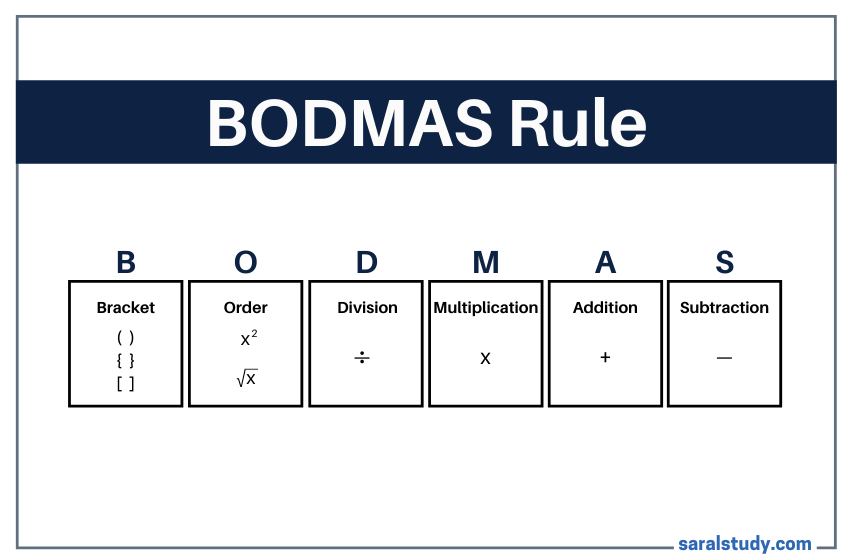
The BODMAS rule is a trick to solve primary school mathematical questions which stands for

  • B – Bracket
  • O – Orders (i.e., powers and square roots, etc.)
  • D – Division
  • M – Multiplication
  • A – Addition
  • S – Subtraction

BODMAS helps students remember the order of operations to follow when solving a mathematical expression. In some regions, it’s referred to as BIDMAS (where ‘I’ stands for Indices) or PEMDAS in the USA (where ‘P’ stands for Parentheses and ‘E’ for Exponents)..

In some places like the USA, it is also known as PEMDAS

  • P – Parentheses
  • E – Exponents
  • M – Multiplication
  • D – Division
  • A – Addition
  • S – Subtraction.

Order of operations of BODMAS Rule

Mathematics relies on a universal set of rules to determine the sequence of operations. The BODMAS rule establishes this order:

  1. Brackets: Solve expressions inside brackets first.
  2. Orders: Solve exponents (orders and indices) next.
  3. Division: Solve division then
  4. Multiplication: Solve multiplication, and then 
  5. Addition and Subtraction: Finally, solve the addition followed by subtraction.

Understanding and applying BODMAS ensures that complex mathematical expressions are solved correctly and consistently.

BODMAS FULL FORM

BODMAS stands for Brackets, Orders, Division, Multiplication, Addition, and Subtraction. It is a mathematical acronym that represents the order in which arithmetic operations should be performed to solve an expression.

Explanation:

  1. Brackets: Solve anything inside brackets first.
  2. Orders: Handle powers and roots (such as squares, cubes, and square roots).
  3. Division and Multiplication: Perform from left to right.
  4. Addition and Subtraction: Finally, perform addition and subtraction from left to right.

Using BODMAS helps avoid confusion and ensures accurate calculation of complex mathematical expressions.

History and Importance of BODMAS Rule

The precedence rules in mathematics have evolved over centuries. Multiplication and division were given higher precedence than addition and subtraction since the introduction of modern algebra. Exponents were introduced in the 16th and 17th centuries, adding another layer to the order of operations. BODMAS was established to provide a clear framework for solving expressions with multiple operations.

Order of operation according to BODMAS Rule

B

O

D

M

A

S

Bracket ()

Order √

Division ÷

Multiplication x

Addition +

Subtraction -

Examples of BODMAS Rule

Example 1: 4 + 2 x 8 =?

Solution: According to the BODMAS Rule, Multiplication needs to be done before addition.
So,
Step 1: 2 x 8 = 16
Step 2: 4 + 16 = 20

The correct answer is 20.
(Common mistake that students make: 4 + 2 = 6, 6 x 8 = 48)

Example 2: 6 – 3 + 8 ÷ 2 =?

Solution: Applying BODMAS Rule,
Step 1: 8 ÷ 2 = 4
Step 2: Mow, We have 6 – 3 + 4
So, 6 – 3 = 3
Step 3: + 4 = 7

7 is the correct answer
(Common errors: 6 – 3 = 3, 3 + 8 = 11, 11 ÷ 2 = 5.5)

Example 3: 4 x (5 + 6) + 5 2 =?

Solution: Apply BODMAS Rule,
Step 1: (5 + 6) = 11
Step 2: 5 2 = 25
Step 3: 4 x 11 = 44
Step 4: 44 + 25 = 69

69 is the correct answer
(Common errors: many students work from left to right and get wrong answer)

Example 4: Find the value of z using BODMAS Rule 33 ÷ 3 + z x 3 -23 = 0

Solution: Apply BODMAS Rule,
Step 1: 33 ÷ 3 = 11
Step 2: z x 3 = 3z
Step 3: now, we have 11 + 3z -23 = 0
Step 4: 11 + 3z = 23
Step 5: 3z = 23 – 11
Step 6: 3z = 12
Step 7: z = 12 ÷ 3
Step 8: z = 4

The value of z is 4.

Example 5: (6÷4+2÷4) -2 =?

Solution: Applying BODMAS Rule
Step 1: (6/4+2/4) = 2
Step 2: 2 – 2 = 0

0 is the correct answer

Example 6: 3×3-3÷3+3

solutions: Applying BODMAS Rule

Step 1: 3 ÷ 3 = 1
Step 2: 3 x 3 = 9
Step 3: now, we have 9-1+3
Step 4: 9 + 3 = 12
Step 5: now, we have 12-1
Step 6: 12-1=11
The correct answer is: 11

Frequently Asked Questions

Q1. What is the need of the BODMAS Rule?

Ans. The BODMAS helps students to solve the mathematical problem in the proper order of operations. When students reach the primary classes, they need to solve mathematical problems that require more than one operation. These kinds of problems have more chances of mistakes, BODMAS plays an important role here in eliminating confusion and errors while solving the problem.

BODMAS instructs that brackets should be solved first, then comes the orders, followed by the division or multiplication and addition or subtraction at the last. It is the most useful rule to make difficult expressions easy to understand. BODMAS is a very easy and simple rule which can be understood easily by the students in primary classes.

Q2. Please give an example of the BODMAS Rule.

Ans. Here is the BODMAS rule example:
4 + 3 x 8 =?
Solution: According to the BODMAS rule, Multiplication needs to be done before addition.
So,
Step 1: 3 x 8 = 24
Step 2: 24 + 4 = 28
The correct answer is 20.
(Common mistake that students make: 4 + 3 = 7, 7 x 8 = 56)
You can find more examples above in the article.

The BODMAS rule is the order of the operations used in solving algebraic problems. First, start with solving the brackets, then orders followed by division and multiplication and addition/subtraction are the last step. If students fail to use the rule properly or ignore the BODMAS rule while solving the question, they will get the wrong answer.

Q3. What is the full form of BODMAS?

Ans. The full form of BODMAS is :
B- Brackets () / {} / []
O- Orders (powers and roots, √)
D- Division (÷)
M- Multiplication (x)
A – Addition (+)
S- Subtraction (-)

Q4. Are BODMAS and PEMDAS the same?

Ans. BODMAS and PEMDAS are exactly the same things. PEMDAS is usually used in the UK. Although PEMDAS indicates to do multiplication before division but that doesn’t change the calculation. Either way, the answer will be the same.
For example: 5 ÷ 2 x 3 = 7.5 and 5 x 3 ÷ 2 = 7.5. In both cases the answer is same.

Q5. Are Orders, Indices and Exponents the same?
Ans. Orders, Indices, and exponents are the same things which are the subscript numbers representing the powers in Mathematics. These are the half-size numbers we usually see in algebraic expressions as powers. For example: 3 2 +5, Here, 2 is the power of 3. This can be denoted as order, index, or exponent.
Q6. Is BODMAS a universal rule?

Ans. Yes BODMAS is a universal rule. It was introduced by Achilles Reselfelt. This was introduced to make it easy to solve mathematical problems involving more than one sign or operation. BODMAS tells us the order in which we have to operate.

BODMAS was created according to the rule of mathematics and the precedence of one operation over another. As it is not easy to remember all the rules and precedence, BODMAS is a simple way to solve them. This is accepted universally. Some places call it PEMDAS or BIDMAS also but they are all the same things.

Q7. Is there any chance of getting the wrong answer after using BODMAS?

Ans. Although BODMAS is the rule to solve problems involving multiple operations but the correct calculations and using it properly is the responsibility of students. If you use the BODMAS rule correctly and make no mistakes in calculations, you will surely get the right answer.

Also Read: Vedic Mathematics: History, Tricks, Techniques and Example

Types of Pollution and Its Effects

Types of Pollution and Its Effects

All types of pollution; in any form around the world is a threat to the health of the planet Earth and the life forms that are settled in it. According to a report, children are most at risk due to pollution as it impacts the health and well-being of a child. Due to this, there can be a rapid increase in non-communicable diseases among children e.g. cancer, diabetes, asthma, birth defects, etc.

What is Pollution?

The definition of pollution is complex to define yet is easy to see at the same time. In distinction to it, pollution is the process of making land, water, air, or other parts of the environment not safe or suitable to use. This is due to the contaminant present in a natural environment. Things such as light, sound, and temperature can also be considered pollutants when introduced artificially into an environment.

Types of Pollution

There can be different types of pollution in our surroundings but the three major types of pollution are water, air, and land pollution.

1. Water Pollution

Water pollution is the release of substances into groundwater, lakes, sea, and oceans which makes it unsafe for drinking, swimming, washing, etc. People who drink polluted water are exposed to perilous chemicals that may make them sick. Around 4,000 children die every day due to drinking dirty water. Sometimes, these polluted waters can harm people indirectly. As the fish that live in polluted water is unsafe to eat which can make one sick. Because they have too many pollutants in their flesh. There are many sources of water pollution and some of them are given below:

  • Oil and natural gas, which can leak into oceans and lakes from natural underground sources are known as petroleum seeps which causes water pollution. The Coal Oil Point Seep is the world’s largest petroleum seep. It affects marine plant and animal life.
  • Another source of water pollution is Oil spills. The Deepwater Horizon oil rig detonated in the Gulf of Mexico, in April 2010 causing oil to burst from the ocean floor is an example of oil spills. In the following months of the same year, hundreds of millions of gallons of oil spewed into the gulf waters resulting in the killing of swamp plants and aquatic organisms such as crabs and fish.
  • The most common source of water pollution is Sewage. Around the world, many cities have a poor facility of sewage systems and sewage treatment plants. For instance, Delhi, the capital of India, is home to more than 21 million people, and the waste produced within the city is dumped in the Yamuna River. This makes it dangerous to use as a source of water for drinking, washing, and hygienic purposes.
  • One of the major sources of water pollution is the fertilizer which is used in agriculture. As it contains large amounts of the element’s nitrogen and phosphorus, which help plants to grow. Rainwater washes fertilizer into streams and lakes which makes water polluted.
  • Garbage is also one of the sources of water pollution. As many plastics such as bottles, caps, bags are seen floating in the river. Which are carried through the Ocean to certain places on the globe. The Great Pacific Garbage Patch is one of the largest garbage patches in the ocean which is the size of Texas.

2. Air Pollution

Air pollution is one of the foremost types of pollution. As air pollutants persevere in the atmosphere and are carried long distances by winds. Air pollution surpasses local, regional, and international boundaries. This affects the global climate and air, which consists mostly of 78% nitrogen, 21% oxygen, and the remaining 1% is inert gases. But now it is under the constant attack of various harmful gases which are released through industries and automobiles.

More than 2 million people die each year due to air pollution only. As it affects the respiratory organ. Due to which there is a rapid increase in asthma cases and other respiratory diseases. Depending on the pollutant present in the atmosphere, human health can vary widely. The effects on health can be extensive and severe if the pollutant present in the atmosphere is highly toxic.

For example, over 2,000 people were killed in the Bhopal gas tragedy in 1984 and 200,000 suffered respiratory problems. Its effect can be seen to date.

3. Land Pollution

All around the world waste materials like household garbage and industrial waste are deposited on Land. According to a report Urban India right now produces 62 million tons of waste and is further assumed that in 2030 it will reach 165 million tons. Commercial or industrial waste is an important share of solid waste. Wastes are classified into two parts hazardous and non-hazardous. Materials that come under Non-hazardous are construction material, medical waste (like bandages, surgical gloves, surgical instruments, discarded needles, etc.).

Hazardous waste is any liquid, solid, or slops waste that contains properties that are dangerous to human health and the environment. These hazardous wastes are generated from mining, petroleum refining, pesticide manufacturing, and other chemical production. Hazardous wastes are generated from households as well, including paints and solvents, motor oil, fluorescent lights, aerosol cans, and ammunition.

Some other types of Pollution

4. Noise Pollution

Albeit humans can’t see or smell noise pollution, but it still affects the environment. The main sources of noise pollution are mostly Industries, Vehicles, Constructions, Planes, etc. Noise can be more than an annoyance. At a certain point in time, it can cause physical damages in the eardrum which can result in temporary or permanent hearing loss. According to a report in addition to causing hearing loss, it also raises blood pressure, pulse rates, causes irritability, anxiety, and mental fatigue.

Underwater noise pollution is also one of the forms of noise pollution as it affects aquatic life. Like the sound coming from ships can disrupt the navigation system of whales, dolphins, and other species as well as marine.

5. Light Pollution

An undesirable or unnecessary artificial light which is a form of waste energy can cause an adverse effect and degrade the quality of the environment. Although light pollution may not appear harmful for public health, it is an environmental quality affair of no small importance. It harms birds, other animals, and astronauts, etc.

Light pollution is assessed as one of the contributing factors in the affected decline of certain migratory birds’ population over the past several decades. Even lights from an impartially small town with a population of mere 3,000 people can cause significant night sky degradation for an observer.

6. Indoor Air Pollution

The air present inside our house can also be polluted. As air and carpet cleaners, insect sprays, and cigarettes are all sources of indoor air pollution.

Effects of Pollution

The pollution effects can be seen every day, around us on water, air-land, and other forms.

1. Effects of Air Pollution

  • An increased risk of heart attack, wheezing, coughing, breathing problems, and irritation of the eyes, nose, and throat are all the causes of high levels of air pollution.
  • It can also cause worsening of current heart problems, asthma, and other lung complexities.
  • Due to air pollution animals also suffer from numerous health problems like humans such as birth defects, reproductive failure, and diseases.
  • The chief cause of acid rain is air pollution. The formation of acid rain is due to the nitrogen oxide and sulfur dioxide which are released by industries. It makes soil and water bodies acidic and damages trees, monuments, etc. By the burning of fossil fuels, nitrogen oxides are released into the air which is responsible for toxic algae blooms. 
  • The depletion of the ozone layer is also the effect of air pollution. As the release of man-made compounds including hydrochlorofluorocarbons, chlorofluorocarbons, and halons formerly used as coolants, foaming agents, pesticides, solvents, aerosol propellants, and fire-extinguishers are depleting the ozone. Because of which harmful ultraviolet rays are entering the surface of the earth and giving rise to Global Warming.

2. Effects of Water Pollution

  • Water pollution effects depend on which chemicals are being dumped whereas it is a serious threat to humans, animals, and aquatic life.
  • By dumping garbage and chemicals, water bodies that are near metro areas tend to be heavily polluted, both legally and illegally.
  • The death of aquatic creatures by far is the biggest outcome of water pollution. Due to the aquatic creature, human beings are also being affected by it directly or indirectly. Through this polluted water, only many infectious diseases like typhoid, jaundice, cholera, dysentery, and malaria are now common. It also causes algal bloom in a lake; the generation of newly introduced nutrients encourages the growth of plants and algae which in return reduces the level of oxygen in the water.
  • Acidification of the ocean is making shellfish and corals difficult to survive. As they absorb carbon pollution which is created each year due to the burning of fossil fuels, oceans are becoming acidic day by day.

3. Effects of Land Pollution

  • Land pollution has substantial consequences for humans, animals, microorganisms, and aquatic life. Contaminated land can cause various problems on the skin, respiratory problems, and even different kinds of cancers.
  • These toxic substances come into touch with the human body directly by eating fruits and vegetables that have been produced in polluted soils, being consumed through drinking water that has been contaminated, direct contact with the skin, and breathing in air polluted with particles and dust.
  • Deforestation is the most important concern when it comes to land degradation and soil erosion. Clear cutting of vegetation and tree cover creates severe conditions that devastate ecosystems and habitats.
  • Deforestation also creates an imbalance in atmospheric conditions, reducing the amount of carbon that is naturally taken out of the atmosphere. This is a severe problem acknowledging that most pollution generated by people is carbon-based.

4. Effects of Noise & Light Pollution

  • Noise pollution can cause stress, hearing loss, headaches, irritation, and sleep loss resulting in decreased productivity.
  • Oil drills, submarines, and other vessels on and in the ocean can cause unnecessary noise that has resulted in the damage or death of marine animals, particularly whales.
  • Too much light causes eye strain and anxiety, harming our eyes and reducing our quality of life. Light pollution also causes a reduction in the hormone melatonin that helps us to fall asleep, resulting in restlessness and exhaustion.
  • Many birds, mammals, insects, and reptiles are photoperiodic meaning their movement, mating, growth and development, and eating cycles are controlled by natural light patterns. Light pollution can prevent these natural ways and cycles, causing a decrease in wildlife populations.

How to Control Pollution

Pollution prevention is major global attention because of its devastating effects on people’s health and the environment. As we are all inhabitants on Earth. So everyone is a stakeholder, and every person has something to contribute to advance effective pollution prevention and awareness. Environmental protection is a natural extension of caring for ourselves, loving our children, and securing a sustainable future for generations to come.

Every action or inaction of any person affects the environment—be it good, neutral, or negative. By becoming aware and doing the right thing, we want to be part of the solution. Some things that you can do mention below:

  • Use Eco-Friendly Transportation.
  • Drive an electric or hybrid car, or at least prefer one that uses unleaded gasoline.
  • Keep your car in good running condition to avoid discharges.
  • Share a ride or carpool.
  • If possible, choose to walk or ride a bicycle whenever.
  • Dispose of Waste Responsibly
  • Never use open fires to dispose of waste, mainly chemicals, and plastic.
  • Adopt the 3 R’s of solid waste management that are reduced, reuse, and recycle.
  • Use sustainable, enhanced, or recycled building materials.
  • Start composting leaves and clippings from your yard and food scraps from your kitchen to decrease waste while improving your soil.
  • Take care to well dispose of your pet’s waste.
  • Adopt Renewable Sources of Energy
  • Utilize the power supplied abundantly and freely by wind and sun. Hang your laundry to dry to reduce your use of gas or electricity, and open a window or put on a sweater rather than switching on the air conditioner or heater.
  • Examine investing in solar panels or other renewable energy sources for your home or business.
  • Support Conservation as a Consumer
  • Purchase local foods and goods. In this method, the use of fuel for transporting goods can be reduced.
  • See around your house or place of business for means you could conserve water.
  • Use and purchase products that are eco-friendly or made with biodegradable materials.
  • Avoid plastic.
  • Always carry a bag when you shop.
  • Avoid Disrupting the Ecosystem.
  • Plant more trees. More number of trees means clean air, more oxygen, and beautiful surroundings.
  • Say a big “NO” to pesticides and GMOs (genetically modified organisms).

How long does some garbage Last?

Different materials decompose at different rates. How long do these common types of trash take to break down?

Paper 2-4 weeks
Tin can 100 years
Plastic Bottle 450 years
Glass Bottle 500 years
Styrofoam Never
Orange Peel 6 months
Milk Carton 5 years
Plastic Bag 15 years

Universal bodies who are trying to control the pollution

Around the world, people and governments are making efforts to resist pollution. Recycling, for instance, is becoming more prevalent. In recycling, waste is processed so its useful materials can be used again. Aluminum, Glass, cans, and various types of plastic can be melted and reused. Paper can be broken down and converted into a new paper. There are the highest recycling rates in Australia and Switzerland. These nations recycle between 50 and 60 percent of their waste. The United States recycles about 30 percent of its waste.

Governments can resist pollution by passing laws that limit the amount and types of chemicals factories and agribusinesses are permitted to use. The smoke formed due to coal-burning power plants can be filtered. People and businesses that illegally dump pollutants into the water, land, and air can be penalized for millions of dollars. Some government programs, such as the Superfund program in the United States can impose polluters to clean up the sites they polluted. Different actions taken by governments and organizations are given below.

  • International agreements can also reduce pollution. The Kyoto Protocol, a United Nations agreement to limit the eruption of greenhouse gases has been signed by 191 countries. This law limited what pollutants could be released into the water and set measures for how clean water should be. Today, the Cuyahoga River is much cleaner. Fish have returned to regions of the river where they once could not persevere. But even as some rivers are becoming cleaner and others are becoming more polluted. Countries with growing economies normally need more power plants, which produce more pollutants.
  • International Environmental Law (IEL) is regarded as an attempt to control pollution and the reduction of natural resources within the framework of sustainable development. It is a branch of public international law – a body of law formed by states for states to govern problems that arise between states.
  • The Clean Air Campaign is a not-for-profit organization. Under this organization, the Georgians take steps to improve the quality of the air and reduce traffic congestion. The organization was established in 1996 by the government, business, environmental, civic, health, and educational organizations to address traffic congestion and air quality concerns in the metro Atlanta region.
  • An international organization, the International Union for Conservation of Nature is serving in the field of nature conservation and sustainable usage of natural resources. It is required in data collection and analysis, research, advocacy, field projects, and education. IUCN’s mission is to encourage, influence, and aid societies throughout the world to conserve nature and to ensure that any usage of natural resources is equitable and ecologically sustainable.
  • United Nations Water (UN-Water) is an interagency mechanism that organizes the efforts of United Nations entities and organizations working on water and sanitation issues. There are over 30 UN organizations that give out water and sanitation programs, considering the point that water problems run in all of the UN’s main focus areas. UN-Water’s role is to organize so that the UN family ‘delivers as one’ in acknowledgment of water-related challenges. India’s role in pollution control.

India’s Role in Pollution Control

In India, all pollution control measures are based on the three major acts: The Water act (1974), The Air act (1981), and The Environment Protection Act (1986). Recently the pollution limits of industries have been bound, and decades-old and outdated norms have been updated. Still, there are gaps in matching global best practices and control measures. For instance, the Orange and Green category industries are not rigorously observed as the Red category industries. Pollution control actions and solutions are not based on technological advancement.

  • The authorized organization, CPCB (The Central Pollution Control Board), was established under the Water (Prevention and Control of Pollution) Act, in September 1974. Moreover, CPCB was trusted with the powers and functions under the Air (Prevention and Control of Pollution) Act, 1981. It helps as area development and also gives technical services to the Ministry of Environment. And Forests of the provisions of the Environment (Protection) Act, in 1986. The basic purposes of the CPCB, as spelled out in the Water (Prevention and Control of Pollution) Act, in 1974. And the Air (Prevention and Control of Pollution) Act, in 1981.
    • To encourage cleanliness of streams and wells in many areas of the States by prevention, control, and reduction of water pollution, and
    • To enhance the quality of air and to prevent, control, or reduce air pollution in the country.
  • The National Green Tribunal has been founded on 18 October 2010 under the National Green Tribunal Act 2010. For efficient and expeditious disposal of cases associating with environmental protection and conservation of forests and other natural resources including implementation of any legal right associating with the environment and providing relief and reimbursement for damages to property and persons and matters connected therewith or incidental thereto. It is a specialized body provided with the requisite expertise to manage environmental conflicts involving multi-disciplinary problems. The Tribunal shall not be bound by the procedure set down under the Code of Civil Procedure, 1908, but shall be conducted by principles of natural justice. New Delhi is the Principal Place of Sitting of the Tribunal and Kolkata, Bhopal, Pune, and Chennai shall be the other four areas of sitting of the Tribunal.

Conclusion

Pollution impact is not something any individual causes or can totally prevent or correct. So, to reduce pollution and its harmful effects we must hang together and should initiate in stopping people from litter. As even as individuals we are not impotent in the battle to preserve our environment.

Related Article:

My Astronaut Adventure: Exploring a New Planet!

Go Online, Go Green

Best Invention of the 21st Century

High Courts of India

In this article, we will inform you in detail about the High courts of India. So that you can have a good understanding and knowledge about the second-highest courts of our country. But before starting, let’s first discuss the types of courts which are operating in India.

In the Indian Judicial System, there are majorly three types of courts- Supreme Court, High Courts and the Subordinate Courts. The Supreme Court of India or The apex court is the highest court in India where anyone can appeal. It was established under article 124 of the constitution of India. One has the right to appeal in this court against the verdict of the High Court or directly without approaching any court in our country, in case your fundamental rights are violated under article 32. Next on the list is the High Court, which is the second-highest court in the hierarchy of our judicial system. It was established under article 214 of the constitution of India. A citizen can appeal in a High Court against the verdict of a Lower Court or directly without approaching any lower court in case his fundamental rights are violated under article 226. Then comes the Lower Court or Subordinate Courts which are further divided into District and Sessions Courts. However, there are several other courts as well for other purposes like Family Court to sort issues like marriage, divorce, alimony, custody of children, etc. There are some Special courts also set up like CBI Court revenue court etc.

Description of the High Court

There were four Supreme Courts in India during the British period. But in the Act 1862, all the Supreme Courts were abrogated and High Courts were established in that place. The Four High Courts were the High Court of Bombay, Calcutta, Madras, and Allahabad. These are the oldest High Courts. Currently, there are 25 High Courts in India, six of them have control over more than one state or union territory. Commonly there is only one High Court in every State but there can be only one High Court for two or more than two States as well, as stated in Article 231, according to the constitution of India. The works under the High court mainly consist of the cases or appeals from lower courts and summons petitions in terms of Articles 226 and 227 of the constitution.

Jurisdictions of High Courts in India

The powers and jurisdiction of the High courts of India can be classified as:

1. Original Jurisdiction: The applicant can directly approach the High court without any means of appeal in the following cases:

  • Disputes related to the parliament or legislative assembly.
  • Cases related to marriage, divorce, law, contempt of court, etc.
  • Enforcing fundamental rights.
  • Cases transferred from other courts involving the question of law.

2. Writ Jurisdiction: Article 226 gives power to the high courts to issue orders or writs. The common writs are:

  • Habeas corpus writ
  • Mandamus writ
  • Prohibition writ
  • Quo warranto and certiorari writ.

3. Appellate jurisdiction: The High courts have the power to hear the appeals against the judgment of the subordinate courts of its area.

4. Power of Superintendence: The high court holds power over all the courts except the ones dealing with the armed forces function in a state. This jurisdiction of high courts include:

  • Call of return from these courts.
  • Issue general rules and prescribe forms regarding the regulation of practice and proceedings in these courts.
  • Prescribe form in which the officers of these courts can keep books, entries, and accounts.
  • The fees payable at sheriff check, officers, or legal practitioners is settled by the high court.

5. Control over the subordinate courts:

  • The subordinate court is bound to consider the opinion of the High court regarding any case.
  • The high court also deals with the matters like position promotion, leave, transfer, and discipline of members of subordinate courts in its area.

6. Court of Record: The judgments and proceedings of high courts are recorded and cannot be questioned further by any court. It holds the power to punish for contempt of court.


7. Judicial Review: High court can examine the executive and legislative orders of central and state governments. The high court checks whether the order is according to the constitution or against the constitution.

List of High Courts of India

The following are the 25 high courts in India for all states and union territories with detail:

Courts

Year Established

Jurisdiction

Seat

Allahabad High Court

1866

Uttar Pradesh

Prayagraj

Andhra Pradesh High Court

2019

Andhra Pradesh

Amravati

Bombay High Court

1862

Goa, Dadra and Nagar Haveli and
Daman and Diu, Maharashtra

Mumbai

Calcutta High Court

1862

Andaman and Nicobar Islands, West Bengal

Kolkata

Chhattisgarh High Court

2000

Chhattisgarh

Bilaspur

Delhi High Court

1966

National Capital Territory of Delhi

New Delhi

Gauhati High Court

1948

Arunachal Pradesh, Assam, Mizoram, Nagaland

Guwahati

Gujarat High Court

1960

Gujarat

Ahmedabad

Himachal Pradesh High Court

1971

Himachal Pradesh

Shimla

Jammu & Kashmir High Court

1928

Jammu and Kashmir, Ladakh

Srinagar / Jammu

Jharkhand High Court

2000

Jharkhand

Ranchi

Karnataka High Court

1884

Karnataka

Bengaluru

Kerala High Court

1956

Kerala, Lakshadweep

Kochi

Madhya Pradesh High Court

1936

Madhya Pradesh

Jabalpur

Madras High Court

1862

Tamil Nadu, Puducherry

Chennai

Manipur High Court

2013

Manipur

Imphal

Meghalaya High Court

2013

Meghalaya

Shillong

Orissa High Court

1948

Odisha

Cuttack

Patna High Court

1916

Bihar

Patna

Punjab and Haryana High Court

1947

Chandigarh, Haryana, Punjab

Chandigarh

Rajasthan High Court

1949

Rajasthan

Jodhpur

Sikkim High Court

1975

Sikkim

Gangtok

Telangana High Court

2019

Telengana

Hyderabad

Tripura High Court

2013

Tripura

Agartala

Uttarakhand High Court

2000

Uttarakhand

Nainital

The High courts with jurisdiction area of more than 1 state:

  1. Bombay High court: the Bombay high court has jurisdiction over Goa, Maharashtra, Dadra Nagar Haveli, and Daman & Diu.
  2. Calcutta High Court: The jurisdiction areas of this high court are – West Bengal, and Andaman & Nicobar Island.
  3. Madras High Court: This High Court has the jurisdiction areas – Tamil Nadu and Puducherry.
  4. Gauhati High court: This covers 4 areas under its jurisdiction – Assam, Arunachal Pradesh, Mizoram, and Nagaland.
  5. Kerala High court: The jurisdiction areas of this high court are – Kerala and Lakshadweep.
  6. Punjab and Haryana High court: This high court has the jurisdiction areas of Punjab, Haryana, and Chandigarh

Judges of High Courts of India

Appointment Procedure

The process of appointing the High court judges is mentioned in article 217 of the Indian Constitution. The number of judges in the court is not fixed, it varies from Court to Court and State to State. The procedure is as follows:

  1. The Judges of high courts are appointed by the warrant of the president along with his seal.
  2. The president needs to take advice from CJI (Chief Justice of India) and the Governor of the state before appointing the High court judges.
  3. The judges other than the chief justice can be appointed after the consultation by the chief justice of the high court.
  4. It is important to follow the provisions under this article even while appointing the additional judges.
  5. The candidate can hold the office of the judge till the age of 62 years.
  6. The consultation should be very transparent while appointing the judges. All the necessary information should be revealed properly.
  7. According to Article 229, the appointed judges have to take an oath before the Governor of the state.

Eligibility

To be eligible to become a Judge in the High Court, the candidate needs to fulfil the following criteria:

  • The person has to be a citizen of India.
  • He/She should have held a Judicial Office in territory India for 10 years or has experience of 10 years practice, as an advocate in a High Court or of two or more such courts in progression.

Tenure and Salary

  • In 1963 according to the 15th amendment of the constitution, a judge of the High Court retired at the age of 62 years.
  • As per the High court and Supreme Court Judges (Salaries and conditions of service) Amendment Act, 2018 now chief justice of a high court will receive Rupees 2,50,000 per month and judges will receive Rupees 2,25,000 rupees per month as salary.
  • The provisions regarding the salaries of high court judges are provided under article 221 of the Indian constitution.
  • According to the provision under this article, the judges are entitled to receive pension and allowance decided by the parliament.

Facts about High Courts of India

  • The oldest High Court in India is The Calcutta High Court, Established on July 1, 1862. It has been designed similar to the Cloth Hall in Belgium.
  • The second oldest High Court in India is the Bombay High Court, established on 14 August 1862.
  • The third oldest High Court in India is the Madras High Court, established on 15 August 1862.
  • Leila Seth was the first female to become a judge at the Delhi High Court. She became the first female Chief Justice of a state High Court, Himachal Pradesh High Court.

Pre-Matric Scholarship for Students in India 2020-21

It is a great initiative by the Govt. of India under the ministry of minority affairs and other government institutions of the state across the nation. The main importance of this scholarship is to encourage parents to send their children to school, to lighten their education burden and make efforts for their future. This scheme has laid a foundation for education that is employing the student to live for their dreams.

Pre-Matric Scholarship List

  • Pre-Matric Scholarship for disabled students
  • Umbrella Scheme for the education of SC students Pre-Matric Scholarship Arunachal Pradesh
  • Pre-Matric Scholarship for Minorities
  • Grameen Pratibha Khoji Pariksha
  • Pre- Matric SC Class 9th and 10 Th Scholarship Tripura
  • Pre- Merit Scholarship for ST/SC/OBC/Minority Students, Delhi
  • Pre- Matric SC Cleaning and Health hazard Scholarship, Tripura
  • Pre- Matric Scholarship for SC Students, Delhi
  • Pre-Matric Disability Scholarship (State Sector) Uttarakhand
  • Pre-Matric Scholarship for OBC Students (State/central sector) Uttarakhand
  • Pre-Matric Scholarship for ST Students, Tripura
  • Pre-Matric Scholarship for Disabled, Maharashtra
  • Pre-Matric Scholarship for VJNT/SBC/SC students, Maharashtra

Pre-Matric Scholarship Details

Name of Scholarship

Provider's Name

Application Period

Pre-Matric Scholarship for disabled students

Department of Empowerment of Persons with Disability, Govt. of India

November

Umbrella Scheme for the education of SC students Pre-Matric Scholarship Arunachal Pradesh

The Ministry of Tribal Affairs
(Government of India)

December

Pre-Matric Scholarship for Minorities

Ministry of Minority Affairs,
Government of India

November

Grameen Pratibha Khoji Pariksha

Einstein Public School

March

Pre-Matric SC Class 9th and 10th Scholarship Tripura

Ministry of Social Justice and Empowerment (Government of India)

February

Pre-Matric Scholarship for ST/SC/OBC/Minority Students, Delhi

Directorate of Education, Govt. of NCT, Delhi

February

Pre-Matric SC Cleaning and Health Hazard Scholarship, Tripura

Ministry of Social Justice and Empowerment

February

Pre-Matric Scholarship for SC Students, Delhi

Department for the Welfare of SC/ST/OBC, Government of NCT of Delhi

February

Pre-Matric Disability Scholarship (State Sector) Uttarakhand

Social Welfare Department,
Government of Uttarakhand

February

Pre-Matric Scholarship for OBC Students (State/Central Sector) Uttarakhand

Social Welfare Department,
Government of Uttarakhand

February

Pre-Matric Scholarship for ST Students, Tripura

Ministry of Tribal Affairs,
Government of India

Text

MOMA Pre-Metric Scholarship Scheme

Ministry of Minority Affairs (MOMA)

November

Pre-Matric Scholarship for Disabled, Maharashtra

Social Justice & Special Assistance Department, Government of Maharashtra

NA

Pre-Matric Scholarship for VJNT/SBC/SC Students, Maharashtra

Social Justice Special Assistance Department, Government of Maharashtra

NA

Pre-Matric Scholarship Eligibility- Who can apply?

Pre-Matric Scholarship for Minorities

  • Candidates must be the natives of India.
  • Candidates must belong to the minority class.
  • Candidates must be studying in class 1st to 10th.
  • They must secure a minimum of 50% marks.
  • This scheme is only for 2 students from one family.

Pre matric scholarship for students with disabilities

  • Candidates must be in class 9th or 10th.
  • They must score a minimum of 40% marks.

Pre-matric scholarship for SC/ST/OBC/minority students, Delhi

  • Students must possess the domicile of Delhi.
  • They must be the students of any technical and professional institute.

Pre-matric scholarship for SC students, Delhi

  • Student must possess the domicile of Delhi.
  • Should belong to the SC category.
  • Family income should not exceed more than 2.5 lakh.
  • The student must be studying in class 9th to 10th.

Pre-matric Disability Scholarship (State Sector Uttarakhand)

  • The student must be a citizen of Uttarakhand.
  • The students who are not physically fit or are disabled by birth.
  • The students must have taken birth in Uttarakhand.

Pre-matric Scholarship for ST Students, Tripura

  • This scholarship is only for the candidates who belong from the tribal areas.
  • This is sponsored by the Tripura government for the native tribal students.
  • The candidate must apply before the 20th February.

Pre-matric Scholarship for SC Students, Manipur

  • The students must belong from the 9th and 10th class of the state or government recognized school.
  • The students must belong to Manipur.
  • Only the candidates who belong from the SC Community.
  • The candidate’s family income should not be more than 2 lakhs.

Grameen Pratibha Khoji Pariksha

  • The students must belong from Uttar Pradesh.
  • The students should belong to the Einstein Public School.
  • The students must be studying in class 6th – 9th.
  • The student must be from VJNT/SC/SBC background.
  • The students must have qualified the examination with at least 50% of marks.

Umbrella Scheme for the education of SC students Pre-Matric Scholarship Arunachal Pradesh

  • The student must be studying in class 9 th or 10th.
  • The candidate must belong to AP and possess a Domicile Certificate.
  • Candidates must possess a ST certificate.

MOMA Pre-Matric Scholarship Scheme

  • The applicant must be a student of class 1st to 10th.
  • Family income should be less than or equal to 1 lac.
  • Minimum 50% marks in the previous examination is must.

Pre- Matric Scholarship for SC students of Class 9th and 10th, Tripura

  • Candidates must possess a ST certificate.
  • The family income must not exceed INR 2,50,000.
  • Candidates must not be receiving any central funded scholarship.

Pre-Matric Scholarship for OBC Students, Uttarakhand

  • Minimum qualifying marks must be scored by the candidate in the previous examination.
  • The Family income should be less than or equal to INR 44,500 per annum.

Pre-Matric Scholarship for VJNT/SBC/SC students, Maharashtra

  • Students must be from VJNT/SBC/SC background.
  • Studying class 5th to 10th.

Pre-Matric SC Cleaning and Health hazard Scholarship, Tripura

  • The Candidate must be a citizen of India.
  • A domicile certificate of Tripura is necessary to apply for this scholarship.

Qualifying Factors- What Documents are Required?

  • Aadhar card.
  • Bonafide certificate.
  • Caste certificate.
  • Residential certificate.
  • Income certificate.
  • Latest passport size photo.
  • Mark sheet for the last qualifying exam.
  • Student ID proof.

The pre-matric Scholarship selection process

A limited number of pre-matric scholarships for minority SC category is available students from the lowest income BPL families will be given preference in the ascending order. The renewal application will be fully devastated before the new application is considered.

Benefits of Pre-Matric Scholarship

  • Scholarship can make education easier.
  • Scholars who win scholarships can excess extensive support.
  • No need to work.
  • With the help of this scholarship, the students can pursue their studies without any financial issues.
  • This scholarship gives various rewards and loans to the students.
  • Visa expenses are also covered under this scholarship scheme.

The Step-wise Application Process – How to Apply?

  • Go to the official website of NSP- scholarship.gov.in
  • Click on the ministry of minority affairs that appeared under the state schemes of the NSP homepage.
  • Read the pre-matric scholarship scheme for minority guidelines carefully.
  • Then click on the “New Registration” appeared on the homepage.
  • You will be redirected to the new student’s registration from the institution page.
  • Read all the instructions mentioned for registration and click on continue.
  • Enter your correct bank details. An OTP will be sent to your mobile given at the time of registration.
  • Enter OTP you received on your mobile number and login.
  • This will generate an application ID and password which can be used for future reference.
  • Fill the pre-matric scholarship application form along with the relevant documents.
  • Submit the pre-matric scholarship application form and take the printout for future usage.

Pre-Matric Scholarship Rewards

  • The students will be awarded with the amount of about INR 100 to INR 300 as per the family condition and economic condition of the family.
  • The selected students will get multiple awards like maintenance allowance, book allowance, and other additional allowance for disabled students.

Terms and Condition of The Pre-Matric Scholarship

  • The scholarship is only given to those students who belong from lower background families.
  • The scholarship can not be given to more than 2 children of the same family.
  • The scholarship board has the full right to negotiate the scholarship if any rules are violated.
  • The certificate and statements should be true.
  • If the board found it false the scholarship is not given to the students.
  • The students must belong to the School of India.
  • The candidates should be the citizens of India.
  • The domicile certificate is very important.
  • The scholarship will only be applicable just in the states of India.
  • As this scholarship is mostly meant for the girls so a big amount of reservations are reserved in India.
  • These scholarships are also awarded based on Union/State territories.
  • The scholarship is awarded only to those students who have been awarded with a minimum of 50% of marks in the qualifying round.

Important Dates of The Pre-Matric Scholarship

Name of Scholarship

Application Period

Pre-Matric Scholarship for disabled students

15th November

Umbrella Scheme for the education of SC students Pre-Matric Scholarship Arunachal Pradesh

30th December

Pre-Matric Scholarship for Minorities

15th November

Grameen Pratibha Khoji Pariksha

10th March

Pre-Matric SC Class 9th and 10th Scholarship Tripura

29th February

Pre-Matric Scholarship for ST/SC/OBC/Minority Students, Delhi

29th February

Pre-Matric SC Cleaning and Health Hazard Scholarship, Tripura

29th February

Pre-Matric Scholarship for SC Students, Delhi

29th February

Pre-Matric Disability Scholarship (State Sector) Uttarakhand

25th November

Pre-Matric Scholarship for OBC Students (State/Central Sector) Uttarakhand

25th November

Pre-Matric Scholarship for ST Students, Tripura

20th November

MOMA Pre-Metric Scholarship Scheme

15th November

Pre-Matric Scholarship for Disabled, Maharashtra

Coming Soon

Pre-Matric Scholarship for VJNT/SBC/SC Students, Maharashtra

Coming Soon

Pre-Matric Scholarship Fee Charges

Items

Hosteller

Day Scholars

Admission Tuition fees

Maximum ceiling of Rs. 7,000

Maximum ceiling of Rs. 7,000

Admission Tuition fees of class X and XII

Maximum ceiling of Rs. 3000

Maximum ceiling of Rs. 3000


Frequently Asked Questions (FAQ’s) regarding Pre-Matric Scholarship

Q1. What is the pre-matric scholarship?

Ans. It is a small initiative by the govt. of India under the ministry of minority affairs and other government institutions of the state across the nation. This scholarship is only for 10th and 12th students.

Q2. What categories are eligible for the scholarship?

Ans. SC/ST/OBC, General ,Minorities , EBC.

Q3. Which are the key states that offer the per-matric scholarship?

Ans. Assam, Andhra Pradesh, Delhi, Maharashtra, Telangana, Uttarakhand.