
My Astronaut Adventure: Exploring a New Planet!

My Astronaut Adventure: Exploring a New Planet!

This imaginative adventure invites students to become astronauts and explore different planets, learning fascinating facts about each one. Designed for grades 2 to 5, the content encourages creativity and curiosity about space.

My Astronaut Adventure Begins

Imagine strapping into your spaceship and blasting off into space! As an astronaut, you get to visit amazing planets in our solar system. Each planet is unique and has its own cool facts. Let’s explore a few of them together!

1. Exploring Mars: The Red Planet

As I landed on Mars, I was amazed by its red, dusty surface. Here are five amazing facts about Mars:

Amazing Fact #1: Red Dust Everywhere!

Mars is covered in red dust, which gives it its nickname, the Red Planet. This dust is made of iron oxide, the same thing that makes rust!

Amazing Fact #2: Giant Volcano

Mars is home to Olympus Mons, the largest volcano in our solar system. It’s about three times the height of Mount Everest!

Amazing Fact #3: Deep Canyons

Valles Marineris is a giant canyon on Mars. It’s so big that it would stretch from California to New York!

Amazing Fact #4: Two Tiny Moons

Mars has two small moons named Phobos and Deimos. They look like little potatoes flying around the planet.

Amazing Fact #5: Dust Storms

Mars has huge dust storms that can cover the entire planet and last for months. They are the biggest dust storms in our solar system.

2. Discovering Jupiter: The Giant Planet

My next stop was Jupiter, the largest planet in our solar system. Here are some fascinating facts about Jupiter:

Amazing Fact #1: Huge Size

Jupiter is so big that you could fit all the other planets inside it! It’s a gas giant, mostly made of hydrogen and helium.

Amazing Fact #2: Great Red Spot

The Great Red Spot is a giant storm on Jupiter. It’s bigger than Earth and has been raging for at least 400 years!

Amazing Fact #3: Many Moons

Jupiter has more than 79 moons. The four largest are called the Galilean moons: Io, Europa, Ganymede, and Callisto.

Amazing Fact #4: Rings of Jupiter

Jupiter has faint rings around it, made of dust particles from its moons. They are not as bright as Saturn’s rings.

Amazing Fact #5: Strong Magnetic Field

Jupiter has the strongest magnetic field of all the planets, making it a powerful giant in our solar system.

3. Visiting Saturn: The Ringed Beauty

I then visited Saturn, known for its stunning rings. Here are some amazing facts about Saturn:

Amazing Fact #1: Spectacular Rings

Saturn’s rings are made of ice and rock. They are so wide that they could stretch from Earth to the Moon!

Amazing Fact #2: Light and Fluffy

Saturn is less dense than water. If there were a big enough bathtub, Saturn would float!

Amazing Fact #3: Mysterious Moon Titan

Titan, Saturn’s largest moon, has lakes and rivers of liquid methane and ethane. It’s like another world!

Amazing Fact #4: Fastest Winds

Saturn has the fastest winds in our solar system, reaching speeds of up to 1,800 kilometers per hour.

Amazing Fact #5: Low Density

Saturn is the only planet in our solar system that is less dense than water. Imagine that!

4. Landing on Neptune: The Windy Planet

Next, I traveled to Neptune, the windy planet. Here are some cool facts about Neptune:

Amazing Fact #1: Bright Blue Color

Neptune is a beautiful blue color because of the methane gas in its atmosphere.

Amazing Fact #2: Strong Winds

Neptune has the strongest winds in the solar system, blowing at speeds of over 2,000 kilometers per hour!

Amazing Fact #3: Great Dark Spot

The Great Dark Spot on Neptune is a giant storm, similar to Jupiter’s Great Red Spot. It could fit the entire Earth inside it!

Amazing Fact #4: Ice Giant

Neptune is an ice giant, made mostly of icy materials like water, ammonia, and methane.

Amazing Fact #5: Coldest Planet

Neptune is the coldest planet in our solar system, with temperatures dropping as low as -214 degrees Celsius.

5. Exploring Venus: The Hottest Planet

Finally, I landed on Venus, the hottest planet. Here are some interesting facts about Venus:

Amazing Fact #1: Thick Clouds

Venus is covered in thick clouds of sulfuric acid, making it hard to see the surface.

Amazing Fact #2: Extremely Hot

Venus is the hottest planet in our solar system, with surface temperatures reaching up to 465 degrees Celsius!

Amazing Fact #3: Retrograde Rotation

Venus spins in the opposite direction to most planets. It has a retrograde rotation, meaning it rotates backwards!

Amazing Fact #4: Volcanic Landscape

Venus has many volcanoes and a landscape shaped by volcanic activity.

Amazing Fact #5: Long Days

One day on Venus is longer than one year on Venus. It takes about 243 Earth days for Venus to rotate once!

Also Read: What is the Blue Planet?

Related Articles:

Yoga For Students: 5 Best Yoga Poses For Children

Healthy Diet for Students in Summer

Prevention and Home Remedies For Cough and Cold


Yoga For Students: 5 Best Yoga Poses For Children

Yoga For Students: 5 Best Yoga Poses For Childrens

In today’s electronic world, where children are even used to mobile and TV, yoga for students be the most important things to grow your child healthy. In this article we will learn 5 easy but very important yoga, to keep the students healthy and fit.

The biggest problem is when the children are sick because many times they are unable to express themselves by saying or cannot bear the pain. And their parents are unable to see their problems. But if children are made to do yoga or exercise regularly, then their immunity power will be correct and they will fall sick less. So in today’s article, we are telling you some yoga asanas, which not only help children develop completely but also cause them to fall ill less. Just get the children to do this Yogasana daily for only 5 minutes and ensure their complete development.

5 Essential Yoga For Students

There must be at least 30 minutes of yoga practice and exercise for the children. Usually, children spend 14-16 hours studying, tuition, going to school, eating, drinking and sleeping. In the midst of this run-of-the-mill life and broken family, children have started living a mechanical life.

Benefits of Yoga For Students

Along with bringing health and awareness in children, yoga and asanas make them vigorous and bright and at the same time, they are helpful in bringing awareness towards the country and the society.

  • It is helpful in increasing the height.
  • Increases concentration.
  • Reduces mental stress.
  • Increases physical flexibility.
  • It is helpful in increasing memory.
  • Regular practice of Pranayama increases the health of the lungs and provides relief from respiratory diseases.
  • Regular practice of yoga brings mental strength and students can contribute to the society and country

Every child must do Pranayam daily for 5-10 minutes so that their memory and concentration can increase. Along with this, due to the supply of plenty of oxygen in the lungs, health also prevails. But only pranayama does not work, the practice of yoga asanas is also essential for physical and mental health.

So let us discuss the five best easy yoga poses for children which will make them fit and fit.

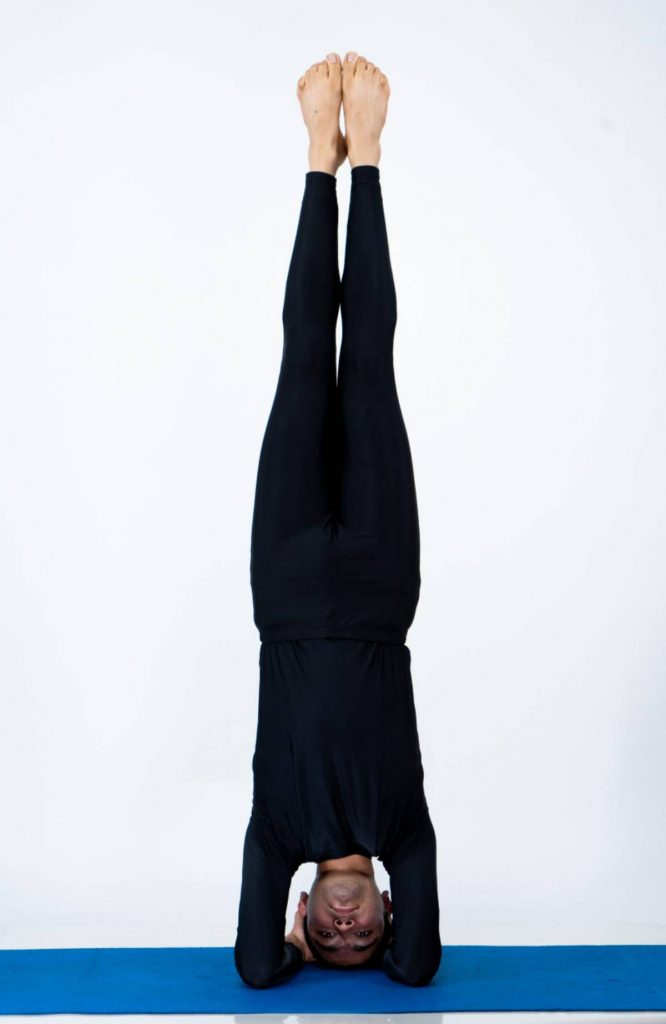
1. Shirsasana (Head stand pose or sirsasana)

Shirshasana is made up of two words, head and asana. Shirshasana is called the king of asanas. Children should do this asana for 1 to 2 minutes.

Sirsasana-Headstand
Sirsasana-Headstand | source: pixahive

Benefits: Shirshasana sharpens the mind of children and increases concentration. Those whose mind is not engaged in studies, start paying attention to studies. Since the flow of pure blood from this asana is towards the brain, then the eye, Ears, nose etc get healthy. This asana heals the pituitary and pineal gland, which activates the brain and improves memory, intelligence and concentration.

Read sirsasana in detail: Sirsasana steps, benefits, and precautions

2. Sarvangasana for students

It comes second in the list of most beneficial asanas. Those who cannot do Shirshasana or those who are prohibited from doing Shirshasana can also do Sarvangasana. This asana can be done for 1-2 minutes.

sarvangasana
sarvangasana |source: arogyabhava

Sarvangasana Benefits: Due to the activation of the thyroid and pituitary glands by this asana, it helps in increasing the height of the children. The rest of the benefits like an increase in brain power, and help in concentration, are similar to Shirshasan. This asana gives relief from tiredness and tension.

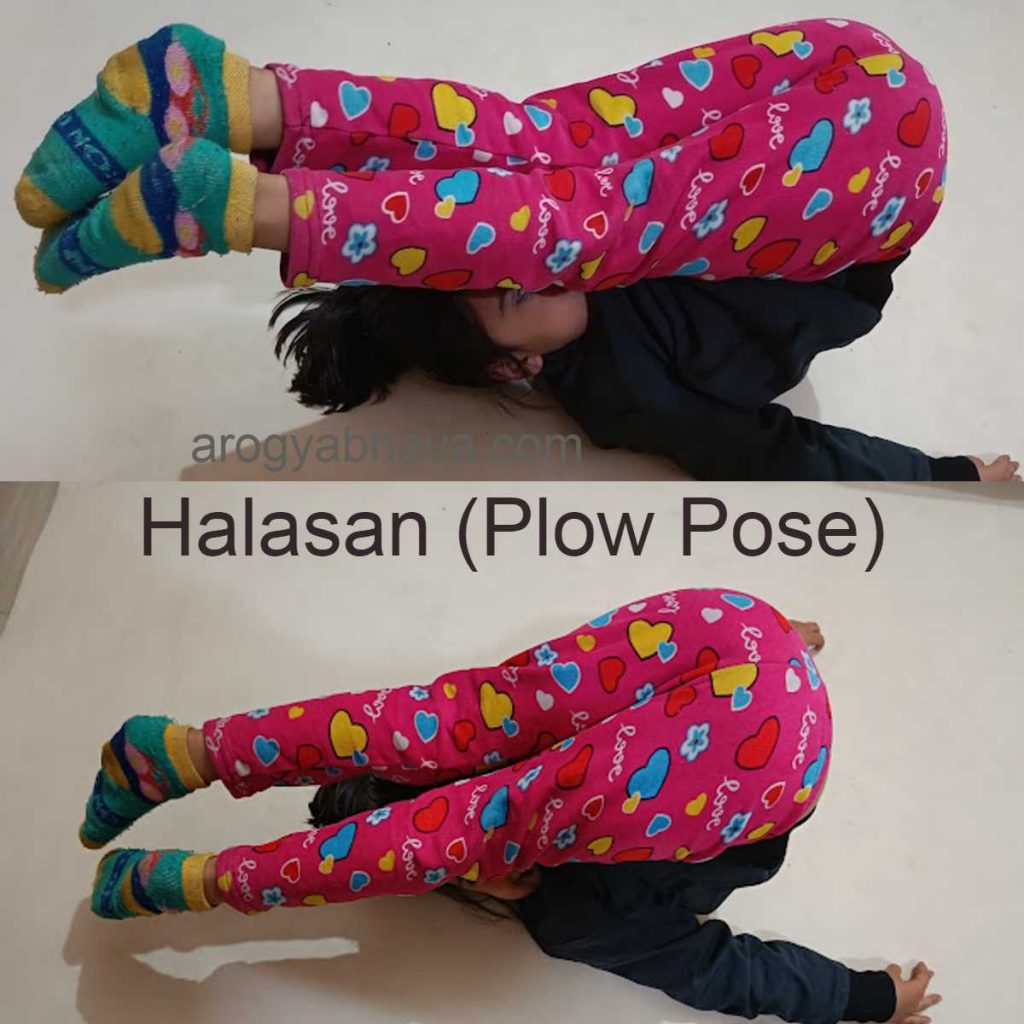
3. Halasana (Plow Pose) for students

Your children definitely learn this asana. The spine can be made healthy and flexible by this asana. Due to this children can be effective in sports, exercise, and athletics. This asana also removes the problem of obesity in children.
Children who cannot do Halasana should practice Mandukasana or Shasakasana.

halasana- plow pose
halasana- plow pose| source: ArogyaBhava

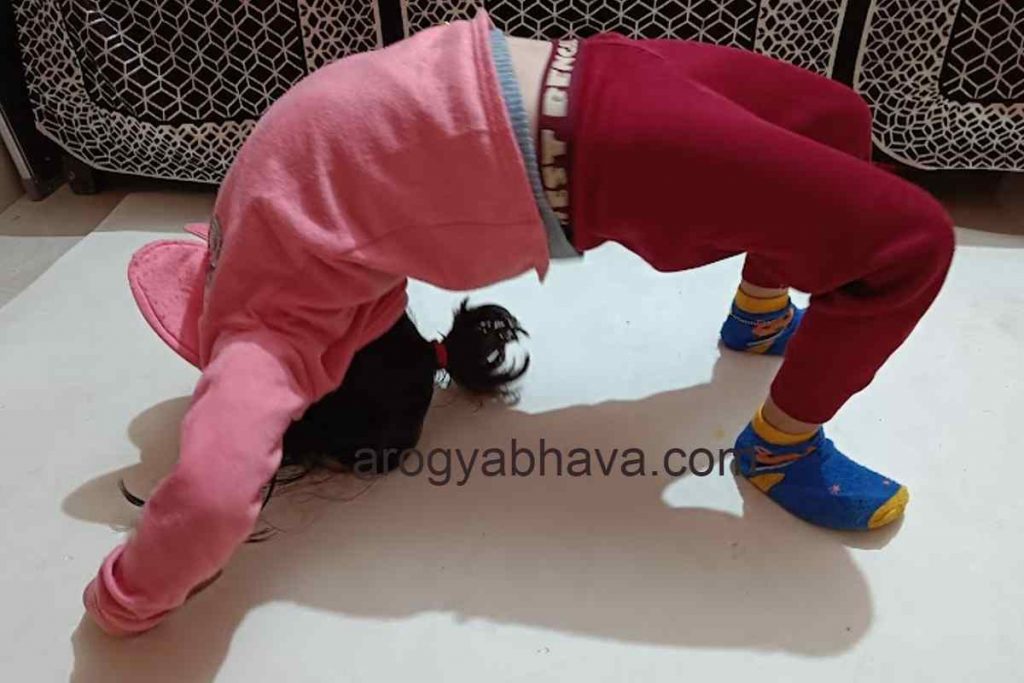
4. Chakrasana (Wheel pose or upward-facing bow)

Chakrasana is a beneficial asana for children. The spine becomes flexible through the practice of this asana. Appetite also feels good and intestines become active. As a result of the practice of this asana, the energy in the body, strength, and brightness of the face increases. It works like a panacea for children who have breathing problems, headaches, or eye disorders.

Chakrasana - Wheel Pose
Chakrasana | Wheel Pose | Image source: arogyabhava

Chakrasana steps:

Lie on your back with your knees bent. The heels should be as near to the buttocks as possible. Maintain equilibrium by keeping both hands upside down behind the shoulders at a small distance. Inhale and raise your waist and chest. Slowly pull the hands and feet closer together, so that the body forms a circle.

Read chakrasana (wheel pose) in detail: Chakrasana steps, benefits, and precautions

5. Paschimottanasana (Seated Forward Bend Yoga Pose)

Paschimottasana (Two legged forward bend)
Paschimottasana|Two legged forward bend|source:arogyabhava

Paschimottanasana is a very beneficial asana for school-going students. By practising this asana, the back muscles of children expand and become healthy. Due to the contraction of the muscles of the stomach, the health of the stomach improves. According to Yoga Shastras, this asana directs the Prana towards the Sushumna, which helps in the awakening of the Kundalini. Children’s concentration increases and their mind is also engaged in studies.

Also Read: Healthy Eating Slogans For Kids

Related Articles:

Healthy Diet for Students in Summer

Study: Junk Food Can Fuel Your Anxiety