IOQJS – Indian Olympiad Qualifier in Junior Science

IOQJS (Indian Olympiad qualifier in junior science )

Indian Olympiad qualifier in junior science (IOQJS) is the first level for the international science Olympiad. It is a single-level test with a time limit of three hours. The examination is usually held in January and consists of two papers. This examination is conducted by the IAPT and  HBCSE mutually. The primary purpose of this examination is to provide basic knowledge about science to the students. In addition, it gives a platform for the students to multiply their abilities and skills in the field of science. 

IOQJS Overview

Conducting Body

IAPT and HBCSE

Conducted during

January

Total timing

3 hours

No. of papers

2

Medium of language

English

Applicable for

Students of classes 11th and 12th

IOQJS Exam pattern

The Indian Olympiad qualifier in junior science is for secondary school students, and this Olympiad covers all the important topics from physics, mathematics, and biology. The detailed exam pattern of the IOQJS Olympiad is given below :

Exam pattern

Detail

Exam duration

There are two paper Paper 1- 1 hour Paper2 – 2 hour Total time- 3 hour

Exam mode

Pen and paper-based

Type of question

Pa[er 1 contains multiple choice questions, and paper two has subjective type question

Negative marking

-1 mark for every wrong answer

IOQJS Eligibility Criteria

The Indian Olympiad qualifier in junior science is a local-level examination conducted to select participants for national and international. Therefore, before appearing for the test, the students should be aware of all the requirement need to be filled. Important criteria that students need to remember are as follows :

  1. The students who are interested in the examination of IOQJS can not appear in the other international test such as IOQ S, IOQB, IOQA, and IOQP. 
  2. The student must have been born between 1st January 2006 and 31st  December 2007.
  3. The candidate must be an Indian native and only acquire an education in India. 
  4. A candidate still needs to complete their studies and start their higher education in college or any institution.
  5. The candidate must have a passport with them.
  6. The students from India or NRI are not eligible to appear in the examination.
  7. The candidate should be studying at any of the affiliated boards, such as CBSE,  ICSE, or any state board that can partition into this examination.
  8. Only those candidates can appear into the examination who have studied since 30th November 2018 or before 30th November 2018.
  9. Any student who was a school student till November  2018 is also eligible to give this examination.

Syllabus for IOQJS examination

Indian Olympiad qualifier in junior science is a national-level examination conducted by the Indian association of physics teachers. The detailed syllabus of the IOQJS exam is given below:

Unit

Syllabus

Matter nature and behavior

Matter Definition Volume, density, shape, and other characteristics of solids, liquids, & gases. Absorption of heat & change of state Sublimation, Freezing, Melting, Evaporation, Condensation Elements, Mixtures & Compounds Homogenous & Heterogeneous mixtures Separation of the components of a mixture Solutions, & concentration of solutions Colloids & suspensions Atoms & molecules Atomic & molecular masses Law of constant proportions Relationship of mole to mass of particles Mole concept Protons, Neutrons, and Electrons Valency Isotopes Chemical formula and symbols of common compounds Isobars

Chemical substances

Types of chemical reactions Balanced chemical equations Definition and general properties of acids, bases, and salts Concept and importance of pH scale Preparation & Uses of: Bleaching powder Plaster of Paris Sodium hydroxide Washing and baking soda Metals & Non-metals Formation & properties of ionic compounds Reactivity series Corrosion and prevention of corrosion Properties of ionic compounds Metallurgical processes Nature & nomenclature of Carbon compounds with functional groups Homologous series Saturated & unsaturated carbon compounds Covalent bonding of carbon compounds, & their chemical properties Soaps & detergents Ethanol Ethanoic Acid Modern periodic table Atomic number Metallic & non-metallic properties Valency Early examples of periodic tables

Organization in the living world

Prokaryotic and Eukaryotic Cells Structure & functions of cells Cell organelles Structure & functions of plant tissues and animal tissues Biological Diversity Health & Diseases

Life Process

Control & coordination in plants and animals Heredity & Evolution Reproduction in animals and plants

Force motion and work

Force definition and types Newton’s laws Distance and displacement Velocity, acceleration, related graphs Uniform circular motion Gravitation Floatation Sound Work, Energy, & Power

Effect of electric current

electric current Potential difference Ohm’s law Resistance Series and parallel combination of resistors Heating effect of electric current Light Relation between P, R, I, and V. Magnetic effects of electric current

Light

Reflection Refraction Refractive index Magnification Functioning of the lens in a human eye Dispersion and scattering of light through a prism

Our environment

Physical Resources Biogeochemical cycles in nature Natural Resources

Food production

Use of fertilizers Organic farming Plant and animal breeding Selection for quality improvement and management Protection of crops from pests and disease

IOQJS Registration Process

  • Registration for the junior science Olympiad starts in October. 
  • Students who want to participate in this exam can register themselves through the official website that is iaptexam. in 
  • The application fees for the IOQJS exam will be the same as last year. 
  • The student is recommended to keep an eye on the official website of IAPT for information and current updates.

IOQJS Results

  • The exam result will be released online and notified on the official website of IAPT.
  • The result of paper one decides whether the student is eligible for the paper two exams.
  • Only those students can participate in the paper two who acquired over the cut-off in paper 1 
  • The Indian association of physics teachers and HBCSE has the authority the set the cut-off for every state and post it on their official website. 

Steps for checking the IOQJS result

  1. Go to the official website www,iapt.org.in.
  2. Next, enter your roll number and DOB. 
  3. Click on the submit button, check your result, take a screenshot, download fit, or future. 

FAQS on IOQJS

  • How can the student verify the exam result? 

Ans: The result is available on the official website of HBCSE and IAPT. You can check it using your password and account details. 

  • Are IOQJS and NSEJS similar exam 

Ans: Yes, these both are the same IOQJS is the combination of the NSEJS exam, and also, these both have the same syllabus from the secondary school level syllabus up to class 10.

  • How to enroll for the IOQJS exam  

Ans: Students can enroll on their official website and fill out the application form. The application window is enabled from November to December.

Also Read: All About Olympiads: Eligibility, Schedules, and Preparation Tips
Physical Education and Its Importance

Benefits of physical Education

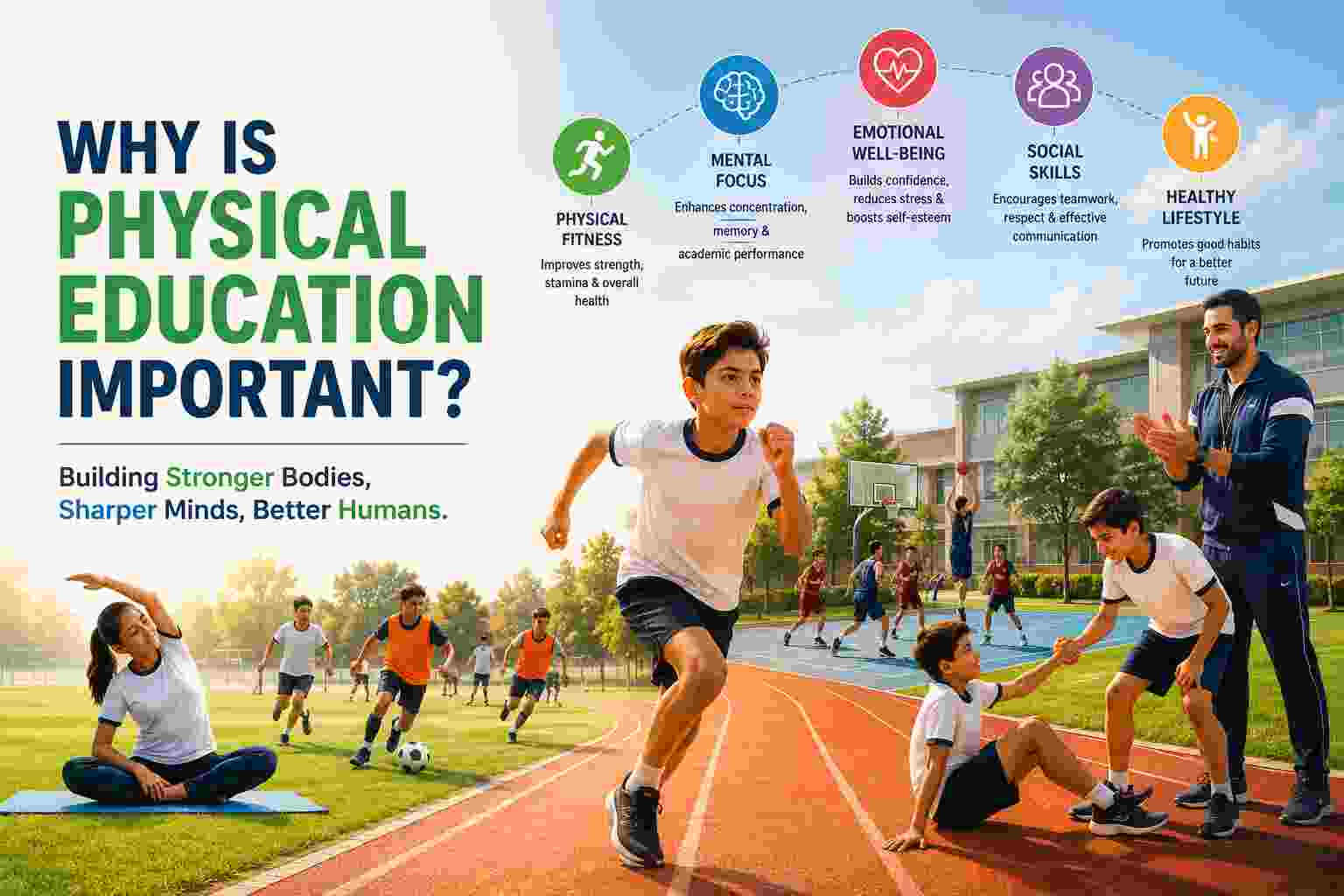
Physical education contains many types of sports and physical activities and helps the overall development of the body. Physical education is a part of every school, and it is a subject that provides learning that goes beyond fun activities and games. Physical education in all schools offers fitness, health, and learning via different sports activities. Many school students also participate in other physical sports like basketball, soccer, volleyball, dodgeball, tennis, etc. This article will discuss a brief concept of physical education and its importance.

What is Physical Education? 

When we ask, “what is physical education?” we refer to a specialized branch of education that focuses on developing physical fitness and the ability to perform daily activities with ease. It is a mandatory subject in most schools where students participate in sports like swimming, badminton, and football.

The focus of the curriculum changes as a child grows:

  • Elementary and Middle School: Focuses on foundational skills like running, catching, throwing, and basic coordination.

  • High School: Shifts toward specialized sports skills, aerobics, and competitive team play to build endurance and strategy.

Definition of physical education 

A formal physical education definition describes it as a process of learning through physical activities designed to improve physical, mental, social, and emotional health. Physical education is the activity related with the holistic development of an individual’s personality.

The main motive is to build the mental and physical capacity required for a productive lifestyle. Regular participation in these activities ensures that a person’s muscles, bones, and cardiovascular system remain in peak condition. For many, this subject is the first step toward a lifelong habit of wellness.

Importance of Physical Education 

Physical education is becoming one of the essential subjects in schools due to its endless benefits. Some of the importance of physical education are discussed below:

1. Development of body and soul

Physical education is an abstract form that is not only limited to a particular area. Physical education is not only concerned with physical activities and needs to be termed as the education of body, mind, emotions, and soul. Nowadays, people should be aware of physical activities and education. People are getting encouraged about their health and influenced towards physical education.  

2. Motor development

The movement of a person is generated because of the neural connection between nerve fibers and the nervous system. They both are responsible for performing many tasks. They are also responsible for quick and slow reflexes. You are born with these motor skills, and you can improve the health of these muscles by working out regularly. Once you start gaining motor development, it will help you to attain a healthy life. 

3. Emotional development

As much as we talk about physical health, people sometimes focus less on their dynamic, which is responsible for your happy life. People should enhance their emotional development by participating in various sports, which could help to maintain their emotions towards multiple situations. Emotional feelings such as happiness, sadness, anger, excitement, and encouragement are essential aspects of life. Focusing on these dynamic aspects of your life will help you to spend your life the way you want.

4. Social development

Human beings are born in a society, and it is necessary to look after your social development. People make friends and spend time with them, which provides the sense of ‘we feeling.’ The more you socialize, the more you know about the people and the world around you. Being a social person helps you to learn the important chapters of life, such as sympathy, corporation, affection, etc. 

5. Cultural development

Cultural development Is an aspect you can learn from sports and games. First, You get to know the culture and heritage of that game. Then, once you start indulging in a particular game, you will be able to understand the history of that specific game. It also provides an essential lesson about the previous generation and their struggle with sports. This generation is highly influenced by physical health because it helps them to flex their muscles, but cultural development is a much more complex topic. 

6. Promotes an active and productive life

Sometimes, without any encouragement, people get sluggard and stop looking at their physical health but being focused and encouraged towards their health will expand the time and quality of their life. In addition, indulging in physical activities will help you regain a better and more positive perspective on life.

Benefits of physical education

Physical education is considered the need of the hour and has to be done regularly to maintain the body. Some people prefer different types of physical activities for their bodies. Performing physical tasks every day can help the body in many ways. Some of the benefits of physical education are as follows:

Physical Education and Its Importance


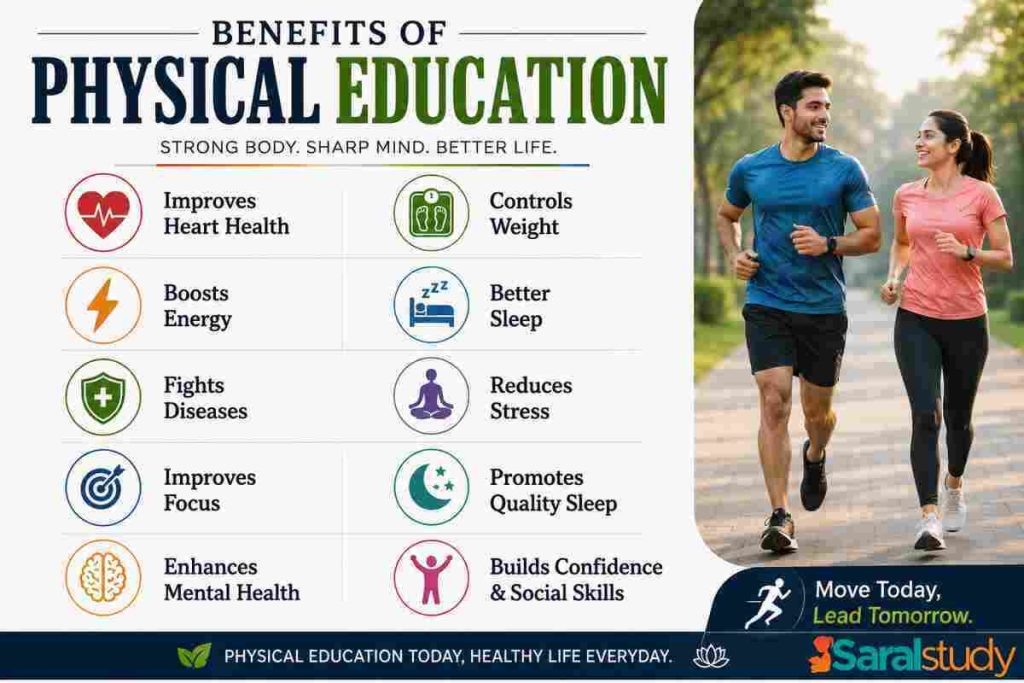
  1. Regular physical exercise can help in dealing with cardiovascular diseases.
  2. Nowadays, most adults and teenagers are obese, which increases the chances of diseases, while physical exercise helps reduce body weight.
  3. Regularly improves the metabolism, which boosts the energy in the body.
  4. Exercising can make our body tired, which helps in better sleep.
  5. Exercise fights various diseases and makes our bodies healthy.
  6. Stress is the most common problem among people, and exercising can reduce the stress level in the body. 
  7. Exercising helps in focusing on the matters of life such as schools, studies, etc.
  8. It builds a healthy body and promotes the quality of sleep.
  9. It improves the physical, mental, and emotional health of a person.
  10. It improves confidence in a person and develops better performing and social skills.

Types of physical activities under physical education

Physical education is based on the four main kinds of physical activities. If you do all these activities, it will improve your body in a miracle way. Even doing one of these activities can also enhance your ability. Each activity has its benefits, which help the body in many ways. The physical education activities are distributed among these four main points, which are as follows:

1. Endurance

Endurance activities involve aerobic exercises, which are concerned with the health of the lungs, heart, and circulatory system. While performing these activities regularly can help increase the breath and heartbeat rate. In addition, performing these activities regularly can help improve diabetes, cancer, and other diseases. Some exercises which amp improve physical health are as follows:

  • Biking
  • Tennis and basketball
  • Brisk jogging and walking
  • Yard work
  • Swimming
  • dancing

2. Strength

Strength activities don’t only include muscle building, but power is beyond this. It helps the person to do heavy work without getting tired. Resilience helps you in performing day-to-day activities, and it makes your muscles strong. Some of the exercises which can improve the stability of a person are as follows:

  • Lifting body weight
  • Overhead arm curl
  • Arm curls
  • Using a resistance band
  • Wall push-ups

3. Balance

Balance helps in maintaining the walk of a person. It helps prevent sudden falls, and with the help of various balance exercises, you can improve your lower and upper body balance. Balance exercises are beneficial in adults and senior citizens. Some of the activities to improve balance are as follows:

  • The balance walk
  • Standing on one foot
  • Standing from a sitting position

4. Flexibility

Flexibility is considered a significant body. Among adults, flexibility is regarded as a widespread problem. Through stretching, you can improve the flexibility of the body. Adults have to face the issue of the ability with the image. Some of the physical activities which can help to improve flexibility are as follows:

  • The back of the leg stretch
  • The back stretch exercise
  • The ankle stretch
  • The inner thigh stretch

Difference between sports and physical education

Many people mistakenly believe that physical education and sports are the same things. However, while sports are a part of the curriculum, they represent only one tool used within the broader scope of physical health education.

Scope and Objective

The primary importance of physical education is to provide a well-rounded foundation for a healthy lifestyle. Its objective is inclusive; it aims to ensure that every student, regardless of their athletic ability, develops basic motor skills and health awareness.

In contrast, Sports are usually competitive and performance-oriented. The objective of a sport is often to win or achieve a specific mastery of a game. While physical education focuses on the “process” of being healthy, sports focus on the “result” of the competition.

Participation and Inclusivity

  • Physical Education: This is a mandatory subject in schools. It is designed for everyone—the athlete and the non-athlete alike. It covers everything from basic stretching and yoga to understanding the physical education definition and human anatomy.

  • Sports: Participation in sports is often voluntary. It usually involves a selection process where individuals with higher skill levels compete in teams like soccer, cricket, or basketball.

The Curriculum vs. The Game

Physical education is the activity related with a structured curriculum. A PT teacher follows a syllabus that might include nutrition, the disadvantages of a sedentary lifestyle, and various movement patterns. Sports, however, are governed by a specific set of rules and fixed boundaries. A sport is a specialized application of the physical skills learned during physical education classes.

Evaluation and Progress

In a physical education class, a student is evaluated on their personal improvement, participation, and understanding of health concepts. In sports, success is measured by scores, trophies, and rankings.

Government of India Initiative on Physical Education

The Government of India has several initiatives to promote physical education, including:

Conclusion

In this growing modern world, people and even small children are the victims of stress and pressure, and physical education is the only measure to improve health. Physical education has various kinds of benefits which can help the body in varied ways. First, it helps improve a person’s physical and mental health. It can help in studies and fulfills all basic skills. 

FAQs on Physical Education

1. How does physical education improve our daily life?

Ans: Physical education is a crucial point that matters significantly in human life. It helps improve motor skills and aids in providing strength to the muscles. It enables the whole body and benefits it in various ways.

2. What is the importance of physical education in a student’s life?

Ans: Physical education helps provide instructions and vital abilities to develop motor skills, developmental skills, and knowledge. 

3. What are the barriers to physical education?

Ans: The barriers in physical education are as follows:

  • Lack of resources
  • Lack of willpower
  • Social influence
  • Fear of injury
  • Lack of skills

4. What are the two main goals of physical education?

Ans: The two primary goals of physical education are as follows:

  • Goal 1: it helps in acquiring the range of movement in various sports activities
  • Goal 2: It helps apply different strategies and principles of physical education.

Also Read: Yoga For Students: 5 Best Yoga Poses For Children

What is Post Secondary Education?

What is Post Secondary Education?

Are you about to finish high school, or have you already earned your high school diploma? But now you are considering studying further for better career opportunities? 

As the name suggests, post-secondary education takes place after high school. Most people see it as a stepping stone to better job opportunities in the future. Education is not limited to college. Therefore, if money hinders your post-secondary education, consider options other than college.

Higher education is the level of education after the successful completion of secondary education. It is commonly referred to as upper secondary education. It includes not only vocational schools but also universities and vocational schools. Post-secondary education usually ends with a college diploma, certificate, or degree. Higher education is decentralized and independent of federal regulation. It is a higher education leading to a university degree. Higher education is also known as post-secondary, secondary, or higher education. The last level of formal schooling occurs after completing secondary education.

This article defines-

  • What is Post-secondary Education?
  • Difference between Secondary and Post-secondary Education
  • What are Post-secondary Institutions?
  • Colleges & Universities
  • Benefits of Post-secondary and Secondary Education
  • Conclusion

What is Postsecondary Education?

Post-secondary education is also called “higher education,” “higher education,” or “tertiary education,” all of which mean the same thing. Subtypes that do not lead to a degree, such as accredited programs and community colleges, are called “continuing education.” These relate to educational programs you can pursue after high school, earning a GED, or similar programs in your country.

Unlike primary and secondary education, which is compulsory for children under 18, post-secondary education is optional. It is the final stage of formal study leading to a degree. Post-secondary education is known as levels 6 to 8 of the International Standard Education Classification. Post-secondary education also includes undergraduate and postgraduate courses.

In the United States, many high school students choose post-secondary education, with more than 21 million students enrolled in high school. 

Many see this as a ticket to financial security, as a college degree can be the key to unlocking more job opportunities in the market. A college is a form of post-secondary education but is not the only form of higher education. Also, even if you have completed your secondary education, you may still get a job offer. Nor does it mean that you will automatically earn more than someone who chooses not to pursue secondary education.

Difference between Secondary and Post-secondary Education

Secondary education, commonly known as high school, can also refer to those who have taken the General Educational Development (GED) test or equivalent anywhere in the world. Unlike post-secondary education, a student must attend secondary school (or at least until they turn 18 and can choose to drop out).

There are also jobs for those who have yet to graduate from high school or high school but have chosen not to pursue secondary education. Let’s say you want to be a doctor. In this case, you will attend a four-year college through an appropriate medical preparation program. You can enter the medical school once he completes his bachelor’s degree. So medical school will only accept a student with a bachelor’s degree, even if they did well in biology in high school.

What are Post-secondary Institutions?

Contrary to popular belief, “post-secondary education” and similar terms are not limited to obtaining a bachelor’s degree in high school. College is the most popular option but not the most economically viable option.

If you are willing to continue your education after High School but would like to consider other options, you have the following options:

  • Vocational Schools

Also known as trade or tech schools, vocational schools teach students on the technical side of certain crafts or skills of a specific job. For a student to pursue a career in a specific vocational field, unlike colleges where they receive their training, apprentices pursue job-specific training that requires specific physical skills rather than academic learning.

These are available in almost every country, even though they have different names. In some countries, the government subsidizes private and public vocational schools. They are for those wishing to acquire skills leading to better job opportunities. 

There are many more vocational courses than are offered, but not all colleges provide all types of studies. We recommend researching the schools in your area, as some may specialize in a particular industry.

Upon completing one of these courses, you will receive a certificate certifying that you have completed and trained in your chosen skill(s). It gives you a competitive advantage in the job market over other high school graduates who have a different education for your skill set. You can also obtain multiple certificates using. For example, if you work in the construction industry, there are certifications for courses in electrician, plumber, and carpenter. It is true even for college graduates who think having a college degree, and a college degree on their resume will set them on their own.

  • Non-Degree Students

Non-Degree Students have two definitions. The first is students who attend a college or university and obtain a bachelor’s, master’s, or doctoral degree but not a degree. These individuals may be interested in studying for a particular class and wish to pursue an academic interest but must be aware of the need to complete a full degree. It may be for the simple reason that you want to study a subject or add that you have taken a course in a particular topic to your resume.

Another type of associate student is an online or face-to-face program in a specific subject. You can use this for resume development and personal enrichment. You will get a certificate of completion instead of a diploma. It’s similar to what you get in a vocational school, but it’s academic rather than skillful.

  • Community Colleges

Community colleges are also known as ‘junior colleges or ‘two-year colleges.’ As the name suggests, community college students earn an associate’s degree in just two years instead of a bachelor’s degree in four years. Some community colleges also offer non-degree certificates and specialized courses, but not all. Apart from academic classes, community colleges provide other programs for the community.

Community colleges offer only the general education requirements that all college students undergo, so it takes half the time to earn a diploma. In a regular college or university, you study for four years. Your first two years are devoted to general education requirements, and the next two years to specialized courses according to your area of ​​expertise.

The Adult Education Center is a step to paid employment and an effort to study. The courses you took at the community college will also allow you to continue your studies at the university for two more years, earning a bachelor’s degree. However, if you decide you don’t need it and want to get a job after attending community college, you can make an associate’s degree upon graduation.

Colleges & Universities

The most popular colleges and universities for post-secondary education offer bachelor’s degrees for high school students and graduate degrees for college students. Examples of graduate degrees that fall into this category include-

  • Graduate school
  • Law school
  • Medical school
  • Dental school
  • Business school

Some go to post-secondary institutions such as graduate and business schools to get their master’s degrees. They give you a head start in the job market for more advanced positions. However, in other institutions, such as law and medical schools, you must complete your education to achieve a specific professional role. For example, a paralegal may require a credential or a bachelor’s degree. It will depend on how competitive the paralegal’s position is in a law firm. However, to become a lawyer, you must complete law school and pass the bar exam.

Some scholarship and grant programs can provide partial or complete tuition without borrowing money. However, many scholarship programs are highly competitive and awarded to students who demonstrate academic or athletic excellence or are most in need of financial assistance.

Benefits of Post-secondary and Secondary Education

Sponsorship of secondary education is much the same as post-secondary education. Still, post-secondary graduates are at higher employment levels than secondary graduates, especially in an economic downturn. It is noticeable that even if post-secondary education is not the main requirement for the job market, education is still essential because it helps us face the more difficult challenges of a modern economy.

As mentioned above, post-secondary education is not compulsory, but because it helps students not only to receive additional education but also to acquire various skills that will ensure their employment at a higher level. It has additional advantages. Please note that post-secondary education requires you to choose the type of school you wish to attend, as your career and areas of interest will determine this.

Conclusion

There are many reasons why Post-secondary education is essential, although it is often related to job requirements in various industries and professions. In some occupations, this level of education may be required to obtain a certification or license. Other industries may not strictly require such education for employment, but it often provides an advantage to those looking for work against the competition. Post-secondary education is also necessary for those interested in further personal development.

FAQs-

  • What is an example of post-secondary education?

Attending college to earn a bachelor’s degree is an example of post-secondary education. Business schools also offer post-secondary education with a focus on specific occupations.

  • What qualifies as post-secondary education?

Education at the post-secondary level includes bachelor’s, master’s, doctoral, and business school programs. Community colleges, four-year universities, and trade schools qualify as post-secondary educational institutions.

Local community colleges typically award degrees at the associate or two-year level, although some offer bachelor’s degrees. Other post-secondary options are public and private colleges. Although universities and colleges refer to as the same, colleges tend to be smaller than universities, with a more limited number of programs to choose from—colleges award bachelor’s, master’s, and doctoral degrees at the undergraduate and graduate levels.

  • Is college post-secondary education?

Post-secondary education is any study after high school—including colleges, universities, and trade schools. These institutions can be public or private, for-profit or not-for-profit, and offer a variety of programs. Before enrolling, it is essential to read more about what qualifies as post-secondary education and determine if the post-secondary school is accredited.

Geography – Does It Help Improve Sense Of Direction?

Geography

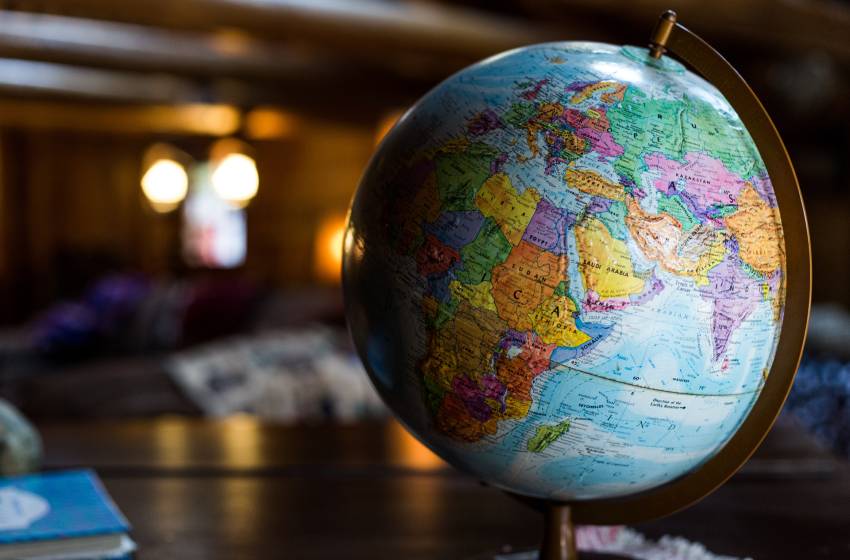
Geography as a subject may not be as popular, but when it comes to developing a sense of direction and being aware of your surroundings, the details geography deals with may come in handy. Geographic knowledge about any place is not considered as essential as details like the culture or traditions. However, paying attention to the demographics can give useful insights into various other aspects. Such observations enable us to understand the things we do on a daily or another occasional basis, and how everyday actions (like traveling to work) affect the world around us (e.g. toxic waste contributing to global warming).
This emphasis expands our horizons and we are able to look at everyday activities in a larger context. This in turn contributes to increasing our awareness of our personal lives and activities and their socio-spatial milieus at measures ranging from regional to global.
We often tend to assume we know all about the physical attributes of a place and hence learning geographical details is not necessary. Some even term it as part of our common sense. Many people refuse to accept that they need to be aware of the basic geographic concepts such as location, distance assessment, place recognition, distribution membership, and regional setting.
We need geographic understanding in every activity we carry out. A person looking for a new apartment often analyses it on the basis of its location in terms of surroundings, proximity to the transport system, locality, prevailing weather conditions in the vicinity, etc. All these are driven by geographical factors prevalent at the location. The same goes with a developer finding a site for a new building. In such cases, people use a personalized Geographic Information System, by combining mental or real maps with physical attributes – like slope, drainage, soil type, vegetation – with mental maps of socio-economic-cultural features – mental maps of (sale prices of different items, demographics of age, children, society, ethnic origins), environmental features (air pollution and noise levels), etc. – to choose optimal locations.

People who live in hazardous areas are aware of the dangers but believe that any natural calamity won’t happen during their lifetime and hence pay less attention to the sensitive geography around them. Those living in metropolitan cities learn the location of shopping malls and use this information to plan their trips for the daily needs of goods and services. While on driving holidays, we determine in advance how far we can travel in a day and when to expect a gas station. Anticipating seasons or weather conditions has a major role to play in our preference for suitable clothes. Climatic conditions and physical environments are also analyzed before planning a holiday to any place far or near.

Hence geographic information is utilized and processed every day. Some are good at it. Some are not. The aim of geography as an instructing science is to give the training to improve the way people can use their spatial abilities. We are all geographers today, just as early beings have been from the dawn of human civilization.