IOQJS – Indian Olympiad Qualifier in Junior Science

IOQJS (Indian Olympiad qualifier in junior science )

Indian Olympiad qualifier in junior science (IOQJS) is the first level for the international science Olympiad. It is a single-level test with a time limit of three hours. The examination is usually held in January and consists of two papers. This examination is conducted by the IAPT and  HBCSE mutually. The primary purpose of this examination is to provide basic knowledge about science to the students. In addition, it gives a platform for the students to multiply their abilities and skills in the field of science. 

IOQJS Overview

Conducting Body

IAPT and HBCSE

Conducted during

January

Total timing

3 hours

No. of papers

2

Medium of language

English

Applicable for

Students of classes 11th and 12th

IOQJS Exam pattern

The Indian Olympiad qualifier in junior science is for secondary school students, and this Olympiad covers all the important topics from physics, mathematics, and biology. The detailed exam pattern of the IOQJS Olympiad is given below :

Exam pattern

Detail

Exam duration

There are two paper Paper 1- 1 hour Paper2 – 2 hour Total time- 3 hour

Exam mode

Pen and paper-based

Type of question

Pa[er 1 contains multiple choice questions, and paper two has subjective type question

Negative marking

-1 mark for every wrong answer

IOQJS Eligibility Criteria

The Indian Olympiad qualifier in junior science is a local-level examination conducted to select participants for national and international. Therefore, before appearing for the test, the students should be aware of all the requirement need to be filled. Important criteria that students need to remember are as follows :

  1. The students who are interested in the examination of IOQJS can not appear in the other international test such as IOQ S, IOQB, IOQA, and IOQP. 
  2. The student must have been born between 1st January 2006 and 31st  December 2007.
  3. The candidate must be an Indian native and only acquire an education in India. 
  4. A candidate still needs to complete their studies and start their higher education in college or any institution.
  5. The candidate must have a passport with them.
  6. The students from India or NRI are not eligible to appear in the examination.
  7. The candidate should be studying at any of the affiliated boards, such as CBSE,  ICSE, or any state board that can partition into this examination.
  8. Only those candidates can appear into the examination who have studied since 30th November 2018 or before 30th November 2018.
  9. Any student who was a school student till November  2018 is also eligible to give this examination.

Syllabus for IOQJS examination

Indian Olympiad qualifier in junior science is a national-level examination conducted by the Indian association of physics teachers. The detailed syllabus of the IOQJS exam is given below:

Unit

Syllabus

Matter nature and behavior

Matter Definition Volume, density, shape, and other characteristics of solids, liquids, & gases. Absorption of heat & change of state Sublimation, Freezing, Melting, Evaporation, Condensation Elements, Mixtures & Compounds Homogenous & Heterogeneous mixtures Separation of the components of a mixture Solutions, & concentration of solutions Colloids & suspensions Atoms & molecules Atomic & molecular masses Law of constant proportions Relationship of mole to mass of particles Mole concept Protons, Neutrons, and Electrons Valency Isotopes Chemical formula and symbols of common compounds Isobars

Chemical substances

Types of chemical reactions Balanced chemical equations Definition and general properties of acids, bases, and salts Concept and importance of pH scale Preparation & Uses of: Bleaching powder Plaster of Paris Sodium hydroxide Washing and baking soda Metals & Non-metals Formation & properties of ionic compounds Reactivity series Corrosion and prevention of corrosion Properties of ionic compounds Metallurgical processes Nature & nomenclature of Carbon compounds with functional groups Homologous series Saturated & unsaturated carbon compounds Covalent bonding of carbon compounds, & their chemical properties Soaps & detergents Ethanol Ethanoic Acid Modern periodic table Atomic number Metallic & non-metallic properties Valency Early examples of periodic tables

Organization in the living world

Prokaryotic and Eukaryotic Cells Structure & functions of cells Cell organelles Structure & functions of plant tissues and animal tissues Biological Diversity Health & Diseases

Life Process

Control & coordination in plants and animals Heredity & Evolution Reproduction in animals and plants

Force motion and work

Force definition and types Newton’s laws Distance and displacement Velocity, acceleration, related graphs Uniform circular motion Gravitation Floatation Sound Work, Energy, & Power

Effect of electric current

electric current Potential difference Ohm’s law Resistance Series and parallel combination of resistors Heating effect of electric current Light Relation between P, R, I, and V. Magnetic effects of electric current

Light

Reflection Refraction Refractive index Magnification Functioning of the lens in a human eye Dispersion and scattering of light through a prism

Our environment

Physical Resources Biogeochemical cycles in nature Natural Resources

Food production

Use of fertilizers Organic farming Plant and animal breeding Selection for quality improvement and management Protection of crops from pests and disease

IOQJS Registration Process

  • Registration for the junior science Olympiad starts in October. 
  • Students who want to participate in this exam can register themselves through the official website that is iaptexam. in 
  • The application fees for the IOQJS exam will be the same as last year. 
  • The student is recommended to keep an eye on the official website of IAPT for information and current updates.

IOQJS Results

  • The exam result will be released online and notified on the official website of IAPT.
  • The result of paper one decides whether the student is eligible for the paper two exams.
  • Only those students can participate in the paper two who acquired over the cut-off in paper 1 
  • The Indian association of physics teachers and HBCSE has the authority the set the cut-off for every state and post it on their official website. 

Steps for checking the IOQJS result

  1. Go to the official website www,iapt.org.in.
  2. Next, enter your roll number and DOB. 
  3. Click on the submit button, check your result, take a screenshot, download fit, or future. 

FAQS on IOQJS

  • How can the student verify the exam result? 

Ans: The result is available on the official website of HBCSE and IAPT. You can check it using your password and account details. 

  • Are IOQJS and NSEJS similar exam 

Ans: Yes, these both are the same IOQJS is the combination of the NSEJS exam, and also, these both have the same syllabus from the secondary school level syllabus up to class 10.

  • How to enroll for the IOQJS exam  

Ans: Students can enroll on their official website and fill out the application form. The application window is enabled from November to December.

Also Read: All About Olympiads: Eligibility, Schedules, and Preparation Tips
NSEP (National Standard Examination In Physics)

NSEP (National Standard Examination In Physics)

The national standard examination in physics is organized by the Indian association of physics Teachers ( ISPT ). It is held all over the country for the students of classes 11th and 12th. This examination aims to select the participants for the international-level Olympiad. It is a single-level test. Before the national level, the regional level examination is conducted. The officials provide the answer key to the students after a week. It provides a platform for students who want to enhance their abilities in the field of physics.

Overview

Complete the form of the examination

NSEP (National standard examination in physics)

Conducting Body

Indian association of physics Teachers (IAPT)

Eligible classes

9th – 12th

Official website

https://www.Iapt.org.in

Exam pattern for NSEP

The question paper consists of 2 parts which are as follows:

Part 1 – This section consists of 50 multiple choice and 6 short answer-based questions. The marks are the same for all the questions. The question paper is both in Hindi and English.

Part 2- This section consists of reasoning-based questions. The second stage is challenging as it contains reasoning and skills questions.

Exam timing

8:30 am – 10:30 am

levels

2

Conducted for

11th and 12th students

Total no. of questions

70 multiple-choice-based questions

Total marks

240 marks

Eligibility criteria for NSEP

The students need to meet the eligibility criteria before applying for the examination.

  1.  The student must be a citizen of India. 
  2. Usually, age is the biggest concern in all the Olympiads, while in this, the candidate must be 15 – 20 years old. 
  3. Candidates can not appear in the examination if they have passed 12th grade.
  4.  It is compulsory to pay the registration fees to all the students.
  5. Candidates who have appeared in the prior international examination can not give this exam.
  6. The students must wait for the official declaration of results until they cannot enroll in any college.
  7. Candidates should be aware of all the rules and regulations that the officials provide.

Syllabus for NSEP

The students have to study the whole syllabus of 9th, 10th, 11th, and 12th grade before appearing for the examination. The most important topics are as follows:

Chapters

Important topics

Wave optics

YDSE with a monochrome light

Surface tension

Excess pressure in drops and bubbles

Rotation

Movement of inertia

Gravitation

The universal law of gravitation

Sound wave

Doppler effect, organ pipes, and resonance

Rectilinear motion

Equation of motion and motion under gravity

fluid

Archimedes' principle and force of buoyance

Newton’s law of motion

Calculation of power and acceleration

miscellaneous

miscellaneous

Modern physics - 1

Electronic transition in the hh like atomspecies, photoelectronic effect, x-ray

Heat transfer

Thermal conduction in the linear conductor

thermodynamics

The first law of thermodynamics, root mean square velocity, kinetic energy

Simple harmonic motion

Equation of SHM, spring-mass system

Work, power, energy

Work done by a variable force, work energy theorem

Semiconductor

Diode, logic gate, transistor

electrostatics

Coulomb's law, electric potential and potential difference, flux calculation and gauss's law, conductor and its properties, electric pressure

Electromagnetic induction

Self-inductance EMF and magnetic energy density

Electromagnetic field

Magnetic field due to a magnet and earth, magnetic fields due to a straight wire, magnetic field due to ring, magnetic force and torque on a current carrying loop, dipole moment, the magnetic force on a charge

Current electricity

The instrument, power, energy, battery, EMF, terminal voltage, and Kirchhoff's law

Circular motion

Kinematics of circular motion, circular motion in a vertical plane

Center of mass, momentum, and collision

Head–on collision, the motion of com

capacitor

A capacitor of a dielectric, combination of capacitors

Alternating current

Power consumed in AC circuit, resonance

Geometrical optics

Lens, reflection by spherical surface, refraction by the prism, spherical mirror, reflection in general, refraction at the plane surface and TIR

Registration Process For NSEP

The students can quickly fill out the registration form as the process is relatively easy and hassle-free. Students can register by themselves or through the educational centers. First, the students can fill out the registration form with all the essential details needed for registration. After that, they have to pay the fees to confirm the process. The registration fee for a student is 200. After registration, officials provide the students with the admit card and center information.

Result of NSEP

Once the whole conduction of the examination is completed, students are provided with the result. The examination result is usually declared after 4- 6 weeks of the examination. After that, students can check it on the official website.

FAQs

  • How many students are selected for the NSEP?

Ans: Approximately 20000 – 60000 students are selected for the examination.

  • What are the total marks in NSEP?

Ans: The total marks for the NSEP are 240, while each question has three marks.

  • What are the benefits of qualifying for NSEP?

Ans: The NSEP provides a platform for students to improve and challenge their abilities in the field of physics.

  • What comes after NSEP?

Ans: After completing the NSEP successfully, students are qualified for the international Olympiad.

Indian NSEJS (national standard examination in junior scientific)

Indian NSEJS (national standard examination in junior scientific)

The national standard examination in junior science is a national-level examination. It is a science Olympiad organized by the IAPT ( Indian association of physics Teachers). The NSEJS was first held in 1987; since then, it has been growing. Many students participate in this examination, and once you qualify, you will get a chance to appear in the international examination. This examination provides an opportunity for those students who want to enhance their ability and intelligence in science.

Stages of NSEJS 

Stage 1- Every year, more than 80000 students participate in this examination with the dream of qualifying for the merit list. However, only 300 lucky students are selected from 8000 students based on merit, and these 300 are eligible to participate in stage 2 of this examination. 

Stage 2 – It is a tricky part of this examination. Only those students are eligible to perform in this stage who scored more than 50%. The top 35 students get the invitation to the 2-week program. After that, only six students get the selection to represent India at an international junior science Olympiad.

Exam pattern of NSEJS

  1. The NSEJS exam contains multiple-choice type questions and focuses on the science topics such as biology,  mathematics, physics, chemistry,
  2. The time duration for this exam is 2 hours. 
  3. The total number of questions will be 80, covering all topics from physics, chemistry, biology, and mathematics. 
  4. There is also a concept of negative marking; 1 mark is deducted for every wrong answer.  

Subject

No of question

Marks

Biology

20

60

Chemistry

20

60

Mathematics

20

60

Physics

20

60

Total

80

240

Eligibility of NSEJS exam 

  1. Class 10th students are eligible for this exam.
  2. The student should verify their eligibility. Otherwise, the student disqualifies from the exam. 
  3. The candidate must b a citizen of India and currently studying in India.
  4. While giving this examination, the candidate can not appear in any alternative examination such as NSEP, NSEC, NSEB, or NSEA.
  5. The candidate should fill in their age carefully because if the details are wrong or above the age limits, the student will be excluded from the examination right away.
  6. The candidate must be born between 1st January 2007 and 31st December 2008.

Syllabus of NSEJS

Subjects

Topics

Physics

Light – concave mirror, deviation through two plane mirrors, T.I.R., shadow, Sound – echo, node, and antinode Electricity Work, energy efficiency, power and Magnetism and gravitation Simple harmonic motion – simple pendulum Fluid – flotation Force Heat radiation, anomalous behavior of water, thermal expansion Rectilinear motion – velocity motion, newton's law of motion Unit dimension Electrostatics – ohm’s law, coulomb's law, a combination of resistance, potential

Mathematics

Permutation and combination Arithmetic progression Area of parallelogram and triangle, similar triangles Geometric progression Linear equation in two variables Number system Quadratic equations Quadrilaterals Ratio and proportion Trigonometry

Chemistry

Acid, base, and salts Analytical Chemistry Metals and nonmetals Mole concept Carbon Study of gas laws Equivalent concept Periodic table and periodicity

biology

Biodiversity – chordates, monera, non-chordates Biotech-GMC Control and coordination Cell Biology Human health and disease immunity Reproduction – asexual reproduction Heredity and evolution -D.N.A., fingerprinting, D.N.A. Microbes in human welfare

NSEJS Registration Process

  • Interested students should register for this examination at the nearest exam center before the deadline. 
  • At the time of registration, the students can also choose the language they are comfortable with. The students can choose any language, Hindi or English. 

The step-by-step structure for the registration process Is given below :

  • Firstly you should visit the nearest exam center in your city or area. 
  • After visiting the center, the center coordinator will provide you with the application form for the NSEJS exam.
  • You must fill in all the necessary details on the form and submit them to the center before the deadline.

How to check the NSEJS exam result?

  • The result is published on the official website of IAPT.
  • You need to visit the website.
  • Enter your necessary details like roll number and date of birth. 
  • After verifying all the information, check your scores and download the result for future 

Important details required for checking the result are: 

  • Roll number 
  • Name of the student  
  • Total points 
  • Name and location of the schools 

FAQS 

  • When will the merit list of the NSEJS exam be released?

Ans: The merit list of NSEJS was released on the official website of IAPT through online mode. 

  • What do you mean by the merit list of the NSEJS exam? 

Ans: The merit list contains the names of selected students or the students who qualify for the NSEJS exam with their scores. The list is published on the official website. 

  • What is the next stage after preparing for the NSEJS exam? 

Ans: After passing the NSEJS exam, the student will be eligible to participate in the INJSO exam.

STEM Education

STEM Education

Education is one of the firmest pillars which is helpful for an individual’s growth and success, and in this article, we will briefly discuss STEM education. The STEM word stands for science, technology, engineering, and mathematics. All these subjects are fascinating and taught so students can learn and apply them. In addition, it promotes skill development and education, which is helpful for children to make their life successful.

What is STEM education? 

It is a transversal education in which science, technology, engineering, and mathematics are taught to develop students’ skills, logical thinking, and creativity. STEM provides project-based learning by which students can search for solutions from classroom learning. Technical vocational education and training is the extension of STEM by which the students can develop their skills and create self-employment by learning.

The objective of STEM education

The STEM education concept is essential for students to develop skills and critical thinking. So here we provide some crucial objectives to understand the primary goal of STEM.

1. Utilization of information and insight 

 STEM is a fundamental concept for the student, which allows students to explore the scientific field, Technological area, engineering, and mathematics area by utilizing the information and solving concept-based projects.

2. Best practices

STEM helps students choose the best practices to help them in the future and develop a solid aptitude for achieving the best career.

3. Knowledge acquisition and creativity 

 In STEM, the student can acquire knowledge and develop the skill to become capable of thinking of new ideas.

 Researching + thinking + applying = creating the main formula for success. 

Benefits of STEM education 

There are five benefits of STEM education which are discussed below:

  • Skill development 

 The primary benefit of STEM education is to provide basic knowledge to the student by developing their creativity, logical thinking, critical thinking, and analyzing power and making their innovative mindset.

  • Meeting global workplace demand.

 STEM education is provided in all parts of India and is globally accepted. Therefore, if any student graduates with STEM, They will get international recognization and can apply for a job anywhere in the world.

  • Edge over traditional students 

STEM focuses on the four primary disciplines science, technology, engineering, and mathematics. STEM contains a traditional approach, teaching our children everything but extra focus on primary subjects because they are essential in their skill development. Traditional education doesn’t focus on the practical part or implementation. It is only focused on books.  

  • Innovation in the stem area 

STEM develops the student’s critical thinking and skills, enhancing their imagination and creating an innovative mindset. According to the survey, innovation is a very abstract and essential component of economic growth. Creative minds have the power to change the world.

  • Encourage experimentation 

Experiments are the main factor of technological advancement. There are many innovations that many people make. STEM education promotes experiments and a creative mindset, allowing students to take risks while learning. 

Components of STEM education 

1. Problem-based learning 

In this learning, the students collect the data and analyze it. This helps them understand the scientific explanation and overcome the problems while conducting research. They also developed the prototype to solve the problem quickly and find its best solution. This activity encourages the students and creates an innovative mindset.

2. Career technology and life skills 

Innovation is a subject that needs a lot of learning and experiments. Learning through projects and internships significantly impacts the student’s career. It develops the student’s critical thinking, innovation, and communication skills.

3. The school community and belonging 

In this learning, the student is taught about respecting every individual and providing opportunities for the students to share their feelings with other students. It promotes an idea of harmony and brotherhood. This activity helps them develop communication skills and trust, which are essential for teamwork.

4. Rigorous learning 

Rigorous learning means the way the lesson can encourage the students and develop their thinking ability. In addition, this activity can help the student to memorize and recall the information.

Why is STEM education essential in India?

Five significant facts that determine the importance of STEM education in the Indian education sector are: 

  • It provides a better mindset among the students 
  • Promote the students for logical thinking 
  • It helps the students to make better leaders and decision maker in future 
  • Student can develop their skills and professionalism by learning in the early stage of education 
  • It promotes the idea of communication skill which promote the concept of brotherhood

STEM V/S traditional schooling 

Stem

Traditional

STEM provides education by using real-life concepts with lots of experiments.

Traditional education only focuses on theoretical education and concentrates only on books.

STEM education focuses on skill development and provides a free space for students to think of innovative ideas. That's why discoveries like 3D printers and water machines contribute to STEM.

Traditional education has stringent rules and a very clear-cut definition of what is right and what is wrong.

The STEM education system can excite students because it contains many innovative ideas and experiments. .

Traditional pencil and paper education has become dull.

Conclusion 

This article helps you understand STEM education and its necessity. Stem education is gaining popularity nowadays. It can encourage the students to learn through practical experiences and develop innovative skills. STEM education has become famous among early-age students because they can tap into their activity and create implementation to a single idea.

FAQS 

1-What is STEM?

Ans: The complete form of STEM is science, technology, engineering, and mathematics, and it is an academic discipline that is essential for the overall development of students.

2-Why is stem education important?

Ans: STEM education is essential for skill development and human prosperity. Scientists’ innovative ideas can make people’s lives better and very easy. Stem education is an excellent idea because it can help the students to encourage their hidden skills through experiments and practice.

3-How does stem education help the student?

Ans: STEM education helps to create innovative thinking among students. It makes them responsible citizens and encourages them to serve the country with their creative ideas. 

Sex education in India

Sex education in India

In India, people are uncomfortable discussing sex education openly because they still think it is unnecessary. However, when we talk about sex, we can differentiate it in two ways one as the gender difference and the second concerning the physical need of the person. Sex is considered an unusual word in India, but we cannot neglect that it is essential for the continuation of the human race. 

The teachers and parents are the chains that remind the social value of a child from their birth. If they do not make their children and students comfortable, this topic will always remain taboo in the country. Therefore, people are not ready to talk about this critical matter, which results in a lack of knowledge about our bodies and sex, which has led to the increasing rate of STDs (sexually transmitted diseases) among people. 

Nowadays, stress is increasing in growing teenagers due to various reasons. They start reliving their stress on porn sites and create unusual fantasies which harm their ability to think and explore. Sex images and videos about women affect teenagers’ mental and physical health. The national council introduced sex education for education in 2007 and dealt with the growing interest and lack of education about sex in teenagers. 

Why sex education is essential in India?

India is a diverse country with a vast population with the highest rate of sexual issues like sexual abuse, adult pregnancy, and diseases like HIV and AIDS. The data shows more than 2.3 million people with HIV have been infected. However, this can be reduced by providing education and awareness according to the national AIDS prevention and control policy 2002. 

Nowadays, more than 50% of teenagers face sexual abuse in their young age, and it is the responsibility of parents, teachers, and adults to educate them by providing knowledge about identifying the abuse and protected themselves. 

Government initiatives for sex education in India 

To change society, the government takes many steps like the national education policy 2016 under which sex education is provided in every single school. The government also offered an adolescent education program in 2017. This program was banned in a few states due to protests. This program covers significant issues like body image, abuse, gender inequality, sexuality, etc.

The CBSE has also issued a program in 2005 called the adolescent reproductive and sexual health education project.

Types of sex education

  1. Sex education for adolescents: In India, almost 30 % of people are illiterate and lack knowledge about sex, including teenagers. In addition, most adolescents in rural areas have poverty which stops them from growing. While low and weak body affects stamina and due to a lack of education, these males and females do not take safe sex measures or use contraceptives.
  2. Sex education in family planning for adults:  Nowadays, people in urban areas are pretty considerate towards child planning due to the high quality of lifestyle and education. Therefore, some adults in urban areas are educated about sex safety and use contraceptives as a savior. But, in contrast, some population is uneducated, which leads to the unplanned children.
  3. HIV / AIDS prevention education: AIDS is the most common issue nowadays which can happen due to various reasons. For example, sharing needles, not using condoms during sex, blood transfusion and other activities which can exchange the body fluids. 

Facts about sex education in India

  1. In India, teachers do not talk about sex education. In most areas, sex education is called sexuality. The typical mentality of people is that sex education will teach students about how to do sex. People get offended if the ‘sex’ word is used openly and named in different ways, such as adolescent education, comprehensive sexuality education, etc. 
  2. During the classes of sex education in school, teachers made the girls and boys sit separately because they think sitting together could make them uncomfortable. While these sessions are conducted to help students gain knowledge about the body and needs.  
  3. The main motive of sex education is to teach people what our body is and understand ourselves and the opposite gender. Sex is not necessary, it’s just the need of the hour to satisfy human nature. 

FAQs

1. Does teaching about sex in schools helpful?

Ans: Sexuality education helps in the accessible and comfortable communication about sex between parents and children. And considering this knowledge, parents become more open-minded toward their teenagers and their need for sexuality. 

2. What is comprehensive sex education?

Comprehensive sex education teaches about human beings’ emotional, physical, and mental emotions toward sexual sex and relationships. It helps them to empower them towards their body and their action:

  • Consider how their choice can affect their health, being
  • It develops the sexual and mutual relationships
  • Providing knowledge of their needs and rights.
  • It helps in providing realization of the market, health, and well-being.

3. Why are people uncomfortable talking about sex education in India?

Ans: People are uncomfortable discussing this topic, and the main problem is that people are not interested in knowing about their bodies and sexual needs and find it vulgar.

Physical Education and Its Importance

Benefits of physical Education

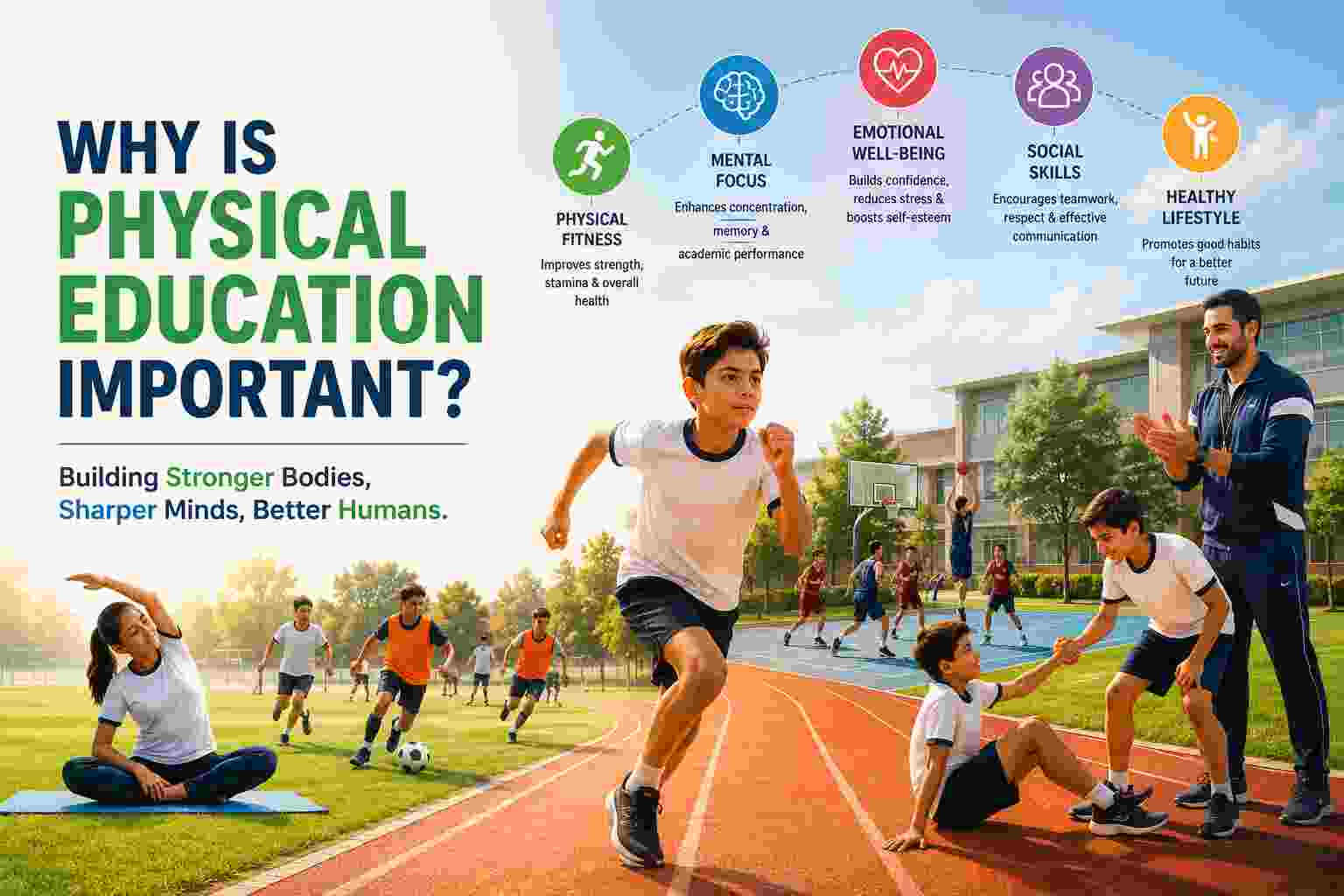
Physical education contains many types of sports and physical activities and helps the overall development of the body. Physical education is a part of every school, and it is a subject that provides learning that goes beyond fun activities and games. Physical education in all schools offers fitness, health, and learning via different sports activities. Many school students also participate in other physical sports like basketball, soccer, volleyball, dodgeball, tennis, etc. This article will discuss a brief concept of physical education and its importance.

What is Physical Education? 

When we ask, “what is physical education?” we refer to a specialized branch of education that focuses on developing physical fitness and the ability to perform daily activities with ease. It is a mandatory subject in most schools where students participate in sports like swimming, badminton, and football.

The focus of the curriculum changes as a child grows:

  • Elementary and Middle School: Focuses on foundational skills like running, catching, throwing, and basic coordination.

  • High School: Shifts toward specialized sports skills, aerobics, and competitive team play to build endurance and strategy.

Definition of physical education 

A formal physical education definition describes it as a process of learning through physical activities designed to improve physical, mental, social, and emotional health. Physical education is the activity related with the holistic development of an individual’s personality.

The main motive is to build the mental and physical capacity required for a productive lifestyle. Regular participation in these activities ensures that a person’s muscles, bones, and cardiovascular system remain in peak condition. For many, this subject is the first step toward a lifelong habit of wellness.

Importance of Physical Education 

Physical education is becoming one of the essential subjects in schools due to its endless benefits. Some of the importance of physical education are discussed below:

1. Development of body and soul

Physical education is an abstract form that is not only limited to a particular area. Physical education is not only concerned with physical activities and needs to be termed as the education of body, mind, emotions, and soul. Nowadays, people should be aware of physical activities and education. People are getting encouraged about their health and influenced towards physical education.  

2. Motor development

The movement of a person is generated because of the neural connection between nerve fibers and the nervous system. They both are responsible for performing many tasks. They are also responsible for quick and slow reflexes. You are born with these motor skills, and you can improve the health of these muscles by working out regularly. Once you start gaining motor development, it will help you to attain a healthy life. 

3. Emotional development

As much as we talk about physical health, people sometimes focus less on their dynamic, which is responsible for your happy life. People should enhance their emotional development by participating in various sports, which could help to maintain their emotions towards multiple situations. Emotional feelings such as happiness, sadness, anger, excitement, and encouragement are essential aspects of life. Focusing on these dynamic aspects of your life will help you to spend your life the way you want.

4. Social development

Human beings are born in a society, and it is necessary to look after your social development. People make friends and spend time with them, which provides the sense of ‘we feeling.’ The more you socialize, the more you know about the people and the world around you. Being a social person helps you to learn the important chapters of life, such as sympathy, corporation, affection, etc. 

5. Cultural development

Cultural development Is an aspect you can learn from sports and games. First, You get to know the culture and heritage of that game. Then, once you start indulging in a particular game, you will be able to understand the history of that specific game. It also provides an essential lesson about the previous generation and their struggle with sports. This generation is highly influenced by physical health because it helps them to flex their muscles, but cultural development is a much more complex topic. 

6. Promotes an active and productive life

Sometimes, without any encouragement, people get sluggard and stop looking at their physical health but being focused and encouraged towards their health will expand the time and quality of their life. In addition, indulging in physical activities will help you regain a better and more positive perspective on life.

Benefits of physical education

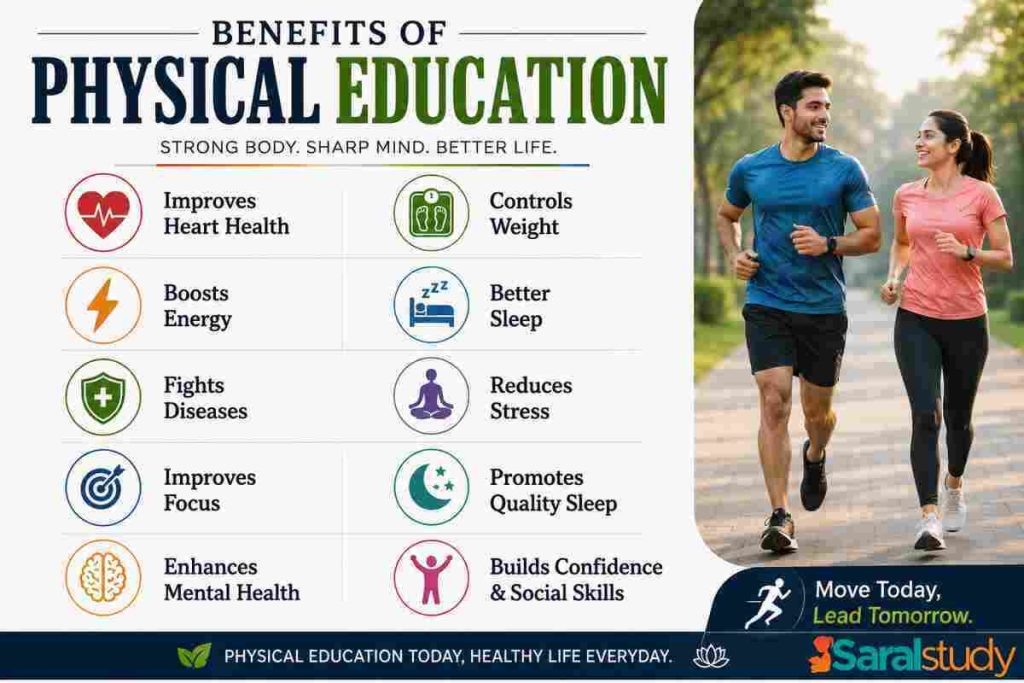
Physical education is considered the need of the hour and has to be done regularly to maintain the body. Some people prefer different types of physical activities for their bodies. Performing physical tasks every day can help the body in many ways. Some of the benefits of physical education are as follows:

Physical Education and Its Importance


  1. Regular physical exercise can help in dealing with cardiovascular diseases.
  2. Nowadays, most adults and teenagers are obese, which increases the chances of diseases, while physical exercise helps reduce body weight.
  3. Regularly improves the metabolism, which boosts the energy in the body.
  4. Exercising can make our body tired, which helps in better sleep.
  5. Exercise fights various diseases and makes our bodies healthy.
  6. Stress is the most common problem among people, and exercising can reduce the stress level in the body. 
  7. Exercising helps in focusing on the matters of life such as schools, studies, etc.
  8. It builds a healthy body and promotes the quality of sleep.
  9. It improves the physical, mental, and emotional health of a person.
  10. It improves confidence in a person and develops better performing and social skills.

Types of physical activities under physical education

Physical education is based on the four main kinds of physical activities. If you do all these activities, it will improve your body in a miracle way. Even doing one of these activities can also enhance your ability. Each activity has its benefits, which help the body in many ways. The physical education activities are distributed among these four main points, which are as follows:

1. Endurance

Endurance activities involve aerobic exercises, which are concerned with the health of the lungs, heart, and circulatory system. While performing these activities regularly can help increase the breath and heartbeat rate. In addition, performing these activities regularly can help improve diabetes, cancer, and other diseases. Some exercises which amp improve physical health are as follows:

  • Biking
  • Tennis and basketball
  • Brisk jogging and walking
  • Yard work
  • Swimming
  • dancing

2. Strength

Strength activities don’t only include muscle building, but power is beyond this. It helps the person to do heavy work without getting tired. Resilience helps you in performing day-to-day activities, and it makes your muscles strong. Some of the exercises which can improve the stability of a person are as follows:

  • Lifting body weight
  • Overhead arm curl
  • Arm curls
  • Using a resistance band
  • Wall push-ups

3. Balance

Balance helps in maintaining the walk of a person. It helps prevent sudden falls, and with the help of various balance exercises, you can improve your lower and upper body balance. Balance exercises are beneficial in adults and senior citizens. Some of the activities to improve balance are as follows:

  • The balance walk
  • Standing on one foot
  • Standing from a sitting position

4. Flexibility

Flexibility is considered a significant body. Among adults, flexibility is regarded as a widespread problem. Through stretching, you can improve the flexibility of the body. Adults have to face the issue of the ability with the image. Some of the physical activities which can help to improve flexibility are as follows:

  • The back of the leg stretch
  • The back stretch exercise
  • The ankle stretch
  • The inner thigh stretch

Difference between sports and physical education

Many people mistakenly believe that physical education and sports are the same things. However, while sports are a part of the curriculum, they represent only one tool used within the broader scope of physical health education.

Scope and Objective

The primary importance of physical education is to provide a well-rounded foundation for a healthy lifestyle. Its objective is inclusive; it aims to ensure that every student, regardless of their athletic ability, develops basic motor skills and health awareness.

In contrast, Sports are usually competitive and performance-oriented. The objective of a sport is often to win or achieve a specific mastery of a game. While physical education focuses on the “process” of being healthy, sports focus on the “result” of the competition.

Participation and Inclusivity

  • Physical Education: This is a mandatory subject in schools. It is designed for everyone—the athlete and the non-athlete alike. It covers everything from basic stretching and yoga to understanding the physical education definition and human anatomy.

  • Sports: Participation in sports is often voluntary. It usually involves a selection process where individuals with higher skill levels compete in teams like soccer, cricket, or basketball.

The Curriculum vs. The Game

Physical education is the activity related with a structured curriculum. A PT teacher follows a syllabus that might include nutrition, the disadvantages of a sedentary lifestyle, and various movement patterns. Sports, however, are governed by a specific set of rules and fixed boundaries. A sport is a specialized application of the physical skills learned during physical education classes.

Evaluation and Progress

In a physical education class, a student is evaluated on their personal improvement, participation, and understanding of health concepts. In sports, success is measured by scores, trophies, and rankings.

Government of India Initiative on Physical Education

The Government of India has several initiatives to promote physical education, including:

Conclusion

In this growing modern world, people and even small children are the victims of stress and pressure, and physical education is the only measure to improve health. Physical education has various kinds of benefits which can help the body in varied ways. First, it helps improve a person’s physical and mental health. It can help in studies and fulfills all basic skills. 

FAQs on Physical Education

1. How does physical education improve our daily life?

Ans: Physical education is a crucial point that matters significantly in human life. It helps improve motor skills and aids in providing strength to the muscles. It enables the whole body and benefits it in various ways.

2. What is the importance of physical education in a student’s life?

Ans: Physical education helps provide instructions and vital abilities to develop motor skills, developmental skills, and knowledge. 

3. What are the barriers to physical education?

Ans: The barriers in physical education are as follows:

  • Lack of resources
  • Lack of willpower
  • Social influence
  • Fear of injury
  • Lack of skills

4. What are the two main goals of physical education?

Ans: The two primary goals of physical education are as follows:

  • Goal 1: it helps in acquiring the range of movement in various sports activities
  • Goal 2: It helps apply different strategies and principles of physical education.

Also Read: Yoga For Students: 5 Best Yoga Poses For Children

What is Educational Psychology

What is Educational Psychology

Educational psychology is a discipline of psychology that studies the early childhood and adolescent learning processes. It studies how individuals learn, including teaching techniques, instructional processes, and individual learning variations. In addition, it investigates the cognitive, behavioral, emotional, and social factors in learning. 

Educational psychologists utilize their knowledge of how individuals learn to create instructional techniques and assist students in succeeding in school. Educational psychology research aims to improve learning, and educational psychologists explore and discover innovative educational approaches to help instructors, students, and anybody attempting to acquire a new skill. 

Educational psychologists strive to discover new ways of learning and thinking, such as determining the most effective strategies to teach students and children with unique learning issues such as attention deficit hyperactivity disorder (ADHD), dyscalculia, or dyslexia. Investigating how effectively people learn in various environments. 

Evaluating and examining instructional techniques, as well as resolving learning challenges. Investigating how genetics, environment, socioeconomic class, and culture influence the child’s learning pattern.

History of Educational Psychology

Although the study of educational psychology is a relatively new discipline, the study of how individuals learn has long interested academics. However, since psychology did not become a distinct discipline until the late 1800s, educational philosophers were primarily responsible for the early interest in educational psychology. For example, in the fifth century B.C. Democritus wrote on the impact of a person’s upbringing on learning, while Plato and Aristotle spoke about educational psychology subjects like: 

  • Different approaches to education
  • Individualized education
  • Arts education’s influence on human development
  • Role of a teacher and instruct
  • Educating oneself without a master

John Herbart is considered one of the founders of Educational Psychology. According to Herbart, a student’s interest in a subject has a significant impact on the results of their learning. Therefore, when choosing the best education, educators should consider this.

William James, a philosopher, and psychologist, later made substantial contributions to the subject. “Talks to Teachers on Psychology,” published in 1899, is a textbook written by him and is considered his first work.

Alfred Binet, a French psychologist, created his renowned I.Q. tests simultaneously. The French government first created the exams to aid in identifying children who had developmental delays and developing special education programs.

John Dewey had quite a good influence on education in the United States. Progressive in his thinking, Dewey thought that students should come first in the classroom rather than specific subjects. He promoted active learning, saying that practical application was a crucial component of the procedure.

Perspectives/ Approaches of Psychology

Physiology is a vast field that has various perspectives. The approaches and perspectives of Physiology are discussed below: 

  1. Behavioral Perspective

The concept of behaviorism in educational psychology is influenced by the child’s conditioning, which may be both positive and negative depending on the environment and setting around them. The atmosphere in which a child has raised influences their psychology and aids them in learning and understanding. 

The behavioral method may also include the use of rewards and punishments. For example, rewarding a student for excellent manners and performance would be an attempt to use behaviorism to drive students to achieve better and behave better. 

However, the behavioral method has been criticized for neglecting to consider attitude, emotions, and intrinsic motivation for learning.

  1. Cognitive perspective

This idea holds that an individual learns through motivation rather than relying on external influences and rewards. The cognitive approach to thinking is concerned with how humans think, learn, remember, and process information. This technique enables students to consider and understand their complex challenges, strengths, and obstacles. 

Under this method, students are given power over their education. Education psychologists investigate how students learn by concentrating on their strengths and shortcomings to get better results.

  1. Experimental Perspective

This viewpoint stresses how a person’s own life experiences shape them and how they interpret new information. This strategy helps someone discover personal significance in what they learn rather than feeling that the material is irrelevant to them. This approach has constructivist and cognitive views; it considers the learner’s experiences, thoughts, and feelings.

  1. Developmental perspective

This viewpoint focuses on how developmental phases affect a child’s learning potential. The educational psychologist focuses on how children acquire new knowledge and skills as they grow. Because children think differently at different stages of development and become capable at each stage, the educational psychologist tries to understand better what the children are capable of at each stage of development. 

This can assist the instructors in developing more inventive and educational ways and resources to educate a certain age category. Jean Piaget proposed the stages of cognitive development as an example of development theory that examines how children grow cognitively.

  1. Constructive approach

This method is impacted by the social and cultural components of the world, which affect a person’s understanding and learning. This viewpoint focuses on how people actively develop their knowledge based on what they already know. 

According to educational psychologists, what a person already knows and believes in determines how they acquire new knowledge. New knowledge may be contributed to and understood in terms of current information using this technique. The work of psychologist Lev Vygotsky, who introduced concepts of the zone of proximal development and instructional scaffolding, has strongly affected this viewpoint.

Topics studied under Educational Psychology.

Educational Physiology covers various topics listed below: 

  • Examining technology: How multiple sorts of technology might assist pupils in learning
  • Instructional design: Creating excellent educational materials
  • Special education is the assistance given to students who may require specialized instruction. Educational psychologists can lead teacher training sessions to assist instructors in developing their abilities, comprehending why particular learning techniques are more successful, offering personalized teaching, and setting reasonable goals for their students.
  • Curriculum creation: Developing a curriculum that will optimize learning. They design the curriculum by collaborating with schools, organizations, and individuals to develop successful learning systems. Educational psychologists can help with the instructional design by assessing existing educational programs to see where a new curriculum can improve the old one.
  • Organizational learning studies how individuals learn in organizations such as workplaces. Educational psychologists can examine institutions that are suffering with test results and assist them in improving their academic programs by identifying gaps that need to be filled to enhance test scores. In addition, educational psychologists can help with the creation of realistic standardized exams as well as study-related topics like how to reduce student anxiety about standardized testing.
  • Gifted learners: Assisting students that have been designated as talented or who are challenged.

A career in Educational Psychology

For careers in this sector, a bachelor’s and master’s degree are often needed; to work at a university or in school administration, you could also need a Ph.D. An educational psychologist may also work in university or school administration. They can affect educational practices and support students in learning in the manner that best suits them in each of these positions.

Finding innovative methods for children and adolescents to learn and understand is the role of an educational psychologist. They spend a lot of time researching students; therefore, they primarily collaborate with academic institutions, including schools, educators, administrators, instructors, and students, to research and identify effective teaching and learning strategies. To make the learning process productive and effective, they closely interact with students and teachers as they build a new curriculum by monitoring and assessing the existing one.

An educational psychologist could even train to be a counselor, personally assisting individuals in overcoming obstacles to learning. However, due to their numerous challenges, specific individuals require more attention, so educational psychologists must develop new teaching methods to help them.

Some educational psychologists may research with the support of a government agency, investigating the most effective teaching strategies for students.

Conclusion

Through diverse techniques and methodologies, educational psychology has significantly contributed to education and helped many individuals overcome their shortcomings and barriers, making learning and understanding easier. It has always been an essential part of our world since we have worked to improve learning approaches. Many psychologists have contributed to the field of psychology. 

It has always fascinated me how humans tend to increase their skills and discover new ways to improve their learning and understanding abilities. Educational psychologist invests their time with educators, teachers, and students to analyze their methods and make learning and teaching more accessible and more convenient. 

It has aided individuals who are unique and challenging. Educational psychologists have used a variety of approaches and perspectives to address the problem of a curriculum that lacks effective and productive methods, and their work has earned a lot of attention in the educational area. Educational psychology is necessary for numerous fields like research, counseling, teaching, etc.

FAQ’s

  • How does educational psychology help in the field of education? 

Educational psychology has played a critical role in the field of education. It has made interacting with the intellectual process more accessible and convenient for teachers, educators, and students. To make schooling easier, many approaches are employed. 

Educational psychology strategies aid specially challenged students as well. This discipline seeks to inspire students or children to educate and become more self-aware. Schools have already made significant advancements in psychology, yielding more excellent results.

  • What are the approaches used in educational psychology?
  1. The Behavioral approach 
  2. The Cognitive approach
  3. The Developmental Approach
  4. Experimental Approach
  5. Constructive approach 
  • What is the role of Educational psychologists?

Educational psychologists employ a variety of approaches to assist pupils in learning and understanding. They observe and analyze individuals and concentrate on the curriculum to provide students with practical and productive learning methods. They must examine the technology, instructional design, special education, curriculum development, organizational learning, and gifted learners.

What is Post Secondary Education?

What is Post Secondary Education?

Are you about to finish high school, or have you already earned your high school diploma? But now you are considering studying further for better career opportunities? 

As the name suggests, post-secondary education takes place after high school. Most people see it as a stepping stone to better job opportunities in the future. Education is not limited to college. Therefore, if money hinders your post-secondary education, consider options other than college.

Higher education is the level of education after the successful completion of secondary education. It is commonly referred to as upper secondary education. It includes not only vocational schools but also universities and vocational schools. Post-secondary education usually ends with a college diploma, certificate, or degree. Higher education is decentralized and independent of federal regulation. It is a higher education leading to a university degree. Higher education is also known as post-secondary, secondary, or higher education. The last level of formal schooling occurs after completing secondary education.

This article defines-

  • What is Post-secondary Education?
  • Difference between Secondary and Post-secondary Education
  • What are Post-secondary Institutions?
  • Colleges & Universities
  • Benefits of Post-secondary and Secondary Education
  • Conclusion

What is Postsecondary Education?

Post-secondary education is also called “higher education,” “higher education,” or “tertiary education,” all of which mean the same thing. Subtypes that do not lead to a degree, such as accredited programs and community colleges, are called “continuing education.” These relate to educational programs you can pursue after high school, earning a GED, or similar programs in your country.

Unlike primary and secondary education, which is compulsory for children under 18, post-secondary education is optional. It is the final stage of formal study leading to a degree. Post-secondary education is known as levels 6 to 8 of the International Standard Education Classification. Post-secondary education also includes undergraduate and postgraduate courses.

In the United States, many high school students choose post-secondary education, with more than 21 million students enrolled in high school. 

Many see this as a ticket to financial security, as a college degree can be the key to unlocking more job opportunities in the market. A college is a form of post-secondary education but is not the only form of higher education. Also, even if you have completed your secondary education, you may still get a job offer. Nor does it mean that you will automatically earn more than someone who chooses not to pursue secondary education.

Difference between Secondary and Post-secondary Education

Secondary education, commonly known as high school, can also refer to those who have taken the General Educational Development (GED) test or equivalent anywhere in the world. Unlike post-secondary education, a student must attend secondary school (or at least until they turn 18 and can choose to drop out).

There are also jobs for those who have yet to graduate from high school or high school but have chosen not to pursue secondary education. Let’s say you want to be a doctor. In this case, you will attend a four-year college through an appropriate medical preparation program. You can enter the medical school once he completes his bachelor’s degree. So medical school will only accept a student with a bachelor’s degree, even if they did well in biology in high school.

What are Post-secondary Institutions?

Contrary to popular belief, “post-secondary education” and similar terms are not limited to obtaining a bachelor’s degree in high school. College is the most popular option but not the most economically viable option.

If you are willing to continue your education after High School but would like to consider other options, you have the following options:

  • Vocational Schools

Also known as trade or tech schools, vocational schools teach students on the technical side of certain crafts or skills of a specific job. For a student to pursue a career in a specific vocational field, unlike colleges where they receive their training, apprentices pursue job-specific training that requires specific physical skills rather than academic learning.

These are available in almost every country, even though they have different names. In some countries, the government subsidizes private and public vocational schools. They are for those wishing to acquire skills leading to better job opportunities. 

There are many more vocational courses than are offered, but not all colleges provide all types of studies. We recommend researching the schools in your area, as some may specialize in a particular industry.

Upon completing one of these courses, you will receive a certificate certifying that you have completed and trained in your chosen skill(s). It gives you a competitive advantage in the job market over other high school graduates who have a different education for your skill set. You can also obtain multiple certificates using. For example, if you work in the construction industry, there are certifications for courses in electrician, plumber, and carpenter. It is true even for college graduates who think having a college degree, and a college degree on their resume will set them on their own.

  • Non-Degree Students

Non-Degree Students have two definitions. The first is students who attend a college or university and obtain a bachelor’s, master’s, or doctoral degree but not a degree. These individuals may be interested in studying for a particular class and wish to pursue an academic interest but must be aware of the need to complete a full degree. It may be for the simple reason that you want to study a subject or add that you have taken a course in a particular topic to your resume.

Another type of associate student is an online or face-to-face program in a specific subject. You can use this for resume development and personal enrichment. You will get a certificate of completion instead of a diploma. It’s similar to what you get in a vocational school, but it’s academic rather than skillful.

  • Community Colleges

Community colleges are also known as ‘junior colleges or ‘two-year colleges.’ As the name suggests, community college students earn an associate’s degree in just two years instead of a bachelor’s degree in four years. Some community colleges also offer non-degree certificates and specialized courses, but not all. Apart from academic classes, community colleges provide other programs for the community.

Community colleges offer only the general education requirements that all college students undergo, so it takes half the time to earn a diploma. In a regular college or university, you study for four years. Your first two years are devoted to general education requirements, and the next two years to specialized courses according to your area of ​​expertise.

The Adult Education Center is a step to paid employment and an effort to study. The courses you took at the community college will also allow you to continue your studies at the university for two more years, earning a bachelor’s degree. However, if you decide you don’t need it and want to get a job after attending community college, you can make an associate’s degree upon graduation.

Colleges & Universities

The most popular colleges and universities for post-secondary education offer bachelor’s degrees for high school students and graduate degrees for college students. Examples of graduate degrees that fall into this category include-

  • Graduate school
  • Law school
  • Medical school
  • Dental school
  • Business school

Some go to post-secondary institutions such as graduate and business schools to get their master’s degrees. They give you a head start in the job market for more advanced positions. However, in other institutions, such as law and medical schools, you must complete your education to achieve a specific professional role. For example, a paralegal may require a credential or a bachelor’s degree. It will depend on how competitive the paralegal’s position is in a law firm. However, to become a lawyer, you must complete law school and pass the bar exam.

Some scholarship and grant programs can provide partial or complete tuition without borrowing money. However, many scholarship programs are highly competitive and awarded to students who demonstrate academic or athletic excellence or are most in need of financial assistance.

Benefits of Post-secondary and Secondary Education

Sponsorship of secondary education is much the same as post-secondary education. Still, post-secondary graduates are at higher employment levels than secondary graduates, especially in an economic downturn. It is noticeable that even if post-secondary education is not the main requirement for the job market, education is still essential because it helps us face the more difficult challenges of a modern economy.

As mentioned above, post-secondary education is not compulsory, but because it helps students not only to receive additional education but also to acquire various skills that will ensure their employment at a higher level. It has additional advantages. Please note that post-secondary education requires you to choose the type of school you wish to attend, as your career and areas of interest will determine this.

Conclusion

There are many reasons why Post-secondary education is essential, although it is often related to job requirements in various industries and professions. In some occupations, this level of education may be required to obtain a certification or license. Other industries may not strictly require such education for employment, but it often provides an advantage to those looking for work against the competition. Post-secondary education is also necessary for those interested in further personal development.

FAQs-

  • What is an example of post-secondary education?

Attending college to earn a bachelor’s degree is an example of post-secondary education. Business schools also offer post-secondary education with a focus on specific occupations.

  • What qualifies as post-secondary education?

Education at the post-secondary level includes bachelor’s, master’s, doctoral, and business school programs. Community colleges, four-year universities, and trade schools qualify as post-secondary educational institutions.

Local community colleges typically award degrees at the associate or two-year level, although some offer bachelor’s degrees. Other post-secondary options are public and private colleges. Although universities and colleges refer to as the same, colleges tend to be smaller than universities, with a more limited number of programs to choose from—colleges award bachelor’s, master’s, and doctoral degrees at the undergraduate and graduate levels.

  • Is college post-secondary education?

Post-secondary education is any study after high school—including colleges, universities, and trade schools. These institutions can be public or private, for-profit or not-for-profit, and offer a variety of programs. Before enrolling, it is essential to read more about what qualifies as post-secondary education and determine if the post-secondary school is accredited.

Philosophy of Education – Characteristics and Importance

Philosophy of Education - Characteristics and Importance

The word philosophy has its origin in two Greek words. 

  • The first word, Philo, means “love”. 
  • The second sophy means “wisdom”. 

Philosophy means “love of wisdom”. Each individual has attitudes towards life, children, politics, learning, and past personal experiences that influence and shape beliefs. You may not be aware, but these beliefs and unique philosophies influence how you live, work, and relate to others. What you believe is directly reflected in the teaching and learning process. This article examines various philosophical views that influence the teaching profession.

Must understand how Philosophy and Education relate to each other. To be the most effective teacher, you must understand your beliefs while empathizing with others. This article reviews the study of philosophy, the major areas of philosophy, and the primary philosophical schools of thought in pedagogy. We can examine how these schools help define an individual’s educational philosophy. Establishing your teaching philosophy is an essential step in becoming a teacher. This article will cover five things educators need to know about teaching philosophies.

Philosophy of Education Meaning:

‍‍Philosophy of Education is a branch of philosophy of practice. It is concerned with the nature of education and the philosophical issues that may arise from the theory and practice of teaching.

The philosophy of education deals with education’s goals, forms, methods, and meanings. You can use the term can to describe the fundamental philosophical analysis of these issues and the analysis of the practical pedagogical approach. Its subjects include essential philosophical topics such as

  • The nature of knowledge
  • Worthy of teaching and learning
  • Educational justice’s context

It also includes practical issues such as the social, economic, and legal impact of standardized exams and schools. It consists of both educational policy and practice issues. 

The philosophy of education sees the overarching discipline from the inside and the outside. Its subjects cover fundamental philosophical issues and specific policy and practice educational problems. In doing so, academic philosophers seek clarity of concept, the rigor of argument, fair consideration of the interests of all those involved in and affected by educational endeavors and arrangements, and the usefulness of educational goals and means. Philosophy of Education relies on competent and well-founded assessments.

Thus

  • Educational philosophy is a criticism of the general educational theory.
  • It consists of critical appraisals and systematic reflections of general ideas. 
  • It is a synthesis of pedagogical facts and pedagogical values.

That is the philosophical process of solving educational problems through intelligent methods, starting with a philosophical attitude to reach philosophical conclusions and results. As such, we aim to achieve both general and comprehensive results.

What are the main types of Philosophy?

The four critical branches of philosophy are metaphysics, epistemology, axiology and logic. 

  • Metaphysics deals with issues concerning the physical universe’s nature and ultimate reality. 
  • Epistemology studies how people learn. 
  • Axiology is the study of fundamental principles and values. 
  • Logic follows the organization of thought processes. Logic has two main components; deductive reasoning and inductive reasoning.

What are the main teaching philosophies?

Major educational philosophies fall into three main types: teacher-centered, student-centered, and social-centered ideologies. These include essentialism, perennialism, progressivism, social reconstructionism, existentialism, activism, constructivism, conservatism, and humanism.

Essentialism and perennials are two types of teacher-centered educational philosophies. Essentialism is now the dominant style of public education in the United States. It is the education of basic skills that society needs. Perennialism focuses on the teachings of great works.

  1. There are three types of student-centered teaching philosophy. 
  • Progressivism focuses on developing a moral compass in students. 
  • Humanism is about maximizing the potential of each student. 
  • Constructivism focuses on using education to shape students’ worldviews.

2. There are two types of social-centered educational philosophy. 

  • Reconstructionism is the view that education is a means to solve social problems. 
  • Behaviorism focuses on fostering behaviors that benefit society.

Philosophy of Education or Scope of Philosophy of Education:

The scope of the philosophy of education is limited to the field of education. So it is a philosophy in the field of education. The area of educational philosophy deals with issues of education.

  • Pedagogy Goals and Ideals Philosophy:

Pedagogy deals critically with the various goals and ideals of pedagogy. Different philosophers have put forward these goals and objectives at other times. They are-

  • Personality formation
  • The human formation
  • Harmonious human development
  • Preparation for adult life
  • Citizenship development
  • Leisure use
  • Training for civic life
  • Training for international life
  • Social and national integration
  • Achievement
  • Scientific and technological development
  • Education

Equal educational opportunities strengthen the democratic political order and develop human resources. These and other educational goals put forth by educational thinkers in different times and climates are questioned and evaluated. Therefore, the philosophy of education critically evaluates different educational goals and ideals to be achieved.

  • Interpretation of Humanity:

The philosophical depiction of humanity results from integrating facts borrowed from the human sciences with values ​​discussed in various normative sciences. The intelligent picture is, therefore, broader than the picture of a man painted by biology, sociology, psychology, economics, anthropology, and other human sciences.

  • Educational Values:

Values ​​are typically philosophical subjects as they are more abstract, integrative, and universal. The philosophy of education critically evaluates values and organizes them hierarchically. The educational value is determined by philosophical value. Various philosophers promulgate educational values. They derive from their worlds, perspectives, and perspectives on the meaning of human life. Therefore, investigating worldviews, views, and beliefs is a specific function of philosophy and is necessary for the philosophical treatment of values.

  • Knowledge Theory:

Education has to do with knowledge. It depends on sources, limits, standards and means of learning. All these discussions fall within one branch of philosophy, epistemology, so an important area of ​​the functioning of educational philosophy is related to the theory of knowledge.

  • The relationship between Education and different sectors of national life and various components of the educational system:

One of the most vital contributions to the educational philosophy is to provide a standard for education, economic system and education, curriculum, school organization and management, discipline, etc. These issues have led to evaluations of different educational philosophies.

Educational philosophy provides criteria for critical judgment and judgment in other areas, as philosophy dictates the requirements.

How is an educator’s educational philosophy determined?

Identifying your educational philosophy to understand your values ​​and belief system is essential. It will make it easier for you to explain your teaching style to future employers.

When writing a personal educational philosophy statement, it is essential to consider several key factors. 

  • What is the purpose of education? 
  • What is the teacher’s role? 
  • How Should Teachers Teach? 
  • What is the student’s role? 
  • What should you teach? 

Also, be yourself and be clear and concise. Research the school you are applying to and include its mission and goals in your statement. Remember that teaching is about the student, and focus on your ​​expertise. Think of the most outstanding teachers you have ever had in your life. Don’t forget to get feedback. Also, don’t go too long or derail. Don’t write a resume, know-it-all, or use strong statements.

Functions of Educational Philosophy 

Educational Ideas serve a variety of roles.

  • Determining Educational Goals: 

The Educational Philosophy provides unique ideas about all aspects of education, especially educational goals. There are different views on the philosophy of education, but this situation is beneficial; it helps to provide education according to the needs of society. Differences in educational philosophies reflect the diversity and diversity of human life. The philosophy of education guides the educational process by proposing suitable goals from the variety of life and choosing the means accordingly.

  • Reconciliation of old and new traditions in the field of education:

In the process of social development, old traditions become bygone for people. New practices will replace them. However, this exchange process only sometimes goes smoothly. She faces a lot of opposition from certain orthodoxies in society. At the same time, it must be taken into account that not all “old things” are obsolete, and not all “new things” are perfect. Therefore, both must reconcile to maintain their harmony.

  • Providing educational planners, administrators, and educators with a progressive vision for achieving academic development:

Spencer rightly said that only a true philosopher could give education a practical form. The philosophy of education provides educational planners, administrators, and educators with the right vision to efficiently achieve academic goals.

  • Preparing the Younger Generation for the Challenges of Our Time:

Social commentators have made many labels for the current historical period. For some, it is the information age; for others, it is postmodern, late modern, highly modern, or even the age of uncertainty. Educational philosophy is a guiding, guiding, and liberating force that helps young people and societies face modernization’s challenges.

Conclusion

Therefore, the philosophy of education is today a critical academic field, and its application is undoubtedly an effective tool for dealing with human problems and their effects and causes.

The issues related to education can only be articulated with the presence of philosophy. Since the early days of social unit formation, it has been discussed, experienced, and incorporated into educational perspectives as interrelated themes. It develops students’ critical sense and allows students to practice a sense of argument, self-awareness, and reflection. We need to understand the philosophers and their thesis to approach a new understanding of reality. Understanding reality is the most important thing for the environment. Therefore, we conceptualize the philosophy of education as a set of ideas that define what education is and how important it is not only in the context of school but also in social life and to connect knowledge, thinking, and knowledge skills. It can empower us to develop attitudes toward the facts that surround us and are rooted in society. Therefore, philosophy aims to form more critical citizens who know how to analyze facts with the capacity to understand reality and act as agents of society. We globalize and propose solutions to challenges in a world saturated with information.

FAQs

  • How does Philosophy affect teaching?

The study of philosophy helps students develop their ability and inclination to think critically. While other disciplines also contribute to this function’s performance, philosophy contributes uniquely, focused, and comprehensively to students’ critical thinking skills.

  • How does Philosophy depend on Education?

Education is the application of the basic principles of philosophy, as philosophy gives ideals, values, and principles. Education resolves these ideals, values, and principles. Education without philosophy is like a wanderer who knows the name of the place he wants to go to but doesn’t know how to find it.

  • What are the benefits of studying Educational Philosophy?

The study of philosophy improves one’s ability to think logically and accept criticism. The skills you learn in a philosophy major will help you in almost any career. Students get to know the questions how to ask good questions and distinguish between worthy and unworthy questions.

Reason For Education

Reason For Education

To pursue education without a purpose is sin. You do not educate yourself to let it stay dead within you. It has to serve a purpose. To lead an uneducated life is felony, and to lead one where you waste your education, is treason to humankind. 

Education should teach you how to lead your life. The difference between how an uneducated person lives is remarkable as compared to that of an educated being. You are aware and know the pros and cons of every aspect of life. You communicate better with the society and contribute to development – both personal and social. An educated person is an asset to a developing nation,and furthers success of the nation. If you want to lead a better life, then educate yourself and your kin. Education stimulates you mentally and guarantees a prosperous future. 

You can fight orthodoxy and backwardness only with the weapon of education. There are so many among us who are highly qualified, but have the narrowest outlook. Their views about society, family and life, will make you snigger. This is because education is not literacy. It is the incorporation and belief in what we are taught. Education is not mugging facts, passing exams, getting admission to the best institute. It is a way to curb evil around you. It makes you respect other people’s point of view, and helps you be flexible and have a liberal perspective. 

This does not mean that education is merely for leading a better, sophisticated, and liberal life. It is essential to give wings to your ambitious goals and motives of life. The target is not to earn big bucks for those who regard education will fulfil their professional dream. An illiterate in India also earns a huge amount and has tall erections. But the educated human being strives to be best in a profession that is mentally satisfying and gives you the feeling of being useful, needed and an essential part of the society. 

You learn to teach others. You learn to educate the ones who are not as privileged as you, to let them live a fulfilling life. In a poverty stricken country not many reap the benefits of an educational system. As a member of the society, the least we can do to better it, is to teach.

It is believed that when you educate a man, you educate an individual alone, but educating a woman is educating the family. A woman is a nurturer and giver. She shares everything that she commands and inherits with her loved ones. An educated woman knows the demands of the family and what is best for them. She can differentiate between right and wrong choice. The children’s upbringing reflects this trait of a woman. And today women are not confined within the bricked cage as in yester-years. She has a professional life as well which is equally important. Women want to create an identity for themselves. And education augments this desire of women and helps them carve out that space for themselves that has been denied for ages. 

Education is the best gift you can present yourself and your loved ones. We have gone through a long phase of deprivation. It is time to awaken to this need. We need education not merely to qualify as members of the upper strata of the society, but should feel and understand its gravity and significance.