National Talent Search Exam (NTSE): Exam Dates & Pattern, Application Process, Eligibility

The National Talent Search Exam Known as NTSE is conducted every year by NCERT to search the deserving candidates who wish to pursue their further studies in social studies and science. The exam is conducted in 2 levels: State Level and National Level. The state-level examination is held for class 10th students by 29 states and 7 UTs. The students who qualify at the state level will be eligible to appear in the National Level examination. The scholars will be awarded cash prizes to continue their studies.

NTSE Scholarship Details

Scholarship Name

Provider's Name

Application Period

National Talent Search Exam (NTSE)

National Council of Educational Research and Training (NCERT)

August- November

NTSE Eligibility- Who can apply?

NTSE Eligibility for Stage 1 (State degree exam)

  • The candidate needs to be a Class X student from any Government/ Private colleges in India.
  • There isn’t any restriction. The candidate may be from any State/Union Territory of India.
  • The applicants studying through open or distance are also eligible to appear in NTSE.

NTSE Eligibility for Stage 2 (National degree exam)

Only the scholars who are certified in degree 1 (state-degree exam) are eligible to appear for the Stage 2 exam. The roll number, venue, date of exam information may be conveyed to the applicants by the NCERT.

NTSE Eligibility for Students Studying Abroad

  • Indian college students studying overseas in Class X or equal are eligible to appear in degree 2 directly and are exempted from the degree 1 exam.
  • The candidate needs to have scored 60% in the preceding year’s annual exam.
  • The applicants need to request via the Head of the Institution in which he/she is studying, along with an attested copy of the Class IX mark sheet.

Qualifying Factors- What Documents are Required?

The documents that candidates are required to submit along with the application form are:

  • Cast Certificate
  • Recent colored passport size photograph.

Benefits of this Scholarship

NTSE scholarship is a financial aid to financially weaker students who wish to continue their studies but are facing financial issues. The NCERT picks out the most deserving candidates and provides them financial assistance to fulfill their dreams. The detailed prize money and other rewards will be explained further in this article.

Rewards of this scholarship

Scholarships are presented for every degree of education. These levels are:

  • For Class XI to Class XII, a scholarship of Rs.1250/- per month is supplied.
  • For Undergraduates and Postgraduates, a scholarship of Rs.2000/- per month is supplied.
  • For Ph.D., the scholarship quantity is constant according to the UGC norms.

The stepwise application process to apply for NTSE

Step 1- Visit the NCERT official website of your state/UTs.

Step 2- The NTSE section will appear on the homepage, click on it, and select the “NTSE application form”.

Step 3- Fill up all the questions in the form.

Step 4- Upload the scanned copy of the photograph, signature file, and other documents as per the instruction given.

Step 5- Pay the fee online.

Step 6- Download the form and submit it to your school. The Principal of the School will forward it to the State Liaison Officer after reviewing it properly.

Important Dates

Events

Dates

Application Starts (Stage 1)

October

Application Starts (Stage 2)

not required

Admit Card Release Date (Stage 1)

November

Admit Card Release Date (Stage 2)

3rd week of May

NTSE Exam Dates (Stage 1)

12th - 13th December

NTSE Exam Dates (Stage 2)

13th June

Result (Stage 1)

January - March

Result (Stage 2)

October

NTSE Exam Pattern

  • NTSE examination papers for Stage 1 & Stage 2 are divided into SAT & MAT.
  • There may be a hundred questions in each MAT and SAT (Science-40, Maths-20, Social science-40).

Part 1 – Mental Ability Test (MAT)

  • This phase will have questions about analytical and logical reasoning.
  • This phase checks the scholars on their capacity to resolve reasoning questions, the capacity to think, examine, and visualize.
  • The phase includes a hundred questions. 
  • The most important subjects from this phase include series, sample perception, analogies, coding-decoding, classifications, hidden figures, and problem-fixing, etc.

Part 2 – Scholastic Aptitude Test (SAT)

  • This phase can have a hundred questions that are divided into Science (40), Social Science (40), and Mathematics (20).
  • The time allocated for the SAT phase is 120 minutes.
  • The level of questions may be equal to the class tenth or equal examination.

Overview of NTSE Exam Pattern

Exam Papers

Maximum Marks of the Examination

Total Number of Questions

Time Duration

MAT

100

100

120 minutes

SAT

100

100

120 minutes

NTSE Exam Marking Scheme

Stage 1: For every correct answer, 1 mark will be allotted with no negative marking.

Stage 2: For every correct answer, 1 mark will be allotted, negative marking of 1/3rd of the mark for every wrong answer. No negative marking will be there for the un-attempted questions.

NTSE Exam Qualifying Marks

  1. 40% Marks in each paper for General category students.
  2. 32% Marks in each paper for SC, ST & PH category students.

NTSE Reservation

Category

Reservation

Schedule Cast

15%

Scheduled Tribe

7.5%

Person with Disability

3%

Terms and Conditions for NTSE

  • The candidate should pursue only the approved courses in Science, Social Sciences, Engineering, and Medical streams only. They should be willing to pursue higher education in India only.
  • Candidates have good conduct at the school and should continue with their higher education.
  • They should not have any record of absence from school without any application leave.
  • The candidates should be a full-time student and should not be working anywhere or getting a salary/stipend.
  • If a candidate is getting scholarships under any other scheme as well, then he/she will have to decide which scholarship scheme he/she wants to continue with.
  • In case if the candidate is already receiving any other scholarship, the NTSE scholarship will be stopped and can be resumed once the other scholarship has ended.
  • If any candidate drops studies or discontinues his/her education within one year of admission, the scholarship will not be awarded to him/her.
  • It is important to qualify all the subjects on the first attempt only. In case they fail to do so in any of the core subjects, their scholarship will be canceled.

Frequently Asked Questions (FAQs) about NTSE

Q1. I am in class 8th, can I also appear for this exam?

Ans. No, you can not appear for this exam because this exam is only for class 10th students.

Q2. I failed in class 10th, now reappearing. Can I apply for NTSE?

Ans. No, you cannot apply for NTSE. It can be applied only during the first attempt in class 10th .

Q3. Is there any separate registration for stage 2 of NTSE?

Ans. No, there is no separate registration for stage 2 of NTSE. Once you qualify for stage 1, you will be eligible for stage 2.

Q4. The result of NTSE stage 2 2020 is not yet announced. When is it expected?

Ans. The result of NTSE 2020 stage 2 is not announced due to COVID Pandemic, It is expected to be announced by December 2020.
CBSE 10th Board Exam 2021: Changes in the pattern of CBSE 10th exam 2021 for Social Science, Science and Maths

CBSE 10th Board Exam 2021

CBSE has made several changes in the question paper pattern of the 10th annual exam 2021. Option questions (MCQs) have been removed from the mathematics topic for 2020-21 10th board exam. Examiners will have to answer the question of one mark in very few words. Two marks questions in science subject have been removed. Now only one, three and five marks questions will be asked. There will be only small questions (very short questions) instead of alternative questions in the social sciences paper too. These changes were made due to the lack of preparation of students in lockdown.

Earlier, the board has changed the question paper pattern of class 12th. This change has been made due to the lack of proper preparation of the students during the lockdown. The number of short questions (very short questions) has also been reduced from 20 to 16. Six questions have been increased in science and four less questions will be asked in mathematics.

Similar pattern of Mathematics in 10th and 12th: For the first time, the board has made 10th board question paper on the question paper pattern of CBSE 12th board. This will help students studying mathematics in plus two. This would be the first time that the pattern of the Class 10th question paper would be similar to Class 12th. The basic and standard math patterns will remain the same. The board has made it clear that the questions will be easy.

Subject wise changes in the 10th board 2020-21 question paper:

Board 2021 Question Paper Pattern

Board 2021 Question Paper Pattern

Subject

Total Questions

Fixed Marks

Total Questions

Fixed Marks

Maths

40

One, Two, Three and Four marks questions

36

Two, Three and Five marks questions

Science

30

One, Three, and Five marks questions

36

One, Two, Three, and  Five marks questions

Social Science

35

One, Three, Five and Six marks questions

32

One, Three, Four and  Five marks questions

CBSE Class 12 Revised Syllabus 2020-21: Download New Syllabus in PDF

CBSE Class 12 Syllabus

CBSE Class 12 Revised Syllabus: CBSE Class 12 is one of the most important stages in every student’s life who is looking for higher education. It is important to get good marks in CBSE Class 12 if you want to choose your desired stream. The Class 12 board exam is conducted by many boards like CBSE, ICSE or State Boards annually. Normally the CBSE Syllabus for Class 12 and CBSE Class 12 Exam pattern doesn’t change every year. But some time boards change the CBSE Syllabus for Class 12 & pattern, as they did this year due to COVID-19 pandemic. 

The new revised CBSE Syllabus for Class 12 contains complete information about the latest academic curriculum, structure of course, exam-pattern etc. The learning of CBSE Class 12 Syllabus 2020-21 is important for the preparation of CBSE Class 12 Board Exams. To gain maximum marks in upcoming CBSE Class 12 board exams 2021, you need to know about the updated CBSE Syllabus for Class 12. Students of CBSE Class 12 should also check other important resources for the preparation of upcoming CBSE Class 12 board exams 2020-21.

The Syllabus of Class 12 CBSE 2020-21 is planned in a manner to assist students with getting away from the course structure and its targets. Board also provides the supply of the question paper design for the annual examination in order that students are ready to practice within the right direction to perform well within the exams.

CBSE Class 12 Syllabus 2020-21 – Highlights

Name of Examination CBSE Board Exam 2021
For Class CBSE 12
Subjects All Subjects
Category New Syllabus
Released Date (Reduced Syllabus) 7th July 2020
Official Website www.cbse.nic.in

CBSE Class 12 Syllabus 2020-21 (Revised) – Free PDF Download

CBSE Class 12 Revised Syllabus 2020-21 of all subjects is given below. Knowing the CBSE Syllabus for Class 12 will help students with organizing their Study schedule and cover important topics. Below are the links to the pdf for CBSE Class 12 Revised Syllabus.

CBSE Class 12 Subjects

Download PDF

CBSE Class 12 Maths Syllabus 2020-21

Click Here

CBSE Class 12 Applied Maths Syllabus 2020-21

Click Here

CBSE Class 12 Chemistry Syllabus 2020-21

Click Here

CBSE Class 12 Physics Syllabus 2020-21

Click Here

CBSE Class 12 Biology Syllabus 2020-21

Click Here

CBSE Class 12 Accountancy Syllabus 2020-21

Click Here

CBSE Class 12 Business Studies Syllabus 2020-21

Click Here

CBSE Class 12 Economics Syllabus 2020-21

Click Here

CBSE Class 12 Biotechnology Syllabus 2020-21

Click Here

CBSE Class 12 Carnatic Syllabus 2020-21

Click Here

CBSE Class 12 Carnatic MI Syllabus 2020-21

Click Here

CBSE Class 12 Carnatic PI Syllabus 2020-21

Click Here

CBSE Class 12 Computer Science Syllabus 2020-21

Click Here

CBSE Class 12 Dance Syllabus 2020-21

Click Here

CBSE Class 12 Engineering Graphics Syllabus 2020-21

Click Here

CBSE Class 12 Entrepreneurship Syllabus 2020-21

Click Here

CBSE Class 12 Fine Arts Syllabus 2020-21

Click Here

CBSE Class 12 Geography Syllabus 2020-21

Click Here

CBSE Class 12 Hindustani MI Syllabus 2020-21

Click Here

CBSE Class 12 Hindustani PI Syllabus 2020-21

Click Here

CBSE Class 12 Hindustani V Syllabus 2020-21

Click Here

CBSE Class 12 History Syllabus 2020-21

Click Here

CBSE Class 12 Home Science Syllabus 2020-21

Click Here

CBSE Class 12 Informatics Practices Syllabus 2020-21

Click Here

CBSE Class 12 KTPI Syllabus 2020-21

Click Here

CBSE Class 12 Legal Studies Syllabus 2020-21

Click Here

CBSE Syllabus for Class 12 is perhaps the main resource for the planning of the board exams. To score well or gain the maximum marks in the coming CBSE Class 12 board exams, students need to understand the revised CBSE Syllabus for Class 12. Students of class 12 are advised to look at other Important resources for upcoming CBSE board tests 2020-21.

CBSE Class 12 Revised Syllabus – FAQs

Q1. What is the syllabus of Class 12 CBSE?
Ans: CBSE 12 Syllabus comprises main subjects as Mathematics, Physics, Chemistry, Biology, English, Hindi, Accountancy, Business Studies, Economics, Political Science, Physical Education. It is must to choose one language subject as per their choice.

Q2. Did CBSE reduced Syllabus for 2020-21?
Ans. After a thorough analysis of the situation and suggestions from experts & teachers, the Central Board of Secondary Education (CBSE) reduced the syllabus up to 30 percent for classes 9 to 12 for the academic year 2020-21. This action was taken to reduce course load of students amid the COVID-19 crisis.

Q3. Is the CBSE syllabus same as NCERT?
Ans. Yes, CBSE Syllabus is same as NCERT Syllabus. CBSE is a governing body, and NCERT is a publishing body (publisher). CBSE runs Institutions and prescribes NCERT books for its courses.

Q4. Is there a change in CBSE Syllabus 2020 from 2019?
Ans: Yes, In order to reduce the pressure of students in view of loss in studies due to pandemic novel coronavirus (COVID-19) and basis on the suggestions from experts & teachers, the school syllabus for class 9 to 12 has been reduced up to 30 percent for the CBSE Academic Year 2020-2021.

CBSE Board Exam 2020: Supreme Court Gives Deadline To Decide On Pending Board Examination For Class 10 & 12 By June 23

The Supreme Court solicited the CBSE to consider the predominant COVID-19 pandemic circumstance today; June 16 and have asked to take a decision on the schedule of Class 10 and 12 pending board examination by June 23, 2020. A bench comprising Justices A.M. Khanwilkar, Dinesh Maheshwari and Sanjeev Khanna directed the CBSE to think about the circumstance and revert by one week (by 23rd June 2020) from now. 

In the first week of June a group of 4 parents, whose children have to appear in Class 12 Board examination, approached the Supreme Court against the CBSE decision to conduct the remaining board examination from July 1 to July 15. Referring to the AIIMS data where it is said that COVID-19 pandemic would be at pick in July, in a petition filed by Advocate Rishi Malhotra, parents argued to cancel the board exams in the wake of the coronavirus disease.

Guardians have additionally contended that the CBSE has cancelled the examinations of Class 10 and 12 for its around 250 abroad schools and has embraced the standards of granting marks based on either practical exams conducted or the inner assessment marks, at that point why comparative methodology can’t be followed for students in India.

Parents Approach Supreme Court for Cancellation of CBSE Examinations, Petition Filed

CBSE has announced that the pending CBSE exams for Classes 10 and 12 will be held between July 1 to July 15. These exams were postponed due to the nationwide lockdown caused by the coronavirus. But, now the group of 4 parents of the students have approached the Supreme Court against this decision of CBSE. In their petition filed against this, they have appealed not to hold the board examinations in July.

In the petition filed by Advocate Rishi Malhotra, parents are demanding cancellation of examinations citing coronavirus. They say that the corona virus infection will be at its peak in July. They are referring to the AIIMS data, where it is said COVID-19 pandemic would be at its peak in the month of July. In view of the increasing transition of Corona, there is a high chance that their children will get exposed to the pandemic. Therefore, the board should cancel the examination and declare the result of children on the basis of internal assessment.

CBSE Exams Result 2020: CBSE 12th result will come before 10th

The 12th board results will be released before the 10th of the Central Board of Secondary Education (CBSE). Board’s Controller of Examinations Sanyam Bhardwaj said that the 12th result will be released first. Due to a time limit for admission in higher education after the 12th pass, the board is trying to relate the result within that time limit. Results will be given in the last week of July or the first week of August. JEE Main will be taken in July and JEE Advanced on 23 August. At the same time, the medical entrance examination will also be held in July.

The results of the first 12th will be released before the JEE Advanced exam. This will facilitate the enrolment of successful students. The board has started preparing for it loudly. The teachers whose duty is in the assessment will not do online classes until evaluation. The assessment of the examination so far (before lockdown due to COVID-19 impact) will be finished in June. Its result will also be prepared.

Due to the lockdown, the examination of the remaining subjects will be taken from July 1st to 15th, 2020. The exam will start from July 1st, 2020. At the same time, its evaluation will start from July 5. The evaluation of the examination to be held on 15 July will be finished by 25 July.

CBSE Releases Guidelines for Art-Education & Art-Integrated Learning for Classes 1 to 10

CBSE Releases Guidelines for Art-Education & Art-Integrated Learning

According to the new CBSE circular, CBSE art-integrated activities are compulsory from 2020-21 in each subject for class 9 and 10 which would be considered for interior appraisal. CBSE students of classes 1 to 8 need to make one project each year not restricted to any one subject.

CBSE students of Classes 1 to 8 need to make in any event one art-integrated project in every academic year which can be considered for Internal Assessment in the subjects concerned the task doesn’t need to focus on just one subject.

But, CBSE students of classes 9 and 10 need to take up an art-integrated task for each subject which will be considered for internal assessment.

CBSE explained in the circular that art-integrated learning was being presented as an instructing apparatus and not to help art skills in general. It was an approach to utilize art to both educate and comprehend different subjects better.

Given below are all guidelines that CBSE schools and CBSE students need to follow for art-integrated projects.

Guidelines for CBSE schools to present art integrated learning:

  1. Classes I–VIII, Art Integrated Project should be of trans-disciplinary nature. The project work can include more than one subject and this can be considered for Internal Assessment in the subjects concerned.
  2. Classes IX and X, the students will take up the art integrated project work as subject enrichment activity in all the subjects for internal assessment.
  3. One of the objectives of art integrated education is to make the students aware of the vast and diverse cultural heritage of our country. Therefore, Students will take up integration with any form of Indian Art – visual or performing, as it will be helpful to students to easily understand the project that is culturally connected to them. Teachers need to facilitate learning of the chosen Indian art form and ensure that the students are able to creatively integrate the art form(s) being used in the project.
  4. In minimum one project work of students from classes I –X, it is mandatory to integrate any art form of the paired State/UT, as defined under Ek Bharat Shreshtha Bharat Programme. For example, CBSE students of Delhi will need to integrate the art form of Sikkim. Click here to confirm the latest pairings
  5. Subject teachers along with Arts teachers must plan and discuss the projects in advance at the beginning of the academic session so that students can be given proper guidance to undertake various projects.
  6. The focus should be given on research of new topics that are not yet taken up in the classroom. Teachers must facilitate exploration of research on the topics to give students hands-on experience.
  7. The project should be taken up in an eco-friendly manner, using readily available local resources without any financial burden on parents or guardians.
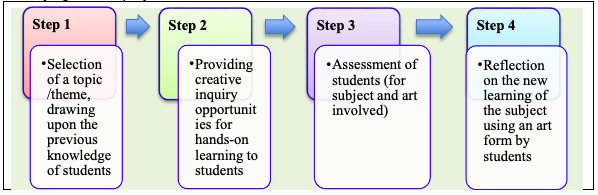
  8. The teachers may follow the following process of embedding arts with other subjects for carrying out the project work:
    CBSE Art Integrated Project
  9. The Project should be done by students in groups with 4-5 students in each group.
  10.  While creating projects, it may also be seen that it should not be too much pro art that it becomes difficult for the subject teacher to take it forward and guide the students. The projects should be simple and doable for the subject teachers and students without the assistance of art teachers/artists or others.
  11. Assessment techniques should be relevant and age appropriate. Criteria along with rubrics for assessment can be devised collectively by teachers and students while planning the projects. Students must be informed about the criteria decided for assessment along with maximum marks before commencement of work on the project.
  12. Schools and teachers may prepare their calendar by assigning dates and months for the execution of project work by the students and the records of assessment of these project works should be maintained at the schools.
  13. The Art integrated project work shall also be an integral part of assessing the student’s participation in art related activities and attainment of learning outcomes for the subject/s.
  14. The marks awarded for these projects, as part of subject-enrichment activities of class X, will be collected by the Board at the time of uploading marks of internal assessment.

Art-Integrated Learning (AIL) as a Pedagogical Tool from classes I to XII

AIL will continue as a pedagogical tool for classes I to XII, in addition to the Art Education under co-scholastic area as provided in the Secondary School Curriculum of the Board.

The objective of AIL is not to promote arts and skills of arts but to use art as a tool to teach other subjects. The focus here should be to accept arts as a medium of the learning process.

So the subject teachers may make use of simple art forms in the classrooms; and give opportunities to students to enjoy planned art activities and while they are experiencing beauty of arts, they also learn and articulate the core concept of different subjects and apply it in daily life.

Art activities which can be integrated with different subjects to aid learning are given in annexure. The activities given in the annexure are only suggestive. Correlation of AIL activities is to be seen broadly and should not restrict to one or the other kind of subjects. For example, what helps us in Agriculture as a subject can also connect to Mathematics and Science subjects. Therefore, the teachers and learners should not limit themselves in the rigid boundaries as suggested in the said annexure.

In AIL activities, teachers and students may go for integration of visual and performing arts too. Since skill of making art is not the criteria of evaluation, children can explore and might come out with very creative expressions that enable achievement of the learning outcomes.

Reporting of Implementation of Art-Education (AE) and Art-Integrated Learning (AIL)

The Board has prepared the Art Education (AE) and Art Integrated Learning (AIL) – AE & AIL portal for reporting of the implementation of Art-Education (AE) and Art-Integrated Learning (AIL). The schools are required to upload data of the Art-Education and ArtIntegrated Learning projects of students in the AE & AIL portal for enabling students of class X and XII to appear in Board exams.

Pairing of States and Union Territories for CBSE AE&AIL Project Work

The following engagement matrix has been adapted from EBSB programme:

  • Jammu & Kashmir: Tamil Nadu
  • West Bengal : Ladakh
  • Punjab : Andhra Pradesh
  • Himachal Pradesh : Kerala
  • Uttarakhand : Karnataka
  • Haryana : Telangana
  • Rajasthan : Assam
  • Gujarat : Chhattisgarh
  • Maharashtra : Odisha
  • Goa : Jharkhand
  • Delhi : Sikkim
  • Madhya Pradesh : Manipur & Nagaland
  • Uttar Pradesh : Arunachal Pradesh & Meghalaya
  • Bihar : Tripura & Mizoram
  • Chandigarh : Dadra & Nagar Haveli
  • Puducherry : Daman & Diu
  • Lakshadweep : Andaman & Nicobar

Check out the full CBSE circular

The CBSE circular was addressed to the heads of all CBSE schools. Look at the full CBSE circular here alongside all the annexures to get the details of what kind of CBSE art-integrated projects are normal for students of classes 1 to 10. 

The Art-Integration guidelines of CBSE enrolls different suggestive exercises, projects, tasks and lesson designs and are accessible here.

Pending CBSE Exams for Classes 10 and 12 will be held from July 1 – CBSE latest announcement

As you are aware, the Central Board of Secondary Education (CBSE) class 10 and 12 board examinations were postponed due to the nationwide lockdown caused by the coronavirus. Now the remaining subject’s exam of 10th and 12th will be held between July 1 and July 15. This was announced by Union Human Resource Minister Ramesh Pokhriyal on Friday; 8 May 2020.

A detailed schedule of examination will be announced on Friday late evening.

Last Minute Preparation Is It Useful

Exam Preparation

Examinations bring stress and tensions to those who do not prepare for it beforehand. Most students get into panic mode during examinations. The growing number of suicides by students is a serious indication of the dangerous levels of stress that students go through during exam times. It is important that students realize that examinations are just another test and there is no need to make a big deal out of it. With timely preparation and systematic study techniques, they can do away with stress and related problems.

Last minute preparation for examinations should essentially focus on revisions of the study material and not starting from scratch. Most students spend nights cramming up information for an upcoming exam. This can lead to an imbalance of the body and mind, further leading to reduced mind power, lesser exam preparation and lots of stress. Here are a few tips on how to prepare for an exam effectively, without having to compromise on sleep and rest.

Positive Stress

Stress needn’t be negative always. For students who haven’t spent much time earlier on exam preparation, it is better that you take the stress in a positive manner and utilize the time at hand to prepare for your exam intelligently. Positive stress enhances mind power and the absorption capacity of the brain. Plan the exam by prioritizing important topics and charting the amount of time that you want to spend on each topic. Write down the exams you need to take, the important topics for the subject, the amount of time that you need to spend studying each topic and for the revisions. This way you will effectively utilize the time and also score good marks.

Organise your study space

Clean up your study space and make enough space for your books, notes etc. Cleaning up the clutter around you will free your mind and cause less distractions. This way your concentration will remain limited to your study materials and will not wander off to unnecessary things.

Practice Exam Question Papers 

Most students believe in covering the entire syllabus in one night to pass their examinations. It is impractical and illogical as it creates an unnecessary load on the brain and also gives way to unnecessary negative stress. When you have less time at hand, focus on the important topics first. Go through the topics that have greater weightage in taerms of marks and probability of questions. Practice questions that have been asked in earlier years and this way you will be able to attend to maximum questions during the exams. 

Revision

It does not matter if you have not been able to cover the entire syllabus. Prepare for the most important questions and the most important topics. Make notes as you study and go through these notes to revise the information that you have learned. This way you can retain the information that you have grasped and remember them for the exams.

Despite the techniques mentioned above, it is always best for a student to plan his studies and prepare for an examination well ahead of time. The last week before the examination should ideally be spent in revising lessons and notes. This way the amount of stress is reduced and a student will not have to compromise on his sleep, food and rest during examinations.