NIRF College Ranking 2020: Miranda House, LSR and Hindu College are The Best Colleges in India, See The List of Top Colleges in India

The hon’ble HRD minister Shri Ramesh Pokhriyal released the NIRF ranking of Indian colleges for 2020 yesterday; 11th June 2020. The country’s prestigious Miranda House continues to hold the first position this time as well. LSR college has jumped from 5th to 2nd position this year, and Hindu College has moved down to 3rd position this year from 2nd position of 2019.

The National Institutional Ranking Framework (NIRF) releases the ranking of universities, colleges, and institutions every. The NIRF was approved by the Minister of Human Resource Development on 29th September 2015. 

The NIRF releases the ranking of Indian educational institutions every year in Engineering, Management, Pharmacy, Colleges, Architecture, Law, Medical, Dental, University and overall disciplines.   

IIT Madras, IISc Bangalore and IIT Delhi are the top three education institutions in India in the list. 7 IITs (Indian Institute of Technology) are listed in top 10 education institutions this year. 

List of Top 20 University in India


NIRF Ranking 2020: IISc, JNU and BHU Best Universities in India, See The List of Top 20 Colleges

The Union Ministry of Human Resource Development released the NIRF ranking of Indian universities for the year 2020 on Thursday. The country’s prestigious Indian Institute of Science (IISc) continues to hold the first position this time as well. Jawaharlal Nehru University, like last year, stands second and BHU third.

The National Institutional Ranking Framework (NIRF) ranking is released every year by the Ministry of Human Resource Development, Government of India. The NIRF was approved by the MHRD and launched by the Honourable HRD Minister (Minister of Human Resource Development) on 29th September 2015.

List of Top 20 University in India


Parents Approach Supreme Court for Cancellation of CBSE Examinations, Petition Filed

CBSE has announced that the pending CBSE exams for Classes 10 and 12 will be held between July 1 to July 15. These exams were postponed due to the nationwide lockdown caused by the coronavirus. But, now the group of 4 parents of the students have approached the Supreme Court against this decision of CBSE. In their petition filed against this, they have appealed not to hold the board examinations in July.

In the petition filed by Advocate Rishi Malhotra, parents are demanding cancellation of examinations citing coronavirus. They say that the corona virus infection will be at its peak in July. They are referring to the AIIMS data, where it is said COVID-19 pandemic would be at its peak in the month of July. In view of the increasing transition of Corona, there is a high chance that their children will get exposed to the pandemic. Therefore, the board should cancel the examination and declare the result of children on the basis of internal assessment.

CBSE Exams Result 2020: CBSE 12th result will come before 10th

The 12th board results will be released before the 10th of the Central Board of Secondary Education (CBSE). Board’s Controller of Examinations Sanyam Bhardwaj said that the 12th result will be released first. Due to a time limit for admission in higher education after the 12th pass, the board is trying to relate the result within that time limit. Results will be given in the last week of July or the first week of August. JEE Main will be taken in July and JEE Advanced on 23 August. At the same time, the medical entrance examination will also be held in July.

The results of the first 12th will be released before the JEE Advanced exam. This will facilitate the enrolment of successful students. The board has started preparing for it loudly. The teachers whose duty is in the assessment will not do online classes until evaluation. The assessment of the examination so far (before lockdown due to COVID-19 impact) will be finished in June. Its result will also be prepared.

Due to the lockdown, the examination of the remaining subjects will be taken from July 1st to 15th, 2020. The exam will start from July 1st, 2020. At the same time, its evaluation will start from July 5. The evaluation of the examination to be held on 15 July will be finished by 25 July.

CBSE Releases Guidelines for Art-Education & Art-Integrated Learning for Classes 1 to 10

CBSE Releases Guidelines for Art-Education & Art-Integrated Learning

According to the new CBSE circular, CBSE art-integrated activities are compulsory from 2020-21 in each subject for class 9 and 10 which would be considered for interior appraisal. CBSE students of classes 1 to 8 need to make one project each year not restricted to any one subject.

CBSE students of Classes 1 to 8 need to make in any event one art-integrated project in every academic year which can be considered for Internal Assessment in the subjects concerned the task doesn’t need to focus on just one subject.

But, CBSE students of classes 9 and 10 need to take up an art-integrated task for each subject which will be considered for internal assessment.

CBSE explained in the circular that art-integrated learning was being presented as an instructing apparatus and not to help art skills in general. It was an approach to utilize art to both educate and comprehend different subjects better.

Given below are all guidelines that CBSE schools and CBSE students need to follow for art-integrated projects.

Guidelines for CBSE schools to present art integrated learning:

  1. Classes I–VIII, Art Integrated Project should be of trans-disciplinary nature. The project work can include more than one subject and this can be considered for Internal Assessment in the subjects concerned.
  2. Classes IX and X, the students will take up the art integrated project work as subject enrichment activity in all the subjects for internal assessment.
  3. One of the objectives of art integrated education is to make the students aware of the vast and diverse cultural heritage of our country. Therefore, Students will take up integration with any form of Indian Art – visual or performing, as it will be helpful to students to easily understand the project that is culturally connected to them. Teachers need to facilitate learning of the chosen Indian art form and ensure that the students are able to creatively integrate the art form(s) being used in the project.
  4. In minimum one project work of students from classes I –X, it is mandatory to integrate any art form of the paired State/UT, as defined under Ek Bharat Shreshtha Bharat Programme. For example, CBSE students of Delhi will need to integrate the art form of Sikkim. Click here to confirm the latest pairings
  5. Subject teachers along with Arts teachers must plan and discuss the projects in advance at the beginning of the academic session so that students can be given proper guidance to undertake various projects.
  6. The focus should be given on research of new topics that are not yet taken up in the classroom. Teachers must facilitate exploration of research on the topics to give students hands-on experience.
  7. The project should be taken up in an eco-friendly manner, using readily available local resources without any financial burden on parents or guardians.
  8. The teachers may follow the following process of embedding arts with other subjects for carrying out the project work:
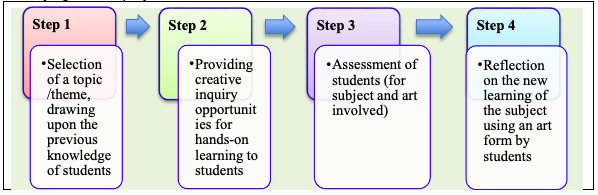
    CBSE Art Integrated Project
  9. The Project should be done by students in groups with 4-5 students in each group.
  10.  While creating projects, it may also be seen that it should not be too much pro art that it becomes difficult for the subject teacher to take it forward and guide the students. The projects should be simple and doable for the subject teachers and students without the assistance of art teachers/artists or others.
  11. Assessment techniques should be relevant and age appropriate. Criteria along with rubrics for assessment can be devised collectively by teachers and students while planning the projects. Students must be informed about the criteria decided for assessment along with maximum marks before commencement of work on the project.
  12. Schools and teachers may prepare their calendar by assigning dates and months for the execution of project work by the students and the records of assessment of these project works should be maintained at the schools.
  13. The Art integrated project work shall also be an integral part of assessing the student’s participation in art related activities and attainment of learning outcomes for the subject/s.
  14. The marks awarded for these projects, as part of subject-enrichment activities of class X, will be collected by the Board at the time of uploading marks of internal assessment.

Art-Integrated Learning (AIL) as a Pedagogical Tool from classes I to XII

AIL will continue as a pedagogical tool for classes I to XII, in addition to the Art Education under co-scholastic area as provided in the Secondary School Curriculum of the Board.

The objective of AIL is not to promote arts and skills of arts but to use art as a tool to teach other subjects. The focus here should be to accept arts as a medium of the learning process.

So the subject teachers may make use of simple art forms in the classrooms; and give opportunities to students to enjoy planned art activities and while they are experiencing beauty of arts, they also learn and articulate the core concept of different subjects and apply it in daily life.

Art activities which can be integrated with different subjects to aid learning are given in annexure. The activities given in the annexure are only suggestive. Correlation of AIL activities is to be seen broadly and should not restrict to one or the other kind of subjects. For example, what helps us in Agriculture as a subject can also connect to Mathematics and Science subjects. Therefore, the teachers and learners should not limit themselves in the rigid boundaries as suggested in the said annexure.

In AIL activities, teachers and students may go for integration of visual and performing arts too. Since skill of making art is not the criteria of evaluation, children can explore and might come out with very creative expressions that enable achievement of the learning outcomes.

Reporting of Implementation of Art-Education (AE) and Art-Integrated Learning (AIL)

The Board has prepared the Art Education (AE) and Art Integrated Learning (AIL) – AE & AIL portal for reporting of the implementation of Art-Education (AE) and Art-Integrated Learning (AIL). The schools are required to upload data of the Art-Education and ArtIntegrated Learning projects of students in the AE & AIL portal for enabling students of class X and XII to appear in Board exams.

Pairing of States and Union Territories for CBSE AE&AIL Project Work

The following engagement matrix has been adapted from EBSB programme:

  • Jammu & Kashmir: Tamil Nadu
  • West Bengal : Ladakh
  • Punjab : Andhra Pradesh
  • Himachal Pradesh : Kerala
  • Uttarakhand : Karnataka
  • Haryana : Telangana
  • Rajasthan : Assam
  • Gujarat : Chhattisgarh
  • Maharashtra : Odisha
  • Goa : Jharkhand
  • Delhi : Sikkim
  • Madhya Pradesh : Manipur & Nagaland
  • Uttar Pradesh : Arunachal Pradesh & Meghalaya
  • Bihar : Tripura & Mizoram
  • Chandigarh : Dadra & Nagar Haveli
  • Puducherry : Daman & Diu
  • Lakshadweep : Andaman & Nicobar

Check out the full CBSE circular

The CBSE circular was addressed to the heads of all CBSE schools. Look at the full CBSE circular here alongside all the annexures to get the details of what kind of CBSE art-integrated projects are normal for students of classes 1 to 10. 

The Art-Integration guidelines of CBSE enrolls different suggestive exercises, projects, tasks and lesson designs and are accessible here.

Pending CBSE Exams for Classes 10 and 12 will be held from July 1 – CBSE latest announcement

As you are aware, the Central Board of Secondary Education (CBSE) class 10 and 12 board examinations were postponed due to the nationwide lockdown caused by the coronavirus. Now the remaining subject’s exam of 10th and 12th will be held between July 1 and July 15. This was announced by Union Human Resource Minister Ramesh Pokhriyal on Friday; 8 May 2020.

A detailed schedule of examination will be announced on Friday late evening.

Best Courses After 12th in Mechanical Field

Medical Courses After 12th

Designing and building innovative machines is the responsibility of mechanical engineers, who specialise in the design, construction, and usage of machines. To put it another way, mechanical engineers create the cornerstone for innovations and technological progress. A diploma in mechanical engineering will be the ideal course for you if you consider yourself to be good with mechanics and desire to pursue that sector as a career.

Top Mechanical Engineering Courses After 12th

Mechanical engineering is the most adaptable and diversified branch of engineering, and its courses provide you with a thorough understanding of cutting-edge machinery. Mechanical engineers use the laws of physics and material science to analyse, design, build, and maintain a variety of mechanical systems. to take a course in mechanical engineering After graduating from high school, one needs to be familiar with fundamental ideas including mechanics, kinematics, material science, and structural analysis. These ideas are often taught to students at the 10+2 level.

List of mechanical engineering courses after 12th

  1. Aerospace engineering
  2. Agricultural engineering
  3. Aircraft maintenance engineer
  4. Architect

Aerospace Engineering

Aerospace engineering is a field of engineering which is related to the development of aircraft and spacecraft. It has two branches: Aeronautical engineering and Astronautical Engineering. Aeronautical engineering is the study of research, design, development, construction, testing, science and technology of aircraft. For applying, this the mandatory subjects are Maths and Physics

Following are some colleges in which you can study Aerospace Engineering:

Agricultural Engineering

Agricultural Engineering is a field of engineering which is related to the design, construction and improvement of farming equipment and machinery. Agricultural engineers’ work is to join technology with farming.

We can understand this as below:

  • Agricultural Engineers design new and improved farming equipment which can work more efficiently and can also perform new tasks.
  • Agricultural engineers work on different kinds of activities such as aquaculture, forestry, developing biofuels, conservation, planning animal environments etc.

For application, this the mandatory subject are Chemistry, Maths and Physics

Following are some colleges in which you can study Agricultural Engineering:

Aircraft Maintenance Engineer

Each and every machine requires regular maintenance to work properly so do aircraft too.

Aircraft maintenance engineers’ responsibility is to install, maintain and repair aircraft engines; airframes; airframe systems; electrical, instrument and radio systems; aircraft structures and surface finishes etc.

They directly work under the control of  Aeronautical Engineers. For applying, the mandatory subjects are Maths and Physics.

Following are some colleges in which you can study Aircraft Maintenance Engineering:

Architect

The responsibility of an architect is to plan, design and review the construction of buildings or structures which are economical and best fit according to the client’s specification.

Career Prospects in which architect work:

  • Architectural and Engineering Managers
  • Civil Engineers
  • Industrial Designers
  • Interior Designers
  • Drafters
  • Construction and Building Inspectors
  • Landscape Architects
  • Surveyors
  • Surveying and Mapping Technicians

For applying, the mandatory subject is Maths.

Following are some Institutes in which you can study Architect:

Best Courses after 12th for Commerce without Mathematics

If someone doesn’t like or not comfortable in mathematics and don’t want to make his/her career in mathematics then below are the options for the same:

Bachelor of commerce (B.Com). This is an academic program and its duration is 3 years. One can pursue it without mathematics.

There are different field in which you can pursue B.Com as below:

  • B.Com. in Banking and Insurance
  • B.Com. in IT
  • B.Com. in Computer Application
  • B.Com. in Banking and Finance
  • B.Com. in Retail Management
  • B.Com. in Foreign Trade Management
  • B.Com in Office Management and Secretarial practices
  • B.Com in Honours
  • B. Com in Accounting and Finance
  • B. Com in Economics
  • B. Com in Marketing
  • B. Com in E-Commerce
  • B. Com in Applied Economics
  • B. Com in Financial Market

Following are the colleges in which you can study B.Com:

Bachelor of Business Administration (BBA).This is an academic program and its duration is 3 years. One can pursue it without mathematics.

There are different field in which you can pursue BBA as below:

  • BBA in Human Resource Management
  • BBA in Marketing
  • BBA in Finance
  • BBA in Operations
  • BBA in International Business
  • BBA in Foreign Trade
  • BBA in Aviation Management
  • BBA in Family Business
  • BBA in Business Analytics
  • BBA in Event Management
  • BBA in Travel and Tourism Management
  • BBA in Hotel and Hospitality Management

Following are the colleges in which you can study BBA:

Bachelor of Law (LLB).This is a bachelor degree program and its duration is 3 years. If you are good at speaking and discussion then go for Law subject. This can also be join without maths:

Below are the law courses:

  • B.Com. LLB
  • BBA LLB
  • BA LLB

Following are the colleges in which you can study LLB:

Bachelor of Business Management (BBM).This is a management degree program and its duration is 3 years. It includes the study of practical and theoretical aspects of business. Specialization in this program are as below:

  • Business Law,
  • Economics,
  • Ethics,
  • Finance,
  • Strategic Management,
  • Supply Chain Management.

Following are the colleges in which you can study BBM:

Company Secretary (CS).A Company Secretary is a senior managerial or administrative post in a company. His responsibility is to ensure Board of Directors that all the statutory and regulatory requirements are into compliance and according to the law are followed timely and the decision of BOD are easily implementing.

ICSI (Institute of Company Secretaries of India) is the institute in India which conduct this course.

Below is the official website of the same:

Best Career Option After 12th in Scientific Field

Agricultural Scientist

Agricultural scientists are related with all aspects of plant and animal life. There are two ways of research:

  • Laboratory-based and
  • Field-based research.

Scientists work for improving crop produce, for environment protection and they work in the testing and quality control of foodstuffs, drugs and farm products. Following are the specialised area for Agricultural scientists :

  • Agronomy
  • Horticulture
  • Plant Breeding
  • Animal Science Research.

For applying for this the mandatory subject are Biology and Agriculture

Following are some colleges in which you can study Agricultural Science:

Astronomer

Astronomy is the study of the sun, moon, stars, planets, comets, asteroids, gas, galaxies, dust as well as man made satellites. Modern astronomers tend to fall into two fields: the theoretical and the observational.

  • Observational astronomers focus on direct study of stars, planets, galaxies, and so forth.
  • Theoretical astronomers model and analyze how systems may have evolved.

For applying for this the mandatory subject are Physics and Mathematics

Following are some colleges in which you can study Astronomer

Ayurvedic Doctor

Ayurveda is a traditional healing technique which is an Indian holistic medical practice too.

Popular career options:

  • Yoga instructor
  • Physical therapist
  • Massage therapist
  • Nutritionist

For applying for this the mandatory subject are Biology, Physics and Chemistry

Following are some colleges in which you can study Ayurveda:

Biotechnologist

In this lots of techniques are applied to the living organism to produce or modify products for the benefit of mankind. The Bio- technologists work in various sectors such as agriculture, pharmaceuticals, medicine, environment etc.

Popular career options:

  • Drug and pharmaceutical research
  • Public funded laboratories
  • Chemicals
  • Environment control
  • Waste management
  • Energy
  • Food processing
  • Bio-processing industries

For applying for this the mandatory subject are Biology and Maths

Following are some colleges in which you can study Biotechnology:

Best Business Courses After 12th for Mathematics lover

Actuary

An actuary is a business professional whose responsibility is to mitigate, measure and manage the risk and uncertainty. The name of the field is actuarial science. One should be the mathematics lover and could be of any academic background to study Actuarial Science.

Actuaries are essential in Insurance Business but nowadays they are spreading their arms. They ensure adequacy of funds for promised benefits just like Leave encashment, Bonus, Gratuity etc. They design the insurance policy as well as pricing.

For applying for this the mandatory subject is Maths.

Following are some colleges in which you can study Actuarial Science:

Business Analyst

A business analyst (BA) is a person who analyses all aspects of an organization or business (it may be real or hypothetical) and makes a report of its business or processes or systems, assessing the business model or its integration with the technology.

They also work on the improvement of the business with technology integration.

For applying for this the mandatory subject is Maths.

Following are some colleges in which you can study Business Analyst:

Credit Analyst

These are the finance persons who make an analysis report on the creditworthiness of an individual or a Business. They usually make analysis of financial statements, banking and credit habits to estimate and evaluate the risk in giving loans to any individual or a Business.

For applying for this the mandatory subject is Maths.

Following are some colleges in which you can study Credit Analyst:

Investment Banker

An investment banker is an individual or a private company that helps in financial activity of an individual, corporate and Government. That financial activity may be managed to raise funds through securities.

For applying for this the mandatory subject is Maths.

Following are some colleges in which you can study Investment Banker: