Sex education in India

Sex education in India

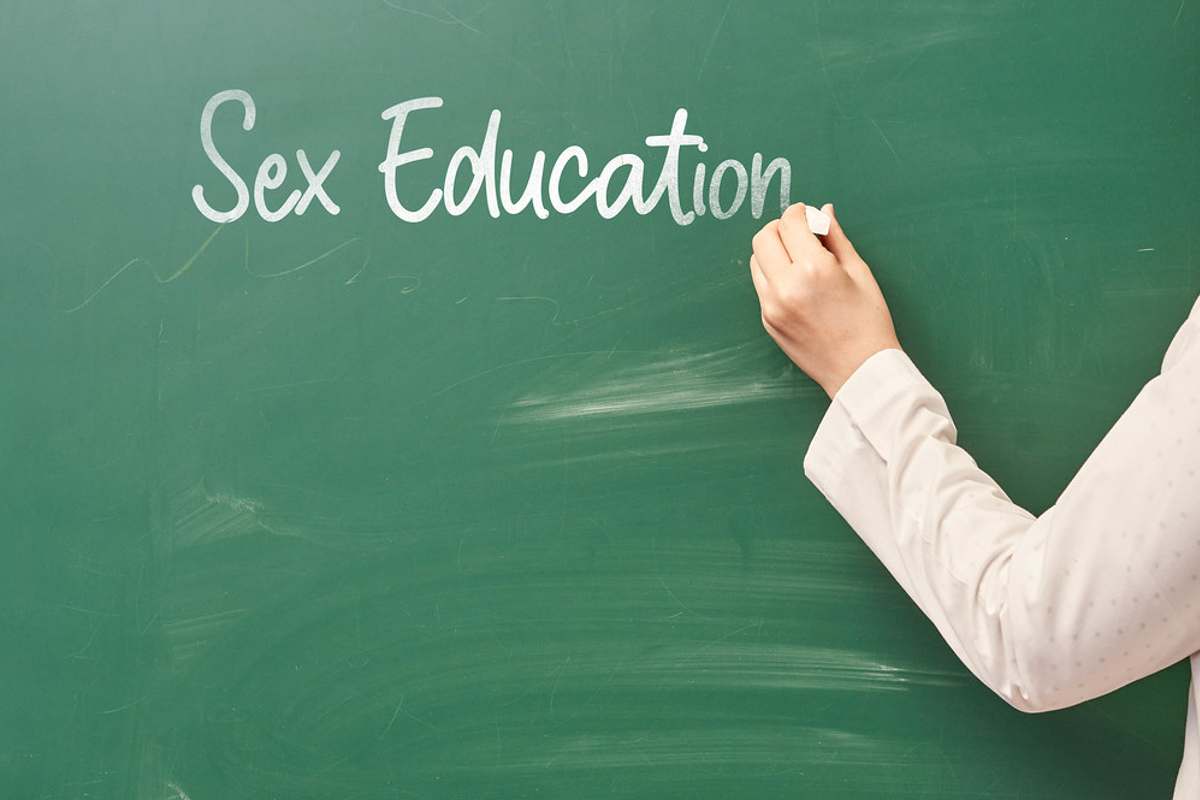
In India, people are uncomfortable discussing sex education openly because they still think it is unnecessary. However, when we talk about sex, we can differentiate it in two ways one as the gender difference and the second concerning the physical need of the person. Sex is considered an unusual word in India, but we cannot neglect that it is essential for the continuation of the human race. 

The teachers and parents are the chains that remind the social value of a child from their birth. If they do not make their children and students comfortable, this topic will always remain taboo in the country. Therefore, people are not ready to talk about this critical matter, which results in a lack of knowledge about our bodies and sex, which has led to the increasing rate of STDs (sexually transmitted diseases) among people. 

Nowadays, stress is increasing in growing teenagers due to various reasons. They start reliving their stress on porn sites and create unusual fantasies which harm their ability to think and explore. Sex images and videos about women affect teenagers’ mental and physical health. The national council introduced sex education for education in 2007 and dealt with the growing interest and lack of education about sex in teenagers. 

Why sex education is essential in India?

India is a diverse country with a vast population with the highest rate of sexual issues like sexual abuse, adult pregnancy, and diseases like HIV and AIDS. The data shows more than 2.3 million people with HIV have been infected. However, this can be reduced by providing education and awareness according to the national AIDS prevention and control policy 2002. 

Nowadays, more than 50% of teenagers face sexual abuse in their young age, and it is the responsibility of parents, teachers, and adults to educate them by providing knowledge about identifying the abuse and protected themselves. 

Government initiatives for sex education in India 

To change society, the government takes many steps like the national education policy 2016 under which sex education is provided in every single school. The government also offered an adolescent education program in 2017. This program was banned in a few states due to protests. This program covers significant issues like body image, abuse, gender inequality, sexuality, etc.

The CBSE has also issued a program in 2005 called the adolescent reproductive and sexual health education project.

Types of sex education

  1. Sex education for adolescents: In India, almost 30 % of people are illiterate and lack knowledge about sex, including teenagers. In addition, most adolescents in rural areas have poverty which stops them from growing. While low and weak body affects stamina and due to a lack of education, these males and females do not take safe sex measures or use contraceptives.
  2. Sex education in family planning for adults:  Nowadays, people in urban areas are pretty considerate towards child planning due to the high quality of lifestyle and education. Therefore, some adults in urban areas are educated about sex safety and use contraceptives as a savior. But, in contrast, some population is uneducated, which leads to the unplanned children.
  3. HIV / AIDS prevention education: AIDS is the most common issue nowadays which can happen due to various reasons. For example, sharing needles, not using condoms during sex, blood transfusion and other activities which can exchange the body fluids. 

Facts about sex education in India

  1. In India, teachers do not talk about sex education. In most areas, sex education is called sexuality. The typical mentality of people is that sex education will teach students about how to do sex. People get offended if the ‘sex’ word is used openly and named in different ways, such as adolescent education, comprehensive sexuality education, etc. 
  2. During the classes of sex education in school, teachers made the girls and boys sit separately because they think sitting together could make them uncomfortable. While these sessions are conducted to help students gain knowledge about the body and needs.  
  3. The main motive of sex education is to teach people what our body is and understand ourselves and the opposite gender. Sex is not necessary, it’s just the need of the hour to satisfy human nature. 

FAQs

1. Does teaching about sex in schools helpful?

Ans: Sexuality education helps in the accessible and comfortable communication about sex between parents and children. And considering this knowledge, parents become more open-minded toward their teenagers and their need for sexuality. 

2. What is comprehensive sex education?

Comprehensive sex education teaches about human beings’ emotional, physical, and mental emotions toward sexual sex and relationships. It helps them to empower them towards their body and their action:

  • Consider how their choice can affect their health, being
  • It develops the sexual and mutual relationships
  • Providing knowledge of their needs and rights.
  • It helps in providing realization of the market, health, and well-being.

3. Why are people uncomfortable talking about sex education in India?

Ans: People are uncomfortable discussing this topic, and the main problem is that people are not interested in knowing about their bodies and sexual needs and find it vulgar.

Physical Education and Its Importance

Benefits of physical Education

Physical education contains many types of sports and physical activities and helps the overall development of the body. Physical education is a part of every school, and it is a subject that provides learning that goes beyond fun activities and games. Physical education in all schools offers fitness, health, and learning via different sports activities. Many school students also participate in other physical sports like basketball, soccer, volleyball, dodgeball, tennis, etc. This article will discuss a brief concept of physical education and its importance.

What is Physical Education? 

When we ask, “what is physical education?” we refer to a specialized branch of education that focuses on developing physical fitness and the ability to perform daily activities with ease. It is a mandatory subject in most schools where students participate in sports like swimming, badminton, and football.

The focus of the curriculum changes as a child grows:

  • Elementary and Middle School: Focuses on foundational skills like running, catching, throwing, and basic coordination.

  • High School: Shifts toward specialized sports skills, aerobics, and competitive team play to build endurance and strategy.

Definition of physical education 

A formal physical education definition describes it as a process of learning through physical activities designed to improve physical, mental, social, and emotional health. Physical education is the activity related with the holistic development of an individual’s personality.

The main motive is to build the mental and physical capacity required for a productive lifestyle. Regular participation in these activities ensures that a person’s muscles, bones, and cardiovascular system remain in peak condition. For many, this subject is the first step toward a lifelong habit of wellness.

Importance of Physical Education 

Physical education is becoming one of the essential subjects in schools due to its endless benefits. Some of the importance of physical education are discussed below:

1. Development of body and soul

Physical education is an abstract form that is not only limited to a particular area. Physical education is not only concerned with physical activities and needs to be termed as the education of body, mind, emotions, and soul. Nowadays, people should be aware of physical activities and education. People are getting encouraged about their health and influenced towards physical education.  

2. Motor development

The movement of a person is generated because of the neural connection between nerve fibers and the nervous system. They both are responsible for performing many tasks. They are also responsible for quick and slow reflexes. You are born with these motor skills, and you can improve the health of these muscles by working out regularly. Once you start gaining motor development, it will help you to attain a healthy life. 

3. Emotional development

As much as we talk about physical health, people sometimes focus less on their dynamic, which is responsible for your happy life. People should enhance their emotional development by participating in various sports, which could help to maintain their emotions towards multiple situations. Emotional feelings such as happiness, sadness, anger, excitement, and encouragement are essential aspects of life. Focusing on these dynamic aspects of your life will help you to spend your life the way you want.

4. Social development

Human beings are born in a society, and it is necessary to look after your social development. People make friends and spend time with them, which provides the sense of ‘we feeling.’ The more you socialize, the more you know about the people and the world around you. Being a social person helps you to learn the important chapters of life, such as sympathy, corporation, affection, etc. 

5. Cultural development

Cultural development Is an aspect you can learn from sports and games. First, You get to know the culture and heritage of that game. Then, once you start indulging in a particular game, you will be able to understand the history of that specific game. It also provides an essential lesson about the previous generation and their struggle with sports. This generation is highly influenced by physical health because it helps them to flex their muscles, but cultural development is a much more complex topic. 

6. Promotes an active and productive life

Sometimes, without any encouragement, people get sluggard and stop looking at their physical health but being focused and encouraged towards their health will expand the time and quality of their life. In addition, indulging in physical activities will help you regain a better and more positive perspective on life.

Benefits of physical education

Physical education is considered the need of the hour and has to be done regularly to maintain the body. Some people prefer different types of physical activities for their bodies. Performing physical tasks every day can help the body in many ways. Some of the benefits of physical education are as follows:

Physical Education and Its Importance


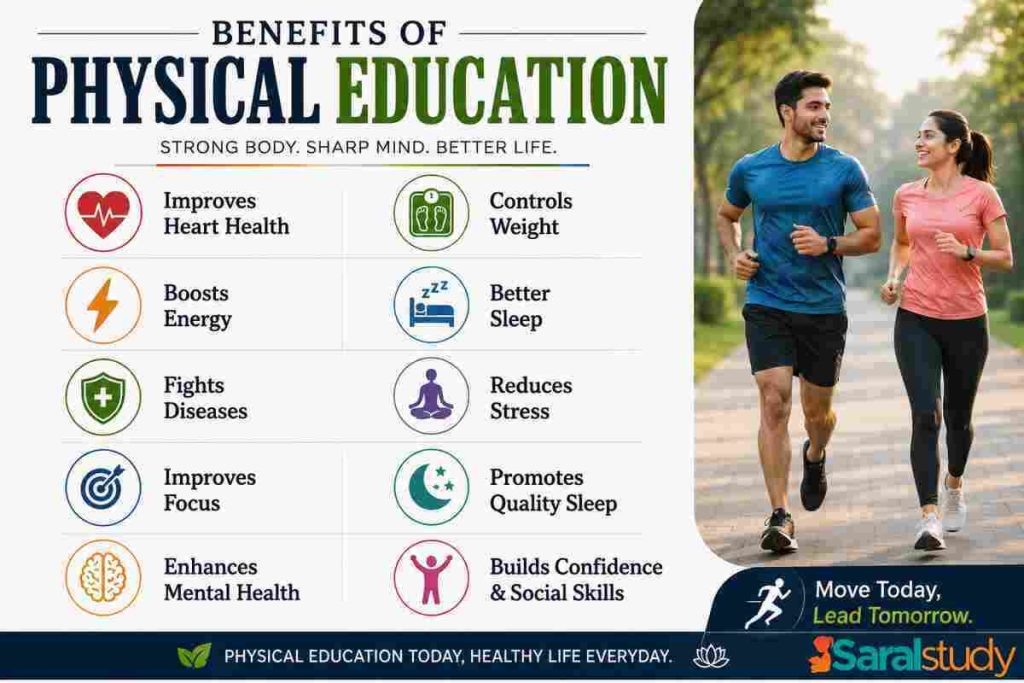
  1. Regular physical exercise can help in dealing with cardiovascular diseases.
  2. Nowadays, most adults and teenagers are obese, which increases the chances of diseases, while physical exercise helps reduce body weight.
  3. Regularly improves the metabolism, which boosts the energy in the body.
  4. Exercising can make our body tired, which helps in better sleep.
  5. Exercise fights various diseases and makes our bodies healthy.
  6. Stress is the most common problem among people, and exercising can reduce the stress level in the body. 
  7. Exercising helps in focusing on the matters of life such as schools, studies, etc.
  8. It builds a healthy body and promotes the quality of sleep.
  9. It improves the physical, mental, and emotional health of a person.
  10. It improves confidence in a person and develops better performing and social skills.

Types of physical activities under physical education

Physical education is based on the four main kinds of physical activities. If you do all these activities, it will improve your body in a miracle way. Even doing one of these activities can also enhance your ability. Each activity has its benefits, which help the body in many ways. The physical education activities are distributed among these four main points, which are as follows:

1. Endurance

Endurance activities involve aerobic exercises, which are concerned with the health of the lungs, heart, and circulatory system. While performing these activities regularly can help increase the breath and heartbeat rate. In addition, performing these activities regularly can help improve diabetes, cancer, and other diseases. Some exercises which amp improve physical health are as follows:

  • Biking
  • Tennis and basketball
  • Brisk jogging and walking
  • Yard work
  • Swimming
  • dancing

2. Strength

Strength activities don’t only include muscle building, but power is beyond this. It helps the person to do heavy work without getting tired. Resilience helps you in performing day-to-day activities, and it makes your muscles strong. Some of the exercises which can improve the stability of a person are as follows:

  • Lifting body weight
  • Overhead arm curl
  • Arm curls
  • Using a resistance band
  • Wall push-ups

3. Balance

Balance helps in maintaining the walk of a person. It helps prevent sudden falls, and with the help of various balance exercises, you can improve your lower and upper body balance. Balance exercises are beneficial in adults and senior citizens. Some of the activities to improve balance are as follows:

  • The balance walk
  • Standing on one foot
  • Standing from a sitting position

4. Flexibility

Flexibility is considered a significant body. Among adults, flexibility is regarded as a widespread problem. Through stretching, you can improve the flexibility of the body. Adults have to face the issue of the ability with the image. Some of the physical activities which can help to improve flexibility are as follows:

  • The back of the leg stretch
  • The back stretch exercise
  • The ankle stretch
  • The inner thigh stretch

Difference between sports and physical education

Many people mistakenly believe that physical education and sports are the same things. However, while sports are a part of the curriculum, they represent only one tool used within the broader scope of physical health education.

Scope and Objective

The primary importance of physical education is to provide a well-rounded foundation for a healthy lifestyle. Its objective is inclusive; it aims to ensure that every student, regardless of their athletic ability, develops basic motor skills and health awareness.

In contrast, Sports are usually competitive and performance-oriented. The objective of a sport is often to win or achieve a specific mastery of a game. While physical education focuses on the “process” of being healthy, sports focus on the “result” of the competition.

Participation and Inclusivity

  • Physical Education: This is a mandatory subject in schools. It is designed for everyone—the athlete and the non-athlete alike. It covers everything from basic stretching and yoga to understanding the physical education definition and human anatomy.

  • Sports: Participation in sports is often voluntary. It usually involves a selection process where individuals with higher skill levels compete in teams like soccer, cricket, or basketball.

The Curriculum vs. The Game

Physical education is the activity related with a structured curriculum. A PT teacher follows a syllabus that might include nutrition, the disadvantages of a sedentary lifestyle, and various movement patterns. Sports, however, are governed by a specific set of rules and fixed boundaries. A sport is a specialized application of the physical skills learned during physical education classes.

Evaluation and Progress

In a physical education class, a student is evaluated on their personal improvement, participation, and understanding of health concepts. In sports, success is measured by scores, trophies, and rankings.

Government of India Initiative on Physical Education

The Government of India has several initiatives to promote physical education, including:

Conclusion

In this growing modern world, people and even small children are the victims of stress and pressure, and physical education is the only measure to improve health. Physical education has various kinds of benefits which can help the body in varied ways. First, it helps improve a person’s physical and mental health. It can help in studies and fulfills all basic skills. 

FAQs on Physical Education

1. How does physical education improve our daily life?

Ans: Physical education is a crucial point that matters significantly in human life. It helps improve motor skills and aids in providing strength to the muscles. It enables the whole body and benefits it in various ways.

2. What is the importance of physical education in a student’s life?

Ans: Physical education helps provide instructions and vital abilities to develop motor skills, developmental skills, and knowledge. 

3. What are the barriers to physical education?

Ans: The barriers in physical education are as follows:

  • Lack of resources
  • Lack of willpower
  • Social influence
  • Fear of injury
  • Lack of skills

4. What are the two main goals of physical education?

Ans: The two primary goals of physical education are as follows:

  • Goal 1: it helps in acquiring the range of movement in various sports activities
  • Goal 2: It helps apply different strategies and principles of physical education.

Also Read: Yoga For Students: 5 Best Yoga Poses For Children

What is Educational Psychology

What is Educational Psychology

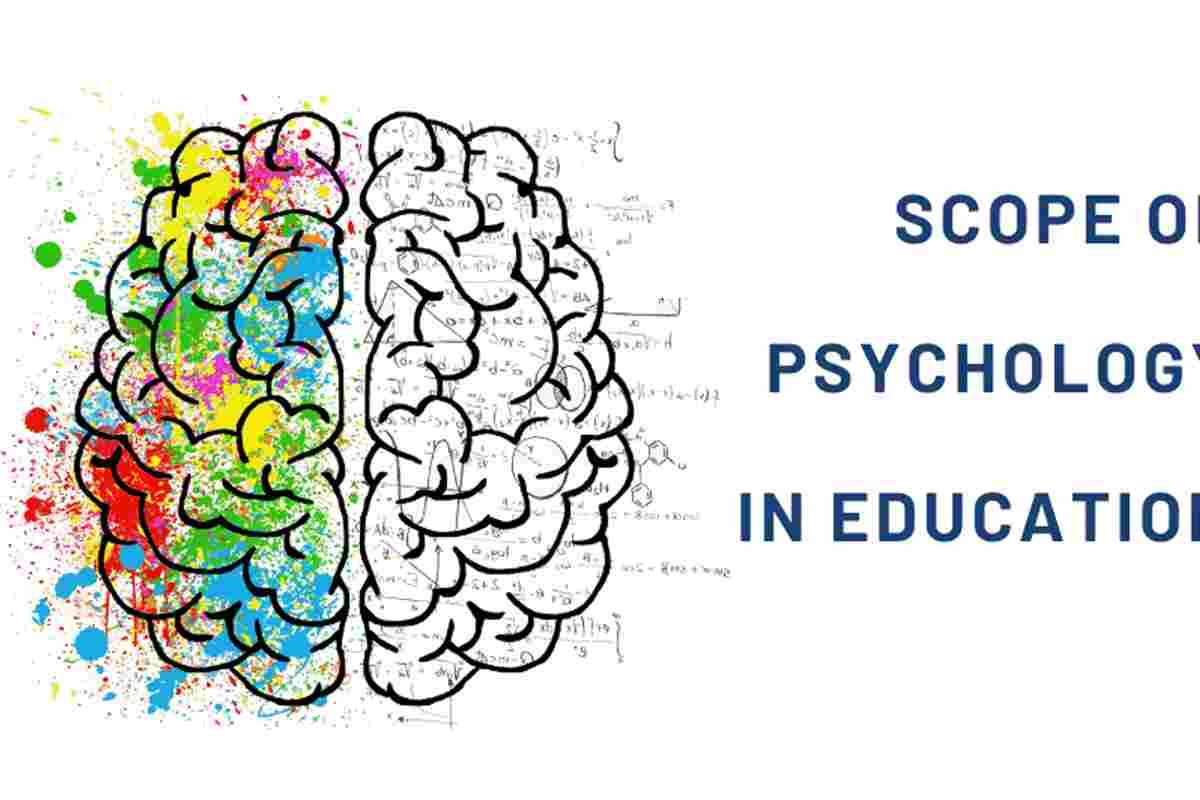
Educational psychology is a discipline of psychology that studies the early childhood and adolescent learning processes. It studies how individuals learn, including teaching techniques, instructional processes, and individual learning variations. In addition, it investigates the cognitive, behavioral, emotional, and social factors in learning. 

Educational psychologists utilize their knowledge of how individuals learn to create instructional techniques and assist students in succeeding in school. Educational psychology research aims to improve learning, and educational psychologists explore and discover innovative educational approaches to help instructors, students, and anybody attempting to acquire a new skill. 

Educational psychologists strive to discover new ways of learning and thinking, such as determining the most effective strategies to teach students and children with unique learning issues such as attention deficit hyperactivity disorder (ADHD), dyscalculia, or dyslexia. Investigating how effectively people learn in various environments. 

Evaluating and examining instructional techniques, as well as resolving learning challenges. Investigating how genetics, environment, socioeconomic class, and culture influence the child’s learning pattern.

History of Educational Psychology

Although the study of educational psychology is a relatively new discipline, the study of how individuals learn has long interested academics. However, since psychology did not become a distinct discipline until the late 1800s, educational philosophers were primarily responsible for the early interest in educational psychology. For example, in the fifth century B.C. Democritus wrote on the impact of a person’s upbringing on learning, while Plato and Aristotle spoke about educational psychology subjects like: 

  • Different approaches to education
  • Individualized education
  • Arts education’s influence on human development
  • Role of a teacher and instruct
  • Educating oneself without a master

John Herbart is considered one of the founders of Educational Psychology. According to Herbart, a student’s interest in a subject has a significant impact on the results of their learning. Therefore, when choosing the best education, educators should consider this.

William James, a philosopher, and psychologist, later made substantial contributions to the subject. “Talks to Teachers on Psychology,” published in 1899, is a textbook written by him and is considered his first work.

Alfred Binet, a French psychologist, created his renowned I.Q. tests simultaneously. The French government first created the exams to aid in identifying children who had developmental delays and developing special education programs.

John Dewey had quite a good influence on education in the United States. Progressive in his thinking, Dewey thought that students should come first in the classroom rather than specific subjects. He promoted active learning, saying that practical application was a crucial component of the procedure.

Perspectives/ Approaches of Psychology

Physiology is a vast field that has various perspectives. The approaches and perspectives of Physiology are discussed below: 

  1. Behavioral Perspective

The concept of behaviorism in educational psychology is influenced by the child’s conditioning, which may be both positive and negative depending on the environment and setting around them. The atmosphere in which a child has raised influences their psychology and aids them in learning and understanding. 

The behavioral method may also include the use of rewards and punishments. For example, rewarding a student for excellent manners and performance would be an attempt to use behaviorism to drive students to achieve better and behave better. 

However, the behavioral method has been criticized for neglecting to consider attitude, emotions, and intrinsic motivation for learning.

  1. Cognitive perspective

This idea holds that an individual learns through motivation rather than relying on external influences and rewards. The cognitive approach to thinking is concerned with how humans think, learn, remember, and process information. This technique enables students to consider and understand their complex challenges, strengths, and obstacles. 

Under this method, students are given power over their education. Education psychologists investigate how students learn by concentrating on their strengths and shortcomings to get better results.

  1. Experimental Perspective

This viewpoint stresses how a person’s own life experiences shape them and how they interpret new information. This strategy helps someone discover personal significance in what they learn rather than feeling that the material is irrelevant to them. This approach has constructivist and cognitive views; it considers the learner’s experiences, thoughts, and feelings.

  1. Developmental perspective

This viewpoint focuses on how developmental phases affect a child’s learning potential. The educational psychologist focuses on how children acquire new knowledge and skills as they grow. Because children think differently at different stages of development and become capable at each stage, the educational psychologist tries to understand better what the children are capable of at each stage of development. 

This can assist the instructors in developing more inventive and educational ways and resources to educate a certain age category. Jean Piaget proposed the stages of cognitive development as an example of development theory that examines how children grow cognitively.

  1. Constructive approach

This method is impacted by the social and cultural components of the world, which affect a person’s understanding and learning. This viewpoint focuses on how people actively develop their knowledge based on what they already know. 

According to educational psychologists, what a person already knows and believes in determines how they acquire new knowledge. New knowledge may be contributed to and understood in terms of current information using this technique. The work of psychologist Lev Vygotsky, who introduced concepts of the zone of proximal development and instructional scaffolding, has strongly affected this viewpoint.

Topics studied under Educational Psychology.

Educational Physiology covers various topics listed below: 

  • Examining technology: How multiple sorts of technology might assist pupils in learning
  • Instructional design: Creating excellent educational materials
  • Special education is the assistance given to students who may require specialized instruction. Educational psychologists can lead teacher training sessions to assist instructors in developing their abilities, comprehending why particular learning techniques are more successful, offering personalized teaching, and setting reasonable goals for their students.
  • Curriculum creation: Developing a curriculum that will optimize learning. They design the curriculum by collaborating with schools, organizations, and individuals to develop successful learning systems. Educational psychologists can help with the instructional design by assessing existing educational programs to see where a new curriculum can improve the old one.
  • Organizational learning studies how individuals learn in organizations such as workplaces. Educational psychologists can examine institutions that are suffering with test results and assist them in improving their academic programs by identifying gaps that need to be filled to enhance test scores. In addition, educational psychologists can help with the creation of realistic standardized exams as well as study-related topics like how to reduce student anxiety about standardized testing.
  • Gifted learners: Assisting students that have been designated as talented or who are challenged.

A career in Educational Psychology

For careers in this sector, a bachelor’s and master’s degree are often needed; to work at a university or in school administration, you could also need a Ph.D. An educational psychologist may also work in university or school administration. They can affect educational practices and support students in learning in the manner that best suits them in each of these positions.

Finding innovative methods for children and adolescents to learn and understand is the role of an educational psychologist. They spend a lot of time researching students; therefore, they primarily collaborate with academic institutions, including schools, educators, administrators, instructors, and students, to research and identify effective teaching and learning strategies. To make the learning process productive and effective, they closely interact with students and teachers as they build a new curriculum by monitoring and assessing the existing one.

An educational psychologist could even train to be a counselor, personally assisting individuals in overcoming obstacles to learning. However, due to their numerous challenges, specific individuals require more attention, so educational psychologists must develop new teaching methods to help them.

Some educational psychologists may research with the support of a government agency, investigating the most effective teaching strategies for students.

Conclusion

Through diverse techniques and methodologies, educational psychology has significantly contributed to education and helped many individuals overcome their shortcomings and barriers, making learning and understanding easier. It has always been an essential part of our world since we have worked to improve learning approaches. Many psychologists have contributed to the field of psychology. 

It has always fascinated me how humans tend to increase their skills and discover new ways to improve their learning and understanding abilities. Educational psychologist invests their time with educators, teachers, and students to analyze their methods and make learning and teaching more accessible and more convenient. 

It has aided individuals who are unique and challenging. Educational psychologists have used a variety of approaches and perspectives to address the problem of a curriculum that lacks effective and productive methods, and their work has earned a lot of attention in the educational area. Educational psychology is necessary for numerous fields like research, counseling, teaching, etc.

FAQ’s

  • How does educational psychology help in the field of education? 

Educational psychology has played a critical role in the field of education. It has made interacting with the intellectual process more accessible and convenient for teachers, educators, and students. To make schooling easier, many approaches are employed. 

Educational psychology strategies aid specially challenged students as well. This discipline seeks to inspire students or children to educate and become more self-aware. Schools have already made significant advancements in psychology, yielding more excellent results.

  • What are the approaches used in educational psychology?
  1. The Behavioral approach 
  2. The Cognitive approach
  3. The Developmental Approach
  4. Experimental Approach
  5. Constructive approach 
  • What is the role of Educational psychologists?

Educational psychologists employ a variety of approaches to assist pupils in learning and understanding. They observe and analyze individuals and concentrate on the curriculum to provide students with practical and productive learning methods. They must examine the technology, instructional design, special education, curriculum development, organizational learning, and gifted learners.

Careers in Solar Energy Sector

A careers in Solar Energy Sector

India is expanding its renewable energy capacity. Solar power in India has grown about 18 times over the last 7.5 years. India’s renewable energy sector ranks fourth in the world. It is the most attractive renewable energy sector. Solar and wind power are the country’s most abundant renewable energy sources.

Natural energy, such as solar and wind energy, has immense potential. Many programs were launched by Prime Minister Narendra Modi on 30 July 2022. They are the best example of a bright future for India’s solar industry than the 

Solar power for homes and businesses is growing in popularity due to benefits such as zero greenhouse gas emissions. There are many jobs in the solar energy industry, and its popularity could lead to steady employee demand. Learning more about the open positions in this exciting field may help you choose a job that matches your interests and goals. Generating solar energy by converting sunlight into electricity reduces emissions. It also lowers long-term energy costs. As solar energy becomes more affordable, it has the potential to meet much of the growing energy demand.

Companies that take their environmental policies need their employees to complete solar education programs to learn how solar energy technology works and how to install solar panels. But what if you are not an employee? How do you train to become a solar energy expert? Luckily, with his online solar courses such as Solar Training-Be a Solar Energy Expert, you can do it at your own pace in the comfort of your home or office and can complete the training.

In this article, we explore why you should consider a career in solar energy and discuss the main methods of solar power.

Overview of Solar Energy in India

Solar energy in India has great potential. The use of sunlight as an energy source began during the industrial age. The future looks very bright as the sun never runs out of light.

India’s solar energy has notably impacted the energy landscape in recent years. If we use this energy resource effectively, it will be possible to meet the energy demand of the whole country quickly.

Solar energy in India has helped millions of people across the country. Due to its decentralized application, many households in India meet their power needs by installing solar panels on their roofs.

But there is more to it. There are many other advantages of using solar energy in India-

  • Solar energy can reduce life-threatening diseases such as cancer and tumors resulting from pollution by coal and other fossil fuels. 
  • Women in rural India, where there are few modern amenities, do not need to cook for hours or work in smoky kitchens.
  • Employment at the rural level will increase.
  • It is improving living standards.
  • Increased Economic Opportunities.
  • Growing Solar Industry in India

As mentioned earlier, solar energy in India has great potential. Most parts of the country receive about 4-7 kWh of sunlight per square meter daily.

The Government has also introduced several exciting schemes to encourage the manufacturing of solar cells and modules in India.

What are the advantages of solar energy in India?

Solar energy offers countless benefits in India. Let’s find out:

  • Solar energy is environmentally friendly and emits no CO2 or other toxic gasses during use. Thus, solar power in India benefits the environment. Pollution, which is still alarming, will drop dramatically again, and more people will start using solar energy.
  • In many rural areas of India, we can use solar energy in many ways. It can be used for cooking, drying, heating, and charging devices.
  • Solar energy in India offers many benefits for city dwellers. Solar panels on the roof maximize the use of the sun’s energy.
  • Solar energy is one of the best alternatives to non-renewable energy sources.
  • Another great advantage is that solar energy is plentiful and inexhaustible. 
  • Solar energy is cost-efficient. Generating electricity from depleted fossil fuels tends to be very expensive. 
  • Considering this, India’s solar power is much cheaper than toxic coal-fired power.

What is the future of India’s solar energy industry? 

Apart from the Basic Customs Duty, the Government has announced various projects to promote the use of solar energy in India. 

Before I walk you through the many groundbreaking solar projects launched in India, let me give you a glimpse into a groundbreaking real-time scenario.

On 30 July 2022, Prime Minister Narendra Modi announced the National Homeowners Assistance Programmed. This landmark policy comes just in time as the country realizes the benefits of adopting solar energy. Nationwide Solar Portal Launched at 12:30 – To simplify subsidies for everyone. Both solar companies and homeowners are benefiting from this.

DBT – also known as Direct Bank Transfer – This system empowers homeowners in the following ways:

  • You can choose your preferred integration provider.
  • All Solar Portals nationwide are available to apply for funding.
  • As a consumer, you can apply for a grant through the National Portal even if your state still needs a valid grant program.
  • You can receive the subsidy in your bank account within 30 days after installing and commissioning your solar system.  

Benefits that solar companies can derive from the One Nation, One National portal include: 

  • The customer must pay the supplier’s total price to install the P.V. system. Discom is responsible for subsidy payments and payments to solar companies, which take three to six months. It significantly reduces the scope of growth. There is now a nationwide portal for customers to apply for subsidies, so installers receive total installation costs upfront.
  • Simplified funding will encourage more and more companies to register with their national Discos. The more vendors you have, the more likely you will have a solar system that meets your assigned goals.

Now let’s look at some statistics.

  • In 2014, Prime Minister Narendra Modi built India’s largest solar power plant at Diken in Neemuch district, Madhya Pradesh.
  • Harnessing the Thar Desert as a location for solar power is one of India’s most ambitious solar dreams. The Government estimates that the Thar Desert can generate up to 2,100 GW of solar energy.
  • The Government of India aims to install 175 GW of renewable energy plants by 2022.
  • About 66 M.W. of solar power has reached many rural areas across India. It has dramatically improved the efficiency of solar water pumps, lanterns and street lighting systems.
  • Apart from these, the government explicitly designed various programs to scale up solar energy in India.
  • Government plans to spread solar energy projects nationwide.
  • The Government has announced the “Development of Solar Power Plants and Super Mega Solar Projects” program. The aim was to reduce the project’s cost and better distribute the P.V.P.V. installation rate. This scheme has allowed many companies to install their projects in a plug-and-play model.
  • In 2019, the Government distributed 7 million solar study lamps to U.P. and Bihar.

In the future, the Government of India will focus on promoting the use of solar energy by homeowners. There are many subsidy programs in place in the country. The government is providing financial assistance to people who are installing solar panels in their homes.

Reason to consider a career in Solar Energy

Considering a career in the solar energy industry can be helpful as the industry grows.

  • Job Outlook: Industry-wide statistics are not currently available, but the U.S. Bureau of Labor Statistics predicts he will see a 27% increase in photovoltaic (PV) installer jobs. A much faster timeframe than the average for other jobs.
  • Fulfilment: Solar energy can help control the effects of climate change. So, this career can be rewarding if you’re passionate about environmental issues.
  • A Wide Range of Roles: The solar energy industry employs individuals in sales, installation, marketing, design and manufacturing.

How much does a Solar Power job pay?

Solar jobs are on the rise, and salaries are good. Solar panel installation and engineering are two of the most popular solar jobs. The Solar Panel Installation course teaches you how to install solar panels in your home or business. Solar Engineering courses teach you how to design and build solar systems. State Solar Education 2021 will help you start your solar energy career. A Solar Technician typically earns over 20,000 rupees per month, while a Solar Engineer earns over 30,000 rupees per month.

Solar jobs are in high demand. So if you are interested in establishing a career in solar energy, now is an excellent time to start your education. You can find solar energy courses online or at your local college. The Solar Technician course teaches you about solar panels, their work, and proper installation techniques. PVsyst solar training provides hands-on experience installing solar systems by participating in real-world projects such as installing solar lighting in public parks and off-grid clinics.

If you’re not looking for a full-time job but want to learn more about solar technology, get a state certification for solar energy, including skills like designing and building solar power systems and designing new ways to store electricity in batteries. 

What about Professional Certification?

The first step to a career in solar energy is education. There are many solar panel courses, but not all are created equal. Look for a solar training centre that offers training from the basics to designing software like Pvsyst training. It will give you the skills you need to become a solar technician. After completing the Solar Technician training, you can proceed to the Solar Module Assembly training course. After completing the solar installation course, you can take the final exam and become certified.

10 Careers in Solar Energy 

Below are ten careers in solar energy that span tenures and cover many sectors.

Career Options National Average Salary (per year)
Engineer Technician $49,702 
Solar Service Technician $56,135 
Solar Sales Representative $63,257
Solar Fleet Manager $63,381
Solar Site Surveyor $65,719 
Quality Assurance Specialist $66,296
Solar Installer $70,286
Electronic Maintenance Technician $71,275
Software Engineer $93,959
Materials Scientist $95,642


  • Engineer Technician

Engineer Technician is responsible for civil engineering work in testing and applying theories to improve the performance of solar energy-related plants, processes, or devices. , mechanical and environmental engineers and scientists. Instead of inventing ideas, you run your applications on your instrumentation site or lab and record data about the results. The specific duties of an engineering technician may vary depending on their speciality.

  • Solar Service Technician

Solar Service Technicians monitor photovoltaic hardware systems to ensure they operate at peak performance levels. We provide our customers with on-site equipment quality assurance by diagnosing problems, optimizing equipment, and repairing poorly performing systems. Assemble hardware and related equipment, test, clean and tune systems to resolve unnecessary or unexpected service interruptions.

  • Solar Sales Representative

The Solar Sales Representative is the business contact for helping customers and potential customers determine their solar energy and equipment needs. They prepare presentations, proposals, quotes and contracts for potential customers and help them select solar energy products, systems and services based on their needs. Sales representatives evaluate locations to determine suitability for solar installations and develop strategic sales territorial plans to find new customers.

  • Solar Fleet Manager

The Solar Fleet Manager oversees the operation of the solar array. You can contact and manage third-party vendors, assist with transportation and installation processes, interact with customers, and ensure that your team meets all service-level agreements.

These managers can manage the performance evaluation of the team of service technicians and the operational quality of the solar energy system. You can also remotely monitor installed systems and determine when technicians are dispatched for checks or repairs.

  • Solar Site Surveyor

Solar Site Surveyors travel directly or remotely to potential system sites to determine how much energy you can harvest at that site. Create and share site drawings and reports to analyze site shading characteristics and weather patterns to determine the optimal solar array type, size, and layout. They can make formal customer report recommendations, calculate potential costs and savings, communicate with the company’s designers and installation team, and ensure that site details are understood.

  • Quality Assurance Specialist

The Quality Assurance Specialist identifies quality issues in solar components and equipment during manufacturing. You can analyze raw materials, environmental samples, assets in production, and finished solar parts. We also implement the solution, make changes where necessary, and create technical reports and documents such as trend analysis, deviation reports, and test logs to share our insights.

  • Solar Installer

Solar Installers install and maintain equipment that connects solar energy systems to the electrical grid. They will design the system layout based on site characteristics and obtain the appropriate approvals to complete the project.

Solar installers also undertake construction functions such as cutting, bolting and assembling structural frames, connecting wires and mounting panels to the roof or ground. We also inspect previously installed equipment to ensure compliance with regulations and safety guidelines.

  • Electronic Maintenance Technician

The Electronic Maintenance Technician monitors the photovoltaic software systems to ensure they function correctly. These technicians assist in designing, setting up and repairing electronic or computer-controlled solar energy systems at hub facilities and equipment sites. They use electronic, hydraulic, mechanical, and pneumatic techniques to test and tune underperforming machines. We also inspect the quality of finished products to ensure they meet customer specifications.

  • Software Engineer

Software Engineers design technical tools, systems and apps for solar power systems. The program helps in system design and monitoring of energy production and consumption, finance, distribution, and investment.

You can specialize in testing, coding, or deploying systems. Some software engineers have designed simulation models to demonstrate the placement and use of large solar systems. We can also develop training modules for other employees to improve their inspection and installation of solar energy systems.

  • Materials Scientist

Materials scientists study the chemical properties of materials such as alloys, ceramics, glasses, metals, polymers, rubbers and semiconductors related to solar energy. They are developing new manufacturing techniques for these materials to increase efficiency and reduce costs.

What is making this industry hot right now?

There are several reasons why the Solar Energy industry is so hot right now:

  1. Solar panels are becoming highly efficient, making them a more viable option for homeowners and businesses.
  2. Solar panels have dropped significantly recently, making them affordable for everyone.
  3. Government incentives for installing solar panels have made it even more attractive for people to switch to solar power.
  4. The growing public awareness of the benefits of solar energy has led more people to consider switching to this clean, renewable energy source.

Many schools, organizations, and businesses offer solar education programs that teach everything from how solar panels work to how to reduce your electricity bill. These courses vary from 3-day workshops to 1-year diploma courses but provide all the knowledge you need to become a certified solar installer, technician, manager, designer, and engineer.

Some of the Government’s most ambitious programs and solar projects: 

  • The PM Kusum program provides farmers with a reliable electricity supply from solar systems. Purpose? Installation of solar pumps for irrigation and an additional source of income.
  • REWA Solar Power Plant is Asia’s most ambitious ultra-mega solar energy project.
  • Omkareshwar Dam Floating Solar Power Plant is India’s largest and most ambitious floating solar power plant project.
  • PM Kisan Urja Suraksha Evam Utthan Mahabhiyan
  • Deen Dayal Upadhyaya Gram Jyoti Yojana (DDUGJY)
  • Integrated Power Development Scheme (IPDS)
  • Solar rooftop subsidy scheme yojana
  • Green Hydrogen Mobility Project, Ladakh
  • Green Hydrogen Natural Gas Blending Project
  • Nokh Solar Project (735 MW) Rajasthan

Conclusion

The Government aims to be a green country. As India gradually increases its solar and wind energy use, CEA says its renewable energy generation could rise from 18% to 44% by 2029-30. increase.

In the future, India would like to install a solar PV system on the terrace of every household in India to create a ‘green’ environment. Several hybrid solar wind systems use to harness these two resources’ power to generate clean electricity. India is becoming one of the few countries to use sustainable energies to fulfil its people’s needs. 

FAQs-

What impact has the Ultra Mega Solar Farm model had on the Indian solar industry? 

Ans: The Ultra Mega Solar Farm model has successfully deployed solar capacity in India.

What were the consequences of the seven million solar study lamps scheme?

Ans: Under the 7 Million Solar Study Lamps Scheme, 832 solar shops have been established in India, and about 7,436 women have received solar energy and trained as lighting technicians.

What is solar energy?

Ans: Solar energy is the potential energy obtained from the sun. The collected solar light and heat are used for electrical and thermal energy. For example, solar cells (the cells that make up a solar panel) convert sunlight into electricity. Solar thermal power plants utilize Sun heat to produce steam to drive turbines that produce energy.

What career opportunities might arise from learning about solar energy?

Ans: Learning about solar energy can prepare you for a career in manufacturing, designing, installing, or marketing solar systems. On the other hand, the job of a photovoltaic power generation system designer is to analyze the site and design products. Solar installers and solar service technicians install and maintain systems to ensure efficient performance. Solar power marketers and salespeople are working on the business side of the space to convince more people to try solar power.

How can online courses help me learn about solar energy?‎

Ans: The online solar energy course provides an opportunity to learn the technical aspects of solar cells and system design. You will also learn about the legal aspects of device installation, such as authorization and zone codes. Instruction takes the form of lectures and readings that you can access anywhere with an internet connection. Flexible courses give you the freedom to study at your own pace.

Also Read: Why Career at Sea is the Right Choice for You?

A Career In Foreign Languages

A Career In Foreign Languages

Are you interested in exploring rich cultures through different languages ​​and accents? Learning new languages opens many opportunities, from gaining new job opportunities to making new connections to experiencing the joy of travel with personal growth. Until now, a career in a foreign language involves acquiring endless knowledge about cultures, peoples and languages ​​around the world. Whether you are interested in European languages, Romance languages ​​or Eastern languages, Enhance your global perspective in the most meaningful way. In addition, globalization has expanded career opportunities for students worldwide and made learning a foreign language more accessible. 

Language is at the heart of communication in all aspects of human endeavor, social, economic and political. As Indians today become global players within the socio-economic framework, there is a need for all individuals to be well-equipped. The ability to maintain parallelism is essential. And you can achieve this through the basics of communication in the valuable process of using multiple languages.

Career opportunities and job requirements are the primary motivations for people to learn another language. It is due to the ever-increasing number of foreign language jobs across India. In the height of globalization, many professions require knowledge of at least one foreign language; it depends on the job’s requirements.

There are many reasons to study a foreign language in India. Of all the people interviewed and listened to over the past 14 years, career is the number one determinant in people’s decision to learn a new language. But the question arises of which foreign languages ​​have more career opportunities. Which language is the most demanding, and where can you learn this language?

Is it necessary to learn a foreign language in India?

The globalization of humanity and endless industrialization by multinationals has made India one of the leading destinations for further investment. In a multilingual country like India, such infinite research in the market creates many language barriers. Therefore, learning a foreign language has opened many employment opportunities for students. The days of learning a foreign language are not just a hobby.

Indians don’t jump on the foreign language learning fad for fun. Business relationships are steadily increasing and accelerating at an unprecedented pace around the world. Indian companies and entrepreneurs operating in India are no exception.

Companies such as- 

  • Amazon
  • Infosys
  • Samsung
  • TCS
  • HCL
  • LG
  • L&T
  • IBM
  • Genpact
  • Fujitsu Technology
  • Accenture
  • Geometric Ltd 

These assess the foreign language skills of their employees. Local options and employment opportunities in various industries are the main incentives for learning an additional foreign language. They also enjoy higher salary levels than regular graduates, making it easier to do business with peers and other stakeholders abroad.

Learn a foreign language to earn extra income from your colleagues. For example, IBM recently posted an ad on LinkedIn stating, “We need core developers with good knowledge of French.”

It says a lot about the significance of learning a foreign language. That is why so many Indians are taking foreign language classes these days.

After being exploited by globalization, knowing your mother tongue is not enough. An engineering degree or MBA may pay less than a foreign language, especially Mandarin, German, Russian, Japanese, Spanish, or French. The overall business environment determines the need for foreign language experts, trainers, translators, and software developers.

Career Mindset

Learning a foreign language has several advantages. But the most compelling reason is that many students are interested in the range of careers. Mainly he found that there are two categories of people learning foreign languages. These are;

  • People learning a foreign language have better career opportunities to get a job.
  • People start learning languages ​​for personal reasons. These include immigration to another country, hobbies, travel, peer influence, or access to music, movies, and literature in different languages.

At some point, it would be a good idea to use your learning to launch a career or further my existing career goals. These two reasons are “extrinsic and intrinsic” inspirations for foreign language learning.

There are about 200 Chinese companies and about 5,000 Japanese companies in India. Job opportunities in India require 200,000+ people with knowledge of different languages.

In addition, the demand for bilingual credibility is increasing, exceeding 20% ​​each year.

Careers in foreign languages ​​after the 12th

There are many foreign languages ​​to learn. However, many factors must be considered when choosing the correct language to learn.

The top 5 foreign languages ​​to study in India are Chinese, French, German, Spanish and Japanese. These languages ​​are considered the most in demand for career prospects, job opportunities and immigration.

However, other foreign languages ​​in India are receiving increasing attention from Indians at home and abroad. Portuguese, Arabic, Italian, Russian, Dutch, Persian, Korean, etc., are a few of them.

If you seek a foreign language job after the 12th, you must have a full degree in your chosen foreign language. The top foreign language courses since the 12th edition are:

  • BA in French
  • BA in Russian
  • BA in French
  • BA in German
  • BA in Persian
  • BA in Italian
  • BA in Spanish
  • BA in Turkish Language and Literature
  • BA Pashto
  • BA Persian
  • BA Japanese

Employment after learning a foreign language

Academic background and good foreign language knowledge are the keys that open wide doors to careers in essential industries. It includes-

  • Tourism
  • Diplomatic services,
  • Embassies
  • Journalism
  • Mass communication
  • Public relations
  • Entertainment
  • Arts, publishing, interpretation and translation
  • Federal and international organizations

It also enables collaboration with multinational corporations (MNCs) and specialized government agencies.

India is the third fastest and largest-growing economy worldwide. In the coming years, India’s high expectations will expand the business and bilateral trade ties with many countries, such as Europe, Africa, Latin America and Asia. 

A process is already running at full speed. The Government is looking to diversify away from its dependence on traditional markets. US and Europe amid a global economic slowdown. Thousands of Indian companies are now becoming more proactive and realigning their business outlook across all sectors.

Most Indian companies are looking for new business opportunities such as Manufacturing, IT, KPO, BPO, Pharma, Hospitality, Healthcare, Education, Media, and BFSI. Many of these new markets may exhibit significant consumption patterns, but English may not be the primary language of migration and transformation in these markets.

Therefore, mastering the local language in these non-English speaking countries is becoming essential for Indian companies doing business abroad. These companies need to improve their business. The only option is to hire staff with foreign language skills with business interests.

It explains the ever-increasing demand from Indian companies for employees with foreign language skills. It comprises transactions with foreign and non-Indian companies operating in the country.

A Career as a Foreign Language Expert

Let’s start with the obvious career choice of a dedicated polyglot: translation or interpreting. Why are these jobs always recommended in multiple languages? Firstly, to move from translating texts in your personal life for yourself and friends to translating meanings in your professional field. It is logical and secondly because being a translator is a good job! In that case, dealing with language in writing is your style. Translating is an excellent foreign language job and can be done in your private study area or wherever you are.

To translate is to make readable text accessible to a specific audience. Suppose you are a native French speaker and are fluent in English. Your translation skills make you an ideal person to translate English to French. As a translator, you translate thoughts, intentions and words into another language. It’s primarily behind-the-scenes work that is very lucrative.

For example, some of the best literature you have read has been translated from its original language. Due to the complexity of languages, machine translation cannot replace human translators. Due to the high pay, translation jobs are one of the most sought-after career opportunities for him in the language field.

Below are some options for a career in foreign languages:

  • As a Translator

Let’s start with the obvious career choice of a dedicated polyglot: translation or interpreting. Why are these jobs always recommended in multiple languages? Firstly, to move from translating texts in your personal life for yourself and friends to translating meanings in your professional field. Secondly, it is logical because being a translator is a good job! In that case, dealing with language in writing is your style. Translating is an excellent foreign language job and can be done in your private study area or wherever you are.

To translate is to make readable text accessible to a specific audience. Suppose you are a native French speaker and are fluent in English. Your translation skills make you an ideal person to translate English to French. As a translator, you translate thoughts, intentions and words into another language. It’s primarily behind-the-scenes work that is very lucrative.

For example, some of the best literature you have read has been translated from its original language. Due to the complexity of languages, machine translation cannot replace human translators. Due to the high pay, translation jobs are one of the most sought-after career opportunities for him in the language field.

  • A Career as an Interpreter

Working as an interpreter means acting as a bridge between two languages. Suppose two ambassadors or two managers meet to sign a bilateral agreement. They don’t know other languages, so they can’t sign contracts.

It is where you come in to fill in language gaps before they reach an agreement.

Usually, when you need help understanding what the speaker is saying. The career field as an interpreter is vast and stretches north.

  • International Sales and Marketing

The International Sales Office is always available for multilingual job seekers in the commodity manufacturing industry. Acting as a global sales marketer for a B2B business is a challenge and a dream job.

Most companies involved know how complex the negotiation process can be. Therefore, they are always willing to pay big. With your language skills, you can become a persuasive salesman negotiating cross-border business deals.

In our increasingly globalized world, no place is far away. Many Spanish-speaking, Portuguese-speaking, and French-speaking countries are primarily looking for bilateral cooperation with India. It’s not just that I have many opportunities to go abroad. But foreign language content is also usually generous.

If you’ve studied a foreign language, you’re a confident person with excellent communication skills. In short, a job in sales is a perfect option for a career you can achieve in a foreign language. You will love reaching out, building connections and forming profitable partnerships with companies on every continent.

Mastering a foreign language opens the door to a career in import-export international sales for his marketing.

  • University Lecturer or Teacher

With the number of people taking language courses increasing each year, the demand for multilingual teachers is growing daily. Almost all universities today have departments to study different languages ​​as the world becomes more and more connected by globalisation with the introduction of the internet. Also, multilingualism is rare, so salaries are high, especially if you are passionate about imparting your knowledge and skills.

You can become a professor in the Department of Linguistics. In other words, you can enjoy what you love and get paid more. The demand for full-time university lecturers, lecturers, or assistant professors is relatively high. 

A master’s degree in the appropriate language and a NET/SET qualification would be helpful. A PhD is a must for promotion and teaching/research experience.

Higher Education Institutions can temporarily hire people without these qualifications at low wages. However, a higher level of competence with relevant experience is a prerequisite.

University faculty is one of several ways he teaches foreign languages. Career advisors recommend another foreign language job option. However, she doesn’t have to spend the day in the classroom. Today there are many modern ways to help others develop their language skills. Provides intensive and enriching one-on-one tutoring sessions.

  • Hospitality Specialist

Language skills open up a world of specialist careers for language learners, including jobs in the tourism industry. Multilingualism is one of the most sought-after skills in the hospitality and tourism industry. With hundreds of people from all over the world visiting daily, hotel staff need to have some language skills to handle the maximum number of inquiries and complaints. Vacationers often ask at the reception about lovely places in town to visit, restaurants to recommend and family activities available. So basic tourism/hospitality language skills are also beneficial.

Many hospitality, leisure, travel and tourism industries are actively seeking qualified language learners. Language skills can assist foreign customers (travellers) and provide excellent and customised service. It is only possible if you have someone who can handle the situation convincingly, like a hotel manager who speaks multiple languages.

For example, Chinese tourists and business people are actively travelling worldwide. The most famous and largest hotels and suites need to look for reliable hotel managers to keep their customers happy.

  • Language Tour Guide

Let’s assume your foreign language skills are more than just hello. Nothing can stop you from doing a profitable job as a tour guide. The Tourism Board of the Government of India issues licences to phrasebooks on a regional basis after proficiency in one of the languages. 

The list includes:

  • French
  • Chinese
  • Spanish
  • German
  • Korean
  • Russian
  • Japanese
  • Portuguese
  • Italian
  • Arabic
  • Persian
  • Romanian
  • Turkish
  • Dutch and more.

The tourism industry is enormous, and employment opportunities are almost limitless. Becoming a tour guide is a dream job, especially for those who love being active outdoors and enjoying the fruits of their labour. Imagine accompanying a group from your home country on tour to another country that speaks your language or guiding a group of foreign visitors to your country. 

Whether the tour guide is in Germany or abroad, the results are exciting and fruitful.

  • Flight Attendants

Some flight attendants’ unique duties include facilitating routine services and responding to emergencies to ensure air travelers’ safety. It is another tourism and hospitality industry area where language learners can achieve great results.

If ​​receiving cash for travel is sound, consider becoming a flight attendant. Most airlines are looking for flight attendants who can speak a foreign language. 

For example, airlines flying between India and China require Mandarin-speaking services.

  • Jobs at the Embassy

Wouldn’t you expect someone to be an ambassador and be at the reception desk to handle the incoming calls and the influx of people at the embassy? The embassy has language jobs. You can do it with your foreign language skills.

You can also work as a support agent, logistics management specialist, IT professional, account manager, and more. Embassy salaries are good, and the excitement of working in your own country or foreign embassy is always appreciated. In general, you will need language qualifications and skills.

  • International Communications (Journalism)

The journalism industry is one of the largest employers of people with language skills. Expertise in this field is extensive.

Suppose you’re interested in travelling and helping people tell their stories. If so, the field of journalism is for you.

You can do this from anywhere, and your foreign language skills allow you to learn real stories from people. There’s a reason journalists risk filming dangerous situations: money and adventurous experiences.

  • Brand Specialists

Giants like Google, Apple and Microsoft always look for brand specialists who can interact in foreign markets to support their corporate clients and customers. The purpose is to provide better service from the company’s products and services.

They usually pay a lot and are something you are comfortable doing. The good thing is that you can do this from anywhere.

  • Intelligence Agencies or Government Agencies

Whether people like it or not, all countries do, and it’s one area where national governments spend big bucks. That’s why Pei is always delicious.

Multilingual skills allow you to work as a government agent, language assistant, or translator. And don’t feel you have to obey the “enemy” all the time.

There may be some fieldwork, but it still needs to change the fact that you can work in many other roles, such as STEM, analytics and support. Most positions are available to existing civil servants in various departments, although more language professionals are needed and may hire on a temporary or contract basis. Salaries are favorable, so depending on rank, there is always a catch for those with foreign language skills.

  • Working with International Organizations

The United Nations is a large organization with many agencies operating worldwide. The organization is always looking for people who can actively participate in various fields. Many of them require people who speak multiple languages.

You can find a large number of foreign language jobs in several organization’s. Places like WHO, UNESCO, ILO, UNICEF, WWF and WTO pay good money to provide their services. Learning a foreign tongue can make you a potential employee of a respected international organization.

  • Research Analyst or Field Researcher

Do you have a keen interest in data research? A research analyst might be right for you. A research analyst is responsible for this.

  • Researching
  • Analysing
  • Interpreting 

Preparing research reports related to the field in which they work for internal or client use. 

As a research analyst, you must be an expert in a particular sector or area.

Opportunities for language learners in research and analysis are growing at an unprecedented pace as more multinational companies enter India. Most companies rely on market and customer data to stay competitive. Therefore, research analyst requirements are always in high demand and are among the most desirable jobs. Usually, she has a college degree, preferably an MBA, and must have strong analytical and communication skills.

Some research analyst jobs require more advanced foreign language skills. Language skills are helpful for those conducting research in various parts of the world where information in English is unavailable.

Foreign language skills can help you assert yourself in various jobs as an analyst or researcher.

  • Language Blogger and YouTuber

Suppose you have a knack for writing, a passion for languages, and a working knowledge of one or more foreign languages. He can then pursue a language career as a freelance blogger.

If you don’t mind cameras, you can start a YouTube channel. It has three distinct advantages. Blogs allow you to move around and work when and where you want.

You can make money too.

  • But how do you make money?

As a language blogger, you want your audience to learn foreign languages, sell many products and services, and earn money through advertising and affiliate marketing. Of course, she attracts a large number of visitors only once.

  • Language Bloggers YouTubers

Blogger success rates are relatively low, especially in India. And most people quit after a year or two. Therefore, it would be great if you could only work part-time. Most successful language bloggers have a wealth of experience, deep language proficiency and good writing skills.

Top Employers for foreign language 

There are many lucrative job opportunities in the private sector if you know at least one foreign language. Some of the top companies accepting foreign language professionals include:

  • Accenture
  • Evalueserve
  • Wipro
  • Fiserv
  • TCS
  • Tech Mahindra
  • Infosys
  • Kuliza
  • Scabbard

Foreign Language Jobs in Indian Government and Embassies

There are many multilingual jobs in foreign embassies and the Indian Government. The best foreign language jobs in the Indian Government and embassies are: 

  • Diplomatic Service Professional
  • Translator
  • Administrative Assistant
  • Interpreter
  • Intelligence Bureau
  • Language Experts

Or if you are an officer, you should apply for the SSC exam CGL or the Indian Ministry of Foreign Affairs exam (IFS).

Top Foreign Language Universities in India

Here are the top Universities and Colleges in India that you should consider to pursue a great foreign language career:

  • Banaras Hindu University
  • Jawaharlal Nehru University
  • University of Delhi
  • Goethe University (Deutschkurse)
  • University of Mumbai
  • University of Pune
  • Jamia Millie Islamia

Top Languages ​​to Learn in 2023!

With over 6,000 languages ​​spoken worldwide, choosing which foreign language you want to build a career in can be challenging. Want to know which languages ​​are in high demand? Here are the best foreign languages ​​to learn in 2023.

  1. Mandarin Chinese-

As China’s economy grows more potent, Chinese is the most demanding language after English, with nearly 1 billion speakers. However, it is one of the most challenging languages ​​to learn due to its complex script and confusing tone of words. Even if you don’t like drinking green tea in mainland China, the beautiful scenery of Singapore, Hong Kong and Taiwan offers a fascinating Chinese learning experience.

  1. French-

Many locations, such as Canada, Switzerland, France and Morocco, offer different opportunities to learn the language of romance, philosophy and fashion. Spoken by over 200 million people, French is a prevalent language to learn. It makes it an ideal choice to start a career in a foreign language.

  1. Spanish-

Soaking up the sun on Spain’s sunny beaches and ziplining through Costa Rica’s lush forests can be combined with a great experience learning Spanish. It is the second most spoken and most accessible language in the world.

  1. Portuguese-

Portuguese is among the most spoken language worldwide, with nearly 300 million people. It is known to be much better than French, German and Italian. If you have a similar origin to Spanish, you can quickly master Portuguese if you learn the basics of Spanish.

  1. German-

German is known as the language of German art and music. With over 100 million speakers, learning German is very beneficial, especially for jobs in the United States. It is her third most popular language in the world and her second most popular language in Japan and Europe. Whether you want to study in Germany or work in Germany, having a German-speaking base is an advantage.

  1. Russian-

The largest native language in Europe is Russian, which is spoken by over 260 million people worldwide. Russia is a technologically advanced country in science and research, so a knowledge of the Russian language will easily open you up to a wide range of job opportunities, including engineering, oil and gas, and defence.

  1. Japanese-

Japan is a mighty economic powerhouse in science and technology, which could make Japanese a popular language with over 120 million speakers. Many major Japanese brands such as Sony, Honda, Toyota, Toshiba and Mitsubishi have branches in India with their technologically advanced products. Additionally, if you plan to study in Japan, you should know that some courses are in Japanese.

  1. Italian-

It is the language of Romeo and Juliet, fashion and art, classical music, cuisine and most crucial, business brands. There are about 90 million Italian-speaking people worldwide in their mother tongue. With the increasing popularity of Italian companies such as Fiat, Benetton, Banco, Gucci, Ferrari, Marconi, Pinnacle and Lloyd of India, you can acquire Italian language skills and explore great career possibilities.

  1. Korean-

As a global player in the business, learning Korean can give you an edge in the job market. South Korea is a great place to learn Korean, with beautiful temples, shrines, coastlines, and famous K-pop music.

  1. Arabic-

It is spoken by over 300 million people in 26 countries as their native language and is considered the fifth most spoken language in the world. Famous Middle Eastern countries such as Dubai, Qatar, Oman, Kuwait and Bahrain offer exciting career opportunities for those with Arabic language skills.

Pros and Cons of a Foreign Language Career

The need to learn a particular language depends on each country’s economic and political situation. If you consider this a risk factor, here are some pros and cons to be aware of when learning a particular language.

PROS

CONS

Making Connections Learning a new language opens up barriers, both virtual and real. Learning a new language allows you to communicate with people worldwide on social media sites and learn about their daily lives. While learning a new language makes travel memories more interesting, like knowing the local language and exploring a new country. Make Money Imagine qualifying for the perfect dream job, only to score lower on the language requirements. Knowing another language will make your profile stand out from your competitors in profile evaluations and get you a lucrative job offer with a higher salary. Encourage Creativity Learning a new language is an active, creative process. If you're learning a new language and can't express it perfectly, you must use actions and gestures to communicate your ideas.

Loss of Cultural Identity Although very rare, learning a new language and using it more often as your native language due to its popularity and accessibility can lead to forgetting your native language. Not Your True Self When you learn a new language, you often have to speak it, and you can't express yourself well enough. It can be very frustrating when you use the wrong terminology to express yourself in the middle of a meaningful conversation or when people need help understanding your actual words.

FAQs-

1. Which foreign language is suitable for work?

Ans: The top 5 foreign languages ​​to study in India are Mandarin Chinese, French, German, Spanish and Japanese. These languages ​​are considered the most in demand for career prospects, job opportunities and immigration.

2. Why are foreign languages ​​necessary for careers?

Ans: Second languages ​​lead to better job opportunities. If you are interested in working abroad, some positions require language skills as a prerequisite.

3. What kind of jobs can you do with languages?

  • Language occupations
  • Translators and interpreters.
  • Education.
  • Business Advice and Business Services.
  • Finance.
  • Tourism.
  • Governments
  • Charities 
  • International Development.
  • National Intelligence and Security

4. What are the five reasons to learn a foreign language?

Ans: Here are some of the rewards for such endeavors:

  • Get hands-on experience with new cultures.
  • I have more opportunities to meet new people.
  • You are a good communicator in general.
  • You will be getting exposed to new ideas.
  • You are not afraid of people who are different from you.

5. What are the 5 C’s of Foreign Languages?

Ans: The five ‘C’ target areas that highlight the application of language learning beyond the classroom are:

  • Communication
  • Cultures
  • Connections
  • Comparisons
  • Communities

Career as a Gym Trainer

Career as a Gym Trainer

Want to make the world a healthier place?

Anyone who has used various fitness methods to get in shape has one real complaint. After the first few attempts, they lose the desire to keep working out and accept spending the night in buckets of chocolate ice cream rather than on a strenuous treadmill. On paper, the Gym Trainer’s primary responsibility is to guide the client through the recommended exercise routine and help them to achieve optimal fitness levels. But in reality, the job requires more than educational skills. Gym Trainers must help their clients choose the right workouts, set clear goals, and work consistently towards those goals. In most cases, meeting the final criteria can be the most difficult.

Gym Trainers are involved in the teaching or instruction of group or individual exercise activities. It demonstrates techniques and forms for various exercise formats, observes participants, and explains corrective actions needed to improve skills.

What is a Gym Trainer?

Individuals who choose a career as a Gym Trainer need to coach, guide, and motivate individuals or groups in exercises such as cardio, strength training and stretching. Individuals work with people of all backgrounds, ages and abilities. Fitness in Small Facilities Those who have chosen a career as an instructor often serves in various health and wellness roles, including posters and flyers and oversight in strength training and cardio equipment.

Gym Trainers help and assist clients in achieving specific fitness goals including, but not limited to, weight loss, strength training, toning, or physical fitness. Individuals who choose careers as Gym trainers and coaches guide, train, and motivate groups and individuals to engage in physical activities such as cardio, strength training, and stretching. You will be working with people of all backgrounds, ages and strengths.

What is the role of a Gym Trainer? 

The individuals who have chosen a career as a Gym Trainer have been taught how to perform various exercises and routines, observed their clients exercising, and taught them the proper techniques to minimize injury and improve their fitness. Shows or teaches alternative activities during a training session or class for different fitness and skill levels. Gym Trainers monitor a client’s progress and adjust the program as needed. Individuals who choose a career as a Gym Trainer demonstrate and enact safety rules and regulations governing sporting events, fitness, and the use of fitness equipment and provide clients with information or equipment on nutrition, weight management, and lifestyle issues.

  • Demonstrable Passion:

Passion for a healthy lifestyle, wellness, fitness and proper nutritional support inspires motivation and confidence when training and educating clients through training plans. Individuals who choose a career as a Gym Trainer need to help their clients achieve their health and wellness goals.

  • Leadership:

Those who choose a career as a Gym Trainer are committed to providing inspiration, guidance, and personal example to get clients back on track when they are off track, encouraging mental health. You must be able to deal with the issues with empathy. Gym Trainers must be able to recognize and respond to individual needs.

  • Activity Planning:

Individuals who choose a career as a Gym Trainer must plan activities that include maximum participation in exercise. They must divide the customers according to their physical needs. They assist clients with weightlifting and everyday activities such as walking and running: outings, and conversations to educate them about the importance of physical health.

  • Time Management:

Individuals who choose a career as Gym Trainers must manage their time while directing and participating in conversations with clients to educate them on the importance of physical health. Poor time management can lead to a drop in customer numbers.

Types of Gym Trainers

This section describes the types of Gym Trainers.

1. Exercise Physiologists:

Exercise Physiologists are medical professionals focused on improving patient health through personalized exercise programs. Exercise physiologists are ideally qualified to work in medical, teaching, strength training, or corporate settings. Reports on exercise physiologists vary widely depending on whether they work in a clinical or nonclinical setting. Still, they are typically associated with daily contact with patients, routine exercise, and cardiovascular diagnosis and treatment. This field requires a lot of experience.

2. Personal Trainers:

Personal Trainers assist clients in achieving specific health goals. It includes, but is not limited to, weight loss, strength training, muscle building, or general health care. Because each client’s fitness level can vary greatly, trainers can introduce clients to strength training and weight loss plans and help them reach advanced exercise goals. It can also support planning. It is keeping a food diary or continuing to work with a nutritionist.

3. Aerobics Instructors:

Aerobics Instructors design and deliver aerobic-based physical exercises for all ages and fitness levels. Gyms, leisure facilities and fitness center’s of all kinds employ aerobics trainers, most of whom work for her around the clock. The fitness coordinator or gym manager supervises the aerobics instructor but independently prepares and performs exercises. Aerobics instructors are physically fit, energetic individuals who can lead groups and inspire others to become fitter and healthier.

4. Nutritionists:

Nutritionists are food and nutrition experts. They can help individuals select the right foods to eat, prepare menu options, and recommend the health effects of many foods. Assess needs, educate about healthy eating and exercise, take steps to ensure menus are working, and make notes to monitor patient progress. We work closely with clients with health issues, such as Help people with diabetes or undergoing chemotherapy find the proper meals and snacks for peak health.

What is the work environment like for Gym Trainers?

Gym Trainers have the same work schedule every day. Gym trainers train in gymnasiums or fitness schools. A Gym Trainers’ responsibilities include the maintenance and transportation of fitness equipment. Individuals who have chosen a career as a Gym Trainer have worked in health clubs, fitness or recovery center’s, gyms, country clubs, hospitals, universities, yoga and Pilates studios, resorts, and client homes.

Responsibility

Nature

Remarks

Travelling

Not Likely

Individuals who choose a career as a Gym Trainer work in health clubs, gyms, and offices, where they organise and lead employee health and fitness programs. They work in the same place but frequently attend different gyms and sporting events.

Employment Shifts

Full-Time Part-Time Hourly Basis

Individuals who choose a career as Gym Trainers can work full-time and part-time. Gym Trainers work from early morning until late at night. Your business hours may extend depending on the customer's convenience. They primarily work by the hour.

Employment Nature

Contractual, Permanent

Individuals who become Gym Trainers work on contract and perpetual terms. In most cases, gym trainers work at a particular gym under contract terms. But they often work full days at the gym.

Work Place

Healthcare Facility

Individuals who choose a career as a Gym Trainer teach exercise and maintain fitness equipment at gyms and other fitness institutions. Some Gym Trainers work in offices and organise health and wellness programs; some will guide you.

Presence in Geographical Area

Semi-urban, Urban

Individuals who choose careers as Gym Trainers work in developed cities where people are fitness and lifestyle conscious. Employment opportunities are increasing in emerging cities such as Delhi, Mumbai, Bangalore, Pune and Kolkata.

Time Pressure

Likely

There is no such time pressure in this career. A Gym Trainer's work schedule is the same each day. They teach as physical education teachers in high schools and schools.

Overtime Details

Likely

People pursuing a fitness coaching career often work in offices and file paperwork. They are required to work overtime during all sporting events but typically do not have to work overtime for a career as a Gym Trainer.

Weekly Hours of Work

Minimum of 40 Hours

A Gym Trainer works every hour. Individuals who pursue a career in fitness coaching are often busy working in offices and filing paperwork. They work in gyms and other fitness institutions, coaching physical exercise and maintaining fitness equipment. There are no fixed working hours.

What are the skills and qualities required to become a Gym Trainer?

Here we have discussed the skills and other requirements to become a Gym Trainer.

  • Coordination:

It is vital to communicate with clients; Gym Trainers must be able to break down complex exercises into simple sections and short steps. Individuals who choose to pursue a career as a Gym Trainer must coordinate effectively with their clients so that they understand their fitness program.

  • Management Skills:

To be successful gym professionals, gym trainers must improve management skills such as time management, interaction, accountability to clients, and self-study. Individuals who choose a career as a Gym Trainer must be able to manage fitness equipment, motivate people, develop people, and guide them in physical activity.

  • Impressions:

Beliefs are getting others to do what you want them to do. On the other hand, making an impact is part of the Gym Trainer’s job. Gym Trainers need solid persuasive powers to convince others to change their attitudes and behavior’s.

  • Physical Fitness:

A Gym Trainer must be physically fit to provide adequate resistance for all hours of exercise. Being healthy also helps you exercise and perform routines throughout the day.

Benefits and Challenges of being a Gym Trainer

One of the most significant benefits of being a Gym Trainer is keeping fit. The work is also friendly and interactive, as you will meet many interesting people daily. Boredom is seldom the case in our daily lives. 

There are also quite a few challenges in this industry. As a freelance trainer, if you get sick or injured, there will be income once you recover.

Skill Set

If you expect a client to do 50 push-ups, you must show them how to do it. Therefore, keeping yourself in good shape is also essential, as clients like visualizing the results they can achieve. Detailed knowledge of the human body is also required, including BMI (Body Mass Index), cardiovascular values ​​and dietary requirements.

You must have good physical as well as social skills. You need to bond with your customers, so they appreciate your advice and direction. The fitness world is dynamic, with frequent developments and workouts entering the industry. So keep your mind abreast of the latest developments while training your body to keep up with the rigors of exercise.

Scope as a Gym Trainer

India’s sedentary lifestyle and dependence on fast food (junk food) are simultaneously increasing the number of obese victims and vigilant fitness enthusiasts. Either way, it will mean more clients for gym trainers, and the opportunities in this sector will continue to grow. A recent report expects that the fitness industry in India will increase by 20-30% annually. 

We, humans, consider health very important and necessary to maintain our daily lives. We are all very conscious when it comes to health. We want to control it, keep it under specific regulations, and manage it to keep our bodies healthy. It’s easy to forget to keep within the rules.

Opportunities as a Gym Trainer are numerous. You can be a yoga teacher, a physical education teacher, a personal trainer or a Gym Trainer. Jobs are plentiful, and demand is high. Gym Trainers help people get in shape by imposing routines, daily workouts, and exercises. The trainer’s job is to take care of their diet and supervise their daily training.

The range is growing daily, and many top companies encourage more Gym Trainers to apply. The Gym Trainer aspires to reach top positions in the Indian Sports Authority and other national or multinational health and fitness clubs. Hotels, resorts and educational institutions are also in high demand. The salary is also quite good. If a gym trainer is excellent and in high order, he can earn close to 50,000 a month. If you have the skills and the passion, this is an area to consider for your future. Nowhere is it more developed and streamlined than at the international level. It is an emerging industry with a lot of growth potential and will continue to expand. The industry holds great promise for Gym trainers willing to use their brains and muscles.

Gym Trainer Jobs in India

There are many opportunities in this field, and you can delve into many other related areas as a Gym Trainer. One option is to work with a fitness club, gym, or other fitness agency as a trainer. Suppose you have professional training in a specific area, such as martial arts, kickboxing or Pilates. In that case, you can take advantage of this by offering classes in these particular forms of fitness. If you’re stuck and want fresh air, you can train as a sports trainer. The need for dedicated facilities for athletes is gradually being recognised and implemented. So if the idea of ​​keeping our nation’s athletes in shape excites you, jump into this profession. Your donation will help them win more medals at the next Olympics!

You’re free to pick and choose your clients, even if you’re a personal trainer and picky about who you work for. Once you have established a reliable reputation, you can decide to only train movie stars and other celebrities. But while these stars may be spending extravagantly, it’s also possible that the demands are unrealistic.

The settlement as a Gym Trainer

Gym trainers have a low starting salary (around Rs 12,000 per month), but their income can increase significantly over time. Once you gain experience and trust, you can earn anything from Rs. From 50,000 to over 1 million rupees per month. You can make this field from various sources (weekend courses, personal training, guest training, etc.).

As a successful Personal Trainer, you can earn an hourly wage (from Rs. 400 to Rs. 1000).

Qualifications required to become a successful Gym Trainer

There is strong demand for this profile in the labor market, and this upward trend is expected to continue shortly. Both private and state-owned institutions are doing their best to support increased competition. Employment opportunities for qualified Gym Trainers are endless. Gym trainer careers in India are booming due to the surge in lifestyle diseases in metropolitan areas. It’s a heightened awareness. You can apply for a vocational diploma in sports education or decide on an accredited course to get into this profession. Many institutions offer fitness training programs that last from two months to a year. If you want to specialize in a particular area, such as Pilates or martial arts, you can find classes in your city. However, train under a certified instructor as many find ways to capitalize on opportunities in this industry.

  • Academic:

Students must know how to become Gym trainers after their 12th time in India. Here are the steps to becoming a fitness coach after high school. A student must complete her 10+2 education from an accredited institution, including science, commerce, arts, humanities, and social sciences. This section will guide you in becoming a Gym Trainer in India. Here are some steps to becoming a fitness coach after high school.

  • Certification:

Students are eligible for certification courses after completing 10+2. No bachelor’s degree is required. However, students with bachelor’s degrees can benefit from the opportunity to become physical education teachers in various schools.

Popular certifications include-

  • Certified Personal Trainer Certification
  • International Fitness Professionals Association Personal Fitness Training Certification
  • Diploma in Sports Nutrition 
  • Certification in Practical Training in Gym
  • Certification in Yoga.

What qualifications and internships will help me become a Gym Trainer?

  • Certified Gym Trainer:

This Certified Gym Trainer course is for people who need a better diet and exercise plan to look and feel great. Perfect for those looking to build insight into the field of nutritional counselling.

In this course, candidates are assessed on their need to be physically fit. People today need qualified professionals. As such, this program provides hands-on experience and empowers candidates to put into practice the concepts learned in this course.

Candidates will demonstrate ways to help clients minimize gym-related injuries and improve performance and endurance by suggesting various physical, mental and dietary solutions. I am learning. Candidates will cover a range of disciplines in this course and learn the appropriate techniques to improve their agility and speed of training. You can run fitness tests and rate your customers’ speed.

  • Introduction to Yoga and Application of Yoga:

Swayam is a government initiative and platform for learners to gain knowledge on specific topics. Provide candidates with appropriate training and guidance from university leaders. Online courses and question-solving sessions make learning easy for learners. This course also leads to personal development and growth. Participants can easily practice these yoga’s and their applications after learning this course.

This course covers various topics, including yoga concepts for health, nutrition benefits, the principles of healthy living, disease, physiology, anatomy, mental health, stress management, research and education.

Topics like this help the learner to understand all of the yoga and his six systems of Indian philosophy. After completing this course, candidates will easily enjoy teaching yoga based on their acquired knowledge and skills.

Conclusion:

Determining a career path can be demanding as you have to consider what you are interested in and what you are passionate about. It would help if you also thought about the long-term benefits of this profession and whether it’s right for you. Many people get into the fitness business because they already have a passion for exercise. Personal Her Trainer provides easy access to exercise facilities so you can focus on your fitness goals. With an online personal trainer, your gym can become your office, even your home.

FAQs-

1 .How much do Gym Trainers earn in India?

Ans: A personal trainer in India can earn between 50,000 and over 1,00,000 rupees per month. Approximately Rs. 10,000 per hour if you provide individual training facilities by the hour. It all depends on the results you bring to your customers.

2. What is a nutritionist?

Ans: A nutritionist is a clinical dietician who provides nutritional advice. They work in hospitals, long-term care canters, and other facilities. They create individual and group nutrition programs considering the health needs of their patients.

3. What are the types of Gym Trainers?             

Ans: There are four types of gym trainers-

  • Exercise Physiologists
  • Personal Trainers
  • Aerobics Instructors
  • Nutritionists.

4. What are the essential qualities that gym trainers need? 

Ans: The Qualities of a Successful Personal Trainer are-

  • Educated
  • Effective Communicator
  • Good Listeners
  • Professional
  • Personable
  • Adaptive
  • Passionate

5. What is the job of a Gym Trainer?

Ans: Gym Trainers create customized fitness programs for their clients, motivating and guiding them to reach their goals. A client may want to lose weight or build muscle, and as a trainer, you must teach and help them train properly using workouts and specific plans.

Health Education – Purpose and Importance

Health Education – Purpose and Importance

Health is considered the most vital aspect of a person’s life. Therefore, having a piece of excellent knowledge about health (simply health education) is very important. Health education helps provide a comprehensive insight into people’s health and health-related issues.

Nowadays, people are behavioral-induced, a disease affecting their intellectual ability. Moreover, it helps generate an atmosphere where everyone can talk about their health and find a solution with the help of health education. In this article, we will briefly describe the purpose and importance of health education.

What is health education? 

Health education is a critical study related to the body and health of a person. Health education promotes knowledge about the body’s needs and maintains internal and external health. It is widely flourishing because it not only improves physical health but also helps develop mental, emotional, and physiological well-being. At the same time, it contributes a broad role in reducing disability, early deaths, etc.

Health education helps in proving awareness, consequences, and scope of health. However, the prime motive of health education is to educate people about their health and motivate people to stay focused. 

It gives the necessary information for physical, mental, and emotional health. Health education improves students’ ability to improve their health to make their lives happy and healthy. However, people often take various steps to improve their health by avoiding bad lifestyle habits and staying focused on the healthy track.

Health education is nowadays an arising topic among all as it helps a person to improve their attitude towards their health and life. However, as days pass, people are becoming more conscious of their health and more focused on the values that contribute to their wellness.

What is the importance of health education?

Health education is a critical topic that educates students about healthy and unhealthy lifestyles. Furthermore, it creates awareness among people. It even helps educate them about common diseases such as diabetes, STDs, viruses, child obesity, etc. Consequently, people should take health education seriously and understand its importance as it improves a person’s inner being. 

  1. Health education helps create a more reliable and transparent atmosphere at home and in schools. Nowadays, teenagers are pretty considerate about their problems which results in depression, so they always need someone with whom they can get comfortable and ask for help.
  2. Health education helps people to provide a detailed understanding of an individual’s body and hygiene. It also guides them toward the essential steps to safeguard themselves from these deadly diseases.
  3. Health education helps provide cognition towards the important bodily habits that can help a person. While knowing about all our concerns about ourselves helps us tackle all our problems.
  4. Health education helps identify various symptoms regarding varied diseases and creates awareness about many disabilities and ailments in the human body. It even helps make us happy because a healthy body eventually leads to happiness.
  5. Health education recognizes the basic knowledge about first aid, which is essential for everyone to learn to tackle emergencies. It helps in combating sudden problems that arise while driving or working.
  6. Health education helps in improving the quality of life as people become concerned about their habits and practices in their daily life. The more focused you become on your health, the more benefit you’ll gain.
  7. Health education reduces premature deaths by educating about various infectious diseases. Health education helps create a scheduled attitude that can enrich day-to-day health activities.

 What are the benefits of health education in school?

When we talk about health, the essential thing that should recognize is universal development. Providing health education in schools helps build a sense of security in a person’s health. When teenagers listen to all these critical matters, it creates awareness in their minds. It helps improve a child’s physical, mental, emotional and social understanding. Integrating physical activities in schools helps children to develop their minds in a better way. 

What are the aims of health education?

There are various aims and objectives of health education. The following are some of the primary purposes of health education:

  1. To maintain norms of good health:  Health education helps create guidelines for people to lead healthy lives. It encourages the students to improve their lifestyles. It allows people to shift toward hygienic water, clear surroundings, better washrooms, etc.
  2. To create awareness among the school-going students and make them understand the nature and purpose of health education:  Health education helps people to make a good command to know about the defects and disabilities in a person’s body and provides them with reachable cures if needed.
  3. To develop and promote mental health:  Physical health is as important as mental and emotional health. However, the body is working perfectly but cannot make good mental decisions, which can reduce the chances for a person to grow.
  4. To develop a sense of civic responsibility: Health education inculcates a sense of responsibility in everyone to live healthily. The critical aim of health education is to combine people and work for the community’s health.
  5. To take essential measures against infectious diseases:  People often need to be educated about health. In contrast, health education provides a brief knowledge about the crucial steps and actions a person needs to take to avoid infectious diseases such as sexually transmitted diseases, Colds and coughs, etc.
  6.  To provide information about health as a community asset: Health education is a broad field that is not limited to an individual but is more than that. It tells about the importance of a person’s well-being because if a person is healthy and active, they can only contribute to the country’s growth.

Purpose of health education

Health education is a growing concern for the country because it is not concerned with individuals but many people. Schools and colleges are now encouraged to speak about it and its importance. Health education is one of the most critical factors for development because it increases health efficiency and reduces disease. Moreover, the primary purpose of health education is to improve and influence the health behaviors of people.

Conclusion

We all know that a healthy person can enjoy their life more than an unfit person or an unhealthy person. A healthy body means a healthy life and a healthy heart responsibly performing its duties. A healthy person enjoys a long and healthy life. That’s why health education is necessary for every individual.

FAQs on Health Education

1. Why is a health essential in life?

Ans: Health is the most crucial matter in a person’s life. You can only achieve all your goals and dreams if you have better health. Good health will lead to a productive life and helps in living the lifestyle that you want.

2. How can we maintain health?

Ans: Health is a critical aspect of a person’s life that you can attain with simple habits. To maintain your health, you should take a balanced diet, monitor your weight, get enough good sleep, reduce screen time, drink water and stay hydrated, consume less alcohol, limit the number of sugar beverages, etc.

3. What are the factors affecting health?

Ans: The factors affecting health are education, environment, relationships, community, safety, housing, financial aspects, security, etc.

4. What are the benefits of being healthy?

Ans: A healthy person can lead a happy and stress-free life. It helps you live longer, supports muscles, boosts immunity, strengthens bones, reduces heart disease risks, etc.

Also Related: How Honey Benefits Your Health During Winter

Related Articles:

Healthy Eating Slogans For Kids

Study: Junk Food Can Fuel Your Anxiety

Most beneficial way of having proteins – Animal Protein or Plant Protein

Sitting Posture – Comfort is Key

Indian Music and Dances

Indian music and dances

Indian music and dances are the most known thing all over the world. Various songs and dance forms have been part of Indian history for extended periods. Indian music and dance forms are considered ancient and have flourished in their beauty since then. Today, various singers and dancers are exploring new forms in India; however, the old tradition is still alive. Indian music and dance are overgrowing globally. Since the 14th century, Indian music has played a broad role in the cultural assessment of the country.

Different Forms of Music and Dances in India

The north Indian classical music was called Hindustani music, while the south Indian music was called Carnatic, distinguished by the region. Indian classical music and dance have been continuously evolving with various regional styles. While talking about dance then, India has been a great structure for its traditional dancing style for a long time. The structure of Indian music is based wholly upon the three primary layers: Melody, Drone, and Rhythm. Each line of Indian music is based on these.

However, it is classified into five primary types: non – Memberous percussion, Memeberous percussion, Windblown, plucked string, and bowed string. This article will provide information regarding the structure of Indian music and dances.   

Indian music and dance culture 

The foremost thing that pops into our mind when we think about India is Indian culture. We should not be amazed by the popularity of Indian culture and tradition among other counties because Indian culture has served various diversities for ages. India has multiple forms of classical dances and music, along with varied folk music and dance styles.

Each dance form represents something different and impressive, impossible to find anywhere else. While listening to this music and watching these dance forms, people found themselves lost in the beauty of Indian culture. Since ancient times, dance and have been an impartible part of Indian culture. Some of the dance forms of India are Kathak, Odissi, Kathakali, Bharatnatyam, Manipuri, Sattriya, etc., while some of the music forms are Thumri, Tappa, Natya, Kajri, Qawalli, Natya sangeet, etc.  

In classical music form, almost songs are based on the beauty of nature. Each piece defines a diverse emotion towards the audience. Indian dance and music are the country’s most flourished and ancient culture. 

Famous Indian musical instruments 

India has a wide range of music, while classical music is considered the most ancient. Some of the famous Indian musical instruments are as follows:

  1. Sitar

    Indian classic sitar
    Indian classic sitar

Sitar is one of the essential instruments in Indian classical music, and it has strings in it. It is a three-string instrument born from the historical instruments – Dutar and Ektar. The second time sitar evolved into Sitar and updated the instrument’s structure. Now it has six strings rather than three. Famous sitar players of India are pt. Ravi Shankar, shahid Parvez, Hara Shankar Bhattacharya, Vilayat khan, Mushtaq Ali Khan, Anushka Shankar.

2. Sarod

SAROD - Musical Instruments
SAROD – Musical Instruments

Sarod is a widely played string instrument in classical music form. It is made of fine teakwood and covered with a layer of goat skin, and can it is quite a new instrument in the world of classical music. It is familiar to the Sitar and played simultaneously with the Table. Sarod is around 200 years old in Indian musical history. Famous Sarod-playing artists of India are Allauddin Khan, Sharan Ravi, Zarin S Sharma, Amjad Ali Khan, and Ali Akbar Khan.

3. Tambura

Tambura - Musical Instrument
Tambura

Tambura is also one of the most ancient instruments in the history of Indian music. It is made of wood and looks like a long-stringed instrument. It is hollow from the inside. It helps provide drone pitches to the songs. It is a widely used instrument while playing classical music. 

4. Vichitra veena

Vichitra Veena - Indian Musical Instrument
Vichitra Veena – Indian Musical Instrument

While working on classical music, Vichitra Veena is the most played instrument in classical and Carnatic music forms. It is a wooden instrument in which two gourds are joined with thick sticks. Veena is the most used icon among the dance stages. It is also related to the people’s religious beliefs as it is the instrument played by the Goddess Saraswati. Famous Veena artists of India are Zia Mohiuddin, Sundaram Balachandrer, Doraiswamy Iyenger, Emani Sankara Shastri, and Chittibabu.

5. Tabla

Tabla - A Musical Instrument
Tabla – A Musical Instrument

The tabla is the old version of drums. A person plays it for a better pitch into the songs. The performer can play varied kinds of sounds with these sets of tabla. The complete game changer while playing Table is the palm. Because with the help of the palm, you can change the song’s sound as per the rhythm. Famous table players of India are Zakir Hussain, Allah Rakha, Ahmed Jaan Thirakva, Anindo Chatterji, Kishan Mahajan, Tari Khan, Talvin Singh, etc. 

6. Shehnai

Indian Classical Wind Musical Instrument Shehnai
Musical Instrument Shehnai

Shehnai has been a famous classical music instrument since ancient times in India and Nepal. It is a two-reed instrument made of wood. It has no thumbholes and seven fingerholes, which helps change the music’s pitch according to the rhythm. It is made of bamboo and shaped with a flared body. The design of Shehnai was made years ago; however, it looks familiar in this modern age. The famous Shehnai players of India are Bismillah Khan, Ali Ahmed Hussain Khan, Anant Lal, S. Ballet, and Raghunath PGT Drasanna. 

The statewide famous dance form of India

India is a vast country with a rich heritage. While each community has some diversification in it. It makes the country look more prosperous and harmonious. And in India, dance forms are considered very important as they depict the nature of a region, people, etc. The table for statewide classical forms is as follows:

S.no

Dance form

State

Significance

Artists

1

Bharatnatyam

Tamil Nadu

It is the most popular and respected dance forms in India this dance form mainly performed in temples of Tamil Nadu in south India. The term Bharatanatyam is a composition of 3 words: Bha- bhavan or expression, ra – ragam means music. Ta- talam means rhythm, and Natyam means dance. Bharatnatyam dance contains three elements 1- nritta rhythmic dance, 2- Natya dance having dramatic aspects, and 3- nritya, which is the combination of nritta and Natya.

Savitha Sastry,

2

Kuchipudi

Andhra Pradesh

India's famous 8th classical dance form originates from Kuchipudi, Andhra Pradesh. Kuchupudi is a dramatic dance form, and the roots f this dance form originated from the Hindu Sanskrit text Natya shastra. The dance started by sprinkling some holy water and burning incense, and men performed all significant roles.

Mallika Sarabhai, Deepa shashindran, Radha reddy, Bhavna reddy, Yamini reddy

3

kathakali

Kerala

Kathakali is the most famous dance in the southern state of Kerala. It is one of the vibrant dance forms in which the dancers wear very colorful costumes. The work kathakali means Katha or storytelling. This popular dance has five leading roles: Pacha, Kathi, Kari, shaadi, and murukku.

Kalamandalam Krishnan Nair, Rita Ganguli

4

mohiniyattam

Kerala

It is a semi-classical dance form of Kerala in which the women performed an honour to the god Vishnu. The mohinittyam dance is a form of Natya shastra. Women's facial expressions are essential, and it is the soul of this dance form. According to the experts, the dance is around 700 years old. In this dance form, the dancers wear white sarees and gold jewelry on their necks, arms, and legs.

Hema Malini, kalamandalam Kalyani Kutty amma, Shobhana, Sunanda Nair, Pallavi Krishnan.

5

Odissi

Odisha

It is one of the interesting and principal classical dance styles of India. This dance form originates from Odessa and follows the Natya shastra principle. Many girls perform this dance in the morning and evening and perform rituals for their deities. According to the arcological evidence, Odissi is the earliest dance form of India.

Sujata Mohapatra,

6

Manipuri

Manipur

It is an ancient dance form that originated in India's northeastern Manipur. In this type of dance form, the artist cannot meet eyes with the audience. The dancers move in a circular motion merging into one another, and the hand gesture is mudras which change gently. Vaishnavism and Hinduism mainly influence the Manipuri dance form.

Yumlembam gambling devi, guru Bipin Singh, Darshana Jhaveri, Nirmala Mehta

7

Pattaya

Assam

The Pattaya dance form originated in the early 15th century by saint Vaishnava. Pattaya dance form follows the hasta mudra, footwork, and Bharatiya principle. Also, it includes 3componentss nritta, nritya, and Natya. The Satya dance form has two categories prusik bhangi and strip bhangi. Parushni bhangi means masculine style dance form, and strip bhangi means feminine style dance form.

Jatin Goswami

8

kathak

Uttar Pradesh

It is one of India's famous six dance forms, originating in Uttar Pradesh. The dance form is linked with Muslim culture because Mughals use to perform it, and the artist used Persian-style costumes while performing kathak. Kathak is a solo performance in which footwork and the erythematic pattern are essential.

Birju Maharaj

Table for statewide folk dance in India

Every state has its culture, which can easily show in the dance form of the state. On the occasion of harvesting, every state performs its state-oriented dance. People perform folk dances to express their gratitude towards their country and people. All the statewide folk dances of India are :

S.no

Dance form

State

Significance

Artists

1

Rouff

Jammu and Kashmir

It is a famous and traditional dance of Jammu and Kashmir. Rouff dance originates from the Muslim community of Kashmir but is now famous among every valley member. People perform the folk dance in the harvesting season of spring. Harvesting season is significant for both males and women to celebrate this occasion by dancing. . We all know that Kashmir valley is one of the most beautiful and popular places in the world, filled with colorful flowers, and the people of Kashmir celebrate the spring season by gathering together and performing roff dance.

2

Bhangra

Punjab

The bhangra dance started in the 14th century during harvesting in Punjab. Today bhangra has gained popularity across the world The bhangra dance is gaining popularity because of its dress. The dresses are unique and colorful

Abril ul Haq and Amar arshi

3

Raas Leela

Uttar Pradesh

Raas Lila is the famous dance of Uttar Pradesh this dance signifies Lord Krishna's love for the village's Radha and milkmaids. Raas Lila dance is performed on the song rasia, which shows the love between Radha and Krishna.

Kshitindranath Mazumdar

4

Garba

Gujarat

It is the famous dance of Gujarat, and the word Garba comes from garbha deep which means a lam inside an earthen pot. It shows that the light of knowledge can remove the darkness of an earthen pot. The Garba dance is very famous among women on the girl's first menstrual cycle, marriage, and on the nine days of the Navratri festival. Garba dance is performed in a circle, and this cycle can symbolize h, life, death, and then rebirth.

Falguni Pathak, Bhoomi Trivedi

5

Ghoomar

Rajasthan

Ghoomar is a famous folk dance of Rajasthan. Ghummar dance is originated from the Bhil tribe and later adopted by all communities. Ghoomar is a women's dance in which women gather and dance in clockwise or anti-clockwise motion, and between performances, they unite their hands and clap their hands.

harish

6

Bihu

Assam

The word Bihu comes from the word busy, which means joy People perform the Bihu dance at the end of the harvesting season. It is a festival of food. The Bengali Bihu starts one night before the actual festival. On this day, people make bhaji and help ghar and burn them the next day, and prayers are offered to the fire god.

Khagen Mahanta

7

Lavani

Maharashtra

Lavani is the folk dance of Maharashtra, a combination of traditional song and dance. Women perform this dance on drum beats. The women wore nine-yard-long sarees. Lavani comes from the word Lavanya which means beauty, and the Lavani dance contains tales of the birth of birds and is inspired by nature.

Vithabi bhau mang, surekha Punekar

8

Raut nacha

Chattisgarh

It is the famous folk dance of Chattisgarh and performed by the Yadav clan, who are the descendants of lord Krishna; according to the Hindus, this is the time of awakening of lord Krishna. The raut contains many dramas, battles, stories, and dance music. Raut each dance is performed in groups, and the women wear colorful dresses.

9

karakattam

Tamil Nadu

This dance is performed on special occasions like marriages, festivals, conferences, and roadshows This dance is organized in the harvest season when the Mariamman pooja is held; Mariamman is the rain goddess. In this festival, men and women dance on muddy ground with lots of joy. This dance is famous in different parts of Kerala.

10

veeranatayam

Andhra Pradesh

Veera Natyam is the most famous folk dance of Andhra Pradesh the word Veera means brave, and Natya means dance. In earlier times, people use to perform this dance in the shiv temple. There are three stages in the veeranatyam performance. Is the Veera Bhadra pallet – holding a large plate from palm to elbow with camphor on fire? Dhwaja sthambha – holding a pole marked with vibhuti means ash Narasam- dancing with spears and tridents pierced into tongue, hands, and legs.

undefined

History of dance culture in India 

The dances in India say that dance and rituals originate in the Vedic time. The earliest text describes dance creation according to the Hindus; the load shiva destroys the universe through dancing. Apart from that, we also saw the caves having many dancing images made by hunters. According to the ancient people, the pharma ordered Bharata muni to write the Natya shastra, which contains many dance practices.

 The Hindu deities like lord shiva, kali, and Krishna represent dancing. In ancient times there were no community halls or auditoriums for dancing and theatres, so they usually danced in functional activities like worship, festivals, and, most critical seasonal harvests. 

There are many classical dance forms, like Bharat Natyam, in which the dancers use different mudras and hand gestures. India is a diverse country with many religions, communities,s and other states, and each has a different dance form. The classical and folk dance originates fromaanaIndiann tradition and mythology.

In India, many pieces of evidence portray the popularity of dance; the dances find expression through sculptures, paintings, poetry, etc. there are many manuals in India, like nandikeshwara’s abhinaya darsana, which contain the gestures and posture of dances. Indian dances are related to the devotional aspects of life. Every dance starts with praying and ends with praying. 

There are numerous dance forms present in India, each exhibiting different cultures. Indian dances are divided into three elements nritya, nritta, and Natya means rhythm, expression, and drama.   

Importance of dance and music culture in India

Dance and music have been an integral part of the culture. It defines the eternal beauty of a place, culture, and diversity. People learn new and better things through various words, languages, and actions. Teenagers try to elaborate their knowledge in the field of curricular activities, which not only flourishes the country’s beauty but also helps develop a person. Dance and music have been a historical part of indiIndianture for ages. Dance allows us to coordinate with the movements and improves body posture. Dance and music have always been a heritage of India; it depicts the beauty of India.  

Music and dance enhance the brain power of people. People can learn new things like sounds, words, etc. 

India has a rich heritage of many dances and forms of music and dance reorganized with many other traditions. The music depends on two aspects that’ is raag and taal. Indian dance and music is a custom of over 2000 years, giving much information about paste.   

Famous dancers and musicians in India 

We’ll know that dance and music lie in our blood and heart. Finding someone who doesn’t like music and dance is a challenging task. Many famous dancers and musicians shine their names in the field of Indian dance and music, like Zakir Hussain, birju Maharaj, Ravi Shankar, and many more. So here we are discussing some famous dancers and musicians in India.

Annapurna devi

Annapurna devi - surbahar player
Annapurna devi – Surbahar Player of India
  • She is a famous surbahar player of India.
  • She was born on 23rd April 1927 at maihar MP and was the daughter of Alauddin khan. Allaudin khan was a famous court musician at the court of maharaja brijnath, Singh.
  • There are many awards received by Annapurna devi, like the sangeet natak Akademi award in 1991, Padma Bhushan in 2004, and many more. She got music training under his father, Alauddin khan.
  • In 1950 she performed a duet with her husband, Ravi Shankar, in Delhi and Calcutta. Annapurna devi was a commercial musician, that’s why they did not participate at the international level. she performed herself and trained students who eagerly wanted to play the Sitar.

Birju Maharaj

  • Pt birju Maharaj was born in 1938-2022 
  • He was a famous kathak dancer belonging to kalkabindadin Gharana. However, he has given thousands of stage performances and workshops for kathak students.
  • At 13, birju Maharaj started learning kathak at sangeet Bharti new Delhi later, and he became a teacher at Bhartiya kala Kendra Delhi. 
  • Pt birju Maharaj composed two famous music sequences: shatranj Ke Khiladi and the 2nd one, the most renowned karate cheese in the movie Devdas.
  • Birju Maharaj received many awards like the sangeet natak Akademi awards, Padma Bhushanlata maMangeshkaruruskar in 2002, Bharat muni Samman, and national film awards for best chirography.

Zakir Hussain

  • He was a famous table player, composer, film actor, and musical producer.
  • Zakir Hussain is the son of Allah Rakha. Zakir Hussain gain fame in the field of music at both Indian as well as national levels. He is also known as the chief architect of the music industry.
  • In 1988 Zakir Hussain became the youngest tabla player and received many awards like Padma Shri, Padma Bhushan,  sangeet natak Akademi awards, and many more. Zakir Hussain is the only musician who gained a huge name at a very little age, and he was the youngest musician who received recognition from the cultural institute. The union is responsible for governing it.

Sonam Tshering Lepcha

  • He is a famous musician from Sikkim and was born on 3rd January 1928 in west Bengal.
  • At age 20, he visited many villages in Sikkim and collected songs, musical instruments, manuscripts, and artifacts.
  • In 1960 he made history by becoming the first captcha player in India. According to him, ure is very important; he says that a man without a culture is a man without a backbone.
  • Apart from the captcha, he plays many other instruments like the banjo. He received many awards, like the Padma Shri in 2007, the sangeet natak Akademi awards in 1996, and many more. He was the first person who played the captcha on all-India radio. 

Conclusion 

India is a place that contains many dancers and musicians. We all know India’s rich heritage culture. India is the world’s 7th biggest country and 3rd largest in the northern hemisphere, containing a large population with different religions, cultures, and traditions. Apart from that, they also have other music and dancing styles. Indian culture is not only food, clothes, and exotic animals; it is beyond that. Indian culture contains various dances and music that join people together.

Besides entertainment, these music and dance cultures give knowledge about our rich heritage culture and unite the diversity. The music and dance show energy and emotions, and Indian classical and folk dances are among the oldest dance forms in the world. In this article, we will try to provide all the information about Indian dance and music culture hope you like it.

FAQs on Indian Music and Dances

1. Why dance and music are essential parts of a culture?

Ans: Dance and music is the essential factor in culture because it gives a brief description of a place and people’s living style. Usually, songs are inspired by nature and depict the beauty of the surrounding. At the same time, the dance forms define the region’s drama, dress, and line. India is a big country surrounded by various communities, and each community shows its differentiated beauty with its dance and music culture.

2. What is Indian music called?

Ans: Indian music varies in India according to the region. The music of north India is classical music, while the music of the south is called Carnatic music. The difference is slight, just the different rhythm and pitch concluded in this music. Hindustani music is a piece of art, and designing this art worth listening to can provide additional space for Indian music. 

3. How many types of Indian music are there?

Ans: There are four types of Indian music: classical music, folk music, and the fusion of classical and folk music. The forms of songs vary according to the region.

4. What are the seven parts of Indian music?

Ans: Indian classical music is a widely liked musical form among the people of India and even outside the country. At the same time, the exact definition of Indian music differs in all regions of India. The music contains seven main parts: silence, rhythm, pitch, timbre, melody, harmony, and form or structure. 

5. Who is the father of music?

Ans: The father of music was Johann Christoph, born on 21st march 1685. He pursued his education in Luneburg. He has given various excellent compositions to the music industry.

6. What is the famous dance of northern India? 

Ans: Kathak is the famous North Indian dance and there are three main gharanas of kathak Lucknow, Jaipur, and Banaras.

7. What is the other name of the Pattaya theatre?

Ans: Satriya is a tradition of dance and music, and ankhiya bhaona is the name of the Kshatriya theatre.

8. Why Gwalior Gharana is famous for?

Ans: It is the oldest school of north Indian classical music and is famous for its different styles.

9. What is a famous instrument of Ravi Shankar? 

Ans: Ravi Shankar is famous for playing the Sitar and was a renowned musician who received many awards.

Also Read: Food, Clothes, Dance and Languages of Indian States

Famous Temples in India

Famous Temples in India

Called ‘Mandira’ in Sanskrit, the temple reflects the history and cultural glory of the place. Part of the world’s oldest civilization, India is a country with a rich history and countless beliefs, traditions, and religious legends. India boasts the country’s rich cultural and religious history as it is the birthplace of Hindu, Jain, Buddhist, and Sikh traditions.

India is a secular country, but Hinduism is the predominant religion in the country. The presence of sacred Hindu temples is, therefore, very high in India as well, with rulers of many dynasties building them over hundreds of years and leaving their presence in the lives of the citizens of the country. The religion has been practiced in Hinduism since the time of the Indus civilization and spread long before the establishment of other major faiths such as Islam, Christianity, and Buddhism. India has experienced multiple rulers, monarchies, and rulers long before the rise of any other religion worldwide.

India is where people of different religions live in harmony and brotherhood. Unlike other religions, Hinduism has no founder and is a fusion of religions. Various ancient manuscripts and scholars describe Hinduism as a traditional way of life, a religion that does not have a trace of its beginning and end.

The heavenly residence of the Almighty on earth is called “Mandir” by Hindus. There are majestic temples in almost every corner of the country. Each temple has its history and legend. In ancient times, Indian rulers encouraged artists and sculptors to create outstanding masterpieces in the form of temples under their control. We introduce you to some of the country’s most popular and magnificent temples.

About famous Temples of India 

Name of Temple

State

Badrinath Temple

Uttarakhand

Kedarnath Temple

Uttarakhand

Ramanathaswamy Temple

Tamil Nadu

Vaishno Devi Temple

Jammu & Kashmir

Brihadeeswara Temple

Tamil Nadu

Somnath Temple

Gujarat

Golden Temple

Punjab

Meenakshi Temple

Tamil Nadu

Amarnath Cave Temple

Jammu & Kashmir

Kashi Vishwanath Temple

Uttar Pradesh

Akshardham Temple

Delhi

Shri Padmanabhaswamy Temple

Kerala

Siddhivinayak Temple

Maharashtra

Gangotri Temple

Uttarakhand

Yamunotri Temple

Uttarakhand

1. Badrinath Temple, Uttarakhand

Badrinath Temple is highly sacred among Hindus and is considered one of the 108 temples in the world created by Lord Vishnu. Lord Badrinath Temple is near the Alaknanda River in Chamoli District, Uttarakhand. The holy shrine of Lord Vishnu is one of the Char Dhams and one of the four Chota Char Dham. Lord Vishnu’s ancient mansion is only accessible from April until November. The two most famous festivals associated with temples are –

  1. Matamurthikamera: A celebration to worship Lord Badrinath’s mother in September.
  2. Badri-Kedar Festival: A festival that takes place for eight days in June at the Badrinath and Kedarnath. It depicts the local traditions of Uttarakhand.

Facts about Badrinath Temple

  • It is on the Garhwal hills on the banks of the Alaknanda River.
  • The temple is at an altitude of 3,133 meters, or 10,279 feet above mean sea level. 

The temple has its name in ancient religious texts, such as the Vishnu Purana and the Skanda Purana.

How to get to Badrinath Temple:

You can travel to Badrinath by road to several railway stations and airports in India, such as Rishikesh, Haridwar, Dehradun, and Chamoli.

2. Kedarnath Temple, Uttarakhand

Located in the Himalayas in Garwal, Kedarnath Temple is one of the most sacred shrines. People believe the Pandavas built Shiva’s sanctuary to atone for their sins during Mahabharata. Adi Sankaracharya restored the temple in the 8th century. It is one in Chota Char Dhams, and pilgrims must walk 14 km through hilly terrain.

At an altitude of 3,583 meters, surrounded by glaciers and snow-capped mountains, the temple is closed in winter due to bad weather. Even the authorities transfer the Shiva idols to Ukimat during the month when the temple remains closed. Kedarnath Temple is not only famous among religious tourists but also very famous among other nature lovers because of its location. The temple sits amidst the majestic Himalayan glaciers, which remain under snow in the winter. Therefore, it is closed for half a year.

Facts about Kedarnath Temple

  • In the Himalayas in Garhwal (Uttarakhand).
  • Pandavas built this temple. 
  • It is one in Chota Char Dhams.
  • Pilgrims must walk 14 km through hilly terrain.

 It is an altitude of 3,583 meters.

How to get to Kedarnath Temple:

Travelers can reach Kedarnath by trekking from Gaurikund. You can go there by bus from Rishikesh. Getting to Rishikesh is relatively easy. Rishikesh connects with other parts of India by train.

3. Ramanathswamy or Rameshwaram Temple, Tamil Nadu

The Rameshwaram Temple is famous and considered sacred by Hindus worldwide. It is on an island in Tamil Nadu known as Rameshwaram. It is very religious as it is one of the four holy sites of India or Char Dham. The temple is not only architecturally stunning but also beautifully located.

According to legend, Lord Rama landed on the shores of this island with his wife Sita after defeating the demon king Ravana.

Lord Rama wished to pray to Lord Shiva to seek atonement for the sin of killing a Brahmin. He said to Hanuman to fly to Kailash and bring Shivalinga. Goddess Sita, on the other hand, made lingam. Goddess Sita makes Ramalingam, and the one that Lord Hanuman brought is called Vishwalingam. According to Lord Rama’s instructions, we must worship Vishwalingam before Ramalingam, which the temple authorities still follow.

Facts about Rameshwaram Temple:

  • One of the 12 Jyotirlinga temples was built in the 12th century.
  • It has the longest cloister of any Hindu temple in India.
  • Dravidian architecture.
  • Creators – Pandyas and Jaffna Kings
  • Rameswaram Island and its surroundings are home to 64 tirthas or holy waters.
  • Also, one of Char Dham.

How to get to Rameshwaram Temple:

Rameshwaram Railway Station connects all major cities in India, making Rameshwaram easily accessible from all parts of India.

4. Vaishno Devi Temple, Jammu, and Kashmir

Vaishno Devi Temple is the most sacred site for Hindu pilgrims on Mount Trikta in Jammu and Kashmir. According to legend, Vaishno Devi, disguised as a young girl, was pursued by the black magician Bhairo Nath. He urged her to marry him. She fled to the mountains to escape him, but he also followed her. After stopping at Banganga, Chalan Paduka, and Adukwari, the Goddess finally reached the holy shrine. When Bhairo Nath showed no signs of retreating, Vaishnavi had no choice but to kill him.

She cut off his head at the cave entrance, and his head fell on a distant hill. After realizing her mistake, Bhairo Nath begged her for forgiveness. The Goddess took pity on him and blessed him with the blessing that anyone who begins a pilgrimage to the shrine must also visit the Bhaironath temple. Thousands of devotees visit the shrine each year to seek blessings.

Vaishno Devi Temple is widely famous and highly sacred among Hindu people worldwide. This temple is renowned for its religious integrity, and the trek accompanying the Katra journey is stunningly beautiful. Millions of pilgrims visit Ma Vaishno Devi and enjoy the snowy hills surrounding the temple. Those who visit Maa Vaishno Devi consider themselves lucky, as not everyone can meet her.

Facts about Vaishno Devi Temple

  • 5200 feet above sea level in Trikuta Hills.
  • It’s a cave temple.

How to get to Vaishno Devi Temple:

The nearest airport is Jammu Tawi Airport, which is 47 km from the temple. However, there is no direct transport between these places, so you must trek about 20 km from Katra to reach Vaishno Devi.

5. Brihadeeswara Temple, Tamil Nadu

Brihadeeswara Temple is one of the largest temples in South India. The Brihadiswara Temple in Thanjavur, Tamil Nadu, is one of India’s most famous and oldest temples. Also known as Peruvudaiyar Kovil and Raja Rajeswaram, Chola Emperor Raja Raja Chola built this temple in the 11th century. Chola is known for his admiration for art. The temple’s grandeur and magnificent architecture reflect Cholas’ luxury and artistry. It is made entirely of granite and built according to the principles of Vastu Shastra.

Not only is this place a UNESCO World Heritage Site, but it is truly an architectural wonder. The incredible thing about this UNESCO World Heritage Site is that it leaves no shadow on the ground at noon. Even if you are not religious, please visit the temple at least once and enjoy its splendid architecture.

Facts about Brihadeeswara Temple:

  • Also known as Raja Rajeswara Temple in Thanjavur.
  • Chola Emperor Raja Raja Chola I built this Dravidian temple.
  • It is one of the tallest temples in India, constructed entirely out of granite.
  • Gangaikonda Cholapuram Temple, one of the great living Chola temples, along with Airavatesvara Temple.
  • Also known as Dakshin Meru, it is located on the banks of the Cauvery River.

How to get to Brihadeeswara Temple:

The nearest stations to the temple are Trichur and Madurai. The nearest airport is Tiruchirapalli Airport. So getting it is okay.

6. Somnath Temple, Gujarat

The Somnath Temple is the oldest pilgrimage site in India. The temple is in the ancient books of Shiv Puran, Skanda Purana, and Srimad Bhagavad Gita. Soma refers to the ‘moon god,’ so Somnath means ‘guardian of the moon god.’

The Indian moon god ‘Soma’ was cursed by his father-in-law to lose his radiance. Lord Shiva cured him of his illness. Then, Soma built this temple in his honor. It is one of the most revered ‘jyotirlingas’ among the 12 jyotirlingas of India. The temple is at Prabhas Kshetra in Saurashtra, Gujarat. In Prabha’s Kshetra, there is a saying that Lord Krishna left his physical body. The place also has the Somnath Museum, Junagadh His Gate, the beach, and a sound and light show to entertain pilgrims

Facts about Somnath Temple:

  • It is also known as Deo Patan.
  • There is no land between the coast from Somnath Temple to Antarctica.
  • Built-in the Chalkian style.
  • 1947 – Sardar Vallabh Bhai Patel ordered the temple’s reconstruction, which was completed in 1951.

How to get to Somnath Temple:

Temple is 6 km from the nearest train station and 65 km from Diu Airport. So you can get there by train or plane, whichever you prefer.

7. Golden Temple, Punjab

In Amritsar, Punjab, the most revered Sikh pilgrimage site is Sri Harmandir Sahib, also known as Darbar Sahib or the Golden Temple. The principles of equality and brotherhood are the foundation of the temple. After completion, Sri Harmandir Sahib received the Guru Granth Sahib for the first time. The temple is primarily composed of gold, and every day, thousands of people receive free meals at the Langar Kana of the temple. In the temple kitchen, volunteers can cook and do dishes. The universal compassion the temple extends to ordinary people gives it its meaning.  

Four doors of this temple that open in four unique directions welcome people of all faiths and races seeking religious and spiritual satisfaction. The building is lower than its surroundings which symbolizes the value of humility.

Facts about Golden Temple:

  • A Gurdwara was built in the 15th century. Also known as Harmindar Sahib. Temple
  • It was gilded from wealth and materials donated by Maharajah Ranjit Singh in 1980.

How to get to Golden Temple:

Temple is conveniently 2 km from Amritsar Railway Station, making it easy for anyone to reach.

8. Meenakshi Temple, Tamil Nadu

Located in Madurai, Tamil Nadu, this architectural wonder is dedicated to Goddess Parvati and her husband, Lord Shiva. Madurai is India’s second-largest city and one of the world’s oldest cities. A dip in a golden lotus pond in a temple is considered auspicious. People usually dip before visiting the main shrines of gods and goddesses. According to legend, Lord Shiva made the pond and pre-dates the temple.

Meenakshi Temple is from the 12th century, but its architectural splendor does not speak for itself. Every 985 pillars adorn the entire temple and are carved in different ways. Tourists come from all over the world not only for religious reasons but for the splendor of the temple.

Facts about Meenakshi Temple

  • It has Dravidian architecture and more than 40 inscriptions.
  • The 985 gorgeously carved pillars depict scenes of Meenakshi’s marriage (Parvati) and Sundareswarar (Shiva).
  • Famous for its three-story gopuram at the main entrance.

How to get to Meenakshi Temple:

Temple has located 1 km from Madurai Crossing. You can easily reach there by rickshaw or car.

9. Amarnath Cave Temple, Jammu, and Kashmir

The sacred caves of Amarnath were built at 3,888 meters altitude in the Union Territory of Jammu and Kashmir. Snow-capped mountains surround the temple. Snow covers the temple throughout the year. During the summer, from June to August, it becomes accessible and open to pilgrims. The cave is said to be 5000 years old.

According to a famous legend, a Muslim shepherd Buta Malik met a saint who gave him a sack of coal. When he got home, the coal had turned to gold. Moved by the miracle, the shepherd searched for the holy one and instead found the sacred abode of Lord Shiva.

The pilgrimage to Amarnath consists of a five-day trek, during which devotees brave harsh and unsettled climatic conditions and cover 40 miles. It is at an altitude of 3,900 meters, and it is not possible to visit during the winter because the road to the shrine is closed due to heavy snow. The temple is a worship shrine for Lord Shiva. An interesting fact about this temple is that it is not artificial; people consider it a miraculous structure.  

A natural cavern made of ice worshipped for its uncanny resemblance to Lord Shiva. Millions of travelers from all over the world trek to this cave, but it is challenging to get there. You have to walk 40 miles to enter the cave. Not all tourists can cope with such adverse conditions.

 Facts about Amarnath cave temple:

  • A cave temple at an altitude of 3888 meters.
  • It is one of his 51 Shakti Peeths.

How to get to Amarnath Cave Temple: 

The trek to Cave Temple starts from Baltar or Pahalgam. You can reach there by car from the nearest airport in Jammu, 178 km from Pahalgam.

10. Kashi Vishwanath Temple, Uttar Pradesh

It is in Kasi, Varanasi, the oldest surviving city in the world. Here are the 12 most revered jyotirlingas in India. The temple is on the west bank of the Ganges and teaches humanity the true meaning of life and death. His one visit to Kashi Vishwanath temple is equivalent to visiting his eleven other jyotirlingas of Lord Shiva.

The temple towers are plated with 800 kg of gold and feature magnificent architecture. Inside the temple is a fountain called Jnana Vapi, which Hindus can only visit. Besides the main temple, there are smaller temples such as Kaalbhairav, Virupaksh Gauri, Vinayaka, Vishnu, and Avimukteshwara.

Many notables such as Adi Shankaracharya, Swami Vivekananda, Goswami Tulsidas, and Guru Nanak have visited this heavenly mansion. Visiting this sacred temple is considered one of the ways to achieve Moksha.

 Facts about Kashi Vishwanath temple:

  • The original Vishwanath Temple was destroyed in 1194 AD by the forces of Qutub Uddin Aibak, who defeated the Raja of Kannauj.
  • Temple has a small well called Jana Vapi, also written as Gyan Vapi.
  • Emperor Aurangzeb demolished the temple in 1669 and built the Gyanvapi Mosque.
  • In 1780, Ahiryabai Holkar, daughter-in-law of Malhar Rao, built the present temple next to the mosque.

How to get to Kashi Vishwanath Temple:

Varanasi has its train station and is only 2 km from the temple. 

11. Akshardham Temple, Delhi

Built on the rules of Vastu Shastra and Pancharatra Shastra, this temple is on the banks of the Yamuna River in Delhi. The temple’s authenticity reflects in its similarity to ancient Indian architecture and the spirituality that this place exudes. The temple’s main deity is Lord Swaminarayan, an incarnation of Lord Vishnu. The 11-foot-tall statue is under the central dome of the temple. 

The structure is of pink Rajasthani stone and Italian Carrara marble. The majestic Temple of Akshardham looks even more enchanting at night thanks to its beautifully placed lighting arrangements. Many activities and events, such as exhibitions, films, statues, and boat trips, provide visitors with an insight into the history and philosophy of the Swaminarayan. The most attractive element of the temple is the light and music show that takes place at night.

Reflecting the beauty and architectural grandeur of Indian culture, Akshardham Temple is a beautiful Hindu temple and spiritual complex. Also known as Swaminarayan Temple, its name is recorded in the Guinness Book of Records due to the largest comprehensive Hindu temple in the world. Home to around 20,000 deities, this place reflects the beauty of India’s rich history.

Facts about Akshardham Temple: 

  • This temple is on the banks of the Yamuna River in Delhi. 
  • The 11-foot-tall statue is under the central dome of the temple. 
  • The structure is of pink Rajasthani stone and Italian Carrara marble.

How to get to Swaminarayan Akshardham Temple:

Delhi Metro connects the temple well. The nearest metro station to the temple is Akshardham Metro Station on the Blue Line. Less than 5 minutes walk from there.

12. Shri Padmanabhaswamy Temple, Kerala

The capital city of Kerala, Thiruvananthapuram, literally means ‘City of Lord Anantha.’ Shri Padmanabhaswamy Temple is one of 108 Divya Desams. Hindus can only visit the temple. There is a strict dress code for men (shirtless dhoti) and women (sari or skirt and blouse) when entering the temple. 

Lord Vishnu’s graceful and glorious idol rests in deep yogic sleep on her five cloaked serpents named Anantha. This idol is beautiful as it represents the trinity of Brahma, Vishnu, and Mahesh. Lord Brahma is seated on a lotus that emerges from the navel of the Lord’s statue. Under the palm of his outstretched right hand is Shiva’s lingam, which combines the three powers into one. The temple is also famous as the wealthiest Indian temple in the world.

Gold-covered temples are of great importance among Hindus. The temple’s main deity is Lord Padmanabha, one of his incarnations of Lord Vishnu. 

This temple is a replica of his Adikesavaperumal temple at Thiruvattar. It is a well-preserved ancient site believed to have existed for about 5,000 years. This temple also has its name in the Bhagavad Gita. 

Facts about Shri Padmanabhaswamy Temple: 

  • The means’ City of Lord Anantha.’ 
  • Temple is one of 108 Divya Desams. 
  • Hindus can only visit the temple. 
  • There is a strict dress code for men (shirtless dhoti) and women (sari or skirt and blouse).

How to get to Shri Padmanabhaswamy Temple: 

You can drive from Chalai Market Road. This temple is easily accessible by car.

12. Siddhivinayak Temple, Maharashtra

The Siddhivinayak Temple in Prabhadevi, Mumbai. It is one of the eight Ganesha temples in Maharashtra. Lord Ganesha is the supreme deity of the temple and is always worshipped first before starting anything new in his life. 

For this reason, he is also known as his Vighnaharta (remover of obstacles). The eight footprints of Lord Ganapathi (Ashtavinayak) have their imprint on the wooden door of the shrine. The Siddhivinayak Temple consists of one of eight statues of Lord Ganesha. The temple is visited by devotees all year round, but Tuesday is when most people come mainly to pray for good luck.

Facts about Siddhivinayak temple:

  • One of the wealthiest temples in India.
  • Built in 1801 by Laxman Vithu and Dubai Patil.

How to get to Siddhivinayak Temple:

You can also take a local train (Central, Western, Harbor) to reach Dadar and go to the temple. You can take a shared or regular taxi to Prabhadevi from Dadar Station. People generally prefer walking to the temple, which is only 15 minutes from the train station.

13. Gangotri Temple, Uttarakhand

Located in the Himalayas in the Uttarkashi district of Uttarakhand, the Gangotri Temple is part of the Chota Cha Dam Yatra. This temple is of great importance for its glorious history. 

According to legend, King Bagiras has performed severe penance for thousands of years to please Mother His Ganga and descend from heaven to earth to free his ancestors from the curse. Satisfied with his sincere devotion, Mother Ganga agreed to drop to earth. However, she asked him to persuade Lord Shiva to help her descend to earth. After rejoicing in Bhagirat’s prayers, Lord Shiva granted his wish and supported Mother Ganga with his hair. 

Gangotri’s sacred temple opens on Akshaya Tritiya (usually in April or May). On this occasion, the priests bring Gangama’s idol back 20 km away from Muhuyamath temple. Maahi Ganga comes back to the Muhuyama Temple every year on Diwali.

Facts about Gangotri Temple: 

It is situated on the Bhagirathi River bank at an altitude of 3,415 m.

How to get to Gangotri Temple:

The nearest railway station is Rishikesh, 234 km before Gangotri on State Highway 58, well connected to major destinations in India by the rail network. Trains to Rishikesh run frequently. Taxis and buses are available to Gangotri from Rishikesh, Tehri Garhwal, Uttarkashi, and many other destinations.

14. Yamunotri Temple, Uttarakhand

Yamunotri Temple is in the Uttarkashi district of Uttarakhand. The Yamunotri temple was rebuilt after being damaged twice by natural disasters. 

Dedicated to his second holiest river in India, the Yamuna River, this temple is also part of his four Chota Char Dham Yatras. At an altitude of 3291 meters, the shrine of Mother Yamuna houses a black marble idol of the Goddess. The temple opens on Akshaya Tritiya and closes on the day after Diwali. Mother Yamuna’s idol is moved to the nearby village of Harsari in winter. There are no roads around Yamunotri Temple, so you have to walk.

Facts about Yamnotri Temple

  • It is located at an altitude of 3,291 meters. 
  • Bandarpunch in the background.
  • It is dedicated to Goddess Yamuna.

How to get to Yamunotri Temple:

You can book a train to Dehradun, the nearest railway station to Yamunotri and the capital of Uttarakhand. From Dehradun, you can travel further afield by private vehicle, reserved car, shareable jeep, or other public transport. The Yamunotri route also has a small trekking section.

Conclusion

To understand the many facets of India, its spirituality, and its religion, you must begin your journey with the temples. Thousands of legends simplifying the complexities of life and death can be seen on the walls of Indian temples.

Imagine losing yourself in a land of excellent knowledge, secret paths to nirvana, and vibrant cultural beliefs. It is what it feels like to be in a country like India. Spiritual tourism is not just a trend in the modern world; it has existed in India since ancient times.

All the temples listed above have their way of preserving their integrity, as they are sacred not only to Hindu people but also to people of other religions. Several tourists from all over the world visit India to visit these temples and learn about the culture and traditions of the country. So if you’re planning a vacation in India, spend some time exploring these temples.

FAQs

  1. What are the famous temples of the Himalayas?

Ans: Badrinath, Kedarnath, Gangotri, and Yamunotri are the most famous temples of the North Himalayas region.

2. What are the most famous temples in South India?

  • Shri Padmanabhaswamy Temple
  • Tirupati Balaji Temple
  • Ramanathaswamy Temple
  • Virupaksha Temple
  • Shri Ranganathaswamy Temple
  • Brihadeeswara Temple
  • Meenakshi Temple

3. Why are shoes prohibited in temples in India?

Ans: Removing shoes before entering a temple helps preserve the sanctity of the temple. It is a sign of respect, and that is why, especially in Indian culture, we apologize when we touch something or someone with our feet.

4. Which cities in India are famous for the number of temples?

Ans: Some cities in India have many Hindu temples, but Varanasi, Jaipur, Kashi, Gaya, Chennai, etc., all have over a thousand temples.

5. Which is the wealthiest temple in India?

Ans: Padmanabhaswamy Temple in Thiruvananthapuram, Kerala, is the wealthiest temple in the country.

6. When is the best season to visit Badrinath Temple?

Ans: Badrinath is in Uttarakhand, India; you can reach there by calling the temple between May-June and September-October.

7. Do I have to follow a dress code when visiting Hindu temples?

Ans: There is no specific dress code for visiting Hindu temples in India. However, women should refrain from wearing revealing clothes. Men prefer to wear a dhoti and kurta but should wear a traditional sari or salwar kameez

8. When will Badrinath Temple close?

Ans: Badrinath Temple will remain closed for six months. The date is around 29th October or the time of Baidooj after Diwali.

9. What is India’s oldest temple?

Ans: Although not scientifically proven, the Mundeshwari Devi Temple is said to be India’s most senior. This temple has existed for centuries in the Kaimur district of Bihar.

Languages of India

Languages of India

India, the Republic of India, is a country in South Asia. By area, It is the seventh largest, second most populous nation, and most populous democracy. Indian languages ​​belong to two large linguistic families.

  1. Indo-European (Indio-Aryan branch spoken by about 75% of the population) 
  2. Dravidian (spoken by about 25%). 

Other languages ​​of India belong to the Austro-Asiatic and Tibeto-Burman families. The number of native languages ​​in India exceeds several hundred thousand. It also includes significant dialects. Summer Institute of Linguistics Ethnologue lists over 400 Indian languages. Over one million native speakers speak Twenty-four of these languages, and 114 over 10,000 of them.

India is a diverse country with different cultures in different regions. Each of the 28 states and the eight union territories that make up this federation represents its unique cultural heritage and dialect. There are 22 designated languages ​​widely spoken in various forms per the 8th Schedule of the Indian Constitution. With so many different languages ​​spoken in India, choosing an Indian national language was difficult. The central Government of India considers Hindi as the Official Language. English as the secondary language. Individual state legislatures may adopt the regional language as their state’s official language.

You might be thinking, What languages do Indians speak? What is the national language of India? This article lets you know India and its national language inside and outside.

History of Languages ​​in India

The North Indian languages ​​of the Calestini language family developed from-

  • Old Indo-Aryan languages ​​such as Sanskrit through Prakrit
  • A Middle Indo-Aryan language
  • Ababramsha in the Middle Ages. 

There was no consensus when modern North Indian languages ​​such as Hindi, Marathi, Punjabi, and Bengali emerged. Social and political contacts with foreign invaders and speakers of other languages influenced the development of each language in the Indian subcontinent. Persian and Arabic have influenced Hindi/Urdu and related languages.

Bengali comes from the Eastern-Central Indic language of the Indian subcontinent. By the beginning of the first millennium, Magadi Prakrit, the first recorded spoken language in the region, evolved into Ardhamagadi. The Ardhamagadi began to give way to the so-called Apabhramsa language shortly before the turn of the first millennium. The local Apabramsa language of the eastern subcontinent, Purvi Apabramsa or Apabramsa Abhatta, eventually evolved into regional dialects and formed his three groups of Bihari, Oriya, and Bengali-Assamese languages. 

Joseph Greenberg said the Andamanian languages ​​of the Andaman Islands and the Nihari languages ​​of central India are considered Indo-Pacific languages ​​related to the Papuan languages ​​of New Guinea, Timor, Halmahera, and New Britain. 

Nihali is related to Kusunda in central Nepal. However, the proposed Indo-Pacific relationship has not been established by comparative law and is dismissed as speculation by most comparative linguists. Hunters who live in the forest speak Nihali and Kusunda. Both languages ​​have accepted many loanwords from other languages, and Nihari has loanwords from Munda (Korku), Dravidian, and Indic.

Classical Languages ​​of India

In 2004, a Constitutional Decree created a new category of languages ​​in which languages ​​meeting specific requirements could be accorded ‘classical’ language status in India. In making this category, Tamil and, one year later, Sanskrit got the status, and the Government started to consider other languages for this classification. Experts consulted by the Government and the Sahitya Academy of India, a literary body, advised against officially giving any speech “classical” status.

The Government declared Tamil a classical language, but a committee established refused to recommend it despite objections from experts consulted by the Government.

Sahitya Akademi Relations made his second entry. Essentially, they restated it is not the Government’s job to declare a language classical. It is a classically stupid move, according to sources.

In the mid-nineteenth century, Indian scholars called Panic Sanskrit “classical Sanskrit” to distinguish it from the old Vedic language. Robert Caldwell, the first linguist to systematically study the Dravidian language as a family, used the term “classical” to diglot Kannada, Tamil, Telugu, and Malayalam literary forms. I distinguished it from the chic colloquial form. In the late 20th century, scholars began to claim that the old Tamil poems of the Sangam anthology were also “classical .”This point was first raised by Kamil Zverebil in the 1970s and has since been supported by several other scholars. 

The term “Classical Tamil” is commonly used in historical literature to refer to texts of that period. Martha Ann Selby, if classicism is defined in terms of the period and values ​​of the literature within the traditions it represents, the Tamil poetry of the Sangam anthology and the Maharashtri language of the Sattisai claims to be “classical” in addition to Sanskrit literature.

Hindi and English

The Constitution of India declares Hindi as the official language of the Federation in Devanagari script. Unless Congress decided otherwise, the use of English for official purposes was to be formally phased out after the Constitution entered into force on January 26, 1965. As a result, Congress enacted the Official Languages ​​Act of 1963, authorizing the continued use of English. After 1965, it was also intended for official purposes along with Hindi. 

In late 1964, officials tried to end the use of English explicitly, but protests erupted across the country, some even violent. In Tamil Nadu, Kerala, West Bengal, and Karnataka, Widespread protests erupted in states such as Pondicherry and Andhra Pradesh. Due to these protests, the proposal was withdrawn. The law was amended in 1967 until resolutions the legislatures of all states passed the resolutions that have not adopted Hindi as an official language and the Houses of the Indian Parliament to phase out the use of English. It was stipulated that the use of English would be allowed to continue.

22 Official Languages ​​of India

The 8th Schedule of the Indian Constitution includes 22 languages, while, Articles 343 to 351 of Part XVII of the Constitution of India cover the country’s official language. The remaining languages ​​were initially only specified for her 14 languages ​​and were eventually added after some changes. These are the 22 Indian languages ​​recognized in the Indian Constitution.

Language

Recognition in state

Assamese/Asomiya

Assam

Bengali/Bangla

Andaman & Nicobar Islands, Tripura, West Bengal,

Bodo

Assam

Dogri

Jammu and Kashmir

Gujarati

Dadra and Nagar Haveli, Daman and Diu, Gujarat

Hindi

Andaman and Nicobar Islands, Arunachal Pradesh, Bihar, Chandigarh, Chhattisgarh, the national capital territory of Delhi, Haryana, Himachal Pradesh, Rajasthan, Uttar Pradesh, Uttarakhand.

Kannada

Karnataka

Kashmiri

Jammu and Kashmir

Konkani

Goa, Karnataka,

Maithili

Bihar

Malayalam

Kerala, Andaman and Nicobar Islands, Lakshadweep

Manipuri

Manipur

Marathi

Dadra & Nagar Haveli, Daman and Diu, Goa, Maharashtra

Nepali

Sikkim, West Bengal

Oriya

Orissa

Punjabi

Chandigarh, Delhi, Haryana, Punjab

Sanskrit

Listed as a Classical Language of India.

Santhali

Santhal tribals of the Chota Nagpur Plateau

Sindhi

Sindhi community

Tamil

Tamil Nadu, Andaman & Nicobar Islands, Kerala, Puducherry. Listed as a Classical Language of India.

Telugu

Andaman & Nicobar Islands, Andhra Pradesh

Urdu

Andhra Pradesh, Delhi, Jammu and Kashmir, Uttar Pradesh, Tamil Nadu

Few facts about 22 Indian Languages ​​recognized in the Indian Constitution.

There are various amazing facts about the Indian official languages that every Indian should know: 

Assamese:

  • This language is primarily spoken in northeastern India, Assam, and serves as the region’s lingua franca.
  • More than 23 million people speak Assamese.

Bengali:

  • It is also known as ‘Bangla.’ 
  • This is the official language of approximately 300 million people.
  • Bengali is also the official and national language of Bangladesh.

Gujarati:

  • This language is the official language of the state of Gujarat as well as the Union Territories of Dadra & Nagar Haveli, Daman, and Diu.
  • Over 55.5 million people speak this language.

Hindi:

  • This language is prominent in northern, central, eastern, and western India.
  • It is also one of the two official languages ​​of the Government of India. 
  • Spoken by approximately 322 million speakers.

Kannada:

  • A Dravidian language is spoken primarily by the Karnataka people of South India.
  • As of 2011, about 43 million people use it.

Kashmiri:

  • It became the official language of UT in Jammu and Kashmir in 2020 and is spoken by the region’s people.
  • There are approximately 7 million speakers of this language.

Konkani:

  • Spoken in the Konkan region of Goa and coastal areas of several other states.
  • Almost 2.3 million people use it.

Malayalam:

  • This language is spoken by the Malayali in Kerala, Lakshadweep, and Puducherry and is spoken by 34 million people worldwide.

Manipur:

  • Also known as Meitei or Meetei.
  • It is spoken in the northeastern state of Manipur.
  • It has approximately 1.8 million speakers worldwide and is currently listed as an ‘Endangered Language’ by UNESCO. 

Marathi:

  • Spoken in Maharashtra with 83 million speakers, the third-largest native speaker group after Hindi and Bengali.

Nepali:

  • Native to Nepal, Nepali is one of the 22 languages ​​planned for India due to the presence of Nepali communities in the northeast.

Oriya:

  • It is prominent in Orissa, parts of West Bengal, Jharkhand, and Chhattisgarh, and spoken by about 35 million people worldwide.

Punjabi: 

  • Spoken by the people of the Punjab province of India and Pakistan
  • Punjabi is the third most widely spoken mother tongue in the Indian subcontinent.
  • Due to the widespread Punjabi diaspora, there are also few speakers abroad.

Sanskrit:

  • It is an ancient language. 
  • It is considered the sacred language of Hinduism and Hindu philosophy.

Sindhi:

  • It is an Indo-Aryan language spoken by the Sindhi peoples of the ancient Sindhi region of the West Indian subcontinent.
  • As of the 2011 Census, it was still spoken by 1.68 million people.

Tamil:

  • Tamil is a classical Dravidian language spoken as a native language by the Tamils ​​of South Asia.
  • Tamil has 75 million speakers and is one of the world’s longest-surviving classical languages​.

Telugu:

  • Telugu is a Dravidian language spoken 
  • It is official in the Indian states of Andhra Pradesh and Telangana.
  • Spoken by approximately 82 million people.

Urdu:

  • Urdu is spoken throughout South Asia, with approximately 230 million speakers.

Bodo:

  • Bodo (also known as Boro) 
  • It is a Sino-Tibetan language spoken by the Boro people of northeastern India, Nepal, and Bengal.
  • There are about 1.4 million speakers.

Santhali:

  • Mainly spoken in 
    • Assam
    • Bihar
    • Jharkhand
    • Mizoram
    • Orissa
    • Tripura
    • West Bengal
  • About 2.6 million people speak Santhali.

Maithili:

  • It is an Indo-Aryan language spoken in Nepal, parts of India, and the Indian states of Bihar and northeastern Jharkhand.

Dogri:

  • Spoken in Jammu and Kashmir, western Himachal Pradesh, and northern Punjab.
  • Spoken by approximately 2.6 million people.

What is the national language of India? 

Due to the cultural diversity of the countries, no language has been given status as the national language of India. In India, less than 44% of the population speaks Hindi. According to the Indian Constitution, no language can be designated as the national language of India. Hindi and English are designated official languages ​​for public purposes across the country.

  • Article 343 (1) of the Indian Constitution, Hindi, written in Devanagari, shall be the official language of the Commonwealth. International versions of Indian numerals are used for all official Union purposes.
  • Only Hindi or English is allowed for official business in the Indian parliament and government buildings. Across the country, English can be used for official purposes such as legislative processes, communications between central and state governments, and court proceedings.
  • According to Section 343, the Central Government shall communicate with Hindi-speaking states only in Hindi. When speaking with the States, English is the relevant official language.

What is the difference between the national language and the official language?

National languages ​​are those spoken by most of the population and used for political, cultural, and social functions. The official language is used for official business, recognized and accepted by a national court, parliament, or business purpose, usually by a government or legislative body.

The Central Government shall use Hindi for communication with Hindi countries under Section 343. English is the Associate’s official language and the language used for communication with the United States. 

According to the Constitution of India, Hindi and English are official languages, not national languages.

Other Interesting Facts About Indian Languages​

  • Hindi is considered one of the most spoken languages ​​in the world. 
  • India does not have a national language.
  • English has many words of Indian origin. Dungaree, Avatar, Jungle, Tank, Shampoo, Roti, Dinghy, Chutney, Mongoose.
  • Telugu is an Indian language known as “Oriental Italian.”
  • The Hindi name comes from the Persian word Hind, which means “Land of the Indus.”
  • Sanskrit, Urdu, Nepali, Bengali, and Gujarati share similarities with Hindi in their spoken or written languages.
  • Malayalam has the longest palindrome in English.

Conclusion

These are some of the most spoken languages ​​in India. As many different languages ​​are spoken in India, most Indians speak multiple languages, so it is easy for people to converse.

In India, most people speak Hindi as their first language. Indians do not consider English a foreign language as it is the most common communication in South and North India. In addition to these planned and classical languages, the Indian Constitution contains provisions protecting minority languages ​​as a fundamental right. 

“Every part of the citizenry living in the territory of India or part thereof and having its language, script or culture has the right to preserve it.” India’s language policy guarantees the protection of minority languages. The Constitution provides for the appointment of envoys for language minorities who are solely responsible for protecting the interests of the languages ​​spoken by minority groups.

In recent years, linguistic diversity has been threatened as fewer people speak different languages, and the primary language is adopted after the abandonment of the mother tongue. This issue needs to be addressed at the societal level, and communities are involved in maintaining the linguistic diversity that is part of their cultural wealth.

Now you can know the most commonly spoken languages ​​in India based on how many people speak them.

FAQs on Language Of India

  1. How many languages ​​are recognized in the 8th Schedule of the Indian Constitution?

Ans: The 8th Schedule of the Indian Constitution recognizes 22 different languages.

2. What are the most spoken languages ​​in India?

Ans: India’s most commonly spoken languages ​​are Hindi, Bengali, Marathi, Telugu, and Tamil.

3. What is the official language of India?

Ans: The 8th schedule of the Constitution allows for 22 different languages. 

4. What is the cutest language in the world?

Ans: Bengali is considered the cutest language in the world.

5. What is the oldest language in India?

Ans: Sanskrit has been spoken since 5,000 BC. Sanskrit is also the official language of India.

6. Does India have a national language?

Ans: India does not have an official language, but the Indian Constitution adopts English and Hindi as official languages.

Also Read: Food, Clothes, Dance and Languages of Indian States